COM/DGX/ALJ/DMG/hkr ** DRAFT Agenda ID #8801 (Rev. 2)
Ratesetting
9/24/2009 Item 36
Decision PROPOSED DECISION OF COMMISSIONER GRUENEICH AND
ALJ GAMSON (Mailed 8/25/2009)
BEFORE THE PUBLIC UTILITIES COMMISSION OF THE STATE OF CALIFORNIA
Application of Southern California Edison Company (U338E) for Approval of its 2009-2011 Energy Efficiency Program Plans and Associated Public Goods Charge (PGC) and Procurement Funding Requests. |
Application 08-07-021 (Filed July 21, 2008) |
And Related Matters. |
Application 08-07-022 Application 08-07-023 Application 08-07-031 |
DECISION APPROVING 2010 TO 2012
ENERGY EFFICIENCY PORTFOLIOS AND BUDGETS
TABLE OF CONTENTS
Title Page
DECISION APPROVING 2010 TO 2012 ENERGY EFFICIENCY PORTFOLIOS AND BUDGETS 22
2.1. Post 2006-2008 Cycle Planning in R.06-04-010 1313
2.2. Initial Applications 1414
2.4. The California Long-Term Energy Efficiency
Strategic Plan (Strategic Plan) 1818
2.6. D.09-05-037 ("Policy and Counting Issues" Decision) 2020
3. Overview of Utility Proposals 2424
4.1. Timeframe of Portfolio 2727
4.2. Energy Savings Goals 3030
4.4. Administrative Costs 4949
4.5. Overall Budget Levels and Cost-Effectiveness 6262
4.6. Market Transformation 8585
4.6.1. Defining Market Transformation 8686
4.6.2. Program Performance Metrics 8787
5.1. Residential Programs 104104
5.3. Commercial Programs 144144
5.4. Statewide New Construction Programs 156156
5.4.1. Residential New Construction 156156
5.4.2. Commercial New Construction 166166
5.5. Statewide Industrial Programs 180180
5.6. Agricultural Programs 188188
5.7. HVAC Statewide Programs 191191
5.8. Codes and Standards (C&S) 197197
5.9. Integrated Demand-Side Management (IDSM) 205205
5.10. Workforce Education and Training 213213
5.11. Marketing, Education and Outreach (ME&O) 219219
5.11.1. Positions of Parties 224224
5.11.2.1. Purpose of ME&O Programs 229229
5.11.2.2. Commission and Utility Roles 229229
5.11.2.3. The Statewide Brand 232232
5.11.2.4. Scope and Implementation of the Web Portal 233233
5.11.2.5. Community Based Organizations 234234
5.11.2.6. 2010-2012 Statewide M&O Implementation Process 235235
5.11.2.7. Coordination With Demand Response
ME&O Programs 236236
5.11.2.8. Coordination With Low-Income Energy Efficiency 236236
6. Non-Statewide Programs 243243
6.1. Local Government Partnerships 243243
6.1.1. Building Benchmarking 248248
6.1.3. Strategic Plan Strategies 252252
6.1.4. Local Government Pilot Projects 255255
6.1.5. Statewide Assistance for Local Governments 257257
6.1.6. Government Facilities 261261
6.1.7. Direct Install Programs 263263
6.1.9. Palm Desert Pilot 266266
7. Evaluation, Measurement, and Verification (EM&V) 291291
7.1. EM&V Budget Authorization 293293
7.2. Commission Goals for EM&V 295295
7.3. Process for Adopting Detailed EM&V Plans and Budgets
for 2010-2012 298298
7.4. Initiating a Broader Examination of California's
EM&V Practices and Frameworks 302302
8. Low-Income Energy Efficiency 303303
9. Mid-Cycle Funding, Fund-Shifting Rules and Rolling Budgets 304304
10. Consistency With Criteria From Decision 07-10-032 310310
11. Incremental Funding Requirements, Requested Ratemaking
Treatment and Projected Rate/Bill Impacts 312312
12. Implementation Issues 318318
12.1. Transition to 2010-2012 Programs 318318
12.3. SCE and SDG&E Motions for Energy efficiency Program Funding
for the remainder of 2008 321321
13. Categorization and Assignment of Proceeding 329329
14. Comments on Proposed Decision 329329
Appendix 1: Proposed Program Budgets
Appendix 2: Program Performance Metrics
Appendix 3: Determination of Customer Incentives for SDG&E and SoCalGas
DECISION APPROVING 2010 TO 2012
ENERGY EFFICIENCY PORTFOLIOS AND BUDGETS
1. Summary
Energy efficiency is the first priority in California's loading order for energy resources. This decision authorizes the next three years of ratepayer-supported energy efficiency programs in step with California's energy policies and greenhouse gas mitigation strategies. Specifically, this decision approves the 2010-20121 energy efficiency programs to be managed by California's investor-owned utilities2 and supported with approximately $3.1 billion of ratepayer funding. This amount is about 42% higher than the prior three-year program cycle and will support programs designed to produce deeper and more comprehensive savings that we believe California's utilities can and will achieve.
In 2008, the Commission adopted the landmark California Energy Efficiency Long Term Strategic Plan (Strategic Plan).3 The programs and budgets we authorize in this decision will make significant progress toward our Strategic Plan goals and our adopted Big, Bold Energy Efficiency Programmatic Initiatives, including taking the next steps towards achieving zero net energy homes in California as standard practice by 2020 and zero net energy commercial buildings by 2030.
By law, the utilities' efficiency portfolios must be cost-effective and program expenditures must be just and reasonable. Precisely because California and our utilities have been leaders in energy efficiency for over thirty years, our energy efficiency programs can no longer rely primarily on inexpensive, easy to obtain energy efficiency but must pursue more challenging and costly implementation efforts.
This decision addresses four main issues:
1) Goals: The energy savings goals the utilities must achieve between 2010 and 2012;
2) Budgets: The budgets we authorize to achieve those goals and the cost-effectiveness finding that is required, with these two in turn determining justifiable ratepayer costs and energy resource savings;
3) Programs: The programs authorized to produce these savings; and
4) EM&V: The evaluation, measurement and verification (EM&V) procedures we will use to ensure projected savings actually occur.
We summarize below briefly our determinations in each of these areas.
1) Goals: Energy savings goals for 2010-2012
In prior decisions we have set annual and cumulative4 energy savings goals for the utilities through 2020. At the utilities' request and with public input, we modified our adopted goals earlier this year in D.09-05-037. In this decision, we further modify these goals to reflect updated values for planned savings.
We further reduce total electricity (kWh) goals by 5%, and cumulative demand (kW) goals by 1% for the 2010-2012 period.5 We do not change the natural gas (therm) goals. The adjusted goals reflect an updated understanding of energy savings potential available to the utilities, and set an ambitious standard for energy efficiency delivery in step with the scale our California's energy and climate goals.
Goals and Budgets for the 2010-2012 Program Cycle
PG&E |
SCE |
SDG&E |
SoCal |
Total | |
2010-2012 Program Cycle Electricity Savings (GWh) |
3,100 |
3,316 |
539 |
- |
6,965 |
Cumulative Savings (GWh) |
6,950 |
7,581 |
1,379 |
- |
15,910 |
2010-2012 Program Cycle Peak Savings (MW) |
703 |
727 |
107 |
- |
1,537 |
Cumulative Peak Savings (MW) |
1,546 |
1,644 |
269 |
- |
3,459 |
2010-2012 Program Cycle Natural Gas Savings (MMTh) |
48.9 |
- |
11.4 |
90 |
150.3 |
Cumulative Natural Gas Savings (MMTh) |
108.8 |
- |
24.2 |
175 |
308.1 |
2010-2012 GHG Reductions (MMt CO2e) |
1.27 |
1.08 |
0.24 |
0.48 |
3.07 |
2010-2012 Budgets (millions) |
$ 1,338 |
$ 1,228 |
$ 278 |
$ 285 |
$ 3,129 |
Notes: 1. Cumulative Savings include annual goals set for the 2006-2008 program cycle. Under CPUC policy IOUs are required to ensure that savings claimed in prior program cycles persist over time and any shortfalls between goals and achievements are made up in subsequent cycles. 2. GHG calculations assume 326 MMt CO2e avoided per GWh and 5,300 CO2e avoided per MMth. | |||||
2) Budgets: Authorized budgets and cost-effectiveness requirements
By law, each utility's portfolio of programs for the funding cycle (2010-2012)6 must be cost-effective. We are also required to ensure that proposed expenditures are reasonable and do not include unnecessary costs. At the same time, because of past successes, our increased emphasis on ensuring that energy efficiency efforts result in long-lasting savings and not just short-term results, and the more comprehensive approach adopted in California's Strategic Plan, many energy efficiency efforts are more costly than previously.
We approve today approximately $3.1 billion in total, three year (2010-2012) budgets for the four utilities. These budgets are 42% higher than in the previous three-year cycle, but are 20% less than requested by the utilities. While there is uncertainty in actual savings and costs of these very large portfolios and acknowledging that not all potential costs or savings are accounted for in this decision, the adopted portfolios are cost-effective. We have reduced proposed expenditures in several areas, including:
· The utilities proposed administrative costs that totaled 14% of overall budgets; we place a cap of 10% on administrative costs, which is consistent with national averages for other energy efficiency programs and our other clean energy programs. Similarly, we place a target of 20% on non-resource support costs.7
· We reduce marketing, education and outreach (ME&O) costs from 9% to 6%, again in the direction of national averages and to reflect a more integrated approach we are taking across all of the clean energy ME&O activities;
· We reduce EM&V budget share from 8% to 4% to align with national averages and to reflect the overall increase in program budgets. We will re-examine specific funding needs in a decision later this year. The Commission will ensure that it has the means necessary to meet the Commission's commitment to effective EM&V.
Our legal duty is to ensure cost-effectiveness and reasonable use of ratepayer monies. As proposed, the utility budgets did not meet our legal requirements. With the changes we make, they do so.
3) Programs: Authorized programs for 2010-2012
The majority of the proposed utility programs are well-designed and among the best in the country, if not the world. However, we are committed to ensuring ratepayer funded utility programs align with the Strategic Plan and reflect current conditions and our EM&V results. We thus have made several changes to ensure ratepayer funds are deployed most effectively and that the most promising programs are sufficiently funded.
· Beginning, January 1, 2010, the utilities will launch 12 statewide programs. The utilities' original March 2008 applications proposed over 300 separate programs. At our request, the utilities have reformulated them into the 12 statewide programs that will be consistent throughout the utilities' service areas. Each utility will also offer additional smaller programs to meet unique conditions in its service area or to pilot new approaches but all programs will be meshed into statewide efforts.
· We launch the California Statewide Program for Residential Energy Efficiency (CalSPREE), under which we establish the largest and most comprehensive residential retrofit program in the United States, funded at $100 million for 2010-2012, out of over $900 million for residential energy efficiency during the same period.
· The utilities will offer a tiered suite of residential "whole house" saving options aimed at reducing the annual energy consumption of 130,000 homes over 3 years by 20% through comprehensive retrofits. The program, in coordination with the California Energy Commission's Comprehensive Residential Building Retrofit Program funded through the American Recovery and Reinvestment Act (ARRA), will capture deep savings potential within existing homes and create green jobs in the growing California home performance industry.
· Reflecting rapid progress toward lighting market transformation and the upcoming federal and state mandated phase-out of conventional incandescent lights, fewer ratepayer subsidies will be needed for basic compact fluorescent lights (CFLs) that have commanded considerable funding in past portfolio budgets. Funding for basic CFL programs are reduced and reallocated to advanced lighting programs and other lighting market transformation activities.
· We enthusiastically support increased attention to "benchmarks" as a way to both inform and motivate building owners to undertake energy improvements. This will be a cornerstone of the commercial and governmental efficiency programs, and also supports implementation of AB 1103, which requires building owners to provide building consumption benchmarks in all commercial real estate transactions starting January 2010. We increase the budget above the utilities' proposed level for building benchmarking efforts in the commercial sector and direct that utilities benchmark any facility "touched" by our Commercial Energy Efficiency Program. We also approve improved energy audit and assessment tools that will help residential customers understand their homes' relative efficiency and their best options for improvement.
· We increase the budget above the utilities' proposed level for a very promising industrial program called Continuous Energy Improvement, which will broaden the scope of energy saving programs available to the industrial sector, a sector with significant untapped energy efficiency potential.
· We provide $265 million of funding for energy efficiency programs that will be carried out by some 64 cities, counties, and regional agencies, offering a wide range of programs including government facility retrofits, "reach" building codes, and direct installation programs for small businesses and residents. In addition, the decision funds $83 million for statewide partnerships with the University of California, the California State University System, the Community Colleges, the Department of Corrections, and the Department of General Services to support comprehensive energy efficiency upgrades to state buildings.
· We initiate a new branding effort to coordinate messages about energy efficiency, renewable energy and demand-side management, alongside those of climate action. Concurrently, we will launch this year an Energy Efficiency Web Portal as an on-line clearinghouse of efficiency information for energy practitioners and consumers.
· We direct our Energy Division to issue a Strategic Plan Progress Report by June 2011. This report will assess the key actions, coordinated tasks, and timelines necessary to achieve the goals of the Strategic Plan. In several sections of this decision, we give further detail as to what factors should be considered in determining progress toward the objectives of the Strategic Plan.
· We conditionally approve and fund pilot projects designed to advance the core objectives of the Strategic Plan and our Zero Net Energy targets through innovative program design and delivery methods. We require a clear end point for and increased oversight of these pilots in order to justify that their lessons are identified and disseminate successful pilots into core statewide programs.
4) EM&V: Evaluation, Measurement and Verification
EM&V supports our ability to translate ratepayer investments in energy efficiency into reliable energy savings estimates that can be counted upon in planning for energy procurement and greenhouse gas reductions. In addition, evaluation studies inform our understanding of program effectiveness and are critical in our ability make forward-looking improvements to programs and efficiency investment portfolios. In short, the success of California's efforts in energy efficiency depends on the success of our EM&V efforts.
In this decision we commit to streamlining our EM&V efforts with the goal of increasing their usefulness while lessening the contentiousness witnessed in recent times. In particular, we commit to holding the savings assumptions used in planning this portfolio constant over the course of the program cycle for the purpose of tracking reported savings against goals, contingent on compliance and consistency in utility-submitted data. We also articulate renewed goals for EM&V activities to guide the development of specific EM&V plans for the upcoming program cycle. In order to set California on course to ensure an effective EM&V framework post-2012, we direct our Energy Division staff to initiate a comprehensive review of California's current technical and institutional EM&V frameworks and the extent to which they can meet our needs in the future. This action is in step with similar review being undertaken in other key regions of the country. We will issue a detailed follow-up decision on EM&V by the end of the year.
We are pleased that this decision rests on a foundation of greatly expanded input and review from stakeholders - product manufacturers, building and construction industry representatives, local governments, financial services actors, and the many professionals in the energy efficiency delivery business - all of whom understand what it takes to mobilize action and investment by energy consumers, the ultimate decision-makers we seek to serve with this decision. We welcome their continued engagement with programs as they roll out and respond to market conditions.
We also recognize that utility efficiency programs are a critical component in California's ability to mobilize the hundreds of millions of dollars available to California's households, businesses and governmental agencies for energy efficiency purposes through the federal economic stimulus package and provide green jobs for the future. We value this additional federal investment support that will further leverage efficiency investments in California. We look forward to continued exchange of future efficiency strategies and initiatives with energy policy leaders in Washington.
In this decision, we take the first step not in imagining new and better portfolios of energy efficiency programs, but in their actual implementation. Embodied in the direction given to utilities is unprecedented cooperation and cost sharing among all levels of government, multiple state agencies, and emerging market actors. We are confident that the quality of programs implemented by utilities and their partners over the next three years will be a national model and keep California at the forefront of addressing our nation's energy and climate challenges.
2. Procedural Background
This decision is the most recent in a series of Commission actions that have changed the paradigm for utility energy efficiency programs in California. Public Utilities Code Section 454.5(b)(9)(c),8 the Energy Action Plan and past Commission decisions have established a policy to procure all cost-effective conservation and energy efficiency resources before adding generation resources.
In Decision (D).04-09-060, the Commission articulated its goal to pursue all cost-effective energy efficiency opportunities in support of the Energy Action Plan commitment that conservation and energy efficiency are first in the "loading order" of electricity and natural gas resources. In accordance with this overarching goal, D.04-09-060 at 22 established short- and long-term numerical targets for electricity and natural gas savings. We stated that these targets must be aggressive and must stretch the capabilities and efforts of all those involved in program planning and implementation.
We specified that achievement of the goals must reflect actual installations of energy efficiency measures, not simply commitments to install them. We ordered the utilities to reflect our adopted goals in their resource acquisition and procurement plans so that ratepayers do not procure redundant supply-side resources over the short- or long-term.9 To encourage longer term planning and funding, we authorized a three-year program implementation and funding cycle for electric and natural gas energy efficiency.
We created a framework for utility-administered energy efficiency programs in D. 04-09-060, D.05-01-055 and D.05-04-051. Those decisions made significant changes to the then-existing programs, including:
· Adoption of aggressive annual and ten-year cumulative goals for measured and verified electricity and natural gas savings by megawatt hour, megawatt, and therm;
· Allowing the utilities to develop their own programs and portfolios. Commission oversight of portfolio design was limited generally to determining whether each portfolio as a whole was cost-effective according to the Total Resource Cost and Program Administrator tests and achieved the utilities' numerical savings goals, and;
· Requiring the Commission's Energy Division to develop, launch and implement an extensive evaluation, measurement and verification (EM&V) program to ensure that the utility programs actually produced electricity and natural gas savings that could be relied on to offset the utility's electricity and natural gas purchases. The EM&V program is unprecedented both in the scope and scale of the undertaking and in the nature of the responsibilities placed on this Commission's regulatory staff.
In D.05-09-043 and D.05-11-011, we committed $2.2 billion in ratepayer funds to procure energy efficiency savings over the 2006-2008 program cycle and approved the utilities' program portfolios, including utility efforts to better integrate their programs at a strategic level. For example, we approved the development of a joint plan on statewide marketing and outreach; a sustainable communities program incorporating higher performance energy efficiency and demand reduction technologies, along with clean on-site generation, water conservation, transportation efficiencies and waste reduction strategies; and programs to assist customers in choosing and implementing a package of demand side management measures such as conservation, demand response, and self-generation.
We next summarize other important background and procedural activity leading up to this decision.
The purpose of Rulemaking (R.) 06-04-010 is to examine the Commission's post-2005 energy efficiency policies, programs, evaluation, measurement and verification and related issues. In D.07-10-032, the Interim Opinion on issues relating to future savings goals and program planning for 2009-2011 energy efficiency and beyond, we directed the utilities to prepare a comprehensive, long-term energy efficiency Strategic Plan (discussed below). D.07-10-032 also provided specific policy guidance to the utilities on the development and composition of their 2009-2011 energy efficiency portfolios. D.07-10-032 stated:
Assuring a more comprehensive, integrated model for energy efficiency will require a significant shift in the utilities' approach to program design, development and implementation. Although we have consistently encourage the utilities to think and act strategically in designing and delivering energy efficiency programs, the utilities and indeed other leaders in business and government must adopt a conceptual framework that is more comprehensive and forward looking.
D.07-10-032 also adopted three "Big, Bold Energy Initiatives"10 as goals for future energy efficiency programs, starting with the 2009-2011 portfolios: Zero net energy homes by 2020, zero net energy commercial buildings by 2030, and optimizing the HVAC industry in California, as well as goals for low-income energy efficiency programs. That decision requires a significant shift in the utilities' program mix toward approaches to market intervention which stimulate durable long-term savings and moderate a bias towards short-term measures that have manifested in recent cycles.
Following D.07-10-032, Assigned Commissioner and Administrative Law Judge (ALJ) Rulings issued on February 29, 2008, March 14, 2008, April 11, 2008 and April 21, 2008 in R.06-04-010 set out the requirements for the utilities' 2009-2011 energy efficiency portfolios. The February 29, 2008 Ruling stated "The program applications must reflect State energy policy, energy efficiency program initiatives discussed in D.07-10-032, and the Joint Utility Strategic Plan . . . ." That Ruling contained specific information requirements for the utilities to meet the requirements of Ordering Paragraphs 12, 13, 14 and 20 of D.07-10-032.
D.08-07-047 in the same docket clarified that energy savings goals for 2009-2011 were to be calculated on a gross basis, and adopted energy savings goals for California through 2020. However, that decision did not adopt utility-specific energy savings goals post-2011.
The utilities filed their initial proposed 2009-2011 energy efficiency portfolios on July 21, 2008. On July 31, 2008, Resolution ALJ 176-3218 preliminarily categorized the proceedings as ratesetting. The filings were consolidated by an ALJ Ruling issued August 1, 2008. The first prehearing conference (PHC) was held on August 11, 2008.
In their July 2008 applications, the utilities requested, in total, more than $3.7 billion for over 390 energy efficiency programs for 2009 through 2011. The utilities also jointly requested a number of changes to the way cost-effectiveness, energy savings goals and incentives would be calculated. Only 40% of the proposed statewide budget was categorized for customer incentives, rebates and direct install costs; 44%, or $1.65 billion, was earmarked for overhead, general and administrative costs. At the first PHC, the ALJ asked parties to file initial comments on the utilities' applications with the understanding that the utilities would be required to update the applications for compliance issues, to take into account the developing California Long-Term Energy Efficiency Strategic Plan (Strategic Plan), and other matters. Parties filed initial comments on August 28, 2008 and the utilities replied to these comments on September 8, 2008. The Peer Review Group (PRG) also filed its comments on September 8, 2008.
A September 29, 2008 ALJ Ruling noted that Energy Division had identified a number of areas where the applications failed to comply with previous Commission decisions and Rulings and additional information needed to fully review the applications. These areas of non-compliance included the utilities' failure to use the most up to date Database for Energy Efficient Resources (DEER) values as directed in D.07-10-032.11 The Ruling indicated the ALJ's expectation that the updated applications would provide consistency in statewide programs.
A second PHC was held October 8, 2008. As anticipated at that PHC, a Ruling was issued on October 30, 2008 which required the utilities to re-file their applications. The Ruling stated that the utility portfolios as filed did not comply with Commission direction, and did not fully reflect the "significant shift" sought by this Commission or the near term activities identified in the Strategic Plan. To this end, the Ruling required the utilities to make a number of modifications to produce applications that would comply with applicable Decisions and Rulings on technical, programmatic and policy issues, provide sufficient information to assess the merits of the individual programs and portfolios as a whole, and adequately and accurately reflect policy direction from the Commission.
Specifically, the Ruling directed the utilities to provide sufficient levels of information to assess the utility's plans to implement the Commission-adopted Big, Bold Energy Initiatives from D.07-10-032, and to provide sector-specific plans to develop coordinated and effective programs that lead to market transformation. To this end the Ruling directed the utilities to work together to reorganize their program offerings into about ten coordinated sectoral programs that would be consistent statewide with perhaps another 10-20 programs specific to each utility, plus the third-party programs required under a minimum 20% competitive procurement requirement intended to achieve innovative program delivery approaches.
The Ruling also reiterated the adopted Commission requirement that the utilities use 2008 DEER values for their 2009-2011 energy efficiency portfolio applications. The Ruling specified use by the utilities of the 2008 DEER values as the basis for a fully-developed base case scenario in the re-filing of their 2009-2011 energy efficiency portfolio plans, and the use of the 2008 DEER values as the basis for any additional scenarios that incorporated "utility preferred" policy proposals (with indicated exceptions). The utilities were directed to thoroughly review their administrative costs and explore every opportunity to reduce the level of administrative costs. Finally, the Ruling addressed coordination with demand-side management programs.
In their July 2008 filings, the utilities each set forth proposals for bridge funding in order to continue certain energy efficiency programs into 2009, in the event that the Commission did not finalize a decision on 2009-2011 program applications before the end of 2008. At the August 11, 2008 PHC, the ALJ indicated that the Commission's final 2009-2011 decision would not be made before the end of 2008 due to a late start to the process,12 the need to supplement the applications to conform to the then-developing Strategic Plan and to ensure that the applications complied with previous Commission direction in D.07-10-032 and subsequent Rulings in R.06-04-010. On August 18, 2008, the utilities jointly filed a "Request for funding and authorization to operate 2008 energy efficiency programs in 2009 pending a final decision on the applications for approval of 2009-2011 energy efficiency programs."
On October 16, 2008, the Commission adopted D.08-10-027 authorizing the utilities to expend funds to continue certain 2008 energy efficiency programs until the Commission adopted a final decision on the utilities' energy efficiency portfolio applications for 2009-2011. In addition, SCE was authorized to spend $27 million in pre-2006 unspent, uncommitted energy efficiency funds to prevent the closure of four energy efficiency programs that had almost exhausted their budgets and would have had to shut down before the end of 2008 without additional funding. Ordering Paragraph 5 of D.08-10-027 stated in part: "The bridge funding period shall end three months after the effective date of a final decision on 2009-2011 energy efficiency programs in this docket, or December 31, 2009, whichever comes first."
In D.07-10-032, the Commission required the utilities to create an energy efficiency Strategic Plan, with the assistance of Commission staff and consultants as necessary. D.07-10-032 also stated that the Strategic Plan should reflect a balance between long-range strategies to achieve all cost-effective energy efficiency, and specific actions to achieve near-term savings goals. The Strategic Plan was to identify, at least generally, the program areas and associated strategic implementation activities needed through 2020 to achieve our goal of implementing all cost-effective energy efficiency. The Strategic Plan was to identify specific activities and implementation milestones to carry out in the 2009-2011 program cycle.
On September 18, 2008, the Commission adopted the Strategic Plan in D.08-09-040. This decision was the culmination of an extensive collaborative process involving the utilities and over 500 individuals and organizations working together through intensive public workshops held from November 2007 to January 2008, with review and comment from February to August 2008. Two major themes emerged from the public input. One was the importance of laying out action strategies that extended beyond utility programs to include initiatives needed from business, the California Energy Commission (CEC), local governments and others. The second was the need for the Commission to take a public leadership position in championing this broad perspective both in a planning document and its subsequent implementation.
The Strategic Plan sets forth a roadmap for energy efficiency in California through 2020 and beyond, by articulating a long-term vision and goals for each economic sector and identifying specific near-term, mid-term and long-term strategies to achieve the goals.13 The decision adopting the Strategic Plan ordered the utilities to file amendments to their 2009-2011 applications to incorporate near-term elements of the adopted Strategic Plan for which utility roles had been identified (as further spelled out in the October 30, 2008 Ruling). The decision directed the utilities to assist staff and the Commission in our development of a statewide energy efficiency brand and an integrated Marketing, Education and Outreach strategy to support the goal to achieve all cost-effective energy efficiency.
On November 25, 2008, the Scoping Memo in this docket was issued by an Assigned Commissioner Ruling. That Ruling stated that the overall scope of this proceeding is to determine energy efficiency budgets and approve programs for 2009-2011 for PG&E, SCE, SoCalGas, and SDG&E, and to pursue Commission energy efficiency policy objectives. All topics and issues in the October 30, 2008 Ruling were ruled within the scope of this proceeding, as well as other specified issues.
The Scoping Memo noted that the utility portfolios are expected to be cost-effective, robust, coordinated and consistent with the Commission's energy efficiency policies. The Scoping Memo stated at 4: "Energy efficiency is the first priority in the loading order adopted in the Commission's Energy Action Plan. This proceeding will attempt to fashion the best combination of Utility core programs, third party programs, local government partnerships, and marketing, education and outreach to continue to showcase California at the leading edge of innovative and effective energy efficiency."
The Scoping Memo determined that some of the utilities' proposed policy changes were appropriate for consideration in this proceeding, and others would not be considered here. The Scoping Memo indicated the intent to propose a new Rulemaking to consider energy efficiency incentives issues and to consider a number of the Utilities' policy proposals in a broader context. Therefore, we deferred consideration of several policy issues related to performance evaluation under the Risk Reward Incentive Mechanism (RRIM) to the new rulemaking, and decided to take up within this proceeding consideration of policy rules which are most essential to the formulation of cost-effective portfolios consistent with the Strategic Plan. We subsequently opened R.09-01-019 as our new Rulemaking on RRIM issues, specifying that certain issues proposed by the utilities in this proceeding instead would be a subject of that proceeding.
However, R.09-01-019 was to consider these issues in the context of incentives, but not in the context of cost-effectiveness or design of portfolios. Because of the need to consider certain policy issues in both this proceeding and in R.09-01-019, the ALJ issued a Ruling on February 25, 2009 to allow consideration in this proceeding of certain of the so-called "policy issues" (also known as "counting rules") raised by the utilities in their initial applications for the purpose of determining the cost-effectiveness of the utilities' portfolios and attainment of energy savings goals.14
On May 24, 2009, the Commission issued D.09-05-037. This decision revised Commission policy and counting rules as follows:
· Cumulative savings will be counted for the years 2006-2011 for this program cycle. The Energy Division will study specific assumptions around efficiency measure savings "decay" in advance of the 2012-2015 applications.
· Natural gas therm goals were adjusted downward by 22% for SDG&E and 26% for PG&E to take into account updated information on interactive effects.
· The utilities' proposal to change attribution rules regarding savings credit for actions taken by customers supported by utility programs, but who may also be motivated by external factors, was denied. However, incentives and savings in communities taking the initiative with "reach" requirements for higher local building efficiency will be treated the same as in other communities, and will not be treated as "free riders".
· The utilities' proposal to allow the maximum effective useful lives of measures to increase to 30 years was denied. The Energy Division was directed to conduct a study on the issue of increasing the maximum expected useful lives of measures and report back to the assigned ALJ and Commissioner in the relevant docket no later than December 1, 2010.
· The utilities' proposal to allow Strategic Plan-related costs to be excluded from the risk/reward incentive mechanism was deferred to R. 09-01-019.
· The utilities' request to use the individual utility weighted cost of capital adjusted for taxes for the 2009-2011 energy efficiency portfolios was granted.
· The utilities' request to revise Section IV, Rule 2 of the Energy Efficiency Policy Manual, version 4, to allow mid-cycle funding augmentation to count towards the minimum performance standard was approved.
· The utilities' request to use gross saving in the performance earnings benchmark was deferred to R. 09-01-019.
In accordance with ALJ Rulings granting the utilities' requests for extension of the filing date, the utilities filed amended applications on March 2, 2009. Several amendments and supplements were filed in the next few weeks to correct missing or inaccurate information in the March 2 filing. A third PHC was held on March 16, 2009 to consider scheduling matters. Comments on the re-filed applications were received on April 17, 2009. Reply comments were received on May 5, 2009.
Following D.09-05-037, the utilities were required to file supplements to their re-filed applications to take into account the outcomes of the policy, gas goals, and accounting changes adopted in that Decision. These supplements were filed on July 2, 2009. Comments were filed on July 17, 2009 with reply comments on July 27, 2009.
A number of workshops were held on matters raised in the re-filed applications and by parties, including a transcribed workshop on energy savings goals held on May 17, 2009. Between May 26 and June 24, 2009 nine non-transcribed public workshops were held to allow more focused explanation and dialogue for an extensive list of issues and topics contained in the utilities' voluminous March 2 filings. Between 20 and 75 individuals attended each of these workshops. Per a May 29, 2009 Assigned Commissioner and ALJ Ruling, parties were given the opportunity to comment on these public workshop issues on June 29, 2009, with reply comments on July 10, 2009. This Ruling also requested comments on other issues intended to enhance the record in this proceeding.
Public Participation Hearings were held in Culver City (Los Angeles area) on June 1, 2009, in San Diego on June 2, 2009 and on July 28, 2009 in San Francisco. There were approximately 70 public speakers at these hearings. A recurring theme of public speakers was that utility outreach efforts did not adequately reach many residential and small business customers who would be eligible for ratepayer-funded programs. Many members of the public recommended that the Commission use locally-based and community-based organizations to reach such customers, including use of local and ethnic media, as well as locally-based contractors. Several speakers also recommended that the utilities not be allowed to use energy efficiency funds to hinder formation of community choice aggregators.
We commend our staff for their exemplary work and enormous contribution to the development and implementation of the largest and most advanced energy efficiency programs in the country, and perhaps the world. Our Energy Division has done a heroic job of analyzing thousands of pages of utility filings, party comments, consultants reports, and EM&V results; providing feedback to the utilities; preparing white papers and straw proposals, conducting workshops and working groups; providing support for the previous energy efficiency decisions; monitoring consultants work; and at the same time monitoring the existing utility programs and performing EM&V activities.
3. Overview of Utility Proposals
In their March 2, 2009 applications, the utilities requested, in total, more than $3.7 billion for over 200 energy efficiency programs for 2009 through 2011.15 In their July 2, 2009 supplements to their applications, the overall requests totaled about $3.9 billion. Table 1 summarizes the July 2, 2009 requests of each utility.
Table 1-Proposed Budgets
Portfolio Budget Requests (Millions), excluding Unspent Funds | |
|
Total Request |
PG&E |
$ 1,633 |
|
|
SCE |
$ 1,344 |
|
|
SDG&E*** |
$ 498.6 |
|
|
SoCalGas |
$ 494.6 |
|
|
NOTE: SDG&E's request includes $43.7 million of unspent fund that it sought to apply to the 2009-2011 funding cycle in its Budget Request | |
Comments on the March 2, 2009 and/or the July 2, 2009 utility filings, or on Rulings requesting comments, were filed by the Division of Ratepayer Advocates (DRA), The Utility Reform Network (TURN), the Natural Resources Defense Council (NRDC), Women's Energy Matters (WEM), City and County of San Francisco (CCSF), Local Government Sustainable Energy Coalition (LGSEC), the National Association of Energy Service Companies (NAESCO), Community Environmental Council (CE Council), EnerNOC, Inc. (EnerNOC), Schweitzer and Associates (Schweitzer), California Building Industry Association/Consol (CBIA), Enalasys Corporation (Enalasys), California Center for Sustainable Energy (CCSE), California Building Performance Contractors Association (CBPCA), California Commissioning Collaborative (CCC), Navigant, and Ice Energy, Inc. (Ice Energy).
In D.07-10-032, the Commission identified several additional energy efficiency objectives beyond those articulated in previous decisions, such as adherence to the to-be-developed Strategic Plan, longer-term energy savings, and leveraging of other stakeholders' actions and resources. D.07-10-032 also listed a combined set of criteria that we intended to use in reviewing the utilities' 2009-2011 applications:16
1. Are the proposed portfolios cost-effective on a prospective basis taking reasonable account of uncertainty with respect to key cost-effectiveness input parameters?
2. Are the portfolios designed such that it will be feasible for the utilities to meet or exceed the Commission's energy savings goals? If each of the annual goals cannot be met in light of the accounting and ramping up transition issues described in D.04-09-060 and D.05-04-051, will the proposed portfolio plans meet or exceed the 2011 cumulative energy savings goal?
3. Are the portfolios and associated funding levels appropriately balanced between activities that address short-term and long-term savings?
4. Do the portfolio plans provide sufficient strategies and funding to address opportunities to reduce critical peak loads and improve system load factors?
5. Do the plans reasonably allocate funds among market sectors and applications with respect to the savings potential that has been identified in the potential studies?
6. Do the plans adequately describe strategies to minimize lost opportunities, per Rule 5?
7. Do the plans provide for adequate statewide coordination of similar program offerings?
8. Do the plans reflect a long-term Strategic Plan that exhibits well-integrated planning along the following four dimensions:
a) Coordination across stages of technology and program developments, such as research and development, emerging technology promotion, public outreach, upstream distributor marketing, utility customer-focused programs, codes and standards advocacy, and other activities that can take advantage of statewide, regional, and national leverage?
b) Leveraging the involvement and contributions from a variety of actors and financial resources, e.g. federal government, national manufacturers and distributors, national and regional building industry organizations and professionals, contractors, and educational institutions?
c) Program designs and implementation strategies that explicitly seek to overcome identified market barriers to increased efficiency adoption? and
d) Identifying an "end game" for each technology or practice that transforms building, purchasing, and use decisions to become either "standard practice" (sometimes referred to as "market transformation"), or incorporated into minimum codes and standards?
9. Are there reasonable proposals for any fund shifting and program flexibility rules that should be adopted for these program plans?
10. Are the overall funding levels proposed for the portfolio plans reasonable?
11. Is there evidence of program continuity across types of programs, or implementers, for those programs which have proven successful and cost-effective?
12. Are there appropriate strategies and program designs proposed for the three targeted programmatic initiatives?
D.08-09-040, in adopting the Strategic Plan, required that its strategies be incorporated into energy efficiency program planning and implementation starting in 2009. Each of these items was addressed in the utility filings. We will consider each of these objectives and criteria as we review the utility proposals and parties' comments. This decision approves the utility filings with specified exceptions. Therefore, to the extent that certain matters are not controversial, we consider the objectives and criteria met if not discussed herein.
4. Policy Guidance
In the approved energy efficiency portfolios, we and the utilities will begin to implement the Strategic Plan to the greatest extent possible. We discuss specific strategies and their relationship to energy efficiency programs in more detail below.
We approve a three year program cycle for the years 2010 through 2012. The original timeframe for this decision called for approving portfolios for the years 2009 through 2011. Due to factors including the adoption of the Strategic Plan and the need for significant revision to the original utility portfolio applications, we delayed the commencement of the program cycle and adopted the bridge funding decision (D.08-10-027) to ensure that viable programs would continue through 2009.
DRA, CE Council and CCSF propose that this decision approve programs which will be in effect for two years instead of three - 2010 and 2011. SCE does not agree, as it claims this would create an artificial start date for the program cycle. In its July 2, 2009 supplement, SCE advocates for a 2010 to 2012 timeframe for this program cycle. PG&E advocates retaining the 2009-2011 cycle because it contends that otherwise there would be program delay between the date of this decision and a January 1, 2010 implementation date for the new program cycle. NRDC states that 2012 will likely require a modified approach due to upcoming state and federal policy changes, and that starting a new cycle in 2012 would maintain alignment with low-income energy efficiency and the demand response proceeding. LGSEC advocates using 2010-2011 as a transition period to better-designed programs to be implemented in 2012 and beyond.
We have strived to coordinate the timing of our general energy efficiency efforts with our low-income energy efficiency programs and other demand side programs. However, we must also consider coordination of the timing of programs with the implementation of AB 3217 efforts in 2012.
The approved portfolios shall commence implementation on January 1, 2010. The nature of this proceeding is that there will need to be an implementation and transition period between the date of this decision and the start of the new cycle. Utilities will need to adjust staffing, sign contracts and make changes to existing programs, all of which take some time. Given that the bridge funding period can last through the end of 2009, it is reasonable that the new cycle should start on January 1, 2010.
A full three year program cycle is reasonable and appropriate. In recent years we have approved a three-year funding cycle for energy efficiency programs. One reason is that new programs often require a significant amount of time to start-up and become known and effective, and existing programs need to remain in the marketplace in a stable form to gain acceptable and wide use. Our analysis of the 2006 through 2008 portfolios shows that savings exhibit a "hockey stick" effect, where savings levels are lower in the first two years and higher in the third as the programs achieve full impact. Further, it is useful to have several years of information to evaluate both new programs and changes to existing programs before considering a new cycle. Finally, as this proceeding has shown, the process for approving the utility portfolios requires extensive preparation time, analysis by utilities and our staff, and party involvement; if we retain the 2011 end-point for the portfolios, the utilities would have to start immediately on their proposal for the next cycle. Therefore, in order to provide sufficient time for utility energy efficiency programs to operate in a stable manner in the marketplace and to provide appropriate review, the portfolios approved today will be in effect for 2010 through 2012.
The energy savings goals to be met by the current round of utility energy efficiency portfolios were originally established in D.04-09-060. In that decision, the Commission adopted savings targets for each of the utilities for the years 2004 through 2013 that reflect the expectation that energy efficiency efforts in their combined service territories should be able to capture 70% of the economic potential and 90% of the maximum achievable potential for electric energy savings over the 10-year period.
Savings goals were defined as cumulative in D.04-09-060, and reaffirmed in D.07-10-032, and again in D.09-05-037. In effect, this policy holds utilities accountable to make-up shortfalls between achievements and goals over prior program cycles, and to ensure that savings claimed in past program cycles persist over time. The Commission has adopted this policy both to encourage investments in lasting savings opportunities, and to ensure that ratepayer investments in efficiency truly reduce demand over time and can be counted on reliably for the purpose of procurement planning and greenhouse gas mitigation efforts.
The long-term goals established in D.04-09-060 were to be updated as necessary to ensure they remain aggressive yet attainable, in light of the savings opportunities available for pursuit by our utilities. We have made steady efforts to keep our goals relevant in light of our continually evolving understanding of the energy savings impacts of particular measures, market changes, and overall potential achievable by utility programs.
In D.08-07-047, we recognized the increasing role that aggressive state building standards, federal appliance standards, and other market forces would play in capturing identified potential in years ahead, and adjusted our characterization of utility-specific goals accordingly. D.08-07-047 also noted, on the basis of the Itron Goals Update Study, that the goals adopted in 2004 for the 2009-2011 program cycle were a closer reflection of gross potential available to the utilities in the program cycle, than they were of net potential.18 In following, the decision re-defined the adopted goals for 2009-2011 as gross goals. This means that in reporting savings achieved over the program cycle, for the purposes of goal attainment, utilities may report gross, as opposed to net, savings.
In D.09-05-037, we acknowledged certain remaining inconsistencies between the savings assumptions underlying our goals and those applied in measuring utility accomplishments against our adopted goals. The Database for Energy Efficiency Resources (DEER), which holds the collective savings assumptions applied in planning and updated through evaluation, has been continually updated as required by the Commission to ensure the most accurate estimates of actual load impacts resulting from ratepayer investments in energy efficiency. While, D.09-05-037 addressed the most consequential of these discrepancies, by adjusting the therm components of PG&E and SDG&E's goals to account for interactive effects measured when evaluating utility performance against the adopted goals, the decision also acknowledged that there "may also be a need in this proceeding to further consider changes to our existing goals to better match the most recent savings parameters of the DEER."
On May 18, 2009, a transcribed workshop was held on energy savings goals where Energy Division presented analysis to reconcile adopted goals with current DEER values.19 One of the key studies used to establish the goals was the Secret Surplus potential study conducted in 2002. Since this study was conducted in 2002, more recent evaluation information was embedded in the DEER 2008 updates and is not reflected in that study. Therefore staff did an analysis to see how the results of that study would differ if the DEER 2008 updates were applied to the underlying data.
Staff's analysis found that a cumulative goals decrement of 20% and 15% to KWh and KW respectively would be necessary in order to correct all program years between 2004 and 2012 for the discrepancy between existing goals assumptions and 2008 DEER. The analysis found that a goals decrement of 5% and 1% respectively would be necessary in order to correct the annual goals adopted for 2009, 2010, and 2011.20
An ALJ Ruling dated June 9, 2009 sought party input regarding the staff analysis and the need to further modify utility goals. Party comments on goals issues were received both in response to the June 9 Ruling and in April 17, 2009 comments on the re-filed joint applications.
PG&E, SDG&E, SoCalGas, TURN, and DRA all support the Energy Division's recommendation that program cycle goals should be adjusted to comport with current DEER values. SDG&E and SoCalGas suggest that this is an essential step in order to ensure consistency between load impact reporting and goals.21 Similarly, PG&E had previously suggested that utility goals originally adopted in 2004 should "float" with DEER changes in order to align with the potential originally used to set the goals.22 In response to the June 9th ALJ Ruling, PG&E supports staff's analysis at the May 18th Workshop.23 PG&E notes, however, that further changes to DEER after this correction would again misalign the goals and potential and requests that Energy Division develop a process to ensure that going forward energy savings goals are adjusted as DEER assumption are updated. PG&E notes further that the proposed adjustment does not address all outstanding goals issues and that the treatment of measure life savings drop-off or decay must be addressed to align goals with potential.
TURN and DRA suggest that adjusting goals to comport with current DEER values should allow the IOUs to scale back programs that have achieved market transformation and to target areas that would receive greater benefit from ratepayer-funded programs. However, TURN and DRA suggest that this step would only produce meaningful results if proposed ratepayer funding for basic CFLs is reduced and the utilities' 2009-2011 portfolio budgets are limited to approximately their 2006-2008 spending levels. TURN and DRA suggest further that in taking this step we should not lose sight of the ambitious targets the state will need to meet in achieving its greenhouse gas (GHG) reduction objectives.24
SCE, NRDC, and WEM do not support the proposal by staff to reduce goals for the current program cycle. SCE instead argues that energy efficiency savings assumptions should be revised to reflect SCE's proposed revisions to the DEER update issued by the Energy Division in December 2008. SCE states that the updated 2008 DEER values proposed by the Energy Division significantly reduce the amount of energy efficiency savings available from utility programs.
NRDC interprets Energy Division's goals analysis to mean that the goals are aggressive, but feasible. They note that according to Energy Division's analysis both SCE and PG&E would be able to achieve the current goals based on the analysis presented at the time of the May 18, 2009 goals workshop. While they acknowledge that current goals were established under a different set of assumptions, NRDC also raises that Energy Division's analysis does not take into account additional potential due to new technological developments since the 2002 study.25
WEM opposes any further changes to the 2009-2011 utility goals on the basis that additional energy efficiency potential exists now that was not identified in the 2004 goals study. WEM urges further that the Commission should challenge utilities to "stretch" their energy efficiency achievements in light of the severity of the global warming challenge. WEM suggests that if the utilities cannot or will not work to meet adopted goals, the Commission should consider alternative administrators.26
In addition to the utility-wide DEER adjustment, SDG&E proposes to adjust its 2009-2013 annual electricity savings goal stream (KWh and KW goals) to correct for a long-standing anomaly. In D.07-10-032 we determined that D.04-09-060 adopted energy savings goals for SDG&E that are set at 118 percent of maximum achievable potential, substantially higher than those adopted for SCE and PG&E. In D.07-10-032, we committed to revisit SDG&E's energy savings goals, or to address the matter in the budget process. In either forum we said that SDG&E will have the burden to provide a proposal that is technically sound and does not compromise our objectives to promote an aggressive energy efficiency strategy its territory. In D.08-07-047 at 32, in our decision updating goals through 2020, we stated that we would consider this issue in this proceeding. SDG&E proposes adjusting the current goals using the ratio of maximum achievable potential of the other utilities (88%) to SDG&E's current ratio (118%). This results in a 25% adjustment, which SDG&E claims is justified as the ten-year cumulative stream of goals would still achieve over 100% of maximum achievable potential. SDG&E contends that it will face unreasonable and unfair risk of not meeting its goals without these proposed adjustments. No party contested SDG&E's proposal.
Analytic consistency is an essential starting point in setting aggressive yet realistic goals for our utilities. We acknowledge that energy efficiency goals were established in 2004 using a set of assumptions developed years prior, while current program accomplishments are being measured using an updated set of assumptions, which benefit from more current evaluation work.
Therefore, we agree with Energy Division's analysis and the view held by various parties that the Commission should take steps to align current portfolio goals with DEER 2008. This is consistent with our commitment in D.04-06-090 to keep goals updated and reflective of potential available to the utilities.
We agree with both NRDC and WEM that it is appropriate that the Commission set and enforce "stretch" goals for energy efficiency savings, and take care not to over-adjust for the differences we have identified. We also take note of the fact that there may well be additional technologies, measures, and savings potential available to the utilities but not reflected in the potential study informing current goals. Our willingness to reexamine goals is not intended to reduce in any regard the rigor by which the utilities pursue energy efficiency, but rather to adjust forward-looking goals on the basis of updates to measure savings parameters. We note further that the determination in D.08-07-047 to allow utilities to count gross savings was also intended to realign goals with potential and largely achieves this end for the annual goals in this program cycle.27
We reject SCE's request to use the utility's preferred values in updating DEER and goals. The Commission already ruled on this matter in D.09-05-037, when SCE raised it last. We also reject SCE's claim that the DEER 2008 updates reduce the amount of efficiency savings available to utility programs. The updates to DEER resulting from Energy Division's independent analysis do not in any way diminish the utilities ability to deliver savings. Rather they ensure that reported savings are more closely aligned with actual load impacts, as informed by our best EM&V data. We believe it is of the utmost importance that reported achievements reflect honest representations of load impacts, and to the extent that a discrepancy exists, it is far preferable to align goals with reality than to resist adjustments based on updated data.
Examining the results of the Energy Division analysis we find that the appropriate adjustment to make is to adjust the annual savings targets adopted for the program cycle by the remaining differential after these targets are defined as gross goals. In comments on the proposed decision, the utilities argued that our DEER adjustments should extend backwards to the annual goals set prior to the last program cycle. This would imply a significant shift in policy, and in effect relieve utilities of the responsibility to make up for shortfalls between goals and achievements over past cycles.
For this reason, we do not find it appropriate to extend the correction retroactively and reconsider the goals set over past program cycles. We therefore modify the utilities' energy savings goals to reduce the utilities joint annual 2009-2011 KWh goal by 5% and the KW goal by 1%, and incorporate these changes into the calculated cumulative goals for each year.
We also adopt SDG&E's proposed goal changes. These changes imply a 25% adjustment to SDG&E's cumulative goals beginning in 2006. SDG&E's proposal is reasonable because it corrects a long-standing anomaly in goals without unduly lowering the bar for utility savings achievements.
We decline to further reduce therm goals. In D.09-05-037 we referred the matter to this decision for further consideration. With the 20% therm reductions already in place from D.09-05-037, the utilities have a reasonable opportunity to meet their therm goals. Therefore, no further reduction to therm goals is necessary or appropriate.
We acknowledge PG&E's concern that the treatment of measure life savings drop-off in relation to cumulative goals remains an outstanding issue for goals accounting. Whether utilities should assume that all, some, or none of the savings achieved in past cycles persist beyond the end of a program measure's useful life (i.e. whether the measure is replaced at equal efficiency, or reverts to the inefficient baseline technology) has not yet been made clear in Commission policy.
We clarify here that, until EM&V results inform better metrics, utilities may apply a conservative deemed assumption that 50% of savings persist following the expiration of a given measure's life. This reflects our expectation that our energy efficiency program efforts are in fact resulting in market transformation, changing consumption habits and preferences, while acknowledging that measure uptake in the absence of program support may not be universal.
Given the exclusion of 2004-2005 from cumulative savings calculations in D.09-05-037, measure life drop off is expected to have a relatively minor effect on utility goal achievement for the current cycle, hence the appropriateness of a deemed assumption. However, we understand that the scope of this issue will grow over time as cumulative savings obligations increase and a larger swath of measure lives expire. Therefore, this is an important analytical issue critical to our understanding of savings persistence over time, and demands greater attention by in our EM&V work. D.09-05-037 directed Energy Division to study specific assumptions around efficiency measure savings "decay" in advance of the 2012-2014 (now 2013-2015) portfolio applications. We intend to take this up for further examination in R.06-04-010, or its successor rulemaking.
Because we are modifying the timeframe of this program cycle to be 2010-2012, we clarify the utilities annual goals for 2012. D.08-07-047 adopted on an interim basis goals for 2012 through 2020 and required that final goals be adopted in advance of program cycle implementation. D.08-07-047 also adopted a new "Total Market Gross" framework for utility goals for 2012 through 2020. As that framework was intended to take effect in the program cycle following the one under consideration here, we utilize the 2012 goal set in D.04-09-060, and incorporate it into the current cycle by applying consistent modifications: redefine the D.04-09-060 adopted goal as gross per D.08-07-047, incorporate the therm adjustments ordered in D.09-05-037, and finally the DEER adjustments ordered in this decision.
PG&E, SCE, and SDG&E all commented on goals and in particular on cumulative goals as presented in the Proposed Decision. PG&E requests that cumulative goals for the 2010-2012 period be eliminated, stating that the Commission does not yet have reliable data on the derivation of cumulative savings, which leaves these goals uncertain. Absent that, PG&E requests application of a 20%/15% (GWh/MW) decrement to 2010-2012 annual goals to make the 2006-2012 period consistent with DEER 2008 values, again citing uncertainty as a rationale.
SCE similarly requests that a 20%/15% (GWh/MW) decrement to 2010-2012 goals stating that a misinterpretation occurred in application of Energy Division information. SDG&E requests that our proposed 5%/1% (GWh/MW) decrement for 2010-2012 annual goals be applied to 2006-2008 goals as well.
There are several reasons why we decline to make these requested changes. First, as stated clearly in D.07-10-032 and reiterated in D. 09-05-037, it is imperative that our investments in energy efficiency over time result in sustained demand reductions. Without a commitment that cumulative goals will be tracked and met, we cannot make the necessary assurances that fundamental benefits of energy efficiency are in fact being realized. We upheld this principle in D. 09-05-037, while moving the start date from cumulative goal tracking to 2006, due to data concerns with the 2004-2005 period. Eliminating cumulative goals for 2010-2012 (i.e., ignoring utility performance for 2006-2008) as requested by PG&E would violate this important principle. It would also harm our efforts and our responsibility to provide reliable data on energy savings for use in load forecasting and procurement planning purposes.
Second, we decline herein to retroactively adjust savings goals, except in the case of SDG&E where a significant historical anomaly on goals has been noted for some time. Goals are set using the best available data at that time and then, as we affirm elsewhere in this decision today, held constant on a going forward basis once the program period starts. We will however, make greater efforts in the future to update goals with the most recent potential study data on a program-cycle basis. With this principle in mind, we decline to either retroactively apply the 5%/1% (GWh/MW) decrement to the 2006-2008 period, or to adopt the 20%/15% (GWh/MW) decrement for the 2010-2012 period. Both would effectively reduce 2006-2008 adopted goals. As noted by TURN, a number of cumulative reductions have occurred since D.04-09-060 was issued, including the exclusion of 2004-2005 from cumulative savings calculations, the redefinition of adopted goals as gross, and the respective alignments with DEER executed in D.09-05-037 and herein.
The total combined effect of the modifications made since D.04-09-060 amounts to a 43% reduction to the GWh, a 42% reduction in MW goals, and a 41% reduction in natural gas therm goals. We are highly concerned that if the utilities cannot achieve the goals as adjusted to date, there are greater challenges ahead in meeting our state's ambitious climate goals under the current framework for delivery of energy efficiency programs.28
Third, we feel confident that we have approved herein an ample budget for utility achievement of annual and imputed cumulative goals. Overall utility energy efficiency budgets for 2010-2012 will increase 42% from the 2006-2008 period, with only a 10% increase in annual energy savings goals. We also believe that we have approved herein more effective programs as compared to the 2006-2008 period-programs that being guided by the Strategic Plan are poised to and should achieve greater savings in the 2010-2012 period as compared to earlier cycles. The expanded stakeholder involvement we now witness in the development of these programs is likely to support the rapid uptake, collaboration with, implementation and impact of these new programs.
We are also poised in the 2010-2012 period to launch a revised or new ME&O brand that should significantly increase customer energy efficiency actions and participation in utility programs. We have observed in utility applications, and approved for new utility programs, management structures to track and modify programs to improve their effectiveness, such as the continuous improvement/feedback structures in the commercial sector, the increased attention to process evaluations that we foresee by both utilities and Energy Division, and tracking of program effectiveness via performance metrics. Building benchmarking requirements should also assist utilities in more effectively targeting high energy using buildings and deploying program incentives strategically. We have also restored basic CFL program funding to the requested amounts for SCE and SDG&E. Additional innovations will be in place during the program period and will tend, we believe, to increase energy savings achievements for utilities, such as the uptake of new financing mechanisms by local governments (AB 811), the support of "reach" building codes, and the insertion of new measures identified by the Emerging Technologies Program in utility core programs.
We expect the utilities to make every effort to streamline and yet improve the delivery of energy efficiency programs to achieve the aggressive yet appropriate cumulative goals determined in this decision. Energy efficiency's place as "first in the loading order" and its importance as recognized in the California Air Resources Board Scoping Plan require nothing less. Therefore, we do not intend to alter goals further in the current program cycle.
We agree with SCE's and PG&E's comments that measure ex ante values established for use in planning and reporting accomplishments for 2010-2012 should be frozen. However, we do not agree with PG&E or SCE that those ex ante measure values should be frozen using the values found in the E3 calculators submitted with their July 2, 2009 applications. We agree with TURN's comment that frozen values must be based upon the best available information at the time the 2010-2012 activity is starting and that delaying the date of that freeze until early 2010 is a reasonable approach to better ensure that the maximum amount of updates is captured before the freeze takes effect.
The utilities' portfolio measure mix contains both DEER measures and non-DEER measures. As discussed in this decision (e.g., Sections 4.2 and 4.5), the Utilities have not always properly utilized current DEER measure values and assumptions in their submitted cost-effectiveness calculations. We note that the Utilities have commented that the documentation on the use of DEER is insufficient and that the Commission should be more specific about the version of DEER to be utilized. We clarify that the DEER 2008 values referred to by this decision are the complete set of data denoted as 2008 DEER version 2008.2.05, dated December 16, 2008, as currently posted at the DEER website ( http://www.deeresources.com) maintained by Energy Division.
Energy Division must provide the utilities with further detail and clarifications on the proper application of DEER so that the utilities are able to correct these problems. Additionally, as of this decision, Energy Division has not performed a review and approval of non-DEER measure ex ante estimates provided by the utilities. Energy Division must complete that review in a timely manner before those measure assumptions are frozen. It is therefore essential that the utilities work with Energy Division in its review and approval of their non-DEER measures ex ante values so that this activity can be completed as soon as possible. However, Energy Division must implement a review and approval process that balances the need for measure review with the utilities need to rapidly implement the portfolios approved by this Decision. We also recognize that the Energy Division or utilities may identify new measures appropriate for inclusion in the 2010-2012 portfolios that are not yet included in current DEER measure datasets. We also recognize that errors may be identified in frozen measure ex ante values. Energy Division, in consultation with the utilities, should develop a process by which new measures values can be added to the frozen measure datasets and mutually agreed errors in the frozen values can be corrected.
Therefore, in measuring portfolio performance against goals over the program cycle, we will freeze both DEER and non-DEER ex ante measure values as the 2010-2012 portfolio implementation begins. We concur with NRDC's comments that the use of these frozen ex ante values is only for this portfolio planning proceeding and implementation management. These frozen ex ante values may or may not be used for purposes of the incentive mechanism that is subject of another proceeding. Furthermore, the decision here to hold constant measure ex ante values for the purpose of measuring performance against goals, does not imply that we will cease from updating DEER and non-DEER measures for other purposes, and in particular for striving for the best estimates of actual load impacts resulting from the program cycle. Our EM&V activity will continue to develop ex post verified measure, program and portfolio impacts to inform future energy efficiency and procurement planning activities. The frequency and scope of DEER updates going forward is discussed further in the EM&V section below. As for non-DEER ex ante measure review and approval, we direct Energy Division to develop that review and approval process within 30 days from the date of this decision, to be issued in an ALJ ruling.
We find that these actions support the design of a robust, aggressive utility program portfolio. The energy savings goals remain stretch goals which will neither be too easy nor too difficult for the utilities to meet. In addition, with more appropriately aligned goals, we gain the freedom to consider adjustments to the utility portfolios which are responsive to evaluation results without concern that we would be imposing a burden on the utilities with regard to reaching energy savings goals.
Table 2 shows the adopted goals, starting from the goals adopted in D.04-09-060 and incorporating in the changes from D.09-05-037 and this decision. Per D.08-07-047 utilities may count gross savings towards these targets.
Table 2-Adopted Goals for the 2010-2012 Program Cycle29
|
2004 |
2005 |
2006 |
2007 |
2008 |
2009 |
2010 |
2011 |
2012 |
2013** |
PG&E |
| |||||||||
Total Annual Electricity Savings (GWH/yr) |
744 |
744 |
829 |
944 |
1,053 |
1,014 |
964 |
1,032 |
1,114 |
1,277 |
Total Cumulative Savings |
744 |
1,487 |
830 |
1,773 |
2,826 |
3,840 |
4,804 |
5,836 |
6,950 |
8,227 |
Total Annual Peak Savings (MW) |
161 |
162 |
180 |
205 |
228 |
230 |
218 |
234 |
251 |
236 |
Total Cumulative Peak Savings (MW) |
161 |
323 |
180 |
385 |
613 |
843 |
1,060 |
1,294 |
1,546 |
1,824 |
Total Annual Natural Gas Savings (MMTh/yr) |
9.8 |
9.8 |
12.6 |
14.9 |
17.4 |
15.1 |
15.6 |
16.2 |
17.1 |
25.1 |
Total Cumulative Natural Gas Savings |
9.8 |
19.6 |
12.5 |
27.4 |
44.8 |
59.9 |
75.5 |
91.7 |
108.8 |
133.9 |
|
|
|
| |||||||
SCE |
|
|
| |||||||
Total Annual Electricity Savings (GWH/yr) |
826 |
826 |
922 |
1,046 |
1,167 |
1,130 |
1,117 |
1,106 |
1,093 |
1,139 |
Total Cumulative Savings |
826 |
1,653 |
922 |
1,968 |
3,135 |
4,265 |
5,382 |
6,488 |
7,581 |
8,720 |
Total Annual Peak Savings (MW) |
167 |
167 |
207 |
219 |
246 |
247 |
245 |
243 |
239 |
240 |
Total Cumulative Peak Savings (MW) |
167 |
334 |
207 |
426 |
672 |
919 |
1,163 |
1,406 |
1,644 |
1,884 |
|
|
|
| |||||||
SDG&E* |
|
|
| |||||||
Total Annual Electricity Savings (GWH/yr) |
268 |
268 |
210 |
214 |
213 |
201 |
195 |
187 |
158 |
214 |
Total Cumulative Savings |
268 |
536 |
210 |
424 |
638 |
839 |
1,034 |
1,221 |
1,379 |
1,803 |
Total Annual Peak Savings (MW) |
50.4 |
50.3 |
41 |
41 |
41 |
40 |
39 |
37 |
31 |
41 |
Total Cumulative Peak Savings (MW) |
50 |
101 |
41 |
82 |
122 |
162 |
201 |
238 |
269 |
350 |
Total Annual Natural Gas Savings (MMTh/yr) |
1.8 |
1.8 |
2.7 |
3.1 |
3.7 |
3.3 |
3.5 |
3.8 |
4.1 |
5.7 |
Total Cumulative Natural Gas Savings |
1.8 |
3.6 |
2.7 |
5.9 |
9.5 |
12.8 |
16.3 |
20.1 |
24.2 |
29.8 |
|
|
|
| |||||||
SoCalGas |
|
|
| |||||||
Total Annual Natural Gas Savings (MMTh/yr) |
9.6 |
9.6 |
15 |
19 |
23 |
27 |
28 |
30 |
32 |
36 |
Total Cumulative Natural Gas Savings |
9.6 |
19.2 |
15 |
34 |
57 |
84 |
113 |
143 |
175 |
211 |
|
|
|
| |||||||
Total IOU |
|
|
| |||||||
Total Annual Electricity Savings (GWH/yr) |
1,838 |
1,838 |
1,961 |
2,204 |
2,433 |
2,344 |
2,276 |
2,324 |
2,365 |
2,630 |
Total Cumulative Savings |
1,838 |
3,676 |
1,961 |
4,165 |
6,599 |
8,944 |
11,220 |
13,545 |
15,910 |
18,750 |
Total Annual Peak Savings (MW) |
378 |
379 |
428 |
465 |
515 |
517 |
502 |
514 |
521 |
517 |
Total Cumulative Peak Savings (MW) |
378 |
758 |
428 |
893 |
1,407 |
1,924 |
2,424 |
2,938 |
3,459 |
4,058 |
Total Annual Natural Gas Savings (MMTh/yr) |
21.2 |
21.2 |
30.3 |
37.0 |
44.1 |
45.4 |
47.1 |
50.0 |
53.2 |
66.8 |
Total Cumulative Natural Gas Savings |
21.2 |
42.4 |
30.2 |
67.3 |
111.3 |
156.7 |
204.8 |
254.8 |
308.1 |
374.8 |
We establish criteria and requirements for the development and approval of pilot programs.
The utilities have proposed a number of pilot programs in their portfolios. PG&E proposes a $30 million Zero Net Energy (ZNE) pilot and a $17 million Innovator Pilot program for local governments. SCE proposes a $17 million continuing Palm Desert Pilot, plus a $9 million Sustainable Portfolios program and a $10 million Sustainable Communities program (both of which we consider to be pilot programs). SDG&E and SoCalGas propose Sustainable Communities pilot programs, at approximately $1 million each. In addition, the utilities propose a number of pilot programs within Workforce Education and Training (WE&T). As discussed in Section 6.1, we add $32 million for SCE Local Government Strategic Plan Pilot projects.
Pilot programs play an important role in California's energy efficiency programs by allowing the testing of innovative program designs and partnerships that may then enable the utilities to achieve deeper savings and market transformation. Such testing is especially important since much of the "low hanging fruit" in energy efficiency has already been achieved in California and additional, cost-effective savings have become harder to reach. Just as the Emerging Technologies programs are designed to create the energy savings technologies of the future, the pilot programs should be designed to create the measures and program delivery mechanisms of the future.
Some of the proposed pilot programs lack critical elements such as a clear statement of the goal of the pilot, the problem or question the pilot is designed to resolve, clear metrics to determine whether the pilot is a success, the likelihood that the program will lead to cost-effective savings, or clear budgets or timelines. While we encourage the utilities to pursue innovative concepts through pilots, we intend to scrutinize pilot programs to ensure they achieve their objectives before allowing these programs to become more permanent.
In D.07-09-050, our decision approving water/energy pilot projects, we set forth a number of objectives for the pilot programs, including:
1. Create a methodology for calculating cost-effectiveness and evaluating water-derived energy efficiency programs;
2. Test a diverse set of water energy programs and measures, with particular emphasis on new technologies and low-income customers;
3. Better understand what programs and measures are likely to save water and energy; and
4. Provide the basis for meaningful ex-post project assessment.
However, we have not set similar guidelines for our general energy efficiency pilots. In order to provide clearer guidance for the utilities and for our own review of utility pilot projects, we set forth criteria for development, monitoring and information sharing of pilot projects and align our treatment of pilot projects with our policies on Emerging Technologies.
The purpose of a pilot project is to test a new and innovative concept, partnership, or program design that is intended to address a specific area of concern or gap in existing programs or to advance a Strategic Plan goal or strategy. The project logic and design should address the concern or gap and contain metrics to measure the success or failure of the pilot project. The pilots should be limited in scope and duration so that results are available in a specified time frame and limited in budget so that unsuccessful programs have a limited impact on the overall portfolio. All results of pilot projects must be shared widely with the other utilities and with the stakeholders in the sector impacted by the pilot. There should be a specific plan and timeframe to move all pilot programs into utility-wide and hopefully statewide use.
Each proposed pilot should contain the following elements:
1. A specific statement of the concern, gap, or problem that the pilot seeks to address and the likelihood that the issue can be addressed cost-effectively through utility programs;
2. Whether and how the pilot will address a Strategic Plan goal or strategy and market transformation;
3. Specific goals, objectives and end points for the project;
4. New and innovative design, partnerships, concepts or measure mixes that have not yet been tested or employed;
5. A clear budget and timeframe to complete the project and obtain results within a portfolio cycle - pilot projects should not be continuations of programs from previous portfolios;
6. Information on relevant baselines metrics or a plan to develop baseline information against which the project outcomes can be measured;
7. Program performance metrics (see Section 4.6.3);
8. Methodologies to test the cost-effectiveness of the project;
9. A proposed EM&V plan;
10. A concrete strategy to identify and disseminate best practices and lessons learned from the pilot to all California utilities and to transfer those practices to resource programs, as well as a schedule and plan to expand the pilot to utility and hopefully statewide usage.
Elsewhere in this decision, we direct the utilities to provide more specific information on proposed pilot projects which do not meet these guidelines. The utilities shall comply with these guidelines for these identified projects and for all future proposed pilot projects. Each utility shall respond to the directives in this decision regarding pilot projects in an Advice Letter for all of the pilot projects approved for funding or otherwise addressed in this decision within 120 days after the effective date of this decision, as directed in Ordering Paragraph 20 of this decision.
We impose a 10% cap on total administrative costs, defined as overhead (General and Administrative (G&A) Labor and Materials), labor (Management and Clerical), Human Resources (HR) Support and Development, Travel and Conference Fees (Administrative Costs).
Administrative costs are a necessary component of implementing energy efficiency programs. Utilities have a number of administrative duties including reporting to the Commission, internal management controls, and oversight of contractors which must be funded in order to carry out their required programs. Administrative costs,30 as we have defined them, include:
· Overhead (G&A Labor/Materials): administrative labor, accounting support, IT services and support, reporting databases, data request responses, CPUC financial audits, regulatory filings support and other ad-hoc support required across all programs.
· Labor (Managerial & Clerical): This category includes utility labor costs related to either management or clerical positions directly related to program administration. SDG&E and SCG also add payroll taxes.
· Travel and Conference fees: This includes labor, travel and fees for conferences.
These Administrative Costs categories do not include EM&V or Marketing and Outreach. Direct Implementation costs for delivering programs, which are defined as "costs associated with activities that are a direct interface with the customer or program participant or recipient (i.e., contractor receiving training)," are also excluded.31 Direct Implementation includes non-resource programs such as Emerging Technologies, WE&T, Lighting Market Transformation, Zero Net Energy Pilots, local & statewide DSM integration and On-Bill Financing. Also included are direct implementation non-incentive costs associated with incentive-based programs. These costs include engineering project management, customer support, certain sub-programs (e.g., Energy Audits and Continuous Energy Improvement), market transformation and long term strategic plan support.
Administrative costs are necessary to well-functioning programs, it is our duty to ensure that administrative costs are reasonable and limited to those overhead and labor costs that are truly required to implement quality programs, so that ratepayer funds are used to the greatest degree possible for the programs themselves.
DRA advocates that the Commission ensure greater transparency over utility administrative costs, claiming that there is not sufficient data in the applications to understand these costs. DRA contends that the original utility applications filed in July 2008 showed overhead, general and administrative costs constituted between 42% (PG&E) and 57% (SDG&E) the total portfolio budgets, averaging 44%. In the March 2, 2009 filings, the utilities show administrative costs ranging between 9% (SoCalGas) and 16% (PG&E) of total budgets, with an average of 14% across all four utilities. However, DRA and TURN believe that the utilities, instead of reducing their administrative costs in the new applications, have relabeled much of their administrative costs as direct implementation costs, as evidenced by the significant increase in direct implementation costs between the July 2008 and March 2009 filings but relatively level total budget amounts. DRA asserts that the utilities did not provide sufficient explanation as to whether administrative costs actually were reduced or merely reallocated. DRA concludes that while administrative costs are essentially a black box, overall administrative costs did not dramatically decrease between the July 2008 and March 2009 applications.
TURN contends that the proposed utility administrative cost budgets have collectively increased from actual expenditures of $234 million in 2006-2008 to collective requests of $649 million for 2009-2011. This is a 177% increase for administrative costs, as compared to an 82% increase in total budgets. TURN claims that this increase indicates no returns to scale with respect to administration of programs. TURN also notes that, even if we were to accept that the utilities' total administrative costs were in the range of 13%, these costs are still higher than the average administrative costs for energy efficiency programs in Oregon, Massachusetts, New Jersey, Connecticut and Vermont. The average level of administrative costs for those states is approximately 8%.
WEM points out that, for PG&E, total administrative costs for utility core programs are 12.6%, but are 20.6% for third party programs and 20.2% for local government partnerships. PG&E did not respond to this point.
PG&E agrees that there should be improved clarity around the types of costs classified as administrative costs by the utilities. PG&E disputes that its administrative costs were 42% in the July 2008 application, but instead says they were approximately 15%, about the same as in the March 2009 re-filing. SCE claims that the apparently high administrative costs in its initial application were a result of mislabeling of costs inputted into the E3 calculator, and thus incorrectly include various costs into the administrative cost category. SDG&E and SoCalGas claim DRA misunderstood the level of administrative costs, resulting in a misrepresentation of program budget allocations. They also contend that the primary criterion for approving budgets is a cost-effective portfolio, implying that the level of administrative costs should not be a concern if the portfolios are cost-effective.
Several parties, including PG&E, SCE, DRA, LGSEC, and CCSF raised concerns about appropriately defining Strategic Planning program costs (PG&E, SCE) and/or possible utility reduction in funding for Strategic Planning programs and pilots below the budgeted amounts included in their applications (CCSF, LGSEC). Indeed, SCE and PG&E stated they would look to Strategic Plan programs first in their budget reduction efforts.
Table 3 shows 2006-2008 reported expenditures and 2009-2011 proposed portfolio budgets highlighting administrative costs and direct implementation costs. This table is shown in two parts on the next page.
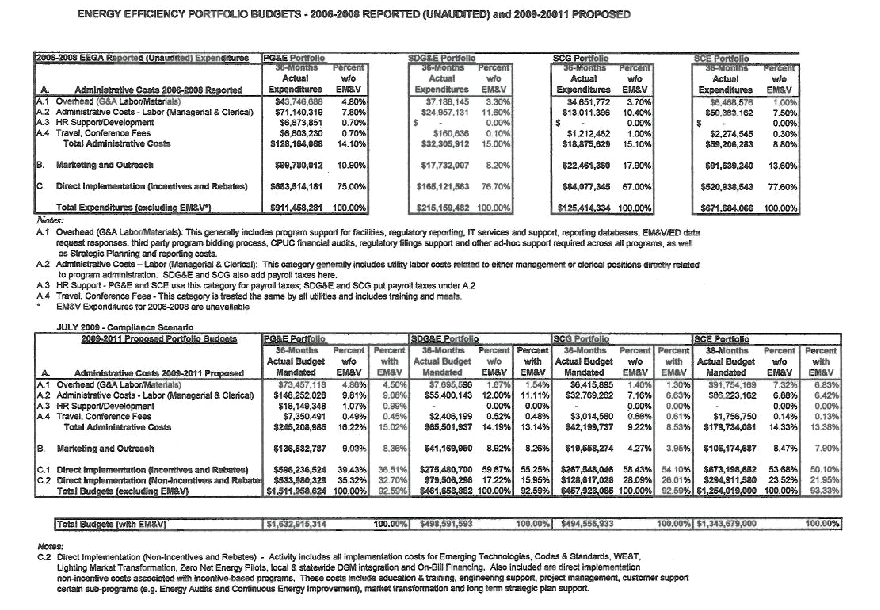
First, we do not agree with SDG&E and SoCalGas that administrative cost levels are irrelevant as long as the portfolio is cost-effective. Total costs matter as well. We are obligated to keep overall ratepayer costs at reasonable levels, allow the utility to recover only reasonable administrative costs, and ensure that the maximum amount of funds go directly to valuable programs. Indeed, if we allow utility administrative costs to go unchecked, then we leave open the possibility that savings that do not appear to be cost-effective would be cost-effective if the utilities' administrative costs were controlled. We would thus fail to carry out our legal obligations to ensure that rates are just and reasonable and that the utilities first obtain all cost-effective energy efficiency. Below, we address the need for greater transparency in the utility budgets and the level of total administrative costs.
We agree that it is difficult to scrutinize the dollar amounts and percentage levels of administrative costs proposed by the utilities. Despite direction from the Assigned Commissioner to the utilities to report budgets consistently, fully and accurately, the utility costs are hard to pin down with any certainty, as they are spread among several chapters within the utility applications and even beyond them (e.g., allocation of certain general rate case costs attributable to energy efficiency) and categorized and reported differently by each utility. According to DRA, in responses to data requests for administrative costs all four utilities responded that some level of costs including payroll tax, benefits and pensions are funded through the utilities' general rate cases (GRCs) and possibly other cost categories. None of the utilities was able to identify the specific costs that might be recovered from other utility accounts in response to the DRA data request.
TURN and DRA correctly point out that the utilities' administrative costs lack transparency and it is difficult to determine accurately the total cost of the energy efficiency portfolios or whether the utilities' costs were properly classified as administrative costs or direct implementation costs.
Although we have provided guidance to the utilities on the costs to be included in each budget category, we agree with TURN and DRA that compliance is inconsistent. For example, Attachment 5-A of the December 2008 Ruling lists utility Payroll Tax and Pensions as included costs in the Human Resource Support and Development category; according to DRA the utilities have not included these costs in their budgets. Therefore, we adopt the DRA recommendation that we require the utilities to provide a detailed breakdown of all administrative costs required to support energy efficiency programs, including regulatory costs and other partial support functions, in their compliance filing in response to this decision. We also adopt the DRA and TURN recommendation to require a full audit of the utilities' administrative and other costs in order to understand the changes in characterization of costs in the revised applications and to ensure accountability of the amount, allocation and composition of the total administrative costs for this portfolio timeframe. We authorize Commission staff to hire contractors to conduct the audit using EM&V funding.
Our review finds that utilities have included program design, development, planning and program/project management costs in direct implementation non-incentive costs in their applications. While this is not consistent with all details of our previous guidance on this matter, we find the utility approach consistent with that taken in other localities and discussed below, as well as consistent with the increased costs of program design/project management work associated with implementing programs that produce long term lasting savings as called for in the Strategic Plan. PG&E noted that improved clarity around administrative costs would be helpful. We therefore clarify here that we accept utility categorization of program planning, design and project management costs as direct implementation non-incentive costs and direct our staff to issue a revised guideline describing the details of administrative costs versus direct implementation costs.
We also clarify here how Strategic Planning program costs should be allocated: (1) administrative and logistical costs related to workshops on Strategic Planning issues may be considered "administrative costs;" (2) program planning/design/project management and information gathering costs related to specific Strategic Plan related non-resource and resource programs may be considered "direct implementation non-incentive costs;" (3) market, cost assessment and other studies as called for or suggested by the Strategic Plan should be considered part of EM&V planning and policy costs. We further prohibit the utilities, as discussed below, from unduly reducing Strategic Planning non-administrative costs as compared to the budget reduction targets we call for with resource program direct implementation non-incentive costs below. This issue is discussed further in Section 4.5.
The utilities propose Total Administrative Costs (Line A.5 in Table 3)32 of 16.2% for PG&E, 14.2% for SDG&E, 9.2% for SoCalGas, and 14.3% for SCE. PG&E and SCE's administrative costs have increased as a percentage basis from 2006-2008, while SoCalGas' costs have decreased from 15.1% to 9.2%.33 As TURN suggests, it would be reasonable to expect that there would be economies of scale for administrative costs, as demonstrated by SoCalGas, for the larger budgets in the up-coming portfolio cycle as well as savings from continuation of existing programs.
One possible reason for increased costs appears to be that the utilities propose higher administrative costs for third-party programs than for their own programs, as WEM has shown for PG&E. This seems counterintuitive, as the third-parties perform some of the administrative tasks otherwise undertaken by utilities. This suggests either that there may be excessive burdens placed by utilities on third parties or that utilities are overestimating the costs in this area. PG&E's overall administrative costs would decrease from 16.25% to 12.6% if all programs had identical levels of administrative costs, and would be lower than 12.6% if non-utility core programs had lower administrative costs. Similar adjustments would occur for the other utilities.
In other proceedings we have limited the percentage of administrative costs. In the California Solar Initiative (CSI) decision, the Commission limited total administration, marketing, outreach, and measurement and evaluation costs to 10% of total budgets. In D.06-08-028, Ordering Paragraph 22, the Commission ordered program administrators to spend no more than 5% of their total budget for administration until the Commission addressed marketing, outreach, and measurement and evaluation in Phase II of that proceeding. There has not been a Phase II decision to date.
In the same proceeding, the Commission adopted a program administrative cap for two programs that are subsets of CSI -- the Single Family Affordable Solar Housing (SASH) Program and the Multifamily Affordable Solar Housing (MASH) program. For the SASH Program, the Commission directed the Program Manager to adhere to the adopted budget allocations, wherein 85% of program dollars would go to incentives, 10% to administration, 4% to marketing and outreach, and 1% to evaluation (D.07-11-045 at 19). For the MASH program the administrative cap is 12% of total funds, which includes marketing and outreach and evaluation (D.08-10-036 at 20).34
In the Self-Generation Incentive Program (SGIP) decision (D.04-12-045) the Commission adopted a 10% administrative budget for each Program Administrator. These costs include, but are not limited to, measurement, verification, and evaluation activities, marketing, outreach, and regulatory reporting. This decision reduced the administrative budget adopted in D.01-03-073, which had allowed each Program Administrator to allocate up to 20% of the SGIP budget toward administrative costs.
In both CSI and SGIP programs, the Commission has limited administrative costs to between 5% and 10% of total costs including marketing, outreach, and measurement and evaluation costs, which are separate categories in the energy efficiency budgets. There are some differences between administration of energy efficiency programs and administration of CSI and SGIP programs, most notably that more CSI and SGIP programs are not directly implemented by utilities. However, the administrative cost caps for these programs are 50 - 75% less than the proposed administrative cost percentages for third party energy efficiency programs, even though the market and EM&V are not included in the energy efficiency administrative costs.
A 10% cost cap is on the upper end of the practices of other states that require utility or third party energy efficiency programs.35 These administrative costs, exclusive of marketing and EM&V, range from a high of 10% to a low of 2%. As some parties suggest in comments on the Proposed Decision, we will delete Vermont from the calculation; In Table 5, Vermont is shown as having 2% administrative costs, which may well not be calculated in a way that is similar to California. Nevertheless, the average of similar states is still under 10%.
SCE, in comments on the Proposed Decision, argues that the data provided by TURN is flawed, inaccurate and misleading. SCE claims that differing administrative structures of utilities in other states and differences in composition of cost categories renders this data unusable. While SCE may be correct that data from other states do not conform exactly to California's energy efficiency structure, using the average levels across several states (excluding the outlier of Vermont) is a meaningful metric to judge the appropriate of administrative cost levels in California. The data from other states also is consistent with the 10% administrative cost cap imposed in other programmatic areas in California, and, while not definitive in and of itself, supports the concept of this cap.
SCE and PG&E also argue that the Proposed Decision substantially increased the administrative and regulatory burden on the utilities. SCE claims that it is unreasonable to expect the utilities to achieve more aggressive goals with fewer resources, while also substantially increasing the regulatory requirements that must be complied with. We acknowledge that this decision increases certain regulatory requirements, consistent with moving toward achieving the comprehensive vision of the Strategic Plan. However, even with a decrease in the percentage of total budget allocated to administrative costs, the overall administrative cost budget for SCE will increase in this portfolio period, from $91 million in 2006-2008 to over $110 million in 2010-2012 due to the increased overall budget. PG&E's administrative cost budget stays about the same as the from $128 million in 2006 - 2008; however PG&E's 2010-2012 administrative costs budget is the highest for any utility for this period.
SDG&E/SoCalGas in their comments on the Proposed Decision that administrative costs would be increased for this next portfolio due to new responsibilities including new Advice Letters and task forces. The Proposed Decision has been modified to streamline or eliminate much of the proposed task force work. While this decision does add certain new responsibilities, the overall additional burden appears to be low compared to approximately $300 million in allowed administrative costs. Any new burden should be offset by economies of scale associated with 42% increases in overall portfolio budget (see Section 4.5) and the fact that the overall administrative cost increase by over 25%, from $238 million in 2006 -2006 (see Table 3 above) to around $300 million for 2010-2012.
A 10% administrative cost cap consistent with the cap for these costs proposed in AB 51 (Blakeslee). The staff analysis of that bill stated that the Commission "supports containing administrative costs for energy efficiency at reasonable levels to maximize the benefits of the programs to consumers." However, the analysis also noted that the Commission was in the process of reviewing administrative costs in the context of the overall budgets and proposed programs in this proceeding and supported the conclusion of that review before considering the appropriate level and method of cost control for administrative costs.
We have now reviewed the record in this proceeding and conclude that a cap is warranted. Throughout this decision, we are attempting to control costs to implement energy efficiency programs to get the most bang for the buck. We find that utility administrative costs can be reduced in order to take into account economies of scale and to bring administrative costs in line with other utility administrative costs for energy efficiency and other similar energy programs. Therefore, we will limit the utilities' administrative costs to 10% for utility programs on a portfolio basis and order the utilities to revise their budgets as set forth below.
The concept of an overall 10% administrative cap provides the utilities with flexibility to implement valuable programs which have different administrative costs. With an overall cap on utility program administrative costs, the utilities need not and should not reduce administrative costs to 10% for all individual utility programs, but they must ensure that overall utility program costs are within the cap.
Different levels of administrative costs must be assigned for different types of programs. However, we do not have a record to allocate these costs among programs within the overall cap. Thus, we require each utility to allocate administrative costs among utility programs in their portfolio compliance filing ( see Ordering Paragraph 15 in this decision), subject to the 10% overall cap.
An administrative cost cap of 10% on third party programs and local government programs is also an important component of containing total portfolio administrative costs. However, imposing a 10% administrative cost cap for each program within these categories would be excessively burdensome for utilities, third party contractors and government partners. Therefore, we direct the utilities to seek to achieve a 10% administrative cost target for third party and local government partnership direct costs (i.e., separate from utility costs to administer these programs). As combined total program categories, third party and local government program administrative costs should strive toward the 10% total administrative cost target. In addition, we agree with comments by LGSEC and CCSF on the Proposed Decision that utilities should not be permitted to unduly shift administrative cost cuts onto local government partnership and third party implementers. Therefore, we direct the utilities to not reduce the non-utility portions of local government partnership and third party implementer administrative costs, as compared to levels contained in the budgets proposed by the utilities in their July 2009 applications and approved herein, except where these costs as filed exceed the 10% cost target level.
Finally, administrative costs include the costs to respond to Commission reporting requirements and other regulatory activities. The Commission must do its part to minimize the regulatory burden on the utilities and have made every effort in this decision to require only necessary filings and reports. We request that the Energy Division review further all existing and new energy efficiency reporting requirements and report on possible ways to streamline these requirements.
The proposed utility budgets result in unacceptably low Total Resource Cost (TRC) ratios for the 2010-2012 portfolios, in the range (as adjusted) of 1.15 to 1.25. In order to mitigate the risk of non-cost effective portfolios, we performed specified budget reductions in order to approach an overall budget TRC ratio of 1.5. The adopted budgets provide TRC ratios that we estimate to be between 1.0 and 1.3 for each utility.
The approved budgets for the 2006-2008 energy efficiency programs, including EM&V, were approximately $2.2 billion total for the four utilities over three years, or about $730 million/year on average for all utilities. For 2009, our bridge funding decision, D.08-10-027, provided $65.3 million per month (plus $6.1 million/per month for EM&V), or $784 million ($857 million with EM&V), for all utilities if the bridge funding period lasted for all of 2009.36 In their March 2, 2009 filings, the utilities collectively requested approximately $3.7 - $4.2 billion over three years (depending on whether the Commission adopted requested changes on several policy issues) or $1.23 to $1.4 billion/year on average, an 80 - 90% increase from the last cycle. Following our policy issues decision, D.09-05-037, the utilities filed supplements to their March 2, 2009 filings to take into account that decision. In those filings, the total utility request is now about $3.9 billion, which would be a 77% increase from last cycle. Table 3 shows the actual budgets for 2006 through 2008, and the utilities' proposed 2009 through 2011 budgets.37
Each utility explains similarly that its proposed budget increase is due to several factors, including increased energy savings targets, reduced ability to count energy savings toward goals, retention of core, third-party and government partnership programs, enhanced focus on long-term savings measures such as HVAC retrofits, reduced support for less costly lighting measures, support for integrated activities and marketing efforts, support for Strategic Plan initiatives, increased difficulty of capturing savings, and higher EM&V budgets. The budgets for the utilities do not include at least two important cost areas. First, as TURN points out, a number of utility administrative costs related to energy efficiency (e.g., pensions and workers' compensation costs) are not included in the utility energy efficiency budgets, but instead are included in accounts that would be recoverable through general rate cases. PG&E agrees that these costs are not in the energy efficiency budgets, but contends that the existing practice of recovering allocated administrative and general expenses in the general rate case is appropriate and that there is no double-counting of energy efficiency administrative costs. SCE notes that its recent general rate case approved general expenses, including those attributable to energy efficiency. As TURN points out, this practice in effect increases cost-effectiveness calculations, as compared to considering both direct and indirect costs in the energy efficiency budgets. However, this has been our practice for some time. We see no reason in this decision to alter the practice of approving certain energy efficiency-related costs in general rate cases.
Second, potential utility incentive payments also are not included in the utility budgets. The level of incentive payments utilities may earn for energy efficiency activities is unknown at this time for two reasons. First and foremost, the overall risk/reward incentive mechanism is currently under review in R.09-01-019; we will not presume any particular outcome of that proceeding. Second, even if the current risk/reward incentive mechanism (as adopted in D.07-09-063 and modified in D.08-01-012) continues, there is no way of knowing what actual utility performance will be and whether rewards would be granted (or penalties assessed). Therefore, it is reasonable to not include potential utility incentive payments in the budgets.
All the utilities verified at the May 17, 2009 Goals workshop that these potential incentive payments are included in the energy efficiency cost effectiveness calculations for their March 2009 re-filed applications. However, in their July 2, 2009 supplements, the utilities did not include potential incentive payments in their TRC calculation. D.07-09-043 states "In D.94-10-059,38 we determined that shareholder incentives represent a true economic cost in the production of utility programs and should be included as a direct cost in the various Standard Practice Manual tests of cost-effectiveness, including the TRC test and the predecessor of the PAC test, the 'Utility Cost' test. [footnote omitted] There appears to be no disagreement that this policy rule is still relevant today." Therefore, the utilities are out of compliance with Commission policies on this point.
TURN contends that the utilities' proposed budget levels are unjustified. TURN notes that the proposed budgets are nearly double 2006-2008 levels, while net energy savings goals have increased only 10.3% over that time period and gross goals are actually lower in 2009-2011 than in 2006-2008. TURN argues there should be some economies of scale and scope with the utilities' budget totals. As discussed in section 5.2 below, TURN also claims the applications continue to be inappropriately CFL-focused portfolios and the CFL budgets should be eliminated. TURN also recommends lowering the utility budgets for new construction to a level consistent with current broad economic conditions, reflecting a significant reduction in new construction for 2009-2011.
DRA claims the large increases in proposed program budgets do not correspond to a proportional increase in energy savings. DRA contends the Utilities have failed to show that a doubling of the program budget will provide commensurate and significant value to ratepayers for their investment in energy efficiency programs. For example, DRA shows that PG&E proposes a 64% increase in its energy efficiency program budget over what it spent for the 2006-2008 program cycle, and yet it projects to achieve less energy savings in the new program cycle than it did in the previous one.
We are required by Public Utilities Code Section 454.5(b)(9)(c) to approve energy efficiency expenditures that are cost-effective; that is, the overall ratepayer or societal benefits must exceed the overall costs. Our policy, as articulated in Rule IV.6 of the Energy Efficiency Policy Manual, is to evaluate the entire portfolio for cost-effectiveness, and not to require each individual program element to meet this test. For example, several elements of our Strategic Plan may not be cost-effective in the timeframe of this portfolio, but should be cost-effective over a longer period. We remain committed to finding all cost-effective energy efficiency opportunities over time.
As stated in the Rule II.1 of the Energy Efficiency Policy Manual, the Commission's overriding goal for energy efficiency efforts is to "pursue all cost-effective energy efficiency opportunities over both the short- and long-term." Therefore, the Policy Rules establish a threshold cost-effectiveness condition for the utilities' energy efficiency portfolios. Cost-effectiveness is measured using two different tests: 1) the Total Resource Cost (or "TRC") whereby the value of the energy savings is greater than the total cost of installed measures and all program costs; and 2) Program Administrator Cost (or "PAC") whereby the value of energy savings outweighs the cost of utility financial incentives to customers and all other program costs.39 These tests are expressed as ratios of costs and benefits; the higher the ratio, the higher the benefits to the ratepayers for each dollar spent. In order to be eligible for ratepayer funding, each utility portfolio and the entire statewide portfolio must pass both tests on a prospective basis, considering all costs of the programs. These include costs not assignable to individual programs, such as overhead, planning, and EM&V, but do not include Emerging Technology Program costs.
Achieving all cost-effective energy efficiency opportunities on a portfolio basis would, in theory, allow approval of any portfolio with a cost-effectiveness ratio over 1.0. However, theory runs into practicality when using actual numbers. As discussed below, there are measurement problems and imperfections in the utility-submitted cost-effectiveness calculations. There is insufficient record to correct for each imperfection, especially as these imperfections tend to reduce cost-effectiveness. Therefore, we must build in a margin of safety in order to ensure that we maximize energy efficiency opportunities in a cost-effective manner.
In their July 2, 2009 supplements to their March 2, 2009 re-filed applications, the utilities' proposed portfolios show their expected cost-effectiveness calculations. In order to determine exact cost-effectiveness ratios, it would be necessary to make several adjustments to the cost-effectiveness calculations provided by the utilities due to data inaccuracies as well as changes required by this decision. In most cases, the utilities did utilize 2008 DEER values and assumptions as directed by this Commission. However, in some cases the utilities did not properly apply the 2008 DEER values and assumptions when developing their underlying calculations for determining cost-effectiveness. For example, utilities did not always use the correct remaining useful life estimates in DEER, and did not properly calculate the positive electric and negative gas HVAC interactive effects for CFL and other measures due to not properly accounting for air conditioning or natural gas vs. electric space heating saturations within their service areas.
There is insufficient record to calculate cost-effectiveness ratios taking into account all necessary DEER adjustments. However, we note that identified inaccuracies above move the cost-effectiveness ratios lower. As discussed above, in their July 2009 filings the utilities did not include potential utility incentive reward payments in their TRC calculations. Properly including these potential incentive payments also has the effect of lowering the actual cost-effectiveness ratios. We will use the July 2009 utility-provided cost-effectiveness calculations in our analysis, as these are the only fully-discussed figures in the record. In order to meet our statutory obligation to approve cost-effective energy efficiency programs and to set just and reasonable rates, it is prudent policy to adopt a sufficient margin of error so that achieved cost-effectiveness ratios will be certain to remain above 1.0.40
The cost-effectiveness ratios proposed by the utilities in their July 2009 supplemental applications are shown in Table 4.
Table 4-Portfolio Cost-Effectiveness in Utility Applications41
Utility Cost-Effectiveness Summary | |||
|
|
Total Resource Cost (TRC) |
Program Administrator Cost (PAC) |
PG&E |
1.15 |
1.37 | |
SCE |
1.25 |
2.07 | |
SDG&E |
1.24 |
1.25 | |
SoCalGas |
1.17 |
1.19 | |
| |||
We agree with DRA that the utilities should be able to attain energy savings consistent with previous portfolio cycles; however, the utilities all proposed portfolios which have high costs and low cost-effectiveness. In this section, significant budget adjustments are made which both decrease costs and increase cost-effectiveness. The method for achieving these dual goals is to reduce proposed budget items which do not directly contribute to cost savings, such as in the areas of overhead, administrative costs, EM&V and ME&O.
In a December 12, 2008 Ruling outlining requirements for the re-filed applications, one principle was that the portfolios should have TRC ratios at or above 1.5. This level of cost-effectiveness provides a safety margin in the event that the utilities do not, for whatever reason, attain the savings anticipated in their applications or if their costs increase above projections. In addition, as noted above the budgets used to calculate the TRCs do not include the costs of any shareholder incentives that may result from the RRIM or administrative costs included in the utilities' General Rate Cases. Each of these variables could cause swings in the costs and/or benefits of the portfolios in the hundreds of millions of dollars.
One of the primary reasons behind our placement of energy efficiency at the top of our loading order is the principle that prudently implemented energy efficiency programs can achieve more savings per dollar spent than a typical power plant. We must ensure that each dollar is spent is necessary in order to deliver the full benefits of energy efficiency programs to ratepayers.
While we are sympathetic to the utilities' arguments that as programs mature, additional savings are harder to reach to ensure the continued premier role of energy efficiency in our loading order and in California energy policies, we must be vigilant in avoiding sky-rocketing costs of obtaining large amounts of energy efficiency. In this decision we approve significant increases in the utility budgets from the last cycle (42% higher) but not the unjustified 77% budget increase from 2006-2008 that the utilities' request.
In Section 4.4, we adopt a 10% cap on the utilities' general administrative costs. In addition, we find compelling the evidence provided by TURN in its April 2009 comments that shows national trends for administrative costs, EM&V levels, ME&O budgets and other areas, as shown in Table 5, below. This table demonstrates that in many cases, the utilities' proposed budgets are out of line with budgets for successful statewide programs in other states. As discussed in Section 4.4, we note SCE's contention that there are significant differences in other states which limit comparisons to California. However, we find the overall set of data from other states to be useful in aggregate (excluding outliers), as they include those states with energy efficiency programs most similar to California's. Further, by taking the average levels of these states, we factor out any significant outliers.
SCE also claims the budget caps in general are unduly restrictive, unnecessary and would jeopardize its ability to successfully implement the portfolio. SCE advocates removal of all such caps, suggesting that otherwise important and useful programs would need to be eliminated and SCE would not be able to achieve Commission Strategic Plan objectives.
PG&E in comments on the Proposed Decision similarly claims that caps on administrative costs, ME&O costs, EM&V costs and Non-Rebate/Incentive Direct Implementation activities-combined with a 1.5 TRC target ratio-will result in elimination or significant reduction of programs that deliver cost-effective savings. PG&E also argues the 20% Non-Rebate/Incentive Direct Implementation cap would result in reduced support for Strategic Plan Big Bold Initiatives in favor of low-cost, high-turnover activities such as upstream incentives. PG&E contends that it is unrealistic to expect it to deliver the energy savings goals in the decision with local ME&O funding capped at 5% of its budget ($43 million in the Proposed Decision).
SDG&E/SoCalGas in comments on the Proposed Decision contends cost caps impose significant, unnecessary barriers to efficient program implementation and innovative program development, removing flexibility to respond quickly to constantly changing market conditions. As with the other utilities, SDG&E/SoCalGas claims that ME&O and other programs in other states are not comparable to those in California. SDG&E/SoCalGas also contends that the TRC ratios of the portfolios should be adjusted to take into account changes cost caps. If the Commission does approve cost caps, SDG&E/SoCalGas state that it is necessary to clearly define these categories to ensure consistency among the utilities and ensure easy tracking of status, with caps based on historical spending and best practices.
Using this data as a guideline for our programs, we reduce the ME&O budget to 6% of the adopted portfolios, which is a reduction from the proposed levels of around 8%, but still above national trends (excluding Vermont as an outlier). This is not a hard cap, as with administrative costs, but a budget target. This target is reasonable. As discussed in the ME&O section, the centerpiece of our ME&O program-the statewide ME&O branding and outreach program-has a budget of $60 million, with additional funding coming from already approved budgets for the LIEE and Demand Response programs This reduction is also consistent with the direction of D.07-10-032, in which we noted our concerns about the increasing ratepayer costs of ME&O for California's demand-side programs and directed a statewide, integrated approach. Such an approach, which is set for launch later this year or early next year, will not only leverage various demand-side customer programs but also allow overall ME&O cost reductions.
We tentatively set an EM&V cost cap at 4% of the total adopted budget, consistent with the national averages in Table 5 (excluding New Jersey as an outlier). As discussed in Section 7, this level appears to provide sufficient funds to carry out both utility and Energy Division EM&V functions. However, we will consider EM&V tasks in more detail in a follow-up decision, and may reconsider this budget item at that time.
We also set a budget target of 20% on the non-incentives and rebates budgets for program delivery, consistent with the national average in Table 5 below (excluding Vermont as a outlier). Of the four utilities, this measure impacts only PG&E's budget. PG&E's proposed program delivery budget includes non-incentives and non-rebate costs of 35%. With the 20% budget target we set, more of the program costs will be available for incentives and rebates, thus bringing PG&E's costs in line with the other utilities as well as the national average.
Table 5-National Energy Efficiency Budgets
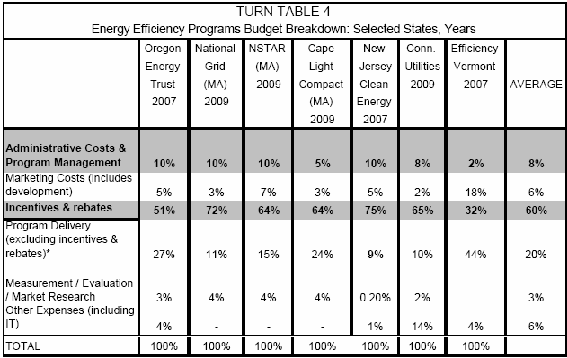
*Program delivery includes direct install labor and materials, sales, technical assistance and quality control. In Vermont, it includes the "Services and Initiatives" category. In New Jersey, it includes "rebate processing".
Sources:
Cape Light: http://www.mass.gov/Eoeea/docs/dpu/electric/0
Efficiency Vermont: http://www.efficiencyvermont.com/stella/filelib/AR20
New Jersey: http://www.njcleanenergy.com/files/file/Library/BPURpt4Q07Master%
Oregon Trust: http://www.energytrust.org/library/financial/2008-09_Budg
Connecticut: http://www.ctsavesenergy.org/files/FINAL%202009%20C&LM%20Electric%2
National Grid: http://www.mass.gov/Eoeea/docs/dpu/electri
NSTAR: http://www.mass.gov/Eoeea/docs/dpu/electric/08-
We also, as discussed below, reduce costs which have been budgeted, but not allocated, and finally, impose some further budget cuts in those areas which have the least impact on direct implementation of programs.
With the reductions in broad budget categories, it appears that it will be possible to reduce the utilities' budgets sufficiently to attain a higher TRC ratio. However, it is not possible to achieve a TRC ratio near 1.5, although PAC ratios are higher by definition than TRC ratios. Nevertheless, we can adopt cost-effective budgets for each utility which provide an appropriate balancing of ratepayer cost protection and quality energy efficiency programs, consistent with the Strategic Plan.
As discussed in detail below, for 2010-2012 PG&E's adopted budget is $1.338 billion, SCE's adopted budget is $1.228 billion, SDG&E's adopted budget is $278 million, and SoCalGas' adopted budget is $285 million. In total, the overall adopted budget level for the four utilities for 2010 through 2012 is $3.129 billion, or $1.043 billion per year. This is approximately 42% higher than the $2.2 billion budgets approved for the 2006-2008 portfolios, and 22% higher than the bridge funding 2009 budget of $857 million. While the adopted budget levels are significantly lower than the utilities' requests, these budgets are still robust and are set at reasonable levels to protect ratepayer interests while at the same time providing a reasonable opportunity for the utilities to achieve the new (lower) adopted energy savings goals levels. As actual experience is gained over the next three years the utilities can request budget augmentations as circumstances warrant if these budget changes cause undue hardship in delivery of programs and savings.
PG&E proposes a budget of $1.633 billion, which it calculates to have a TRC ratio of 1.15. To determine a final budget, we look to achieve a TRC closer to 1.5. In order to achieve a TRC of 1.5, PG&E's budget would have to be reduced to around $1.1 billion, a target reduction of over $500 million.42 Such a large budget reduction would be inadvisable, as PG&E would have to eliminate or scale back a significant number of valuable programs. Instead, we seek to streamline PG&E's budget consistent with the caps and targets discussed above, and in light of other appropriate changes discussed herein.
The PG&E budget includes a $30 million reduction from the Basic CFL budget, as explained in Section 5.2. $11 million is added for Advanced Lighting programs in Section 5.2. $45 million is added for residential retrofit programs in Section 5.1.
We adopt a budget of $1.338 billion. Table 6 summarizes the changes discussed herein.
Table 6-PG&E Budget Adjustment Categories
Cost Category |
Proposed (Millions) |
|
Adjustment (Millions) |
Approved Budget (Millions) |
Administrative G&O |
$245 |
10% |
-$110 |
$ 134 |
EM&V |
$121 |
4% |
-$68 |
$ 5343 |
ME&O |
$136 |
6% |
-$56 |
$ 80 |
Program Delivery, |
||||
non-rebates and |
||||
incentives |
$336 |
20% |
-$61 |
$ 275 |
Unallocated Third Party Funds |
n/a |
-$27 |
$ | |
Basic CFLs |
$60 |
n/a |
-$30 |
$ 30 |
Advanced Lighting Increase |
+$11 |
|||
Residential Retrofit |
+$46 |
|||
Budget and Changes |
$1,633 |
-$295 |
$1,338 |
In total, the reductions for administrative costs, EM&V and ME&O categories consistent with the guidance in this section reduce PG&E's costs by $234 million. To consider additional reductions, we turn to non-incentive costs associated with resource programs.
PG&E's budget shows $534 million for "Direct Implementation (Non-incentives and Rebates)." This category (labeled "C.2" in its budget and in Table 3) has the following description:
Activity includes all implementation costs for Emerging Technologies, Codes & Standards, Workforce Education & Training, Lighting Market Transformation, Zero Net Energy Pilots, local and statewide Demand-Side Management integration and On-Bill Financing. Also included are direct implementation non-incentive costs associated with incentive-based programs. These costs include education and training, engineering support, project management, customer support for certain sub-programs (e.g., Energy Audits and Continuous Energy Improvement), market transformation and long term strategic plan support.
These activities are generally consistent with a broad-based energy efficiency program. However, some of these activities are peripheral to the direct delivery of energy efficiency services and may not contribute to the cost-effectiveness of PG&E's portfolio. Of the $534 million associated with this category, we do not touch the $198 million of costs dedicated to specific non-resource programs. We make adjustments to the remainder ($336 million) which appears to be indirect and support activities for resource programs. We reduce resource program indirect and support activities to 20% of the total portfolio. This is the national average of program delivery costs (excluding incentives and rebates) shown in Table 5 above, and is consistent with or higher than the level of costs for SCE, SDG&E and SoCalGas. By reducing these costs to approximately 20% of the adopted budget level, PG&E's indirect and support costs for resource programs are reduced from $336 million to $275 million, a reduction of $61 million.
PG&E's proposed third-party program budget44 is $248 million, including $27 million in "Third-Party Reserve Funds." This latter category appears to consist of unallocated funds with no specific programs or recipients. We eliminate this line item.
With these changes, we will adopt PG&E's total budget at $1.338 billion. Most of the changes do not impact energy savings, but (as PG&E points out in comments on the Proposed Decision), changes to CFL programs, residential retrofit programs and other items do have an impact. It is not possible to determine a definitive TRC ratio for PG&E's portfolio. However, we find by decreasing various costs for administration, ME&O and EM&V line items the overall TRC ratio is likely to be higher than proposed by PG&E.45 At this budget level, we find that PG&E would have a cost-effective portfolio, with a reasonable margin of safety.
Using a similar methodology as for PG&E, we would need to adjust SCE's proposed budget of $1.343 billion46 to a target budget of about $1.1 billion, a reduction of about $240 million, to increase SCE's TRC from its calculated level of 1.25 to a target TRC of 1.5. Such a large budget reduction would be less problematic than for PG&E, as SCE's starting TRC ratio is higher. However, with this reduction, SCE may have to eliminate or scale back a significant number of valuable programs. We will modify SCE's budget consistent with the caps and targets discussed above, and in light of other appropriate changes discussed herein.
SCE's budget is increased by $33 million for residential retrofit programs discussed in Section 5.1. We adopt a budget of $1.228 billion for SCE. Table 7 summarizes the changes discussed herein.
Table 7-SCE Budget Adjustments Categories
Cost Category |
Proposed (Millions) |
% of total budget |
Adjustment(Millions) |
Approved Budget (Millions) |
Administrative G&O |
$180 |
10% |
-$58 |
$ 122 |
EM&V |
$90 |
4% |
-$41 |
$ 49 |
ME&O |
$106 |
6% |
-$33 |
$ 73 |
Program Delivery, |
||||
non-rebates and |
||||
incentives |
$206 |
20% |
0 |
$ 206 |
Unallocated Third Party Funds |
|
n/a |
-$53 |
|
Local Government Increase |
+$32 |
|||
Residential Retrofit Programs Benchmarking program |
+$33 $4 |
|||
Budget and Changes |
$1,344 |
-$116 |
$1,228 |
In total, the reductions for administrative costs, EM&V and ME&O categories, reduce SCE's costs by $132 million.
SCE's total third-party budget proposal is $263, including $53 million in `Third-Party Solicitation Programs (Non-Resource and Direct)." This latter category appears to consist of unallocated funds. We eliminate this line item, thus reducing SCE's budget by $53 million. This brings SCE's third-party budget to $210 million which is above our 20% threshold from D.05-01-055. Thus no further adjustments are required for this item.
SCE's budget shows $295 million for "Direct Implementation (Non-incentives and Rebates)." Of the $295 million associated with this category, we do not touch the $89 million of costs dedicated to specific non-resource programs. We make adjustments to the remainder ($206 million) which appears to be indirect and support activities for resource programs. This amount is above 20% of the total portfolio. We will not make any adjustments on this item.
With these changes, we will adopt SCE's total budget at $1.228 billion. Most of the adopted changes do not impact energy savings, but residential retrofit programs and other items do have an impact. We anticipate that residential retrofit programs are likely to have a positive TRC ratio, however we are unable to determine the impact of the additional local governmental programs. Overall, it is not possible to determine a definitive TRC ratio for SCE's portfolio. However, we find that the overall TRC ratio should be higher than proposed by SCE, due to reductions in administrative costs, EM&V and ME&O line items and the addition of the residential retrofit program. At the approved budget level, we find that SCE would have a cost-effective portfolio with a reasonable margin of safety.
The situation for SDG&E is somewhat different than for PG&E and SCE. First, we have decreased SDG&E's electricity energy savings goals by an additional 25% as compared to the other utilities, as described in Section 4.2. This reduction will allow SDG&E much more ease in reaching its energy savings goals. Second, as discussed below, SDG&E's proposed budget includes zero participant costs for many measures, distinct from its counterparts.
SDG&E's proposed budget of $499 million has a TRC of 1.24, based on SDG&E's calculations. SDG&E included $45 million in unspent funds in this budget; after review of SDG&E's errata to its supplemental testimony filed August 20, 2009, SDG&E identified $80.1 million in unspent, uncommitted funds. In Section 12, we approve $17.4 million of these funds for use in 2009, leaving approximately $63 million that can be applied to 2010 -2012. In order to normalize SDG&E's budget for consistency with the other utilities, SDG&E's budget is adjusted to $436 million. Further, as discussed below, SDG&E's TRC ratio is affected by the changes to customer incentive levels.
Using a similar methodology as for PG&E and SCE, in order to achieve a cost-effectiveness ratio of 1.50, SDG&E's budget of $436 million would need to be reduced by about $175 million to around $255 million. Such a large budget reduction would be less problematic than for PG&E and SCE, because a significant amount of the reduction comes from reduced customer incentive payment, which do not otherwise change programs. We seek to streamline SDG&E's budget consistent with the caps and targets discussed above, and in light of other appropriate changes discussed herein.
We adopt a budget of $278 million for SDG&E. Table 8 summarizes the changes discussed herein.
Table 8-SDG&E Budget Adjustment Categories
SDG&E |
||||
Cost Category |
Proposed (Millions) |
% of total budget |
Adjustment (Millions) |
Approved Budget (Millions) |
Administrative G&O |
$66 |
10% |
-$39 |
$ 27 |
EM&V |
$37 |
4% |
-$25 |
$ 12 |
ME&O |
$41 |
6% |
-$23 |
$ 18 |
Incentive Payments |
$276 |
n/a |
-$84 |
$192 |
Residential Retrofit Program |
+$13 |
|||
Budget and Changes |
$436 |
-$158 |
$ 278 |
In total, the reductions for administrative costs, EM&V and ME&O categories, including carryover dollars, reduce SDG&E's costs by $89 million.
Our review of SDG&E's program cost numbers reveals a significant issue in its budget. Unlike PG&E and SCE, SDG&E does not include any customer participation costs in its program costs, instead proposing to pay incentives at 100% of the full incremental costs of the measures. While we have not provided specific guidance in this area in the past, the practice of PG&E and SCE is more appropriate and more consistent with past portfolios. Customers are likely to demand more services when they do not pay for them, even if these services are not valuable. It is common industry practice to include a customer contribution-which is still below the full cost of the energy efficiency service or product-in order to ensure customer "buy-in," minimize ratepayer costs, and to offer incentives to a larger number of customers. Paying 100% incentives is also inconsistent with all past practices of California utilities, including SDG&E.
It appears that SDG&E may have proposed overly high customer incentive levels in order to meet unrealistic energy savings goals. However, we have now adjusted SDG&E's goals downward by 25% to correct an historical anomaly. Therefore, consistent with adjusted energy saving goals, we require SDG&E to reduce incentive payments to levels consistent with those provided by SCE and PG&E for similar programs. Based on comparisons with SCE and PG&E incentives we estimate that SDG&E can spend at least $84 million less due to this adjustment.47
Some of the adopted changes do not impact energy savings, but residential retrofit programs and other items do have an impact. In particular, reducing SDG&E's customer incentive payments to reasonable levels lowers SDG&E's energy savings and changes its cost-effectiveness by unknown amounts. It is not possible to determine a definitive TRC ratio for SDG&E's portfolio. Because the changes we make affect SDG&E's cost-effectiveness to a greater degree than for PG&E and SCE, we can find that the SDG&E will have a cost-effective portfolio, but we cannot determine a specific range for the TRC ratio.
The situation for SoCalGas is similar to that of SDG&E, in that SoCalGas' proposed budget includes zero participant costs for many measures, distinct from its other counterparts. While SDG&E may have included this unorthodox proposal in order to attempt to achieve high energy savings goals (which we have now reduced substantially), there is no clear rationale for why SoCalGas also made this proposal.48
SoCalGas' proposed $495 million budget would have an estimated TRC ration of 1.17, by its calculations. The proposed budget needs to be reduced by at least $200 million to below $300 million to achieve a target cost-effectiveness ratio of 1.5, using the same methodology implemented for SDG&E.
We will adopt a budget for SoCalGas of $285 million. Table 9 summarizes the changes discussed herein.
Table 9-SoCalGas Budget Adjustment Categories
Cost Category |
Proposed |
% of total budget |
Adjustments (Millions) |
Approved Budget (Millions) |
Administrative G&O |
$42 |
10% |
-$14 |
$ 28 |
EM&V |
$37 |
4% |
-$26 |
$ 11 |
ME&O |
$19 |
6% |
-$2 |
$ 17 |
Unallocated Third Party Funds |
$76 |
n/a |
-$40 |
$ 36 |
Incentive Payments |
$268 |
n/a |
-$135 |
$ 133 |
Residential Retrofit Programs |
+$8 |
|||
Budget and Changes |
$495 |
-$210 |
$ 285 |
In total, the reductions for administrative costs, EM&V and ME&O categories reduce SoCalGas' costs by $42 million. SoCalGas' total third-party budget proposal is $76 million, including $40 million in "IOU Administration." This latter category appears to consist of unallocated funds. We eliminate this line item, thus reducing SoCalGas' budget by $40 million.
Like SDG&E, SoCalGas does not include any customer participation dollars in program costs, instead proposing to pay incentives at 100% of the full incremental costs of programs. It is unclear why SoCal Gas included these higher incentive levels, although this may because of its sister utility relationship with SDG&E. As with SDG&E, for consistency with longstanding practice, we will require SoCalGas to reduce incentive payments to levels consistent with those provided by PG&E for similar gas programs. Based on comparisons with PG&E gas incentives we estimate that SoCalGas can lower its costs by at least $135 million from this adjustment.49
With these changes, we will adopt SoCalGas' total budget at $285 million. Some of the adopted changes do not impact energy savings, but residential retrofit programs and other items do have an impact. In particular, reducing customer incentive payments to reasonable levels lowers SoCalGas' energy savings and changes its cost-effectiveness by unknown amounts. It is not possible to determine a definitive TRC ratio for SoCalGas' portfolio. Because the changes we make affect SoCalGas' cost-effectiveness to a greater degree than for PG&E, we can find that the SoCalGas will have a cost-effective portfolio, but we cannot determine a specific range for the TRC ratio.
D.06-06-063 adopted electric and gas avoided cost for use in planning and evaluation of the 2006-2008 energy efficiency utility portfolios. These interim values were not adopted for other uses or future energy efficiency cycles. Thus there are no avoided costs adopted for this program cycle yet. The April 21, 2008 Ruling directed the utilities, for planning purposes, to update the generation cost values and natural gas prices using the updated 2007 values as adopted in the Commission's October 4, 2007 Resolution E-4118 (the updated 2007 Renewable Portfolio Standard market price referent values) for their portfolio cost-effectiveness calculations. Energy Division provided updated electric avoided cost values utilizing these generation costs and updated generation natural gas fuel cost estimates. The utilities used these values in their applications. We adopt these avoided cost values used by the utilities for this portfolio.
In this decision, we revise our definition of Market Transformation, require the development of Program Performance Metrics, and set forth a process for adopting market transformation metrics and tracking systems.
In our decision adopting the Strategic Plan, we discussed our vision of market transformation for energy efficiency:
As early as 1998, the Commission defined market transformation as "Long-lasting sustainable changes in the structure or functioning of a market achieved by reducing barriers to the adoption of energy efficiency measures to the point where further publicly-funded intervention is no longer appropriate in that specific market."50 D.07-10-032, p. 33, directed that "a key element of the Plan would be that it articulates how energy efficiency programs are or will be designed with the goal of transitioning to either the marketplace without ratepayer subsidies, or codes and standards." These statements continue to encompass our definition of market transformation. D.07-10-032 also stated that the forthcoming Plan would incorporate the market transformation goal described above and "develop milestones to measure progress towards that goal," including the development of a "targeted timeframe for such market transition and the process for tracking progress so that it is clear at what point a program has made a successful transition or conversely, is having problems." (D.08-09-040 at 14-15, emphasis added).
D.08-09-040 at 10 also stated that "the Commission will take action by the end of 2009, or when the utility 2009-2011 portfolios are approved, whichever is sooner, on the remaining issues that need to be addressed in market transformation. This includes, at minimum, identifying the process to track progress towards defined end points for program efforts and progress metrics." In this decision we:
_ Amend our definition of "Market Transformation"
_ Adopt a process to develop and apply Program Performance Metrics to the 2010-2012 portfolios and beyond. As part of our regular EM&V process, these metrics will measure and track whether a specific energy efficiency portfolio program - e.g., incentives for high efficiency air conditioners -- is advancing our market transformation goals.
_ Discuss a process to track market conditions in the broader markets - e.g., the air conditioning market in California -- in order to determine whether and what interventions are needed and when the market has been transformed.
_ Clarify how these metrics will be used to evaluate utility programs.
_ Decline to establish a Market Transformation Task Force.
A number of parties commented that the Commission's definition of market transformation should be updated and that an important component of market transformation is to pull new technologies into the marketplace more quickly than is achievable without public or utility program intervention. This is consistent with the Strategic Plan focus on accelerating the adoption of new technologies and building or system designs into the marketplace.
We modify the existing Commission definition of market transformation to state (changes noted in italics):
Market transformation is long-lasting, sustainable changes in the structure or functioning of a market achieved by reducing barriers to the adoption of energy efficiency measures to the point where continuation of the same publicly-funded intervention is no longer appropriate in that specific market. Market transformation includes promoting one set of efficient technologies, processes or building design approaches until they are adopted into codes and standards (or otherwise substantially adopted by the market), while also moving forward to bring the next generation of even more efficient technologies, processes or design solutions to the market.
We also clarify the definition of "defined end points." Previous decisions have employed this terminology in different ways. In D.08-09-040, we stressed the need to develop "a process to track progress towards defined end points for program efforts and progress metrics." In this context "defined end points" refer to the time-bound and quantitative milestones and targets included in the Strategic Plan, specifically the Big Bold Programmatic Initiatives on zero net energy buildings, as well as the other quantitative targets contained in the Strategic Plan.
This concept is also used for specific technologies or practices, i.e., the extent to which each program plan included an `end game' for each technology or practice. An example of the technology approach could be a plan to terminate upstream utility incentives for medium-base CFLs when market penetration reaches a certain level while continuing targeted programs for CFLs in niche market segments that have not yet reached those adoption saturations.
An October 30, 2008 Ruling directed the utilities to "demonstrate that their 2009-2011 energy efficiency programs reflect the short-term steps and milestones laid out in the Strategic Plan for the programmatic initiatives identified in D.07-01-032 and for each sector or cross-cutting action area."51 To this end, the utilities were directed to submit market transformation planning estimates and program logic models in a specified Program Implementation Plan (PIP) format with their re-filed portfolio applications. The purpose of this requirement was to supply data that linked the program logic models to short and long-term Strategic Plan goals. After a June 8, 2009 workshop on this issue, a Ruling solicited additional information from stakeholders for consideration for the 2009-2011 portfolios.
SDG&E and SoCalGas recommend that simplicity and cost-effectiveness should be considered when identifying appropriate program performance indicators. PG&E states that the metrics included in the current PIPs are preliminary in nature and will be further developed along with program logic models once the Commission adopts the portfolio applications. PG&E points out that program decisions and assessments cannot be based on performance metrics alone as other factors contribute to program performance such as external market conditions. PG&E also suggests that not all programs need metrics if overarching market metrics that can track the success of several programs are more applicable.
SCE suggests that the Commission should carefully consider metrics already provided by the utilities and not entertain another process to determine alternative metrics as proposed in Energy Division's Program Performance Metrics Workshop. TURN/DRA supports the Energy Division's proposed process for developing program performance metrics with the caveat that the utilities should not be the driving entity for developing program performance metrics. They propose that the Commission establish a task force comprised of the utilities, Energy Division staff, and interested stakeholders. Performance metrics would be updated when the Strategic Plan is updated and the utilities would be required to submit and track program performance metrics in a publicly available data base such as the Energy Efficiency Groupware Application (EEGA) used for utility quarterly energy savings reports.
As PG&E points out, the information submitted by the utilities in response to the October 30, 2008 Ruling is, at best, preliminary. After review of the limited utility response, we recognize that further guidance to the utilities is needed to define our expectations and objectives for the program performance metrics. The utilities are in the best position to develop metrics for their own programs, but input from stakeholders and further Commission review is necessary. We adopt a process for development of targeted program performance indicators and logic models. This required process applies to all statewide programs and sub-programs, as well as pilot projects, as discussed throughout this section and in Section 4.3. In order to adequately develop these indicators, it is important to have a clear definition of what they are and the characteristics they should have.
Program performance metrics are objective, quantitative indicators of the progress of a program toward the short and long-term market transformation goals and objectives in the Strategic Plan. Appendix 2 of this decision includes an Energy Division process for developing program performance metrics that the utilities shall use when developing these metrics.
The proposed performance metrics shall comply with the following principles:
1. The metrics shall be designed for simplicity and cost effectiveness when considering data collection and reporting requirements.
2. Integrated metrics shall be developed for programs that employ more than one technology or approach, such as whole building programs.
3. Program models and logic should be dynamic and change in response to external, e.g., market conditions, and internal conditions.
4. The metrics shall link short-term and long-term strategic planning goals and objectives to identified program logic models.
5. Performance metrics shall be maintained and tracked in the Energy Efficiency Groupware Application database (or a similar database to be determined under the guidance of Energy Division).
We accept PG&E's position that in some cases, overarching market metrics that can track the success of several programs may be more appropriate than program-specific metrics. We have no objection to the application of one set of program metrics to several programs if the metrics are otherwise valid for each program.
The utilities shall request approval for their proposed logic models and metrics via an advice letter filing within 120 days of the effective date of this decision. One joint utility advice letter shall be filed encompassing the proposed performance metrics for each statewide program (and associated sub-programs) and other information as specified in Appendix 2. The utilities will track the program performance metrics using the EEGA or a similar database as DRA/TURN recommend and under the guidance of our Energy Division.
Beyond this program cycle, the utilities shall submit one similar joint advice letter encompassing each statewide program and associate sub-programs for each program cycle as part of their three year energy efficiency portfolio application process.
The utilities shall track Program Performance Metrics via the EEGA or a similar database as DRA / TURN suggest. Under Energy Division oversight, the utilities shall develop and post a standardized Program Performance Metric Reporting Table to the EEGA or a similar database no later than January 29, 2010. The utilities shall use these tables to report progress toward meeting program performance metrics and post this information onto the EEGA or a similar database on a quarterly basis. The utilities shall also work with Energy Division to develop and post onto EEGA or a similar database a standardized Program Performance Metrics Narrative Reporting Template at the same time. This template shall then be used by the utilities to provide narrative description of progress to accompany each quarterly Program Performance Metric Reporting Table submission. This Program Performance Metrics Narrative Reporting Template shall include sections for describing progress toward meeting program metric goals as well as descriptions of changes in metrics used and reasons for the change as well as any program related or economic changes that impact metric results. If the utilities revise their program performance metrics via the Advice Letter process described above, they shall clearly indicate in their EEGA or similar database submissions when this occurs and reasons for any changes as part of their Program Performance Metrics Narrative Report filed on EEGA Narrative description. All historical Program Performance Metric submissions shall be maintained in EEGA or a similar database, as determined by Energy Division.
In order to track market transformation, it is necessary to track market conditions. The results of the program performance metrics can then be compared with the market data to determine the relative success of the programs. We set forth principles and a process for developing and implementing market tracking systems.
DRA/TURN, SCE, SDG&E and SoCalGas all agree with Energy Division's general approach on market indicators, specifically the merits of using both "ultimate" and "proximate" metrics as indicators of market change. Several parties provided suggestions on the best indicators of technology and sector-based market transformation. DRA/TURN consider market share and measure adoption and saturation rates to be key indicators. NRDC finds sales, market share, saturation and the prevalence of a practice or technology to be the most important indicators. WEM stresses evaluated net-to-gross ratios as the key market transformation indicator.
PG&E contends that utility program strategies must be based on an understanding of the factors that drive market penetration into each significant submarket and the opportunities to influence them rather than pre-identified model curves. SDG&E, SoCalGas and SCE all focus on incremental measure cost (meaning that as the incremental cost of a high-efficiency measure or device declines toward zero, this is an indicator the market is being transformed) as a key market transformation indicator, as well as sales, building stock penetration rates, customer satisfaction and the disappearance from the market of less efficient options.
On process issues, DRA/TURN and CCSF recommend that Energy Division develop detailed recommendations for market transformation indicators and measurement approaches starting with the Big Bold Programmatic Initiatives from D.07-10-032. SCE disagrees, stating that the identification of appropriate market transformation metrics and reasonable goals based on those metrics must be established by a broader group. PG&E agrees with TURN/DRA's recommendation that the Energy Division lead the process, PG&E believes that the basic indicators shaping market transformation efforts should be adopted by the Commission to ensure they align with long-term policies developed by the CEC and CARB.
It is evident from the discussion at the Market Transformation workshop and party comments that it would be premature to adopt metrics in this decision. Therefore, in this decision we set forth the principles and the process for the development of a system to measure and monitor market transformation efforts.
We agree with DRA/TURN, SCE, SDG&E and SoCalGas, who supported Energy Division's general approach to developing market transformation indicators, specifically that both "ultimate" and "proximate" metrics as indicators of market change are warranted. Ultimate indicators are defined as indicators of structural changes in the patterns of adoption of the technology or behavior change, which should relate closely to key barriers that need to be overcome. Examples of ultimate indicators are: market share and sales; saturation and prevalence of practices; changes in codes & standards; and, adoption of technology or practice as common practice. Proximate indicators are indicators that are necessary preconditions for increases in ultimate indicators. Examples of proximate indicators include: awareness and knowledge; attitudes/beliefs/acceptance; availability; trade ally promotional efforts; and, incremental cost. These indicators shall form the basis of the market transformation metrics.
The market transformation metrics require the identification of indicators to track, the identification of data sources, and agreement on the frequency of data collection, analysis and use. DRA/TURN and CCSF suggest the most practical process to identify key market transformation: Energy Division should develop detailed recommendations for market transformation indicators and measurement and present their recommendations in a workshop followed by a public comment period. Further, we concur with PG&E that it is appropriate that such indicators are ultimately adopted by the Commission in order to ensure their alignment with not only the Strategic Plan, but also the work of other California agencies, such as the CEC and the CARB.
Although we decline to adopt SCE's recommendation that market transformation metrics be developed by a broader group that includes multiple energy efficiency program administrators and key industry stakeholders, the insights and suggestions of such entities are key to the success of the Strategic Plan and its market transformation goals. Therefore, we direct Energy Division to ensure appropriate involvement and input of market actors during their development of recommendations for market transformation indicators.
Energy Division should provide initial recommendations on specific market transformation ultimate and proximate indicators, as well as data collection and tracking processes, for a subset of portfolio programs or measures that have the most impact in terms of their importance, such as the Big Bold Programmatic Initiatives, their savings potential or dollars spent. Staff may also consider qualitative factors as necessary and appropriate.
It is both necessary and possible to begin the work of gathering baseline data, as CCSF, PG&E, DRA/TURN and others have noted. We therefore direct the utilities to include key data sources and indicators for which to begin collecting market transformation baseline data in their Advice Letters on Utility Program Performance Metrics.
We will address the market conditions data tracking process in R.06-04-010, the umbrella energy efficiency rulemaking proceeding, or its successor. In that proceeding, we will also consider the appropriate timing for the commencement of the system of market transformation metrics.
SCE argues that the proposed metrics should not be used to measure program performance during the program cycle since program performance is already measured by the energy savings and demand reductions achieved by the program. DRA recommends that the Commission devise a specific long-term market transformation plan for each energy efficiency strategy and require utilities to intervene in the market where they have control over strategies to target and educate consumers. DRA/TURN contends that all ratepayer-rebated measures should be on trajectory for phase out, with milestones indicating progress towards this goal, and elimination of ratepayer-funded market interventions once the technologies reach more than 51% market segment participation. Further, DRA/TURN argue that the utilities should be required to present rationales and supporting material for each portfolio measure strategy that it believes has not yet achieved market transformation under the established.
In general, we agree with DRA/TURN's recommendations, but decline to adopt a bright line rule such as the 51% market participation rate. While we do not rule out the possibility of adopting specific market segment participation rates as targets for phase out of ratepayer funded programs on a case-by-case basis, we have no basis for adopting a single rule for all programs and markets.
We agree with TURN that the market transformation data and metrics should not only serve to define end points for programs and measures but also to improve existing programs. Program Performance Metrics and market conditions data shall serve the following purposes:
· To track California's progress towards achievement of the Strategic Plan objectives, specifically the Big Bold Programmatic Initiatives and other key Plan goals and objectives.
· To inform portfolio development and necessary modifications in future portfolio decisions, including improving program design or eliminating non-performing programs.
· To target the next generation of improvements and thus continue the cycle of market transformation.
Once approved, we will use these program performance metrics to track the progress of each program towards our market transformation goals. We clarify that these metrics are not a "pass/fail" test such that a failure to achieve a specific metric indicates the failure of the program or of utility performance. These metrics will allow the Commission to evaluate progress toward market transformation and to as a factor in determining whether the programs should be continued, modified or eliminated in future portfolios.
In future portfolio applications, the utilities shall provide rationale for continuing the measure and supporting material for each significant portfolio-level efficiency measure that they believe has not yet achieved market transformation, as suggested by DRA/TURN. For any program that the utilities propose to continue but which has failed to achieve established benchmarks for market transformation in previous cycles, the utilities must provide additional rationale for continuing these programs despite this non-performance. The utilities shall work with the Energy Division to agree on the format by which such information shall be provided.
A number of parties recommended the establishment of a Market Transformation Task Force or Collaborative, including DRA/TURN, CCSF, NRDC, PG&E and SCE. However, parties differ on proposals for the governance structure and work to be undertaken by such a group.
In this decision, we have outlined process to develop and to adopt market transformation indicators and a market transformation tracking framework that will enable the Commission to track progress on implementation of the Strategic Plan and for specific technologies and measures. However, we recommend that Energy Division's Strategic Action Plan Progress Report (referenced in Section 12) include as applicable progress on:
· further defining and characterizing markets;
· refining measure and market segment and sub-segment baseline information;
· sharing information on and refining market transformation program objectives, strategies and tactics and program tracking systems; and
· coordinating concurrent implementation of programs, program tracking, and program metrics systems.
Under the 2009 Federal American Recovery and Reinvestment Act (ARRA), California expects to receive funding for four areas of energy efficiency programs. These areas are:
· $351.5 million for the Energy Efficiency and Conservation Block Grant (EECBG) program52 for local governments energy efficiency and renewable energy projects and programs,
· $226 million for the State Energy Program (SEP) administered by the CEC,
· $35 million expected for an Energy Star Appliance program likely to be administered through the CEC, and
· $185.8 million for additional funds to California for the low income Weatherization Assistance Program (WAP) administered by the state's Community Services and Development Department.
This Commission has participated in several activities to ensure effective coordination and leverage of these federal funds, including holding a public workshop in March 2009, participation in a State interagency task force convened by the Governor's Office and staff discussions with the CEC.
Guidelines from the U.S. Department of Energy (DOE) identify as one objective for the federal funds to leverage additional investment and additional energy savings activity beyond the levels that otherwise would have occurred. Specifically, US DOE has established a target for the minimum additional energy savings expected per dollar of ARRA funding, measured against a baseline of state-level efficiency activity. Several participants in the March workshop stated that ratepayer-funded programs' technical assistance and incentive payments can facilitate the use of ARRA funds on expanded efficiency activities. However, it was acknowledged that there is a need for ARRA-funded activities to support services or functions that are not supported by utility ratepayer programs.
In D.09-05-037 we declined to alter policy rules governing crediting of energy efficiency savings to utilities in the case of multiple sources of customer motivations to take action. In a June 9, 2009 Ruling, parties were asked: "How should ratepayer funding for energy efficiency programs best be combined and leveraged with energy efficiency funding from the American Recovery and Reinvestment Act (federal economic stimulus program or ARRA) to support the energy efficiency activities of local governments? What principles or guidelines should the CPUC use in this combining and/or leveraging?" Parties' comments were received on June 29, 2009.
CCSF argues that the Commission should not establish or change any utility rules or requirements in response to ARRA and that the Commission should support local governments using ARRA funds to supplement ratepayer funded programs. CCSF proposes four guidelines for leveraging of ARRA and ratepayer funds towards energy efficiency: a) Recognize that local governments are accountable for how ARRA funds are spent; b) Respect the rules and criteria for ARRA spending by not adding further tracking and reporting requirements for ratepayer funded projects; c) Refrain from changing the existing Commission rules on shareholder credit for savings as a result of the ARRA; and d) Avoid penalizing projects for complying with ARRA requirements.
CCSF notes that local governments will be required by US DOE to track, records and report all activities related to ARRA spending including those that receive ratepayer dollars and demonstrate that the combination of ARRA funds and all other leveraged sources do not constitute "double dipping" and do not exceed total project cost. CCSF requests that where ratepayer funded incentives are available for particular measures, there should be no barriers imposed by the CPUC regarding how local governments use stimulus money to provide funds to cover the local government's share of project costs, or to fund additional measures in a proposed project such that the number and scope of projects can be increased. It also states that utilities should only claim savings from measures receiving ratepayer funds but should not be permitted to claim savings for Commission energy savings goals from any projects that do not receive ratepayer funded incentive dollars. NRDC agrees. CCSF notes that local governments should only report savings to US DOE from measures funded solely by stimulus money as savings additional to the savings reported for ratepayer funded programs. LGSEC's comments also generally agree with those of CCSF.
TURN and DRA also generally agree with the CCSF comments but disagree with the CCSF recommendation against adjusting cost-effectiveness determinations TRC estimate) for ARRA-funded projects, arguing instead that all energy efficiency costs should be included in the calculation of TRC and other performance metrics in order to produce accurate information. WEM requests that the Commission ensure that energy savings resulting from federally funded programs alone are clearly separated from accomplishments attributed to utilities from ratepayer funded programs or measures and notes that the Commission will need to be aware of all additional energy efficiency programs resulting from the ARRA.
SCE argues against prescribing new and different rules for crediting savings from combining ratepayer program funds with federal stimulus funds, noting that ARRA funds should be leveraged and combined just as any other source of funding would be. SCE explains that it is already working directly with local governments to ensure decision makers are aware of opportunities to leverage stimulus funds to promote energy efficiency and renewables in their communities, and stresses the need to maintain flexibility as much as possible given the short time frame for disbursement of ARRA funds.
PG&E disagrees with this approach, arguing that to encourage continued coordination and leveraging of utility funds with ARRA funds, the Commission should explicitly confirm that utilities will receive full energy savings credit when ARRA funds are used for the customer's share of costs to participate in utility energy efficiency programs. It also states that the Commission should not treat projects funded by ARRA any differently than projects that are not funded by ARRA. SDG&E and SoCalGas agree with PG&E that the Commission should encourage leveraging by not discounting utility savings attributions in any way in these collaborations.
We largely agree that no changes to our rules or procedures are warranted at this time. As stated by CCSF and SCE, current Commission rules are sufficient to encourage coordination and leveraging of ratepayer and ARRA funds and to avoid duplicate attribution of savings. However, we clarify that that utilities should only claim savings to the Commission from measures receiving ratepayer funds, and should not claim savings from any non-resource program or project that does not receive ratepayer funded incentive dollars. Where there are projects or programs that receive both ratepayer and ARRA funding, the utilities (or the third party) should where possible track sources of costs and savings, and must ensure against double counting savings. We will review this as needed when the DOE releases final ARRA guidelines.
We direct Energy Division staff to work closely with the CEC to ensure that all savings from ratepayer funded programs are included in the state baseline provided to DOE and to inform DOE representatives of the results of this decision. If rules or conditions change such that a potential for double counting arises, we direct the Energy Division to bring the issues to the attention of the Assigned Commissioner and ALJ for further consideration and action.
As TURN/DRA state, accurate reporting of project costs where ARRA funds are combined with ratepayer funds should be reflected in record-keeping regarding project cost-effectiveness or other performance metrics.
Finally, we see no need, as requested by PG&E, SDG&E and SoCalGas, to state a-priori that utilities will receive full energy savings credit if ARRA funds are used in conjunction with ratepayer funds in a particular program. As identified above, existing Commission policies are sufficient to motivate coordination, leveraging, tracking and appropriate attribution of savings.
5. Statewide Programs
We adopt and fund twelve statewide programs, with some modifications specified below to be consistent with the Strategic Plan:
· Residential,
· Commercial,
· Industrial,
· Agricultural,
· New Construction,
· Lighting Market Transformation,
· Heating, Ventilation, and Air Conditioning (HVAC),
· Codes and Standards (C&S),
· Emerging Technologies,
· Workforce Education and Training (WET),
· Marketing Education and Outreach (ME&O), and
· Demand Side Management Coordination and Integration (IDSM).
The initial utility applications in July 2008 included well over 200 distinct programs. These programs often overlapped within utilities, and failed to coordinate similar programs among utilities. One of our goals is to simplify the existing maze of programs into fewer, clearer and more coordinated programs so that customers, particularly those in multiple jurisdictions, can more easily access and understand the availability of ratepayer-funded programs.
The October 30, 2008 Ruling directing the utilities to re-file their applications stated: "(W)e must reduce very significantly the overall number of programs. We envision no more than 10 core statewide programs and perhaps another 20-30 for the entire suite of utility portfolios (not including third party programs)."53
In their March 2, 2009 re-filed applications and in the July 2, 2009 supplements, the number of utility programs was reduced to 12 statewide programs, plus a number of subprograms (some for only one utility). While this is not quite the minimal level sought by the October 2008 Ruling, it is a far more streamlined and integrated approach than in the initial applications. We find that the applications are consistent with our guidance in this area.
We consider each of the 12 statewide program areas below. Because of the high number of individual proposed programs within some of the statewide program areas, we do not discuss each subprogram. We discuss below major issues in each statewide program area and particular subprograms requiring our guidance.
Overall, the utility proposals are generally consistent with our previous decisions (including the Strategic Plan), and the guidance provided in rulings in this proceeding and R.06-04-010. All utility proposed programs are approved, except for those specifically modified or denied in this decision. The specific programs and program elements which we find need modifications are discussed in detail herein.
5.1. Residential Programs54
We approve the utilities' proposed programs and direct them to include a Prescriptive Whole House Retrofit program.
The Strategic Plan at 9 sets forth the Commission's vision for the residential sector: "Residential energy use will be transformed to ultra-high levels of energy efficiency resulting in zero net energy new buildings by 2020. All cost-effective potential for energy efficiency, demand response and clean energy production will be routinely realized on a fully integrated, site-specific basis."
The Strategic Plan goals for the residential sector are:
· Home buyers, owners and renovators will implement a whole-house approach to energy consumption that will guide their purchase and use of existing homes, home equipment (e.g., HVAC systems), household appliances, lighting, and "plug load" amenities.
· Plug loads will be managed by developing consumer electronics and appliances that use less energy and provide tools to enable customers to understand and manage their energy demand.
· The residential lighting industry will undergo substantial transformation through the deployment of high-efficiency and high performance lighting technologies, supported by state and national codes and standards.
The target outcome for these goals is an average 40% reduction in energy purchases by all homes by 2020.
Table 10 contains the utility proposed budgets for all programs within the residential portfolio.
Table 10-Residential Program Budget and Savings
Residential Statewide Programs | |||||
|
|
Budgets |
kWh |
KW |
Therms |
|
PG&E |
$269,652050 |
1,460,488,865 |
266,519 |
-22,343,368 |
|
SCE |
$227,166,000 |
1,642,062,213 |
291,095 |
0 |
|
SDG&E |
$80,290,528 |
314,275,201 |
58,739 |
-1,435,200 |
|
SCG |
$116,556,144 |
4,748,956 |
2,577 |
12,945,965 |
|
Total |
$693,664,723 |
3,421,575,235 |
618,930 |
(10,832,603) |
|
|
|
|
|
|
Residential Third Party Programs | |||||
|
PG&E |
$9,285,172 |
3,426,324,191 |
621,507 |
2,113,362 |
|
SCE |
$20,597,000 |
34,875,620 |
13,572 |
0 |
|
SDG&E |
$22,658,455 |
1,187,201 |
1,691 |
17,443 |
|
SCG |
$32,852,136 |
510,564 |
751 |
2,750,109 |
|
Total |
$85,392,763 |
3,462,897,576 |
637,521 |
4,880,914 |
|
|
|
|
|
|
Residential Local Utility Programs | |||||
|
PG&E |
$0 |
0 |
0 |
0 |
|
SCE |
$1,360,000 |
0 |
0 |
0 |
|
SDG&E |
$9,817,080 |
2,178,839 |
1,362 |
61,554 |
|
SCG |
$11,889,010 |
650,562 |
469 |
947,167 |
|
Total |
$23,066,090 |
2,829,401 |
1,831 |
1,008,721 |
|
|
|
|
|
|
Total Sector Budgets/ Savings |
$802,123,576 |
6,887,302,212 |
1,258,282 |
(4,942,968) | |
The utilities' proposed residential portfolio includes the following programs:
· PG&E, SCE, SDG&E Statewide Residential Program: Home Energy Efficiency Survey Program, Residential Lighting Incentive Program for Basic CFLs, Advanced Consumer Lighting Program, Home Energy Efficiency Rebate Program, Appliance Recycling Program, Business and Consumer Electronics Program, Multifamily Energy Efficiency Rebate Program.
· SoCalGas Statewide Residential Program: Multifamily Energy Efficiency Rebates, Home Energy Efficiency Rebates, Home Efficiency Energy Survey.
· PG&E Local Utility and Third Party Programs: Enhance Time Delay Relay, ENERGY STAR Manufactured Homes, Direct Install for Manufactured and Mobile Homes, Whole House Performance Program.
· SCE Local Utility and Third Party Programs: Local Island Program, Whole House Performance, Efficient Affordable Housing, Comprehensive Mobile Home, Community Language Efficiency Outreach, On-Line Buyer's Guide.
· SDG&E Local Utility and Third Party Programs: Micro-Grid Pilot Program, Whole House Performance, Residential HVAC Tune-up/Quality Installation, Comprehensive Mobile Home (SW), K-12 Energy Efficiency Education, CHEERS Training.
· SoCalGas Local Utility and Third Party Programs: Whole House Performance Program, On Demand Efficiency, HERS Rater Training Advancement, Multifamily Home Tune-Up, Multifamily Solar Pool Heating, Community Language Efficiency Outreach, Multifamily Direct Therm Savings, LivingWiseTM, Manufactured Mobile Home, Upstream High Efficiency Gas Water Heater, and Energy Efficient Ethnic Outreach.
Pursuant to our direction, the residential section in the utility portfolios contains a single statewide residential program. Beginning January 2010, the California residential energy efficiency efforts shall be known as the California Statewide Program for Residential Energy Efficiency55 (SPREE), which will promote a comprehensive set of energy solutions within the residential market sector. The California SPREE will be comprised of seven subprograms and offer statewide consistency for measure availability, incentive levels, and marketing and outreach materials across the California utilities. The California SPREE portfolio will employ various strategies and tactics to overcome past market barriers and to deliver programs and services aligned to support the Strategic Plan's three existing residential sector goals listed above by encouraging adoption of economically viable energy efficiency technologies, practices, and services.56
The remainder of the utilities' proposed residential portfolio is comprised of Local Utility and Third Party residential programs. In their July 2, 2009 re-filed applications, the utilities proposed 26 Local Utility and Third Party programs. In general, these proposed programs either support the statewide residential program by addressing local issues unique to a utility service territory, or are programs with less statewide application such as innovative small-scale programs, and programs that address market characteristics specific to that territory.
Improving the energy efficiency of all households is necessary to achieve the target outcome for the 2020 existing residential Strategic Plan goals. Both renters and owners are represented in the 13 million home figure cited within the Strategic Plan although the majority are owners. Because renters and owners have different levels of control over the structures they live in and the appliances which influence energy consumption, the range of applicable energy efficiency programs differs. Both segments of the residential sector are well covered by the programs proposed by utilities in this program cycle and both must receive comprehensive energy efficiency upgrades.
Both types of households can also be characterized by income level. We have already adopted a Low Income Energy Efficiency (LIEE) portfolio for households at or below 200% of the federal poverty guidelines. We recognize that those households who are lower income but do not qualify for assistance are underserved and will require greater focus from the state's many energy efficiency resources.57
As noted above, the new California SPREE will consist of seven major subprograms. We discuss three of the subprograms below.58
The Home Energy Efficiency Survey (HEES) Program will offer statewide innovative initiatives to reverse the growth of plug loads and other energy consumption through behavioral solutions and, as warranted, DSM integration opportunities through energy surveys. The HEES Program will be used to reach out to customers in multiple languages through different delivery channels to perform a variety of energy surveys. The program will provide survey results to enable participants to understand how their energy use varies throughout the year and how their household compares with similar households. The HEES program will be available to both homeowners and renters. A multi-language approach will enhance the program's ability to reach California's diverse culture and provides efficiency recommendations based on a whole-house system approach. Additionally, HEES will provide information and referrals to other energy efficiency programs, water conservation efforts, demand response and low-income programs, as applicable.
A second subprogram in SPREE will be the Home Energy Efficiency Rebate (HEER) Program. HEER will help residents pay for the costs of comprehensive energy efficiency measures, including whole house solutions, plug load efficiency, performance standards, and integration opportunities with local government and DSM. HEER will offer consumers rebates for energy-efficient choices when purchasing and installing household appliances and equipment. It will offer customers educational materials on energy efficiency options, rebates, and other incentive offerings, the correct use of products, and guide customers toward exploring other DSM opportunities. In addition to a statewide on-line rebate application process, the program will offer immediate point-of-sale rebates for many measures at the retailer's cash register.
A third non-lighting subprogram in California SPREE will be the on-going Appliance Recycling Program (ARP). ARP picks up operable but inefficient appliances from residential dwellings and businesses and prevents their continued operation by recycling them in an environmentally safe manner. In accordance with the Strategic Plan, this program advances plug load efficiency, and effective decision making to increase demand for high efficiency products.
Each utility plans to begin a local comprehensive Whole House Performance Program (WHPP). WHPP will provide incentives, marketing, contractor field support, and quality assurance to demonstrate the practicality of building the infrastructure and market for comprehensive home retrofits. Utilities propose to refine and expand this offering to yield substantial new long-term home energy savings and eliminate lost opportunities in existing homes to the maximum extent possible. WHPP will include close coordination with program activities outside of traditional utility programs including a streamlined interface with municipal financing options (AB 811, Mello Roos, PACE Bonds or other) and home efficiency retrofit efforts funded by ARRA (federal stimulus) monies.
Also among the Local Utility and Third Party Programs is SCE's proposed On-line Buyer's Guide (OBG). Its goal is to provide SCE's residential customers with one web-based resource for information and tools to overcome market barriers that inhibit the purchase of energy efficient products and program participation. The guide will provide an overview on products by category including appliances, HVAC, lighting, refrigerators. The guide will link with other online energy efficiency resources including customer rebate options.
NRDC and LGSEC state that the statewide HEES program must clearly inform customers which surveys are available to them, as well as cross-market survey results with the various statewide and third party programs available. SCE responded by clarifying that on-line and mail in surveys will be universally available while the availability of phone and in-person surveys would be unique in each service territory. SCE further clarified that survey results from the HEES program would direct participants to statewide incentive programs such as the WHPP.
TURN proposes ending the long-running ARP. It argues that EM&V results indicate that most refrigerators being replaced are early retirements of primary appliances and not the secondary "dinosaur fridges" described in the program logic. TURN also argues that utilities overstate expected savings from the program and that major market participants such as Lowe's, Home Depot, and Sears currently provide free pickup when delivering new models, sometimes with the same contractor as the utilities' ARP program. SCE cites numerous evaluation studies to demonstrate that the program is operating effectively.
The June 9, 2009 Ruling sought additional party input regarding the utilities' residential portfolio. The Ruling asked parties if the scope of utility-proposed residential programs should be expanded beyond the small-scale "home performance" programs that each utility proposes to offer as a local utility program to also include a "prescriptive whole house retrofit" program. Specifically, parties were asked about an Energy Division "Straw Proposal" at a workshop held June 11, 200959 for a "prescriptive program" to be added to the utilities proposed Statewide Residential Program. The Straw Proposal assumes rapid changes in the residential market since the design of the utility statewide residential program in December 2008 (for example, the addition of millions of federal dollars to local governments for energy projects and efforts to develop regional financing programs through AB 811 or Mello-Roos authorizing legislation) could be leveraged to enhance residential programs.
The Straw Proposal suggests the addition of a prescriptive "whole house" program modeled after the proposed U.S. DOE Retrofit for Energy and Environmental Performance (REEP) program design within H.R. 2454, The American Clean Energy and Security Act of 2009, (Waxman/Markey) currently being considered in Congress. The Straw Proposal also asks questions about how many homes to target during this program cycle, the proper role for utilities in facilitating the comprehensive retrofit market, and the appropriateness of the TRC test for approving and evaluating market transformation programs.
NRDC supports the concept, stating that comprehensive residential retrofits of all of California's homes are necessary to address the energy and climate challenges California faces. NRDC suggests that a prescriptive utility program should utilize existing rating and labeling systems such as Home Performance with ENERGY STAR and California Home Energy Rating System (HERS II).
CBPCA comments that a prescriptive approach is an important and necessary addition to the utilities' WHPP in order to transform the market and bring contractors into the industry. CBPCA suggests that the addition of ARRA funds and AB 811 financing districts to the market could help greatly to facilitate the Strategic Plan targets. CBPCA offers that with these market additions, the remaining roles are to perform the actual delivery, quality assurance, and verification of savings, which are roles already familiar to utilities. Also, given the Strategic Plan target of retrofitting 13 million homes by 2020, CBPCA suggests an interim milestone of retrofitting 1% of California homes by 2011.
SCE, SDG&E, and SoCalGas do not support the Straw Proposal, and assert that the proposed utility Statewide Residential Program already "...provides a thoughtful approach to developing the market and consumer awareness for comprehensive measures."60 Additionally, SCE states that, "(i)n the event that CHPP (proposed Whole House Performance Program) achieves more traction in the next program cycle, SCE will have the opportunity to shift funds into CHPP from lesser-performing programs."61
PG&E does not indicate support or opposition to the Straw Proposal, but offers comments that "(a) well-designed, properly staged prescriptive approach can start moving customers and contractors toward a more holistic systems approach to residential retrofit projects." PG&E indicates a willingness to incorporate a prescriptive element as suggested in the Straw Proposal to its Residential portfolio. Furthermore, PG&E offers to organize and host the first of a series of comprehensive home performance stakeholder meetings.
The residential energy efficiency market has traditionally been difficult to penetrate deeply. The Strategic Plan endorses strategies to achieve deeper savings and to achieve specific targets in the residential sector; i.e., a 40% reduction in energy purchases from all homes by 2020. This target can only be achieved by moving toward comprehensive whole house retrofits, which is a significant departure from relying on massive single measure rebate programs such as a few light bulbs now, new high-efficiency windows later, a new high-efficiency refrigerator some other year, and a high-efficiency clothes or dish washer yet another year, with each incremental measure the subject of separate marketing, delivery, and program administrative costs. We expect the utilities in this the 2010 - 2012 program cycle to transition from reliance on single measure incentive programs to implementation of an approach which incentivizes comprehensive savings and leverages creative financing.
We recognize and commend the effort utilities have expended to comply with our directives by balancing projected savings achievements with support for the market transformation targets of the Strategic Plan in their proposed Statewide Residential Program. However, the current design is a program offering a comprehensive menu of efficiency measure rebates, without a strong incentive for customers to participate in a comprehensive manner. There must be offered a strong reason for customers (other than a few early adopters) to participate in deep and comprehensive levels of efficiency while reducing the expenses of multiple program offerings and participation over many years if we are to achieve the Strategic Plan targets and to realize our other energy and climate goals.
We see evidence of an unprecedented opportunity to quickly re-shape key portions of the proposed statewide Residential portfolio to support the comprehensive approach we find is needed. We also see the opportunity to leverage this approach to market transformation with the CEC.62 We applaud the good judgment of the CEC in focusing the majority of SEP funding on building retrofit efforts. Together, our two agencies can realize our shared goals for market transformation in the residential sector by addressing the market structure, financing, outreach, and education in a coordinated manner with a diverse pool of resources. We thus approve the California Statewide Program for Residential Energy Efficiency (SPREE) and the local utility and third party programs as proposed with the modifications indicated below.
We direct utilities to provide a tiered suite of home retrofit options. This will include inserting a Prescriptive Whole House Retrofit Program (Prescriptive Program) in the California SPREE and small adjustments to the proposed local utility Whole House Performance Program (WHPP) including appropriate expansion. We agree with the many parties who identify coordination of the Prescriptive Program63 with the WHPP as critical to market transformation. To develop details for this prescriptive program addition and to make minor adjustments to the WHPP program design or size to maximize coordination we direct the utilities to organize and jointly host stakeholder meetings that includes Energy Division staff and consultants, the CEC, local governments and appropriate trade associations.64
This discussion shall assist the utilities to develop the design and implementation details for a statewide Prescriptive Program and, coordinate adjustments to each utility's Whole House Performance Program or other residential subprograms. Based on the stakeholder group efforts, the utilities shall jointly submit a program implementation plan by advice letter no later than December 15, 2009. Funding for the Prescriptive Program addition and expanding the WHPP is authorized at $100 million statewide. This approved subprogram budget shall include all administrative, marketing, workforce education, and EM&V expenditures associated with the subprogram. Funding will be allocated among utilities based on the ratios EM&V invoices are paid: PG&E: 46% SCE: 33% SDG&E: 13% SoCalGas: 8%.
Following approval of the advice letter, the utilities shall continue to convene stakeholder meetings no less than twice a year at different locations around the state to review implementation progress on SPREE, WHPP, the Prescriptive Program and other elements of the residential sector retrofit effort that are key to implementation of the Strategic Plan, and to identify program improvements or enhancements.
As recommended by parties, we will require the utilities' suite of retrofit programs including the new Prescriptive Whole House Retrofit program and their Whole House Performance Program (the Whole House Programs) to embrace the following structural elements and direct that the advice letter address each of these items. The Whole House Programs shall seek to drive the market to retrofit at least 1% of California homes in the utility service areas to at least 20% annual savings by the end of this program cycle (i.e., December 2012). The utilities shall provide a more attractive incentive level for the Whole House Performance Program than for the Prescriptive Whole House Retrofit Program in a consistent incentive structure. The Whole House Programs shall leverage ARRA funding (State Energy Program funds, federal efficiency tax credits, and additional appliance rebates), shall be designed to be compatible with municipal financing options (AB 811, Mello Roos, PACE Bonds or other), and shall fulfill the role of delivering energy consumption reductions in coordination with the CEC's anticipated ARRA-funded California Comprehensive Residential Building Retrofit Program. The Whole House Programs shall support pre installation assessments and post installation verification consistent with the California HERS Program. The Whole House Programs shall establish approaches to coordinate with the CEC HERS Providers regarding training and certification of HERS raters and quality assurance. The Whole House Programs shall establish measures to insure that installers are well qualified, that building permits are pulled on every job that receives incentives, and that installing contractors comply with state contracting laws. We are concerned that there could be some consumer confusion in understanding the unequal precision and degree of home-specific analysis and recommendations associated with the spectrum of efficiency potential identification services that will be available in the residential sector. For this reason, we direct utilities to eliminate the provision of on-site residential "audits" within the HEES (survey) program. Commercial or industrial on-site audits are not affected by this direction. Most of the utilities already opt for phone, mail, or on-line interactions to provide home energy use survey information due to their lower cost. To enable consumers to better understand these distinctions, we clarify that these remote interactions shall not be referred to as "audits."65 Audits typically refer to a robust on-site diagnostic study of the unique efficiency opportunities of a building and are expected to be performed by a highly-trained and perhaps certified practitioner. Moreover, given the expense of such on-site analyses, these should be clearly named and distinguished from "surveys" and reserved for programs targeting more comprehensive levels of energy improvements. The HEES program should be structured to convey its survey findings in a way that directs participants toward applicable residential efficiency retrofit, solar, and demand response programs that facilitate consumers taking the more comprehensive actions we seek.
Turning now to other elements in the Residential portion of the utilities' proposed portfolios, we commend SCE in their development of the innovative On-line Buyer's Guide (OBG) program. We approve the implementation plan and budget request with several modifications. SCE shall:
· Include information about the California Solar Initiative and other DSM options on the OBG website.
· Co-brand with the new energy efficiency brand and link to the new energy efficiency web portal once both are operational.
· Provide a link to the Low Income Energy Efficiency webpage.
· Link the On-line Buyer's Guide to the statewide Marketing and Outreach website.
We direct all utilities to implement an on-line buyer's guide using SCE's program as a model. Each utility shall have a working on-line buyer's guide by end of this program cycle in anticipation of its rollout as a statewide program in the post 2012 program cycle.
Regarding the Appliance Recycling Program (ARP), DRA/TURN and SCE disagree about whether the market for used appliances has been transformed such that utility incentives are not needed in their current form. We find the evidence inconclusive. We rely on the Energy Division and its contractors to perform EM&V studies and for the utilities to use the studies' findings in program administration and funding decisions. We will continue to support the removal and destruction of less efficient major appliances until EM&V studies indicate they are no longer needed or need to be modified. Preliminary EM&V results for the 2006-2008 Appliance Recycling Program will become available before January 2010. Once available, we direct the utilities to review closely the findings and file an advice letter within ninety days of availability of the preliminary evaluation report to propose any changes to the ARP program.
We approve the proposed Lighting Programs with some modifications described below. Most significantly, we require that the utilities reduce funding levels for the Basic CFL Program, and in PG&E's require greater funding for the Advanced Lighting Program.
Table 11-Proposed and Approved Lighting Program Budgets
Basic CFL Program Funding | ||||
Utility |
Proposed - July 2009 ($ millions) |
Authorized ($ millions) |
Reduction (%) |
Reduction ($ millions) |
PG&E |
$60 |
$30 |
50% |
$30 |
SCE |
$32 |
$32 |
0% |
$0 |
SDG&E |
$16 |
$16 |
0% |
$0 |
TOTAL |
$108 |
$78 |
28% |
$30 |
Advanced Lighting Program Funding | ||||
Utility |
Proposed - July 2009 ($ millions) |
Authorized ($ millions) |
Increase (%) |
Increase ($ millions) |
PG&E |
$22 |
$33 |
50% |
$11 |
SCE |
$45 |
$45 |
0% |
$0 |
SDG&E |
$11 |
$11 |
0% |
$0 |
TOTAL |
$78 |
$89 |
14% |
$11 |
The Strategic Plan at 11 sets forth the Commission's vision for the lighting market and future utility lighting programs: "The residential lighting industry will undergo a substantial transformation through the deployment of high-efficiency and high-performance lighting technologies supported by state and national codes and standards. Utilities will begin to phase traditional mass market CFL bulb promotions and giveaways out of program portfolios and shift focus toward new lighting technologies and other innovative programs that focus on lasting energy savings and improved consumer uptake."
The utilities' lighting programs represent some of the longest running and most extensive energy efficiency efforts in the country. Relatively low-cost and easy-to-capture lighting savings have tended to constitute the majority share of utility portfolio spending and savings achievements over past program cycles. The backdrop for standard utility lighting programs, however, has shifted significantly in recent years. Recent studies show that, both in California and nationwide, Compact Florescent Light (CFL) availability has been widely expanded, bulb quality has improved, costs have declined, and sales have increased dramatically.66
State and national legislation addressing lighting efficiency further contributes to a changed context for ratepayer-funded lighting programs. The California Lighting Efficiency and Toxics Reduction Act of 2007 (Huffman, AB 1109) sets stringent standards for general purpose lighting sold in California, applying to indoor residential, indoor commercial and outdoor lighting technologies. Specifically the bill directs the CEC to adopt minimum energy efficiency standards for all general purpose lights in order to reduce average indoor residential lighting energy by not less than 50%, relative to 2007 levels. The 2008 Title 20 standards adopted by the CEC, under which AB 1109's general purpose lighting standards will be implemented, specify that the general service lighting standards will be fully phased-in by January 1, 2013, coinciding with the completion of the 2010-2012 program cycle.67 At the national level, federal lighting standards under the 2007 Energy Independence and Security Act (H.R. 6) mirror those in AB 1109, but lag one year behind the schedule set in California.
The Commission, the utilities, and other parties recognized these trends in the Strategic Plan process. D.07-10-032 at 22 discusses market transformation as it pertains to the lighting market, stating: "Short-term programs such as the replacement of incandescent light bulbs with compact fluorescent light bulbs must be accompanied by programs to encourage new technologies in lighting, consumer education on the benefits of energy efficient lighting and conservation, and advocacy for higher codes and standards for lighting." The Strategic Plan articulates a number of strategies to advance high performance residential lighting, including a coordinated phase out of utility incentives for basic CFLs.
In this section, we review the proposed residential lighting programs and the degree to which they respond to direction in the Strategic Plan and recent trends exhibited within the market for CFLs and other forms of efficient lighting.
Each utility's proposed effort in residential lighting has separate budgets for a Residential Lighting Incentive Program for Basic CFLs, a Residential Advanced Consumer Lighting Program, and the Statewide Lighting Market Transformation Program.
The proposed Residential Lighting Incentive Program for Basic CFLs (Basic CFL Program) is an upstream discounting program for Energy Star-labeled lamps of single brightness up to 30 watts. The utility proposal reflects basic continuity with the 2006 -2008 portfolio, utilizing a manufacturer wholesale buy-down mechanism and incentive levels identical to those offered since 2006. According to the Program Implementation Plans submitted by the utilities, the proposed per bulb incentives for the Basic CFL Program are as follows:
Lighting Product |
Incandescent Equivalent |
Incentive |
Basic CFL - 0 to 799 Lumens (up to 15 W) |
40 W, 60W |
$1 |
Basic CFL - 800 to 1,099 Lumens (15 to 25 W) |
75 W |
$1.25 |
Basic CFL - 1,100 to 1,599 Lumens (25 to 30 W) |
100 W |
$1.75 |
Basic CFL - 1,600 Lumens or greater (above 30W) |
150+ W |
$2 |
The utilities propose to distribute basic CFLs to over 370 retailers at more than 2,700 store locations, targeting their efforts towards independent retailers, deep discount stores, and small chains, which exhibit the lowest rates of free-ridership. SCE proposes to fund the Basic CFL Program at $32 million, PG&E proposes $60 million and SDG&E proposes $16 million.
The Advanced Consumer Lighting Program aims to shift consumer behavior toward the use of high efficiency specialty products and away from incandescent specialty products. This program targets lighting products other than standard, screw-in CFLs of less than 30 watts, including dimmable, three-way, and specialty CFLs, so-called "super" CFLs, light emitting diodes (LEDs), halogen, and other lighting products.
The Advanced Consumer Lighting Program proposes the same incentive levels as the 2006-2008 budget cycle (with the exception of certain LED incentives, which are set to increase). As with the basic CFL program, the program employs upstream rebates (for simple-to-install products), though also utilizes midstream rebates for products typically purchased by lighting contractors. According to the Program Implementation Plans submitted byt the utilities, the proposed per bulb incentives for the Basic CFL program are as follows:
Lighting Product |
Incentive |
Specialty CFL Screw-in - 1 to 799 Lumens (pre-incentive adder) |
$1 |
Specialty CFL Screw-in - 800 to 1,099 Lumens (pre-incentive adder) |
$1.25 |
Specialty CFL Screw-in - 1,100 to 1,599 Lumens (pre-incentive adder) |
$1.75 |
Specialty CFL Screw-in - 1,600 Lumens or greater (pre-incentive adder) |
$2 |
Specialty CFL with Incentive Adder - Incentive Above plus: |
$1.50 |
Interior Hardwired Fluorescent or LED Fixture - < 1,100 Lumens |
$5 |
Interior Hardwired Fluorescent or LED Fixture - 1,100 Lumens or greater |
$10 |
Exterior Hardwired CFL or LED Fixture - < 1,100 Lumens |
$5 |
Exterior Hardwired CFL or LED Fixture - 1,100 Lumens or greater |
$10 |
LED Screw-in - 800 to 1,099 Lumens |
$5 |
LED Screw-in - 1,100 Lumens or greater |
$10 |
Fluorescent Torchiere Floor Lamp |
$10 |
Fluorescent or LED Table, Desk or Floor Lamp |
$5 |
LED Night Light |
$0.50 |
Electroluminescent, Fluorescent or Neon Night Light |
$0.30 |
LED Holiday Lights per LED |
$0.05 |
LED Task or Accent Light |
$1 |
Other variations of fluorescent lighting (ex. cold cathode and induction) |
Unspecified |
Screw-in Halogen Lamps |
Unspecified |
The proposed Advanced Consumer Lighting Program includes several subprograms, such as the Advanced LED Ambient Lighting subprogram. According to the utilities' proposals, quality assurance of LED ambient lighting will abide by guidance put forth by DOE and the EPA.
SCE proposes to fund this program at $45 million, PG&E proposes $22.1 million and SDG&E proposes $11 million. Total spending for the Advanced Lighting program totals $78 million across the utilities over three years.
The proposed Statewide Lighting Market Transformation (LMT) Program would establish a statewide, integrated process for the development and testing of market transformation strategies for various lighting technologies. Program activities would include market research, coordination, and educational outreach designed to inform market actors about lighting technology options. Total funding for the program is proposed at $1,512,473. The program is designated as a non-resource program.
The Statewide LMT Program is proposed to be carried out through three subprograms: a Lighting Technology Advancement Subprogram; a Lighting Education and Information Subprogram; and a Lighting Market Transformation Subprogram. The Lighting Technology Advancement Subprogram would entail coordination and leveraging with other lighting activities and programs at the federal, state and local level. The Lighting Education and Information Subprogram would offer information to market actors on product choices, installation practices and lighting disposal methods. The Lighting Market Transformation Subprogram would establish technology roadmaps and processes to define how and when to introduce and phase out various lighting technologies.
Under the proposal, utility staff would lead many of the tasks specified in the proposed Statewide LMT Program. Of these tasks, the utilities propose undertaking the task of clearly defining "market transformation" by reviewing research and other data. Also, the Statewide LMT Program proposal includes the development of "appropriate metrics and guidelines for determining when market transformation has occurred and publicly-funded intervention is no longer appropriate, so as to define an end-point for strategies and set the course for new programs and goals."68
Table 12 -- Statewide Lighting Market Transformation Program | |||
Utility |
Total Administrative Cost |
Total Direct Implementation Cost |
Total Budget |
PG&E |
$308,473 |
$150,000 |
$458,473 |
SCE |
$1,054,000 |
$0 |
$1,054,000 |
SDG&E |
$0** |
$0** |
$0** |
TOTAL |
$1,362,473 |
$150,000 |
$1,512,473 |
** Included as part of Statewide Residential Program | |||
The Statewide LMT Program would be carried out in coordination with the residential lighting programs mentioned above. According to PG&E's proposal, the above costs do not reflect other program budgets that would be leveraged with this program, including the Emerging Technologies Program and Codes & Standards.
There has been extensive comment and record development on the utilities' proposed portfolio of residential lighting programs. Party comments on lighting entail a range of interrelated concerns described below.
Some parties argue that funding for basic CFLs should be dramatically scaled back for this program cycle, or at the extreme, eliminated. In a white paper submitted as part of its April 23, 2009 comments to the utilities' March 2, 2009 Revised Filings, TURN outlined several arguments to support its view that the heavy reliance on basic CFLs exhibited by utilities' portfolios represents an increasingly unproductive use of ratepayer funding.69 In particular, TURN asserts that utility reliance on CFLs whose gross savings decay quickly and exhibit high levels of free-ridership renders it nearly impossible to grow energy efficiency savings over time. TURN shows that utilities intend to hold relatively steady with lighting-dominated portfolios, with lighting elements comprising 54% of total net GWh savings and 46% total net MW savings.
TURN argues that the utilities can and should move beyond CFLs in their portfolios. Citing data from recent surveys by KEMA, TURN argues that the potential identified for CFLs has been largely captured over past program cycles and trends in market transformation. TURN also argues that unwarranted subsidies create market distortions, and presents information that California consumers pay more for utility-subsidized CFLs than customers in comparable national retail stores which do not rely on utility subsidies.70 Furthermore, TURN claims that pending standards at the state and federal levels will ensure that remaining CFL potential will be captured irrespective of ratepayer funding.
TURN argues that rather than funding CFLs at levels comparable to the past program cycle, the utilities should focus on other high-efficiency lighting and other key end-uses such as HVAC, refrigeration, motors, and thermal integrity improvements. To that end, they argue that the utilities should pursue an exit strategy for the current program which would entail a near-term phase-out of subsidies for basic CFLs. TURN recommends, based on current levels of CFL penetration and remaining high use sockets to which CFLs are applicable, that CFLs covered in the next round of upstream incentives should not exceed 28 million bulbs. This 28 million is 10 million less than the 38 million CFLs PGE proposed to rebate in 2009-2011, and only about one third of the three year amount proposed by the three electric utilities.71
DRA agrees that the utilities are misguided in their strategy to further ramp-up sales of subsidized basic CFLs in a transformed market. DRA's supporting arguments echo those of TURN's described above, and they present additional analysis to support their points. Noting that approximately 42 million basic CFLs purchased through utility programs are currently in storage in CA residences,72 DRA suggests that the remaining sockets occupied by incandescent bulbs face barriers to CFL saturation unlikely to be addressed by a program fundamentally designed to address price barriers and little else. Therefore, DRA asserts that upstream CFL programs focused solely on price barriers to CFL uptake represent an increasingly poor use of ratepayer funding.73
DRA also warns that the continued sale of subsidized CFLs in a transformed market may result in market distortions ultimately damaging to the energy efficiency cause, including unwarranted support of inefficient or low quality producers, and increasing the real price of bulbs faced by California ratepayers. DRA suggests redirecting Basic CFL Program funding toward the Advanced Lighting Program. To address CFL potential yet untapped, DRA encourages greater emphasis on understanding customer behavior and remaining barriers to uptake.
LGSEC and WEM also agree that fewer resources should be devoted to basic CFLs.
NRDC maintains that basic CFL incentive programs should continue. It argues that subsidies are justified so long as cost-effective savings are achieved. NRDC also argues that the basic CFL market has not yet been transformed. Citing the same data as DRA and TURN, NRDC points out that that only 21% of California residential sockets have CFLs. NRDC also touts the success of prior utility lighting programs, citing the significant increase in CFL use in the past decade. NRDC suggests, however, a reassessment of the current incentive structure and questions the vast differences between the utilities' proposed budgets, including why the spending ratio among the residential lighting programs varies so greatly among utilities.
In reply comments, the utilities agree with NRDC that the market for basic CFLs has not yet been transformed, as evidenced by remaining potential and demand for their programs. The utilities plan to rely on market data from manufacturers and retailers to determine when subsidization is no longer needed. Additionally, they cite past program success in upstream lighting programs and remaining market potential to justify a relatively unchanged approach for basic CFLs in this program cycle. Also, the utilities claim that incentives are needed to prepare California for the enactment of new lighting codes set forth in AB 1109. Under their interpretation of the Strategic Plan, basic CFL phase out begins in 2009 and continues through 2020.
Despite differences in positions regarding the degree of market transformation which has occurred within the market for basic CFLs, parties unanimously recognize the limitations of current CFLs and support the objectives of the Advanced Consumer Lighting Program as a vehicle to spur further market transformation in the lighting sector.
In its "Next Generation Lighting" submission, TURN discusses several new technologies in the lighting industry and their market availability. Increasingly available through large retailers, non-standard CFLs are dimmable and offer better lighting and lower mercury content. LEDs are highly efficient, do not require mercury, and are often viewed as "a more likely future successor to incandescent bulbs than CFLs."74 TURN also states that the market for T-8 lamps and high intensity discharge lighting is growing. TURN urges the utilities to work with manufacturers to advance the availability and affordability of advanced lighting products.
NRDC recommends further expanding the Advanced Lighting Programs, yet cautions that certain lighting products are not ready for widespread use. Citing past experience with CFLs, NRDC warns that there may be risks associated with bringing a product to market too soon. In addition to emergent "Super CFLs" and LEDs, NRDC suggests the utilities expand incentives to existing specialty products that are less efficient than CFLs yet more efficient than the traditional incandescent lamp, including next generation incandescent lamps and halogen bulbs. These alternative advanced lighting products may spur increased customer use by addressing concerns held by would-be CFL users, including light quality, performance and mercury content, all of which have been documented barriers to further uptake of basic CFLs in many applications.
The utilities indicate a willingness to scale up the advanced lighting program, contingent upon innovation and product readiness.
Parties also offered comments on aspects of program design relating to the utilities' lighting efforts. DRA suggests that the upstream lighting program model utilized over past program cycles for basic CFLs be modified prior to its use in promoting specialty lighting products and advanced lighting technologies. DRA urges the utilities to exercise greater control over the upstream lighting program strategy (rather than the CFL approach of almost complete deference to manufacturers), specifically in the areas of direct sales and marketing, retailer selection, recycling programs and program design. DRA recommends further that the utilities investigate the use of an auction, by which subsidies would be awarded to optimal bidders. Such a model, DRA suggests, would leverage market signals from manufacturers and retailers to determine optimal quantities and pricing for a specific product.
Both DRA and TURN recommend tighter utility control over bulb quality and better efforts to target certain customer segments, with a special focus on hard-to-reach customers.
NRDC supports the current upstream lighting program design, believing it affords utilities with the ability to respond to market data and adjust programs accordingly. According to NRDC, the program fosters competition and innovation while enabling the utilities to respond to market changes accordingly. NRDC does suggest targeting specific customers, such as those who are not CFL users. Additionally, NRDC recommends including consumer labels with energy efficiency information on lighting products sold through utility programs.
DRA recommends that the proposed Statewide LMT Program be reconceived in the context of the larger lighting market and that parties other than the utilities take on roles in carrying out the Statewide LMT Program. DRA suggests that the Strategic Plan's objectives for market transformation would be better achieved by a broader entity than the utilities themselves. Similarly, TURN suggests more information is needed on how the utilities' Statewide LMT Program relates to other utility lighting program efforts and budget. In particular, TURN states that a marketing and implementation budget break-down is needed.
Finally, both DRA and TURN suggest the utility approach to realizing lighting efficiency gains is lacking a systems-based approach, which would advance deeper energy savings by encouraging fixture replacements and lighting system retrofit improvements.
A number of parties commented on CFL mercury content and related disposal and recycling concerns. Both the Basic CFL Program and the Advanced Consumer Lighting Program include efforts to support customer awareness for proper CFL disposal. To comply with the environmental safety goals on CFLs outlined in the Strategic Plan, the utilities set forth plans to work with the California Environmental Protection Agency's Department of Toxic Substances Control to expand CFL disposal infrastructure and educate consumers about proper disposal methods.
As TURN and DRA point out, the 5 mg. per CFL limit proposed by the utilities for the basic CFL program is the same as that required in AB 1109. According to TURN, "The utilities' role in this market is too important for them to endorse what is soon to become the status quo, the AB 1109 mercury limit."75 For this reason, TURN and DRA suggests the adoption of a 3 mg. limit for CFLs that receive ratepayer subsidies, in line with the utilities' Super CFL Program and current market trends.
Additionally, DRA and TURN recommend that the utilities share the cost of CFL recycling and disposal. Specifically, TURN recommends that manufacturers and retailers who participate in ratepayer-funded CFL programs must agree to partake in recycling and bulb disposal programs. CCSF and LGSEC support these recommendations, decrying the current system which holds local governments to be ultimately responsible for bulb disposal and waste.
While NRDC agrees that bulbs with lower mercury content levels should be incentivized preferentially, NRDC does not support the view that the cost of CFL disposal should be rolled into the utilities' programs. Instead, utilities should contribute to education and bulb disposal costs, with lighting manufacturers bearing the majority of such costs and producing bulbs with lower mercury content levels.
While opinions vary widely on the appropriate program scope and strategies to address lighting within the utility portfolios, there are distinct points of agreement and common facts to form the basis of our decision.
Lighting efficiency offers a vast, low-cost energy resource for California. There are many opportunities yet untapped, but only if California can craft a comprehensive and innovative approach to unlocking them. It appears quite clear, from rising free-ridership values and the data on household CFL saturation, that much of the low-hanging fruit has been captured over prior program cycles.
Market data suggests that the CFL market today is significantly progressed beyond where it was at the time of the last round of utility portfolio approvals by this Commission. In contrast to market circumstances only a few years ago, CFLs are now both widely available in retail stores and reasonably priced. Available data indicate that relatively high levels of CFL sales are being recorded throughout the U.S., even in the absence of the high levels of utility-ratepayer subsidies characteristic to California.
In addition we cannot ignore that impending standards which will take hold over the course of this program cycle are likely to serve as a backstop to many lighting savings achieved to date and help to realize remaining potential at no direct ratepayer cost.
The utilities cite past program success in upstream lighting programs and remaining market potential to justify a relatively unchanged approach for basic CFLs within this program cycle. In terms of incentive levels and overall funding, the proposed program is by and large a continuation of what the utilities have implemented over 2006 -2008.
While past efforts by our utilities are to be credited for much of this favorable market movement, it does not follow that programs should continue unchanged as the market moves. We agree with DRA, TURN and NRDC that, in concert, the federal stimulus funding, impending standards, and other market forces warrant an adapted response to capturing further lighting potential. The need to achieve major incremental efficiency gains is too urgent and the costs too great to continue to sink ratepayer dollars into outdated programs. California utilities should continue leading the effort to push the frontier of efficiency opportunity and program execution.
Several other regions with leading edge efficiency programs have also recognized this fact and are similarly shifting utility ratepayer funds out of basic CFL programs to other lighting and non-lighting energy efficiency activities. This shift is motivated by the fact that ratepayer dollars are better spent on products that align with energy efficiency goals yet have not achieved widespread recognition.
The Connecticut Department of Public Utility Control is shifting incentives towards specialty bulbs and planning to eliminate upstream incentives for common CFLs by 2010. The Northwest Energy Efficiency Alliance (NEEA) has dedicated less effort to the CFL market in light of the success of its previous work in the area. Similarly, the Northeast Efficiency Partnership (NEEP) recently recognized that its strategy regarding CFL lighting has to change, due to the success of its programs and changes in the market. California utilities should continue leading the effort to push the frontier of efficiency opportunity and program execution.
In addition, we agree with the concern raised by some parties that unwarranted price supports hinder market transformation. Keeping the market price for program CFLs artificially low represents a sink on ratepayer resources and can impair important competitive forces which help to improve lighting technologies over the near and long term.
To ensure their continued impact on California's lighting market, utility lighting programs must spur the availability of new and improved lighting products. With a new generation of lighting products on the rise, utility support is needed to capitalize on potential efficiency gains.
With standard CFLs fast becoming accepted in the market, the advent of new lighting standards makes the upcoming budget cycle an opportune time to initiate a phased reduction in basic CFL subsidies and scale up utility efforts on advanced lighting products.
For the reasons set forth above, we find that the upcoming budget cycle should entail a strategic shift toward more advanced lighting technologies. To the greatest extent possible, basic CFL program dollars shall instead be geared toward the Advanced Consumer Lighting Program. We recognize that in the July 2009 filings, the utilities made some effort towards doing this and adjusted their budgets, reducing overall funding for the Basic CFL Program and increasing overall funding for the Advanced Lighting Consumer Program. We recognize and commend the effort the utilities have expended to comply with our directives.
Table 14-Proposed Funding Split between Basic CFLs and Specialty Lighting Products | |||
UTILITY |
PROGRAM |
July 2009 filing ($ millions) |
% |
PG&E |
Basic CFLs |
$60 M |
73% |
Advanced Lighting |
$22 M |
27% | |
SCE |
Basic CFLs |
$32 M |
42% |
Advanced Lighting |
$45 M |
58% | |
SDG&E |
Basic CFLs |
$16 M |
59% |
Advanced Lighting |
$11 M |
41% | |
TOTAL |
Basic CFLs |
$104 M |
57% |
Advanced Lighting |
$78 M |
43% | |
Funding at the levels proposed stands in contrast to levels that parties advocate is warranted given the degree of market progress exhibited over the past several years. While much evidence suggests that funding levels for basic CFLs should be reduced significantly, a reasonable level of program support is needed during this program cycle in order to smooth the transition away from CFL-dominated portfolios.
Overall we are satisfied with the allocation of lighting dollars proposed among basic and advanced lighting technologies. However, in PG&E's case, we believe further adjustment is warranted to ensure adequate investment in next-generation lighting technologies and responsiveness to market progress in basic CFLs. For this reason, we require that PG&E reduce funding levels for the Basic CFL Program by 50%, and commensurately increase its funding for the Advanced Lighting Program by 50%.
The approved Basic CFL and Advanced Lighting Program budgets are shown below:
Table 15-Basic CFL Program Funding | ||||
Utility |
Proposed - July 2009 ($ millions) |
Authorized |
Reduction (%) |
Reduction |
PG&E |
$60 |
$30 |
50% |
$30 |
SCE |
$32 |
$25 |
0% |
$0 |
SDG&E |
$16 |
$16 |
0% |
$0 |
TOTAL |
$108 |
$78 |
28% |
$30 |
Advanced Lighting Program Funding | ||||
Utility |
Proposed - July 2009 ($ millions) |
Authorized |
Increase (%) |
Increase |
PG&E |
$22 |
$33 |
50% |
$11 |
SCE |
$45 |
$45 |
0% |
$0 |
SDG&E |
$11 |
$11 |
0% |
$0 |
TOTAL |
$78 |
$89 |
14% |
$11 |
While it remains within the utilities' discretion to optimize incentive levels and bulb quantities as necessary, we agree with NRDC that the utilities should reconsider relative incentive levels. A review of the utilities detailed filings, demonstrates that incentives for basic CFLs are set above the $1.00 level specified in the utilities' submitted Program Implementation Plans.76 Relative to national price data, the utilities planned incentives appear notably high. Given the state of the CFL market, we expect that program bulb sales would not be dramatically impacted if these incentive levels were to be reduced. We encourage the utilities to explore reductions to per bulb incentives for basic CFLs as a means of freeing up budget for more pressing needs and accommodating budget adjustments. We encourage the utilities to coordinate with other regions which have initiated careful and successful efforts to shift ratepayer funding out of basic CFLs.77
We recognize that over the past program cycle fund-shifting allowed that the utilities ultimate investment in lighting was nearly double what was anticipated at the time of portfolio approval. In order to achieve the overarching objectives of this decision, we will not permit fund shifting into the Basic CFL program during the 2010 to 2012 period, and we will allow the utilities to direct any amount of Basic CFL Program funding into Advanced Consumer Lighting Programs. We impose these fund-shifting rules notwithstanding any other fund-shifting rules required by this decision for 2010-2012.
We agree with NRDC that certain customer concerns regarding basic CFLs may be resolved through the promotion of next generation halogen and incandescent bulbs. However, current program proposals do not specify incentive levels for these lamp types, unlike other advanced lighting products. Utilities are hereby authorized to explore the incorporation of next generation halogen and incandescent bulbs in their programs and to use authorized program funds to subsidize these lamp types at incentive levels deemed appropriate in the context of the overall lighting programs.
We agree with DRA, that the utilities should incorporate lessons learned from the upstream lighting program model utilized over past program cycles for basic CFLs into their design of the same model with the Advanced Lighting Program. We expect that the utilities will exercise greater control over the upstream lighting program strategy, specifically in the areas of quality specification, incentive level design, marketing and display.
We are concerned about the relatively low installation rates associated with upstream lighting programs. Furthermore, we believe there is an opportunity to expand socket penetration leveraging significant number of bulbs which the Residential Metering Study finds remain in storage. Outreach and education efforts associated with the lighting program should focus on ensuring bulbs funded through upstream programs are installed reliably such that they generate new savings consistent with the intent of our public-purpose program. We direct the utilities to submit in their compliance filing an outreach campaign focused on getting these bulbs out of storage and into sockets.
We wholeheartedly agree with those parties who have suggested that the quality of bulbs promoted through utility programs is essential to the long-term success of CFLs in the marketplace. While we do not have enough information on record to direct in this decision specific quality standards for utility lighting programs, we expect this to be an area of focus in the Lighting Market Transformation activities described below.
5.2.3.2. Statewide Lighting Market Transformation (LMT) Program
We approve the utilities proposed budget for the Statewide LMT Program, unchanged.
We support the overall goal of promoting lighting market transformation, as set forth in the utility proposals for the Statewide Lighting Market Transformation (LMT) Program. However, the proposal requires more clarity as to the specific goals and milestones which will be accomplished. For these reasons, we direct that the utilities submit, at a minimum, the following information on an annual basis:
· Annual plans for lighting solutions to be implemented in each key market segment (residential, commercial, industrial, agriculture and exterior lighting).
· A prioritized list of key lighting technologies, systems and strategies that require LMT pipeline plans.
· New or revised LMT pipeline plans for key lighting technologies, with plans based on market data. LMT pipeline plans will identify funding, partnerships and needed coordination with the following Commission efforts: Workforce Education and Training, Codes and Standards, DSM Coordination and Integration, Marketing, Education and Outreach, Research and Technology and Local Governments.
· Status update on the design and development of at least one LMT pilot project for each market segment (residential, commercial, industrial, agriculture and exterior lighting). Each pilot should be used as a vehicle to test new technology and program delivery mechanisms. Status update should include information on each pilot and collaboration with other utility programs and public and private partnerships.
The utilities shall submit the above Statewide LMT Program information in a Report by June 1 of each year (beginning in 2010). The Statewide LMT Program information shall be submitted to the Energy Division and the service list.
We agree with DRA that a broad group of stakeholders should play a role in carrying out the activities specified in the Statewide LMT Program and related lighting market transformation efforts. Currently, various entities are undertaking the challenge of advancing California's lighting market, including Energy Star®, the Consortium for Energy Efficiency, the Program for Evaluation and Analysis of Residential Lighting (PEARL), the California Lighting Technology Center (CLTC), and the Energy Commission.
To create a vision for California's transformed lighting market in 2020, we direct Energy Division, as feasible, to create a Strategic Lighting Plan (SLP). The SLP will serve as an addendum to the Strategic Plan, and will include specific goals, strategies and milestones. Energy Division should seek to engage key actors and secure industry perspectives as necessary, through any combination or series of meetings and public workshops. We direct Energy Division to include lighting in the Strategic Action Plan Progress Report as discussed in section 12.
We expect that the Statewide LMT Program will work closely with Energy Division. We also expect the Statewide LMT program to offer periodic opportunities for expert, government agency and public input on plans, including pilot projects. Stakeholders engaged in the SLP discussions should be invited to participate in such meetings. The Statewide LMT Program, led by the utilities, should not serve as a venue for determining when market transformation has been achieved for a given technology, as this is a Commission responsibility.
With regard to CFL Mercury Content and Recycling, we reject DRA and TURN's recommendation to require that utilities lighting programs contribute to state CFL recycling and disposal efforts. There are a number of processes underway to consider and develop an effective and coordinated response to the problem of CFL recycling. We expect that the utilities will be engaged in designing an efficient outcome, and leverage their position in the marketplace to facilitate proper CFL handling and disposal. However, we find little value added in prejudging the outcome of those processes by requiring in this decision that such programs be funded through EE program budges.
Several major retailers have imposed limits on the mercury content of their CFL bulbs. In May 2007, WalMart announced that its suppliers had committed to mercury content that is substantially below the 5 mg. standard set by the National Electrical Manufacturers Association in early 2007. Similarly Ikea has imposed a 3 mg. mercury limit on the CFLs it sells, and several manufacturers make CFLs that contain less than 3 mg. of mercury.
As TURN and DRA point out, the 5 mg. per CFL limit proposed by the utilities for the basic CFL program is the same as that required in AB 1109. SCE, Ecology Action and NRDC raise concerns related to the quality of CFLs that have a 3 mg. mercury maximum, especially in relation to advanced lighting technologies which are the ones that need more market penetration. NRDC points out those potentially low quality bulbs could undermine the efficient lighting market. Both SCE and Ecology Action support the 3 mg. limit on bulbs with small to medium wattage. To the extent that utilities have a continuing role in affecting the market for basic CFLs, they should be striving to set the bar for quality and moving the market in a progressive direction. For this reason, we adopt a 3 mg. limit for basic medium screw base CFLs of 25 watts or less and a 5 mg. limit for bulbs of 25 watts or more that receive ratepayer subsidies.
We approve the utilities' proposed statewide commercial programs and the commercial subprograms with some modifications, discussed below. Most significantly, we require PG&E and SCE to increase their building benchmarking efforts and, to do so, we increase SCE's budget by $4.0 million.
Commercial buildings represent a significant energy efficiency savings opportunity: they account for 38 percent of the state's electricity use and over 25 percent of natural gas consumption.
The Strategic Plan at 30 sets forth the following vision for the commercial sector:
Commercial buildings will be put on a path to zero net energy (ZNE) by 2030 for all new and a substantial proportion of existing buildings. Innovative technologies and enhanced building design and operation practices will dramatically grow in use in the coming years through a combination of technology development, market pull, professional education, targeted financing and incentives, and codes and standards.
Achieving this vision will require increased use of innovative technologies, enhanced building design and operation practices through an integration of technology development, market pull, professional education, targeted financing and incentives, and codes and standards.78 The proposed commercial program implementation plans incorporate many Strategic Plan objectives while also presenting cost-effective sector portfolios. The implementation of the proposed commercial programs will provide the needed direction to drive forward commercial sector work on the Strategic Plan milestones, and reach proposed energy savings for existing commercial buildings in the 2010-2012 program cycle.
The following table contains the utility proposed budgets for all programs within the commercial portfolio.
Table 16-Proposed Commercial Program Budget and Savings
Commercial Statewide Programs | |||||
|
|
Budgets |
kWh |
KW |
Therms |
PG&E |
$188,195,450 |
752,369,598 |
145,219 |
5,612,111 | |
SCE |
$231,606,000 |
919,105,562 |
182,951 |
0 | |
SDG&E |
$91,693,985 |
203,364,563 |
49,710 |
886,721 | |
SCG |
$26,156,661 |
0 |
0 |
17,806,497 | |
Total |
$537,652,096 |
1,874,839,722 |
377,880 |
24,305,329 | |
| |||||
Commercial Third Party Programs | |||||
|
|
Budgets |
kWh |
KW |
Therms |
PG&E |
$137,025,667 |
333,270,751 |
58,443 |
3,922,145 | |
SCE* |
$105,621,486 |
228,550,209 |
45,478 |
0 | |
SDG&E |
$22,100,984 |
9,354,817 |
0 |
879,565 | |
SCG |
$55,603,764 |
0 |
0 |
453,180 | |
Total |
$320,351,900 |
571,175,777 |
103,921 |
5,254,890 | |
| |||||
Commercial Local Programs | |||||
|
|
Budgets |
kWh |
KW |
Therms |
PG&E |
$0 |
0 |
0 |
0 | |
SCE |
$0 |
0 |
0 |
0 | |
SDG&E |
$67,235,094 |
141,461,679 |
31,082 |
5,725,284 | |
SCG |
$9,928,302 |
0 |
0 |
1,309,959 | |
Total |
$77,163,396 |
141,461,679 |
31,082 |
7,035,243 | |
| |||||
Total Sector Budgets/ Savings |
$935,167,392 |
2,587,477,178 |
512,882 |
36,595,461 | |
*Note: SCE's Sustainable Communities third party is located in the ZNE section.
The utility-proposed Commercial Energy Efficiency Program (CEEP) for existing commercial buildings is an integrated set of sub-programs that lays out a plan to both overcome traditional market barriers and achieve optimal energy management for existing commercial buildings. The CEEP includes three resource sub-programs (Calculated Incentives, Deemed Incentives, and Direct Install), and two non-resource subprograms (Continuous Energy Improvement (CEI) and Non-Residential Audits). All five sub-programs contain continued and new program components. The statewide program will be available to all commercial customers in the designated utility territory and will provide strategic energy planning, technical energy services such as audits, and financial services through rebates and incentives. The CEEP also targets integrated energy solutions required by the Strategic Plan, including: energy efficiency, distributed generation, and demand response.
SCE and PG&E have included three additional core sub programs in their application for statewide implementation: Energy Efficiency for Entertainment Centers, Private Schools and Colleges Program, and California Preschools Program. These sectors were identified based on the evaluation of the 2006-2008 commercial programs as areas with untapped savings potential. SDG&E/SoCalGas do not propose to offer these programs.
The utilities propose three key innovations within their proposed commercial sector programs: a) a robust, statewide, adaptive management structure; b) a new program element aimed at improving business commitment to energy efficiency as a business strategy (the Continuous Energy Improvement (CEI) sub-program); and c) increased emphasis on target markets as a program strategy.
In the June 9, 2009 Ruling, parties were asked to comment on the Energy Division proposal that "all IOU commercial building programs, including government partnership programs, should integrate the use of benchmarking tools and information into their functioning during the 2009-2011 period." The June 29, 2009 comments reflect a consensus among the parties with respect to benchmarking. SCE, CCSF, and PG&E agree the Energy Division proposal is justified and that baseline information is necessary to work towards the ZNE goals in the Strategic Plan and D-07-10-032. SCE notes benchmarking is an integral part of their Continuous Energy Improvement (CEI) sub program, and plans on focusing on government agencies because of their large building portfolios and energy loads. PG&E states that it has unique Automated Benchmarking software to help assess building energy performance. PG&E will continue to use the Pacific Energy Center and other local Building Owners and Managers Association (BOMA) facilities to provide free benchmarking training for commercial building owners and operators. This training will also be valuable for implementation of Assembly Bill (AB) 1103.79
SDG&E agrees with the other IOUs, and points out that the passage of AB 1103 will push benchmarking to become the standard if it is available to building operators via the U.S. Environmental Protection Agency (EPA) and utility interfaces. However, both SDG&E and LGSEC voice concern about resources to perform benchmarking coordination. NRDC also supports benchmarking and proposes integration between the benchmarking asset-value approach (calculated benchmarking of process and plug loads) and the operational approach (measured ratings of how the building is being used). Asset-value ratings currently do not exist for commercial buildings, but are being discussed as part of AB 1103 implementation. DRA and TURN concur with the overarching ED proposal on benchmarking but note that commercial buildings should be focusing on energy efficient retrofits.
We approve the utilities' proposed statewide Commercial Program (CEEP) and subprograms. The proposed subprograms are existing programs that have been revised from the previous program cycle to be consistent across all four utilities, presenting a truly integrated statewide program. These programs incorporate key elements of the Strategic Plan such as Integrated DSM, work force training, and linkages to codes and standards programs.
While statewide programs further the goals of the Strategic Plan, there are two areas where program modification is needed in the forthcoming program cycle. The first area is the Direct Install subprogram in the statewide CEEP. Direct Install delivers free energy efficiency hardware retrofits, through third-party contractors, to reduce peak demand and energy savings for commercial customers with monthly demand under 100 kW. Third party contractors provide audits, install measures, and follow up with verification protocols. This contact between the third party contractor and customer presents an opportunity to offer and install more comprehensive measures than are currently offered.
The Direct Install measure is usually triggered by a high level audit, in which certain energy savings opportunities are provided at no cost to the customer. However, the audit may also reveal additional savings opportunities that are covered by another program, such as the On-Bill Financing Program and/or the Calculated and Deemed Savings commercial sub programs. Linkages between various sub-programs must be included in program planning, because success in one subprogram can lead to uptake of another subprogram and increased energy savings.
With many interacting programs, it is necessary to ensure that proper evaluation efforts and management structures are in place so that these opportunities are not lost, thereby maximizing the use of ratepayer funds. We direct the utilities to include in their updated Program Performance Metrics Advice Letter a description of the integrated program evaluation and management structures put in place to ensure linkages between subprograms to minimize lost opportunities.
Second, we require modifications to the utility commercial sector program to include benchmarking. Benchmarking "...is a beginning step in managing a building's energy cost, one that should motivate the building's owner or manager to take actions to improve the building's energy profile." Benchmarking is also mentioned in the CEI sub program implementation plan as a necessary first step in comparing progress between commercial buildings and against industry standards. Utilities have noted this data will be collected as part of the AB 1103 requirement to generate a benchmarking score for disclosure at point of sale/lease for building owners, as well as serve as a filter to inform their CEI sub program component of their statewide Commercial Program. Both SCE and PG&E will use U.S. EPA's ENERGY STAR Portfolio Manager as the main driver behind their benchmarking initiative.
While we recognize the utilities are working toward integration of benchmarking into their commercial programs, this component should be expanded to cover more buildings that are "touched" by the CEEP subprograms. We require the IOUs to benchmark all facilities that enter any of the CEEP sub-programs for services, similar to the directive in the local government partnerships section of this decision. In particular, the nonresidential audit sub program shall incorporate benchmarking, which is a complementary action for a building that is already in the process of accounting for its energy usage and remaining efficiency opportunities.
Increasing benchmarking activity does not appear to be a significant cost concern. In response to a July 2009 ED staff data request, the utilities report proposed benchmarking budgets for 2010-2012 of $1. 3 million for PG&E, $800,000 for SCE and $315,000 for SDG&E. PG&E reports that they have already benchmarked some 1,750 buildings in their service territory, and that they expect that with their budget they can achieve benchmarking of some 20,000-50,000 buildings during the 2010-2012 program period. PG&E has benchmarking software programs-the Automated Benchmarking Service Tool-in place already. SCE is further behind in applying updated software programs to its benchmarking work, but does report a goal of some 3,500 buildings for the 2010-2012 period. SCE reported in its data request a budget need of approximately $9.3 million to benchmark approximately 85,600 buildings in its service territory. SDG&E reports that they have already benchmarked some 350 buildings with a similar Automated Benchmarking Tool, and that they can achieve 5,000 - 20,000 buildings during the 2010-2012 program period.
We applaud PG&E for making progress on benchmarking and encourage both PG&E and SCE to set a benchmark goal of 50,000 commercial and institutional buildings for the next program cycle. SCE is directed to model PG&E's cost-effective approach on benchmarking and to benchmark 50,000 buildings at a per unit cost that approaches that of PG&E during the 2010-2012 program cycle. SDG&E is directed to benchmark 20,000 commercial buildings in the 2010-2012 program period. For these efforts, we approve PG&E's benchmarking budget at a total of $1.3 million, and direct SCE to increase its benchmarking budget to from $800,000 to $4.8 million, a $4.0 million increase to provide for benchmarking for all commercial, institutional and government buildings included in the 50,000 building target. We approve SDG&E's benchmarking budget for $315,000. We direct all utilities to collaborate on the use of automated benchmarking tools to achieve economies of scale and consistent benchmarking services statewide. We expect any cost savings to be applied to benchmarking more buildings.
We are aware that EPA's Portfolio Manager addresses perhaps half of the common commercial building types in California. We direct the utilities to use the updated benchmarking guidelines as developed by the California Energy Commission under their activities to implement AB 1103. The Energy Commission is developing a California Specific Benchmarking Energy Rating which includes broader building types and the ability to compare buildings with similar energy codes, legislation, and climate conditions. This should allow for a larger range of building to be benchmarked in a meaningful way.
Commercial sector local programs are designed to enhance statewide programs while utilizing local avenues for implementation and innovation. Local utility programs in the commercial sector focus on: innovative financing tools, Integrated Demand Side Management, energy efficiency measure adoption, and energy efficiency audits. Financing assistance is a large focus of utility local programs, and provides a unique opportunity to stimulate higher levels of customer participation by enabling access to funds for energy efficiency projects by offering zero-interest installation. Local financing programs include PG&E and SDG&E, and SoCalGas On-Bill Financing programs (OBF), and SCE's Financial Solutions program. SCE's Financial Solutions program includes the following components: non-residential on-bill financing; non-residential third-party energy efficiency loan programs; AB 811 energy efficiency for cities and counties; and, a financial services working group. The OBF programs and SCE's Financial Solutions program are discussed in the Section 6.2 of this decision.
The remaining two local commercial programs are the SDG&E and SoCalGas Local Non-Residential BID and Local Strategic Development & Integration programs. These local commercial programs address demand-side management integration, audits, energy efficient measures, and strategic planning. The BID program is a two-part, continuing program, and customizes incentives to cater to the needs of diverse non-residential market segments. One component of this program allows customers to propose specified incentive levels for measures associated with an energy efficiency project. Another component of this program addresses upfront cost barriers for large, long-lived energy efficient equipment in non-residential markets.
The Local Strategic Development & Integration program is a new program which focuses on aligning utility programs with the Strategic Plan. This program is led by an internal utility group, whose main purpose is to collaboratively work with internal and external participants and stakeholders to ensure current program and program planning support the Strategic Plan.80
Both of these local programs enhance the statewide programs described earlier in the commercial section, and aid the existing efforts to make progress on the Strategic Plan. These local programs promote IDSM and focus implementation on the unique needs of the local customers. We approve these programs with a few modifications to enhance program impact. First, we direct that all local utility programs adopt the benchmarking recommendation included in the commercial statewide program.81
Second, SDG&E and SoCalGas should include in their updated Program Performance Metrics a description of an integrated internal management and evaluation structure that will ensure increased coordination and information sharing between these local and the statewide commercial programs, both within utility and between utilities. This integrated management structure should involve the use of real-time data to inform management, improve current programs, and enhance the design of future programs.
The utility applications include 58 third-party commercial sector programs across the four utilities. Third party programs are an opportunity for utilities to utilize third party contractors to help implement local and statewide program components, and to target unique programs that focus on deep energy savings in niche markets. Successful third party programs that attain deep energy savings will either be continued as third party programs in the following programs cycle, or components and lessons learned from these programs will be transitioned into statewide programs. A list of third-party programs per utility can be found in Appendix 1.
There were no party comments filed for commercial third party programs. With a few specific programs modifications outlined below, we approve the utility commercial third party programs.
The SCE Automatic Energy Review for Schools (AERS) program is designed to increase the energy performance of new and modernized school buildings by utilizing the Division of State Architects (DSA) review and approval process.82 The program will work with DSA staff to flag and refer projects that just marginally exceed the state energy code. In many instances, AERS is trying to have influence in a process, where the design is hardened, and efficiency opportunities are limited.
This program can fill a gap in public sector energy efficiency work. We approve this program, and direct SCE to ensure appropriate evaluation work to track progress and problems solved by this program. The data that is tracked should also be used to inform the design process so that problems can be cost-effectively addressed early, before the DSA gets involved. In addition, the number of projects that choose AERS as suitable instead of SBD and CHPS should be collected. Obtaining data on the AERS program will capture important lessons on program usage and help inform program design to ensure that the AERS can be phased out. This data should be analyzed by SCE at the end of this program cycle to determine if this program will continue.
The SCE Sustainable Portfolios program targets significant energy, water, waste and greenhouse gas (GHG) reductions in the difficult market of leased commercial office space. This program seeks a sustainability commitment from a variety of actors including real estate owners, investors, and tenants, and will focus on leased buildings with floor space larger than 100,000 sq. ft. Sustainable Portfolios incorporates audits, sustainable implementation plans with budgets/schedules, technical assistance, verification of performance, financial incentives from utility programs, other financing options to cover the remaining costs, and assistance in purchasing equipment to achieve sustainable practices. Additional program components include an array of standard measures, a desire to incorporate the "Go Green" marketing practice, incorporation of a Green Leasing kit, and a variety of less common approaches to incorporate broader sustainability strategies.
Sustainable Portfolios is an innovative program as leased building space programs face notoriously difficult "split incentive barrier" between the owner of a building and tenants that make energy efficiency more difficult. SCE has designed both this program and the Management Affiliates Program, to increase diversification of implementation efforts, and create lessons learned and best practices.
This program has ambitious sustainability goals, with assistance at the technical, financial, and implementation level, but is lacking a clear strategy to achieve its program related outcomes. We are concerned that the program as designed, could lead to an unsuccessful effort as it attempts to addresses too many areas. We approve the Sustainable Portfolios program as a pilot program only. We believe the program is innovative and focuses on an important market subsegment, but we recommend that it take a more defined approach, similar to the SCE Management Affiliates Program.
As a pilot project, we will require SCE to submit via advice letter additional information on the Sustainable Portfolios program as required of all pilot projects and as outlined in Section 4.3 above. The advice letter should include Program Performance Metrics to track progress within this program such as: 1) the number of whole building projects for which the pilot achieves deep energy savings investments; and, 2) the number of standard construction projects with an Energy Star score of 90+. This advice letter should be filed within 120 days of the adoption of this Decision.
We approve the utilities' proposed residential and commercial construction programs with modifications. For residential new construction, we reduce SCE, SDG&E and SoCalGas' budgets to reflect the severe downturn in the new residential construction market, and require SDG&E to include a manufactured home program in its portfolio. For commercial new construction, we require the utilities to add a benchmarking component to their Savings by Design program.
D.07-10-032 set a target that all residential new construction in California should be zero net energy83 by 2020. The Strategic Plan elaborated on the tactics and coordination efforts necessary to improve state building code to zero net energy levels by 2020. The CEC endorsed the goal of incorporating ZNE in state-wide buildings codes by 2020 in its 2007 Integrated Energy Policy Report.
The Strategic Plan contains an interim milestone for 2011 that 50% of new homes exceed 2005 Title 24 standards by 35%, and 10% of new homes exceed 2005 Title 24 standards by 55%. The Strategic Plan makes clear that these interim milestones for residential new construction are purposefully aggressive "...to capture the imagination and spark the enthusiasm of all who participate in transforming residential new construction to ultra-high levels of energy efficiency." The Strategic Plan identifies many of the strategic partnerships and actions the utilities should immediately pursue to achieve the next set of interim milestones in 2015 such as advancing technological innovation through collaboration with the Energy Commission, PIER, the Emerging Technologies Programs, Lawrence Berkeley National Laboratory (LBNL), National Renewable Energy Laboratory (NREL), California Building Industry Association (CBIA), and other appropriate organizations.
The utilities filed a single statewide New Construction program which encompassed both Commercial and Residential New Construction (RNC). This program is designed with the goal of achieving the interim milestones in the Strategic Plan. Within RNC, two subprograms were proposed; the California Advanced Home Program (CAHP) and the ENERGY STAR® Manufactured Homes (ESMH) program.
Table 17-Residential New Construction Program Budget and Savings
Residential New Construction Statewide Programs | ||||
|
Budgets |
kWh |
KW |
Therms |
PG&E |
$28,450,244 |
11,956,748 |
14,111 |
1,273,504 |
SCE |
$28,410,000 |
6,418,460 |
5,929 |
0 |
SDG&E |
$8,068,590 |
870,546 |
1,045 |
110,040 |
SoCalGas |
$12,242,980 |
16,752,120 |
18,427 |
837,606 |
Total |
$77,171,814 |
35,997,874 |
39,512 |
2,221,150 |
The programs, by utility, characterized in the table above include:
· PG&E,84 SCE, SoCalGas: California Advanced Home Program, Energy Star Manufactured Home Program.
· SDG&E: California Advanced Homes Program.
CAHP encourages single and multi-family builders of all production volumes to construct homes that exceed California's 2008 Title 24 energy efficiency standards by a minimum of 15 percent. In this program, multi-family, single-family, and low-income projects are approached identically. CAHP is proposed as a redesigned program continuation from 2006-2008 and attempts to address some key barriers identified by internal program evaluations. Specifically, the CAHP program proposes to improve the demand for high efficiency homes by assisting builders with marketing efforts and leveraging consumer awareness of "green" products rather than re-educate in terms of efficiency. Further, the CAHP aligns its participant entry point (15% above code) with that of the New Solar Homes Program, administered by the California Energy Commission.
A major innovation in the residential program proposal is to use the calculated incentive structure used by the "Savings by Design" Commercial New Construction program. The incentive structure sets an incentive rate per unit of energy ($/kW, $/kWh or $/Therm) as a function of the percentage by which the project exceeds code. In this way, each kWh at 35% better-than-code is offered a greater incentive than each kWh at 15% better-than-code. This incentive structure is designed to drive builders to find the least cost methods to achieve the highest levels above code. The incentive amounts are designed to cover approximately 50% or more of the incremental cost of building above code.85
Finally, the CAHP program is designed to achieve the aggressive interim milestone of half of all homes built in 2011 reaching 35% above the 2005 state building code, Title 24.
In each service territory except SDG&E, the Energy Star Manufactured Homes subprogram will be implemented, representing less than 5% of the RNC budget or $5.5 million. This is an upstream program that provides incentives to manufactured home builders to improve efficiency at the design stage to meet Energy Star standards.
The June 9, 2009 Ruling asked: "Given that the number of permits for new home construction is at its lowest level in 10 years, and that the Strategic Plan sets an interim milestone of 50% market penetration of above-code homes for 2011, should the utilities scale back funding parallel to the market or, could increasing incentive levels (while keeping the same proposed budget) be the least cost path to achieving the Strategic Plan target?"
TURN and DRA recommended that the Commission reduce the proposed budget for all of New Construction given the economic climate and housing downturn. TURN suggested that during this program cycle, the utilities develop an integrated demand side management new construction program incorporating demand response, energy efficiency, and distributed generation programs.86
NRDC recommends that the financial incentive for builders to achieve 30% above 2008 Title 24 be raised above $3,000 in order to attract a higher level of penetration to more likely meet the Strategic Plan interim milestone of 50% market penetration for Tier II homes by 2011. Bacchus suggests that in this depressed housing market, there is a major opportunity to intervene and alter building practices. He recommends that the utility budget be kept the same and that higher incentive levels be used to achieve the efficiency targets.
CBIA states that the Construction Industry Research Board (CIRB) predicts new single family housing starts in 2009 to be 23,600 homes-the lowest number of housing starts since 1980 by a factor of two. Further, they claim that an industry review of the 2009-2011 residential new construction March 2 program filing estimated the proposed incentive cost coverage for above code energy efficiency features at less than 30%. CBIA states that they are confident utility incentives will not change market behavior until the incentive levels covered exceed at least 70% and recommended that the utilities increase incentive payments accordingly in order to achieve the Strategic Plan goals.87
Schweitzer contends that reduced program funding would result in lower market penetration, alluding that this action was counterproductive during a cycle where the Strategic Plan interim milestone targets expanded penetration. They recommend that the utilities increase incentive levels for their residential new construction program based on this logic.
SDG&E and SoCalGas disagree with TURN and suggest that abandoning the new construction market during a down period would create major lost opportunities because builders are looking to differentiate themselves by marketing their product as green. SCE states that the economic climate did not change their goals or the interim Strategic Plan milestones, and thus they cannot reduce their attention to the market during this slowdown. SCE and SDG&E/SoCalGas present an analysis which used a housing start forecast from Moody's which projects over 44,000 new home starts in 2009 and over 90,000 in 2011. Based on the Moody's forecast, SCE and SDG&E/SoCalGas contend that the program budget is correctly sized and that neither increased incentives nor a reduced budget is appropriate.
In its July 2, 2009 filing, PG&E reduced its funding proposal by 58%, from $64 million to $27 million for 2009-2011. PG&E cites the recently published Residential New Construction Market Effects Phase I Final Report that did not recommend increasing incentive levels, but rather increased marketing.
CBIA supports the proposed structure but suggested a step up at the New Solar Homes Partnership Tier 2 level (30% above 2008 Title 24) to a significantly greater calculated incentive. CBIA states that this step increase in the incentive offered "...would greatly facilitate moving participants toward better (energy efficiency) building practices (and) moving the market toward this level as a standard." CBIA argues that this bonus level should cover 85% of the incremental cost of building to the NSHP Tier 2 level.88
We find that the program plans for the residential portion of the statewide new construction program provide a strong plan to move the market with incentives, design assistance, and added marketing. We approve the utility plans for the Energy Star Manufactured Homes program and the California Advanced Home Program with the modifications below. With these modifications, the utilities' budgets would be modified as shown in Table 18.
Table 18-Modified Residential New Construction Budgets
RNC Programs |
Proposed Budget (Millions) |
Modification |
Approved Budget (Millions) |
SCE |
|||
CAHP |
$24.9 |
($ 7.47) |
$17.43 |
ESMH |
$3.5 |
$3.5 | |
PG&E |
|||
CAHP |
$27.0 |
$27.0 | |
ESMH |
$1.4 |
$2.0 | |
SoCalGas |
|||
CAHP |
$12.2 |
($3.9) |
$9.1 |
SDG&E |
|||
CAHP |
$8.1 |
($3) |
$9.7 |
ESMH |
0 |
$0.41 |
$0.41 |
RNC Totals |
$77.2 |
$13.96 |
$63.24 |
The Big Bold Programmatic Initiative target for zero net energy residential new construction in 2020 catalyzed the industry by generating discussion and aligning planning resources. Since California's adoption of the ZNE goals, Massachusetts has set a similar target for all commercial and residential buildings and new construction by 2030.89 As noted above, the CEC shares the goal of zero net energy residential new construction for Title 24 in 2020. Title 24 code update cycles typically occur every three years and build upon the progress within the market for new practices and building materials. As described in detail in the Residential chapter in the Strategic Plan, only three code update cycles exist between 2009 and 2020 during which utility programs and other market forces are to raise awareness among builders and push adoption of more efficient building practices. Achievement of such a challenge will require a strong start during this program cycle. With each code update we commit to revising the reference used to describe the goals of the Strategic Plan. We do so here by re-defining the interim milestones based upon current 2008 Title 24 building code90 such that the interim milestones for 2011 are:
· 50% of new homes exceed 2008 Title 24 standards by 20%
· 10% of new homes exceed 2008 Title 24 standards by 40%
We agree with TURN that the current housing market provides considerable uncertainty. This is evidenced by the significantly different housing start estimates cited in the record, ranging from 23,600 to 44,000 housing starts in 2009. Given this substantial uncertainty, the utility budgets should be decreased to prevent unnecessary collection of ratepayer funds in the event that housing starts remain at low levels. Accordingly, the utilities (other than PG&E) shall reduce the size of their CAHP program budgets from their July 2, 2009 filing by 30%. The utilities may submit mid-cycle budget augmentation requests for the CAHP if the market demand outstrips available program funding.
Financial incentives, although not a panacea, do act in concert with outreach and education to bring increased program participation. In their filing, the incentive levels proposed for CAHP were stated to be designed to cover approximately 50% or more of the incremental cost of above code construction. We agree with multiple parties that the decreased volume in this historically low market offers a unique opportunity to partner with production builders. We direct utilities to support transformation of the residential new construction market using a diverse set of program outreach and retention tools, including attractive incentive levels. We support utility proposed per-unit (kWh, kW, therm) incentive levels at 50% of the incremental measure cost and we direct utilities to ensure that incentives meet this level for projects at 20% and above for Title 24 2008. The threshold for participation may remain at Tier 1, or 15% above code.
The utility CAHP proposal also included a series of "performance bonuses" for specific actions rather than design efficiency. We agree with CBIA that to achieve efficiency gains of the scope described by the Strategic Plan, utility programs must not only blanket the market for incremental improvements, but also sow the seeds of significantly advanced construction improvements that will become widespread in the 2012-2014 program cycle. We direct utilities to offer a performance bonus (in addition to the sliding scale incentive determined under the calculated incentive structure) to be offered for participants who design homes to surpass Title 24 at the New Solar Home Partnership Tier 2 level of 30% above the 2008 Title 24 standards. We direct the performance bonus to be set at $1,000 per unit and authorize the utilities to review this level in 2011 in consideration of market conditions, cost-effectiveness, and equity. The utilities shall coordinate their CAHP performance bonus for solar hot water with the Energy Division's proposed CSI Thermal Energy program, authorized by AB 1470.
The CAHP program proposed that achievement of the Strategic Plan interim milestone for RNC, e.g. half of all homes built in 2011 reaching 35% above 2005 Title 24, was transferable to achievement of a fixed level of savings. The utilities argued that 100% of the market at 15% better than 2005 code is the equivalent of 50% of the market being 35% better than 2005 code. We disagree. The purpose of the interim milestone is to set the stage for proportionately higher levels of efficiency in each successive Title 24 update in order to meet the 2020 goal, not to achieve a specified number of kWh savings. The 35% level of efficiency sets a reasonable baseline for the next interim milestone, whereas, a 15% milestone will make the achievement of the next interim milestone correspondingly more difficult. Therefore, making 50% of new homes achieve 35% above code does more to advance the goal of reaching ZNE in codes by 2020 than making 100% of homes 15% more efficient.
The ESMH program addresses a segment of the residential market that has historically been a lost opportunity. As proposed by SCE and PG&E, this program provides relatively comprehensive savings. SDG&E failed to provide justification for omitting the statewide Energy Star Manufactured Homes program offered by SCE and PG&E. We find that this program would be a benefit to the ratepayers of SDG&E and direct SDG&E to include the ESMH program in its 2010-2012 portfolio. PG&E's ESMH budget is approximately 5% of its CAHP, therefore, we approve an equivalent budget of $410,000 for SDG&E.
We approve the utilities' statewide commercial new construction programs with a modification discussed below. We also direct the utilities to participate in a "Path to Zero" series of workshops, facilitated by Energy Division.
Commercial new construction is one of the three Big Bold Programmatic Initiatives, outlined in the Strategic Plan's ZNE goals. As directed in D-07-10-032, "100% of newly constructed commercial buildings will be zero net energy by 2030."91 To assist in this effort, utility programs must incorporate integrated design that reduces market barriers and results in high performance buildings.
The utilities' Commercial New Construction program employs the existing Savings by Design (SBD) program for commercial buildings. SBD encourages use of a whole-building design approach and a systems approach to achieve energy efficiency and green building practices significantly better than Title 24 code. SBD is implemented through strong coordination among the utilities, and with the Sacramento Municipal Utility District. The utility SBD proposals include: feasibility studies, pilot projects, training, peak load reduction incentives, integrated design incentives for the design team, sustainability incentives (linked to various green programs), commissioning and monitoring of energy performance at the individual building level. Since SBD is an ongoing state-wide program, it has brand name recognition, effective management, a mechanism for working with chains/franchises, and good leverage with partners beyond the utilities. The SBD program has addressed utility coordination and IDSM through interaction with California Lighting Technology Center, using the Office of The Future Project to advance demand response and integration of photovoltaic systems in the whole building approach.
Table 19-Commercial New Construction Program Budget and Savings
New Construction Programs - Savings by Design | |||||
|
|
Budgets |
kWh |
KW |
Therms |
PG&E |
$24,720,178 |
46,169,377 |
14,339 |
119,190 | |
SCE |
$49,245,000 |
124,324,393 |
25,908 |
0 | |
SDG&E |
$16,397,205 |
18,974,772 |
6,849 |
856,647 | |
SCG |
$7,737,262 |
34,648,380 |
3,811 |
1,732,419 | |
Total |
$98,099,645 |
224,116,922 |
50,908 |
2,708,256 | |
| |||||
In the June 9, 2009 Ruling, parties were asked to provide feedback on a "Path to Zero" Task Force for commercial buildings as called upon in the Strategic Plan. Party comments favor the Energy Division proposal of a "Path to Zero" Task Force for commercial buildings. PG&E notes that in order to have a success ZNE Pilot Program, all relevant stakeholders must be engaged including: "publicly owned and investor owned utilities; developers, architects, builders, municipalities, and redevelopment agencies; the CEC PIER program; the U.S. Department of Energy (DOE) National Laboratories (National Renewable Energy Laboratory, Lawrence Berkeley National Laboratory, etc.); professional building and trade associations; research institutions; state, federal, regional and local agencies; and the CPUC" (p.19).
NRDC also supports the "Path to Zero" Task Force proposed by the Energy Division, but notes collaboration with the Energy Commission is vital for successful ZNE outcomes given the size and energy usage of commercial buildings. NRDC suggests this task force should begin by identifying a "workable definition of zero-net energy commercial buildings," and include a directive for the task force to "evaluate all cost-effective energy efficiency measures before integrating electricity generation into building design" (p. 10).
SCE also believes a "Path to Zero" Task Force is needed, but cautions that the utilities already have a general statewide task force for commercial new construction and duplication of efforts should be avoided. SDG&E concurs with SCE on the need to assess existing efforts and strongly recommends identifying the gaps between the SBD and ZNE objectives before moving ahead with a "Path to Zero" Task Force. DRA/TURN are supportive of a "Path to Zero" Task Force and envision this as a worthy long term strategy, but state efforts should be focusing more towards existing buildings which are larger in scope than new building in the current commercial real estate market.
The June 9, 2009, Ruling also asked for comments on the proposal to integrate benchmarking92 tools for all commercial buildings. Reply comments filed on June 29, 2009 demonstrated party acceptance of benchmarking for both commercial existing and new construction buildings and the value it brings to understanding a buildings energy performance. Without accurate data on how a building is performing it is difficult to track progress on the goals the CPUC has set forth in D-07-10-032. Achieving 100% of ZNE new construction commercial building by 2030 will be challenging without data to monitor and report on progress.
The SBD program is an innovative program with the necessary components to assist California in achieving maximum energy savings in commercial new construction. SBD presents a holistic approach to support the Strategic Plan and ZNE goals through innovative tools, integrated design, training, and code assistance.
While SBD has key innovations, we find two areas where modification in the proposed 2009-2011 energy efficiency program cycle is needed. One area, which is both consistent with both party comments and commercial statewide programs is benchmarking.
We direct the utilities to benchmark all new SBD programs and to use the updated benchmarking guidelines as developed by the California Energy Commission under their activities to implement AB 1103. We are aware that EPA's Portfolio Manager addresses perhaps half of the common commercial building types in California. The CEC is developing a California Specific Benchmarking Energy Rating which includes broader building types and the ability to compare buildings with similar energy codes, legislation, and climate conditions. This should allow for a larger range of building to be benchmarked in a meaningful way.
Utilities should submit annual reports on their benchmarking data to the Commission and make these reports available to the public. These reports will be used by the Commission to understand how the utilities are making progress on their new construction and benchmarking goals. In addition, utilities will be able to use these reports to market their energy efficiency programs, as well as convey the benefits of benchmarking buildings as a way to compare and increase energy performance.
Once SBD projects are benchmarked and energy use indices are accessible, energy modeling outputs should be used to inform the SBD program and ensure that the current program strategies are effective in impacting operations and occupant choices on energy use. Poor performing buildings should be reviewed and directed towards commissioning services.
Party comments strongly favor the establishment of a "Path to Zero" or Zero Energy Pathway (ZEP) Task Force and agree that such an effort could play a critical role in achieving utility, agency and private sector engagement in the Strategic Plan's zero energy goals for the commercial building sector. We therefore direct the Energy Division to collaborate with the utilities and a broad range of non-utility actors to initiate a statewide "Path to Zero" workshop process for commercial buildings, following the party suggestions presented above, by the end of calendar year 2009. Specifically, the utilities, Energy Division and other agencies and stakeholders in this process should focus on prioritizing Strategic Plan milestones, identifying the key actions required to achieve those milestones and building broad industry support necessary to realize the larger Strategic Plan vision and goals. Energy Division should include Path to Zero in the Strategic Action Plan Progress Report and updates described in Section 12.
Energy Division will also use lessons learned from the "Path to Zero" process to inform ZNE initiatives in the Residential sector, as many of the policy, research, education, and technical areas will be transferable. Coordinating on zero net energy will provide California and the utilities with the leadership and expertise to advance Strategic Plan goals on commercial, residential and integrated DSM.
We approve PG&E's Zero Net Energy Pilot at the budget level of $25 million on a pilot basis. We approve SCE's ZNE Test Center at $2.4 million and require SCE to hold stakeholder workshops to discuss and take input on this project. We approve SCE, SDG&E and SoCalGas Sustainable Communities programs on a pilot project basis only, at the levels of $14 million, $960,000 and $800,000 respectively. We do not approve PG&E's Zero Energy Lab or Demonstration Home, budgeted as a capital costs for the 2010-2012 period at $640,000.
In D.07-10-032 and D. 08-09-040 we adopted ambitious ZNE goals as part of our Big Bold Programmatic Initiatives and the California Long Term Energy Efficiency Strategic Plan. Achieving ZNE in all new residential construction by 2020, and all new commercial by 2030 will be challenging and require increased collaboration with industry, government and utilities. The utilities have presented a variety of approaches to reach these goals through research, demonstration and integration of ZNE principles and activities into their current portfolio. They have allocated resources for ZNE projects in their Emerging Technology statewide program, as well as local, and third party programs. The utilities propose to advance technical expertise and lessons learned through implementation of ZNE field based projects.
Table 20-Zero Net Energy Program Budget and Savings
Zero Net Energy Programs | |||||
|
|
Budgets |
kWh |
KW |
Therms |
PG&E: Zero Net Energy Lab/Demo Home (capital cost) |
$638,848 |
0 |
0 |
0 | |
PG&E: Zero Net Energy Pilot |
$30,697,168 |
0 |
0 |
0 | |
SCE: Technology Test Centers |
$2,437,000 |
0 |
0 |
0 | |
SCE: Sustainable Communities |
$14,254,000 |
0 |
0 |
0 | |
SDG&E: Sustainable Communities |
$964,081 |
0 |
0 |
0 | |
SCG: Sustainable Communities |
$828,450 |
0 |
0 |
0 | |
Total |
$49,180,699 |
0 |
0 |
0 | |
| |||||
PG&E proposes two program initiatives to advance ZNE concepts and build ZNE homes. One of these initiatives is a ZNE Lab and Demo Home, which PG&E placed in their Emerging Technology statewide program. The other is a PG&E Local Zero Net Energy Pilot Program. Both initiatives are described below.
PG&E proposes to create a ZNE laboratory to be operational by 2011 to test ZNE measures and their integration within buildings. The proposed lab would provide independent verification of the performance and energy savings of technologies with potential to help meet ZNE goals, and would support appropriate design of ZNE codes and standards. PG&E also proposes to build a ZNE Demonstration home to allow integrated ZNE technology evaluation, training, and educational visits. The proposed ZNE Demonstration home would be operational by 2011. An operational budget to manage the ZNE Demonstration home was included in PG&E's proposed local ZNE Pilot Program, discussed below.
The proposed ZNE Laboratory/Demonstration Home are both proposed as capital costs. We do not believe that this is the appropriate way to fund the proposed activities and we decline to approve these capital costs. Capital costs are discussed further in section 6.3.
PG&E proposes a ZNE Pilot Program to conduct building research, development, and demonstration (RD&D) projects. The proposed pilot aligns with the Strategic Plan implementation plan and timeline, aiming to "push" the development of long-term (2016 - 2030) cost-effective technologies to the market while "pulling" customers towards the adoption of long-term advanced energy efficiency technologies and practices.
The pilot proposes to engage in whole building research, development, and demonstration projects that meet the California Energy Commission's New Home Tier II requirements and that include on-site clean distributed generation. PG&E proposes that the pilot build on foundations laid in the statewide CAHP and SBD programs93 to provide a clear linkage to mid-term (2012-2015) and long-term (2016-2030) Strategic Plan milestones. The purpose of the proposed pilot is to advance understanding of the linkages between ZNE buildings and land-use planning issues like building orientation, compact planning, transit oriented development, advanced and efficient district heating and cooling systems. The ZNE pilot program will also target low and moderate-income communities. The proposed PG&E ZNE Pilot Program consists of four subprograms.
Table 21-Summary of PG&E ZNE Pilot Program components
Total Budget | |
1. ZNE Communities |
$ 10,221,314 |
2. ZNE Demonstration Showcase |
$ 6,451,232 |
3. ZNE Technology Advancement |
$ 7,674,291 |
4. ZNE Design Integration |
$ 6,350,331 |
Program Total |
$ 30,697,168 |
Note: Allocation of the ZNE Pilot subprograms was decreased
incrementally from the March 2, 2009 filing to $30 M.
PG&E proposes $30 million for the Zero Net Energy Pilot Program not including the capital costs discussed above (totaling $639,000 and placed in PG&E's statewide Emerging Technology program budget). Below is a description of the four ZNE Subprogram components: ZNE Communities, ZNE Demonstration Showcase, ZNE Technology Advancement, and ZNE Design Integration.
The PG&E ZNE Communities Subprogram will offer design assistance and technical support to teams considering commercial or residential projects. It will target mixed-use complexes, multi-family complexes, advanced residential new construction, advanced commercial new construction, compact development, and transit-oriented development at the early stages of the entitlement and design process, helping to capture energy and resource savings that would normally fall outside of the scope of a typical project.
The Communities Subprogram will provide cost-sharing for commissioning to achieve ZNE status; recommend operations and maintenance procedures to maintain buildings at a ZNE level; assist with the development of ZNE building owners' manuals; and, prepare and publish case studies. The program will offer developers the opportunity to participate in scaled field placements of ZNE technologies developed within the Emerging Technologies statewide program. The subprogram will coordinate with utility codes and standards programs on methods to achieve ZNE levels within California's Title 24 building code.
The PG&E ZNE Program Demonstration Showcase Subprogram has three key elements: 1) the administration and operation of the proposed ZNE Demonstration Home and Laboratory; 2) a series of commercial and residential demonstration projects; and 3) case studies and performance monitoring and assessment of existing passive, low energy, and ZNE buildings. As discussed above, the ZNE Showcase Subprogram includes an operational budget to operate the proposed ZNE Demonstration Home. The ZNE Demonstration Showcase Subprogram would initiate a series of third-party demonstration residential and commercial projects. PG&E proposes to provide detailed technical assistance, design assistance, and cost sharing of advanced energy efficiency measures for developers and design teams interested in building cutting edge homes and commercial buildings. In exchange for this assistance, after the design and construction is complete, each home and building would be made available for visitation by the public, published as a case study, and subjected to performance verification and assessment.
The PG&E ZNE Technology Advancement Subprogram will deliver information, insights, analytical tools, and resources to accelerate and expand the commercialization of innovative technologies as stated in the Strategic Plan.
The PG&E ZNE Design Integration Subprogram will develop and disseminate information on best practices for the design of ZNE communities, buildings, and homes by engaging relevant organizations and offering assistance to planning and code officials who are in the process of reviewing proposed ZNE buildings and development. This subprogram will produce best practice guidelines and software tools to design and evaluate "beyond-code" projects.
PG&E's proposed ZNE Pilot Program subprograms directly address needs identified within the Strategic Plan for accelerating California's progress towards the 2020/2030 ZNE goals. However, as with other pilot programs we found that the application did not provide sufficient discussion of the methods by which the pilot will be evaluated and lessons learned would be disseminated to core utility programs as well as other key actors on ZNE within California. In particular, any ZNE program should consider how the best practices and technologies will be translated to benefit the existing buildings markets. In addition, key milestones, timelines and an end date for the pilot was not identified. We also declined to approve the ZNE Demonstration Home capital costs, and therefore an operational budget for such a home is not needed.
Therefore, we conditionally approve PG&E's ZNE Pilot Project at the level of $25 million on a pilot project basis only, a $6 million decrease from the requested budget. As a pilot project, we require PG&E to submit via advice letter additional information on the ZNE Pilot Program as outlined in Section 4.3 above. The advice letter should be filed within 90 days of the adoption of this Decision.
SCE proposes two program initiatives to advance ZNE concepts and experience. One is the SCE Technology Test Center (TTC); the budget for this initiative was placed in SCE's Emerging Technology statewide program budget. SCE's second ZNE initiative is the non-residential third party program, Sustainable Communities. Both programs are described below.
The SCE Technology Test Center is comprised of three test facilities focused on distinct end uses: Refrigeration, Air Conditioning, and Lighting. For the 2009-2011 program cycle, SCE proposed to add a fourth test facility to advance ZNE residential and to a lesser degree commercial ZNE goals, funded at the level of $2.4 million. This facility, a ZNE Test Center, will be used to investigate the viability of integrated energy efficiency, demand response, smart meters, and on-site renewable generation in ways that meet builder and occupant needs. It will be designed as a flexible facility to accommodate a range of different envelope, space conditioning, lighting, plug-load, and renewable technologies. The ZNE Test Center will provide the opportunity to examine these technologies on a system level.
We approve the SCE Technology Test Center. The center meets several of our Strategic Plan goals by acting as an educational and research facility that will also be used to contribute to proposed codes and standard test procedures. We further direct SCE to hold public stakeholder workshops that include invitations to investor owned and public utilities, Energy Division, local governments and other interested parties, to receive information on and provide input into the strategic decisions surrounding ZNE technology testing within the facility. We direct SCE, with insights gained at these workshops, to produce a plan to disseminate best practices and lessons learned at the facility, and to provide this plan to Energy Division by June 2010.
The Sustainable Communities program is a non-resource program that includes early stage design assistance and community-scale development. The proposed budget for this program is $14.3 million, with approximately 75% to be used to fund consultants to provide design assistance.
The Sustainable Communities Program focuses on sustainable design interventions and notes the importance of tracking influence of the program on measures SCE cannot claim energy savings on, such as: water conservation, reduction in vehicle miles traveled, secondary energy benefits, on-site water retention, and waste diversion. The program proposal states that these non-resource benefits are important sustainability indicators, and that it is useful to track program impacts on them to guide future program design. As a pilot project, lessons learned should inform integrated progress towards the statewide ZNE commercial and residential goals.
As proposed, the SCE Sustainable Communities program did not fully explain the methodology it will use to advance ZNE and integration concepts within community scale development projects. As described, the outcomes of the program did not clearly link to its stated goals, and the program plan did not appear fully representative of the proposed program scope. The Sustainable Communities program attempts to accomplish a large scope of activities; it may be more successful if the sustainable design components of the proposed program were moved to programs that specialize in these areas such as SBD and CAHP. The program proposal does not provide sufficient information on the selection and oversight mechanisms for the sustainable design consultants. However, the program appears innovative and that it will yield useful information on integrating water/energy/land use decisions in ZNE community scale projects.
We approve the SCE Sustainable Communities on a pilot project basis only, and direct SCE to file an advice letter containing all information requested from pilot projects as outlined in Section 4.3. This advice letter shall also identify clear program targets and indicators such as: the number of LEED buildings it will result in; and the number of individual ZNE sub-projects that it will advance. The advice letter shall also describe SCE methods to ensure dissemination of lessons learned from the pilot to all utility core programs and to other entities statewide.
SDG&E and SoCalGas propose a local residential ZNE Sustainable Communities program to advance ZNE goals. This program will intervene at the community planning stage to ensure the inclusion of ZNE technologies in sustainable communities development projects. Program components include:
· Program training for builders and contractors on sustainable design and construction practices.
· Development of `learning center kiosks' for residential education of sustainable communities.
· Design assistance to engineers and architects to foster the incorporation of sustainable features into projects.
· Development of modeling procedures so that residential builders can demonstrate energy performance improvement of their projects to document participation in the program.
· Development of a comprehensive community modeling tool to track a wide range of sustainable community development impacts, and to share this information through case studies.
The main targets of this program are community developers, with a number of the mechanisms oriented toward building-specific market players.
The goals of this program align with our adopted ZNE goals. However, key information on comprehensive and concrete, measureable objectives and other program criteria are missing. We approve the SDG&E/SoCalGas Sustainable Communities proposal on a pilot project basis only, and direct SDG&E/SoCalGas to file an advice letter containing all information requested from pilot projects as outlined in Section 4.3. This advice letter shall also identify clear program targets and indicators such as: the number of buildings it will result in; specific energy savings or sustainable design features; number of new communities participating in the program and specific performance goals for the individual projects within the community; transportation impacts, water conservation, and other resource elements. The advice letter shall also describe SCE methods to ensure dissemination of lessons learned from the pilot to all utility core programs and to other entities statewide.
With the approval of these ZNE pilot projects and programs, we require utilities to consult with, inform and advise local governments and other key entities of activities and opportunities to participate in ZNE pilots, as well as lessons learned. Local government buildings are being retrofitted through local government partnership programs; many have expressed interest in on site generation, solar photovoltaics, benchmarking, and an integrated audit, all of which are important elements of moving along the path toward zero net energy. With ZNE as a prominent theme in the Strategic Plan, and government building retrofits as major program component, 2010-2012 utility programs must begin to leverage local government facility retrofits towards long-term ZNE goals.
We approve the utilities' proposed statewide industrial programs with modifications. Specifically, we require SCE to increase its budget for Continuous Energy Improvement Program from $121,000 to $2 million.
The Strategic Plan at 42 sets forth the following visions for the industrial sector: "California industry will be vibrant, profitable and exceed national benchmarks for energy efficiency and resource management" and "industry has the capacity to significantly improve its overall energy performance and help meet both private-sector and national goals for energy and the environment." The Strategic Plan's industrial sector goals are to: 1) support California industry's adoption of energy efficiency by integrating energy efficiency savings with achievement of GHG goals and other resource management objectives; 2) to build market value of and demand for energy efficiency through branding and certification; and 3) to provide centralized technical and public policy guidance for resource efficiency and workforce training. The Strategic Plan also calls for initiatives in a fourth area -- the development of integrated energy demand side management utility programs to be initiated and tested via pilot programs.
The utilities propose a statewide Industrial Program with the following sub-programs:
· Non-residential audits -- options include remotely analyzed on-paper analysis, on-site inspections, or via a "retro-commissioning" focus on operational optimization.
· Deemed/Express Efficiency -- Rebates for the installation of specific energy efficient measures providing pre-defined incentives with prescribed energy savings.
· Calculated Incentives -- Provides technical assistance and incentives based on calculated savings for retrofit and added load applications. The proposed incentive rate is 15 ¢/kWh for AC and refrigeration loads and 9 ¢/[first year?] kWh for all other end-uses and measures. The proposed incentive for gas savings is $1 per first-year therm.
· Continuous Energy Improvement (CEI) -- A collection of strategic planning tools and resources that lay the groundwork for long-term integrated energy planning and provide a platform for launching other utility and non-utility programs and services. CEI is a non-resource sub-program.
Table 22-Industrial Sector Program Summary
Industrial Statewide Programs | |||||
|
|
Budgets |
kWh |
KW |
Therms |
PG&E |
$98,303,380 |
310,729,721 |
38,194 |
40,726,140 | |
SCE |
$101,066,000 |
528,595,985 |
88,641 |
N/A | |
SDG&E |
$41,321,235 |
48,288,958 |
8,603 |
3,886,105 | |
SCG |
$110,457,232 |
N/A |
N/A |
41,197,541 | |
Total |
$351,147,848 |
887,614,664 |
135,438 |
85,809,786 | |
| |||||
Industrial Third Party Programs | |||||
|
PG&E94 |
$85,420,959 |
243,405,405 |
29,755 |
8,371,597 |
SCE95 |
$53,743,999 |
236,580,108 |
29,811 |
N/A | |
SDG&E96 |
$4,378,775 |
missing |
missing |
missing | |
SCG97 |
$3,128,716 |
N/A |
N/A |
421,408 | |
Total |
$146,672,449 |
479,985,513 |
59,566 |
8,793,005 | |
| |||||
Total Sector Budgets/ Savings |
$497,820,297 |
1,367,600,177 |
195,004 |
94,602,791 | |
Table Note: for program list, see footnotes
In December, 2008, the CARB adopted a Scoping Plan to implement AB 32, California's Global Warming Solution Act. The Scoping Plan proposes an energy efficiency and co-benefits audit measure that applies to certain industrial facilities. This measure requires such facilities to "conduct an energy efficiency audit and...to determine the potential [GHG] reduction opportunities, including criteria air pollutants and toxic air contaminants." The CARB subsequently issued a proposed rule that would apply to power plants, refineries, oil & gas production/transmission facilities, cement and mineral plants, and industrial gas production facilities, which comprise only a subset of California's industrial facilities. CARB is proposing that the regulation be a general guidance for these facilities to conduct an energy efficiency audit and an assessment of energy efficiency improvement opportunities. CARB will consider this rule in October, 2009, and if adopted, the audit and assessment reports would be required for covered facilities by early 2011.
In a June 9, 2009 Ruling, parties were asked: "Given the potential value for industrial plant energy efficiency certification via a Continuous Energy Improvement (CEI) certification identified in the Strategic Plan, are utility funding levels for this program too low (currently less than 0.5 % of total industrial program funds)? Please describe how the utility CEI programs can be improved and expanded, including the role that utility programs should have in supporting the development of voluntary/mandatory energy reduction targets.
DRA and TURN recommend that since the industrial sector is a high energy use sector, the Commission should re-work the industrial program paradigm to optimize energy savings from industry and to adopt longer term strategies that are consistent with AB 32 implementation, the Strategic Plan and market transformation goals. DRA/TURN recommend that the Commission work closely with the CARB to develop new and forward-thinking approaches for industrial programs, citing programs in countries such as United Kingdom, Sweden and the Netherlands that promote voluntary industrial energy efficiency programs as part of larger national GHG emission reduction strategies.
SCE contends that "the proposed integrated energy audit and continuous improvement program (also) provides customers with concrete advice to move them towards greater long term efficiency by offering education as well as a path to enabling tools like incentives and financing." Without elaborating, SCE suggests "that the budget allocated for the Continuous Energy Improvement (CEI) sub-program provides a sufficient starting point for this offering, given the economic uncertainty that currently exists within the State. If economic conditions improve and demand for this service outstrips funding allocated, SCE can rebalance the portfolio as needed to maximize program results."
SDG&E/SoCalGas filed similar comments and added a description for how CEI will be used as an integrative, organizing framework and platform for launching the other industrial sub-programs and leverage applicable WE&T programs. In response to the question of how CEI can be leveraged to promote market transformation in the industrial sector PG&E stated that the CEI is intended to be a customizable approach used for select and motivated customers and it is not an appropriate method to address technology saturation or transformation questions.
SCE also noted that its Application specifically addresses proposals to integrate AB 32 with SCE's programs. SCE notes that a statewide Industrial Working Group has been established and is expected to continue working collaboratively on program development.
We approve the proposed Statewide Industrial Program with certain modifications identified below.
As discussed in the Strategic Plan, a national Superior Energy Performance partnership in the industrial sector has developed industrial plant certification standards nationally via the American Standards Institute (ANSI) and is progressing internationally, via the International Standards Organizations. California utilities have the opportunity to shape these energy management standards, and administer programs to promote CEI within the state. While the utilities proposed a CEI subprogram as part of their statewide industrial program, requested funding levels and other resources committed to this program appear insufficient relative to the magnitude of untapped efficiency potential in industry.
As submitted, the directly allocated funding for this subprogram is only $2.8 million. CEI programs primarily involve instigating systems and standards to bring about behavior change in facility-level energy management. We therefore agree with DRA/TURN who call for increased utility attention to programs that target behavior change and focus on long-term savings.98 This recommendation is consistent with the Strategic Plan recommendation to broaden utility industrial program approaches to increase focus on energy management processes.
More broadly, we are not convinced by PG&E's statement that the CEI is intended to be a customizable approach applicable only to select and motivated customers and that it is not an appropriate method to address technology saturation or market transformation questions. We believe that the utility industrial programs must be designed to contribute in a meaningful way to the goals and objectives identified in the Strategic Plan for the industrial sector as a whole, including market transformation objectives for behavioral and process energy management. It is important to make CEI programs and approaches accessible to a broad range of industrial customers in order capture a maximum amount of efficiency potential.
PG&E almost tripled its funds for the CEI program between its March and July 2009 showings, while SCE did not change its proposed budget. We believe that SDG&E and SoCalGas' proposed funding levels for the CEI is largely appropriate for the size of industrial operations in their service territories. In order to ensure consistent funding levels and opportunities for industrial customers across utility territories, we increase SCE's budget for CEI from $121,000 to $2 million for the 2010-2012 period. We further direct the utilities to jointly assess the opportunities of expanding CEI programs to all industrial sector customers, and to consult with Energy Division staff, their consultants, CEC, CARB, and industry stakeholders to develop a more robust set of industrial sector CEI programs.
Table 23-Summary of CEI Program Funding, as Proposed and as Adopted
March 2009 Proposed ($ millions) |
July 2009 Proposed |
Adopted Budgets | |
PG&E |
.569 |
$1.957 |
$2 |
SCE |
.121 |
$.121 |
$2 |
SDG&E |
.601 |
$.740 |
$.750 |
SCG |
$1.53 |
$1.338 |
$1.50 |
Total |
$2.821 |
$4.156 |
$ 6.25 |
Secondly, if adopted, CARB's proposed regulation to require audits within the identified industrial sectors could increase energy efficiency opportunities identified and acted upon within those facilities. This presents both an opportunity and a challenge for the utilities' industrial programs. The regulation will identify efficiency opportunities that can be captured through utility programs, while potentially complicating identification of utility program "free-riders." We therefore direct Energy Division evaluation staff to assess the impact of any final adopted CARB industrial facility audit requirements on EM&V efforts in coordination and consultation with CARB.
SCE has established a statewide Industrial Working Group on energy efficiency, consistent with the Strategic Plan's call for the formation of "industrial collaboration mechanisms." We applaud the utilities for establishing the Working Group but suggest that participation in any industrial sector working group be sufficiently broad to include all interested stakeholders, agencies, and Energy Division. Utilities shall consult with Energy Division as needed to identify important objectives and tasks for this Working Group. Energy Division shall include the industrial sector in the Strategic Action Plan Progress Report and updates as described in Section 12.
With the above modifications, we approve the proposed statewide Industrial Program. We direct utilities to closely examine 2006-2008 program final evaluation results when they become available and to apply the results to the approved programs as warranted for the 2010-2012 program period.
The Strategic Plan provides the following vision for the agricultural sector: "Energy efficiency will support the long-term economic environmental success of California agriculture." The Strategic Plan highlighted that "the agricultural sector accounts for about 7% of California's overall energy, a similar percentage of its private sector jobs, and around 1.5% of the gross state product." The Strategic Plan goals for the agricultural sector are to: Establish and maintain a knowledge base sufficient to support development of all available, cost effective, reliable, and feasible energy resources, coordination of California regulations, financing mechanisms, and incentive programs for mutual advantage, and achieving significant increases in efficiencies of onsite energy usage. The Strategic Plan further states:
Success in carrying out these strategies will require the collaboration and active engagement of numerous stakeholders...Agricultural sector stakeholders have identified the single highest priority is to conduct baseline studies to understand the energy usage patterns in California's agricultural sector, forecast likely changes in the future, determine the energy efficiency potential in the seven sub-energy sectors, and evaluate the cost-effectiveness of measures and programs, best practices, etc.
The utilities' proposed program begins the move towards these agricultural sector goals. The utilities proposed a statewide Industrial Program with the following sub-programs:
· Non-residential audits
o Basic: Remote audits provide recommendations with estimated project costs and savings and a roadmap for project implementation.
o Integrated: On-site audit including energy efficiency, demand response, and distributed generation measures with implementation costs, energy benefits, available incentives, and payback calculations.
o Retrocommissioning: Assessments to identify opportunities to optimize existing building or system performance through correcting operational deficiencies and recommending corrective measures.
· Deemed/Express Efficiency -- Rebates for the installation of specific energy efficient measures providing pre-defined incentives with prescribed energy savings.
· Calculated -- Technical assistance and incentives based on calculated savings for retrofit and added load applications.
· Continuous Energy Improvement (CEI) -- A collection of strategic planning tools and resources that lay the groundwork for long-term integrated energy planning and provide a platform for launching other utility and non-utility programs and services. CEI is a non-resource sub-program.
· Pump Test and Repair -- Pump tests, retrofit incentives, and targeted education, training, and technical support for customers and pump companies to overcome key informational, technical, and financial barriers towards pump optimization.
The IOUs will target the following markets for their statewide agricultural programs: irrigated agriculture, greenhouses, dairies and confined animal feed operations, post harvest processing facilities, and food processing operations including general, wineries, and refrigerated warehouses. The following table provides a summary of the agricultural program budget allocations for the IOU's across the five sub-programs, utility local programs and third party programs.
Table 24-Agricultural Programs
Program Components |
PG&E |
SCE |
SDG&E |
SoCalGas |
Statewide Totals Budget | ||||
Audits |
$1,775,769 |
$707,000 |
$224,135 |
$176,521 |
$2,883,425 | ||||
Calculated |
$57,106,931 |
$16,732,000 |
$9,924,622 |
$5,966,576 |
$89,730,129 | ||||
Deemed |
$10,390,152 |
$4,114,000 |
$2,462,483 |
$21,603,771 |
$38,570,406 | ||||
CEI |
$1,956,732 |
$81,000 |
$302,545 |
$64,222 |
$2,404,499 | ||||
Pumps |
$5,746,724 |
$7,944,000 |
$446,112 |
$266,538 |
$14,403,374 | ||||
Budget Totals |
$76,976,308 |
$29,578,000 |
$13,359,897 |
$28,077,628 |
$147,991,833 | ||||
3rd Party/Local |
$19,699,908 |
$15,198,000 |
$0 |
$0 |
$40,644,637 | ||||
Table 25-Expected Savings for Agricultural Programs (as filed in the revised July 2009 utility filings)
Agricultural Program Savings Estimates |
PG&E |
SCE |
SDG&E |
SoCalGas |
Total Savings |
GWh |
198.13 |
160.88 |
3.05 |
0 |
362.06 |
MW |
45.99 |
39.21 |
0.25 |
0 |
85.45 |
BTU |
9.21 |
0 |
1.88 |
7.52 |
18.61 |
3rd party / Local Prog |
|
|
|
|
|
GWh |
51.78 |
51.28 |
0 |
0 |
103.06 |
MW |
6.55 |
8.69 |
0 |
0 |
15.24 |
BTU |
1.29 |
0 |
0 |
0 |
1.29 |
We received no party comments on the utilities' proposed statewide agriculture program. The statewide agricultural program, as a whole, is consistent with direction provided in the Strategic Plan. The program provides the support and incentives necessary for promoting energy efficiency and energy management in the agricultural sector. For example, the Integrated Demand Side Management for Food Processing Program (SCE-L-003) actively promotes integration of demand side technologies for the food processing sub-industry within the agricultural industry. If successful this program can be broadened and expanded in future program cycles. The Continuous Energy Improvement sub-program for the agricultural sector is similar to the Industrial CEI program in that it engages numerous stakeholders in the agricultural sector to become active participants in promoting the goals and objectives of the Strategic Plan. In addition the Statewide Agricultural Program provides the Pump Test and Repair sub-program that offers pump tests, retrofit incentives, and targeted education, training, and technical support for agricultural customers and pump companies to overcome key informational, technical, and financial barriers towards pump optimization. This program also contributes to the Strategic Plan goal to link energy efficiency programs to water conservation.
For the reasons outlined above, we approve the IOU proposed statewide agricultural program via this decision.
We adopt the utilities proposed HVAC statewide programs without modification.
The Strategic Plan at 58 sets forth the following vision for HVAC: "The residential and small commercial HVAC industry will be transformed to ensure that technology, equipment, installation, and maintenance are of the highest quality to promote energy efficiency and peak load reduction in California's climate."
The ultimate objective for HVAC is to reduce electrical peak demand caused primarily by air conditioning load and to reduce gas heating demand efficiently. The statewide HVAC program includes strategies, tactics, and incentives are specifically targeted to all levels of the HVAC value chain (i.e. manufacturers, distributors, contractors and customers) through the programs below. Parts of the HVAC plans link to Codes and Standards for compliance and to Emerging Technologies for continuous improvements.
The proposed statewide HVAC Program is contained in an umbrella PIP named "Residential and Commercial HVAC Program" that contains six sub-programs:99
1. EnergyStar Quality Installation (QI) - a financial incentive for installations of residential central air systems and air-source heat pump systems with a rated capacity up to 65,000 BTU/H, that meet the Environmental Protection Agency's (EPA) HVAC Quality Installation Guidelines.
2. Commercial Quality Installation (QI) - financial incentives for installations of packaged HVAC systems with a rated capacity of up to 760,000 BTU/H,100 which meet appropriate industry standards.101
3. Upstream HVAC Equipment Incentive - incentives to distributors who sell qualifying high efficiency HVAC equipment, leveraging existing market structure and relationships. An online incentive application is provided to facilitate distributor sales and invoice tracking.
4. Residential and Commercial Quality Maintenance (QM) - a non-resource subprogram to promote quality maintenance practices. The subprogram will quantify the potential savings and develop and launch program activities aimed at residential and commercial customers.
5. Technologies and Systems Diagnostics Advocacy - The Technologies and System Diagnostics Advocacy subprogram is designed to provide a central forum located at the Western Cooling Energy Center to coordinate HVAC-related communications between the utilities and the various industry-wide organizations.
6. HVAC Workforce Education and Training (WE&T)102 - an industry-specific effort that offers education and training opportunities targeted at all levels of the HVAC value chain. Prior to initiating the program, a comprehensive needs-assessment will be made to determine industry skill gaps, identify opportunities for collaboration with existing HVAC education and training infrastructure, and implement recommendations needed to close gaps.
In developing these HVAC statewide programs, the utilities expanded the definition of covered HVAC technologies to include higher tonnage units (excluding customized installations) and to address gas heating issues. This latter element incorporates gas technological issues and improvements.
Table 26-Statewide HVAC Proposed Budgets and Savings
HVAC Statewide Programs | |||||
|
|
Budgets |
kWh |
KW |
Therms |
PG&E |
$90,053,786 |
$59,747,868 |
$41,611 |
$1,911,042 | |
SCE |
$76,413,000 |
124,443,900 |
91,954 |
0 | |
SDG&E |
$1,610,786 |
0 |
0 |
0 | |
SoCalGas |
$1,756,378 |
0 |
0 |
0 | |
Total |
$169,833,950 |
184,191,768 |
133,565 |
1,911,042 | |
| |||||
HVAC Third Party Programs | |||||
|
|
Budgets |
kWh |
KW |
Therms |
PG&E |
$24,898,632 |
61,518,796 |
16,567 |
329,799 | |
SCE |
$65,130,000 |
400,536,606 |
95,838 |
0 | |
SDG&E |
$24,831,249 |
45,822,605 |
18,846 |
-11,416 | |
SoCalGas |
$0 |
0 |
0 |
0 | |
Total |
$114,859,881 |
507,878,007 |
131,251 |
318,383 | |
| |||||
Total Sector Budgets/ Savings |
$284,693,831 |
692,069,775 |
264,816 |
2,229,425 | |
Table 26A-Statewide HVAC Subprograms
Program |
PG&E |
SCE |
SDG&E |
SoCalGas |
Totals |
1. Upstream Incentives-R |
16,798,484 |
14,022,000 |
66,961 |
84,027 |
30,971,472 |
2. Comm. QI-R |
7,033,955 |
2,886,000 |
107,306 |
111,991 |
10,139,252 |
3. Res QI-R |
13.063,059 |
2,956,000 |
114,526 |
174,335 |
3,244,861 |
4. Tech & Diagnostics-NR |
24,897,875 |
11,556,000 |
901,499 |
926,527 |
38,281,901 |
5. Res-Comm QM-R in 2010 |
26,417,034 |
34,510,000 |
204,452 |
203,208 |
61,334,694 |
6. HVAC WE&T - NR |
1,843,379 |
10,483,000 |
137,181 |
146,284 |
12,609,844 |
HVAC Core-Umbrella PIP |
|
78,862 |
110,009 |
188,871 | |
|
0 | ||||
Totals |
90,053,786 |
76,413,000 |
1,610,787 |
1,756,381 |
156,770,895 |
R = Resource Program |
|
|
|
|
|
NR= Non Resource Program | |||||
Gross Savings Portfolio 2009-2011 |
PG&E |
SCE |
SDG&E |
SoCalGas |
Totals |
kWh |
59,747,868 |
248,887,800 |
7,840,392 |
0 |
316,476.060 |
KW |
41,611 |
183,907 |
2,962 |
0 |
228,480 |
Therms |
1,911,042 |
|
0 |
0 |
1,911,042 |
TURN suggests that all new and commercial HVAC retrofits require variable air volume systems to reduce energy and conditioning costs. SCE replies that it agrees with TURN's recommendations on variable air volume systems, and that when a system requires the use of such a system, the program will capture the element.
Bacchus proposes enhancing the proposed HVAC upstream incentive program in order to supply the California market with high efficiency units that surpass current federal and state codes. The program also proposes a tracking system from the manufacturers through distributors to establish the sales within the State in order to assure the deliveries and savings. Bacchus has solicited written support from 4 out of 7 major HVAC unit manufacturers who assure delivery in large quantities can be made available to California.
SCE responds that "by increasing the magnitude of incentive dollars paid for by a factor of fifteen, the sales of top-tier efficiency equipment would be quickly transformed." However, SCE also asserts that the HVAC programs as proposed within the pending applications "provide the proper balance of approaches". WEM supports the Bacchus proposal and suggests that the proposal's ability to leverage funds with tax credits and federal stimulus dollars make the proposal appealing despite that it would absorb a majority of the energy efficiency funding.
ICE Energy stresses that the Commission needs to address peak load reduction more aggressively, especially in Southern California, and can accomplish this by promoting load shifting technologies under an integrated DSM approach such that utility programs do not "artificially constrain(s) demand response, load management, and demand response programs."
We adopt the proposed utilities' Statewide and third party HVAC programs without modification. The proposals closely adhere to the Strategic Plan by presenting a common set of strategically-designed and coordinated innovative statewide programs, with programmatic elements ranging from incentives and technological developments to a specific HVAC Workforce Education and Training subprogram under one umbrella. We find this approach to be holistic and necessary to directly address all of the problematic issues surrounding HVAC in order to help it achieve its large potential for energy savings and peak load reduction.
Third party programs specific to HVAC-only measures are listed by utility at the end of this discussion. Each of these programs enhances the Strategic Plan for HVAC by providing specific HVAC measures and services to targeted customer groups. No comments were received regarding the HVAC-specific third party programs. Additional third party and utility programs containing HVAC measures with other energy efficiency measures are reviewed under the Residential, Commercial, and Partnership Programs.
All comments submitted regarding HVAC-specific subprograms have merit. However, while Bacchus' proposal to saturate California with high efficiency HVAC units is intriguing, it would require shifting the majority of the HVAC funds to the upstream incentive programs at the expense of programs addressing quality installations and maintenance, improved technologies and educational opportunities which currently comprise some 75% of the $147 million statewide HVAC budget. We decline to significantly expand the HVAC budget without more certainty regarding the level of savings that will be achieved and whether this expansion would positively or negatively affect the cost-effectiveness of the HVAC program. However, given the importance of peak energy savings, we direct the utilities to continue discussions with relevant industry players regarding a beyond-Title 24 upstream incentive program. The utilities may apply for mid-cycle funding augmentations as necessary and appropriate.
It is appropriate to adhere to the Strategic Plan for HVAC programs and to develop consensus with the Energy Commission, the Evaluation, Measurement and Verification (EM&V) community and HVAC experts regarding metrics for HVAC. It is important to assess the various HVAC elements to develop a sound foundation of science and baseline assessments for the non-resource program elements so that we can gain knowledge about the strategies and programs to improve upon or alter in order to achieve the end goal - reduced peak load. As a first step, we request Energy Division to work with the utility and broader HVAC community to develop technical basis for common metrics and measurement and verification.
Energy Division shall include the HVAC sector in the Strategic Action Plan Progress Report and updates as described in Section 12.
We approve the utility statewide programs with the modifications discussed below.
The Strategic Plan recognizes the important role of the utilities in coordinating with the Energy Commission and other entities to develop common goals promoting an accelerated strategy to make the codes more stringent and to expand the codes to cover more end uses and measures. The Strategic Plan describes strategies and timeline to accomplish two main goals in the C&S chapter: (1) to continually strengthen and expand building and appliance codes and standards as market experience reveals greater efficiency opportunities and compelling economic benefits. This goal will result in California's codes and standards supporting the Strategic Plan's residential, commercial, and HVAC sector goals; and (2) to dramatically improve code compliance and enforcement. This goal will result in full realization of energy savings from codes and standards. The utilities' proposed Statewide C&S program aligns program goals and objectives with Strategic Plan goals. It also includes specific strategies to meet these goals.
The proposed utility Statewide C&S program includes four sub-programs: 1) a Building Codes Sub-Program, with Advocacy, Extension of Advocacy and Codes And Standards Advocacy (CASE) Studies program elements (all of which are continuations of 2006-2008 programs); 2) an Appliance Standards Sub-Program, with Advocacy, Extension of Advocacy and CASE Studies program elements (all of which are continuations of 2006-2008 programs); 3) a Compliance Enhancement Sub-Program (CEP), which includes Measure-Based and Holistic program elements (both of which are new programs); and 4) a Reach Codes Sub-Program, with Local Government Ordinances and Green Building Standards program elements (both of which are new programs).
Table 27-Proposed Codes & Standards Statewide Programs Codes & Standards Statewide Programs
Budgets kWh KW Therms PG&E $19,006,039 224,619,353 41,920 -912,370 SCE $11,080,000 270,023,041 47,516 0 SDG&E $4,275,722 52,007,000 9,655 -509,792 SCG $2,760,458 - - 3,441,301 Total $37,122,218 546,649,394 99,091 2,019,139
Total Sector Budgets/ Savings $37,122,218 546,649,394 99,091 2,019,139 |
|||||||||||||
Codes & Standards Statewide Programs |
|||||||||||||
|
Budgets |
kWh |
KW |
Therms | |||||||||
PG&E |
$19,006,039 |
224,619,353 |
41,920 |
-912,370 | |||||||||
SCE |
$11,080,000 |
270,023,041 |
47,516 |
0 | |||||||||
SDG&E |
$4,275,722 |
52,007,000 |
9,655 |
-509,792 | |||||||||
SCG |
$2,760,458 |
- |
- |
3,441,301 | |||||||||
|
|||||||||||||
Total Sector Budgets/ Savings $37,122,218546,649,39499,0912,019,139 | |||||||||||||
The CEP sub-program responds to the Commission's interest in robust implementation of existing standards and supports the Strategic Plan's HVAC Big, Bold Programmatic Initiatives. The CEP's primary purpose is to increase the number of customers complying with codes. This sub-program will focus on measures for existing regulations not adopted as a result of the utilities' advocacy work associated with the CASE studies, such as pre-2005 Title 24 or federal standards, for which no credit for advocacy is expected. CEP will focus its activities on:
_ providing training and support to building officials;
_ developing and testing process improvement tools while collaborating with California Building Officials (CALBO), International Code Council (ICC) and the CEC to conduct outreach and encourage other jurisdictions to adopt these tools;
_ working with the CEC, CALBO and California Association of Building Energy Consultants (CABEC) to increase the stringency of the Title 24 Certified Energy test, initiate a certification process for Title 24 consultants, and encourage California Department of Consumer Affairs (CSLB) to encourage HVAC permitting requirements to its members; and
_ working with different experts and entities to simplify and expedite the permitting and compliance processes such as increase the availability of online permitting resources and consistency of requirements and documentation across all jurisdictions.
The Reach Codes sub-program will develop and/or support the development of locally adopted ordinances that exceed statewide minimum requirements. Reach codes are typically codes adopted by local governments and provide a means to test new codes as well as testing the efficacy of increasing the stringency of existing codes at a local level prior to disseminating the code on a statewide basis. The main activities of the Reach Codes sub-program are to:
_ Encourage all local governments to first optimize compliance with existing codes. The Reach Codes subprogram is designed to facilitate mutual support from the utilities and local governments to realize the full savings potential from codes, both statewide, and at a local level. The IOUs will request that prior to adopting any new codes, building department staff attend role-based training as well as relevant measure-specific training (HVAC replacements, controls under skylights), and to identify, implement and document two actions designed to increase compliance;
_ Coordinate development approach between local governments to reduce the wasted energy and cost resulting from duplication of efforts, provide better staging for statewide adoption, leverage for local governments to encourage adoption, and increase the likelihood of code adoption and compliance; and
_ Work with interested local governments as well as others including, but not limited to, IOU voluntary rebate programs, CEC, Building Standards Commission, the Local Government Commission (LGC), IOU green or sustainable communities programs, regional local government associations, and organizations that promote green building rating systems, to identify characteristics of reach codes that meet the needs of the majority of jurisdictions. The IOUs will then develop a package of climate-zone based reach codes for both new construction and existing buildings (at time of sale). The IOUs will submit the package to the CEC to obtain pre-approval as required to eliminate local government development costs and facilitate subsequent adoption of the code(s).
At present, there are approximately a dozen local jurisdictions with reach code ordinances surpassing Title 24-2005 approved by the CEC, all of which are different. Going forward, there is an opportunity to develop a pre-approved reach code based upon surpassing Title 24-2008. Reach codes may also include codes targeting government-owned buildings or particular activities such as commissioning. The IOUs are also proposing to work with various agencies such as school districts, colleges, universities, and industry groups are adopting reach-code policies. Examples include:
_ CHPS (Collaborative for High Performance Schools) as adopted by school districts,
_ Green building requirements adopted by the UC, CSU, and community college districts,
_ LEED and GreenPoint Rated as adopted by various agencies, builders and jurisdictions, and
_ ASHRAE Standard 189: High Performance Green Buildings, is expected to be adopted by agencies and local jurisdictions.
In their March 2, 2009 First Amended Application, the utilities proposed modifying current policy rules to allow additional energy savings to be attributed to C&S programs. D.09-05-037 at 46 considered these proposals and stated "we do not at this time see a rationale for changing the current policy on Codes and Standards work". In their July 2, 2009 Second Amended Application, the utilities again proposed modifications to current C&S counting and attribution methodologies. We discuss these proposals and related issues below.103
In their July, 2009 Second Amended Application, the utilities propose to: 1) count 100 percent of gross savings from all proceedings including pre-2006 advocacy efforts towards minimum performance standard and performance earnings basis; 2) gain credit for savings achieved through the Compliance Enhancement and Reach Code sub-programs, 3) clarify the calculation methodology of gross savings for C&S; and 4) reconsider and calculate savings resulting from non-utility territories. These issues will be deferred to the forthcoming decision in this docket on EM&V issues.
In their comments, DRA and TURN recommend that the Commission ensure that double counting does not occur, keeping in mind the high risk that exists to double counting "savings" via their dual attribution in both utility C&S programs and other resource programs.
The utilities state that there is no potential for double counting of savings between the existing C&S program and the new CEP, because the CEP will target increasing compliance for existing codes that are not part of the C&S EOA efforts. The CEP activities are included under a separate sub-program as opposed to the advocacy and EOA sub-program associated with building codes and appliance standards CASE studies. Since the CEP sub-program activities target existing codes that are not part of advocacy work associated with the C&S CASE studies, the utilities argue that any potential for double counting the savings resulting from both sub-programs can be avoided.
The utilities state that measures targeted by the CEP measure-based element will generate additional savings that are expected to be substantial and they request that they be permitted to count these savings using the same methods being applied by the current C&S program evaluation work. The utilities request that an initial list of CEP program measures (and possibly others) be added to the list of measures to be evaluated by Commission C&S program evaluations. The utilities state that these measures target the three Big, Bold Programmatic Initiatives adopted in D.07-10-032. The proposed measures are:
_ SEER 13 air conditioners
_ Storage water heaters
_ Nonresidential window U-factor and SHGC
_ Mandatory requirements for duct sealing
_ Quality insulation installation
_ HVAC quality installation
The utilities also suggest that local governments should not adopt a Reach Code or some other efficiency standard (such as voluntary standards promoted by the Collaborative for High Performance Schools or via the Leadership in Energy and Environmental Design program) without a concurrent commitment to enforce compliance with the standard, lest the savings be illusory. The utilities suggest that because the potential savings from Reach Codes are likely to be significant and are difficult to estimate in advance, the Commission should develop a protocol to separate Reach Codes savings from the non-participant baselines used to estimate IOU program savings.
We agree that the utilities' proposed statewide C&S program meets the goals and strategies for C&S set forth in the Strategic Plan. There were no party comments regarding the proposed Building Codes sub-program and Appliance Standards sub-program. These are continuations of existing programs which have worked well, and which are consistent with our Strategic Plan goals for C&S programs. We will approve these subprograms without modification.
We agree with TURN and DRA that the Commission must ensure that double counting of energy savings in the utility C&S programs does not occur. First, we direct the utilities to ensure that the activities in CEP only target Federal Standards and pre-existing codes and standards (non-CASE measures) that have low compliance rates in the IOU's service territories.
Second, although we agree with CCSF that code compliance is primarily the responsibility of the CEC, we are concerned by and recognize the very low compliance rates with codes and standards in some areas.
The utilities state that the savings from the CEP and Reach Code sub-programs are expected to be substantial. We are not certain about what the level of actual savings will be because the utilities did not provide projected savings numbers104 or how they derived the savings estimates that are expected to result from the CEP and Reach Codes sub-programs; however, we believe that there is a reasonable likelihood that these programs will be beneficial. We realize the importance of the CEP sub-program in playing a proactive role in improving compliance with existing regulations and addressing our interest in robust implementation of existing standards and support the strategic plan's HVAC Big, Bold Programmatic Initiatives.
We concur with the utilities' proposal to target their Reach Codes activities towards jurisdictions with low compliance rates with existing code to optimize compliance with existing regulations. We concur with the utilities on the importance of their Reach Codes sub-program in working with local governments to optimize compliance with existing code before adopting new reach codes as well as the proactive role of the utilities in playing a coordinating role in order to reduce duplication of efforts, ensure consistent requirements, and encourage the adoption of and compliance with codes.
Therefore, with these conditions, we approve the utilities' Reach Codes sub-program of the Statewide C&S Program and the proposed Compliance Enhancement Sub-Program of the Statewide C&S Program.
We approve the utilities' proposed State-wide IDSM program and associated budget of $3.6 million, with modifications. We require the utilities to file a joint advice letter within 120 days from the effective date of this decision to set forth clear timelines, outputs and objectives for the statewide program and detailed information on the enhanced audit tool for IDSM.
A Joint Assigned Commissioners' Ruling (ACR) in R.06-04-010 and R.07-01-041 issued on April 11, 2008 conveyed the Commission's commitment "to better coordinate across the entire range of Demand Side Management (DSM) programs so as to leverage opportunities to maximize energy saving offerings to customers." The ACR identified priority areas for program planning including integrated audit development and program delivery coordination.
The Commission has provided much guidance to the utilities with respect to integrating their demand side programs. The Strategic Plan highlighted demand side program integration as a strategic planning priority and identified specific strategies to improve integration across the IOU programs including 1) IDSM pilot programs, 2) Stakeholder Coordination, 3) Promotion of Integration Supporting Technologies, and 4) Coordinated DSM Marketing, as well as an on-going working group to develop and implement a blueprint for integration.
The October 2008 Ruling required that the utilities revise their energy efficiency applications as follows:
· Proposed integration pilots, should include only those demand-side technologies currently eligible for inclusion in existing energy efficiency, low-income energy efficiency, demand response, Self-Generation Incentive Program, and California Solar Initiative programs.
· While IDSM programs should promote all eligible technologies, the resulting combination of measures should be determined by the customer.
· IDSM programs include incentive options that promote higher levels of integration within the boundaries established by existing programs.
The October 30, 2008 ACR directed the utilities to submit DSM integration strategies that included an integrated audit tool. Appendix C of the ACR listed specific characteristics and outputs required for an audit tool that would facilitate integration of EE, DR and DG program offerings to consumers.
The utilities' proposal for IDSM is two-fold: first they propose funding a statewide IDSM program, designated as a non-resource program, to assist in coordination across program areas; and second they propose to fund a host of integrated projects housed in sector-specific budgets. The specific programs, other than the Statewide IDSM Program, are considered in other sections of this decision.
Table 28-Proposed IDSM Programs
Program Name |
Portfolio Location |
Budget Amount |
Zero Net Energy Pilot |
PG&E - Cross-Cutting |
$30,697,168 |
Innovator Pilot Program |
PG&E - Local Government Program |
$17,338,798 |
Green Communities |
PG&E - Local Government Program |
$20,929,593 |
Integrated DSM for Food Processing Programs |
SCE |
$694,000 |
Sustainable Communities |
SCE |
$14,254,000 |
Sustainable Portfolios |
SCE |
$8,686,000 |
Local Sustainable Communities |
SCG - Residential |
$838,450 |
Local Strategic Development and Integration |
SCG - Commercial |
$853,187 |
Local Strategic Development and Integration |
SDG&E - Commercial |
$2,096,386 |
Local Sustainable Communities |
SDG&E - Residential |
$964,081 |
In addition to the integrated programs included in sector-based programs the IOUs propose a statewide IDSM program, consisting of dedicated staff that will comprise a utility IDSM task force to promote IDSM coordination within and between utilities, and an enhanced integrated audit tool. The program implementation plans submitted by each of the IOUs addressed these issues in general terms. The program implementation plans also indicated that the IOUs would make interim enhancements to their existing audit tools in advance of the integrated audit tool. The IOUs state that establishing this utility Task Force will allow for targeted review and tracking of IOU proposals and progress in this area.
The Task Force would focus specifically on promoting the goals and objectives for integrating demand side resources described in the Strategic Plan. The utilities propose that the Task Force would address eight main tasks critical to promoting successful integration efforts to which we add additional specificity and clarification as noted below:
1. Development of a proposed method to measure cost-effectiveness for integrated projects and programs including quantification and attribution methods that includes GHG and water reductions benefits and the potential long-term economic and electric / gas hedging benefits.
2. Development of proposed measurement and evaluation protocols for IDSM programs and projects.
3. Review IDSM enabling emerging technologies for potential inclusion in integrated programs.
4. Development of cross-utility standardized integrated audit tools using PG&E's developed audits as a starting point.
5. Track integration pilot programs to estimate energy savings, develop best practices and lessons learned and develop standard integration best practices that can be applied to all IOU programs based on pilot program evaluations and the results of additional integration promoting activities (i.e. EM&V and cost-benefit results)
6. Develop regular reports on IDSM progress and recommendations to the Commission.
7. Organize and oversee internal utility IDSM strategies by establishing internal Integration Teams with staff from EE, DR, DG, marketing, and delivery channels.
8. Provide feedback and recommendations for the IOU's integrated marketing campaigns including how the working group will ensure that demand response marketing programs approved as category 9 programs are coordinated with energy efficiency integrated marketing efforts.
The utilities propose a budget of $3.6 million for the statewide IDSM program over the three year cycle. The budgets proposed represent only administrative costs and not the costs included in the various IDSM pilot programs outlined above. PG&E identified four activities in its Chapter on Integrated Activities, that are anticipated to promote integration for marketing, education & training, sales training, and support. They are listed in the budget table below as PG&E Local DSM Coordination & Integration (PGE2113). The other IOU's shared budgets for integrated activities are included and approved within their other programs. We support clear identification of other budgets used to support IDSM and approve of the budgets that PG&E have separately identified for this purpose. We encourage the IDSM Taskforce to explore similar budget reporting and tracking mechanisms for the other IOUs to emulate once the task force is convened.
Budget for Integrated Demand-Side Management
Budgets |
kWh |
KW |
Therms | |
Southern California Edison |
$1,200,000 |
N/A |
N/A |
N/A |
Sempra Utilities |
$1,200,000 |
N/A |
N/A |
N/A |
Pacific Gas and Electric |
$1,200,000 |
N/A |
N/A |
N/A |
Total: |
$3,600,000 |
N/A |
N/A |
N/A |
PGE2113 - Integrated Marketing |
$3,500,000 |
N/A |
N/A |
N/A |
PGE2113 - Integrated Education / Training |
$300,000 |
N/A |
N/A |
N/A |
PGE2113 - Integrated Sales Training |
$1,500,000 |
N/A |
N/A |
N/A |
PGE2113 - Integration Support |
$2,000,000 |
N/A |
N/A |
N/A |
Further, PG&E and SCE requested demand response funding for their integration programs in the integration chapters as required by the Joint Commissioner's Ruling issued on April 11, 2008. The Assigned Commissioner's and Administrative Law Judges Ruling issued March 26, 2009 deferred the integration demand response budgets to the current EE proceeding. The following requests for demand response funding are approved for 2009 to 2011, but are subject to fund shifting rules as set forth in the demand response decision (D.09-08-027). If applicable, the utilities shall subtract funds spent in 2009 that were approved through D 08-12-038, the Decision adopting bridge funding for demand response programs, from the totals listed below.
Demand Response Integration Budgets | |
PG&E - Integrated Marketing |
$1,000,000 |
PG&E - Integrated Education / Training |
$200,000 |
PG&E - Integrated Sales Training |
$250,000 |
PG&E - IDSM Clearinghouse |
$500,000 |
PG&E - PEAK |
$1,639,000 |
SCE - Non-Residential New Construction |
$831,674 |
SCE - Residential New Construction |
$417,066 |
SCE - Institutional & Govt Partnerships |
$327,003 |
SCE - IDSM Food Processing Pilot |
$291,628 |
SCE - WE&T Smart Students |
$149,485 |
SCE - IDEEA Program |
$543,492 |
SCE - TRIO Program |
$310,401 |
SCE - Statewide IDSM Program |
$88,785 |
In the June 9, 2009 Ruling, parties were asked, "What should be the overarching objectives, coordination mechanisms, and priorities of the utility-proposed Statewide Integrated Demand Side Management Program? What should its priorities and specific milestones and outputs during the 2009 - 2011 period?"
DRA and TURN suggest that IDSM activities should be assigned more specific milestones and outputs in order to demonstrate that these activities are successful. They recommend the IDSM Task Force be charged with articulating measurable objectives.
SDG&E/SoCalGas reiterated the appropriateness of the objectives and goals currently outlined in their proposed statewide IDSM program indicating that once the decision for the 2009-2012 portfolios is adopted, the IDSM Task Force will begin its work and be better positioned to establish specific milestones and timelines for accomplishing program objectives. SCE and PG&E submitted similar responses.
DRA provided comments indicating that it was not clear in the proposed decision that the advice letter filing described in this section should include a clear description, including identified tasks and milestones, for how the utilities will pursue the eight tasks they identify in their IDSM PIP. We clarify here that the advice letter described in this section also applies to the list of eight tasks as listed above.
Both PG&E and SCE submitted comments indicating that budget items were omitted from the IDSM section of the proposed decision. These items consist of set aside integration budgets that PG&E included in its filing as well as DR bridge funding budgets that were submitted in the demand response proceeding but included in Energy Efficiency program review. We correct these omissions and add these budget amounts now.
As parties agree, the Statewide IDSM Program is pivotal in promoting and achieving clearly defined goals and objectives for integrating demand side technologies and program offerings across the IOU portfolios. We agree with DRA and TURN's recommendations concerning the need for specific milestones and outputs for IDSM programs and the IDSM Task Force.
Both the statewide IDSM program and the integrated audit tool proposal lacks clear milestones, outcomes and objectives. The audit tool proposal did not include implementation plans, specific timelines, budgets or detailed examples of the audit reporting tools -- for either the interim enhancements to existing audit tools or the revised, integrated audit tool, called the "Universal Energy Audit Tool" (UEAT). Therefore, we require the IOUs to submit a revised program implementation plan for the statewide IDSM Program through an advice letter to be submitted to the Energy Division within 120 days of this Decision.
This advice letter shall include detailed information on timelines, budgets and implementation plans for developing the UEAT and other IOU sponsored audits that comply with Appendix C referred to above. The advice letter shall also include clear timelines, tasks, and action plans for the eight tasks currently included in the statewide IDSM PIP and listed above. In addition, the advice letter should provide a clear plan to obtain input from stakeholders concerning each of the eight areas, including, as necessary, public workshops, reporting, and coordination with Energy Division and the Integrated Demand Side Task Force created by this Decision.
Specific to the audit tool, the advice letter shall contain a section that describes the interim enhancements that will be made to the existing audit tools. Once the advice letter is approved the audit tools will be developed according to the approved plan and consistent with the specified requirements previously set forth for integrated audits.
Finally, the Advice Letter shall clarify the role of the utility Task Force with descriptions for how they will coordinate, influence, and work with other utility staff and subject matter experts. The advice letter shall include how the task force will interact with utility market sector programs, utility emerging technologies program, outside stakeholders, and their role in disseminating best practices and lessons learned in coordination with statewide WE&T efforts.
We suggest the Task Force include utility representatives within key portfolio sector and demand-side programs in order to ensure adequate communication and coordination across utility programs. At least one energy efficiency representative from each of the IOUs' statewide sector and cross-cutting programs should sit on the IDSM Task Force. These taskforce members will represent the statewide program they work with on behalf of all the IOUs (for example, one utility industrial program representative would represent the industrial statewide program on behalf of all the IOUs). Similarly, there should be one IOU representative from the California Solar Incentive Program, Self-Generation Incentive Program, and Demand Response Program.
Energy Division staff can also participate in the IDSM statewide Task Force. Expert external stakeholders may participate on the taskforce as needed. The utility IDSM task force should seek opportunities to work collaboratively with the Energy Division's internal IDSM working group as appropriate. Additionally, in order to obtain public input and feedback the IDSM Task Force should hold public workshops as needed. At least one of these workshops will include a status report presentation depicting IDSM program status, including status toward program performance metrics (see section 4.6.3.4). These workshops must be adequately noticed to the Energy Efficiency, Distributed Generation, and Demand Response service lists. Energy Division shall include IDSM issues in the Strategic Action Plan Progress Report and updates as described in Section 12.
We approve the utilities' statewide Workforce Education and Training (WE&T) programs and budgets, but require the utilities to conform these programs to the findings of the anticipated statewide needs assessment on WE&T.
The Strategic Plan identifies WE&T strategies to promote the goal of "developing the human capital necessary to achieve California's energy efficiency and demand-side management potential." The Strategic Plan recognizes that the first priority is the preparation of an in-depth, statewide training and education resource inventory and needs assessment in order to guide long-range strategic planning and resource delivery. The WE&T statewide program proposed by the IOUs incorporates the following strategies identified in the Strategic Plan: 1) initiation of a Statewide WE&T Needs Assessment, 2) WE&T Web Portal Development, 3) WE&T Task Force creation, and 4) development of WE&T programs for all levels of education. Three distinct sub-programs are included as part of the overall statewide WE&T program and approach. Below is a brief description of each program.
Table 29-WE&T budgets as proposed
Workforce, Education, and Training Statewide Program | |||||
|
|
Budgets |
kWh |
KW |
Therms |
PG&E |
$46,916,680 |
N/A |
N/A |
N/A | |
SCE |
$38,869,000 |
N/A |
N/A |
N/A | |
SDG&E |
$15,094,006 |
N/A |
N/A |
N/A | |
SCG |
$10,877,458 |
N/A |
N/A |
N/A | |
Workforce, Education, and Training - Cross Cutting Programs | |||||
PG&E |
$3,333,286105 |
||||
SCE |
$10,486,000106 |
||||
Total |
$125,573,430 |
N/A |
N/A |
N/A | |
| |||||
Centergies: The WE&T Centergies Sub-Program, the largest component of the WE&T program, has a proposed budget of $84,103,039. The utilities' Energy Centers represent the largest element of this sub-program, and for many years have provided WE&T curriculum and related deliverables - training courses, seminars, workshops, clean energy technology demonstration, equipment efficiency testing, interactive training exhibits and lectures. Training topics include facility electrical, HVAC, and lighting systems, indoor air quality, environmental health and safety and energy conservation. This is a continuing statewide program from the 2006-2008 program cycle.
Connections: The WE&T Connections Sub-Program has a proposed budget of $19,783,025. This sub-program focuses on education curriculum and related activities for all educational levels that inspire interest in energy careers, new and emerging technology, as well as future EE skill development. The utilities will work with educational, labor and community institutions to promote interest in green careers by K-12, community college, occupational, vocational, and major university students. In addition, the program will assist in the growth of low-income and transitional workforce-targeted clean energy training programs. This sub-program will also educate students on energy, water, renewable energy, demand response, and distributed generation, as well as, the impact of greenhouse gases, with the goal of influencing day-to-day decisions of students and their households.
Planning: The WE&T Planning Sub-Program has a proposed budget of $10,066,368. The WE&T Planning sub-program involves management and execution of several strategic statewide planning tasks and project implementation actions initiated by the Strategic Plan. The goal of these tasks and projects is to focus on the achievement of long-term goals in workforce, education and training. The WE&T Planning sub-program proposes to facilitate implementation of the four key strategic tasks:
· Forming a WE&T Task Force
· Conducting a needs assessment
· Creating a WE&T-specific web portal
· Facilitating bi-annual WE&T public workshops.
Pilot programs: The utilities propose five pilot programs within the statewide WE&T program. Three of these pilot programs will be administered through the Centergies sub-program. The other two pilot components will be administered through the Connections program and geared toward linking K-12 level education to community/adult education and other higher education institutions. In addition, they aim to create better linkages to community-based educational programs. The pilot programs are as follows:
WE&T Centergies |
WE&T Connections |
1. Building Commissioning Workshop Series |
1. Green Pathways |
2. Residential HVAC Seminars |
2. Green Training Collaborative |
3. Comprehensive Evaluation of Food Svc. Center |
We received comments from PG&E and LGSEC. The GreenPlumbers USA also provided non-party comments, placed in the correspondence file.
According to LGSEC there are many examples of partnerships between community colleges and K-12 educational institutions to develop regional occupational programs that allow high school students to gain credit at community colleges, as well as provide adult education. LGSEC suggests the Commission and IOUs include existing partnerships in the WE&T programs.
GreenPlumbers USA notes that the proposed WE&T training programs do not include water and energy related water conservation training programs to a significant degree, including conservation technologies such as solar domestic hot water, high efficiency toilets, recycled and grey water, rainwater and other conservation technologies. GreenPlumbers recommend that water/energy conservation accreditations be developed within the portfolio of training programs to help close this gap.
The Strategic Plan highlights the importance of a coherent, statewide WE&T plan and called for a statewide WE&T Needs Assessment on critical workforce needs and opportunities to help identify and fulfill those needs through collaboration and fund sharing. The Plan states that the utilities will sponsor foundational activities that will identify specific WE&T needs and actions and that these activities will "enable the IOUs to review their existing programs and better align them within the context of a comprehensive WE&T strategy."
It is expected that development of the statewide WE&T needs assessment will begin in October of 2009. The Needs Assessment will include a detailed inventory of the multitude of workforce training programs across the state and will identify collaborative opportunities to make the three year portfolio of IOU training programs responsive to the Needs Assessment findings.107 Similarly the IOUs have begun to make plans to roll out the WE&T web portal as part of the EE web-portal described in the ME&O section of this decision.
We direct the IOUs to make the findings of the WE&T Needs Assessment publicly available when the study is complete by posting it to the energy efficiency web portal (see section 5.11.2.4) and sending a notice of this posting to the service list for this proceeding as well as the service lists for the Demand Response and Distributed Generation proceedings (R.07-01-041 and R.08-03-008 respectively). In addition, within one month of the release of the Needs Assessment, the IOUs in conjunction with Energy Division staff will host a public workshop at the Commission headquarters to obtain public input for ways of incorporating the findings into existing WE&T training programs. This workshop should be noticed to the energy efficiency, Demand Response and Distributed Generation service lists. Within 60 days from the date of the workshop the IOUs, under Energy Division oversight, should propose appropriate adjustments to the existing WE&T statewide program and existing training programs to reflect the findings of the Needs Assessment in an advice letter.
The WE&T Task Force was established in 2008. We direct the IOUs to continue the Task Force, with Energy Division and other key stakeholder participation. The Task Force shall monitor and track progress of the statewide utility WE&T program as well as to advance strategies to meet the Strategic Planning goals and objectives. Further, the IOUs shall provide annual progress reports to Energy Division highlighting the status of the utilities' statewide WE&T program's progress toward meeting its stated goals and objectives.
Energy Division shall include WE&T in the Strategic Action Plan Progress Report and updates as described in Section 12.
As discussed above, we reduce the utilities' ME&O budgets to 6% of the total portfolio budgets to a total of $186 million for 2010 - 2012. We approve the proposed programs.
The Strategic Plan states at 80:
A highly successful ME&O program is a fundamental part of many of the strategies and programs presented in this Plan as well as the overarching goals of behavior and market transformation for energy efficiency. A successful ME&O effort must move consumers through a transitional process from awareness, to attitude change, to action.
Over the past 18 months, this Commission has engaged in a thorough review of the energy efficiency ME&O programs to evaluate the effectiveness of the programs and to ensure that the hundreds of millions of dollars of ratepayer money are used wisely. In D.07-10-032, we addressed concerns regarding the effectiveness of on-going ME&O programs and directed our staff, working under the direction of the Assigned Commissioner, to engage in an EM&V feedback process to evaluate the strengths and weaknesses of current programs. D.08-09-040 at 69 stated "If the feedback demonstrates serious weaknesses with the current ME&O programs, we will consider a change in direction...."
The 2006-2008 indirect impact program evaluation feedback to the Energy Division shows that the FYP program affected general awareness rather than behavior, although, there was some influence on customers to take simple actions such as purchasing CFLs. Furthermore, tracking of comparison states like Oregon and Arizona that do not have a statewide energy efficiency campaign indicates awareness levels were only marginally higher in California. This marginal awareness increase in California can be attributed to program implementation in a state with an already high awareness level.
We are committed to ensuring that future ratepayer spending on statewide ME&O corresponds to significantly higher levels of both awareness and behavior change. At the public participation hearings in May, June and July of 2009, many speakers emphasized another critical weakness in current outreach efforts, namely that both residential and commercial customers in their communities (particularly in ethnic communities) were not aware of utility programs from which they could benefit. Some speakers reported receiving information only about isolated CFL bulb events. Statewide advertising campaigns on global warming failed to convey the linkage to energy efficiency and to specific behaviors, while advertising campaigns for specific products failed to provide a clear linkage to other actions or to a broader message on clean energy. Speakers also pointed out that community members would likely have more trust in messages that come from their own community groups and leaders, and therefore, would be more willing to take action on these messages. In addition, both the ME&O and IDSM chapters of the Strategic Plan state the need to coordinate clean energy messaging beyond energy efficiency.
We are committed to ensuring that future ratepayer spending on statewide ME&O corresponds to significantly higher levels of both awareness and behavior change. In the Strategic Plan, we recognized that the majority of the $176 million dollars expended on ME&O in 2006-2008 was focused on promoting isolated consumer actions, and lacked "a comprehensive focus that is necessary to engage consumers in adopting energy efficiency broadly as a way of life." We concluded that a comprehensive, coherent, state-wide consumer awareness campaign should be a top priority for the next round of efficiency programs.108 This program would have four strategies: an energy efficiency brand, integrated marketing, social marketing, and internet-based networking. In our Bridge Funding Decision we directed the utilities to fund these Strategic Plan activities through the Bridge Funding period using money allocated to current Statewide M&O programs.109
The implementation of the key objectives in the ME&O section of the Strategic Plan is underway. These implementation efforts include a brand assessment of Flex Your Power and potential revision of this brand or creation of a new brand ("brand assessment/creation"), the development of a web portal, and the development of a Statewide ME&O integrated communication plan. The integrated communication plan will detail the deployment of ME&O strategies such as social marketing techniques and customer segmentation targeting Californian's diverse ethnic populations and income levels.
In 2006-2008, approximately $300 million was spent for public education and outreach to support customer demand-side management programs.110 Close to $100 million of this amount was allocated specifically to energy efficiency messages, through statewide ME&O, third-party and local government programs. In their current portfolio applications, the utilities allocate over $253 million for marketing and outreach for all customer-related energy efficiency programs, more than doubling their budgets as compared to 2006-2008. As discussed above, we reduce this amount to $167 million for the three year program cycle. Given the less than stellar results from the 2006-2008 spending on energy efficiency ME&O, it is imperative that this Commission ensure maximum benefit for the substantially increased ratepayer investment in energy efficiency marketing and outreach. To that end, we must remain actively involved in ensuring that these programs are highly effective in creating actual energy savings and that the process is open and transparent.
Message cohesion and coordination, as well as use of the statewide brand, will be essential components of the approach to all ME&O efforts moving forward. The Commission will review and assess M&O spending allocated to all energy efficiency customer programs including statewide, local utility, third-party, and local government programs, to ensure effective and efficient use of ratepayer funds.
The utilities' portfolio includes the Statewide ME&O program which consists of two sub-programs: Statewide Marketing & Outreach and ME&O Strategic Plan. The Statewide M&O sub-program, Flex Your Power, is proposed to end after 2009. For 2010-2012, either a new brand or revised existing brand will be utilized. Additionally, the statewide integrated communication plan, currently in development, will direct 2010-2012 Statewide Marketing and Outreach program implementation. The integrated communication plan is the roadmap of strategies and channels used to motivate consumers to take action to reduce energy consumption on a daily basis and to choose clean energy supply options such as solar. Once completed, implementation of the communications plan will be put out for an open and transparent competitive bidding process and the winning bidder(s) will commence implementation during 2010.
Table 30-Marketing, Education and Outreach program budgets
ME&O Statewide Programs |
||||||
Budgets |
kWh |
KW |
Therms | |||
PG&E |
$24,948,382 |
|||||
SCE |
$20,213,514 |
|||||
SDG&E |
$8,919,698 |
|||||
SCG |
$6,341,089 |
|||||
Total |
$60,422,683 |
N/A |
N/A |
N/A | ||
ME&O Third Party Programs |
||||||
PG&E |
N/A |
|||||
SCE |
$4,760,000 |
|||||
SDG&E |
N/A |
|||||
SCG |
$4,173,634 |
|||||
Total |
$8,933,634 |
N/A |
N/A |
N/A | ||
ME&O Local Programs |
||||||
PG&E |
N/A |
|||||
SCE |
$19,594,000 |
|||||
SDG&E |
N/A |
|||||
SCG |
N/A |
|||||
Total |
$19,594,000 |
N/A |
N/A |
N/A | ||
Total Sector Budgets/ Savings |
$88,950,317 |
N/A |
N/A |
N/A | ||
Table Note: for program list, see footnote111
The goal of the ME&O Strategic Plan sub-program is the implementation of the Strategic Plan ME&O objectives. The program will fund the brand assessment/creation work, the web portal, audience segmentation research, as well as integrated communication plan development. The integrated communication plan in 2010-2011 will feature ME&O strategies such as using social marketing best practices to create behavior change, and utilizing segmentation research to develop successful messages for specific target audiences, including low income and ethnic communities.
In a June 9, 2009 Ruling, parties were asked the following: Should the scope of the proposed new energy efficiency marketing, education and outreach (ME&O) brand be expanded to include other DSM options such as solar and demand response? Who are the key players that should be involved in advising and implementing the ideal statewide ME&O communications plan implementation? What is the range of tools that the new energy efficiency web portal should offer?
As stated in D.07-10-032112 and restated in D.08-10-027,113 both the brand assessment/creation and web portal will be implemented under the general direction of the Assigned Commissioner. DRA/TURN recommends that California develop a unique clean energy brand that can initially represent energy efficiency but also expand to encompass other clean energy programs under its umbrella. However, DRA/TURN contends that this brand should not simply promote the image of the utility, but should create a trusted brand that is free from any conflict of interest. Therefore, DRA/TURN advocates that the Energy Division take the lead for oversight and responsibility for developing and managing the brand, including any statewide messaging, logos and advertising that results from this brand.
SCE disagrees with DRA/TURN, arguing that its in-house marketing professionals are experts in their field and are better equipped to effectively identify and deliver the state's desired energy efficiency message. NRDC proposes the utilities lead in implementing the Statewide Marketing & Outreach Program; however, they urge the utilities to stay involved in ME&O task force and to incorporate pertinent and effective marketing design recommendations from key stakeholders and field experts.
PG&E urges that statewide branding efforts not replace local utility marketing efforts but complement them, and that the Statewide M&O Program direct consumers to utility energy efficiency programs. DRA/TURN, SCE, SDG&E/SoCalGas, PG&E, Schweitzer, and CCSE all support the expansion of the brand to include other DSM options such as solar, demand response and low income energy efficiency programs. DRA/TURN believes this approach is consistent with evolving an "Energy Management" consumer approach. They also cite examples of successful co-branding options such as those used with a parent company and its individually branded products. SDG&E/SoCalGas propose that messaging should stress the loading order for prioritizing DSM actions, be customer segment based, and focus on general awareness to support the utilities programs. They advise that if solar customer options are included in the marketing message, the California Solar Initiative should allocate funding towards the ME&O brand.
PG&E states that including other DSM options in the brand is consistent with the Strategic Plan directives, but advises that widening the scope necessitates that regulatory and funding issues be considered when expanding web and brand marketing activities, and used to govern the phase in of new elements. They propose that the statewide brand effort complement local utility marketing efforts, and focus on increasing education and awareness of the programs. SCE proposes that brand expansion be limited to other DSM options that have funding already earmarked for statewide ME&O efforts. Schweitzer stresses that the efficiency of an integrated ME&O effort facilitates the uptake of IDSM options in land use, design, development and construction life cycles with master developers, investors, and appraisers. CCSE stresses that effective branding is needed and the brand should be leveraged at a local and regional level for maximum effects.
Regarding the key players that should be involved in advising and implementing the ideal statewide ME&O communications plan, DRA/TURN proposes that the Commission manage the new energy efficiency brand because the Commission has the regulatory responsibility for clean energy programs and for safeguarding ratepayer's long-term investment in the brand. In addition, they argue that the Commission, as the Strategic Plan manager, should have a responsibility for all statewide ME&O, including branding, communication campaigns, and the web portal development. They state that the Commission is uniquely positioned to foster collaboration with other state agencies such as the California Air Resources Board and the California Energy Commission to coordinate climate change messages and resources.
SDG&E/SoCalGas proposes that the ME&O communications plan be broad and incorporate input from the utilities, the Commission, DRA/TURN, Flex Your Power implementers, Energy Star, as well as key representatives from community and faith-based organizations, program implementers, participating municipal utilities and small and multi-jurisdictional utilities, the Low-Income Oversight Board, and the solar program administrators. PG&E recommends that the ME&O Task Force determine the best combination of experts-including utility representatives, and Commission staff-to be involved in developing the statewide communications plan and implementation process, as well as the web portal. SCE proposes that the key players for advising and implementing the statewide ME&O communications plan implementation be limited to the utilities and the Energy Division.
In comments on the range of tools for the web portal, SDG&E/SoCalGas provides an extensive list of tools and functions that would allow customers to find out about demand side management including utility and non-utility programs such as: zip code locators retailers and contractors; search by zip code for all utility and municipal energy services available to low-income customers; links to utility programs and services; financing options; tax incentives; cost benefit tool for return on investment; information on energy efficient products; and information on the GHG/energy relationship. In reply comments, CCSE recommends that the web portal direct visitors to existing local and regional resources because these institutions are best positioned to assist interested participants in concrete ways. They suggest that the portal not be the absolute repository of all information on energy efficiency and renewables because it would be duplicative of existing efforts.
PG&E makes similar suggestions and recommends that web tools and brand options be further defined by the ME&O Task Force following issuance of this decision and establishment of budgets. SCE states that the energy efficiency web portal will create a shared knowledge repository and gateway for stakeholders with a user friendly interface that facilitates the uptake of salient information. SCE supports the web portal's role in facilitating the exchange of information and best practices among energy efficiency practitioners and using technology and design strategies for secure interconnectivity and interactivity.
To a large extent, this Commission has already established the elements of the ME&O program to be implemented in 2010-2012. In D.07-10-032, we directed the utilities to coordinate ME&O efforts across utility territories and consumer demand-side options, in order to optimize the development and delivery of energy efficiency messages and reduce costs, while simultaneously increasing the impact of efficiency measures, information and offerings. The Commission directed the utilities and third parties to expand their efforts to achieve the goals of: (a) coordination of related ME&O programs, such as incentives for solar and other distributed generation installation, demand response programs, conservation and low income programs; and (b) coordination of providers with similar or related interested and services, such as local government, community-based organizations, firms and municipal utilities.114 A joint ruling in the energy efficiency and demand response rulemakings115 gave specific recommendations on the process and strategies for integrated ME&O programs. As discussed above, the Strategic Plan has laid out the path for an integrated ME&O program.
The proposed ME&O programs and budgets implement our previous direction and are hereby approved. We discuss specific elements of these proposals and provide further direction below.
The 2006-2008 Statewide Marketing & Outreach Process Evaluation determined that there was confusion and lack of clarity about the program's goals between the Energy Division, the utilities, and the program implementers during that program cycle. The evaluation report recommended that the Commission provide clear guidance on specific and actionable goals and objectives for the program. We agree with this important recommendation, and further clarify that the goal of the Statewide Marketing & Outreach Program is to motivate ratepayers to take action on energy efficiency/conservation measures and behavior change. The program should aim to both increase ratepayer awareness and facilitate the ability to act and incorporate technology advances or behavior changes, using all available resources to reduce energy use and choose clean energy options. The program should increase the percentage of ratepayers reducing energy consumption. Furthermore, the program should have the flexibility to include discussion of renewable self-generation options as deemed appropriate. The program should also motivate those who are taking energy efficiency action to do more and move along a continuum to become clean energy advocates. The Commission and implementers shall work together to define, document, and provide a baseline for specific metrics prior to launching any efforts.
In D.08-09-040, the Commission directed the utilities to work with the Energy Division in the development of a statewide brand and integrated marketing and outreach strategy.116 SCE recommends that the utilities and the Energy Division be the key players to advise and implement this statewide program, and acknowledges that there are other key players that can ensure the program's success. PG&E and SDG&E/SoCalGas propose a diverse stakeholder group similar to those currently involved in the ME&O Task Force, to determine the best combination of experts, including utilities and Commission staff, be involved in developing the statewide communications plan and implementation process. DRA/TURN advocates for the Commission to serve as manager of the Statewide ME&O program implementation, citing its role in advancing the Strategic Plan, responsibility to ratepayers, and its advantage in working with other state agencies to mitigate climate change.
Since the beginning of 2008, the implementation of the ME&O strategic tasks has been managed by the utilities (with SCE as the lead for the four utilities) under the direct guidance and supervision of the Energy Division. This includes the market assessment, brand assessment/creation, audience segmentation, integrated communication plan and web portal efforts. Even though the day-to-day involvement of Energy Division is a new development, this process is working extremely well and all of the key tasks are well underway. In addition, the ME&O Task Force provides invaluable feedback to both the Energy Division and the utilities and is an excellent forum for stakeholder input and guidance on the various ME&O issues and tasks. The administration of the program will remain the duty of the utilities. Energy Division shall include ME&O in the Strategic Action Plan Progress Report and updates as described in Section 12.
We agree with TURN and DRA that even though the utilities are the administrators of energy efficiency programs, the Commission has the overall responsibility for clean energy programs, and for safeguarding the ratepayers' interests in a statewide brand that is free of any conflict of interest. In addition, it is important to give credit where credit is due; utility ratepayers fund all of the Commission's clean energy programs. Therefore, we direct Energy Division staff to work with the brand consultants and the utilities to develop an appropriate tag line or other method to clearly state that these programs are funded by ratepayers. This tag line (or other method) shall be used in all marketing and outreach materials for the energy efficiency programs.
We will initiate a process to review and assess the utilities' use of Marketing and Outreach budgets allocated to all their energy efficiency programs. We agree with DRA/TURN's comment that we are uniquely positioned to work with other state agencies such as the Energy Commission and the CARB on marketing efforts to both increase energy efficiency and renewable energy as solutions for greenhouse gas reduction. We will continue to collaborate with these agencies and others to effectively develop coordinated and harmonized marketing and outreach.
We reiterate the point from D.07-10-032 that evaluation results will continue to be used to determine the best administrative structure, including the options stated in D.07-10-032, to assure the effectiveness of the Statewide Marketing and Outreach program in motivating consumers to reduce energy consumption.
Previous Commission decisions, rulings, and the Strategic Plan have laid the groundwork for ME&O integration, and called for a brand for the state with a scope that can include other DSM and renewable self-generation options. The utilities and Energy Division have commenced a brand assessment effort. We support the brand's evolution towards inclusion of all DSM areas, and realize that a wider brand scope necessitates a thoughtful, methodical process. SDG&E/SoCalGas suggest using the resource procurement loading order -- energy efficiency, demand response and renewable energy -- as a way to prioritize the brand's scope. DRA/TURN suggests that the brand can serve as a parent brand that could consolidate or act like an umbrella brand for energy efficiency, including low income, solar, demand side management programs, and provide the example of Apple as the "parent" brand to the iPod, iPhone, etc. This is a useful example of how an ME&O brand could be an overarching brand for other DSM programs, as well as existing brands like "Go Solar California" and even the utility brands used in energy efficiency program marketing.
PG&E advises that although including other DSM options in the brand is consistent with the Strategic Plan strategies, there is a need to consider regulatory and funding issues with an expanding scope. SDG&E/SoCalGas also suggests that if solar offerings are included in brand messaging that the California Solar Initiative should allocate funding to the brand effort.
The brand assessment efforts have been based on empirical market research conducted by experts in the field that utilized rigorous methodologies to determine the current equities and potential of the Flex Your Power (FYP) and Flex Alerts brands, as well as the Department of Energy's Energy Star brand for achieving the behavior change goals set forth in the Strategic Plan. Further market studies will help inform the brand strategy and the best path to conveying clean energy or smart energy trusted information, choices and actions. We agree with the parties' comments to have the brand scope include all IDSM (including low-income) and renewable self generation options. However, we will use the market research studies to determine the most effective pragmatic approach to launch and evolve the scope of the brand beyond energy efficiency/conservation.
We direct the utilities, working under the direction of Energy Division, to complete the brand assessment studies and to implement the recommendations of that study in compliance with the direction provided herein and consistent with the Strategic Plan.
We agree with parties' suggestions on the range of web tools to be used for the web portal and will include many of those tools plus others to ensure that the portal is a comprehensive, user-friendly and secure platform that provides access to information and networking that advances energy efficiency practices policies and technologies, as well as other clean energy options. The first phase of the web portal will be directed towards energy efficiency practitioners and the second phase will be consumer oriented.
We require the web portal to introduce and deliver large amounts of constantly changing energy efficiency and clean energy information to key audiences; use the latest technology and design strategies for secure interconnectivity, interactivity and social networking to promote immediate information exchange between users with various levels of expertise; and enable users to contribute content that will help create networks using energy efficiency and other IDSM data as a driving force.
The current Statewide M&O sub-program uses community-based organization (CBOs) in its rural outreach, and for 2009 has added some urban based CBOs. Preliminary evaluation results of the 2006-08 indirect impact evaluation show that CBO outreach is an effective way to increase consumer energy efficiency awareness and action, particularly in rural, hard to reach, and ethnic communities. In addition, in the previous program cycle and in PY 2009, the program implementers ensured that the marketing messages were translated and adapted for cultural appropriateness and significance. The developing integrated communication plan for 2010-2011 will include the use of CBO outreach. In addition, the plan will incorporate market research results to increase effective outreach to both low income and ethnic households in order to motivate these groups to increase energy efficiency/conservation actions.
In their program portfolio, SCE and SDG&E/SoCalGas have two third-party ME&O programs, Community Language Efficiency Outreach (CLEO) and Pacific Asian Consortium in Employment (PACE) Energy Efficiency Ethnic Outreach, that are targeted in-language residential and small business ME&O and training programs for Vietnamese, Indian, Filipino, Chinese and Korean, Hispanic and low income African Americans. These programs will deploy several in-language services including residential classroom style seminars, short in-home energy audits, community booths, toll-free hotline, and a website. The programs will also conduct workshops & presentations on simple energy efficiency/conservation low or no cost practices, and develop and implement energy efficiency education business programs for nursing, hospices and convalescent home that are owned and operated by these community members. They will market these services through in-language print, radio and television ads, as well as CBOs.
We support this important and targeted low income and ethnic outreach and encourage the utilities, particularly PG&E, to increase these kinds of ME&O programs and incorporate culturally-appropriate, relevant and in-language marketing techniques in all their energy efficiency programs for the 2010-2012. By the next portfolio cycle, we direct the utilities to create a statewide subprogram for low-income, ethnic and hard to reach populations.
The Commission will oversee the development and issuance of a competitive solicitation to hire a third-party(ies) to implement the 2010-2012 Statewide M&O sub-program. The process will be executed with the utilities, through a third-party solicitation system administered by the utilities. We will take special care to ensure WMDVBE entities are made aware of this opportunity and included in the solicitation. The winning bidder's proposal will be available upon request. The utilities will retain the duty of contracting with the third-party implementer(s) of the SW M&O program.
Existing statewide ME&O programs should be continued until the launch of the new 2010-2012 ME&O programs to avoid lapses in ME&O to support our energy efficiency efforts, especially during the summer months of 2010. In order to prevent any discontinuity in ME&O efforts, we direct the utilities to continue current statewide ME&O programs through the selection of the third-party ME&O contractor(s) and the launch of the 2010 -2012 Statewide M&O sub-program. In determining the appropriate level of funding, the utilities shall take into account the need to wind down campaigns that will be discontinued and the need to effectively launch a new program.
In D.09-08-027, we approved the utilities' 2009-2011 Demand Response programs, including the ME&O efforts. We approved $11.6 million in funding for Flex Alert and directed the utilities to coordinate their statewide demand response outreach with the energy efficiency ME&O program. Customer outreach should provide comprehensive integrated information about all of the options that are available for customers to manage their energy use. In order to facilitate coordination among demand-side management ME&O efforts, we direct the utilities to coordinate energy efficiency ME&O program efforts with those of Demand Response program. These Demand Response ME&O efforts include those of the statewide Flex Alert program, utility program specific and specialized marketing.
As stated in D.07-12-051 at 47, the utilities can take advantage of economies of scope and scale with the implementation of a statewide marketing campaign for the Low Income Energy Efficiency (LIEE) Program. This LIEE campaign should utilize the statewide brand, and "be conducted in ways that could reduce the stigma some potential participants may attach to participating in the [LIEE] program". Incorporating the pending research to inform specific messaging and effective channel strategies, the statewide campaign will feature targeted marketing tactics to inform and engage minority, low-income, and other disadvantaged communities residents of California. D.07-12-051 at 45 sets a similar goal for LIEE, of "coordination of related marketing, education and outreach programs, such as incentives for solar and other distributed generation installations, demand response programs, conservation and low-income programs."
D.08-11-031 at 220 directed the utilities to hold two thirds of their ME&O budgets "in abeyance as the Commission works to develop a single statewide ME&O program that supplants existing utility ME&O for 2010 and beyond." It further directs "once that program is in place, we expect to allow the utilities to use all of the funding they requested, but in a way that is consistent with the single statewide ME&O program.117"
We recognize, however, that in order for the LIEE program to be successful, customers must not only be made aware of the existence and benefits of the LIEE program but the customers must also enroll in the program. Thus, the success of the LIEE program depends on increasing enrollment which cannot be done solely through the statewide energy efficiency ME&O program, but rather through a combination of the statewide ME&O program and statewide LIEE ME&O efforts.
A decision in A.08-05-023 et al. will be issued authorizing the utilities to spend the 2010-2012 LIEE funds allocated to LIEE marketing to be deployed for coordinated efforts utilizing the market research and segmentation information gained through the statewide ME&O. These efforts will help maximize impact and success across low income communities in the state. Additionally, that decision will provide guidance as to the distribution of funds to the single statewide energy efficiency ME&O program and to the LIEE ME&O efforts.
Overall, we reaffirm our support for ME&O activities as a key component to transforming energy efficiency and other clean energy options from a program to a lifestyle. As such, we approve the adjusted 2010-2012 budgets and direct the utilities to:
· Work under the direction and guidance of the Commission staff to implement the Statewide ME&O program. This includes but is not limited to these tasks: brand assessment/creation, audience segmentation, integrated communication planning, web portal development, and the Statewide M&O program implementation for 2010-2012.
· Institute the range of web tools suggested by parties to ensure that the web portal is a comprehensive, user-friendly and secure platform that provides access to information and networking that advances energy efficiency practices policies, technologies, as well as other clean energy options. Phase I of the web portal will be for energy efficiency practitioners and phase II will be for consumers.
· Work under the direction and guidance of the Commission to develop and issue a competitive solicitation process to hire a third-party(ies) to implement the 2010-2012 statewide M&O sub-program. The winning bidder's proposal will be available upon request.
· Continue existing statewide ME&O programs through the selection of the 2010-2012 Statewide ME&O third party contractors and the launch of the new statewide program.
· In the LIEE marketing effort, utilize the market research and segmentation information gained through the statewide ME&O for maximum impact and success across low income communities in the state.
· Use the ME&O brand for all LIEE marketing efforts with the use of a unique LIEE program name that all utilities will use to describe the LIEE program.
· Use the brand alone or in a co-branded capacity across all energy efficiency marketing efforts for all programs,
· Undertake a review of all energy efficiency portfolio program-specific energy efficiency marketing to ensure that the marketing is consistent with the statewide ME&O implementation plan and eliminate any redundancies or conflicts between the statewide ME&O and program specific ME&O.
· Coordinate all energy efficiency ME&O programs with Demand Response ME&O programs, including Flex Alert, program specific and utility specialized marketing to ensure integration across DSM programs.
· Continue to utilize the expertise of the ME&O Task Force in the development and implementation of the Statewide ME&O program.
· Increase outreach to low income and diverse ethnic groups using in-language culturally appropriate messages and trusted message channels such as Community Based Organizations, in all energy efficiency marketing efforts.
We direct our staff to continue to use evaluation results to determine statewide ME&O program success to determine the best implementation administrative structure, including the option of soliciting third-party bids for the administration and implementation of all or part of the ME&O programs or working with a non-profit organization. Staff should also continue to collaborate with CARB, CEC and other state and local agencies to develop effective, coordinated and harmonized marketing and outreach efforts.
We approve the Emerging Technologies statewide programs and subprograms with modifications. We have defined emerging technologies as new energy efficiency technologies, systems or practices that have significant energy savings potential but have not yet achieved sufficient market share (for a variety of reasons) to be considered self-sustaining or commercially viable. Emerging technologies include early prototypes of hardware, software, design tools or energy services.
The Strategic Plan strives to create market pull and deployment of emerging technologies at a desired scale, engaging utilities, private entities, national labs, local governments and consumers is essential. In addition, the Strategic Plan (at 84) establishes the following goals for the utilities' emerging technologies programs:
· Refocus utility and Energy Commission energy efficiency research and technology support to create both demand pull and set the research agenda for both incremental and game-changing energy efficiency technology innovations. This goal should result in ratepayer-funded R&D programs that will explicitly support widely applicable whole-building improvement, lighting, and plug load solution envisioned in the Plan that will be used to leverage other private and public funds for the deployment of new technologies.
· Conduct target emerging technologies R&D to support the Big, Bold Energy Efficiency Strategies and integrated energy solutions goals. This goal should result in profound improvement in equipment efficiency as well as new building materials and designs aimed at achieving more efficiency form new buildings than technically feasible today, and necessary to achieve Zero Net Energy and hot/dry climate HVAC outcomes.
The utilities propose a statewide integrated Emerging Technologies Program (ETP) which will have three main goals: 1) increasing adoption of energy efficiency measures, 2) increasing energy efficiency technology supply, and 3) supporting achievement of the Strategic Plan Big Bold Programmatic Initiative for ZNE. In the course of developing and revising the proposed ETP plans between July 2008 and July 2009, the utilities identified additional specific subprograms including subprograms that broadened the scope of the program in line with the Strategic Plan objectives. They also provided clear quantitative objectives and well-considered logic models that included expected programmatic outputs and short, intermediate and long term outcomes. Below is a summary of the proposed ETP budget and savings, and the main ETP program elements.
Table 31-Emerging Technology Program Budget and Savings
ET Statewide Programs | |||||
|
|
Budgets |
kWh |
KW |
Therms |
PG&E* |
$46,587,158 |
0 |
0 |
0 | |
SCE* |
$20,464,001 |
0 |
0 |
0 | |
SDG&E |
$6,409,919 |
0 |
0 |
0 | |
SCG |
$5,289,583 |
0 |
0 |
0 | |
Total |
$78,750,661 |
0 |
0 |
0 | |
| |||||
Total Sector Budgets/ Savings |
$78,750,661 |
0 |
0 |
0 | |
Note: *PG&E ZNE Lab and Demo Home Capital Cost and *SCE Technology Test Centers (TTC) are located in the ETP proposed budget from the Utilities. These budgets are not included in this ETP budget.
The proposed ETP is composed of six core program elements:
1. Technology Assessments - this is an existing main activity of the program. This program element focus on evaluating energy efficient measures that is new to a market or new and/or underutilized for a given application. The assessment function supports the transfer of promising measures into the utility portfolio, and can provide opportunities for allies, channel partners, financial institutions, investors, ratepayers, and the general public.
2. Scaled Field Placements - new element. This program element will be used to place a number of measures at customer sites as a key step to gain market understanding and traction. The measures will typically have already undergone an assessment or similar evaluation to reduce risk of failure.
3. Demonstration Showcases - new element. These possibly large-scale projects will expose measures to various stakeholders utilizing in situ, real-world applications and installations.
4. Market and Behavioral Studies - new element. The studies will focus identifying potential barriers to adoption early in the process. The results can provide crucial insights at multiple points in technology development, assessment justification, and transfer to and deployment by EE programs.
5. Business Incubation Support - new element. TRIO (Technology Resource Incubator Outreach) is a statewide program that is focused on providing training and networking for developers of energy saving technologies. TRIO is an incubation program designed to accelerate the successful development of technologies through an array of engineering support, resources and services, developed and orchestrated by TRIO management and offered both in the incubator and through its network of contacts. TRIO acts as a diffusion process by which an innovation is communicated through certain channels over time among the members of a social system.
6. Technology Development Support - new element. The ETP will look for opportunities to benefit energy efficiency product development. Although in most cases, product development is best performed by private industry, the ETP under unique opportunities will be able to undertake very targeted, cost-effective activities which provide value in support of private industry product development efforts.
We received no party comments on proposed emerging technology programs. The four utilities' statewide ETP and subprograms will advance Strategic Plan goals, objectives and strategies, and we approve these programs in full with the procedural guidance set forth below. The ZNE portions of the utilities' ETP programs are discussed in section 5.4.
The ETP program objectives are in clear alignment with the Strategic Plan and provide specific measurable targets that will allow the tracking of progress. However, utilities shall work with Energy Division to further refine the utility -submitted logic models and establish performance indicators for the different subprograms based on the logic models. Utilities should also, with Energy Division, solidify the quantitative program targets. This work should take place as part of utility updates to utility Program Performance Metrics (see Program Performance Metrics Section 4.6.2). We also direct the utilities to work with other entities, particularly those in the Pacific Northwest, which have similar emerging technology efforts to leverage funding and expedite driving new measures, technologies, systems and practices to the market.
6. Non-Statewide Programs
The Strategic Plan at 90 set forth a vision for local government partnerships: "By 2020, California's local governments will be leaders in using energy efficiency to reduce energy use and global warming emissions both in their own facilities and throughout their communities." The Strategic Plan's goals for local governments are:
· Local governments lead adoption and implementation of "reach" codes stronger than Title 24, on both mandatory basis and voluntary bases.
· Strong support from local governments for energy code compliance enforcement.
· Local governments lead by example with their own facilities and energy usage practices.
· Local governments lead their communities with innovative programs for energy efficiency, sustainability and climate change.
· Local government energy efficiency expertise becomes widespread and typical.
Each utility provided a master Local Government Partnership Program Implementation Plan in its application. These master programs are comprised of three categories of activities: 1) Government Facility Retrofits, 2) Strategic Plan Support, and 3) Utility Core Program Coordination. The four utilities propose spending $265 million on 64 city, county, regional and joint power authority partnerships and 1 local pilot in 42 different geographic areas.118 Most are partnerships that are continuing from the 2006-2008 cycle.
The partnership budget breakdown by category of activity is indicated in Table 32, and estimated savings as indicated in Table 33.
Table 32-Summary of Local Government Partner Budgets | ||||
Government Facility Retrofit |
Strategic Plan Support |
Utility Core Program Coordination |
Total | |
PG&E |
$53,706,942 |
$37,646,305 |
$68,154,631 |
$159,507,878 |
SCE |
$39,046,488 |
$5,327,459 |
$12,896,485 |
$69,232,000 |
SCG* |
$2,702,982 |
$2,638,793 |
$5,984,210 |
$11,325,985 |
SDG&E* |
$10,724,426 |
$8,566,607 |
$5,708,595 |
$24,999,628 |
Total |
$106,180,838 |
$54,179,164 |
$92,743,921 |
$265,065,491 |
* SDG&E and SoCalGas budgets include incentives budgeted to resource programs in the application.
Table 33-Local Government Partner Three-Year Gross Savings by IOU
2010-2012
Gross kWh Savings |
Gross kW Savings |
Gross Therm | |
PG&E |
294,659,940 |
44,670 |
(999,086)** |
SCE |
159,871,371 |
37,665 |
n/a |
SoCalGas* |
n/a |
n/a |
n/a |
SDG&E* |
n/a |
n/a |
n/a |
Total |
454,531,311 |
82,335 |
(999,086) |
* SDG&E and SoCalGas report savings from Local Government Partnerships in the commercial sector programs that perform government building retrofits.
** Negative therms are due to interactive effects of replacing incandescent lights in small businesses and small government buildings.
Specific information on partnerships and budgets by utility are contained in Appendix 1. The types of activities that occur in each of the three budget categories are:
· Government Facility Retrofit: Local Government retrofit programs range from simple direct install programs for replacing lighting and other basic measures, to retro-commissioning of facilities.119 These retrofits are frequently performed by utility statewide commercial program implementers.
· Strategic Plan Support: This includes local government and utility work to adopt and enforce local planning and building codes; work to develop and adopt energy components of local climate action plans; work to promote the adoption of "reach" building codes; and work to increase energy efficiency expertise at the local level. Also included is technical and policy assistance to local governments provided by statewide non-profit associations of local governments.
· Utility Core Program Coordination: The primary activity in this category consists of utility contracts with local governments to market and promote utility commercial and residential core programs. PG&E includes in this category commercial & residential retrofit work performed by local government partnerships, such as by LIEE contractors for moderate income homes and small business direct install programs.
SCE's local government partnerships are organized under a model that links increasing tiers of energy saving responsibility and funding, called "Energy Leader.'' PG&E, SoCalGas and SDG&E partnerships reflect many of the same attributes of this SCE approach, although not through a formal model. SDG&E and SoCalGas treat their partnerships as non-resource programs and credit energy savings from local government facility retrofits to the commercial programs that actually perform the retrofits.
The majority of the proposed local government partnership programs continue 2006-2008 partnership programs. They embody Strategic Plan goals such as local government retrofits of their own buildings; support for local government adoption of Reach Codes or improved code enforcement; and, implementation of cost-effective direct install programs. We approve the proposed Local Government and Statewide Institutional Partnership Programs, with the modifications discussed below and summarized here:
- utilities shall benchmark all government buildings and facilities impacted by a utility program in a substantial way;
- utilities shall work cooperatively with local government partners to provide usage information on local government facilities, building sectors (e.g., residential, commercial) within a county or neighborhood and to facilitate the transfer of usage data for private buildings, as authorized by written paper or electronic customer consent;
- utilities shall provide one, statewide list of Strategic Plan strategies that local governments can choose among, and shall measure and track partners' progress on strategy milestones;
- Utilities shall submit criteria for assessing reasonable scopes of work and funding end points for all three categories of local government partnership work;
- PG&E shall submit an advice letter demonstrating compliance of its proposed Innovator Pilot and the Green Communities program to pilot project criteria outlined in Section 4.3;
- The utilities shall fund a non-utility position for a statewide local government energy efficiency best practices coordinator at $200,000/year. They shall work with this coordinator to convene an annual local government best practices forum;
- Utilities shall provide integrated audits to government partners where building size makes it cost effective;
- Utilities shall study opportunities for a statewide local government streetlight retrofit program and request funding augmentation for such a program in 2010, if warranted;
- Utilities shall assess and report to Energy Division on best practices and the cost-effectiveness of local government direct install and utility core program marketing programs, and shall modify or eliminate such programs in early 2010, as warranted;
- SCE and SoCalGas funding for the Palm Desert Pilot program is reduced to $3.9 million, or one-sixth of the requested amount. SCE and SoCalGas shall reapply in a separate application for further funding for this project. That application shall document the pilot's performance to date and shall address all pilot project criteria as outlined in Section Ordering Paragraph 20 of this decision ;
- Statewide Institutional Government Partnerships are approved without modification.
Below we provide specific direction in several areas of local government partnership activities.
The Strategic Plan states that new and existing local government facilities should be benchmarked using the Energy Star system or another rating system. Benchmarking allows energy use to be reported on a per square-foot basis, and sets up classifications of buildings depending on use and other factors. These metrics make it easy to compare energy use among buildings, and measure buildings against the norm. Building benchmarking is supported by AB 1103, which requires energy use data on commercial buildings to be made available at the time of sale or lease. Ultimately this data could be aggregated regionally and statewide and become a powerful tool to educate, and track market transformation of the city and county government facility sector.
Utilities and local governments agree that government facility energy use should be benchmarked by use per square-foot so it can be compared across like buildings. In their comments, SDG&E and SoCalGas note that AB 1103 has made benchmarking a "standard tool'' and hope to have their local government partnership facilities benchmarked by the end of the cycle. However, SDG&E and SoCalGas also raise concerns about the administrative impacts on partners and the utility to reach this goal. At the same time, SCE notes that government agencies, with their large portfolios and limited funds, stand to benefit from benchmarking, and that benchmarking is a critical milestone on the "Path to Zero'' net energy.
PG&E proposes to use benchmarking to identify building retrofit candidates. PG&E will give local governments access to training and software toward this end. LGSEC supports benchmarking but says that the use of U.S. EPA Portfolio Manager requires expert knowledge to ensure accuracy and that partners might need resources to help them accomplish this work, which they say is best done by in-house staff.
We concur with party comments on the importance of building benchmarking for the government sector and the "Path to Zero'' effort. While benchmarking is identified in some program implementation plans, it is often difficult to assess the extent and intended recipient government facilities for benchmarking.
We therefore direct the utilities to benchmark all government buildings and facilities impacted by a utility program in a substantial way.120 We direct the utilities to benchmark a broad range of government facilities.121 Utilities and government agencies should explore using a single, standardized approach to benchmarking that mirrors the efforts of the commercial sector programs. We direct the utilities wherever possible to give government agencies the resources they need to perform this task themselves, as LGSEC suggests, and otherwise to ensure that their cost effective delivery of data coincides with format and other needs local governments might have.
Energy use data is a key tool for local governments to assess the energy use in their own facilities and to inventory energy use in their communities. Local governments need facility specific data to benchmark their own facilities, compare their use to like facilities in other jurisdictions, and prioritize them for retrofit or retro-commissioning. Local governments use data aggregated by sector (residential, commercial, and industrial sectors, etc.) to create community inventories, or profiles. They use this data to devise strategies to reduce energy use and related greenhouse gas emissions, through climate action plans and the like.
The utilities report that they have already been providing this data in some form. PG&E reports that it has been evolving templates for the data they provide to also address AB 32 reporting needs, and that it is working on an automated process to provide data. PG&E states there have been increasingly detailed requests for private customer data. PG&E, SoCalGas and SDG&E oppose providing data on specific private buildings without the owner's written approval, due to privacy concerns. CCSF contends that government partnerships need individual customer data in order to target specific customers for assistance, that the current system of securing a signed paper waiver is costly and time consuming, and that individual data can be screened and delivered in a useful format in a way that insures privacy. CCSE states that local governments' need for this to address climate and energy issues is going to increase over time. DRA suggests local governments and all customers need utility energy use data to optimize savings and meet California's legislated goals.
LGSEC requests that a statewide system be set up by the end of 2009 to help local governments support AB 32 and asks that all utilities follow PG&E's lead by adopting the EPA Portfolio Manager portal program. LGSEC has a range of other concerns regarding the format and automatic uploading of data in disaggregated format.
We are sympathetic to the requests of local governments but mindful of the need to maintain the privacy of our ratepayers and legal restrictions on the dissemination of consumer information. We agree with CCSF that written paper waivers are burdensome and believe that electronic consent is also feasible. Under Tariff Rule 22, direct access providers must receive written consent from each and every customer in order to get access to that customer's energy usage information. This tariff has been in place for ten years and, to our knowledge, this requirement has worked.
We therefore require the utilities to work cooperatively with their local government partners to provide usage information on local government facilities and on building sectors in a jurisdiction or neighborhood, which the local governments are entitled to, and to facilitate the transfer of usage data for private buildings authorized by written paper or electronic customer consent. We also direct the utilities to jointly devise a cost-effective means to accomplish this in a format that meets local government needs, and is compatible with AB 32 and related efforts. This methodology should be aligned statewide, and the system shall be operating by January, 2010. PG&E's efforts could serve as a model starting point. We direct the utilities to consider if there is a cost-effective means - perhaps through peer-to-peer training, or use of statewide associations of local governments - to build the capacity of these local governments to use this data.
In its comments, the Local Government Sustainable Energy Coalition (LGSEC) noted that using bridge funding, the City of Irvine, SCE and SoCalGas have been working on a utility data transfer protocol based on GIS. According to LGSEC, parties have agreed on the outline of a protocol, though the effort is not complete. Elsewhere in this Decision (Section 6.1) we authorize an additional $32 million to SCE for local government Strategic Plan pilot programs. Completion of this City of Irvine GIS-based energy data protocol effort should be included and funded though this budget item at the level of at least $200,000. Any protocol developed from this effort should be disseminated and utilized widely.
Energy Division should consult with parties and hold a workshop to vet issues and terminology that could not be settled in this proceeding.
The Strategic Plan chapter on local government emphasizes local governments' ability to lead their communities by the example of retrofitting their own buildings, and with visionary efforts, such as inventories of energy use and emissions sources within jurisdictions, climate action plans to target reductions in energy use and emissions, and AB 811-type districts that allow property owners to finance improvements to their buildings on their property tax bills. This type of non-resource work has not been previously funded in prior program cycles.
In their 2009-2011 applications, the utilities budgeted $59 million for Strategic Plan Support work, to be carried out by: (1) allocation of funds directly to local government partnerships to advance Strategic Plan goals; (2) the four IOUs will contract with three statewide nonprofit associations of local governments122 to provide coordinated statewide assistance to local governments on Strategic Plan goals; (3) PG&E's creation of a $20.9 million Green Communities program to support local governments Strategic Plan work in certain regions;123 and (4) PG&E's $17 million Innovator Pilot that will fund innovative Strategic Plan pilot proposals submitted by local governments, nonprofit agencies and others.
All parties supported funding for local government partnerships in these areas but noted that proposals were sometimes vague, that tracking and energy savings measurement metrics have not yet been identified, and that it is not yet clear which local governments will receive funds under PG&E's new innovator programs. We agree that these programs appear to be valuable and able to advance the ambitious goals of the Strategic Plan; however, clear metrics to track progress, including clear end points for success a given area or partnership, are needed in order to ensure proper use of ratepayer funds. The utilities were asked in a May 29, 2009 Ruling to provide this information, but did not do so with sufficient levels detail. In addition, SDG&E, SoCalGas, PG&E and SCE observed that there is no existing policy framework to attribute savings for work on local government long-term, strategic goals and that the market transformation possibilities of this work are not completely understood
We are supportive of the local government Strategic Plan proposals submitted by the utilities. However, explicit goals and milestones are needed to track progress on these long-term energy saving efforts at the local government level. These goals and milestones will also support the development of protocols to assign savings and could become a powerful tool for tracking the transformation of local government policies and practices.
To address the above omissions, we direct the utilities to file by end of February, 2010, an advice letter that provides the following information:
_ One list of statewide Strategic Plan program strategies that local governments can choose among for work under the Strategic Plan portion of their program.
_ Consistent labels for these strategies that will be used statewide.
_ Budgets that detail which Strategic Plan item each partner is working on and how much is budgeted for each item by partner and how much funding is allocated for each item by IOU.
_ Goals for each partner's work on each of their items, clear end points, and measurable milestones to track progress. The IOUs shall develop these milestones for each item with input from others such as the statewide associations of local governments, and the CEC.
_ To add transparency to all local government efforts we also extend the requirement that the statewide plan for the LGC/ILG/ICLEI work described in 6.1.5 shall be provided as part of this advice letter, though work by these organizations should not be delayed. The plan for work by the statewide associations of local governments shall address: deliverables expected from each organization, related milestones and targets, the operations of peer-to-peer training and budgeting for it, and indication of how this assistance will dovetail with the Strategic Plan goals government partnerships identify for themselves in this same advice letter.
It is important to underscore that funding for local government partnership work on Strategic Plan areas must be justified every program cycle in terms of the specific strategic accomplishments of such work, clear showings of plans for the efficient use of ratepayer funds and plans to leverage additional funds, and lack of alternative funding sources. Indeed, such criteria should apply to all categories of local government partnership activities.
Towards this end, we require that the utilities shall jointly report by June 2010 suggested criteria for all local government programs: (1) assessing reasonable scopes of work for a local government partnership to accomplish within a three year program period; (2) criteria to estimate when partner work in a given category of program funding will be complete; and, (3) when funding for that component of the partnership should end. The utilities shall create such criteria for all categories of partnership work including Strategic Plan Support, as discussed in this section, and work in the areas of Government Facility Retrofits, and Utility Core Program Coordination.
PG&E proposes a $17 million Innovator Pilot program. This program will pilot Strategic Plan strategies developed via proposals from local governments, nonprofits and a few other entities. Funds were not allocated to specific local governments or other organizations in the application. In Section 4.3 and Ordering Paragraph 20, we provide a list of informational elements that all pilot project proposals must contain; PG&E's Innovator Pilot does not yet meet these criteria. In addition, in its proposal PG&E did not identify the local government partners that will participate in this pilot project or specific budgets for such partners.
In order to ensure accountability and transparency for this pilot, we therefore direct PG&E to file an advice letter detailing how its Innovator Pilots complies with the criteria for pilot programs outlined in Section 4.3 and Ordering Paragraph 20. This advice letter should also name the selected pilot partners, the budgets for each partner, and the specific activities that each partner in the pilot project will take in order to advance and measure progress towards pilot goals and objectives. No contracts may be awarded prior to the approval of this advice letter. Provision of program performance metrics for the pilot shall adhere to the methodologies outlined in Appendix 2. With these modifications we approve PG&E's Innovator Pilot Program.
PG&E has also proposed $21 million for a Green Communities program that will work with local governments to advance Strategic Plan priorities. The program proposes to provide technical support to local governments, such as tools that deliver energy use data for local government GHG inventories and assistance with developing energy or GHG action plans. PG&E intends to contract with organizations such as the Association of Bay Area Governments and the Great Valley Center to provide this support.
The Green Communities program can advance long term energy savings within local government jurisdictions, as called for in the Strategic Plan. The strategies proposed, however, are still under development, most are largely untested and it is unknown what level of energy savings they will produce over what time frame. Some of the specific goals and objectives of the program also remain vague, and specific partner and partner budgets were not provided.
Therefore, we approve PG&E's Green Communities program on a pilot project basis only. As a pilot project, we therefore require PG&E to submit via advice letter additional information on the Green Communities program as required of all pilot projects and as outlined in Section 4.3 above. The advice letter should also name the selected pilot partners, the budgets for each partner, and the specific activities that each partner in the pilot project will take in order to advance and measure progress towards pilot goals and objectives. No contracts shall be awarded prior to the approval of this advice letter. However, the LGC/ILG/ICLEI portion of PG&E's Green Communities program should begin outside of the Pilot advice letter approval as this is part of a coordinated statewide assistance effort. PG&E should also proceed with providing data under the Green Communities program to local governments for their energy use inventories and climate action planning, and include details of this work in the Pilot advice letter. Green Communities funds totaling more than $3 million that are not allocated in time for the advice letter should be handled in a subsequent advice letter.
Similarly, SCE shall provide an opportunity for its city county and regional governments to pilot innovative local government Strategic Plan strategies. SCE shall add $32 million to its partnership funding, bringing its spending for the program category of Strategic Plan Support in line with PG&E's proposal. SCE shall solicit competitive proposals from local governments in its territory and review those unchanged submissions at a public workshop before submitting an Advice Letter on its proposed selections and specific budget allocations within 120 days of the effective date of this decision. The Advice Letter shall comply with the criteria in Section 4.3 of this decision.
The Strategic Plan at 96 calls for a broad education program and peer-to-peer support for local governments, as well as for a statewide energy efficiency liaison to local government associations. The IOUs have filed plans for non-profit statewide associations of local governments (ICLEI, Local Government Commission, Institute for Local Government)124 to provide workshops, technical assistance, a recognition program, and other means to share best practices so local governments can learn from each other and adapt successful policies, programs and plans to meet their unique needs. PG&E and SDG&E and SoCalGas have planned for and budgeted this work under the Strategic Plan support section of their partnership budgets. WEM/DRA/TURN and PG&E support the need for peer-to-peer mentoring and the identification and sharing of best practices. PG&E believes models for peer-to-peer mentoring should be tested by each IOU.
Parties agreed that it would be beneficial to local governments to have a staff person to coordinate the identification and sharing of local government energy efficiency best practices statewide, and that this is in alignment with Strategic Plan goals. Parties disagree on where this person should be housed: CCSF/WEM/DRA/TURN suggest a location outside the IOUs; CCSF suggests the ARB or CEC; DRA/TURN suggest the Energy Division; and, SDG&E and SoCalGas defer to local governments.
In the Strategic Plan, we called for a statewide local government best practices coordinator to facilitate a statewide focus both in gathering exemplary policies and practices, and tracking progress on a statewide level on government facility energy use, retrofits, and strategic plan metrics to be developed, as discussed above. We believe that the best location for this position is outside of the utilities and in close contact with statewide and regional local government associations.
To this end, the utilities shall fund a non-utility position (one full-time equivalent) for a statewide local government energy efficiency best practices coordinator embedded in and reporting to ICLEI, the Local Government Commission and/or the Institute for Local Government. Funding for this position will be $200,000 per year for three years, or $600,000. IOUs will share the cost as follows: SCE & PG&E $75,000 each per year; SoCalGas and SDG&E $25,000 each per year. This coordinator will identify best practices on Strategic Plan strategies such as revolving loan funds, residential energy conservation ordinances, green building codes, general plan vision for energy efficiency, building retrofits and energy savings. The coordinator should develop case studies and disseminate them in coordination with the statewide associations. The coordinator should also work to advance and track progress on local government Strategic Plan strategies, and assess progress toward market transformation on local government building retrofits, reach codes, etc.
Utilities shall regularly provide this statewide coordinator with information on individual local government partnership program work and progress in an easily accessible format, to facilitate the tracking and creation of best practices case studies. The utilities shall jointly provide the Energy Division with a draft template that outlines how they will develop, organize and transfer information on the best practices to the coordinator. We suggest that a local government energy efficiency best practices web page be included in the statewide marketing and outreach web portal under development and discussed above, with links to other online resources, including those of the statewide local government associations.
An important area of emerging new best practices for local governments and other government facilities is that of retro-commissioning (RCx), and monitoring based retro-commissioning (MBCx).125 PG&E in particular has experimented with lowering their minimum size requirement for retro-commissioning by treating smaller buildings as clusters, and retro-commissioning smaller buildings as a group, thereby achieving greater cost effective savings. Lessons learned from these efforts in utility government and commercial sector programs, and via the statewide retro-commissioning collaborative, should be identified and shared as part of the statewide local government energy efficiency best practices work described above.
Finally we note that D.07-10-032 at 89 directed the utilities to conduct at least one statewide meeting annually with local governments, extending invitations also to the publicly owned utilities. We are not aware that such annual meetings have occurred, although the utilities did participate in meetings on local government Strategic Plan issues convened by Energy Division. The Strategic Plan at 97 notes the importance of peer-to-peer networking and the sharing of best practices, and this approach is widely supported by Parties. We therefore direct the utilities to host an annual local government energy efficiency best practices forum. The utilities should plan this forum with guidance as provided by the three statewide local government associations, the new statewide local government energy efficiency best practices coordinator, Energy Division, the CEC, CARB and other local government entities. The forum should serve as an opportunity to share best practices, identify coordination opportunities, and to publicize what has been accomplished by local governments and the utilities in implementing the Strategic Plan in the preceding year, as well as plans for the upcoming year. Publicly owned utilities, the CEC, CARB, the CPUC, local governments, local government associations and other entities should be invited to participate in the forum, free of cost.
The Strategic Plan recognizes local governments' ability to lead by example, by retrofitting their own facilities. Utility local government partnerships will provide support towards this aim. However, program plans had gaps in promising areas, as outlined below.
Integrated Audit: An integrated audit determines the cost-effective opportunities for demand response, energy efficiency, and distributed generation in a building. We provide detailed guidance for further utility development of integrated audits in Section 5.9. SCE, PG&E and SDG&E propose to provide integrated energy efficiency and demand response audits for all of their statewide institutional partnerships, and SCE plans to offer them to some local government partners.
The performance of integrated audits identifying all cost effective demand side management opportunities is critical to achieving deep energy savings and moving towards ZNE buildings. Therefore, we direct all utilities to offer integrated audits to government partners where building size and other factors make it cost effective. Utilities shall align their integrated audit tools so that they are the same statewide, across commercial and government programs, as outlined in Section 5.9, and include a robust distributed generation component.
Streetlight Retrofit: Green Cities California126 reports that there are nearly one million streetlights maintained by cities in California, and PG&E reports that public lighting often represents up to 50 percent of municipal energy usage. PG&E proposes that its partnerships implement streetlight retrofits using new technologies qualifying under pending Energy Star standards. SDG&E and SoCalGas suggest that cities within each county could jointly purchase the most efficient streetlight technology available at prices reduced for a bulk purchase, and that existing commercial programs offer street lighting rebates which local governments can apply for. Green Cities proposes piloting two new technologies: induction and LED on streetlight poles.
Street light retrofits offer important opportunities for cost-effective energy savings. We are encouraged that PG&E has called out this technology for emphasis in its partnerships, but would like to see the development of a statewide street light retrofit program for local governments. We direct the utilities to study opportunities for such a statewide program, examining in particular leverage opportunities as provided with ARRA funds and regional bulk purchase coordination, conferring with Energy Division, the statewide local government associations and regional energy centers, and other leaders in this area. If warranted, utilities are directed to return to this Commission with a funding augmentation request for a statewide street light retrofit program for local governments by September 2010.
One of the three program and budget categories for local partnerships across the state is Utility Core Program Coordination. Statewide, $93 million of the $265 million proposed for local government partnership programs is allocated to work in this category. Most partnerships will have work in this category. For instance, PG&E proposes to continue programs where local governments implement small business direct install programs via third party contractors. Some partnerships, such as East Bay and San Francisco, focus on hard-to-reach small businesses. Two PG&E partnerships have been operating small business direct install programs since before 2006. In 2010-2012, five PG&E partnerships will pilot a residential retrofit program for customers just above the LIEE income ceiling. Direct install work is very limited in SCE partnerships programs, and is not part of SDG&E and SoCalGas' partnership programs.
The Peer Review Group (PRG) in 2008 discouraged having local governments involved in direct install work unless this is "fundamentally different than those (direct install programs) offered by private third party firms in ways that capitalize on the unique abilities and attributes of local governments.'' The PRG found comprehensive retrofits as another feasible comparative advantage justifying local governments operation of direct install programs. Some partnerships do use unique outreach methods such as canvassing businesses on foot, using bi-lingual auditors, saturating neighborhoods that have been targeted by business associations and government leaders, and otherwise striving to retrofit small, hard to reach businesses. However, these approaches should be used to improve targeting and delivery methods in all direct install programs.
A Commission study127 has shown that while twelve of sixteen existing small business direct install programs gained 88% of their savings from lighting measures, two obtained only 48% percent from this technology. CFLs represented between 5% and 75% percent of lighting energy saved, depending on the program.
We share TURN's concern regarding the comparative advantage of local government operation of direct install programs. It is also unclear if there are sufficient ratepayer benefits from the local government partnership oversight of direct install to justify the high administrative costs for this program, which TURN states may be as high as 35% at PG&E and 54% at SDG&E.
We therefore direct the utilities to examine, and report in an assessment provided to the Energy Division by 120 days after the adoption of this decision, whether local government administration of residential and small business direct install should continue and why, on a partner-by-partner basis. In determining this, the utilities should start by considering the findings of the above referenced report on best practices in local government direct install programs, as well as pertinent 2006-2008 evaluation results. They should outline explicit benefits accruing from local government operation of direct install programs given the higher administrative costs this approach incurs.
We further direct the utilities to revise any poorer performing local government partnerships to adopt best practices for residential and small business direct install programs or to eliminate these program components. In their reporting to Energy Division, PG&E and SCE shall identify where small business or residential direct install programs overseen or coordinated by government partnerships could more efficiently be run under local or statewide utility commercial or residential programs.
Also funded under the Utility Core Program Support category is the use of local government agency and community communication channels to promote utility statewide and local programs relevant to community needs. Local governments often use marketing collateral from statewide programs, adding local logos to it. TURN calculates that 16% of SDG&E's partnership costs are for marketing, outreach, rebate processing and inspection. There does not appear to be any data indicating that local governments are the best entity to perform this marketing, or that the benefits in terms of increased program participation justify the cost.
We direct the utilities to examine and report in an assessment provided to the Energy Division by 120 days after the adoption of this decision on the cost effectiveness of 2006-2009 local government marketing, outreach and education efforts, including estimates of increased direct energy savings tied directly to this marketing work. Utilities should base their assessment of costs and benefits on 2006-2008 evaluation results and their own data. Utilities should respond to all aspects of the findings of the 2006-2008 evaluation and should justify costs incurred. Utilities should include in their assessment a detailed description of the marketing, education and outreach work performed by local governments, including the subject matter, materials, and channels used.
As warranted by this assessment, utilities shall jointly file an advice letter in the first quarter of 2010 proposing to shift funds used for marketing, outreach and education from the Utility Core Program Support budget category of their local government programs to the Government Facilities category.
The Palm Desert Pilot began as a two-year pilot in 2007 with a budget of $16.2 million. SCE and SoCalGas have together requested a total of $23 million for the approaching three year cycle. The pilot program implementation plan identifies a number of program elements it describes as unique, including early replacement of residential and commercial HVAC systems; behavioral messaging tailored to each customer's usage history; replacing working variable speed pool pumps with more efficient models; comprehensive mobile home retrofits; small business lighting and refrigeration retrofits; and incentives for mangers or owners of multi-family buildings to purchase and install Energy Star rated HVAC equipment.
The Commission approved the initial two-year program in December 2006 in D.06-12-013. That decision at 19 found the Palm Desert Pilot to include "potentially innovative technology" which could be a model for other projects. The Commission allowed SCE to spend $14.0 million for 2006 through 2008 on the pilot, and allowed SCE to seek an additional two years through future funding requests.128 In that decision we held that we must consider the results of ex-post EM&V before approving a future funding request to continue this pilot. Those results are expected by the end of 2009. To date, SCE has not undertaken a comprehensive, empirically-based assessment of the pilot to examine the accomplishments of this project that are unique, highly successful and warrant dissemination to other programs.
The 2006-2008 Palm Desert Pilot projected estimated energy savings. Over the five-year implementation period, the Project's objective was to reduce overall energy usage and peak load in Palm Desert by thirty percent. D.06-12-013 at 7 states that SCE expects to achieve 84 gigawatt-hours (GWh) of annual, long-term energy savings and nearly 29 megawatts (MW) of demand reduction in Palm Desert. During the 2006-08 implementation period, SCE expects to achieve approximately 40.2 GWh of energy savings and 12.3 MW of peak demand reduction in Palm Desert.
While we might reasonably expect there to be less savings per dollar spent when innovative measures are being piloted, the preliminary review of program data in the Commission's 2006-2008 impact evaluation has shown that the majority of measures found in the SCE portion of the Palm Desert program are not innovative measures, but rather are standard measures that are offered routinely by SCE in other energy efficiency programs, with the exception of the early retirement of residential air conditioning systems. For example, SCE's ex-ante kWh savings for Palm Desert reported in the Energy Efficiency Groupware Application database show that at least 42% of savings came from CFLs for the 2006-2008 program cycle. Further, the Palm Desert Pilot did not spend all of the allotted budget in the 2006-2008 program cycle. In fact it spent a lower percentage of its total budget than the average spending for SCE programs in general, and government partnerships in particular.
The absolute level of spending for this Pilot Program is significant on its own, but even more so considering Palm Desert has a population of about 51,000. The proposed budget would translate into $462 per capita. Proposed spending on 29 cities in the San Gabriel Valley amounts to $1.50 per capita; in Los Angeles County $3.30; and $2.50 and $1.40 in Riverside and San Bernardino Counties respectively.
In joint comments on this portfolio application, DRA and TURN ask the Commission to require the current pilot be evaluated and demonstrate both success and the need for continued pilot funding.
As we stated in D.06-12-013, we must evaluate the EM&V results before approving any additional funding for this pilot. However, we understand that a disruption in program implementation may create difficulties and additional costs to restart the program if the EM&V results are positive. To the extent that the pilot is found to have provided innovative and beneficial elements, we want to ensure the program may continue pending evaluation results. Therefore, we approve interim funding of $3.9 million for the first six months of this pilot in the 2010-2012 cycle, or one-sixth of the proposed budget.
We postpone further action to a separate Decision, to be made in early 2010. SCE and SoCalGas shall reapply in a separate application for further funding for the Palm Desert program. That application shall provide detailed information documenting the pilot's performance to date and shall substantively address all pilot project criteria outlined in Section 4.3 of this decision.
The utilities also propose Statewide Institutional Government Partnerships comprised of building retrofit programs with the University of California, California State University, California Community Colleges, California Department of Corrections, Department of General Services. These are summarized in Table 34. These are existing programs which have produced solid energy savings from retrofit activities consistently over time. No party commented on these programs. We will approve these programs as proposed.
Table 34-Statewide Institutional Partnerships by Utility*
Statewide Institutional Partnerships |
Total Administrative Cost |
Total Marketing & Outreach |
Total Direct Implementation |
Total Budget By IOU |
PG&E |
$7,878,633 |
$286,910 |
$31,875,380 |
$40,040,923 |
SCE |
$4,481,675 |
$247,246 |
$28,241,078 |
$32,970,000 |
SDG&E |
$1,030,913 |
$858,220 |
$3,736,463 |
$5,625,596 |
SoCalGas |
$933,450 |
$912,200 |
$2,467,961 |
$4,313,611 |
Total |
$14,324,671 |
$2,304,576 |
$66,320,882 |
$82,950,130 |
* Represents total budgets for the following partnerships in each IOU service territory: UC/CSU; California Community Colleges; Department of Corrections; Department of General Services
At the July 27, 2009 Public Participation Hearing, several speakers expressed concern about PG&E's use of energy efficiency funds to lobby against forming Community Choice Aggregators. While we have no clear evidence in the record on this point, we will require utilities not to use energy efficiency funds in any way which would discourage or interfere with a local government's efforts to consider or to become a Community Choice Aggregator.
CCSF, WEM and LCSEC argue that the utilities should not retain administration of all some or all local government partnerships. As we stated in D.07-10-032 at 4, "California's investor-owned utilities will continue to fulfill their key role as administrators of ratepayer-funded programs..." We reiterated in the Scoping Memo that independent administration of energy efficiency programs is not within the scope of this proceeding and will not revisit this issue at this time.
We approve the utility financing programs with modifications to align loan terms across the utilities. We also address the treatment of the cost of the revolving loan pool for budget and TRC purposes.
Financing mostly has languished as a "silent" partner in achieving energy efficiency over the past three decades. It received substantial attention thirty years ago with zero interest loans for residential weatherization, and then slipped off the radar as an element of utility programs until San Diego Gas and Electric initiated its On-Bill Financing Program in 2005. Financing was assumed to be the domain of banks, credit card companies, or special purpose government loan programs, the latter intended to make energy capital loans to state and local government facilities with presumed excellent repayment prospects.
Actual experience has shown that in many customer markets the lack of access to capital for energy improvements on attractive terms may be holding back substantial levels of potential efficiency investments. The reasons are many-a hassle to arrange financing separate from the purchase and installation of efficiency measures, higher competing uses for borrowed funds, payback periods of 3, 5, or 10 years that exceed an owner or occupant's expected use of a home or business, high transaction costs, or the principal-agent problem where a building owner has no economic motivation to undertake energy improvements where an occupant pays the utility bill and would reap the benefits of bill savings. In the meantime many utility customers have taken low-cost or fast-payback efficiency measures while ignoring substantial opportunities for additional savings with attractive societal resource economics.
Recognizing these challenges, the Commission previously, in D.05-09-043, had directed utilities to explore on-bill financing during 2006-08 as a way to remove the first-cost barrier to rapid deployment of energy efficiency measures by allowing customers to finance these measures on their energy bills at low interest or no interest. On bill financing can match the payment schedule for energy improvements by allowing the cash savings on utility bills to repay the cost of the improvement. The convenient access to capital and the cash flow profile are expected to boost the levels of efficiency adoption and increase energy savings.
In preparation for the next efficiency program period, D.07-10-032 at 90 directed the utilities to create (PG&E) or continue on-bill financing pilot programs for small commercial customers, to propose on-bill financing programs for institutional customers, and to continue to investigate programs for other sectors such as residential customers. In addition, the decision directed SDG&E and SCE to share the results of their 2006-2008 programs with Commission staff and other interested parties as part of the Strategic Plan and 2009-2011 portfolio development processes.
The Strategic Plan adopted in D.08-09-040 identified the need for financing solutions in both the residential and commercial sectors. The Plan called for a Finance Task Force to be created to include representative of financial institutions, building owners and operators, real estate interests, contractors, local governments, and utilities to explore partnerships and lending solutions. For the commercial sector the Plan identified the need for determining the magnitude of investment needed, identifying methods to attract the necessary capital, and to explore expanding on-bill financing offerings.
During the past two years, several local governments have pursued a new energy improvement financing mechanism based on property liens or tax assessments (referred to as "AB 811" programs, or "Mello-Roos" loans). Such mechanisms offer long terms up to ten or twenty years, with the financial obligations passed on to subsequent owners until the improvements are fully repaid.129
The four utilities have proposed to offer a nearly-uniform on-bill financing program, using ratepayer funds as the loan capital pool. This program is proposed for small-to-medium size businesses and institutional (taxpayer funded or non-profit) facilities. The table below shows the budgets requested by each utility for their on bill financing program, and selected terms that make up the program. Both PG&E and SCE propose to fund their financing programs from efficiency portfolio funds. SCG and SDG&E propose balancing accounts drawing upon ratepayer funds outside of their energy efficiency portfolios. With one specific exception, none of the utilities proposes utility financed efficiency for residential customers, citing the complexity and overhead costs of adhering to federal and state consumer lending laws.130
Table 35-Summary of On-bill Financing Program Budgets and
Loan Terms by IOU
PG&E |
SCE |
SoCalGas |
SDG&E | |
Finance Program Budget Total*** |
$29,450,000131 |
$23,978,000 |
$6.3 million |
$11.6 million |
OBF Lending Amount ** (estimated new loan funds) |
$9,860,000132 ($9.86 million) |
$16,000,000 revolving loan pool* ($15 million) |
$3,500,000 revolving loan pool** ($3 million) |
$9 million uncapped revolving loan pool** ($5 million) |
Administration, billing, marketing, other direct costs**** (% of OBF Total Lending Amount/ New loan funds) |
$12.8 mil 133 (130%/ 130%) |
$ 7.98 mil (50%/53%) |
$2.8 mil (80%/93%) |
$2.6 mil (30%/52%) |
Commercial Loan Cap |
$5,000-100,000 |
$5,000-50,000 |
$5,000-100,000 |
$5,000-100,000 |
Commercial Loan Term |
Five years |
Five years |
5 years or EUL134 |
5 years or EUL |
Institutional Loan Cap (per meter) |
$5,000-250,000 |
$5,000-250,000 |
$5,000-$250,000 |
$5,000-$250,000 |
Institutional Loan Term |
10 years |
7 years |
10 years or EUL |
10 years or EUL |
Non-Owner Occupied Multi-Family |
Not included |
Not included |
Uses Commercial Terms |
Uses Commercial Terms |
Interest Rate |
0 % |
0 % |
0 % |
0 % |
* Budget total includes: program development costs, administration, payment system set-up (on- or off-bill), taxes, and lending amount. Note there is no cost of capital incurred, since the loan pool is comprised of ratepayer funds and not borrowed funds. ** All utilities having existing loans from 2006-2009 (not PG&E) indicate they will use the new revolving loan pool to replace the previous capital sources used; the remaining funds for new loans, after subtracting reported or estimated existing loan amounts, is shown in parentheses. ***SDG&E and SoCalGas' loan pools are two-way balancing accounts **** May include one-time IT and billing system set-up costs, not always specified. | ||||
Proposed loan terms vary across the utilities. SDG&E, SoCalGas and PG&E propose no ceiling for the size of the business eligible, while SCE proposes to limit eligibility to customers having no more than 200 kW of demand per customer account. SCE proposes to cap commercial loans at $50,000, while the others propose $100,000 caps. SCE proposes institutional loans up to seven years, while the others plan institutional loans for 10 years or the expected useful life of the measures financed, whichever is less.
In addition to on-bill financing, the utilities describe their intent to pursue several other financing mechanisms for which details are not presented in the application. These include the following:
· Commercial
· SCE describes a non-utility, third-party-arranged energy efficiency loan program for loans above $25,000 to nonresidential customers. Presumably SCE will arrange and/or offer to collect payments for this loan.
· SDG&E and SoCalGas seek Commission authorization to commit up to $1 million of ratepayer funds as equity investments in one or more community-based banks to leverage up to ten times this amount in energy efficiency lending aimed at small businesses in low and moderate income neighborhoods. While the bank would absorb any potential loan losses, the ratepayer funds would be at-risk for up to the amount of the initial equity investment.
· SDG&E/ SoCalGas propose "Green Energy Systems" where the utilities would finance major energy systems, such as chiller, boiler, co-generation or HVAC central plants for projects of greater than $2 million in owner-occupied or managed buildings. The utilities either would own the equipment with a lease-back to the building owner or provide financing to the owner. No details are provided on the extent to which capital or operating costs would be drawn from shareholder or ratepayer funds. If the Commission supports this direction the utilities would file an Advice Letter seeking specific authorization to proceed with any such projects.
· PG&E proposes to explore how private capital can serve customers with large projects and paying market-rate interest rate (unless ratepayer funds are used to buy-down some or all of the interest cost). Where desired, PG&E would use its utility bill to collect loan payments from the borrowers on behalf of the lender, using the payment system to be established for the on-bill financing. PG&E describes this approach as a way to expand the size of lending capital available to large customers without committing ratepayer OBF funds beyond the amounts proposed in the application.
· PG&E reports it has market research among 35 U.S. utilities operating on-bill finance programs showing some success targeting a specific customer segment with one or two selected efficiency technologies, such as HVAC, where a "nudge" is needed to transform markets. PG&E indicates some interest in taking such a targeted approach, rather than financing an entire bundle of energy improvements. SCE, SDG&E and SoCalGas, on the other hand, expect to continue using on-bill financing for a wider scope of measures addressed in their building efficiency programs.
· Institutional
· PG&E reports it is working with the Clinton Climate Initiative to investigate recruiting financial institutions to lend cities and counties funds to replace outdated streetlights with LED technology. The loans would be repaid through PG&E's proposed on-bill payment collection system.
· Residential
· SDG&E, SCE and PG&E plan to "coordinate with and support" local governments that may offer property tax lien-based financing describe above as "AB 811" or "Mello-Roos" financing. SCE indicates this would take the form of informing cities of this financing mechanism, helping set up action plans for their development, and pursuing potential loan guarantees through the U.S. Department of Energy.
· SDG&E already sponsors unsecured residential energy financing developed by Fannie Mae and administered by Viewtech Financial Services, Inc. SDG&E reports it is investigating partnering with a financial institution to more directly offer residential retrofit financing, allowing the lending partner to absorb any risk and transaction costs, and freeing SDG&E from the learning curve, costs, and liabilities of being subject to residential lending regulations.
· Financial Services Working Group
· SCE proposes to join with the other utilities to develop a Financial Services Working Group, as called for in the strategic plan.
A June 9, 2009 Ruling seeking additional comment asked parties: "What is the best way to implement financing programs, including on-bill financing, for residential, small commercial, and institutional customers? What other financing approaches for energy efficiency programs should be adopted? What are the appropriate roles for utilities and ratepayer funds?"
Utility comments underscored the fact that early trials of non-residential on bill financing by SCE, SDG&E and SoCalGas, and review of the experience with similar programs on the East Coast, revealed some challenges to cost-effectively providing this program. These challenges are reflected in the proposed terms, and total amount of lending offered.
All of the utilities expressed significant concerns regarding the risk of default. As SDG&E, SoCalGas and PG&E point out, the longer the loan term, and the higher the amount loaned, the greater the potential risk of default. Further, the more comprehensive the retrofit project, the longer the loan term is likely to be in order to keep a positive cash flow of bill savings to project cost repayment. The utilities argue this in turn creates a greater risk of default - creating a tension between deep energy efficiency savings and potential repayment risk. SCE states it is willing to examine changes in loan terms as long as there is no undo risk to ratepayers.
Navigant states that the bulk of potential opportunities savings lie in longer-lived measures that require higher levels of upfront investment. The initial cash outlay needed to pay for these deeper energy efficiency retrofits is the biggest barrier for many customers, Navigant comments, thus full financing of the total costs and over the life of the retrofit measure(s) is what customers need.
PG&E discusses uncertainties surrounding customer utilization of on bill financing. PG&E reviewed results from a number of on-bill finance programs and found that even with zero percent interest, adoption rates are low and the programs take years to build customer participation. SDG&E reported that it amended its OBF pilot in January of 2009 so that reductions on rebate payments for projects that enjoy on-bill financing (originally put in place to reduce the total cost of providing both rebates plus financing to any single customer) was eliminated for any projects beyond lighting so as not to diminish customer interest in deeper energy savings combined with financing. On the other hand, PG&E seems to anticipate there could be substantial demand for loans from public sector customers. PG&E indicates its market research of institutional customers revealed that state agencies and public utility districts need loans of substantial scale that would overwhelm the utility OBF loan pool envisioned from ratepayer funds.
There also is some ambiguity in the total package of efficiency program support that customers may or may not need, ranging from technical information, to facilitation assistance or other "hand-holding", to cash rebates and financing. PG&E commented that it plans comprehensive market research into the financing needs of small commercial customers. PG&E further indicates that while large government agencies with dedicated energy staff might lack only the investment capital for building retrofits, many smaller public agencies also lack information and technical skills to define and manage energy improvement projects to make use of loaned funds. They need technical assistance in addition to access to financing.
Total cost appears to be another expressed utility concern for the cost-effectiveness of the overall efficiency portfolio, evidenced by the limit each utility proposes for its loan pool. Commenting on the cost of financing programs, WEM states that ratepayer subsidized financing is one type of incentive and measure rebates are another. WEM notes that while rebates (in theory) pay for part of the cost of a retrofit, customers with no cash to pay for the balance of the cost of improvements cannot benefit from rebates. WEM suggests that on bill financing could replace rebates, and reduce the additional marketing and administrative costs that accompany rebate programs.
In the case of financing for residential customers, WEM asserts that too much time has passed without action since the Commission directed utilities to study residential on bill finance. DRA and TURN state that five years ago in D.04-09-060, the Commission directed utilities to pursue financing, yet there has not been substantial progress, especially for residential customers. All utilities report significant ratepayer risk to financing residential energy efficiency on utility bills. PG&E commented that it has done research into residential on bill financing (although not reporting the results of this research) and now proposes to conduct a "market assessment" to be performed after the 2009-2011 portfolio decision. SCE also plans to "review barriers" to residential on bill financing.
PG&E reports that it expects to coordinate its existing residential incentive programs with emerging community-based property-tax assessment districts (such as authorized in AB 811), expanding their ability to deliver integrated residential retrofits. PG&E also states it is exploring the viability of partnering with the Association of Bay Area Governments on a financing district. SCE says it will help implement AB 811 districts through its local government partners. SDG&E and SoCalGas reveal similar support for this type of loan mechanism, commenting that it nearly eliminates risk since the loan stays with the property tax obligation no matter who owns the building.
CCSF takes a contrary view in stating that utilities should not become involved in the property tax lien-based financing mechanisms that local governments now are creating. They recommend the CEC or CARB are more appropriate entities for providing assistance. LGSEC also questions the role of utilities in formulating these districts since they are formed using local government authority under state law. LGSEC also observes that this kind of financing is best for improvements integrated into the building, such as weatherization, (but not for removable lighting or appliance measures).
PG&E calls for an analysis of a new "tariffed installation mechanism," which ties an energy efficiency loan to the utility meter (as opposed to a property tax obligation). In this way, tariffed installation approaches might overcome the principal-agent problem (i.e., whoever lives in the building and is paying the utility bill could repay improvements financed and assigned to their meter by using the savings from the lower bill). When a tenant moves, the loan obligation would remain with the next occupant who takes over paying for energy usage attached to that metered space. SDG&E/ SoCalGas note that this type of approach solves the challenge of transferring a traditional loan from one occupant to the next Still, SDG&E/ SoCalGas comment that tariffed installation mechanisms are complicated and would likely require state legislation. PG&E says that the tariffed installation model is in place at just two utilities in the U.S.135 and that results are preliminary.
DRA and TURN comment that the Commission should explore the feasibility of working with the State Treasurer's Office to form a statewide coordinating entity responsible for financing energy efficiency projects. TURN proposes a revolving loan fund seeded by ratepayer dollars, and potentially overseen by the State Treasurer's California Alternative Energy and Advanced Transportation Financing Authority (CAEATFA). TURN suggests this approach as a pilot for state and local government agency projects and proposes $100 million funding to jumpstart the fund. TURN anticipates the fund later could be expanded with bonds secured by loan repayments, a structure similar to other state revolving loan programs, and having AA ratings. Similarly, Navigant proposes a single statewide clean energy financing program for energy efficiency and other customer-side clean energy measures, administered by the state, and with ratepayer funds for an initial risk pool. Such a program would offer statewide consistency, a larger loan pool and financing issuances, resulting in potentially lower interest costs and program administration expenses.
PG&E comments that its pool of funds for on bill financing is small.136 For this reason PG&E states its desire to modify its billing system to collect customer payments for larger loans that might be made by third party lenders.137
We appreciate the quantum increase in ideas and possibilities for financing now receiving attention. It is clear that financing is a complex terrain that must be well-matched to the particular needs of customers as these are affected by size, tenure in facilities, and whether business or institutional organizations. It is equally clear there are significant issues of cost and leverage that require attention when ratepayer funds might be called upon to support financing transactions. Moreover, we sense that much of the record before us could be enhanced by input from financial industry experts who can better inform questions of risk, eligibility, leverage, and transaction costs. Finally, since the utility financing programs are presented as non-resource programs, we do not yet have a full picture of the combined costs and cost-effectiveness of utility financing programs offered in tandem with more traditional utility technical and incentive programs serving the same customer base. Thus while we will authorize the proposed on bill financing programs, with certain revisions indicated below, we also see a compelling need for continued stakeholder discussions including leadership and engagement from knowledgeable financial experts. We direct Energy Division, as feasible, to prepare an assessment and plan to ensure effective financing instruments are available that can facilitate achieving the high levels of energy efficiency that California needs. In performing this work, Energy Division should seek to engage key actors and secure industry perspectives as necessary through any combination or series of meeting and public workshops.
We do not see the need for any direct utility role in developing community-based property-tax assessment districts at this time. We form this opinion by drawing on both the utilities' testimony regarding the difficulties of utility direct lending to consumers, and the general comments by CCSF that utilities should not provide assistance outside their core competency at ratepayer expense. We hope that some assistance to local governments in developing financing mechanisms will be provided by peers, the statewide education that is proposed to be provided by the statewide associations of local governments, and/or through a possible CEC initiative using ARRA stimulus funds. However, we recognize three areas where local and regional governments developing such financing programs could benefit from coordination with utilities. First, it is understandable that the development of financing programs may require some routine information about typical energy improvements, their costs, expected lives, and savings that can be useful to community financing program development. Second, there may be opportunities for implementing procedures of such financing programs to utilize existing consumer-specific documentation from ratepayer-supported energy programs that can expedite financing processing or eliminate duplicate tasks (e.g., verification of completed installations, rebate applications that reveal the costs and acceptability of selected equipment or other improvements). Third, there is clear value in ratepayer-supported efficiency programs pointing customers to community (or other) non-utility financing programs when these are available. We anticipate that utilities could assist with these three areas at relatively low expenditure of staff time. Thus we exclude these three types of coordination and leverage from our general prohibition against utility direct involvement of the utilities in community financing program development.
6.2.2.1. On-Bill Financing We applaud the utilities' efforts to develop near-consensus parameters of on-bill financing for commercial and institutional customers. Thus we will authorize these programs with a limited set of adjustments to the loan terms to ensure greater uniformity across the four utilities. Specifically, we direct all four utilities to use the following loan terms that were not uniform across the four applications (as depicted in Table 35 above):
_ Each loan pool will be a revolving fund, applying loan repayments to make additional loans during this program cycle, and most likely into future cycles.
_ SCE should adjust its commercial loan cap to match the $100,000 level of the other utilities.
_ Commercial loans may have their terms extended beyond five years, not to exceed the expected useful life (EUL) of the bundle of efficiency measures proposed, when credit and risk factors support this.
_ SCE shall extend the institutional loan term to 10 years or the EUL, whichever is less, to match the other utilities.
_ All utilities may exceed the individual loan cap for institutional customers up to a total of $1 million per facility, for unique opportunities to capture large savings, and when all other terms will be met.
_ PG&E shall increase its target lending pool to $18.5 million, equivalent to the combined targets for SCE and SCG, and do so by transferring financing program budget funds otherwise proposed for taxes and now-capped expenditures (see discussion below).
We are concerned with the widely varying administration and overhead costs requested by the utilities, shown as "other costs of lending" in Table 35 above.138 SDG&E requests the lowest such cost, amounting to about 30% of its proposed total lending pool or 52% of the estimated new loan pool; SCE requests funds equivalent to 50% and 53% respectively; SoCalGas requests 80% and 93% respectively; and PG&E requests the disproportionately large amount of 130% if its federal/state tax allowance cost is excluded. We understand that these seemingly stratospheric overhead costs as a percent of new loan transactions may be explained in part by initial one-time costs necessary to modify billing systems and establish loan payment tracking systems. Further, we understand that some utilities may already have incurred these one-time costs in the 2006-2008 funding cycle, some may be mid-way in such expenditures that may fall into both portfolio cycles, and that PG&E will be experiencing such costs for the first time in 2010-2012. For these reasons, we will not impose a percentage cap on such administrative, overhead, and other direct implementation expenses for this funding cycle. However, we put the utilities on notice that we will not authorize additional expenditures beyond this decision for such billing and loan payment tracking upgrades to utility IT systems. Moreover, we expect that these system investments will be amortized over a larger value of new loans to come over the years.
Several parties commented that the total amount of funds being committed to these loan pools may prove insufficient in the face of potential customer demand. Indeed, we would hope and expect that the availability of such financing might drive many more customers to undertake efficiency actions and at greater degrees of scale than might occur absent the financing. We anticipate that in the face of such demand, utilities may return to the Commission to seek increased funding for these loan pools under fund-shifting or budget augmentation rules.
We note the different funding approaches taken by the utilities to establishing the loan pools, Sempra choosing to establish balancing accounts outside of ratepayer efficiency funding, and SCE and PG&E choosing to establish loan pools from within the efficiency funding portfolios. Regardless of the funding mechanism, we are convinced that the Standard Practice Manual for cost-effectiveness does not require that ratepayer funds used to establish a revolving loan fund (where the loans will be paid back and the funds are available either for continued lending or eventual return to ratepayers) needs to be treated as a "cost" or "program expense." Thus we are inclined to remove the value of any revolving loan funds from the utilities' portfolio cost-effectiveness calculations. A true financing program (and portfolio) cost would, however, include any allowance for funds not repaid, e.g., as the result of a loan default. Similarly, if ratepayer funds were used to reduce the interest rate of funds otherwise having an interest cost, then that subsidy would be a non-repayable program expense to be included in the portfolio. As utilities finalize their plans for financing programs, we direct them to make these adjustments to the portfolio cost-effectiveness calculation in their compliance filings.
PG&E indicates that it must pay a 40% combined federal and state income tax, nearly $7 million, on the money it collects for the loan pool. Other utilities have not indicated the need to make such payments nor sought regulatory treatment of such costs. We do not accept the premise of this tax requirement, disallow it here as a charge to energy efficiency funds, and direct PG&E to take whatever corrective action is necessary to eliminate this obligation. In its opening comments PG&E indicates that it will vigorously seek Internal Revenue Source exemption from such a tax payment. We think that is the correct approach.
In the case of SCE and SoCalGas, where service territories overlap, we anticipate both customers and energy management contractors would welcome the coordination of energy improvements loans into a single package for gas and electric measures. SCE and SoCalGas should endeavor to arrange combined loans when possible.
WEM raises an interesting issue about the interplay between the costs for resource programs (e.g., for technical assistance and incentives) and for ratepayer-supported non-resource financing programs. In the future as utilities present details of their financing programs or propose new mechanisms identified by the Energy Efficiency Financing study described below, we will expect to see analysis of the combined cost-effectiveness of offering both resource and financing programs to customer sectors, accompanied by discussion in program designs as to tradeoffs and possible economies from reducing expenditures for incentives and/or zero interest financing. We encourage the utilities to focus attention on combined program features that will produce the greatest overall energy savings at the lowest possible total ratepayer cost.
TURN's proposal to provide revolving funds for institutional customers through CAEATFA is intriguing. We are very encouraged by the engagement of the Treasurer's office in energy efficiency financing and welcome their expert participation in the on-going discussion on financing issues. However, TURN proposes a level of investment of ratepayer funds that is more than triple the proposed utility budgets for the on-bill financing programs for all non-residential customers. While we are not prepared to authorize such a program in this decision without a clearer understanding of the risks and benefits for ratepayers, we believe that further discussion and cooperation is warranted. Therefore, we direct Energy Division to work with the Treasurer's office, the utilities and interested parties to explore how the various opportunities to leverage the Treasurer's expertise to provide robust financing mechanisms.
We understand that loans to residential customers involve complex issues and that utilities are not eager to enter the world of consumer loans. SDG&E described in its testimony that residential financing is burdened by extensive federal and state lending laws that dictate both specialization of personnel and economies of scale in lending activities in order to manage compliance and transaction costs. These include such issues as lending timelines, loan statement format, loan repayment terms, lender reporting, disclosures, and other aspects. Moreover, unlike the rules for commercial and institutional customers, Commission rules do not allow utilities to shut off service to residential customers who default on loans. Thus we find the identification of effective residential finance mechanisms warrants careful attention by an expert task force, which we describe below.
Contractors, parties and others assert generally that financing is needed for large and small commercial customers, taxpayer funded institutions, and residential customers. Utilities state that more research is needed to understand customer segments, financing needs, and appropriate lending instruments. There seems to be agreement that, as the California Center for Sustainable Energy points out, a number of different financing tools are needed to meet needs. Moreover, we find it important that attention to identifying, developing, or offering appropriate energy improvement financing instruments and programs should address the needs of all energy users in the state, and not just those of customers in the utility service areas. Thus we seek to achieve statewide alignment and similarity in the instruments in California.
We direct Energy Division to undertake meetings, workshops, or other means to explore this wide range of additional financing possibilities and oversee preparation of a report that can recommend the most-promising approaches that should be considered in California for underserved segments of energy users.
As we described earlier, the utilities have posed a number of intriguing approaches to energy efficiency financing. We believe it is in the ratepayers' interest that utilities investigate these possibilities by contributing to the report. We expect the utilities to refrain from the filing of any advice letters for additional financing mechanisms beyond OBF until Energy Division publishes the financing report. To best inform the work of the report, utilities should coordinate any potential market research on financing instrument feasibility or development in association with the Energy Division effort.
PG&E requests recovery of a capital revenue requirement of $10.6 million. $10 million is for the replacement of a Marketing Decision Support System (MDSS) database which it considers to be obsolete, and which it claims is critical to measuring and reporting program savings. PG&E requests 90% of the revenue requirement for this program through energy efficiency funds, and 10% through demand response funds.139 PG&E explains that the MDSS is a two-decade old platform that serves many of the information system needs for the company's legacy energy efficiency and demand response programs. PG&E contends the volume of users and transactions has increased dramatically in recent years, and is expected to increase as energy efficiency, demand response and distributed generation programs are more integrated. PG&E claims its MDSS is not able to meet the growing need of Commission-sponsored EM&V efforts, PG&E's process evaluation plans and PG&E's IDSM programs going forward. PG&E proposes to build a new system to fully develop integrated programs for specific customer segments, to better forecast future activity across the portfolio, and more effectively respond to future changes in customer preferences and needs. Overall, PG&E claims specific benefits from the new system include lower costs to process customer rebate applications, enhanced forecasting capabilities, more standardized reporting and several other benefits.
PG&E also requests funding to develop a zero net energy demonstration home to showcase new technologies. PG&E says this would provide a one-stop solution for testing the performance of integrated zero net energy measures and provide hands-on technical training. PG&E also proposes to develop a zero net energy product and technology laboratory to provide a rapid means of obtaining the information needed to help PG&E and other utilities identify products and technologies that merit further investigation. PG&E seeks a three-year capital revenue requirement of $600,000 for these projects, based on $6.4 million in total capital expenditures.
DRA opposes PG&E's capital proposals. DRA contends that expanding and improving the capabilities of MDSS or to undertake the zero net energy capital projects without fully including all relevant energy programs would waste a valuable opportunity to advance the goals of the Energy Action Plan. DRA recommends consideration of these projects in PG&E's next general rate case, so that there is full review of these programs in a broader context and full vetting of the projects by stakeholders in all of the affected programs.
PG&E responds that each of these projects directly relates to achieving energy efficiency goals. PG&E agrees with DRA that the projects should optimize the development, marketing and education of clean energy solutions to customers, but contends that this is consistent with the integration with demand-side management programs in it portfolio.
The capital MDSS and the ZNE projects proposed by PG&E may well be worthy, cost-effective and helpful to our energy efficiency program. However, to the extent that these are worthy projects, they will also benefit other programs. PG&E's proposal to assign 90% of costs of the MDSS and 100% of the ZNE project to energy efficiency is arbitrary. It is not consistent with its own (and the other utilities') treatment of certain administrative and general costs which benefit energy efficiency and other programs but are considered in general rate cases. We agree with DRA that these proposals are better suited to be analyzed in the context of a general rate case. We will deny PG&E's request for capital programs.
7. Evaluation, Measurement, and Verification (EM&V)
The success of California's energy efficiency efforts is ultimately tied to effective Evaluation, Measurement and Verification (EM&V). In D.05-01-055, we established the administrative structure for energy efficiency activities, under which the Energy Division was assigned management and contracting responsibilities for EM&V projects. Over the last several years, the Energy Division has overseen an unprecedented scope of EM&V activity, in order to estimate energy savings resulting from utility portfolios, evaluate program effectiveness, and assess the basis for shareholder earnings.
Recent developments have greatly increased the demands placed on EM&V efforts in California. The establishment of the Risk/Reward Incentive Mechanism (RRIM) has greatly increased the stakes of findings on utility program achievements and controversy over underlying assumptions, in turn increasing the demands for accountability and demonstrated independence in the derivation of claimed savings. The Strategic Plan has set California on a path to pursue energy savings in a comprehensive rather than measure-by-measure basis. The concerted effort to go deeper and broader is likely to increase the need for market characterization and process evaluation studies to help develop and test new program designs. In addition, market changes and augmented efficiency spending by non-utility entities complicates the already complex topic of savings attribution.
Accordingly, the Commission is determined to take a fresh look at several aspects of our EM&V activity in California for the upcoming program cycle, to reduce unnecessary burden on staff and other resources, and streamline our EM&V processes. Since California developed its current framework, a number of other jurisdictions have explored alternative models for EM&V with various technical and institutional design features which hold potential for improving California's EM&V practice. We are interested in examining the best practices of other regions which have achieved alternative balances of cost, precision, and accuracy.
On June 17, Energy Division held an EM&V workshop to present and discuss an Energy Division Straw Proposal on EM&V Issues,140 a staff document which attempts to improve the current EM&V process and results and reduce possible points of contention in the future. Procedurally, the Straw Proposal suggests a process of authorizing a provisional EM&V budget and high level Commission guidance to Energy Division and the utilities, with a more substantive decision on EM&V policies, procedures and final EM&V budget and projects to be adopted in the fall of 2009.
On July 7, 2009 the assigned ALJ issued a ruling141 seeking parties' comments on the Energy Division straw proposal and recommendations for EM&V for the upcoming program cycle and other issues discussed and questions raised during the Energy Division EM&V workshop.
Accordingly, we adopt in this decision the following: 1) a budget for 2010-2012 EM&V, 2) Commission goals for EM&V, and 3) a process for adopting detailed EM&V projects, refined EM&V budgets, and remaining EM&V policy issues in a subsequent EM&V Decision expected in the final quarter of 2009.
In D.05-04-051, the Commission adopted a "funding guideline" of 8% of the portfolio budget for all 2006-2008 EM&V projects and directed Energy Division staff to begin preparing EM&V plans and budgets. Subsequently, in D.05-09-043, the Commission adopted portfolio funding of $1.97 billion for 2006-2008, and D.05-11-011 adopted the joint Energy Division and utility EM&V plans with a total funding of $163 million (for a total budget of $2.16 billion). In D.07-10-032 we authorized the utilities to set aside 8% of the 2009-2011 portfolio budget for EM&V. In D.08-10-027 and D.08-11-003 we adopted bridge funding of $73,400,052 for 2009 EM&V.
Substantial funds remain from past EM&V budget authorizations which should be carried over into the budgeting process for the next program cycle. The Energy Division estimates that there will be approximately $18.7 million remaining from the funding we allocated for the Energy Division's 2006-2008 EM&V, $13.5 million remaining from the funding we allocated for the utilities' 2006-2008 EM&V, and $56 million remaining from the 2009 bridge funding EM&V. Taken together, the Energy Division's conservative estimate of the total funding already approved by this Commission and available for 2010-2012 EM&V is $88.2 million.142
Given carryover funds remaining, the total EM&V budget for the upcoming program cycle can be set at a level equal or less than the $163 million approved for 2006-2008. While the total budget we approve in this decision for the 2010 -2012 portfolio is nearly 42% larger than the budget for the 2006-2008 portfolio, the EM&V budget need not be proportionate to the total portfolio budget increase. Capping the EM&V budget at the level approved for 2006-2008 will encourage cost efficiencies and support our efforts to streamline the scope and reporting of EM&V projects by prioritizing EM&V projects, minimizing redundant efforts, and enhancing collaborative working wherever possible. The Commission will ensure that Energy Division has the means to seek and obtain additional funding to meet the Commission's EM&V commitment.
We tentatively set the overall EM&V budget at a conservative level of 4 percent of the overall adopted portfolio budgets, approximately $125 million (See Tables 6 through 9 in Section 4.5). We will review this funding level in the follow-up EM&V decision in this docket. Energy Division and utility EM&V staff should prioritize and complete required EM&V projects within this budget. This overall funding level should be reconciled with the remaining EM&V funding previously adopted for 2006-2008 and 2009. Since EM&V funding already authorized by the Commission is in excess of $88 million, we authorize an additional $37 million for EM&V projects in this decision. Consistent with the last round of EM&V funding, approved in D.05-11-011, this funding will includes funds for overarching planning and policy support studies managed by the Commission (set at approximately 7% of overall budget for 2006-2008).143 Such policy and planning support is an essential component in supporting Energy Division's oversight capacity in the context.
Current EM&V activities are driven largely by the foundation laid out in D.05-01-055 at 115:
...for the 2006 program year and beyond, Energy Division will assume management and contracting responsibilities for all EM&V studies that will be used to: (1) measure and verify energy and peak load savings for individual programs, groups of programs and at the portfolio level (including load impacts, useful measure life, savings retention and persistence studies), (2) generate the data for savings estimates and cost-effectiveness inputs, (3) measure and evaluate the achievements of energy efficiency programs, groups of programs and/or the portfolio in terms of the `performance basis' established under Commission-adopted EM&V protocols and (4) evaluate whether program or portfolio goals are met.
These objectives are summarized in the Energy Division's White Paper, "Proposed Energy Efficiency Risk-Reward Incentive Mechanism and EM&V Activities," issued by ruling in this docket and A.08-07-021 on April 16, 2009.144 In its EM&V Straw Proposal, the Energy Division has recommended that the Commission re-articulate the objectives this Commission wants to accomplish with EM&V.
Given the significant changes in policy that have occurred since 2005 as well as the experience accumulated over the past three years, our EM&V goals need to be restated in order to provide guidance to our staff, the utilities' EM&V staff, and provide clarity for parties. We did not fully anticipate the size and the complexity of the EM&V task when we approved the current administrative structure in 2004 and 2005. Given the complexity and scope of work involved in conducting EM&V, clearly stated goals are a critical part of delegating responsibility to our staff and the utilities.
In comments on the Energy Division staff white paper, parties made a number of suggestions to improve the articulation of EM&V goals, including the need to acknowledge the value of market characterization (SCE, DRA), enhance the reliability of savings for procurement planning (DRA, NRDC); recognize the role of EM&V in performance assessment under a shareholder incentive mechanism (DRA, SCE, PG&E); and provide timely feedback within the program cycle for purposes of improving performance and supporting mid-cycle correction to programs and portfolios (DRA, PG&E, SCE). SCE suggests that the proposed goals are overly detailed and that we should refocus on two overarching objectives, letting the detailed list fall under broader categories.
We therefore amend the EM&V objectives recommended by Energy Division, as specified below:
EM&V activities shall be planned and implemented to achieve the following core objectives in order to support the Commission's oversight function of ensuring the efficient and effective expenditure of ratepayer funds within the energy efficiency portfolios. All activities should be undertaken to meet the overarching goals of clarity, consistency, cost-efficiency, and timeliness. The core objectives are:
1. Savings Measurement and Verification - Measurement and verification of savings resulting from energy efficiency measures, programs, and portfolios serve the fundamental purpose of developing estimates of reliable load impacts delivered through ratepayer-funded efficiency efforts. Measurement and verification work should reflect a reasonable balance of accuracy and precision, cost, and certainty, and be designed for incorporation into in procurement planning activities.
2. Program Evaluation - Evaluation of program-specific qualitative and quantitative measures, such as the program performance metrics discussed earlier in this decision and process evaluations, serves a key role in providing feedback for the purposes of improving performance and supporting forward-looking corrections to utility programs and portfolios. In order to maximize return on ratepayer dollars, program evaluations must be completed on a timeline which informs mid-course corrections and/or program planning for the following cycle.
3. Market Assessment - In a constantly evolving environment, market assessments are an essential EM&V product needed to set the baseline for strategic design and improvement of programs and portfolios. Saturation studies, surveys of emerging technologies and other such analyses which inform estimates of remaining program potential and forward-looking goal-setting are key aspects of market assessment.
4. Policy and planning support - Consistent with prior program cycles, it is essential to reserve funding to support overarching studies and advisory roles which support Commission policy goals. Over the last program cycle this has been inclusive of potential and goals studies, maintenance of DEER database, developing databases of best practices for program design and delivery, program design mix, and other means which support the Commission's oversight role, but do not fall under the core EM&V categories described above.
5. Financial and Management audit - Supporting the Commission's oversight function of ensuring the efficient and effective expenditures of ratepayer funds within the utilities' energy efficiency portfolios is another objective of EM&V activities. Rigorous financial and management audits overseen by Commission staff145 will be critical in ensuring that the utilities' general and administrative costs, and other program expenditures are prudent and reasonable.
In restating our overarching goals for EM&V, our intent is to guide EM&V activities over the upcoming program cycle. EM&V plans and budgets for 2010-2012 should be categorized in accordance with the first four objectives articulated above, and will be prioritized for approval in following with the most pressing needs across each category. We recognize that the Energy Division may not have identified all of its policy and planning support needs for 2010-2012 by the upcoming EM&V decision and thus we do not require a similar level of specificity with regard to potential expenditures for these items.
7.3. Process for Adopting Detailed EM&V Plans and Budgets for 2010-2012
Except for the overall EM&V budget and our articulation above on the overall EM&V goals, we defer our detailed review of the issues raised in the Energy Division Straw Proposal and associated party comments to a subsequent decision to be adopted in the fourth quarter 2009. We intend to make near-term improvements in order to streamline EM&V processes, and enhance timeliness, transparency and consistency across EM&V work products. The additional time afforded by a following decision will allow us to fully consider changes to our EM&V framework which can be feasibly implemented in the short term. We address potentially significant major long-term EM&V framework changes below.
The EM&V Decision we will adopt later this year will include, but not be limited to, the following issues:
· Approval of the joint Energy Division and utility EM&V plans and budgets - As stated above, we intend to approve detailed EM&V plans consistent with the objectives articulated in this section. The Energy Division and utilities have been gathering public and stakeholder input and taking other measures to refine their respective EM&V portfolios, identifying priority projects, and developing estimated budgets for individual projects. In D.07-10-032, we directed Commission staff to post on our energy efficiency website146 a detailed budget and plan for receiving comments on proposed EM&V projects, no later than 60 days after our authorization of the utility portfolio budgets. We modify this direction by directing the Energy Division and utilities to prepare a proposed EM&V plan. This plan will be jointly submitted to the assigned ALJ to be issued for public comment via ruling, no later than 60 days after the effective date of this decision. The Energy Division and utilities shall hold public workshops to discuss with parties and other stakeholders proposed adjustments to the EM&V framework going forward. The Commission may then use the Energy Division and utility EM&V portfolios and party comments as a record for preparing our later decision this year adopting EM&V plans and budgets for the 2009-2012 portfolios.
· Clarification of the respective scope of responsibilities for IOU and Energy Division staff - The Energy Division Straw Proposal recognized the need to clarify and in some cases improve the respective scope of EM&V responsibilities between Energy Division and the utilities. Parties have commented on this topic in response to the Straw Proposal.
· Recommendation on improved stakeholder input process for EM&V projects and work products - Disputes over EM&V results and work products have consumed a disproportionate share of overall EM&V resources for the Commission, the utilities, and stakeholders. Improving stakeholder input and resolution of analytical disagreements will free up valuable EM&V resources. The Straw Proposal discusses this issue and parties have offered comments in response.
· Improvements to the cost-effectiveness calculation tool and tracking and reporting requirements for EM&V related data - As the Straw Proposal describes, the current cost-effectiveness calculation tool is an open spreadsheet, into which thousands of cells of data must be input in an unmanaged fashion. The Energy Division Straw Proposal documented that despite repeated directives in Commission decisions, assigned Commissioner and ALJ rulings, the utilities repeatedly misapply DEER values and methodologies and submit inconsistent program data. This has resulted in a significant burden on Commission staff and consultants to realign the utility submissions and engenders much delay in key activities. The Energy Division plans to release in the first quarter of 2010 a cost-effectiveness tool into which utilities input basic program tracking data, greatly improving quality control of savings and cost-effectiveness metrics for the next program cycle.
· Frequency and Scope of DEER Updates -- We are aware of the concerns expressed by the utilities that the continual updating of the DEER values creates a "moving target" for the utilities in terms of goal attainment. While this is the model that we approved in our 2004 and 2005 decisions, as with other aspects of those decisions, we recognize that these factors have not played out as we originally envisioned. There is a need to ensure that our DEER values reflect the most recent technical information gathered in our EM&V processes while fairly addressing concerns that the utilities must be offered a reasonable opportunity to meet their goals and that the goals themselves cannot become constantly moving targets. Consistent with this, in the goals section of this Decision, we commit to holding constant the 2008 DEER ex ante values and methodologies for the purpose of measuring portfolio performance against goals contingent upon essential corrections in the utilities' compliance filings. The decision here to hold constant current DEER values for the purpose of measurement against goals, does not imply that we will cease from updating DEER for other purposes. We also will hold constant the non-DEER ex ante values finalized in the process to be determined as described in Section 4.2.2. There remains value in updating these metrics to ensure the best available load impact estimates. In the upcoming decision on EM&V we will examine the optimal scope and timing of such updates.
· Consideration of methodologies to verify savings driven by behavior-based energy efficiency programs - Consistent with the Strategic Plan, many of the programmatic directives in this decision shift toward a market transformation focus. In order to harness fully new program approaches oriented towards market transformation, we will consider expedited approval of new EM&V methodologies to verify savings driven by behavior-based efficiency programs (currently considered non-resource programs). This work should focus in particular on opportunities in the residential sector and should ensure synergies and leveraging of any new behavior-based approaches with the residential programs approved herein, in particular the Residential Prescriptive Program.
As discussed in Section 4.2.2, the DEER 2008 and non-DEER measures ex ante estimates will be frozen for planning and program implementation purposes. Energy Division has not had the opportunity to perform the non-DEER measure ex ante parameter review and approval. We direct Energy Division to provide the utilities within 30 days after the effective date of this decision a document that details the requirements and procedure for the utilities to submit non-DEER measure workpapers for Energy Division's review and approval. The utilities shall fully cooperate with Energy Division during the course of the workpaper review so that this review and the finalization of non-DEER ex ante parameters that will be frozen for planning and program implementation purposes is completed in time for utilization in the utilities' first quarterly reports in 2010.
7.4. Initiating a Broader Examination of California's EM&V Practices and Frameworks
Both the Northeast and Northwest are undertaking more collaborative regional approaches to EM&V and reviewing overall their approach to this complex issue. The Northeast Energy Efficiency Partnership (NEEP) has developed a Regional Evaluation, Measurement and Verification Forum to establish consistent EM&V protocols, coordinate research and evaluation, improve access to data, and strengthen visibility and technical support for EM&V work products and results. Similarly, the Northwest Power and Conservation Council's (NWPCC) Regional Technical Forum (RTF) provides the region's energy efficiency efforts with a wide range of technical and analytic support, including cost-effectiveness software, standardized EM&V protocols and other functions. Bonneville Power Administration, a major participant and user of RTF, is also conducting a comprehensive review to better understand where its EM&V stands today and the most effective path forward in the future.
A review of a similar nature is timely for California. Such a review should focus not solely on the Commission's needs and activities, but also those of the CEC, municipal utilities, and the California Air Resources Board (CARB). We therefore direct the Energy Division to hire a contractor to initiate in 2010 a comprehensive review of current EM&V technical and institutional frameworks. The main purpose of this review will be to set a course to develop effective EM&V going forward, post-2012. However, to the extent this review will allow us to improve the 2010-2012 program cycle, we will do so.
8. Low-Income Energy Efficiency
D.08-11-031 approved the utilities' 2009-2011 Low-Income Energy Efficiency (LIEE) and California Alternate Rates for Energy programs and budgets. In that decision at 116, the Commission discussed integration of LIEE programs as follows:
Integration constitutes an organization's internal efforts among various departments and programs to identify, develop, and enact cooperative relationships that increase the effectiveness of customer demand side management programs and resources. Integration should result in more economic efficiency and energy savings than would have occurred in the absence of integration efforts.
DRA contends the utility applications miss opportunities for increased energy savings through integration between the Low-Income Energy Efficiency (LIEE) program and several energy efficiency programs considered here. In particular, DRA sees a strong need for coordination between the LIEE program and the Energy Efficiency Mobile Home Programs, so that residents do not have to file two identical applications.
PG&E agrees with DRA that better coordination between energy efficiency and LIEE is needed to ensure that mobile home customers receive the program that bet serves their needs. To this end, PG&E plans to assess the energy efficiency contractors' delivery methods to ensure optimal coordination with LIEE program delivery and outreach. SCE does not agree with DRA that some LIEE-eligible mobile homes are at risk of not being treated, but agrees with DRA that LIEE programs should be optimally integrated with energy efficiency programs.
We are pleased that the utilities recognize the need for coordination between energy efficiency and LIEE programs, particularly in the mobile home area. We will monitor efforts in this area to ensure that our policies and direction are being fully implemented by requiring the utilities to provide a report to Energy Division detailing these coordination efforts. This report will be due on July 1, 2010 and July 1, 2011. Energy Division will post the report with any comments on the appropriate energy efficiency website.
9. Mid-Cycle Funding, Fund-Shifting Rules and Rolling Budgets
The utilities request increased flexibility and autonomy to shift funds within their portfolios after they have been approved. We have already addressed one part of this issue in D.09-05-037. By Ordering Paragraph 8 of that decision, the utilities' request to revise Section IV, Rule 2 of the Energy Efficiency Policy Manual to allow mid-cycle funding augmentation to count towards the minimum performance standard was approved.
In D.07-10-032 we modified our fund-shifting rules to permit the utilities to spend next-cycle funds in the current budget cycle (once the next-cycle portfolio has been approved) to avoid interruptions of those programs continuing into the next cycle and for start-up costs of new programs. We authorized the utilities to borrow funding from future years' budgets without Commission approval up to 15% of the current program cycle budget. Beyond that amount, the utilities were required to seek approval by filing an Advice Letter. We provided that the utilities should tap into the next-cycle funds only when no other energy efficiency funds (i.e. unspent, uncommitted funds from previous program years, or 2006-2008 funds that will not be needed) are available to devote to this purpose.147 We address each budget issue separately.
Fund shifting rules are set forth in Section II, Rule 11 of the Energy Efficiency Policy Manual. The rules were most recently amended in D.07-10-032, and are set forth in the Table below.
Category |
Shifts Among Budget Categories, Within Program |
Shifts Among Programs, Within Category |
Shifts Among Categories |
Resource / Nonresource Programs (includes multiple program categories - see definitions below) |
Yes, no formal Commission review/approval triggered. |
· Yes, no formal Commission review/approval triggered. · However, 15 day PRG notification and comment required if shifts exceed 25% on an annual basis or 50% on a cumulative basis. · Adding a new program outside the competitive bid process triggers Advice letter process. · Advice letter required if allocation to third-party implementers is expected to fall below 20%. |
· Yes, up to 25% on an annual basis or 50% on a cumulative basis. Advice letter required for larger shifts. · Adding a new program outside the competitive bid process triggers Advice letter process. · Advice letter required if allocation to third-party implementers is expected to fall below 20%. |
C&S / ET / Statewide M&O |
Yes, same as above |
Advice letter required for shifts that would reduce any of these programs by more than 1% of budgeted levels. |
Advice letter required to shift funds OUT of any program more than 1% of budgeted levels. |
EM&V |
Yes, within utility portion. Fund shifting between the utility and ED portions only with Assigned Commissioner or ALJ approval, in consultation with Joint Staff. |
Not Applicable - Single Program |
Assigned ALJ or Commissioner ruling required to shift funds OUT of EM&V by any amount. |
For purpose of these fund-shifting rules, the Resource/Non-Resource program categories are as follows:
· Resource / Non-Resource Program categories for SCE, SDG&E, and SoCalGas are: (1) Residential; (2) Nonresidential; (3) Crosscutting (except C&S, ET, SW Marketing and Outreach, EM&V).
· Resource / Non-Resource Program categories for PG&E are: (1) Mass Market (residential/small commercial cross-cutting); (2) Residential targeted market sectors within Targeted Markets and (3) Non-Residential targeted market sectors within Targeted Markets.
DRA recommends that the Commission formulate more stringent fund shifting rules with Energy Division in a strong oversight role. DRA and TURN claim that the ability to shift energy efficiency funds without sufficient oversight can quickly warp the portfolios into something different from what the Commission intended. For example, DRA and TURN point to how the share of CFLs grew from 30% in the approved 2006-2008 portfolios to 59% in actual 2006-2007 expenditures. DRA and TURN recommend:
· The utilities should notify Energy Division of modifications to funding
· The role of the Portfolio Review Group in reviewing fund-shifting should be eliminated
· The utilities should file an Advice Letter for shifts of more than 10% in any category for the entire portfolio cycle (with some flexibility as provided by Energy Division)
SCE opposes the recommendations to change fund-shifting guidelines, arguing that new rules would diminish the utilities' ability to effectively manage their portfolios to achieve required energy savings goals, and to respond to changing consumer and market needs. PG&E believes potential revisions to the risk/reward incentive mechanism in R.09-01-019 will eliminate concerns about fund-shifting flexibility, because there may no longer be a mechanism solely focused on energy target achievements.
We agree with DRA and TURN that our current fund-shifting rules have given the utilities so much flexibility that they can make major changes in the balance of adopted portfolios without oversight or approval. For most programs (resource and non-resource), the utilities currently have flexibility to shift at least 25% of funds within and between categories annually, and up to 50% cumulatively. With the adoption of the Strategic Plan and in the body of this decision, we have taken a firm view on what programs are appropriate and which are not. Too much fund-shifting authority without review would be inapposite to our goals. At the same time, we do not want to put the utilities in a straightjacket. There are indeed changes in market conditions and customer needs to which the utilities must be able to respond. We will make simplifying changes to Section II, Rule 11 of the Energy Efficiency Policy Manual to continue to allow funding flexibility, but increase oversight and transparency of funding decisions.
We find that the DRA/TURN threshold of 10% shifts in funds in any category is too low and too all-encompassing of a threshold for further review. As SCE points out in comments on the Proposed Decision, there may also be forecasting errors due to regulatory changes which would lead to necessary shifts in funding. We will apply a threshold of 15% per annum instead in order to balance the need for flexibility with our desire to see the 2010-2012 portfolios implemented as approved.148 We will define the term "category" to include the statewide program categories addressed in this decision (other than Codes and Standards and Emerging Technologies), so that, for example, a utility may not shift away more than 15% of statewide commercial program funds into statewide industrial programs without filing an advice letter. Further, notwithstanding whether a 15% shift in funds would occur, the utilities shall not eliminate any program or sub-program except through the advice letter process.
We require that utilities inform the Commission, through the Energy Division, of modifications to funding which are less than the 15% per annum threshold. Specifically, each utility must report to the Energy Division in writing every 90 days of any fund-shifting away from any budget levels approved in this decision, even if within the new 15% per annum threshold, starting June 30, 2010.
For clarity, the fund shifting rule changes adopted today do not apply to ME&O and EM&V programs, as these programs are subject to overall caps adopted in Section 4.5 of this decision. For these programs, a utility may request funding augmentations if it wishes to increase these budget caps. In addition, the fund-shifting changes adopted herein are not intended to change Section II, Rule 11 of the Energy Efficiency Policy Manual as applied to EM&V and ME&O spending below the adopted caps, nor to change the fund-shifting rules for C&S or Emerging Technologies programs.
DRA proposes eliminating the PRG for the purposes of reviewing fund-shifting. We agree with this proposal because review of fund shifting issues is now in the purview of the Strategic Plan review process. However, we will not eliminate other functions of the PRG.
SCE requests that there be a rolling budget to avoid future bridge funding situations. SCE requests that utilities be allowed to spend up to 15% of next-cycle funds within the final year of the program cycle prior to the next-cycle portfolio being approved. DRA opposes this proposal because it believes the Commission must ensure that the utilities expenditure of ratepayer funds must support the Strategic Plan, reflect market conditions and promote market transformation. However, DRA does support the concept of rolling budgets in a different way, so that if new budgets have not been approved by a date six months before the end of a portfolio cycles, an automatic bridge funding process would be triggered. SCE responds that the funds encumbered for continuing programs will be counted when those funds are actually spent, consistent with current Commission policy. PG&E supports SCE's position, because it sees a need to ramp up and continue momentum for the future cycle by ensuring that ongoing programs do not run out of funds at the end of a cycle.
We are presented with two different issues here-SCE's proposal to allow a utility to increase its budget in the final year of a program cycle without further review of program spending, and DRA's proposal to allow automatic bridge funding. SCE's proposal is to update Energy Efficiency Policy Manual Section II, Rule 12, which currently utilities to carry funds from a future cycle to the current cycle, but only for 2006-2008, so that this same policy applies for 2009-2011. While DRA is correct that this gives the utilities much flexibility to expend funds as they see fit, such expenditures would have to be consistent with programs already approved by the Commission. We will approve SCE's proposal to update the Policy Manual.
Our experience with bridge funding in 2009 has shown that this method has allowed programs to continue operating, but at the twin costs of additional regulatory effort (the bridge funding decision process) and, more importantly, considerable uncertainty among market participants. In particular, LGSEC and CCSF have pointed out that local government partnership programs have long processes for reaching agreements with utilities, and need greater certainty for transition periods between budget cycles. An automatic system would avoid these problems and protect against an unanticipated program hiatus. To this end, we will adopt DRA's rolling budget trigger proposal, so that the average monthly level of expenditures for the final year of a budget cycle may continue on a month-to month basis until the next portfolio budget is approved (or as specific in the Commission decision for the next portfolio budget cycle).
10. Consistency With Criteria From Decision 07-10-032
As required by D.07-10-032, we have evaluated the proposed energy efficiency portfolios by a number of criteria. Here we give an overview of how well the adopted portfolios meet these criteria.
Cost-effective Programs: The proposed portfolios were marginally cost-effective using the TRC and PAC tests. Reducing administrative costs, EM&V costs and EM&V budgets to levels consistent with national averages for states with significant energy efficiency programs allowed improvements to the cost-effectiveness of portfolios, everything else being equal. By making other necessary budget adjustments, we are able to approve cost-effective portfolios for each utility, consistent with Criterion #1, as well as Public Utilities Code Section 454.5(b)(9)(c).
Savings Goals Achievement: We found it necessary in D.09-05-037 to reduce therm savings goals for interactive effects, and we further reduce annual and cumulative electricity savings goals in this decision, consistent with 2008 DEER values. These changes will make it feasible for the utilities to meet or exceed the Commission's annual and cumulative energy savings goals for 2010 -2012, consistent with Criterion #2.
Balanced Portfolios: The adopted portfolios are a mix of traditional energy efficiency measures with expected near-term energy savings, and significant new and improved measures consistent with the long-term savings goals of the Strategic Plan. Therefore, we can conclude Criterion #3 is met, as the adopted portfolios and associated funding levels are appropriately balanced between short-term savings and long-term savings.
Reductions in Peak Load: The adopted portfolio plans meet Criterion #4 to provide sufficient strategies and funding to address opportunities to reduce critical peak loads and improve system load factors. This is particularly evident in adopted HVAC strategies.
Savings Potential: Over the past two years, our staff has worked closely with the utilities and interested participants to design the portfolios which were proposed and adopted as adjusted herein. A significant portion of this effort went to aligning programs with their likely savings potential. Therefore, we can reasonably conclude that Criterion #5 is met as the plans reasonably allocate funds among market sectors and applications with respect to the savings potential that has been identified in the potential studies.
Lost Opportunities: Criterion #6 calls for the plans to adequately describe strategies to minimize lost opportunities. While we have not discussed this issue in this decision at any length, our review of the portfolios concludes that this criterion has been met.
State-wide Coordination: By jointly providing twelve statewide programs for our approval, the plans meet Criterion #7, which calls for the utilities to provide for adequate statewide coordination of similar program offerings. Our establishment of several Task Forces will serve to reinforce such coordination.
Strategic Plan: Criterion #8 calls for the proposal to reflect a long-term Strategic Plan. Throughout this decision, we have detailed the multiple ways the portfolios, as proposed and as adopted, will move forward our goals from the adopted Strategic Plan.
Fund-shifting: We address the fund-shifting proposals suggested by Criterion #9 in Section 9 of this decision.
Funding: Criterion #10 asks us to determine whether the overall funding levels proposed for the portfolio plans are reasonable. We have reviewed the proposed budget levels in Section 4.5 and determined that significant adjustments needed to be made to the proposed portfolio budgets. We have found that the adopted funding levels are reasonable.
Program Continuity: In order to ensure Criterion #11 -- evidence of program continuity across types of programs, or implementers, for those programs which have proven successful and cost-effective - is met, we first ensured continuity through 2009 by adopting bridge funding for continuing programs. While we are adopting a number of new and innovative programs in these portfolios, successful and cost-effective programs are also continuing through 2012.
Big Bold Initiatives: Finally, Criterion #12 calls for appropriate strategies and program designs proposed for the three targeted programmatic initiatives. As these Big Bold Energy Initiatives were integrated into the Strategic Plan, we have also brought forward measures consistent with these initiatives into the adopted portfolios.
We appreciate the efforts of all of the utility, consumer, environmental, market and other participants in the long process leading up to the adoption of the 2010-2012 energy efficiency portfolios. We also thank the many dedicated staff of our Energy Division for their tireless efforts.
11. Incremental Funding Requirements, Requested Ratemaking Treatment and Projected Rate/Bill Impacts
Table 36 below presents the incremental/decremental funding requirements associated with the utilities' 2010-2012 energy efficiency budgets, including EM&V.
Table 36-Incremental/Decremental Funding Requirements
SCE |
PG&E |
SoCalGas |
SDG&E |
Totals | |
2010-2012 Budgets |
$1,228,000,000 |
$1,338,000,000 |
$285,000,000 |
$278,000,000 |
$3,126,000,000 |
Estimated Unspent Uncommitted |
$35,000,000 |
$0 |
$45,000,000 |
Included above |
$80,000,000 |
Estimated EM&V Carryover |
$29,000,000 |
$40,500,000 |
$7,000,000 |
$11,400,000 |
$87,900,000 |
Annualized Budget |
$388,000,000 |
$432,500,000 |
$77,666,667 |
$88,866,667 |
$987,033,333 |
Annualized Revenue Change from Bridge Funding Revenues |
$110,912,572 |
$37,557,332 |
$(8,770,089) |
$(12,869,105) |
$126,830,709 |
Percent Change |
140.0% |
109.5% |
89.9% |
87.4% |
114.7% |
The overall 2010-2012 budgets on an annual basis vary with the annual adopted revenues and rates for the bridge funding period, which had been estimated in relation to energy savings goals. The electric revenue amounts shown in the table above exclude franchise fees and uncollectibles (FF&U) for electric and do not separate the electric and gas revenue requirements for combined energy utilities. However, unspent/uncommitted funds are included to inform the percentage changes to rates per utility. Unexpended 2006-2008 EM&V funds of $88 million are also included in the table, apportioned by PG&E-46%, SCE-33%, SoCalGas-8%, and SDG&E-13%. The percentage changes identified above indicate that the energy efficiency rates will increase for SCE by 40%, for PG&E by 9.5%, above the interim bridge funding levels adopted by D.08-10-027, as corrected by D.08-11-003. Energy efficiency rates will decrease by 12.6% for SDG&E and 10.1% for SoCalGas from the interim bridge funding levels. It is important to clarify that these projected revenue impacts reflect the immediate impacts associated with increasing/decreasing funding requirements for the authorized programs, and do not reflect the net impact on rates and bills over time. The overall impact of the programs is that customer bills will decrease relative to the level without the energy efficiency programs.
The incremental funding requirement for natural gas programs is derived directly from program expense budgets since, per D.04-08-010, the Commission ruled that adjustments for franchise fees and uncollectables (FF&U) should not be made in calculating the natural gas public purpose surcharge. The incremental electric revenue requirement, on the other hand, requires an adjustment for FF&U.
The costs associated with natural gas energy efficiency programs are currently recovered through the utility's annual gas public purpose surcharge advice letter filings. Per Assembly Bill 1002, which added Article 10, §§ 890 et seq. to the Public Utilities Code, revenues from the surcharge are collected by each natural gas utility and remitted to the State Board of Equalization, and ultimately appropriated back from the State Treasurer to fund the utility programs. In their applications, the utilities acknowledge that the gas energy efficiency funding requirements will continue to be recovered in this manner, as long as the statute remains in effect. They propose that such amounts be recovered through the gas public purpose program surcharge rates effective January 1 of each program year.
In its comments on the proposed decision, PG&E requests that the Commission allow for a timely cost recovery of Energy Efficiency gas surcharges, by allowing a one-time exception to D.04-08-010, OPs 6(f) and 22 in order to update its Gas PPP surcharge advice letter before the end of the year if the 2010-2012 EE budget is not adopted in time to be included in the surcharge advice letter due October 31, 2009. PG&E states further that Commission final approval of the EE compliance advice letter is needed by December 17, 2009 to be properly included in its rate changes. PG&E states that if the approval of the EE compliance advice letter is not complete by December 17, 2009, PG&E will assume the July 2, 2009 net benefit split of 85%/15% for its January 1, 2010 rates in its supplemental AET and gas PPP surcharge ALs, and will make adjustments as needed to reflect the final adopted net benefits in 2011.
Due to the timing of this decision and the fact that most all gas surcharge rates will need to change before the end of October and will also affect the balancing account splits for the combined utilities, we will adopt the following, one-time exception to D.04-08-010. If an exact surcharge rate for gas cannot be calculated, PG&E and SDG&E will rely on the estimated budgets above and the most recent gas/electric split for its balancing accounts to estimate the gas surcharge and submit it by advice letter by October 31, 2009. A reduction in SoCalGas' surcharge rate is expected. If the budget is not fully known, SoCalGas will impute the expected reduction using the surcharge rate increase authorized for the bridge funding period under D.08-10-027, as corrected by D.08-11-003 and shall submit this figure in its October 31, 2009n surcharge filing.
Costs for electric energy efficiency program expenses are currently recovered as a non-bypassable charge through public purpose program and procurement rate components authorized by the Commission.149 The portion of the electric revenue requirement collected through electric public goods charge rate components is constant except for an annual addition equal to the lesser of sales growth or inflation. These collections are tracked via the Energy Efficiency Program Adjustment Mechanism (EEPAM). PG&E, SCE and SDG&E would continue to file advice letters by March 31 of each year to establish and recover the authorized electric public goods charge, including the annual addition.
Remaining electric energy efficiency revenue requirements are currently collected via the Procurement Energy Efficiency Balancing Account (PEEBA), established for this purpose in D.03-12-062. This account tracks the difference between the authorized procurement energy efficiency revenue requirement and actually incurred procurement energy efficiency expenses to determine the monthly over-or-under collection recorded in the PEEBA. Due to the one-way nature of the EEPAM and PEEBA, any undercollections (i.e., excess expenditures) existing at the end of the authorized program cycle are not be eligible for recovery from customers.
PG&E, SCE and SDG&E propose that all of the incremental electric revenue requirement resulting from approval of the proposed energy efficiency budgets continue to be recovered through procurement rates in this manner. They recommend that these incremental revenue requirements be consolidated in the annual Energy Resource Recovery Account (ERRA) Forecast proceeding, or other proceedings authorized by the Commission for inclusion in their respective non-bypassable public purpose and procurement rate components effective January 1 of each program year, or as soon thereafter as possible. For the combined utilities, PG&E and SDG&E, the portfolio budgets should split the electric and gas cost recovery according to an expense ratio aligned with the portfolios for savings/budgets. This method was adopted under D.05-09-043 for PG&E and equates to roughly 85% electric and 15% gas. We extend its application under this decision for PG&E and apply it to SDG&E as well.
To implement the 2010-2012 Energy Efficiency portfolios, revenues and rates for each of the utilities, a compliance filing will be required to conform to the changes ordered by this decision. The rate and bill impacts associated with the 2010-2012 funding requirements, including the EM&V placeholder amounts by utility shall accompany the compliance filing, truing up the adopted budget amounts to be in effect beginning January 1, 2010 with the adopted interim rates for the 2009 bridge funding period, and including any remaining unspent/uncommitted funds. We direct the utilities to submit estimates of the overall bill impacts expected from the portfolios in their compliance filings.
The utility compliance filing shall include an update to all application tables and budget and savings "placemats" submitted per utility in Excel, and also using the E3 calculators as modified by Energy Division for conformance with DEER, as updated December, 2008. The placemats for budgets and programs will be sorted identically.
Some modifications have been made to each utility's July 2009 E3 submissions for purposes of consistency across measure values and more appropriate use of DEER measures. The modified E3 calculators for each utility shall be used for the compliance filing and are available for downloading through the Commission's website under the Energy Efficiency section's "What's New in Energy Efficiency?" box entitled 2009-11 Compliance E3s at http://www.cpuc.ca.gov/PUC/energy/Energy+Efficiency/. The utilities shall work with Energy Division to correct problems with their July 2009 E3 submission for purposes of the compliance filing.
In addition, the compliance filings will be required to list all bridge funding programs, showing the adopted budgets per program and any fund additions, fund shifts, and deletions. This listing will then add or delete all programs and budgets in compliance with this decision, showing all fund additions, shifts, and deletions, to final program budgets for 2010-2012.
The compliance filing will include standard Rate and Bill Impact Tables by major customer class, showing changes from existing bridge funding rate allocation levels to decision-compliant rate increases or decreases as applicable. A second set of tables showing changes from existing bridge funding revenue allocation levels to decision-compliant revenue increases or decreases by major customer class shall accompany the rate tables. The average rate for bundled-service customers and the associated usage will accompany these tables.
The compliance filing will also include the standard revenue and funding tables, identifying the adopted budgets, the applicable unspent/unallocated funds to be used to reduce the budgets; and identifying applicable electric franchise fees and uncollectibles (FF&U). A second set of tables shall identify revenues to be collected under each funding source - PGC funds, Procurement funds, and Gas Public Purpose Program (PPP) funds, by year.
12. Implementation Issues
This 2010-2012 budget cycle will begin on January 1, 2010. The bridge funding adopted in D.08-10-027 will remain in effect until that date. Utilities should do everything necessary to ensure continuation of current programs and ramp-up of new programs between now and January 1, 2010. It is our intention that all new programs begin on January 1, 2010 or as soon as possible thereafter. We understand that certain contractual arrangements must take place before local government partnership and other programs can commence or continue, and that there have been delays in effectuating such contracts in the past. We expect the utilities to do everything possible to minimize delays.
Because we require the utilities to file a compliance Advice Letter which, among other things, reallocates administrative costs among programs, we are aware that there may be some uncertainty about what final program budgets will be. This in turn may create some uncertainty about contracts, including when existing contracts will be redone and when new contracts will be signed. As mentioned above, we expect the utilities to move as quickly as possible to enter into new contracts and to update existing contracts. In order to ensure continuity and mitigate uncertainty, for only those 3rd party and government partnership programs and other relevant contracts that will be continued and implemented as part of programs during the 2010-2012 period, we will require the utilities to continue existing contracts into 2010 until March 1, 2010, or until 60 days after the effective date of this decision, whichever is later.
We are aware that this decision directs utilities to undertake a number of compliance filings, advice letter filings, studies and reports. It directs Energy Division to undertake a number of activities, studies, workshops, meetings, and reports. We also limit utility administrative expenditures and are aware of the severe constraints on the state budget and authorized staffing levels in the Commission. For these reasons we expect Energy Division and the utilities to discuss and develop plans for the most effective ways to comply with these many directives within the human resources available.
Numerous advice letters are expected to be filed to address the current lack of specificity on many details of energy efficiency portfolio activities we authorize in this decision. We also are eager to see the launch of the 2010-2012 programs, including many important and new activities to further the Strategic Plan. As just indicated, we recognize that human resources are limited within both the utilities and Energy Division. We expect Energy Division and the utilities to confer to best manage the scope, number, and timing of such Advice Letter filings, including how to provide sufficient information to enable staff to undertake prompt handling of those filings.
On June 25, 2009, LGSEC filed a Motion to, among other things, remove the cap on bridge funding and direct the local government partnership contracts authorized in D.08-10-027 with utilities to extend at least six months beyond the date of today's decision.150 SCE opposes the Motion. SCE claims LGSEC's request is premature, because adoption of the next cycle programs will occur with sufficient time to have new local government partnership program agreements operational by the start of the new program cycle.
We are approving a number of local government partnerships in this decision, many of which are continuing programs and some of which are new. We allowed existing local government partnership programs to continue through the bridge funding period, which provides funding through the end of 2009. We recognize that it takes time to negotiate agreements between local governments and utilities, and that this process can be difficult. However, as LGSEC itself notes, approval of this decision by September 2009 would provide sufficient time for such agreements to be undertaken. Therefore, we will deny LGSEC's Motion on this point. However, we emphasize that the utilities should make every effort to have agreements with both new and continuing local government partners in place before January 1, 2010.
SCE filed a "Motion to Shift Unspent, Uncommitted Funds from Past Program Cycles to Ensure Adequate Funding For Identified 2009 Energy Efficiency Transition Programs" in this docket on July 31, 2009. Comments were filed by LGSEC on August 17, 2009. In SCE's comments on the proposed decision, SCE requests that the Commission resolve its Motion in this Order.
In its Motion, SCE seeks authority to use $27.4 million of SCE's estimated $62 million in pre-2009 unspent, uncommitted energy efficiency funds for seven programs to increase energy savings commensurate with the Strategic Plan and to maintain program readiness for the next cycle. The seven programs are the Appliance Recycling Program, the Home Energy Efficiency Rebate Program (Business and Consumer Electronics), The Palm Desert, Desert Cities and State of California Partnerships, The UC/CSU/IOU Energy Efficiency Partnership, the Industrial Energy Efficiency Program, the Nonresidential Direct Installation Program and the Multifamily Energy Efficiency Rebate Program. SCE claims the 2009 bridge funding budgets for each of these programs were lower than 2008 expenditure levels and these programs could benefit from increased funding in the remainder of 2009.
Table 37 summarizes SCE's request.
Table 37-SCE Bridge Funding Request
SCE Program |
Additional Funding ($millions) |
Additional Savings, Excluding Commitments |
Additional Savings, Commitments | ||
MW |
GWh |
MW |
GWh | ||
Appliance Recycling Program |
$2.3 |
4.79 |
26.22 |
1.3 |
7.11 |
Home EE Rebates |
$4.0 |
0.99 |
10.48 |
5.8 |
45.60 |
Multifamily Rebate Program |
$3.7 |
0.73 |
9.25 |
1.0 |
2.84 |
Desert Cities Partnership |
$0.2 |
0.11 |
0.44 |
0 |
0 |
Industrial EE Program |
$11.0 |
12.2 |
114 |
66.4 |
332.21 |
Non Residential Direct Install |
$2.0 |
1.2 |
5 |
0.3 |
2.37 |
Palm Desert Partnership |
$2.8 |
1.92 |
7.5 |
0 |
0 |
State of California Partnership |
$0.1 |
0.01 |
0.2 |
0 |
0 |
UC/CSU/IOU Partnership |
$1.4 |
1.04 |
5.67 |
0.72 |
3.95 |
|
|
|
|
| |
Total |
$27.400 |
22.99 |
178.77 |
75.5 |
394.1 |
The majority of SCE's request is to allocate 40% to its Industrial EE Program, which has a January-June unaudited, reported TRC of 3.03. SCE explains in its supplementary comments to this decision that the year-to-date savings trend for this program are over 316% higher than the average year-to-date savings achieved in 2006-2008. In addition, EEGA reporting through June 2009 identifies over $26.6 million in commitments, or roughly twice the annualized budget for this category. Each of the other programs excepting the UC/CSU/IOU Partnership has TRCs ranging from 1.89 to 2.23. The UC/CSU/IOU Partnership TRC is below 1.0. SCE reports that while this program, the Direct Install Program and the Multi-Family Program are progressing more slowly than in the 2006-2008 cycle, additional funding provided here will allow SCE to continue to support CPUC goals and assist small businesses. According to SCE, the Palm Desert partnership (TRC of 1.9) has seen strong progress and high demand from the end of 2008 and continuing into 2009, but since commitments for direct install measures and pool pumps are not determined until post measure installation, these measures have been temporarily suspended unless and until additional funding can be provided.
LGSEC recommends that the Commission should be taking a uniform approach to Bridge Funding to avoid a piecemeal review of particular programs and separate applications. LGSEC states that SCE has not provided an explanation of the criteria it has used in selecting the specific programs over others. LGSEC argues that SCE should be spending a greater amount of its available unspent/uncommitted funds to enhance 2009 Bridge Funding, stating that "the current reduced and inflexible budgets are diminishing the effectiveness of local government partnership programs and not allowing us to pursue opportunities that further the goals of the Commission's Energy Efficiency Strategic Plan." LGSEC also argues that SCE's proposal to enhance the Palm Desert Partnership by $2.75 million when it has an annual budget of over $5 million is excessive. Finally, LGSEC urges the Commission to anticipate end of the year contracting issues with local government partnerships by extending its continuing contracts at least six months beyond the date of this decisions.
We have reviewed the available data and SCE's request, and believe that its incremental funding requests for the programs identified above through the end of 2009 is justified on a TRC basis and on an expected savings basis. We have also reviewed the available data provided on EEGA for the current bridge-funded local government partnerships to see if SCE has overlooked any particular program showing particular need of additional funding. All of these partnerships reflected expenditures trending well under the annual budgets to last through the end of the year. In addition, these programs showed little or no savings through June 2009 as compared to the programs cited above. We will approve SCE's request of up to $27.44 million for supplemental bridge period funding for 2009.
As was ordered for PG&E's advice letter request for 2009 bridge funding augmentation under Resolution G-3439, energy savings accruing from the funding augmentation for the identified programs will count towards the Performance Earnings Basis (PEB) and towards the Minimum Performance Standard (MPS).151 SCE is directed to report savings and enhanced budget amounts under EEGA.152 This funding request will not increase rates.
SCE's current unspent/uncommitted funds are $62.2 million, as identified in SCE's July 2, 2009 Supplemental filing to its Application 08-07-021. We incorporate the appropriate adjustment to this amount in the final tabulation of the overall revenue requirement for SCE's portfolio request under A.08-07-021 and this decision.
SDG&E filed a "Motion to Shift Unspent, Uncommitted Funds from Previous Program Cycles to Ensure Adequate Funding For Identified 2009 Energy Efficiency Transition Programs" in this docket on August 11, 2009. Comments were filed by LGSEC. In SDG&E's comments on the proposed decision, SDG&E requests that the Commission resolve its Motion in this Order.
In its Motion, SDG&E seeks authority to use $17.44 million of SDG&E's pre-2009 unspent, uncommitted energy efficiency funds for seven programs to augment bridge funding and ensure that customer energy efficiency projects and activities which are focused on delivering energy savings and demand reductions will continue uninterrupted and have sustained funding through 2009. The seven programs are the Residential Incentive, the Multifamily Rebate Program, the Energy Savings Bid Program, the HVAC Training Installation and Maintenance Program, and the Lodging/Intergy Energy Efficiency Program.
Table 38 summarizes SDG&E's request.
Table 38-SDG&E Bridge Funding Request
SDG&E Program |
Additional Funding ($millions) |
Additional Savings, Including Commitments | ||
kW |
kWh |
Therms | ||
Residential Incentive Program |
$0.9 |
784.0 |
807,691 |
905,594 |
Multifamily Rebate Program |
$0.7 |
305.0 |
760,022 |
125,254 |
Energy Savings Bid Program, excluding Commitments (BID) |
$13.3 |
99,008.6 |
79,000,000 |
166,000 |
Energy Savings Bid Program, Commitments (BID) |
10,089.0 |
80,438,697 |
321,456 | |
HVAC Training Installation & Maintenance |
$1.0 |
1,631.0 |
2,962,963 |
8,135 |
Upstream HVAC Motors |
$1.0 |
1,329.0 |
2,180,819 |
-5,919 |
Healthcare Energy Efficiency Program - 3rd Party |
$0.2 |
323.7 |
975,000 |
0 |
Lodging Intergy - 3rd Party |
$0.4 |
510.9 |
2,105,000 |
0 |
Total |
$17.443 |
113,981.2 |
169,230,192 |
1,520,520 |
SDG&E filed additional information requested by Energy Division regarding its Bridge Funding request and attached this information to its comments to the proposed decision. The additional information adds TRC/PAC information through June 2009, a breakdown the commitment expenses and savings for the Energy Savings Bid (BID) program, and describes the fund shifting steps SDG&E has taken through June 2009 regarding the itemized program enhancement request. The unaudited, reported total TRC for these programs is 3.7 from January through June 2009.
The majority of the funding request (76%, or $13.3 million) is to increase the funding for the Energy Savings Bid program by 151%. This is due to a slightly overspent annual budget (through June 2009) and substantial energy commitments. In short, SDG&E has received over 9 industry-specific bids with committed incentive amounts over $500,000 each, with 80% of these to be completed and installed before the end of 2009. This is a performance-based incentive program for very large commercial/industrial energy efficient retrofit projects. The overall TRC ratio for the BID programs is 3.02 - very cost effective. SDG&E explains that the projects being submitted are at a much higher rate than can be funded through the bridge funding period, and, requests supplementary funding to meet the demand. SDG&E states that "(a)bsent increased bridge funding, the BID Program will stop accepting projects and will lose the momentum that took years to create, resulting in a significant amount of lost energy efficiency opportunities and associated jobs."
There are two programs in the list that are not cost effective - the Single Family Rebate program, at 0.55, and the HVAC Maintenance Training program run by KEMA. Each of the remaining programs has TRCs ranging from 1.67 to 5.22 through June 2009. The Single Family Rebate program funding will allow SDG&E to sustain the continuing rebates for appliances, to introduce new measures, and to allow SDG&E to work in coordination with local retailers and vendors who plan heavy promotional events in early fall. The HVAC Maintenance Training program run by KEMA (AC TIMe) provides training and incentives to contractors for the implementation of qualifying HVAC EE maintenance measures. This training is critical to the HVAC portion of the Strategic Plan. As stated by SDG&E, "(t)he current program has seen tremendous growth in participation, and the additional funds will ensure the program remains open through the end of the year. " SDG&E states that unless approved, the program would likely be closed by the end of September 2009.
As with its SCE Comments, LGSEC repeats its criticism of SDG&E's approach to Bridge Funding, remarking that SDG&E has even more unspent funds that are being carried over from prior years. LGSEC argues that SDG&E could use some of these funds to assist local government partnerships and other programs that are otherwise being forced to slow their programs and forego opportunities due to funding inadequacies. Finally, LGSEC urges the Commission to anticipate end of the year contracting issues with local government partnerships by extending its continuing contracts at least six months beyond the date of this decisions.
We have reviewed the available data and SDG&E's request, and believe that all incremental funding requests for the programs identified above through the end of 2009 is justified, both on a TRC basis and on a practical basis given the nature of the programs considered. We also reviewed the local government partnership program report filed under EEGA for Bridge Funding program budgets and savings through June 2009. As was the case with SCE, we found that the partnership program expenditures were well within the annual budgets and the savings reported for these programs were either low or not significant. We will approve SDG&E's request of $17.443 million for the programs identified above without modification. As was ordered for PG&E's advice letter request for 2009 bridge funding augmentation under Resolution G-3439, energy savings accruing from the funding augmentation for the identified programs will count towards the Performance Earnings Basis (PEB) and towards the Minimum Performance Standard (MPS). SDG&E is directed to report savings and enhanced budget amounts under EEGA. This funding request will not increase rates.
SDG&E's current unspent/uncommitted funds are $80.2 million, as identified in SDG&E's Errata to Supplemental Testimony, August 20, 2009. We incorporate the appropriate adjustment to this amount in the final tabulation of the overall revenue requirement for SDG&E's portfolio request under A.08-07-023 and this decision.
12.4. Strategic Action Plan Progress Report
In their comments on the Proposed Decision, the utilities each expressed concern that the Commission was imposing a number of new administrative responsibilities on the utilities. Specifically, the utilities cite the creation of at least eight statewide task forces to implement the direction of the Strategic Plan, and associated reporting requirements. We agree that these task forces, while important in concept to bring together various participants to implement this decision and the Strategic Plan, may demand extra commitment from the utilities and other constituencies. In order to minimize time and resource demands, and in line with our decision to cap utility administrative costs, we will task Energy Division with finding a way to achieve the meritorious objectives of the task forces in a simpler, more flexible and less burdensome manner.
It is important that the commission and the energy efficiency community in California and beyond be able to track the progress of this decision as we seek to implement the strategic plan. To this end, we direct Energy Division to issue a Strategic Action Plan Progress Report by June 2011. This report will assess each of the major sectors key actions, coordinated tasks and timelines necessary to achieve the goals of the Strategic Plan. In several sections of this decision, we give further detail as to what factors should be considered in determining progress toward the objectives of the Strategic Plan.
As part of Energy Division's review process, Energy Division will provide quarterly updates starting in June 2010 on California's progress against the Strategic Plan's 2009-2011 near-term milestones. In lieu of the task forces envisioned by the Strategic Plan, Energy Division should seek to engage a broad-based and representative set of utility, consumer, environmental, end-user and industry key actors in developing its progress report and quarterly updates. Energy Division should engage these participants through the appropriate combination or series of meetings and public workshops. Energy Division should post reports and relevant documents online, ultimately integrated with the commission's new energy efficiency web portal for public access and marketplace participation.
13. Categorization and Assignment of Proceeding
This proceeding is categorized as Ratesetting. The assigned Commissioner is Dian M. Grueneich and the assigned Administrative Law Judge is David Gamson.
14. Comments on Proposed Decision
The proposed decision of Commissioner Grueneich and ALJ Gamson in this matter was mailed on August 25, 2009 to the parties in accordance with Pub. Util. Code § 311 and comments were allowed under Rule 14.3 of the Commission's Rules of Practice and Procedure. Comments were filed on September 14, 2009, and reply comments were filed on September 21, 2009 by PG&E, SCE, SDG&E, and SoCalGas (filing jointly), DRA, NRDC, TURN, WEM, LGSEC, Proctor, Positive Energy, NAESCO, CCSE, CCSF, and Rocky Bacchus.
The following revisions were made based on comments:
· The Motions of SDG&E and SCE for authority to spend unspent, unallocated pre-2009 funds in 2009 were approved.
· Section 5.9 was revised to include funding for specified ISDM programs.
· Ordering Paragraph # 34 was modified to require the utilities to create a statewide ME&O subprogram for low-income, ethnic and hard to reach populations.
· $32 million in additional funding was added for SCE to allow innovative local governmental programs consistent with those authorized for PG&E.
· The 10% cap on administrative costs was clarified to be a cap on utility administrative costs, plus a target for combined administrative costs when utilities work with third party implementers and/or local government partners.
· The 25% cap on third party programs was eliminated, along with the requirement to end third party programs with low cost-effectiveness ratios.
· The 6% cap on ME&O funds was modified to be a budget target.
· Cumulative energy savings goals for SDG&E were adjusted and reconciled with the 25% reduction in annual energy savings goals.
· The Statewide ME&O Program was modified to clarify how to move toward a new brand.
· A number of Task Forces were eliminated in favor of a requirement that Energy Division convene meetings and public workshops. These activities will lead to an Energy Division Strategic Action Plan Progress Report.
· $100 million for funding the new Residential Retrofit Program was included.
· The guidelines for fund-shifting were modified to allow utilities to shift 15% per annum of funds among categories without a requirement to file an Advice Letter, and clarified with regard to EM&V and ME&O caps and C&S and Emerging Technologies funding.
· The full funding request of SCE and SDG&E for basic CFL programs was restored.
· The issue of whether the utilities should receive credit for Reach Codes activities will be addressed in the forthcoming EM&V decision. Ordering Paragraph #25 has been modified to clarify this and related points.
· An additional EM&V objective was added regarding financial and management audits. Ordering Paragraph #14 was added to require Commission staff to conduct an audit of utility administrative costs using EM&V funding.
· The decision was changed to clarify that a 1.5 TRC cost-effectiveness ratio was used to consider budget changes, but is not a requirement of the portfolios.
· Ordering Paragraph #57 was added to adopt avoided cost values.
· The overall 2010-2012 budgets were increased by approximately $250 million.
· Until EM&V results inform better metrics, the utilities may apply a conservative deemed assumption that 50% of savings persist following the expiration of a given measure's life.
· SCE's benchmarking budget was increased by $800,000 to a total of $4.8 million to provide funds for benchmarking government and institutional buildings.
· We clarified the data source and process to freeze ex ante values for the 2010-2012.
In addition, a number of clarifications were made to the Proposed Decision, as well as fixes to typographical errors and minor corrections.
1. Public Utilities Code Section 454.5(b)(9)(c), the Energy Action Plan and past Commission decisions have established a requirement to procure all cost-effective conservation and energy efficiency resources before adding generation resources.
2. A framework for utility-administered energy efficiency programs was developed in D.04-09-060, D.05-01-055 and D.05-04-051.
3. D.07-10-032 identified several energy efficiency program objectives, including adherence to the later-adopted California Energy Efficiency Strategic Plan (Strategic Plan), longer-term energy savings, and leveraging of other stakeholders' actions and resources. D.07-10-032 also listed a combined set of criteria intended to be used in reviewing the utilities' 2009-2011 applications.
4. The Strategic Plan, adopted in D.08-09-040, set forth a roadmap for energy efficiency in California through 2020 and beyond, by articulating a long-term vision and goals for each economic sector and identifying specific near-term, mid-term and long-term strategies to achieve the goals. The vision and goals of the Strategic Plan are intended to be implemented starting with this portfolio cycle.
5. It is important to ensure that ex ante values used for planning and reporting accomplishments for 2010-2012 are known and stable. While some savings may revert to inefficient baseline at the end of EUL, some program efforts are resulting in market transformation with a substantial share of savings persisting beyond a given measures EUL.
6. In determining their obligations under the Commission's cumulative goals policy, utilities face an unnecessary planning uncertainty with respect to decay.
7. The utilities can meet all of their energy savings goals and produce cost-effective portfolios with minor reductions to energy savings goals, except for SDG&E which requires adjustments to its energy savings goals to correct an historical anomaly.
8. There are other ways than goal partitioning to achieve the objectives of promoting statewide efforts toward rapid market transformation and integration of programs and strategies.
9. Energy savings goals are not currently aligned with 2008 Database for Energy Efficient Resources values.
10. The therm reductions from D.09-05-037 and the use of the correct interactive effect values provide the utilities with a reasonable opportunity to meet their therm goals.
11. Aligning the 2008 DEER update with past studies of energy savings potential, results in a 5% downward adjustment for kwh goals and a 1% downward adjustment for kw goals.
12. A reduction in electricity goals is consistent with the adoption of a robust, aggressive, cost-effective utility program portfolio.
13. D.04-09-060 adopted energy savings goals for SDG&E that are equal to 118% of the maximum energy savings achievable potential over ten years while the allocation to SCE, SoCalGas, and PG&E is 88%. Therefore, SDG&E's electricity energy savings goals are approximately 25% higher than other utilities. This differential has been noted as problematic in D.07-10-032 and referred to this docket.
14. Using the Total Resource Cost test in the utilities' July 2009 supplemental applications, PG&E's proposed portfolio has a cost-effectiveness of 1.15. SCE's proposed portfolio cost-effectiveness is 1.25. SDG&E's proposed portfolio cost-effectiveness is 1.25. SoCalGas' proposed portfolio cost-effectiveness is 1.17.
15. There are inaccuracies in the utilities' July 2009 supplemental applications concerning DEER assumptions. Further, the utilities did not include potential utility incentive reward payments in their TRC calculations. There is insufficient record to calculate cost-effectiveness ratios taking into account corrected DEER assumptions and including potential incentive payments. Correcting these two errors would have the effect of lowering the actual cost-effectiveness ratios.
16. It is necessary to impose budget reductions on the utility portfolios to ensure reasonable rates. It is feasible to make adjustments in areas such as administrative costs, ME&O and EM&V to improve cost-effectiveness without harming beneficial programs.
17. The utilities' proposed budgets for several line items are out of line with the average line items for budgets for successful statewide programs in other states, even when outliers are discarded. Utility budget requests can be reduced in several areas to be closer to the national averages in areas including administrative costs, ME&O, Non-Resource programs and EM&V, while improving the cost-effectiveness of the portfolio.
18. PG&E has a proposed cost category entitled "Third Party Reserve Funds." This $27 million line item appears to constitute unallocated third party funds.
19. SCE has a proposed cost category entitled "Third Party Reserve Funds." The two line items for approximately $41 million and $11 million appear to constitute unallocated third party funds.
20. SoCalGas has a proposed cost category entitled "IOU Administration" under the category of non-residential third-party programs, budgeted at about $40 million, which appears to constitute unallocated funds.
21. Distinct from PG&E and SCE, SDG&E and SoCalGas do not include any customer participation in program costs, instead proposing to pay incentives at 100% of the full incremental costs of programs. The practices of PG&E and SCE are more appropriate and consistent with past portfolios.
22. Total ratepayer cost is an important consideration in setting just and reasonable utility energy efficiency budgets.
23. Potential utility incentive payments of up to $450 million are not included in the utility budgets. Certain energy efficiency costs are included in general rate case budgets and not in energy efficiency budgets.
24. The Commission's definition of market transformation, stemming from 1998, needs updating to take into consideration updated experience and information with energy efficiency programs.
25. An important component of market transformation is pulling new and more technologies into the marketplace more quickly than is achievable without public intervention. The Strategic Plan reflects this focus on accelerating the entry of technologies in early stages of adoption into the marketplace.
26. It is important to develop performance metric to track progress towards defined end points for each technology or practice that transforms building, purchasing, and use decisions to become either standard practice, or incorporated into minimum codes and standards.
27. The utilities have not met the criterion established in D.07-10-032 for progress towards defined end points in their applications. It is necessary for the utilities to follow the Energy Division process and principles for developing performance metrics.
28. Developing a process to track progress from the Strategic Plan and its market transformation goals requires identification of market indicators and agreement on the frequency of data collection, analysis and use.
29. Energy Division's approach to developing market transformation indicators is appropriate. Both "ultimate" and "proximate" metrics are needed to identify such indicators.
30. The adopted protocols for determining cost effectiveness for the utility energy efficiency portfolios were conceived when there were fewer market influences and utility programs were designed to be primarily resource acquisition programs.
31. There will be American Recovery and Reinvestment Act (ARRA) funds available to utilities and entities receiving ratepayer funds for energy efficiency programs in California.
32. Current Commission rules are sufficient to encourage coordination and leveraging of ratepayer and ARRA funds and to avoid duplicate attribution of savings.
33. Where there are projects or programs that receive both ratepayer and ARRA funding, the utilities (or the third party) should allocate costs and savings carefully and must ensure against double counting savings.
34. The energy efficiency portfolio budgets are necessarily considerably higher than in previous years, due to factors including enhanced focus on long-term savings measures such as HVAC retrofits, reduced support for less costly lighting measures, support for integrated activities and marketing efforts, support for Strategic Plan initiatives, and increased difficulty of capturing savings.
35. Bridge funding for utility energy efficiency programs ends no later than December 31, 2009.
36. The utility portfolios contain some programs which can begin very soon after the date of this decision, and some which require time to ramp-up.
37. A three-year energy efficiency portfolio cycle allows sufficient time for new programs to develop, for changes to existing programs to work, and for evaluation of programs before the next cycle.
38. Administrative costs are a necessary component of implementing energy efficiency programs. Utilities have duties including reporting to the Commission, internal management controls and oversight of contractors which must be funded in order to carry out their required programs.
39. Administrative costs include costs for utility programs, and both utility and third party implementer and/or local government partner costs for third party implementer and/or local government partnership programs. Utilities have included program design, development, planning and Program/project management in direct implementation costs.
40. Administrative costs were 12% in actual 2006-2008 levels, and are 14% in the utilities' 2009-2011 proposed budgets. There is no evidence that administrative costs have been included in direct implementation costs.
41. In both the California Solar Initiative and Self-Generation Incentive Program, the Commission has limited administrative costs to between 5% and 10% of total costs (not counting marketing, outreach, and measurement and evaluation cost, which are also separate categories in energy efficiency budgets).
42. Utility administrative costs for energy efficiency programs can be reduced to take into account economies of scale and to bring administrative costs in line with administrative costs for similar Commission energy programs.
43. A Ruling and the Scoping Memo in this proceeding envisioned no more than ten statewide energy efficiency programs areas. The utilities proposed twelve statewide program areas, which is a far more streamlined set of proposals than in their initial applications and past portfolios.
44. Overall, the utility proposals are generally consistent with guidance in previous decisions and in the Strategic Plan, and the guidance provided in Rulings in this proceeding and R.06-04-010, with specific exceptions as discussed herein.
45. The proposed residential statewide programs are generally consistent with the goals of the Strategic Plan, except as discussed herein.
46. A target of 40% reduction in energy purchases from all homes by 2020 can only be achieved by moving toward comprehensive whole house retrofits, as opposed to large single measure rebate programs.
47. The proposed utility residential program does not offer an integrated approach with a comprehensive set of measures to provide sufficient incentive for customers to participate.
48. A utility-provided on-line buyer's guide can provide residential customers with one web-based resource for information and tools to overcome market barriers that inhibit the purchase of energy efficient products and program participation. An on-line buyers' guide would be enhanced provided links to and consistency with our ME&O and demand-side management programs.
49. More information is needed to determine whether the market for used household appliances has been transformed such that utility incentives are not needed in their current form.
50. Rising free-ridership values and household CFL saturation data show that much of the low-hanging fruit has been captured over prior program cycles.
51. A KEMA Study show that over 40 million ratepayer-subsidized CFLs are in storage and thus not generating energy savings at this time. There are certain persistent non-price barriers which cannot be effectively overcome by upstream programs.
52. The end-point for CFL subsidization is near, as evidenced by increased basic CFL socket penetration across California, new lighting technologies, and new state and federal lighting standards including the California Lighting Efficiency and Toxics Reduction Act of 2007.
53. A certain level of basic CFLs subsidies is needed during the 2010-2012 period as a transition away from the historic dependence on utility subsidies.
54. Unwarranted price supports for CFLs hinder market transformation.
55. Statewide consistency is an important objective in determining utility energy efficiency budgets.
56. Significant energy savings potential remains in advanced residential and commercial lighting applications. To ensure their continued impact on California's lighting market, utility lighting programs must spur the availability of new and improved lighting products.
57. Given the state of the CFL market, it is likely that program bulb sales would not be dramatically impacted if current incentive levels were to be significantly reduced.
58. PG&E's budget for basic CFLs is disproportionately higher than that of the other utilities.
59. Fund shifting rules currently do not limit the amount of money that can be shifted from basic CFL programs to advanced lighting programs.
60. The proposed Statewide Lighting Market Transformation program is reasonable.
61. A broad group of stakeholders can play a role in carrying out the activities specified in the Statewide LMT Program and related lighting market transformation efforts.
62. The overall goal of promoting lighting market transformation requires more clarity as to the specific goals and milestones which will be accomplished.
63. A 3 mg. limit of mercury content per bulb for basic CFLs that receive ratepayer subsidies is in line with current market trends.
64. The Strategic Plan contains an interim milestone for 2011 that 50% of new homes exceed 2005 Title 24 standards by 35%, and 10% of new homes exceed 2005 Title 24 standards by 55%.
65. The decreased volume in this historically low housing market offers a unique opportunity for utilities to partner with production builders to deliver energy efficiency services.
66. While the evidence is uncertain concerning housing start estimates, the potential of reduced housing starts means that ratepayer funds could be over-collected for residential new construction energy efficiency programs. PG&E has already reduced its budget request in this area to account for projected lower housing starts.
67. Utilities have flexibility to request budget augmentations if their residential new construction budgets turn out to be too low.
68. The Energy Star Manufactured Homes program addresses a segment of the residential market that has historically been a lost opportunity. As proposed by SCE and PG&E, this program provides relatively comprehensive savings.
69. The proposed Statewide Commercial New Construction programs are generally reasonable and make progress toward the Strategic Plan goals that 100% of newly constructed commercial buildings will be zero net energy by 2030.
70. Without accurate data on how a building is performing, it is difficult to track progress on the zero new construction goals set forth in D.07-10-032. Achieving 100% of zero new construction commercial building by 2030 will be challenging without data to monitor and report on progress.
71. The Strategic Plan call for engaging the utilities, the private sector and the commercial building industry to work toward the Commission's zero net energy goals.
72. In D. 07-10-032 and D. 08-09-040 the Commission adopted ambitious ZNE goals as part of our Big Bold Programmatic Initiatives and the California Long Term Energy Efficiency Strategic Plan. Achieving ZNE in all new residential construction by 2020, and all new commercial by 2030 will be challenging and require increased collaboration with industry, government and utilities.
73. The proposed Statewide Codes & Standards Building Codes sub-program and Appliance Standards sub-program are continuations of existing programs and are consistent with the Strategic Plan goals for Codes & Standards programs.
74.
75. It is reasonable to believe that both the Compliance Enhancement sub-program and Reach Codes sub-program could be beneficial and create significant savings.
76. Double-counting of energy savings in the Statewide Codes & Standards programs could occur via their dual attribution in both utility Codes & Standards programs and other resource programs, and should be avoided.
77. The proposed Statewide Emerging Technologies program is consistent with the Strategic Plan's vision.
78. The proposed ZNE Pilot subprograms are well designed and directly address certain needs identified within the Strategic Plan for accelerating California's movement towards our 2020/2030 ZNE goals. However, PG&E's proposal to devote over 80% of its total emerging technologies budget to efforts to support new construction goals needs further consideration into how to translate improvements into the substantially larger existing buildings market.
79. The proposed Statewide Commercial programs are consistent with the Strategic Plan direction and reach the proposed energy savings for existing commercial buildings in this program cycle.
80. Benchmarking provides value to utilities and customers because it gives access to energy data about buildings which can be used to improve energy efficiency performance over time.
81. Feedback loops between local and statewide commercial programs are important because real-time data will enhance future design of utility programs and should increase program effectiveness.
82. The proposed local commercial programs by SDG&E and SoCalGas enhance the Statewide Commercial programs and aid efforts to make progress toward the Strategic Plan.
83. The proposed third party commercial programs make significant progress toward the Strategic Plan goals, such as zero net energy goals.
84. The Sustainable Communities program, as currently structured, does not fully address the goal of community scale development because the expected outcomes of this program do not relate to all the stated goals, and the program plan is not representative of the program scope.
85. The proposed Sustainable Portfolios Program is lacking a clear strategy to achieve its program related outcomes, and, as designed, addresses too many areas that could lead to an unsuccessful effort. However, the Sustainable Portfolios program is innovative and focuses on a niche market.
86. Continuous Energy Improvement programs primarily involve instigating systems and standards to bring about behavior change in facility-level energy management.
87. Proposed funding levels are insufficient to make Continuous Energy Improvement programs and approaches accessible to a broad range of industrial customers.
88. The proposed statewide agricultural programs are similar to the proposed statewide Industrial programs and are consistent with the goals of the Strategic Plan.
89. The utilities' HVAC proposals adhere to the goals of the Strategic Plan by presenting a common set of statewide programs, with programmatic elements ranging from incentives and technological developments to a specific HVAC Workforce Education and Training subprogram under one umbrella. Third party programs specific to HVAC-only measures enhance the Strategic Plan by providing specific HVAC measures and services to targeted customer groups.
90. It is important to assess the various HVAC program elements to gain knowledge about the programs so as to improve upon or alter them in the future to achieve the end goal of reduced peak load.
91. The proposed utility Statewide IDSM Program Task Force appears to be useful for promoting and achieving the Commission's goals and objectives for integrating demand side technologies and program offerings across the utility portfolios.
92. The proposed integrated audit tool proposal lacks clear milestones, outcomes and objectives.
93. Message cohesion and coordination, as well as use of the statewide brand, are essential components of the approach to all marketing, education and outreach efforts moving forward.
94. Existing statewide ME&O programs should be continued until the launch of the new 2010-2012 ME&O programs to avoid a lapse in ME&O programs, especially during the summer months of 2010. In determining the appropriate level of funding, the utilities shall take into account the need to wind down campaigns that will be discontinued and the need to effectively launch a new program.
95. The 2006-2008 Statewide Marketing & Outreach Process Evaluation determined that there was confusion and lack of clarity about the program's goals between the Energy Division, the utilities and the program implementers during that program cycle.
96. The Statewide Marketing & Outreach program goal is to motivate ratepayers to take action on energy efficiency/conservation measures and behavior change, as well as renewable self-generation options.
97. Although the 2006-2008 Statewide Marketing & Outreach program has shown success in increasing ratepayer awareness of energy efficiency, it has not been equally successful in motivating ratepayers to take action.
98. There are a wide range of web tools that can be used for the marketing, education and outreach web portal.
99. Community-based organization outreach is an effective way to increase consumer energy efficiency awareness and action, particularly in rural, hard to reach and ethnic communities.
100. Per the Strategic Plan, there will be a Needs Assessment of statewide workforce training programs.
101. Local government partnership programs are mostly continuations of ongoing programs.
102. Statewide institutional partnerships are ongoing retrofit and lighting programs which have been successful over time.
103. Local government partnerships are an important element of energy efficiency portfolios and an essential part of a long-term strategy for energy efficiency programs in California.
104. Benchmarking local government facilities makes it easy to compare energy use among buildings, and measure buildings against the norm.
105. Utility plans for benchmarking local government facilities need to be more explicit, for example, outlining which programs it will be used in, for which buildings, and triggered by which actions.
106. Government agencies would like access to data on their own facilities, and on the building sectors in their jurisdictions.
107. The utility applications do not identify performance metrics for many local government Strategic Plan strategies. However, it can be difficult until the later stages of the contracting process for government partners and utilities to identify particular policy goals, determine funding allocations, and to project exactly when and if a policy will be adopted and the schedule on which it will be implemented successfully.
108. Local governments learn from each other, by adapting each other's successes, and that workshops, websites, and peer-to-peer technical assistance are complementary tools for this.
109. More work is needed to transfer findings about research and evaluation into building commissioning to the government sector, and set up a framework for their explicit implementation through partnership programs. The same need exists for moving government buildings toward zero net energy.
110. Integrated demand response and energy efficiency in the statewide institutional and local partnerships are critical tools for addressing peak demand.
111. Small business and residential direct install programs overseen or coordinated by government partnerships have high utility administration costs compared to other utility programs, and possibly could more efficiently be run under local or statewide utility commercial or residential programs.
112. To date there is no comprehensive assessment of the joint SCE and SoCalGas Palm Desert Pilot Program.
113. There are challenges to cost-effectively providing on-bill financing programs, including risk of default, transfer of retrofitted property to new owners, low adoption rates and lack information and technical skills to make use of loaned funds.
114. Utility financing programs should be consistent across the state.
115. PG&E is the only utility which states that it must collect an up-front tax on the loan pool for financing.
116. SDG&E and SoCalGas updated their billing systems for the purposes of on-bill financing for approximately $2 million each, half of what PG&E proposes to pay for this function.
117. Government agencies are relatively low risk customers which could benefit from longer long terms for retrofits.
118. PG&E's proposal to assign 90% of costs of the MDSS to energy efficiency is not consistent with its own (and the other utilities') treatment of certain administrative and general costs which benefit energy efficiency and other programs but are considering in general rate cases. These proposals are better suited to be analyzed in the context of a general rate case.
119. The total initial EM&V budget, inclusive of both the IOU and Energy Division EM&V budgets, can be decreased to take into account cost efficiencies, prioritization of EM&V projects, and minimization of redundant efforts, and by not repeating EM&V research that has been successfully completed in the recent past and by not conducting original research when other more cost effective means of obtaining information are available.
120. The EM&V funding level adopted in this decision should be reconciled with the remaining EM&V funding previously adopted for 2006-2008 and 2009. A conservative estimate of the available EM&V funding already authorized by the Commission is $88 million.
121. Given the complexities involved in conducting EM&V and the detailed day to day decision-making that is required to scope and implement EM&V projects, clearly stated goals are a critical part of allocating responsibility between Commission staff and the utilities.
122. Current rules, authorized in D.07-10-032, allow the utilities to borrow funding without Commission approval up to 15% of the current program cycle budget. Beyond that amount, the utilities are required to seek approval by filing an Advice Letter.
123. While there are changes in market conditions and customer needs to which the utilities must be able to respond during a three year portfolio cycle, utilities currently have so much flexibility to shift funds at this time that they can effect major changes in the balance of adopted portfolios, contrary to the Strategic Plan and Commission decisions which specify in detail which programs are appropriate and which are not.
124. Review of fund shifting issues is now in the purview of the Strategic Plan review process.
125. Reducing administrative costs and EM&V budgets improves the cost-effectiveness of portfolios, everything else being equal.
126. Reducing or eliminating budgets for programs which are not cost-effective, and reducing budgets for areas other than direct implementation, improves the cost-effectiveness of portfolios, everything else being equal.
127. Reducing annual and cumulative energy savings goals consistent with 2008 DEER values will make it feasible for the utilities to meet or exceed the Commission's annual and cumulative energy savings goals for 2010 -2012.
128. The adopted portfolios and associated funding levels support activities that address short-term savings, and long-term savings consistent with the Strategic Plan.
129. The adopted portfolio plans provide sufficient strategies and funding to address opportunities to reduce critical peak loads and improve system load factors.
130. The plans reasonably allocate funds among market sectors and applications with respect to the savings potential that has been identified in the potential studies.
131. The plans adequately describe strategies to minimize lost opportunities.
132. By jointly providing twelve statewide programs, the plans provide for adequate statewide coordination of similar program offerings.
133. There is evidence of program continuity across types of programs, or implementers, for those programs which have proven successful and cost-effective.
134. There are appropriate strategies and program designs proposed for the three targeted Big Bold programmatic initiatives.
135. Because there is a need for "compliance" filings to implement this decision, there may be uncertainty about final utility budgets. This could have a negative impact on finalizing contractual agreements between utilities and governmental partners and third party implementers, both for continuing programs and new programs.
136. Given carryover funds remaining, the total EM&V budget for the upcoming program cycle can be set at a level equal or less than the $163 million approved for 2006-2008.
137. Capping the EM&V budget at approximately the dollar level approved for 2006-2008 will encourage cost efficiencies and support efforts to streamline the scope and reporting of EM&V projects by prioritizing EM&V projects, minimizing redundant efforts, and enhancing collaborative working wherever possible.
138. In its EM&V Straw Proposal, the Energy Division has recommended that the Commission re-articulate the objectives this Commission wants to accomplish with EM&V.
139. SCE filed a motion requesting $27.4 million from its unspent uncommitted funds to augment funding for particular 2009 Bridge Funding programs. SCE's request includes a 40% allocation to its Industrial Energy Efficiency program. Other amounts range from 1% to 15%.
140. SDG&E filed a motion requesting $17.4 million from its unspent/ uncommitted funds to augment funding for particular 2009 Bridge Funding programs. SDG&E's request includes a 76% allocation to its Energy Savings Bid program, largely in support of customer commitments expected to be installed before the end of 2009.
141. Government Partnerships expenditures and savings through June 2009 reflect expenditures within the annual budgets, and little or no savings for both SCE and for SDG&E.
142. Energy Division provided updated electric avoided cost values utilizing these generation costs and updated generation natural gas fuel cost estimates. The utilities used these values in their applications.
1. In order to meet the requirement of Public Utilities Code Section 454.5(b)(9)(c) to approve cost-effective energy efficiency programs, and to set just and reasonable rates, it is prudent policy to adopt a margin of safety for the calculation of cost-effectiveness.
2. While imperfect, July 2009 utility-provided cost-effectiveness calculations should be used to calculate the cost-effectiveness of the portfolios. Because the imperfections tend to lower the actual cost-effectiveness of the portfolios, the adopted portfolios must include a margin of safety so that the cost-effectiveness ratios using the TRC method are above 1.0 in order to meet the statutory obligation of Public Utilities Code Section 454.5(b)(9)(c).
3. It is reasonable to reduce utility-proposed energy efficiency budgets for administrative costs, EM&V levels, ME&O budgets and Non-Resource costs to be more in line with the average of budgets for successful statewide programs in other states, after eliminating outliers.
4. The budget for administrative costs should be capped at 10% at the adopted portfolio budget. Administrative costs should not be shifted to any other cost category.
5. The utility approach to categorization of program design, development, planning and program/project management costs is consistent with that taken in other localities and with the increased costs of program design/project management work associated with implementing the Strategic Plan.
6. The budget for EM&V should be capped at 4% of the adopted portfolio budget.
7. The ME&O budget should be reduced to 6% of the adopted portfolios, which is a reduction from the proposed levels of around 8%, but still above national trends.
8. An appropriate target for utilities' non-incentives and rebates budgets for program delivery should be 20%, which is consistent with national averages.
9. The proposal of PG&E and SCE to require customer contribution to energy efficiency costs is more appropriate and more consistent with past portfolios than the proposals of SDG&E and SoCalGas to provide incentives to customers at 100% of incremental costs.
10. The definition of market transformation should be changed to state (changes noted in italics):
Market transformation is long-lasting, sustainable changes in the structure or functioning of a market achieved by reducing barriers to the adoption of energy efficiency measures to the point where continuation of the same publicly-funded intervention is no longer appropriate in that specific market. Market transformation includes promoting one set of efficient technologies until they are adopted into codes and standards (or otherwise adopted by the market), while also moving forward to bring the next generation of even more efficient technologies to the market."
11. The process to track progress towards end points should focus on tracking progress towards achievement of the Strategic Plan targets and objectives, including data collection on the market penetration levels associated with key efficiency measures and utilization of such data.
12. Energy Division should ensure appropriate consultation with key market actors during their development of recommendations for market transformation indicators. Such indicators ultimately should be adopted by the Commission in order to ensure their alignment with not only the Strategic Plan, but also the work of other California agencies, such as the California Energy Commission and the California Air Resources Board.
13. At this time, the establishment of an additional Energy Division-led market transformation task force or collaborative is not warranted.
14. Energy Division should undertake a full analysis of the adopted cost effectiveness tests and their applicability to market transformation programs which shall identify benefits from market transformation programs and which benefits are captured by the current cost effectiveness tests, and recommend alternative cost effectiveness tests for market transformation programs in the report.
15. It is necessary that the Commission keep aware of the disbursement and use of ARRA funds towards energy efficiency in California.
16. Consistent with Commission rules, in order to avoid duplicate attribution of energy savings when both ratepayer funds and ARRA funds are used, utilities should only claim savings from measures receiving ratepayer funds but not savings from any projects that do not receive ratepayer funded incentive dollars.
17. The utility energy efficiency programs for this cycle should begin by January 1, 2010. All programs approved in this decision should be undertaken.
18. The utility energy efficiency portfolios should be in effect from the start of 2010 through the end of 2012.
19. It is reasonable to expect that there should be economies of scale for administrative costs.
20. Consistent with other decisions in similar areas under Commission regulation, administrative costs for the utilities' energy efficiency portfolios should be limited to 10% and the utility budgets should be reduced correspondingly.
21. In order to limit ratepayer costs, adhere to 2008 Database for Energy Efficient Resources values, and allow the utilities a reasonable opportunity to achieve their energy saving goals, certain of these goals need to be reduced further than the levels approved in D.09-05-037.
22. Electricity goals should be reduced to reflect the relationship between DEER values, energy savings potential, and goals. This is consistent with the Commission's commitment in D. 04-06-090 to keep goals updated and reflective of energy savings potential available to the utilities.
23. No further reduction to therm goals is necessary or appropriate at this time.
24. Electricity savings goals should be reduced for this portfolio cycle by 1% for kw and by 5% for kwh for 2010 to 2012.
25. SDG&E will face unreasonable and unfair risk of not meeting its electricity energy savings goals if adjustments are not made. SDG&E's proposed 25% reduction in electricity goals is reasonable because it corrects a long-standing anomaly in goals without unduly lowering the bar for achievement of these goals.
26. Measure ex ante values established for use in planning and reporting accomplishments for 2010-2012 should be frozen, based upon the best available information at the time the 2010-2012 activity is starting.
27. 50 percent savings persistence is a reasonable and conservative planning assumption, until EM&V results generate empirical results.
28. By proposing twelve statewide programs, the utilities' re-filed applications are substantially consistent with our guidance in this area. The twelve programs are reasonable sets of programs, subject to analysis of specific program elements.
29. All utility-proposed programs should be approved as consistent with Commission direction and the Strategic Plan, except for those specifically modified or denied in this decision, and except for adjustments required by adopted reductions to the proposed utility budgets.
30. An integrated and comprehensive statewide residential Prescriptive Whole House Retrofit Program is needed to achieve the Strategic Plan goal of 40% reduction in residential sector energy usage by 2020.
31. The proposed on-line buyer's guide should be approved, with the addition of links to and consistency with ME&O and demand-side management options.
32. EM&V studies will guide whether appliance recycling programs should be modified or eliminated.
33. New lighting technologies and standards, and the requirements of the California Lighting Efficiency and Toxics Reduction Act of 2007 makes this budget cycle an appropriate time to phase-out basic CFL subsidies and phase-in more advanced lighting products.
34. Statewide consistency in basic CFL budgets should be ensured by lowering PG&E's budget to be more in line with the spending ratios of SCE and SDG&E.
35. An overall reduction in basic CFL funding levels places the portfolio applications more in line with the strategies set forth in the Strategic Plan to phase-out basic CFL subsidies.
36. The upcoming budget cycle should entail a strategic shift toward more advanced lighting technologies. For PG&E, basic CFL program dollars should instead be directed to the extent possible toward the Advanced Consumer Lighting Program.
37. There should be an exception to fund shifting rules set forth in this decision and the Energy Efficiency Policy Manual, to permit the utilities to direct any amount of Basic CFL Program funding into Advanced Consumer Lighting Programs.
38. The utilities should exercise greater control over the upstream lighting program strategy, specifically in the areas of quality specification, incentive level design, marketing and display.
39. At minimum, lighting programs must abide by the California Lighting Efficiency and Toxics Reduction Act, as well as any code changes.
40. It is reasonable to require the utilities to require manufacturers of ratepayer-subsided basic CFLs to meet a 3 mg. limit of mercury per bulb for bulbs under 25 watts and to 5 mg. for other bulbs.
41. The proposed Residential New Construction program provides a strong plan to move the market with incentives, design assistance, and added marketing, and makes sufficient progress towards the Strategic Plan interim milestones for 2011.
42. The proposed Energy Star Manufactured Homes program and the California Advanced Home Program should be approved, with modifications.
43. The utilities should support transformation of the residential new construction market using their diverse set of program outreach and retention tools including attractive incentive levels.
44. Utilities should coordinate their CAHP performance bonus for solar hot water with the Commission's CSI Thermal Energy program.
45. Because of a reasonable chance that housing starts will remain historically low, the CAHP program budgets should be reduced from their July 2, 2009 filing by 30%, except for PG&E.
46. SDG&E failed to provide justification for omitting the statewide Energy Star Manufactured Homes program offered by SCE and PG&E. SDG&E should include this program in its 2010-2012 portfolio.
47. The proposed Statewide Commercial New Construction programs should be adopted, with modifications to the Savings By Design Program.
48. The utilities should benchmark their buildings in all Savings By Design projects in this program cycle.
49. The utilities have proposed test and pilot programs to demonstrate and integrate of ZNE principles and activities into their current portfolio. PG&E's application did not provide sufficient discussion of the methods by which the pilot will be evaluated and lessons learned would be disseminated to core utility programs as well as other key actors on ZNE within California.
50. The proposed Codes & Standards programs should be approved, with minor modifications.
51. The Commission must ensure that double counting of energy savings in the utility Codes & Standards programs does not occur.
52. The proposed Statewide Emerging Technologies Program should be approved, with minor modifications.
53. The proposed Statewide Commercial, local commercial and third party programs should be approved, with modifications that relate to benchmarking, feedback loops and specific third-party program issues.
54. The utilities should benchmark all facilities that enter any of the statewide or commercial energy efficiency sub-programs for services.
55. Feedback loops between local and statewide commercial programs should be required.
56. Utility industrial energy efficiency programs, such as the Continuous Energy Improvement program, should be designed to contribute in a meaningful way to the goals and objectives identified in the Strategic Plan for the industrial sector as a whole, including the adopted market transformation objectives.
57. The funding for the Continuous Energy Improvement program should be increased to total $6.25 million, and the utilities should assess the opportunities of expanding Continuous Energy Improvement programs to all industrial sector customers.
58. The proposed statewide agricultural programs should be approved.
59. The proposed statewide HVAC programs should be approved.
60. The utilities should submit a revised program implementation plan for the "Universal Energy Audit Tool" (UEAT) and the statewide IDSM Program.
61. Future ratepayer spending on statewide marketing, education and outreach programs should corresponds to significantly higher levels of both awareness and behavior change.
62. The Statewide Marketing & Outreach Program should aim to both increase ratepayer awareness and facilitate their ability to act and incorporate technology advances or behavior changes, using all available resources to reduce energy use and choose clean energy options. The program should increase the percentage of ratepayers reducing energy consumption and choosing renewable self-generation options. The program should also motivate those who are taking action to do more and become clean energy advocates.
63. In order to ensure that the statewide marketing, education and outreach program is successful, the utilities should work under the direction and guidance of the Commission to the implement this program.
64. The ME&O brand scope should include all Integrated Demand Side Management and renewable self generation options.
65. The marketing, education and outreach web portal should be a comprehensive, user-friendly and secure platform that provides access to information and networking that advances energy efficiency practices policies and technologies, as well as other clean energy options.
66. The developing integrated communication plan for 2010-2012 should include the use of community-based organization outreach. In addition, the plan should incorporate market research results to increase effective outreach to both low income and ethnic households in order to motivate these groups to increase energy efficiency/conservation actions.
67. The utilities should propose appropriate adjustments to the existing WE&T statewide program and existing training programs to reflect the findings of the upcoming Needs Assessment.
68. The utilities should obtain public input for how to incorporate findings into existing workforce education and training programs.
69. The proposed statewide institutional partnerships should be approved.
70. All of the proposed local government partnership programs should be approved, with the caveats and modifications discussed herein.
71. Utilities should benchmark a broad range of government facilities and, with local governments, should explore using a single, standardized approach to benchmarking that mirrors the efforts of the commercial sector programs.
72. Utility and local government partner work on Strategic Plan strategies can be tracked across program cycles until it is complete. When a local government accomplishes most of the strategies in the Strategic Plan, the utility administrator should consider whether that partnership should end.
73. Assistance provided by statewide nonprofit associations should support the goals local governments set for the Strategic Plan strategies, as well as other strategic needs. This work should be coordinated statewide, and be a non-utility initiative.
74. Utilities should provide integrated audits to all government partners statewide, whether they are cities, counties or universities, and regardless of utility service territory, where building size and other factors make it cost effective.
75. Only interim funding for Palm Desert programs should be approved to allow for a review of the accomplishments of this project.
76. The utilities should not limit the use of governmental partnership funds for regional coordination.
77. PG&E should offer similar levels of financing as the other utilities, as part of harmonizing all utility financing programs.
78. PG&E failed to show that it is subject to different tax requirements for financing loan pools compared to other utilities.
79. Utilities should increase their loan terms for government agencies to payback the initial cost of a retrofit.
80. PG&E's request for capital programs should be denied.
81. The role of the Peer Review Group in reviewing fund-shifting is no longer necessary.
82. The fund shifting and program flexibility rules in the Energy Efficiency Policy Manual should be changed to provide greater public oversight and greater certainty that the utilities will carry out the adopted programs at or near adopted funding levels.
83. It is reasonable to require the utilities to periodically notify Energy Division of all modifications to approved funding levels, and to require an Advice Letter for shifts of more than 15% in any category for the entire portfolio cycle.
84. It is reasonable to amend Section II, Rule 12 of the Energy Efficiency Policy Manual to allow utilities to spend up to 15% of next-cycle funds within the final year of the program cycle after the next-cycle portfolio is approved, and to allow the average monthly level of expenditures for the final year of a budget cycle to continue on a month-to month basis until the next portfolio budget is approved (or as specified in the Commission decision for the next portfolio budget cycle).
85. $88 million for EM&V projects is still available for use in this portfolio cycle from remaining available EM&V funding previously adopted for 2006-2008 and 2009.
86. It is reasonable to adopt goals so that EM&V activities are planned and implemented to achieve a balance of precision, accuracy, and cost efficiency.
87. The adopted portfolios are cost-effective on a prospective basis taking reasonable account of uncertainty with respect to key cost-effectiveness input parameters.
88. The adopted portfolios are designed such that it will be feasible for the utilities to meet or exceed the Commission's annual and cumulative energy savings goals.
89. The adopted portfolios and associated funding levels are appropriately balanced between activities that address short-term and long-term savings.
90. The adopted portfolio plans provide sufficient strategies and funding to address opportunities to reduce critical peak loads and improve system load factors.
91. The adopted plans reasonably allocate funds among market sectors and applications with respect to the savings potential that has been identified in the potential studies.
92. The adopted plans adequately describe strategies to minimize lost opportunities.
93. The adopted plans provide for adequate statewide coordination of similar program offerings.
94. The adopted plans reflect the intent of and make substantial progress toward the goals of the Strategic Plan.
95. The adopted overall funding levels for the portfolio plans are reasonable.
96. It is reasonable to require the utilities to continue contracts with current governmental partners and third parties into 2010 to allow time for uncertainties about budget levels to be clarified and provide program continuity.
97. The Commission should tentatively set the overall EM&V budget at approximately 4 percent of overall portfolio budgets.
98. The EM&V objectives recommended by Energy Division should be modified to take into account parties' comments on these recommendations, such as refocusing on fewer objectives.
99. Incremental funding for SCE's and SDG&E's identified programs through the end of 2009 is justified on a TRC basis and on an expected savings basis.
100. SCE's request to use $27.4 million of its identified unspent/uncommitted funds should be approved.
101. SCE's request to use $17.4 million of its identified unspent/uncommitted funds should be approved.
102. Energy savings accruing from a bridge funding augmentation will count towards the PEB and the MPS.
103. The avoided cost values used by the utilities for this portfolio are reasonable.
IT IS ORDERED that:
1. Application (A.) 08-07-031 of Pacific Gas and Electric Company, A.08-07-021 of Southern California Edison Company, A.08-07-022 of Southern California Gas Company, and A.08-07-023 of San Diego Gas & Electric Company are approved, subject to the modifications in the following ordering paragraphs.
2. The energy efficiency program cycle for Pacific Gas and Electric Company, Southern California Edison Company, Southern California Gas Company, and San Diego Gas & Electric Company shall start on January 1, 2010. All approved energy efficiency programs should begin January 1, 2010. The energy efficiency portfolios approved today will be in effect for 2010 through the end of 2012.
3. The budgets for energy efficiency portfolios for 2010 through 2012 shall be:
a. $1.338 billion for Pacific Gas and Electric Company;
b. $1.228 billion for Southern California Edison Company. Southern California Edison Company is also authorized to incorporate up to $35 million of unspent, uncommitted funds into its budget;
c. $285 million for Southern California Gas Company. Southern California Gas Company is also authorized to incorporate up to $45 million of unspent, uncommitted funds into its budget; and
d. $278 million for San Diego Gas & Electric Company. San Diego Gas & Electric Company is also authorized to incorporate up to $63 million of unspent, uncommitted funds into its budget.
4. San Diego Gas & Electric Company and Southern California Gas Company shall reduce incentive payments to customers for energy efficiency measures to levels consistent with those provided by Southern California Edison Company and Pacific Gas and Electric Company for similar measures, as provided for in Appendix 3 to this decision.
5. The 2010 through 2012 annual and cumulative energy savings goals for Pacific Gas and Electric Company, Southern California Edison Company, Southern California Gas Company, and San Diego Gas & Electric Company shown in Table 2 are adopted.
6. All outstanding motions not addressed herein are hereby denied.
7. All submitted testimony is admitted into the record of this proceeding.
8. The Commission definition of market transformation is modified to state (changes noted in italics):
Market transformation is long-lasting, sustainable changes in the structure or functioning of a market achieved by reducing barriers to the adoption of energy efficiency measures to the point where continuation of the same publicly-funded intervention is no longer appropriate in that specific market. Market transformation includes promoting one set of efficient technologies until they are adopted into codes and standards (or otherwise adopted by the market), while also moving forward to bring the next generation of even more efficient technologies to the market."
9. Pacific Gas and Electric Company, Southern California Edison Company, Southern California Gas Company, and San Diego Gas & Electric Company, in future energy efficiency portfolio applications, shall provide rationales and supporting material for each significant portfolio measure strategy that it believes has not yet achieved market transformation. These utilities shall work with Energy Division to agree on the format by which such information shall be provided.
10. Pacific Gas and Electric Company, Southern California Edison Company, Southern California Gas Company, and San Diego Gas & Electric Company shall include key data sources and indicators for which to begin collecting market transformation baseline data in the "Performance Metrics" Advice Letters required in Ordering Paragraph # 11.
11. Pacific Gas and Electric Company, Southern California Edison Company, San Diego Gas & Electric Company, and Southern California Gas Company shall jointly file a "Program Performance Metrics" Advice Letter requesting approval for their proposed logic models and metrics, with sections for each statewide program (and associated sub-programs) within 120 days of the effective date of this decision. In their filing, Pacific Gas and Electric Company, Southern California Edison Company, San Diego Gas & Electric Company, and Southern California Gas Company shall include a completed Program Performance Indicator Worksheet for each energy efficiency statewide program and associated sub-program (see Appendix 2). In addition, the Advice Letter filing shall include for each statewide program (and associated subprograms):
a. A completed Program Performance Indicator Table as depicted in Appendix 2.
b. An updated program logic model as indicated in the Program Performance Indicator Worksheet.
c. A discussion to specifically address the extent to which each program and sub-program plan included an end game for each technology or practice that transforms building, purchasing, and use decisions to become either standard practice, or incorporated into minimum codes and standards.
d. Southern California Edison Company, Southern California Gas Company, and San Diego Gas & Electric Company shall set forth program targets for the Sustainable Communities pilot program.
e. Southern California Edison Company shall provide quantitative targets for the Sustainable Portfolios pilot program.
f. A draft template that outlines how the utilities will develop, organize and transfer information on best practices to the statewide local government program coordinator.
g. For the Direct Install Commercial subprogram, a description of the integrated program evaluation and management structures put in place to ensure linkages between subprograms to minimize lost opportunities.
h. Southern California Gas Company and San Diego Gas & Electric Company shall include a description of an integrated internal management and evaluation structure that will ensure increased coordination and information sharing between these local and the statewide commercial programs, both within utility and between utilities.
12. Pacific Gas and Electric Company, Southern California Edison Company, San Diego Gas & Electric Company, and Southern California Gas Company shall track energy efficiency performance metrics on an annual basis via the Energy Efficiency Groupware Application (EEGA) or a similar database. Under Energy Division oversight, Pacific Gas and Electric Company, Southern California Edison Company, San Diego Gas & Electric Company, and Southern California Gas Company shall develop and post a standardized Program Performance Metric Reporting Table to the EEGA or a similar database no later than January 29, 2010.
13. For Pacific Gas and Electric Company, Southern California Edison Company, San Diego Gas & Electric Company, and Southern California Gas Company in 2010 to 2012, the following caps and targets are adopted:
a. Administrative costs for utility energy efficiency programs (excluding third party and/or local government partnership budgets) are limited to 10% of total energy efficiency budgets. Administrative costs shall be closely identified by and consistent across utilities. Administrative costs shall not be shifted into any other costs category. Utilities shall not reduce the non-utility portions of local government partnership and third party implementer administrative costs, as compared to levels contained in budgets approved herein, unless those levels exceeded 10% in the July 2009 utility supplemental applications in this proceeding.
b. Marketing, Education and Outreach (ME&O) costs for energy efficiency are set at 6% of total adopted energy efficiency budgets, subject to the fund-shifting rules in Section II, Rule 11 of the Energy Efficiency Policy Manual.
c. Non-resource costs (excluding non-resource direct implementation costs) are set at 20% of the total adopted energy efficiency budgets.
d. The utilities shall not unduly reduce Strategic Planning non-administrative costs as compared to resource program direct implementation non-incentive costs.
14. Program planning, design and project management cost may be categorized as direct implementation non-incentive costs for this program cycle. Commission staff shall conduct a full audit of the utilities' administrative and other costs in order to understand the changes in characterization of costs in the revised applications and to ensure accountability of the amount, allocation and composition of the total administrative costs for this portfolio timeframe. Commission staff is authorized to hire contractors to conduct the audit using EM&V funding. Strategic Planning program costs should be allocated as follows: (1) administrative and logistical costs related to workshops on Strategic Planning issues may be considered "administrative costs"; (2) program planning/design/project management and information gathering costs related to specific Strategic Plan related non-resource and resource programs may be considered "direct implementation non-incentive costs"; (3) market, cost assessment and other studies as called for or suggested by the Strategic Plan should be considered part of EM&V planning and policy costs.
15. Pacific Gas and Electric Company, Southern California Edison Company, San Diego Gas & Electric Company, and Southern California Gas Company shall, within 60 days of the effective date of this decision, file a "compliance" Advice Letter containing the following information:
a. An allocation of administrative costs among programs, subject to the 10% cap required by Ordering Paragraph #13 of this decision. This shall include a detailed breakdown of all administrative costs required to support energy efficiency programs including regulatory costs and other partial support functions.
b. A complete cost-effectiveness showing including anticipated risk/reward incentive payments (or other incentive payments developed in Rulemaking 09-01-019).
c. An allocation of EM&V costs, subject to the tentative 4% cap required by Ordering Paragraph #51 of this decision.
d. Pacific Gas and Electric Company, Southern California Edison Company, San Diego Gas and Electric Company and Southern California Gas Company shall establish the revised energy efficiency budgets approved for program years 2010-2012. The adopted budgets shall then add any unspent/uncommitted funds, and FF&U for electric, as identified above. The revenue changes authorized by this decision shall be consolidated with other year-end rate changes occurring for each utility to be effective January 1, 2010.
e. Pacific Gas and Electric Company, Southern California Edison Company, San Diego Gas and Electric Company and Southern California Gas Company shall file revised tariff sheets to implement the authority granted by this decision. The revised tariff sheets shall become effective January 1, 2010, subject to a finding of compliance by the Energy Division, and shall comply with General Order 96-B. The revised tariff sheets shall apply to service rendered on or after their effective date.
f. All portfolio application tables and budget and savings placemats, updated to reflect changes as described above.
g. The individual utility E3 calculators as modified by Energy Division to use as the base starting point for modeling the portfolio mix of measures and budget changes. Energy Division shall notify the assigned Administrative Law Judge and Commissioner of significant deviations from the modified E3 calculators.
h. A list all bridge funding programs, showing the adopted budgets per program and any fund additions, fund shifts, and deletions. This listing will then add or delete all programs and budgets in compliance with this decision, showing all fund additions, shifts, and deletions, to final program budgets.
i. Standard Rate and Bill Impact Tables by major customer class, showing changes from existing bridge funding rate allocation levels to decision-compliant rate increases or decreases as applicable. A second set of tables showing changes from existing bridge funding revenue allocation levels to decision-compliant revenue increases or decreases by major customer class shall accompany the rate tables. The average rate for bundled-service customers and the associated usage will accompany these tables.
j. Standard revenue and funding tables, identifying the adopted budgets, the applicable unspent/unallocated funds to be used to reduce the budgets; and identifying applicable electric franchise fees and uncollectibles (FF&U). A second set of tables shall identify revenues to be collected under each funding source-PGC funds, Procurement funds, and Gas Public Purpose Program (PPP) funds, by year.
16. The revenue changes authorized by this decision shall be consolidated with other year-end rate changes occurring for Pacific Gas and Electric Company, Southern California Edison Company, San Diego Gas & Electric Company, and Southern California Gas Company.
17. San Diego Gas & Electric Company and Southern California Gas Company shall include the revised incentive payment levels adopted in Ordering Paragraph # 4 of this decision in their "compliance" Advice Letters required in Ordering Paragraph # 15 of this decision.
18. All programs approved in this decision shall be undertaken by Pacific Gas and Electric Company, Southern California Edison Company, San Diego Gas & Electric Company, and Southern California Gas Company for the 2010 to 2012 portfolio period. These utilities shall not eliminate approved programs or sub-programs which implement the California Energy Efficiency Strategic Plan adopted in Decision 08-09-040 unless authorized pursuant to the Advice Letter process.
19. The following energy efficiency pilot programs of Pacific Gas and Electric Company, Southern California Edison Company, San Diego Gas & Electric Company, and Southern California Gas Company are approved, subject to the requirements listed in Ordering Paragraph # 20: PG&E ZNE Pilot Program, PG&E Innovator Pilots, PG&E Green Communities program, SCE Sustainable Communities program, SDG&E and SoCalGas Sustainable Communities programs, SCE Sustainable portfolios program, SDG&E Micro-Grid Pilot Program and WE&T Pilot programs (Building Commissioning Workshop Series, Residential HVAC Seminars, Comprehensive Evaluation of Food Svc. Center, Green Pathways, Green Training Collaborative). In addition, for Southern California Edison Company, a pilot program for Local Government Strategic Plan programs is approved with a budget of $32 million.
20. Pacific Gas and Electric Company, Southern California Edison Company, San Diego Gas & Electric Company, and Southern California Gas Company shall each file a "Pilot Program" Advice Letter 120 days after the effective date of this decision which includes each of the approved pilot programs in this decision. Each proposed pilot program summary should contain the following elements:
1. A specific statement of the concern, gap, or problem that the pilot seeks to address and the likelihood that the issue can be addressed cost-effectively through utility programs;
2. Whether and how the pilot will address a Strategic Plan goal or strategy and market transformation;
3. Specific goals, objectives and end points for the project;
4. New and innovative design, partnerships, concepts or measure mixes that have not yet been tested or employed;
5. A clear budget and timeframe to complete the project and obtain results within a portfolio cycle - pilot projects should not be continuations of programs from previous portfolios;
6. Information on relevant baselines metrics or a plan to develop baseline information against which the project outcomes can be measured;
7. Program performance metrics following the methodology outline in Ordering Paragraph #11;
8. Methodologies to test the cost-effectiveness of the project;
9. A proposed EM&V plan;
10. A concrete strategy to identify and disseminate best practices and lessons learned from the pilot to all California utilities and to transfer those practices to resource programs, as well as a schedule and plan to expand the pilot to utility and hopefully statewide usage.
21. The proposed Statewide Residential Energy Efficiency Programs of Pacific Gas and Electric Company, Southern California Edison Company, San Diego Gas & Electric Company, and Southern California Gas Company are approved with the following modifications:
a. Pacific Gas and Electric Company, Southern California Edison Company, San Diego Gas & Electric Company, and Southern California Gas Company shall include a Prescriptive Whole House Retrofit Program in their statewide residential program, consistent with guidance provided in this decision. Funding for the Prescriptive Program addition and expanding the Whole House Retrofit Program is authorized at $100 million statewide. Funding shall be divided as follows: $46 million for Pacific Gas and Electric Company; $33 million for Southern California Edison Company; $13 million for San Diego Gas & Electric Company; and $8 million for Southern California Gas Company.
b. Pacific Gas and Electric Company, Southern California Edison Company, San Diego Gas & Electric Company, and Southern California Gas Company shall file a program implementation plan for the Prescriptive Whole House Retrofit Program referenced in subsection (a) of this Ordering Paragraph by Advice Letter by December 15, 2009.
c. Southern California Edison Company shall include information about the California Solar Initiative and other demand side management options on the On-line Buyer's Guide website. SCE shall co-brand with an new energy efficiency brand that may be implemented and link to the new energy efficiency web portal when both are operational. SCE shall provide a link to Low Income Energy Efficiency webpage. SCE shall link the On-line Buyer's Guide to the state wide Marketing and Outreach website.
d. Pacific Gas and Electric Company, Southern California Edison Company, San Diego Gas & Electric Company, and Southern California Gas Company shall make changes to the Appliance Recycling Program through an advice letter to be filed no later than 90 days after a final 2006-2008 appliance recycling program final evaluation report is issued.
22. The proposed energy efficiency Lighting and Statewide Lighting Market Transformation programs of Pacific Gas and Electric Company, Southern California Edison Company, and San Diego Gas & Electric Company are approved, with the following modifications:
a. The overall Basic CFL Program budget is reduced by 50% for Pacific Gas and Electric Company. The total Basic CFL Program budget amounts are Southern California Edison Company at $32 million, San Diego Gas & Electric Company at $16.3 million and Pacific Gas and Electric Company at $30 million.
b. Notwithstanding any other rule or order, Pacific Gas and Electric Company, Southern California Edison Company, and San Diego Gas & Electric Company shall not shift funds into the Basic CFL program from any other energy efficiency portfolio program during the 2010 to 2012 budget cycle.
c. Pacific Gas and Electric Company, Southern California Edison Company, and San Diego Gas & Electric Company shall jointly submit Statewide Lighting Market Transformation Program information by June 1, 2010. The Statewide Lighting Market Transformation (LMT) Program information shall be submitted to the Energy Division and the service list. The plans will be updated and implemented on an annual basis. Pacific Gas and Electric Company, Southern California Edison Company, and San Diego Gas & Electric Company shall submit the following information:
· Annual plans for lighting solutions to be implemented in each key market segment (residential, commercial, industrial, agriculture and exterior lighting).
· A prioritized list of key lighting technologies, systems and strategies that require LMT pipeline plans.
· New or revised LMT pipeline plans for key lighting technologies, with plans based on market data. LMT pipeline plans will identify funding, partnerships and needed coordination with the following Commission efforts: Workforce Education and Training, Codes and Standards, Demand Side Management Coordination and Integration, Marketing, Education and Outreach, Research and Technology and Local Governments.
· Status update on the design and development of at least one LMT pilot project for each market segment (residential, commercial, industrial, agriculture and exterior lighting). Each pilot should be used as a vehicle to test new technology and program delivery mechanisms. Status update should include information on each pilot and collaboration with other utility programs and public and private partnerships.
23. Pacific Gas and Electric Company, Southern California Edison Company, San Diego Gas & Electric Company, and Southern California Gas Company shall require manufacturers of ratepayer-subsided basic CFLs to meet a 3 mg. limit of mercury per bulb for basic medium screw base CFLs of 25 watts or less, and a 5 mg. limit for bulbs of 25 watts or more.
24. The proposed Statewide New Construction energy efficiency programs of Pacific Gas and Electric Company, Southern California Edison Company, San Diego Gas & Electric Company, and Southern California Gas Company are approved, with the following modifications:
a. Pacific Gas and Electric Company, Southern California Edison Company, San Diego Gas & Electric Company, and Southern California Gas Company shall adjust the per-unit (kilowatt-hour, kilowatt, therm) incentive levels within their proposed incentive structure such that the CAHP program provides participants an average of 50% of the incremental measure cost at 20% above Title 24.
b. For the CAHP program, Pacific Gas and Electric Company, Southern California Edison Company, San Diego Gas & Electric Company, and Southern California Gas Company shall offer a $1,000 performance bonus per unit that is built at or above Title 24 by 30% and participates in the NSHP at the Tier 2 level.
c. Pacific Gas and Electric Company, Southern California Edison Company, San Diego Gas & Electric Company, and Southern California Gas Company shall coordinate their CAHP performance bonus for solar hot water with the Energy Division's proposed CSI Thermal Energy program, authorized by AB 1470.
d. Southern California Edison Company, San Diego Gas & Electric Company, and Southern California Gas Company shall reduce the size of their CAHP program budgets from their July 2, 2009 filing by 30%.
e. The Strategic Plan interim milestone for residential new construction, adopted in Decision 08-09-040, is clarified so that the milestone is based upon current 2008 Title 24 building code such that the interim milestones for 2011 are 50% of new homes exceed 2008 Title 24 standards by 20%, and 10% of new homes exceed 2008 Title 24 standards by 40%.
f. San Diego Gas & Electric Company to include the Energy Star Manufactured Home program in its 2010-2012 portfolio at a budget level of $410,000.
g. Pacific Gas and Electric Company, Southern California Edison Company, San Diego Gas & Electric Company, and Southern California Gas Company shall benchmark buildings in all Savings By Design projects in the program cycle 2010-2012. Utilities should use data collected from the calendar year 2010 to report new and existing benchmarking data to the Energy Division and the service list by July 1, 2011.
h. Energy Division and Pacific Gas and Electric Company, Southern California Edison Company, San Diego Gas & Electric Company, and Southern California Gas Company shall work together during the 2010-2012 program cycle to undertake a series of "Path to Zero" workshops for commercial buildings.
25. The proposed statewide Codes & Standards energy efficiency programs of Pacific Gas and Electric Company, Southern California Edison Company, San Diego Gas & Electric Company, and Southern California Gas Company are approved, with the following modifications:
a. Pacific Gas and Electric Company, Southern California Edison Company, San Diego Gas & Electric Company, and Southern California Gas Company shall ensure that the activities in the Compliance Enhancement sub-program (CEP) only target Federal Standards and pre-existing codes and standards (non-CASE) measures) that have low compliance rates in these utilities' service territories.
b. Pacific Gas and Electric Company, Southern California Edison Company, San Diego Gas & Electric Company, and Southern California Gas Company shall ensure that activities that are related to voluntary programs related to reach codes support activities associated with other energy efficiency programs such as New Construction programs.
26. The Pacific Gas and Electric Company Zero Net Energy pilot project is conditionally approved at the level of $25 million on a pilot project basis only, a $6 million decrease from the requested budget. The pilot project is approved pending approval of the Pilot Program Advice Letter in Ordering Paragraph #20.
27. Southern California Edison Company shall undertake one or more workshops with investor owned and public utilities, Energy Division, local governments and other interested parties, to receive information on and provide input into the strategic decisions surrounding Zero Net Energy technology testing within its Zero Net Energy test center facility.
28. Pacific Gas and Electric Company, Southern California Edison Company, San Diego Gas & Electric Company, and Southern California Gas Company shall consult with, inform and advise local governments and other key entities of activities and opportunities to participate in Zero Net Energy pilots, as well as lessons learned.
29. Southern California Edison Company shall, with insights originating in the workshops referenced in Ordering Paragraph #27, produce a plan to disseminate best practices and lessons learned at the facility, and to provide this plan to Energy Division by June 2010.
30. The proposed Statewide and Local Commercial energy efficiency programs of Pacific Gas and Electric Company, Southern California Edison Company, San Diego Gas & Electric Company, and Southern California Gas Company are approved, with the following modifications:
a. Pacific Gas and Electric Company, Southern California Edison Company, San Diego Gas & Electric Company, and Southern California Gas Company shall benchmark all facilities that enter any of the Commercial Energy Efficiency Program sub-programs for services. The budget for Southern California Edison Company for benchmarking is set at $4.8 million.
b. San Diego Gas & Electric Company and Southern California Gas Company shall create feedback loops for local programs, Local Strategic Development & Integration and Local Non-Residential (known as BID), where overlap occurs with the statewide programs.
c. All utility-run local commercial energy efficiency programs shall adopt the benchmarking recommendation, consistent with the commercial statewide program.
d. Southern California Edison Company shall incorporate Evaluation, Measurement and Verification results in the AERS program to track progress and problems solved by this program.
31. The proposed Statewide Industrial and Statewide Agricultural energy efficiency programs of Pacific Gas and Electric Company, Southern California Edison Company, San Diego Gas & Electric Company, and Southern California Gas Company are approved, except that funding to the Continuous Energy Improvement subprograms shall be increased as shown in Table 23 in this decision.
32. The proposed Statewide and third party HVAC energy efficiency programs of Pacific Gas and Electric Company, Southern California Edison Company, San Diego Gas & Electric Company, and Southern California Gas Company are approved.
33. The proposed statewide Integrated Demand Side Management (IDSM) energy efficiency program of Pacific Gas and Electric Company, Southern California Edison Company, San Diego Gas & Electric Company, and Southern California Gas Company, including demand response IDSM program budgets, is approved with the following modifications:
a. A utility statewide IDSM Task Force shall be formed by and under the joint direction of Pacific Gas and Electric Company, Southern California Edison Company, San Diego Gas & Electric Company, and Southern California Gas Company with Energy Division participation.
b. Pacific Gas and Electric Company, Southern California Edison Company, San Diego Gas & Electric Company, and Southern California Gas Company shall jointly submit a revised program implementation plan for the statewide IDSM Program through an Advice Letter within 120 days of the effective date of this Decision. This Advice Letter filing shall include a detailed explanation of tasks, timelines, and role of the utility task force in addressing the following integration tasks:
· Development of a proposed method to measure cost-effectiveness for integrated projects and programs including quantification and attribution methods that includes GHG and water reductions benefits and the potential long-term economic and electric/gas hedging benefits.
· Development of proposed measurement and evaluation protocols for IDSM programs and projects.
· Review IDSM enabling emerging technologies for potential inclusion in integrated programs.
· Development of cross-utility standardized integrated audit tools using PG&E's developed audits as a starting point.
· Track integration pilot programs to estimate energy savings, develop best practices and lessons learned and develop standard integration best practices that can be applied to all IOU programs based on pilot program evaluations and the results of additional integration promoting activities (i.e., EM&V and cost-benefit results).
· Develop regular reports on IDSM progress and recommendations to the Commission.
· Organize and oversee internal utility IDSM strategies by establishing internal Integration Teams with staff from EE, DR, DG, marketing, and delivery channels.
· Provide feedback and recommendations for the utilities' integrated marketing campaigns including how the working group will ensure that demand response marketing programs approved as category 9 programs are coordinated with EE integrated marketing efforts.
c. Pacific Gas and Electric Company, Southern California Edison Company, San Diego Gas & Electric Company, and Southern California Gas Company shall submit a revised program implementation plan for the "Universal Energy Audit Tool" and the statewide IDSM Program within 120 days from the effective date of this decision.
34. The proposed Marketing Education and Oversight energy efficiency programs of Pacific Gas and Electric Company, Southern California Edison Company, San Diego Gas & Electric Company, and Southern California Gas Company are approved, subject to the following modifications. Pacific Gas and Electric Company, Southern California Edison Company, San Diego Gas & Electric Company and Southern California Gas Company shall:
· Work under the direction and guidance of the Commission staff to implement the 2010 - 2012 Statewide Marketing, Education and Outreach program. This includes but is not limited to these tasks: brand assessment/creation, audience segmentation, integrated communication planning, web portal development, and the Statewide M&O program implementation for 2010-2012.
· Continue existing statewide ME&O programs through the selection of the 2010-2012 Statewide ME&O third party contractors and the launch of the statewide program. In determining the appropriate level of funding, the utilities shall take into account the need to wind down campaigns that will be discontinued and the need to effectively launch a new program.
· Institute the range of web tools suggested by parties to ensure that the web portal is a comprehensive, user-friendly and secure platform that provides access to information and networking that advances energy efficiency practices policies, technologies, as well as other clean energy options. Phase I of the web portal will be for energy efficiency practitioners and Phase II will be for consumers.
· Work under the direction and guidance of the Commission to develop and issue a competitive solicitation process to hire a third party(ies) to implement the 2010-2012 Statewide M&O sub-program. The winning bidder's proposal will be available upon request.
· In the Low-Income Energy Efficiency marketing effort, utilize the market research and segmentation information gained through the statewide ME&O for maximum impact and success across low income communities in the state.
· Use the new or existing brand alone or in a co-branded capacity across all energy efficiency marketing efforts for all programs,
· Undertake a review of all energy efficiency portfolio program-specific energy efficiency marketing to ensure that the marketing is consistent with the statewide Marketing, Education and Outreach implementation plan and eliminate any redundancies or conflicts between the statewide Marketing, Education and Outreach and program specific Marketing, Education and Outreach .
· Increase outreach to low income and diverse ethnic groups using in-language culturally appropriate messages and trusted message channels such as Community Based Organizations, in all energy efficiency marketing efforts.
· Work with Energy Division and the brand consultants to develop an appropriate tag line or other method to clearly state that Marketing, Education and Outreach materials are funded by ratepayers.
· Use the Marketing, Education and Outreach brand for all Low-Income Energy Efficiency marketing efforts with the use of a unique Low-Income Energy Efficiency program name that all utilities will use to describe the Low-Income Energy Efficiency program.
· Coordinate all energy efficiency Marketing, Education and Outreach programs with Demand Response Marketing, Education and Outreach programs, including Flex Alert, program specific and utility specialized marketing to ensure integration across Demand Side Management programs by the next portfolio cycle, create a statewide subprogram for low-income, ethnic and hard to reach populations
35. Pacific Gas and Electric Company, Southern California Edison Company, San Diego Gas & Electric Company, and Southern California Gas Company, working under the direction of Energy Division, shall implement the recommendations of the brand assessment report including, as appropriate, development of a new statewide smart energy brand that will effectively elevate customer participation in the suite of clean energy options. The Marketing, Education and Outreach brand's scope shall include energy efficiency, low-income energy efficiency, demand response, and renewable self-generation program offerings.
36. The proposed energy efficiency Workforce Education and Training programs of Pacific Gas and Electric Company, Southern California Edison Company, San Diego Gas & Electric Company, and Southern California Gas Company are approved. Pacific Gas and Electric Company, Southern California Edison Company, San Diego Gas & Electric Company, and Southern California Gas Company shall make the findings of the Needs Assessment (ordered in Decision 08-09-040) publicly available by posting them to the energy efficiency web portal ordered to be adopted in this decision and sending a notice of this posting to the service list in this proceeding and the Distributed Generation and Demand Response proceedings. Within one month of disclosing Needs Assessment findings, the utilities shall host a public workshop to disseminate the results. Within 60 days from the date of the workshop these utilities shall jointly file an Advice Letter to modify the existing Workforce Education and Training statewide program consistent with the Needs Assessment.
37. The Workforce Education and Training Task Force established by Pacific Gas and Electric Company, Southern California Edison Company, San Diego Gas & Electric Company, and Southern California Gas Company shall monitor and track progress of the Statewide Workforce Education and Training program and monitor and track revised strategies to meet Strategic Plan goals and objectives. The Task Force shall hold at least one publicly-noticed meeting annually.
38. The proposed energy efficiency statewide institutional partnerships of Pacific Gas and Electric Company, Southern California Edison Company, San Diego Gas & Electric Company, and Southern California Gas Company are approved.
39. The proposed energy efficiency Local Government Partnership programs of Pacific Gas and Electric Company, Southern California Edison Company, San Diego Gas & Electric Company, and Southern California Gas Company are approved, subject to the following modifications:
- Pacific Gas and Electric Company, Southern California Edison Company, San Diego Gas & Electric Company, and Southern California Gas Company shall benchmark all government buildings and facilities impacted by a utility program in a substantial way;
- Pacific Gas and Electric Company, Southern California Edison Company, San Diego Gas & Electric Company, and Southern California Gas Company shall work cooperatively with local government partners to provide usage information on local government facilities and building sectors and to facilitate the transfer of usage data for private buildings, as authorized by written paper or electronic customer consent;
- Pacific Gas and Electric Company, Southern California Edison Company, San Diego Gas & Electric Company, and Southern California Gas Company shall provide one, statewide list of Strategic Plan strategies that local governments can choose among, and shall measure and track partners' progress on strategy milestones;
- Pacific Gas and Electric Company, Southern California Edison Company, San Diego Gas & Electric Company, and Southern California Gas Company shall submit criteria for assessing reasonable scopes of work and funding end points for all three categories of local government partnership work;
- Pacific Gas and Electric Company shall submit an advice letter demonstrating compliance of its proposed Innovator Pilot and the Green Communities program to pilot project criteria outlined in Section 4.3 of this decision;
- Pacific Gas and Electric Company, Southern California Edison Company, San Diego Gas & Electric Company, and Southern California Gas Company shall fund a non-utility position for a statewide local government energy efficiency best practices coordinator at $200,000/year. They shall work with this coordinator to convene an annual local government best practices forum;
- Pacific Gas and Electric Company, Southern California Edison Company, San Diego Gas & Electric Company, and Southern California Gas Company shall provide integrated audits to government partners where building size makes it cost effective;
- Pacific Gas and Electric Company, Southern California Edison Company, San Diego Gas & Electric Company, and Southern California Gas Company shall study opportunities for a statewide local government streetlight retrofit program and request funding augmentation for such a program in 2010, if warranted;
- Pacific Gas and Electric Company, Southern California Edison Company, San Diego Gas & Electric Company, and Southern California Gas Company shall assess and report to Energy Division on best practices and the cost-effectiveness of local government direct install and utility core program marketing programs, and shall modify or eliminate such programs in early 2010, as warranted;
- Southern California Edison Company and Southern California Gas Company funding for the Palm Desert Pilot program is reduced to $3.9 million or one-sixth of the requested amount. Southern California Edison Company and Southern California Gas Company shall reapply in a separate application for further funding for this project. That application shall document the pilot's performance to date and shall address all pilot project criteria as outlined in Ordering Paragraph # 20 of this decision;
- Pacific Gas and Electric Company, Southern California Edison Company, San Diego Gas & Electric Company, and Southern California Gas Company shall not use energy efficiency funds in any way which would discourage or interfere with a local government's efforts to consider becoming, or to become, a Community Choice Aggregator.
40. The proposed energy efficiency financing programs of Pacific Gas and Electric Company, Southern California Edison Company, San Diego Gas & Electric Company, and Southern California Gas Company are approved with the following modifications:
_ Each loan pool will be a revolving fund, applying loan repayments to make additional loans in the future.
_ Southern California Edison Company should adjust its commercial loan cap to match the $100,000 level of the other utilities.
_ Commercial loans may have their terms extended beyond five years, not to exceed the expected useful life (EUL) of the bundle of efficiency measures proposed, when credit and risk factors support this.
_ Southern California Edison Company shall extend the institutional loan term to 10 years or the EUL, whichever is less, to match the terms of Pacific Gas and Electric Company, San Diego Gas & Electric Company, and Southern California Gas Company.
_ Pacific Gas and Electric Company, Southern California Edison Company, San Diego Gas & Electric Company, and Southern California Gas Company may exceed the individual loan cap for institutional customers up to a total of $1 million per facility, for unique opportunities to capture large savings, and when all other terms will be met.
_ Pacific Gas and Electric Company shall increase its target lending pool to $18.5 million, equivalent to the combined targets for Southern California Edison Company and Southern California Gas Company, and do so by transferring financing program budget funds otherwise proposed for taxes and billing system modifications for on-bill repayments.
_ Pacific Gas and Electric Company's request for $7 million for front-end state taxes on the loan pool is disallowed.
_ Pacific Gas and Electric Company, Southern California Edison Company, San Diego Gas & Electric Company, and Southern California Gas Company should not file any advice letters for additional financing mechanisms beyond On-Bill Financing until a Energy Division publishes a report on energy efficiency financing.
41. The request of Pacific Gas and Electric Company for funding for specified capital programs is denied without prejudice. Pacific Gas and Electric Company may request funding for these programs in its next General Rate Case.
42. An initial Evaluation, Measurement &Verification budget of $125 million is adopted, subject to review in the follow-up Evaluation, Measurement &Verification decision in this docket. $88 million in remaining funds shall be used for these purposes, with $37 million in additional funds approved for 2010-2012. Evaluation, Measurement &Verification funds shall be allocated as follows: Pacific Gas and Electric Company 46%; Southern California Edison Company 33% million; San Diego Gas & Electric Company 13%; and Southern California Gas Company 8%.
43. Section II, Rule 11 of the Energy Efficiency Policy Manual, and any other applicable rule regarding fund shifting and the Peer Review Group, shall be updated so that:
a. The role of the Peer Review Group is eliminated for the purposes of reviewing fund-shifting.
b. Pacific Gas and Electric Company, Southern California Edison Company, San Diego Gas & Electric Company, and Southern California Gas Company shall file an Advice Letter for shifts of funds of more than 15% per annum within and between any of the twelve statewide energy efficiency programs, third-party programs, or governmental programs for the entire portfolio cycle.
c. Notwithstanding the requirements of Ordering Paragraph 46 (b), Pacific Gas and Electric Company, Southern California Edison Company, San Diego Gas & Electric Company, and Southern California Gas Company shall not eliminate any energy efficiency program or sub-program except through an Advice Letter seeking such a change.
d. The fund shifting rule changes in this Ordering Paragraph do not negate the budget caps for ME&O and EM&V programs adopted in Ordering Paragraph # 13 of this decision. The fund-shifting changes adopted herein are not intended to change Section II, Rule 11 of the Energy Efficiency Policy Manual as it applies to EM&V and ME&O spending below the adopted caps, or Codes and Standards or Emerging Technologies programs (notwithstanding the requirements of subsection (a) of this paragraph).
e. In addition to the requirements of Ordering Paragraph 46 (b), Pacific Gas and Electric Company, Southern California Edison Company, San Diego Gas & Electric Company, and Southern California Gas Company shall inform the Energy Division, in writing every 90 days beginning July 1, 2010 of any fund-shifting away from any budget levels approved in this decision or through the compliance Advice Letter required by Ordering Paragraph # 15. This report shall be posted on the Energy Efficiency Groupware Application website.
44. Section II, Rule 12 of the Energy Efficiency Policy Manual shall be updated so that Pacific Gas and Electric Company, Southern California Edison Company, San Diego Gas & Electric Company, and Southern California Gas Company may carry 15% of funds from a future cycle to the current cycle for 2010 to 2012 once the future cycle budget has been approved, otherwise consistent with the current Rule adopted in Decision 07-10-032.
45. A rolling budget trigger is approved, so that the average monthly level of energy efficiency expenditures of Pacific Gas and Electric Company, Southern California Edison Company, San Diego Gas & Electric Company, and Southern California Gas Company for the final year of a budget cycle may continue on a month-to month basis until the next energy efficiency portfolio budget is approved (or as specified in the Commission decision for the next energy efficiency portfolio budget cycle).
46. Pacific Gas and Electric Company, Southern California Edison Company, San Diego Gas & Electric Company, and Southern California Gas Company shall continue existing contracts that are approved in this decision to be extended for the 2010-2012 period with government partnerships and third-party implementers until March 1, 2010 or 60 days after the approval of the "compliance" Advice Letter required by Ordering Paragraph 15 of this decision, whichever is later.
47. Pacific Gas and Electric Company, Southern California Edison Company, San Diego Gas & Electric Company, and Southern California Gas Company shall closely examine 2006-2008 program final evaluation results when they become available and to apply the results to the approved programs as warranted for the 2010-2012 program period.
48. Both DEER 2008 and non-DEER measure ex ante values established for use in planning and reporting accomplishments for 2010-2012 energy efficiency programs shall be frozen, based upon the best available information at the time the 2010-2012 activity is starting.
49. Until Evaluation, Measurement and Verification results inform better metrics, Pacific Gas and Electric Company, Southern California Edison Company, San Diego Gas & Electric Company, and Southern California Gas Company may apply a conservative deemed assumption that 50% of savings persist following the expiration of a given measure's life.
50. The overall energy efficiency Evaluation, Measurement and Verification budget is tentatively set at 4 percent of overall energy efficiency portfolio budgets. This figure is subject to review in a future Evaluation, Measurement and Verification decision in this docket. Energy Division shall have the means to obtain additional funding to meet the Commission's EM&V commitments.
51. The adopted core objectives for Evaluation, Measurement and Verification are: a) Savings Measurement and Verification; b) Program Evaluation; c) Market Assessment; d) Policy and Planning Support; and e) Financial and Management Audit.
52. This proceeding remains open.
53. The assigned Commissioner and assigned Administrative Law Judge are authorized to take all procedural steps, including modifications to the schedule set forth herein, to promote the objectives in this decision and to provide clarification and direction as required to assure the effective, fair and efficient implementation of this decision in this proceeding or in the Energy Efficiency Rulemaking 06-04-010 or its successor.
54. The assigned Commissioner is hereby authorized to approve modifications to the Energy Efficiency Policy Manual and related rules, consistent with this decision.
55. All Rulings issued in this proceeding to date are hereby confirmed.
56. Southern California Edison's request to use $27.4 million to augment certain 2009 Bridge Funding programs is approved.
57. San Diego Gas & Electric Company's request to use $17.4 million to augment certain 2009 Bridge Funding programs is approved.
58. The avoided cost values used by Pacific Gas and Electric Company, Southern California Edison Company, San Diego Gas & Electric Company, and Southern California Gas Company for this portfolio are adopted.
59. Energy Division may hire a contractor to initiate in 2010 a comprehensive review of current Evaluation, Measurement and Verification technical and institutional frameworks.
60. A forthcoming Evaluation, Measurement and Verification Decision to be adopted in this docket will include, but not be limited to, the following issues:
· Approval of the joint Energy Division and utility Evaluation, Measurement and Verification plans and budgets
· Clarification of the respective scope of responsibilities for utility and Energy Division staff
· Recommendation on improved stakeholder input process for Evaluation, Measurement and Verification projects and work products
· Improvements to the cost-effectiveness calculation tool and tracking and reporting requirements for Evaluation, Measurement and Verification related data
· Frequency and scope of Database for Energy Efficient Resources updates
· Consideration of methodologies to verify savings driven by behavior-based energy efficiency programs
This order is effective today.
Dated , at San Francisco, California.
1 In this decision, we change the timeframe of this portfolio from 2009-2011 to 2010-2012.
2 Pacific Gas and Electric Company (PG&E), Southern California Edison Company (SCE), Southern California Gas Company (SoCalGas) and San Diego Gas & Electric Company (SDG&E).
3 www.californiaenergyefficiency.com.
4 Cumulative goals add up each year's annual goals and thus ensure that utilities pursue long-term savings comparable to supply side resources.
5 For SDG&E, we adjust electricity goals by an additional 25% to correct an historical anomaly.
6 Bridge funding adopted in D.08-10-039 will continue through the end of 2009, and contractual arrangements for continuing programs will remain uninterrupted into the new portfolio cycle.
7 This activity includes direct implementation non-incentive costs associated with incentive-based programs, such as education and training, engineering support and project management, and long term strategic plan support.
8 Public Utilities Code Section 454.5(b)(9)(c) states: "The electrical corporation will first meet its unmet resource needs through all available energy efficiency and demand reduction resources that are cost effective, reliable, and feasible."
9 D.04-09-060, Ordering Paragraph (OP) 6.
10 Also called "Big, Bold Programmatic Initiatives."
11 A June 2, 2008 Ruling in R.06-04-010 required use of final DEER 2008 Update
values, posted on May 30, 2008, in the utilities 2009-2011 energy efficiency portfolio applications.
12 D.07-10-032 called for the Utilities to file their 2009-2011 energy efficiency program applications on May 15, 2008. This due date was extended to July 21, 2008 by assigned Commissioner/ALJ Rulings on May 5, 2008 and June 2, 2008 to account for new information, including updates to the DEER, new avoided costs, and a second scenario for a carbon adder.
13 Electronic copies of the Strategic Plan and the planning documents supporting its development are available at www.CaliforniaEnergyEfficiency.com.
14 The utilities proposed two additional policy changes in their amended portfolio applications on March 2, 2009. Pursuant to a March 17, 2009 ALJ Ruling, parties filed comments on these issues April 3, 2009. Reply comments were filed on April 10, 2009.
15 The utilities' "mandated scenario" totaled about $4.2 billion and their "preferred scenario" totaled about $3.7 billion.
16 Assigned Commissioner's and ALJ Ruling of February 29, 2008 in R.06-04-010 similarly laid out eight energy savings objectives for the 2009-2011 portfolios.
17 As noted in D.08-10-037, Final Opinion on Greenhouse Gas Regulatory Strategies, energy efficiency is the cornerstone of the Commission's approach to AB 32, "Energy efficiency is the least expensive strategy available to reduce GHG emissions significantly in the electricity and natural gas sectors. We believe that, in order to meet the GHG reduction goals of AB 32, more energy efficiency is required. With intensified efforts in building and appliance standards and utility programs, and with new strategies and technologies, the State can capture all cost-effective energy efficiency. In this decision, we reaffirm our commitment to a bold and aggressive approach to realize significant new reductions in energy consumption and GHG emissions via energy efficiency measures."
18 Net energy program impacts represent the amount of energy attributable to a program after adjustments for free-ridership. Gross energy program impacts represent the amount of change in energy consumption and/or demand that results directly from measures installed in the program without adjustments for attribution. Net-to-gross ratios refer to the ratio or percentage of net program impacts divided by gross or total impacts. Net-to-gross ratios are used to estimate and describe the free-riders that may be occurring within energy efficiency programs (Energy Efficiency Policy Manual, Version 4.0).
19 See "Applying 2008 DEER" Presentation at: http://www.cpuc.ca.gov/PUC/energy/Energy+Efficiency/EE+Workshops/090514_May18EE+Goals+Workshop.htm
20 Ibid., Slide 5.
21 SDG&E and SoCalGas Comments, June 29, 2009, p. 2.
22 PG&E 2009-2011 Amended Testimony p. 2A-5.
23 PG&E Comments, June 29, 2009, p. 5.
24 DRA Comments, June 29, 2009, pp. 2-3.
25 NRDC Reply Comments, July 10, 2009, p. 3.
26 WEM Comments, June 29, 2009, pp. 4-5.
27 This can be seen by examining slide 5 in the Energy Division analysis presented at the Goals Workshop. When comparing net potential, the differential between 09-11 goals and DEER 2008 is 36% (KWh) and 30% (KW). When 2009-2011 goals are made to be gross the differential is reduced to 5% and 1% respectively. This can be interpreted to show that the majority of the difference between DEER 2008 and adopted goals lies in net-to-gross values. When IOUs are afforded the ability to report gross savings, this differential becomes marginal.
28 TURN comments on Proposed Decision on 2010-2012 Energy Efficiency Portfolios and Budgets; Sept. 14, 2009, p. 5.
29 5% reduction applied to Total Annual Electricity Savings (GWH/yr).
1% reduction applied to Total Annual Peak Savings (MW). Annual MW goals were not included in D. 04-09-060, but derived by subtracting out the prior year from the cumulative MW savings goal.
The therm adjustments approved in D. 09-05-037 for SDG&E and PG&E were extended to 2012.
* The 25% reduction for SDG&E's GWh and MW goals to account for the overstatement of potential was applied first, followed by the 5% and 1% reduction of goals to reflect updates in ex-ante savings assumptions.
** Annual goals for 2013 were not updated, but cumulative savings adjustments are reflected in this column.
The goal for 2009 was also adjusted downward for GWh and MW by 5% and 1% respectively.
30 A list of allowable administrative costs is attached to the December 2008 Assigned Commissioner's Ruling, at attachment 5-A.
31 February, 2006 ALJ Ruling in R.01-08-028 on reporting requirements for the utility energy efficiency programs.
32 These administrative cost percentages are for utility-proposed budgets, excluding EM&V. The administrative cost percentages for proposed budgets including EM&V are slightly lower, and are also shown in Table 3.
33 There is no disagreement that higher overall budgets require higher overall administrative costs in absolute terms.
34 The adopted SASH cap was higher than MASH because the Commission concluded there were more administrative difficulties finding and dealing with single family eligible homes.
35 TURN, April 23, 2009 Comments, p. 18. Also, see Table 5 herein.
36 As discussed above, the next portfolio period will begin January 1, 2010. Therefore, bridge funding period will last until the end of 2009.
37 Throughout this decision, we consider the utilities' budget requests for 2009 through 2011 to encompass 2010 through 2012, unless otherwise specified.
38 The reference in D.07-09-043 is incorrectly attributed to D.04-10-059.
39 See Rules IV.1-IV.3.
40 The utilities were also directed in the April 2008 Ruling to provide scenarios using a $30/tonne carbon adder to be consistent with the carbon equivalent emission value being modeled in the GHG proceeding. The utilities provided these scenarios. While we do not adopt the $30/tonne carbon adder in this proceeding, we consider the information provided by the utilities in determining the overall cost-effectiveness of the adopted portfolios. To the extent that the Commission adopts a higher carbon adder than is implied in the utility applications, the portfolio cost-effectiveness ratios will increase.
41 Any number over 1.0 is literally considered cost-effective. At 1.0, the per kWh/kW or per therm cost of energy efficiency programs is equal to the avoided cost of a power plant.
42 This $500 million figure is derived by assuming: a) indicated changes to the CFL budget, and b) all other budget adjustments do not reduce energy savings benefits. For PG&E, the effect of the latter change is approximately $400 million ($1.633 billion divided by (1.5/1.15)). A similar methodology is used for the other utilities, with exceptions as noted. These calculations are necessarily inexact, but illustrate the magnitude of potential changes.
43 For each utility budget, the EM&V budget includes carryover funds, as discussed in Section 7.1
44 Not counting third party Administrative costs, EM&V and ME&O.
45 For PG&E and the other utilities, we again use their cost-effectiveness numbers. As mentioned, we must include a margin of safety for the TRC ratio due to imperfections in the utility calculations.
46 SCE also has approximately $35 million in carry-over funds still available from past portfolio periods, consistent with the disposition of SCE's July 2009 Motion regarding unspent, unallocated funding, as discussed in Section 12.
47 The basis for this calculation for SDG&E and SoCalGas is shown in Appendix 3.
48 It is possible that SDG&E and SoCalGas chose to propose the same change because both utilities are part of the same parent company, Sempra Utilities.
49 The basis for this calculation is shown in Appendix 3.
50 D.98-04-063, Appendix A.
51 ACR, p. 19.
52 California Energy Commission ,"HR 1 American Recovery and Reinvestment Act of 2009 Energy-Related Funding Summary", updated July 2, 2009.
53 The October 30, 2008 Ruling setting forth requirements for the utilities to re-file their applications stated:
"In their re-filed applications, the revised utility portfolios must contain a solid base of a limited number of core, statewide programs for each sector with consistent measures and approaches as described herein. These programs should leave room for adaptation for different markets and conditions or innovative approaches. The portfolios shall also contain innovator pilots as appropriate to develop new programs that are likely to achieve long-term goals. To the extent that this approach will not work in any program area, the utilities must provide facts and analysis on the specific conditions that render coordination infeasible. Finally, to simplify and facilitate inter-utility coordination, each utility shall identify a lead point person for each statewide program within each utility, and, an overall lead for statewide programs for each of the four utilities."
54 This section includes only programs for existing residential buildings. Residential new construction programs are included in the utilities' New Construction programs. See Section 5.4 below.
55 We change the utility proposed name from Residential Energy Efficiency Program (REEP) to the California Statewide Program for Residential Energy Efficiency (California SPREE). REEP is the acronym used by the Retrofit for Energy and Environmental Performance program within the House-adopted American Clean Energy and Security Act. We make this change to avoid confusion in acronyms.
56 Program summary from page 2. PG&E 2009-2011 EE Portfolio Program Implementation Plan (PIP) Statewide (SW) Residential, March 2, 2009.
57 Lower-middle income households are a significantly neglected segment of the market for energy efficiency and are in need of assistance. These customers do not qualify for either low income program assistance - limited to those households earning less than 200% of the federal poverty level - and cannot afford to make any major improvements beyond their home improvement skill level. These customers often cannot afford professional emergency repairs or upgrades despite not qualifying for low income programs. Their solutions to problems are too often piecemeal and of poor quality, losing important opportunities for long-term energy efficiency savings. In California, a family of four earning $35,000-$49,000 is part of this group. According to the U.S. Census this lower-moderate income segment represents roughly 15% of California's population, or 1.7 million households.
58 The other four proposed subprograms are for lighting, which we discuss in the Lighting section of this decision, and Consumer Electronics and Multi-Family Efficiency Rebates which we both approve in their current form.
59 May 29, 2009. Energy Division Staff Straw Proposal "Designing a prescriptive whole house retrofit program to bridge the HEES (Home Energy Efficiency Survey) program and the Whole House Home Performance program" available at: http://www.cpuc.ca.gov/PUC/energy/Energy+Efficiency/EE+Workshops/EE+Residential+Whole+House+Workshop.htm
60 SCE June comments, page 6, 7.
61 Ibid., pages 6, 7.
62 As administrator of $226 million of State Energy Program (SEP) funds, the CEC on July 16, 2009 issued Preliminary State Energy Program Guidelines (CEC-150-2009-004-D) for proposals to receive ARRA funds under a CEC Comprehensive Residential Building Retrofit Program, which is designed to be consistent with the federally proposed REEP Program and the WHPP and Prescriptive Program we fund in this decision.
63 Related program design efforts have been made by groups such as the Home Energy Retrofit Coordinating Committee (HERCC). Other parties including CBPCA, Green Homes America, DRA/TURN, NRDC, and PG&E, provided comments as to how portions of a prescriptive retrofit program should be structured. These insights should be taken into account during the work group process.
64 All California stakeholders who attended the June 11 workshop hosted by Energy Division should be invited to participate in the stakeholder meetings. We will also seek the participation of the publicly owned utilities, since they will be receiving ARRA funds, likely participate in the CEC program, and are essential to the success of statewide energy efficiency efforts.
65 Use of the terms "survey", "benchmark" or "comparative analysis" is preferred to "audit" for such remote activities. The terms "assessment", "audit", or "diagnosis" should be reserved for analyses occurring on-premise, reflecting site-specific physical conditions or characteristics, and thus unique to a single customer.
66 This data was discussed in detail at the June 16 Lighting workshop held at the CPUC. In particular see KEMA's presentation "California Residential CFL Market Status", available at: http://www.cpuc.ca.gov/PUC/Energy+Efficiency/EE+Workshops/Lighting+Issues+Workshop.htm
67 http://www.energy.ca.gov/2008publications/CEC-400-2008-022/CEC-400-2008-022.PDF
68 SCE, p. 553.
69 TURN White Paper: Moving Beyond Utility CFL-Dominated Energy Efficiency Portfolios.
70 According to TURN, in 2007, the national average price for CFL purchased at Wal-Mart and Home Depot was less than $2.00 a CFL and the California IOUs paid manufacturers $1.70 to $1.90 per CFL to bring the retail lamp price down to $0.50 to $1.25 per lamp, with an additional estimated $0.50 to $1.00 per lamp for CA utilities overhead and internal expenses, which equals an estimated cost to CA ratepayers of $2.70 to $4.15 per CFL.
71 TURN White Paper, p.13.
72 DRA Workshop Comments, p. 22.
73 DRA Reply Comments, May 5, 2009, p. 15.
74 TURN "Next Generation Lighting." Attachment 3, Comments submitted April 17, 2009.
75 TURN April 23, 2009 comments, p. 45.
76 The utilities refilled E3 calculators indicate per bulb incentive levels (weighted average) ranging from $1.69 (PG&E) to $2.79 (SDG&E).
77 We note that the Energy Trust of Oregon and NEEA managed a successful transition from buy-down of standard CFLs to specialty lamps in Oregon. Over 2007-2008 the entities withdrew incentives from big-box retailers and found that the consequences on average shelf prices were modest, while sales continued undeterred.
78 http://www.californiaenergyefficiency.com/docs/EEStrategicPlan.pdf
79 Assembly Bill 1103, signed into law in October 2007, requires non-residential building owners or operators to disclose Energy Star Portfolio Manager benchmarking data and ratings to prospective buyers, lessees or lenders beginning in 2010.
80 SDG&E Appendix B: Program Implementation Plans Volume 3 of 3. Partnerships/Local and Third Party Programs. P. 1085.
81 As with the statewide CEEP program, this implies that any building provided with services via a utility local program should be benchmarked. Services include: audits, retrofits, direct install and retrocommissioning.
82 SCE Crosscutting: Automatic Energy Review for Schools, PIP filed 3-12-09, p. 338.
83 Per the Strategic Plan, zero net energy is a general term applied to a building with a net energy consumption of zero over a typical year. To cope with fluctuations in demand, zero energy buildings are typically envisioned as connected to the grid, exporting electricity to the grid when there is a surplus, and drawring electricity when not enough electricity is being produced.
84 PG&E, unlike the other utilities, does not include funding for Multi-Family New Construction under the CAHP program. Instead, PG&E includes funding for Multi-Family New Construction in its Third Party programs. However, the PG&E CAHP program will co-market the Multi-Family New Construction program to offer seamless delivery.
85 SCE RNC program implementation plan, March 2, 2009. P. 489.
86 TURN, April comments, p. 77.
87 CBIA June comments, page 1-2.
88 CBIA April comments, page 5.
89 Massachusetts Zero Net Energy Building Task Force: "Getting to Zero: Final Report of the Massachusetts Zero Net Energy Building Task Force" (2009).
90 2008 Title 24 is believed by the CEC and building community to require 15% greater efficiency than 2005 Title 24. We use this figure to update the characterization of Strategic Planning milestones.
91 http://docs.cpuc.ca.gov/PUBLISHED/FINAL_DECISION/74107-03.htm#P360_80328
92 Benchmarking is the process of measuring performance by using a specific indicator, such as energy usage data, to compare a building to an industry standard, or comparable building. The Environmental Protection Agency (EPA) has a nationwide benchmarking tool called Portfolio Manager, which provides a score of performance of a building. This score can be used to target buildings for improvement, and monitor the ongoing performance over time.
93 California Advanced Homes Program (CAHP) encourages residential teams to exceed California's Title 24 EE standard by a minimum of 15%, while the proposed Savings By Design Program (SBD) encourages commercial teams to exceed Title 24 by a minimum of 10%.
94 PG&E Third Party Industrial Programs include: 2220 AIM Compressed Air Efficiency, 2221 California Wastewater Process Optimization, 2222 Energy Efficiency Services for Oil Production, 2223 Heavy Industry Energy Efficiency Program, 2224 Industrial Compressed Air, 2225 Refinery Energy Efficiency Program, 2226 Laboratory AirFlow and Fume Hood Control Systems, 2227 Cement Production and Distribution Energy Efficiency, and 2228 Industrial Re-commissioning Program.
95 SCE Third Party Industrial Programs include: SCE-TP-008 Comprehensive Beverage Manufacturing and Resource Efficiency, SCE-TP-009 Solid Waste Energy Efficiency Program, SCE-TP-013 Food & Kindred Products, SCE-TP-014 Primary and Fabricated Metals, SCE-TP-015 Industrial Gases, SCE-TP-016 Nonmetallic Minerals and Products, SCE-TP-017 Comprehensive Chemical Products, SCE-TP-018 Chemical Products Efficiency Program, SCE-TP-019 Comprehensive Petroleum Refining, SCE-TP-020 Oil Production, SCE-TP-021 Refinery Energy Efficiency Program.
96 SDG&E Third Party Program includes: 3P-NRes12 - Comprehensive Industrial Energy Efficiency.
97 SoCalGas Third Party Program includes: #3P-NRes3 - Small Industrial Facility Upgrades.
98 The Strategic Plan recognizes the opportunities potentially offered via voluntary energy efficiency agreements. The context for industrial energy efficiency is changing rapidly in California and that likewise, utility industrial efficiency programs may need to evolve in the context of new policies such as AB32, market transformation goals, and the Strategic Plan. The Energy Division CEI workshop identified several additional best practices in industrial program design that have not yet been implemented in California. We anticipate that Energy Division will continue to examine this program in the 2010-2012 program period.
99 The Strategic Plan for HVAC covers code compliance, QI/QM, Workforce Education & Training, Technologies and Systems Diagnostics, and some Whole House and branding. Since HVAC is cross-cutting to many of the other statewide plans, the utilities have not incorporated all of the HVAC Strategic Plan under the HVAC Statewide PIP.
100 British Thermal Units per hour.
101 These organization examples are the Sheet Metal and Air Conditioning Contractor's National Association (SMACNA), and the American Society of Heating, Refrigerating, and Air Conditioning Engineers (ASHRAE).
102 Many HVAC elements are included in other utility programs. Most utility work on improving compliance with existing state and local HVAC permitting requirements is included in the utility statewide Codes and Standards program, with a few appropriate compliance features added to the Statewide HVAC PIP, such as tracking the HVAC equipment through distributors and not allowing a rebate without the proper paperwork. Whole house programs are addressed under the statewide Residential Program. However, the utilities do incorporate the HVAC WE&T under the HVAC program due to its specificity, and then indicate linkages to the Statewide Workforce Education & Training Program.
103 The applications included energy savings estimates based on their requested policy changes. Decrementing these savings estimates to conform with current policy would result in a reduction in the total C&S projected energy savings (kWh) by 44%, demand savings (kW) by 49%, and therm savings by 35%.
104 We will address this issue in the forthcoming EM&V decision in this docket.
105 PGE2240 - Builder Energy Code Training ($1,543,273) / PGE2241 - Green Building Technical Support Services ($1,790,013).
106 SCE 7F - HVAC Workforce, Education, and Training ($10,483,000).
107 To the extent water conservation measures reduce electricity consumption, the initial Needs Assessment will aim to identify associated workforce training needs. Additionally, the Needs Assessment will identify opportunities to increase participation in energy and water-conservation related education and training programs by low income and minority residents of California.
108 D.08-10-027, p. 80.
109 D.08-10-027, p. 9.
110 This number aggregates ratepayer funding for ME&O for all customer demand-side programs (energy efficiency, demand response, low income and the California Solar Initiative).
111 ME&O programs include: SW ME&O; SCG 3P-Res05-Community Language Efficiency Outreach, SCG3P-Xc-06-Energy Efficiency Ethnic Outreach; SCE TP-004- Community Language Efficiency Outreach; SCE L-006-Integrated Marketing & Outreach.
112 D.07-10-032, p. 65.
113 D.08-10-027, p. 9.
114 D.07-10-032 at 62 and re-emphasized in a joint ruling in R.06-04-010 and R.07-01-041 entitled "Joint Assigned Commissioners' Ruling Providing Guidance on Integrated Demand-Side Management in 2009-2011 Portfolio Applications" dated April 11, 2008.
115 Joint Ruling in R.06-04-010 and R.07-01-041.
116 D08-09-040 at 19.
117 D.08-11-031 at67.
118 Fourteen of the 56 partnerships represent programs operated by two or more utilities in the same county.
119 Commissioning of existing buildings improves the performance and interaction of their lighting, heating, air conditioning and other systems. Computerized monitoring can possibly extend the life of the commissioning by signaling when the systems are underperforming or interacting inefficiently (heat and air conditioning on at the same time, etc.)
120 This includes government facilities subject to a utility-funded audit and/or building commissioning, local partnerships, and the statewide Institutional Government Partnerships.
121 Examples of building types should include offices, recreation facilities, sewage treatment plants, fire stations, libraries, jails, museums, animal shelters, etc.
122 ICLEI - Local Governments for Sustainability; the Local Government Commission; and, the Institute for Local Government.
123 PG&E proposes to contract organizations including the Association of Bay Area Governments and the Great Valley Center through this program.
124 PG&E embeds this plan under Green Communities in its master government partnership program implementation plan. SDG&E has a separate program plan among its other local partnership plans. It is titled: "ICLEI - Local Governments for Sustainability, U.S.A., Inc. (ICLEI), the Institute for Local Government (ILG), and the Local Government Commission.'' SCE includes this work in its Energy Leader Strategic Support plan. In the future, the utilities shall select one consistent place in their PIPs for shared elements of statewide programs.
125 Commissioning of existing buildings improves the performance and interaction of their lighting, heating, air conditioning and other systems. Computerized monitoring can possibly extend the life of the commissioning by signaling when the systems are underperforming or interacting inefficiently (heat and air conditioning on at the same time, etc.)
126 Organization that describes its members as "10 of the largest and highest performing jurisdictions relative to environmental protection in California.'' Includes: Berkeley, Los Angeles, Marin County, Pasadena, Sacramento, San Diego, San Francisco, San Jose, Santa Barbara, Santa Monica.
127 Comprehensiveness in California's Small Business Retrofit Programs Within Local Government Partnerships, May 22, 2009, CPUC/CIEE.
128 D.06-12-013, O.P 1 and FOF 1.
129 The Cities of Berkeley and Palm Desert, and Sonoma County have such mechanisms in place, all drawing upon borrowed funds, with interest and transaction costs passed on to the borrowers undertaking home or business energy improvements. The mechanisms may target efficiency, solar, or combinations of such improvements. Initial administrative fees largely have been absorbed by the sponsoring local governments so far, with the total capital investment amounts quite modest, in the range of one-half to two or three million dollars per jurisdiction.
130 SDG&E plans to continue to offer on-bill financing to multi-family buildings that are not owner occupied, and thus qualifying as a business.
131 PG&E's total budget includes approximately $7 million (40%) in taxes on the loan pool capital and $5 million in one-time costs for billing system modifications to accept loan repayments and establish the small business loan mechanism. PG&E explains that the tax allowance reflects its interpretation of IRS rules on the loan pool, with ultimate cost recovery once the loans are fully paid back. It appears the other utilities handle the tax accounting in a different way.
132 PG&E does not describe this as a revolving pool loan fund, but offers no other particulars for the planned lending fund. CPUC staff has assumed this will be a revolving loan fund identical to the other utilities.
133 This excludes the $6.8 million allowance for taxes.
134 Expected Useful Life of the group of efficiency measures financed.
135 Maui Electric and Midwest Energy.
136 Presumably this is PG&E's own limit because they configure OBF as a non-resource program devoting large amounts of funding to a capital loan pool and having substantial overhead costs, both of which hurt cost-effectiveness calculations of the portfolio.
137 Note: the request to establish the on-bill payment collection system was submitted via Advice Letter this spring; ED staff suspended action on this pending the outcome of this portfolio decision.
138 This information is based on the sketchy descriptions of the financing programs in each of the utilities' testimony. Unfortunately, there are not detailed implementation plans to better explain the program details and associated expenditures.
139 PG&E requests $28.5 million in total capital expenditures, with $25.7 million allocated to energy efficiency and $2.9 million allocated to demand response.
140 http://docs.cpuc.ca.gov/EFILE/RULINGS/103946.htm
141 http://docs.cpuc.ca.gov/EFILE/RULINGS/103946.htm
142 Because the 2006-2008 and 2009 EM&V work is on-going the actual amount remaining may be slightly different.
143 D. 05-11-011 at 5.
144 http://docs.cpuc.ca.gov/EFILE/RULINGS/99881.htm
145 This decision makes no determination about which branch of Commission staff would perform any such audits.
146 http://www.cpuc.ca.gov/PUC/energy/Energy+Efficiency/EM+and+V/
147 This requirement is consistent with the Commission's treatment in D.05-09-043 at 6 of "carry back" funding from 2006 for use in 2005.
148 This change obviates the need to have accumulative 50% fund shifting cap.
149 SCE's costs for electric energy efficiency program expenses are recovered through the Public Purpose Programs Charge, consistent with D.97-08-056 and D.03-12-062. For SDG&E, these expenses are currently recovered through the Public Purpose Programs and Procurement Energy Efficiency Surcharge component of rates, consistent with these decisions. For PG&E, these expenses are recovered through Energy Efficiency and Procurement Energy Efficiency rate subcomponents of the Public Purpose Programs Revenue Adjustment Mechanism.
150 LGSEC also makes several other requests regarding program issues. These requests are denied, except as they may be addressed elsewhere in this decision.
151 D.09-05-037, "Interim Decision Determining Policy and Counting Issues for 2009 to 2011 Energy Efficiency Programs", Conclusions of Law #11, p.58
152 EEGA is the acronym for the CPUC's Energy Efficiency Groupware Application used for reporting energy budgets, savings, and commitments.
