Item #
Agenda #8968
D R A F T
PUBLIC UTILITIES COMMISSION OF THE STATE OF CALIFORNIA
Communications Division |
RESOLUTION T- 17237 |
Carrier Oversight and Programs Branch |
November 20, 2009 |
R E S O L U T I O N
Resolution T - 17237 Approval of Funding for the CASF Grant Application of Siskiyou Telephone Company (U-1017-C), from the California Advanced Services Fund (CASF) Amounting to $2,621,824 for the Seiad Underserved Broadband Project
____________________________________________________________
Summary
This Resolution adopts funding for the CASF Grant Application of Siskiyou Telephone Company, (Siskiyou) amounting to $2,621,824 from the California Advanced Services Fund (CASF) for its Seiad Underserved Broadband Project. The amount granted represents 40% of the total project cost plus Contribution in Aid of Construction (CIAC) of this underserved area application filed in accordance with Resolution T-17143.
Background
On December 20, 2007, the Commission approved Decision (D.) 07-12-054 which established the two-year CASF program to provide matching funds of up to 40% of the total project costs for the deployment of broadband infrastructure in unserved and underserved areas in California.1 Resolution T-17143, approved on June 12, 2008, adopted the application requirements, scoring criteria for the award of funds, and a prescribed timeline for other filings and notifications including a projected Commission Meeting date for final approval of award(s).
On July 9, 2009, the Commission issued D.09-07-020 approving a new CASF schedule and plan for an additional round of broadband projects that would complement broadband grants awarded under the federal government's American Recovery and Reinvestment Act (ARRA).2 While retaining the 40% matching grant process, the Commission in this Decision authorized providers an option of seeking a 10% grant from the CASF concurrent with efforts to seek an 80% grant from the ARRA fund.
As of September 24, 2009, CASF funding of $12.6 million has been granted for 28 projects covering 4,318 square miles, benefiting 32,943 potential households as follows:
· Unserved areas: $11.6 million, 16 projects 4,284 square miles, 32,284 households,
· Underserved: $1 million, 12 projects, 34 square miles, 659 households.
Notice/Protests
The Census Block Group (CBG) list for the Siskiyou Telephone project appeared by county on the Commission's CASF website page under "UNDERSERVED areas proposed to be served as of July 17, 2009: Census Block Groups (CBGs)." Although another applicant submitted a competing application for the same CBGs proposed to be covered by Siskiyou, the competing applicant failed to provide the information required under Resolution T-17143 despite repeated requests from staff. Thus, the Communications Division (CD) proceeded with the evaluation of the Siskiyou application.
Discussion
This Resolution adopts CD's recommended CASF funding award of $2,621,824 (inclusive of CIAC) for the Siskiyou Telephone Seiad project. The Commission is deferring action on the project's three other areas until after the current CASF funding phase is complete. The Seiad underserved project is described in detail in Appendix A.
Siskiyou submitted their CASF application on July 14, 2009. This application which covers four project areas, namely: 1) Seiad (Seiad - Fort Goff - Thompson Creek- Hwy. 96 - Seiad Creek), 2) Hamburg (Hamburg C.O. - Steelhead - Scott Bar - Sunny Slope - Steelhead - Horse Creek - West Horse Creek), 3) Member Creek (Member Creek to Boulder Creek) and 4) Oak Knoll (Oak Knoll to McKinney Creek), would bring fiber optic facilities to nine underserved nodes in Siskiyou County. Reliability of the customer's DSL service would be increased by replacing old, undersized and vulnerable aerial copper cable with underground cable in conduit which is currently under constant threat from ice, snow, wind and lightning damage plus occasional destruction of aerial cable due to wildfires. For the four project areas, Siskiyou seeks a CASF grant for $7,378,103, equal to 40% of the project's costs, and does not plan to seek federal ARRA funds for this proposed project.
Siskiyou's current broadband infrastructure consists of old, undersized aerial copper cable wire which is used to feed remote subscriber carrier nodes. This is done by means of a digital T-1 circuit which travels to each cabinet over 2 copper cable pairs. Each T-1 circuit provides 1.5 mbps of capacity to the subscriber carrier cabinet. Currently all of the remote shelves within the project area are set to provide maximum data rates of 0.768 mbps download and 0.256 mbps upload. Lengthy copper cable wire loops to the end user premises (up to 20,000 feet) pose a further challenge to the data rates subscribers can obtain.
In its application, Siskiyou proposes to construct approximately 30 miles of underground fiber optic cable replacing aerial copper wire to nine nodes in the Seiad Valley and Scott Bar areas. This proposal would provide broadband service in the 4 areas (i.e. Seiad, Hamburg, Member Creek and Oak Knoll) to 295 households covering an area of about 108 square miles at average speeds of 3 mbps download and 1 mbps upload. The 40% CASF subsidy for this project is $7,378,103 of the total project cost of $11,097,700.
For qualification purposes under the CASF program, underserved areas are defined as areas in which broadband is available but no facilities-based provider offers service at speeds of at least 3 mbps download and 1 mbps upload. CD reviewed this project's eligibility through the analysis of the required data submitted. These data include, but are not limited to: proof of CPCN registration; descriptions of current and proposed broadband infrastructure; Geographic Information System (GIS) formatted Shapefiles mapping the subject areas; assertion that the area is underserved; potential subscriber size and household incomes; project construction schedule; project budget; proposed pricing and commitment period for new subscribers; and, financial qualifications of the applicant. In addition, CD reviewed the Shapefiles submitted which mapped the broadband deployment proposed using United States 2000 Census data, the January, 2008, Broadband Task Force Report (BBTF) including its on-line maps, and the revised August 10, 2009, California Broadband Task Force (CBTF) map, among others. Comparisons of submitted maps to that of the BBTF and CBTF verified the existence or non-existence of broadband service as well as speeds in areas where broadband services are available.
CD verified this project and, when necessary, requested additional information and/or meetings with the applicant to clarify its project proposal. CD determined that the four CBGs covering the proposed area are qualified as underserved as defined in Resolution T-17143.
While there were no challenges filed on Siskiyou's proposed four CASF project areas (i.e. Seiad, Hamburg, Member Creek and Oak Knoll), CD finds that the CASF cost per household for the entire project for the four areas is $25,011 which is quite high compared to the cost per household of all CASF projects approved to date.3 CD recognizes that any infrastructure development in Siskiyou's service area will be higher, in part, based on the area's topography and demographics.4 However, since the CASF has limited funds with competing demands from CASF only applicants requesting for 40% matching funds and CASF and ARRA applicants requesting for 10% matching funds, CD has a responsibility to manage the optimum utilization of the fund.
To determine which of the areas proposed by Siskiyou would result in the optimum use of the CASF fund in terms of the cost and the number of households that the project would benefit, CD asked Siskiyou to submit a breakdown of the project costs into the four proposed areas.5 Of the four Siskiyou proposed areas, CD recommends funding only for the Seiad area at this time. The Seiad portion of the Siskiyou project will involve CASF funding of $2,621,824 to benefit 134 households at a CASF cost per household of $19,566. CD proposes deferring a CASF funding decision for the other 3 areas until the current CASF funding phase is complete.
The Commission finds CD's recommendation of CASF award of $2,621,824 for Siskiyou's underserved Seiad project as summarized in Appendix A of this Resolution to be reasonable and consistent with Commission orders and should be adopted.
The Application Requirements and Guidelines on the awarding of CASF Funds6 provide that the execution of a Performance Bond is not required if 60% of the total project costs come from the applicant's capital budget and is not obtained from outside financing sources. In its application, Siskiyou certified that 60% of the total project costs will come from its existing capital budget as submitted in the company's financial documentation. Therefore, a performance bond is not required under the CASF.
Siskiyou should comply with all guidelines, requirements, and conditions associated with the granting of CASF funds as specified in Resolution T-17143 such as compliance with the California Environmental Quality Act (CEQA) and the submission of FCC Form 477, among others.
Payments to CASF Recipients
Submission of invoices from and payments to Siskiyou shall be made in accordance with Section IX of Appendix A of Resolution T-17143 and according to the guidelines and supporting documentation required in Resolution T-17143.
Payment to Siskiyou shall essentially follow the process adopted for funds created under Public Utilities Code §270. The following table describes the timeline for processing CASF payments.
Event |
Payment Cycle 1 (Day/Month) |
Payment Cycle 2 (Day/Month) |
Invoices due from Siskiyou Telephone Company, to CD |
5th of Month 1 |
20th of Month 1 |
Payment letters from CD to Information and Management Services Division (IMSD) 7 |
On 19th of Month 1 |
On 4th of Month 2 |
Invoices submitted from IMSD to State Controller's Office (SCO) for payments |
20th through 26th of Month 1 |
5th through 13th of Month 2 |
Siskiyou may submit its invoices under Payment Cycle 1 or 2.
If any date in this payment schedule falls on a weekend or holiday, that date will be advanced to the next business day but the remaining dates in the payment schedule will remain unchanged. SCO requires 14 to 21 days to issue payment from the day that requests are received by SCO.
Establishment of a Memorandum Account
We note that in D.07-12-054 in which we implemented the CASF, we restricted CASF awards to only provide funds for capital projects on approved broadband deployment projects. CASF does not allow payments for general operating or maintenance expenses.8 To assure adherence to this requirement we direct Siskiyou to establish a memorandum account for the use of CASF grant funds for the Seiad project area.
In D.07-12-054 we also required recipients of CASF awards to offer basic voice service to customers within the service area of the broadband deployment subject to the CASF awards.9 Finally, in Resolution T-17143, we reiterate that we do not regulate broadband service as it is a service that is regulated by federal authorities.10
However, we note that Siskiyou Telephone Company is a rate-of-return regulated company and therefore, Siskiyou's proposed test year estimates of intrastate revenues, expenses and rate base estimates used to establish the utility's rates and charges must be approved by the Commission. Since Siskiyou continues to be under rate-of-return regulation, it is authorized to receive support from the California High Cost Fund A (CHCF-A). to keep its local rate affordable, so long as the utility makes regular General Rate Case (GRC) filings in accordance with the requirements of the CHCF-A.
As discussed, we also require recipients that receive CASF awards to provision basic voice service. Since this resolution is not the appropriate venue for us to resolve how or what operational recurring expenses related to the provision of basic voice service will be allowed for rate making purposes, we will require Siskiyou to establish a memorandum account to keep track of these recurring expenses. In Siskiyou's next general rate case filing, this memorandum account will be used to assist the Commission's ratemaking process by identifying, Siskiyou's operational recurring general operating and/or maintenance expenses and additional capital improvement expenditures used to provision basic voice service from its Seiad broadband infrastructure project.
Therefore, Siskiyou shall track all operational recurring expenditures, as discussed above, for its Seiad broadband infrastructure project in a memorandum account. These operational recurring expenditures shall be allocated on a percentage basis between that infrastructure used to provision basic voice service and that used to provision non-regulated broadband services including DSL internet service, cable television, video services, etc.
Comments on Draft Resolution
In compliance with PU Code § 311(g), a notice letter was emailed on October 21, 2009, informing a) all applicants filing for CASF funding under D.09-07-020 and b) parties on the service list of R.06-06-028 of the availability of the draft of this Resolution for public comments at the Commission's website http://www.cpuc.ca.gov/static/documents/index.htm. This letter also informed parties that the final conformed Resolution adopted by the Commission will be posted and will be available at this same website.
Findings
1. The California Advanced Services Fund (CASF) was implemented by Decision (D.) 07-12-054. The CASF was established as a two-year program that will provide matching funds of up to 40% of the total project costs for the deployment of broadband infrastructure in unserved and underserved areas in California.
2. Resolution T-17143, approved on June 12, 2008, adopts the application requirements and scoring criteria for the award of funds, a prescribed timeline for other filings, and notifications including a projected Commission Meeting date for final approval of award(s).
3. On July 9, 2009, the Commission issued D.09-07-020 approving a new CASF schedule and plan for an additional round of broadband projects that would complement broadband grants awarded under the federal government's American Recovery and Reinvestment Act (ARRA). While retaining the 40% matching grant process, the Commission in this Decision authorized providers an option of seeking a 10% grant from the CASF concurrent with efforts to seek an 80% grant from the ARRA fund.
4. Siskiyou Telephone Company filed a CASF application on July 14, 2009.
5. Underserved areas are defined as areas in which broadband is available but no facilities-based provider offers service at speeds of at least 3 mbps download and 1 mbps upload.
6. A list of census block groups (CBGs) appeared by county on the Commission's CASF website page under "UNDERSERVED areas proposed to be served as of July 17, 2009: Census Block Groups (CBGs)."
7. CD reviewed the Siskiyou Telephone Company CASF Grant Application project eligibility through the analysis of required data submitted. These data include, but are not limited to: proof of CPCN registration; descriptions of current and proposed broadband infrastructure; geographic information system (GIS) formatted Shapefiles mapping the subject areas; assertion that the area is underserved; potential subscriber size and household incomes; project construction schedule; project budget; proposed pricing and commitment period for new subscribers; and, financial qualifications of the applicant.
8. Shapefiles, which mapped the broadband deployment, were reviewed by CD using sources including, but not limited to, the United States 2000 Census data, the January, 2008, Broadband Task Force Report, and the revised July 9, 2009, California Broadband Task Force (CBTF) map, among others. These maps helped to verify the existence or non-existence of broadband service areas and broadband speeds, where available.
9. CD verified this project and, when necessary, requested additional information and/or meetings with the applicant to clarify its project proposal. Of the 4 CBGs in this project, none were formally challenged and CD determined that the CBGs covering the proposed area are qualified as underserved as defined in Resolution T-17143 and eligible to receive funding under CASF.
10. Siskiyou's project cost per household is higher than other approved CASF projects cost per household to date, in part due to the areas' topography and demographics.
11. In seeking to promote the optimum utilization of CASF funds among competing applications, CD requested Siskiyou to submit a breakdown of the project costs among the proposed four areas. Based on the analysis of the costs and household that would benefit from the broadband project, CD recommends funding the Seiad area at this time and deferring action on the project's three other areas until after the current CASF funding phase is complete.
12. The Commission finds CD's recommendation of CASF award of $2,621,824 for the Siskiyou Telephone Seiad underserved project as summarized in Appendix A of this Resolution to be reasonable and consistent with Commission orders and should be adopted.
13. The posting of a performance bond by Siskiyou Telephone Company, is not required for this recipient because 60% of the total project cost will be financed through Siskiyou Telephone Company's capital budget.
14. Siskiyou Telephone Company should comply with all guidelines, requirements, and conditions associated with the granting of CASF funds as specified in Resolution T-17143 such as compliance with the California Environmental Quality Act (CEQA) and the submission of FCC Form 477, among others.
15. Siskiyou Telephone Company should be required to maintain a memorandum account for the use of CASF grant funds for the Seiad project area and to keep track of recurring expenses associated with the provision of voice services. This memorandum account should be used to assist the Commission's ratemaking process by identifying Siskiyou's operating and/or maintenance expenses and additional capital improvement expenditures to provision basic telephone service form its Seiad broadband infrastructure project.
16. A notice letter was emailed on October 21, 2009, informing a) all applicants filing for CASF funding under D.09-07-020 and b) parties on the service list of R.06-06-028 of the availability of the draft of this Resolution for public comments at the Commission's website http://www.cpuc.ca.gov/static/documents/index.htm. This letter also informed parties that the final conformed Resolution adopted by the Commission will be posted and available at this same website.
THEREFORE, IT IS ORDERED that:
1. The California Advanced Services Fund shall award $2,621,824 to Siskiyou Telephone Company for the Seiad underserved area broadband project as described in the Discussion section and summarized in Appendix A of this Resolution.
2. Siskiyou Telephone Company shall not be required to post a performance bond.
3. The program fund payment of $2,621,824 for this Commission-approved underserved project shall be paid out of the CASF fund in accordance with the guidelines adopted in Resolution T-17143.
4. Payments to the CASF recipient shall be in accordance with Section IX of Appendix A of Resolution T-17143 and in accordance with the process defined in the "Payments to CASF Recipients" section of this Resolution.
5. Siskiyou Telephone Company shall maintain a memorandum account for the use of CASF grant funds for the Seiad project area and to keep track of recurring expenses associated with the provision of voice services.
6. The CASF fund recipient, Siskiyou Telephone Company, shall comply with all guidelines, requirements and conditions associated with the CASF funds award as specified in Resolution T-17143.
This Resolution is effective today.
I hereby certify that this Resolution was adopted by the Public Utilities Commission at its regular meeting on November 20, 2009. The following Commissioners approved it:
|
PAUL CLANON Executive Director |
APPENDIX A
Resolution T- 17237
Siskiyou Telephone Seiad CASF Grant Application
Key Information
1 |
Project ID |
256 | ||
2 |
Project Name |
Siskiyou Telephone Seiad Project | ||
3 |
Project Plan |
High-speed Internet to Seiad via underground fiber optic conduit. | ||
4 |
Project Size (in square miles) |
108 |
|
|
5 & 6 |
Download / upload speed (in Mbps) |
3 Mbps/1 Mbps |
|
|
7 |
Location |
Siskiyou County |
|
|
a) |
Community Name |
Seiad |
| |
b) |
CBGs / Household Income |
|
| |
|
|
060930005001 |
$23,375 |
|
|
|
060930005003 |
$23,015 |
|
|
|
| ||
c) |
ZIP Codes |
96086 |
|
|
|
|
|
| |
8 |
Estimated Potential Subscriber Size |
|
|
|
a) |
Households |
134 |
|
|
b) |
Broadband Subscribers |
289 |
|
|
c) |
Deployment Schedule (from Commission approval date) |
24 months |
|
|
9 |
Proposed Project Budget |
|
| |
a) |
Total (Seiad) |
$4,987,978 |
|
|
b) |
CASF (40%) |
$1,577,436 |
|
|
c) |
CIAC |
$1,044,388 |
|
|
d) |
Amount of CASF Funds Requested |
$2,621,824 |
|
|
e) |
Internally funded (60%) |
$2,366,154 |
|
|
APPENDIX A
Resolution T- 17237
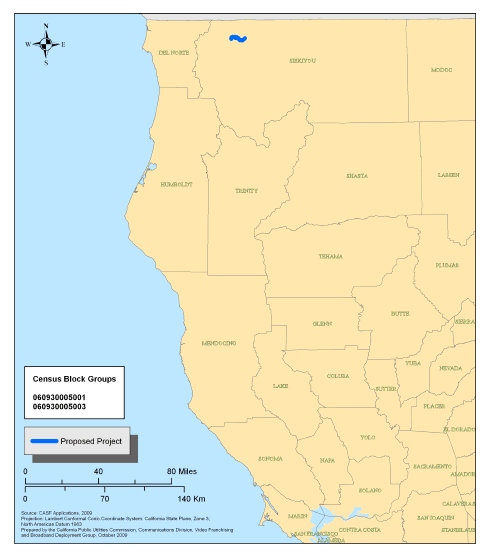
Siskiyou Telephone CASF Seiad Project - Shapefiles

APPENDIX A
Resolution T- 17237
Siskiyou Telephone Seiad Underserved Project - Regional Map
END OF APPENDIX A
1 SB 1193 (Chapter 393, Statutes ff 2008) established the California Advanced Services Fund as a new public purpose program.
2 The American Recovery and Reinvestment Act (ARRA) appropriates $7.2 billion for grants and loans to support broadband deployment on a national level. ARRA offers a unique and ground breaking opportunity for California to partner with the federal government and other state agencies in advancing the goal of bridging the digital divide.
3 To date, the CASF cost per household for approved unserved areas is $360.44 while CASF cost per household for approved underserved areas is $1,531.48.
4 Siskiyou Telephone has also applied for a grant under the Rural Telephone Infrastructure (RTI) program. Staff has gone on site-visits and noted that the area's topography and demographics would result in relatively high build-out cost. The cost per mile of the proposed projects under the RTI ranges from $220,000 to $630,000.
5 The four areas are Seiad, Hamburg, Member Creek and Oak Knoll.
6 Resolution T-17143
7 The above schedule is contingent on the CASF recipient submitting clear, complete, and error-free invoices to CD. Additional time to process payments may be necessary if CD finds problems with the submitted invoices.
8 D.07-12-054, Finding of Fact 38
9 Ibid, Findings of Fact 28 and 29
10 T-17143 at pg. 15, mimeo
