Item # Agenda ID# 8971
D R A F T
PUBLIC UTILITIES COMMISSION OF THE STATE OF CALIFORNIA
Communications Division |
RESOLUTION T-17242 |
Carrier Oversight and Programs Branch |
November 20, 2009 |
R E S O L U T I O N
Resolution T-17242 Approval of Funding for the Nevada County Connected Middle Mile Project of Nevada County Economic Resource Council from California Advanced Services Fund (CASF) Amounting to $1,312,747
__________________________________________________________________
Summary
This Resolution adopts a contingent funding award for the Nevada County Economic Resource Council's Nevada County Connected Middle Mile project in the underserved areas of Nevada county amounting to $1,312,747 from the California Advanced Services Fund (CASF). The $1,312,747 grant amount represents 10% of the total project cost of this underserved area application filed in accordance with Resolution T-17143 and Decision (D.) 09-07-020.
Background
On December 20, 2007, the Commission approved Decision (D.) 07-12-054 which established the CASF program to provide matching funds of up to 40% of the total project costs for the deployment of broadband infrastructure in unserved and underserved areas in California.1 In Resolution T-17143, approved on June 12, 2008, the Commission adopted the application requirements, scoring criteria for the award of funds, and a prescribed timeline for other filings and notifications, including a projected Commission Meeting date for final approval of award(s). This same Resolution directed interested applicants, seeking funding for unserved and underserved projects, to file their project proposals and funding requests beginning July 24, 2009.
D. 07-12-054 limited the extension of CASF funding to:
· Entities with CPCNs that qualify as "telephone corporations" as defined in § 234 of the Public Utilities Code (PU Code);
· Wireless carriers registered with the Commission and have granted a Wireless Identification Number (WIR);
· Entities who have pending applications for a CPCN; and
· A consortium with a member holding a CPCN or a WIR who will serve as the fiscal agent of the consortium (D.07-12-054 at pgs. 33-35, mimeo).
On July 9, 2009, the Commission adopted D.09-07-020 establishing new schedules and plans for filing, review and approval of an additional round of broadband project requests. While retaining the CASF 40% matching grant process, D.09-07-020 modified the CASF grant to extend 10% matching funds to the applicant provided the remaining 80% of the project cost is funded by the federal government's American Recovery and Reinvestment Act (ARRA) 2 and 10% is provided by the applicant.
On July 29, 2009, Governor Schwarzenegger signed AB 1555 (Chapter 24, Statutes of 2009), amending Section 281 of the PU Code to expand CASF eligibility to any entity applying for CASF funding in conjunction with their ARRA funding request provided that entity satisfies the eligibility requirement for CASF funding. AB 1555 also provides that the Commission establish requirements and guidelines for non-certificated applicants.
The Commission has put forth a Draft Resolution (DR) T-17233 which proposes requirements for non-certificated applicants. DR T-17233 is currently pending Commission adoption in its October 29, 2009 meeting.
As of September 24, 2009, $12.6 million has been granted for 28 projects covering 4,318 square miles, benefiting 32,943 potential households as follows:
· Unserved- $11.6 million, 16 projects, 4,284 square miles, and 32,284 households
· Underserved- $1 million, 12 projects, 34 square miles, 659 households.
Notice/Protests
The Census Block Group (CBG) list for the Nevada County Connected Middle Mile project (Nevada project) was placed on the Commission's CASF website under the heading "UNDERSERVED areas proposed to be served as of July 17, 2009: Census Block Groups (CBGs)." Of the 36 CBGs submitted by the Nevada County Economic Resource Council (NCERC), Comcast and Digital Path challenged a total of 10 CBGs. Therefore, Communications Division (CD) proceeded to review and analyze these project areas to verify that they were indeed underserved as of the applicants' filing date.
Discussion
This Resolution adopts a contingent CASF award of $1,312,747 for the Nevada project. This project is described in detail in Appendix A, pages A-1 to A-3
On July 17, 2009, NCERC submitted a project proposal (Nevada project) for the underserved areas of Nevada County. The total project cost is estimated at $13,127,468 of which 10% or $1,312,747 is being requested from CASF as a match to NCERC's 80% ARRA request.
NCERC is a California non-profit economic development agency. Its telecommunications committee, which was formed in 2001, recognized the need to build and deploy a wireless infrastructure which could offer broadband service to its unserved and underserved areas.
According to NCERC, the Nevada project is a carrier-class 622 mbps backbone ring architecture which will create a complete and redundant middle mile network with scalable bandwidth available. The network backbone that interconnects the tower system consists of microwave 4xOC-3 links (633 Mbps) which form a ring configuration. The West Ring with ten towers, the East Ring with four towers and a northern spur loop that integrates north Nevada County. Each ring provides path diversity for every core tower on that ring. Each ring is connected through a connection from Level 3; the East Ring connected at Soda Springs and the West Ring connected at Colfax. The network design provides full redundancy across each ring backbone. Each tower will be outfitted with unlicensed radio arrays for service provider and last-mile connections.
The system will use 3 existing towers and will include the construction of 11 additional towers. These towers will be constructed to enable adequate coverage of the service area and enhance both broadband and public safety services to these areas.
Wireless last-mile technologies will be deployed by local wireless internet service providers at each of the tower sites, enabling endpoints throughout the service area. NCERC along with CONXX Inc. and Spiral Internet, local wireless internet service providers, will manage the deployment of this project.
The Nevada project will use internet service providers to provide wireless internet service to serve approximately 1,294 households covering an area of approximately 303.72 sq. miles. Nevada project plans to complete its project within 18 months.
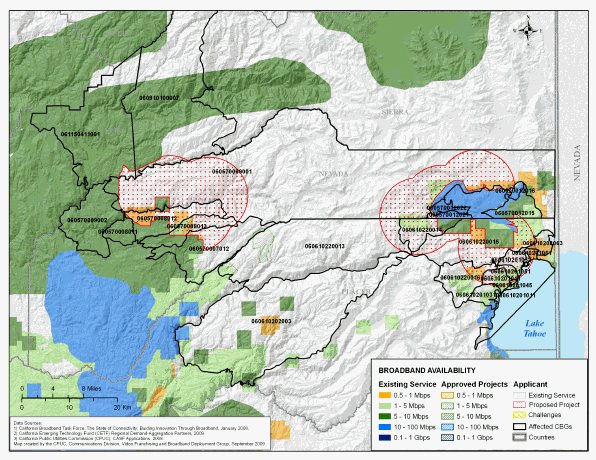
Of the 36 CBGs NCERC included in its proposal, 10 were formally challenged by Comcast and Digital Path, and CD staff identified 23 additional CBGs as already partially served. CD overlaid the Shapefiles submitted by NCERC to the updated California Broadband Task Force (CBTF) Report maps and challenged areas to verify the broadband speeds in the proposed area. CD staff used this same method of overlaying shapefiles applicants submitted onto the CBTF maps to determine which areas in a CBG are served, unserved or underserved with all the other applicants.
For purposes of the CASF program, "underserved areas" are defined as areas where broadband is available but no facilities-based provided provider offers service at speeds of at least 3 Mega Bits per Second (mbps) download and 1 mbps upload. CD reviewed this project's eligibility in the underserved review phase by analyzing required data which the applicants submitted. These data include, but are not limited to: descriptions of current and proposed broadband infrastructure, Geographic Information System (GIS) formatted Shapefiles 3 mapping the subject areas; assertion that the area is underserved; potential size of the subscriber base and household incomes; project construction schedule; project budget; proposed pricing and commitment period for new subscribers; and, financial qualifications of the applicant.
CD reviewed the shapefiles, which mapped the broadband deployment, using sources including, but not limited to, the United States 2000 Census data and the January, 2008, Broadband Task Force Report and the revised August 10, 2009, California Broadband Task Force (CBTF) map, among others. These maps helped to verify the existence of or non-existence of broadband service areas and broadband speeds, where available.
On September 9, 2009 NCERC resubmitted its proposal, withdrawing 31 CBGs from its proposal. NCERC proposes to provide service in five CBGs asserting that these CBGs do not have broadband service. NCERC also provided documentation to support its statement.
CD's staff reviewed the resubmitted proposal and confirmed the accuracy of the coverage of the total project area in square miles. This was done through a three-step process in the NAD83 coordinate systems4 and California State Plane Zone 3 projection (appropriate for central California) using the Arc GIS software. First, staff calculated the square footage of each closed polygon in the applicant's submitted shapefile (GIS boundary file) using the Calculate Areas function in the ArcToolbox. The result was then calculated to six decimal places (one-millionth of a square foot). Next, staff divided the square footage of each closed polygon by 27,878,400 (number of square feet in a square mile) using the Field Calculator in ArcMap, to arrive at the square mileage. Finally, the area of the polygons was summed to arrive at the total area. CD staff confirmed that this method is the standard procedure used for calculating the size of an area for geographic analysis.
The Application Requirements and Guidelines under Resolution T-17143 required each applicant to possess a CPCN or a U-Number. However, AB 1555 amended Section 281 of the PU Code expanding CASF eligibility to any entity applying for CASF funding in conjunction with their ARRA funding request provided that the entity satisfies the eligibility requirement for CASF funding.
AB 1555 also provides that the Commission establish requirements for non-certificated applicants. The Commission is scheduled to review DR T-17233, which addresses the requirements for non- certificated applicants, at its October 29, 2009 public meeting. If the Commission adopts DR T-17233, NCERC is required to comply with all the requirements set forth in DR T-17233. As such, since NCERC is a non-certificated applicant, the Commission should require NCERC to post a performance bond equal to the total amount payable under this CASF award, or 10% of the project costs, and provide a copy of the bond to Communications Division as prescribed under existing CASF rules.
In addition to the guidelines, requirements and conditions set forth in DR T-17233, we also will require NCERC to comply with all the guidelines, requirements and conditions associated with the granting of CASF funds as specified in Resolution T-17143, including, but not limited to, the submission of Form 477.
The Commission must complete California Environmental Quality Act (CEQA) review before dispersing CASF funds to NCERC for the construction of the proposed facilities.
Though the specific locations of the proposed towers are too speculative to conduct meaningful environmental review at this time, NCERC shall submit a Proponent's Environmental Assessment to Commission staff as soon as the precise locations for the proposed towers are known.
The receipt of the CASF grant is contingent on NCERC's 1) compliance with the requirements in Res. T-17233 (if adopted) and Res. T-17243; 2) receiving the 80% ARRA grant for its Nevada project; and 3) completion of CEQA review. NCERC should notify the Director of CD of the disposition of its ARRA application and work with the Commission's staff to complete its CEQA review. If the Nevada County project will not be constructed, NCERC shall promptly notify the Director of CD so that the committed CASF funds may be reallocated for other grants.
If the applicant is not successful in its request for the ARRA grant or if the ARRA grant is less than 80%, then NCERC may request additional CASF funds in accordance with Ordering Paragraph No. 7 of D.09-07-020. The granting of additional funds will be contingent on the availability of CASF funds.
Payments to CASF Recipients
Submission of invoices from and payments to NCERC shall be made in accordance with Section IX of Appendix A of Resolution T-17143 and according to the guidelines and supporting documentation required in Resolution T-17143.
Payment to NCERC shall essentially follow the process adopted for funds created under Public Utilities Code §270. The following table describes the timeline for processing CASF payments.
Event |
Payment Cycle 1 (Day/Month) |
Payment Cycle 2 (Day/Month) |
Invoices due from NCERC to CD |
5th of Month 1 |
20th of Month 1 |
Payment letters from CD to Information and Management Services Division (IMSD) 5 |
On 19th of Month 1 |
On 4th of Month 2 |
Invoices submitted from IMSD to State's Controller Office (SCO) for payments |
20th through 26th of Month 1 |
5th through 13th of Month 2 |
NCERC may submit its invoices under Payment Cycle 1 or 2.
If any date in this payment schedule falls on a weekend or holiday, that date will be advanced to the next business day but the remaining dates in the payment schedule will remain unchanged. SCO requires 14 to 21 days to issue payment from the day that requests are received by SCO.
Comments on Draft Resolution
In compliance with P.U. Code § 311(g), a notice letter was emailed on October 21, 2009 informing a) all applicants under D.09-07-020 and b) parties on the service list of R.06-06-028 of the availability of the draft of this Resolution for public comments at the Commission's website http://www.cpuc.ca.gov/static/documents/index.htm. This letter also informed parties that the final conformed Resolution adopted by the Commission will be posted and will be available at this same website.
Findings
1. The Commission created the California Advanced Services Fund (CASF) in Decision (D.) 07-12-054. The CASF was established as a two-year program that will provide matching funds of up to 40% of the total project costs for the deployment of broadband infrastructure in unserved and underserved areas in California.
2. In Resolution T-17143, approved on June 12, 2008, the Commission adopted the application requirements and scoring criteria for the award of funds, a prescribed timeline for other filings and notifications including a projected Commission Meeting date for final approval of award(s).
3. On July 9, 2009, the Commission issued D.09-07-020 approving a new CASF schedule and plan for an additional round of broadband projects that would complement broadband grants awarded under the federal government's American Recovery and Reinvestment Act (ARRA). While retaining the 40% matching grant process, the Commission in this Decision authorized providers an option of seeking a 10% grant from the CASF concurrent with efforts to seek an 80% grant from the ARRA fund.
4. On July 29, 2009, Governor Schwarzenegger signed AB 1555 (Chapter 24, Statutes of 2009), amending Section 281 of the Public Utilities Code (PU Code) expanding CASF eligibility to any entity applying for CASF funding in conjunction with their ARRA funding request provided that entity satisfied the eligibility requirement for CASF funding.
5. Draft Resolution (DR) T-17233, which addresses the requirements for non- certificated or non-licensed broadband providers applying for CASF grant money in conjunction with their ARRA funding request, is currently scheduled for Commission review at its October 29, 2009 public meeting.
6. A list of census block groups (CBGs) appeared by county on the Commission's CASF website page under "UNDERSERVED areas proposed to be served as of July 17, 2009: Census Block Groups (CBGs)". Communication's Division (CD) proceeded with its independent review and analyses of the areas proposed in this project to verify that they were underserved as of the applicants' filing date.
7. Underserved areas are defined as areas where broadband is available but no facilities-based provided offers service at speeds of at least 3 Mega Bits per Second (mbps) download and 1 mbps upload.
8. The Nevada County Economic Resource Council (NCERC) filed an application on July 17, 2009, seeking 10% CASF funding.
9. According to NCERC, the Nevada project is a carrier-class 622 Mbps backbone ring architecture which will create a complete and redundant middle mile network with scalable bandwidth available. Wireless last-mile technologies will be deployed by local wireless internet service providers at each of the tower sites, enabling endpoints throughout the service area. NCERC along with CONXX Inc. and Spiral Internet, local wireless internet service providers will mange the deployment of this project.
10. CD reviewed NCERC's Project eligibility in the underserved review phase by analyzing the required data submitted. These data include, but are not limited to: proof of CPCN registration; descriptions of current and proposed broadband infrastructure; geographic information system (GIS) formatted Shapefiles mapping the subject areas; assertion that the area is unserved; potential subscriber size and household incomes; project construction schedule; project budget; proposed pricing and commitment period for new subscribers; and, financial qualifications of the applicant.
11. CD reviewed the shapefiles, which mapped the broadband deployment, using sources including, but not limited to, the United States 2000 Census data and the January, 2008, Broadband Task Force Report and the revised July 9, 2009, California Broadband Task Force (CBTF) map, among others. These maps helped to verify the existence of or non-existence of broadband service areas and broadband speeds, where available.
12. CD verified NCERC's project and, when necessary, requested additional information and/or meetings to clarify the project proposal. Of the 36 CBGs NCERC included in its proposal, 10 were formally challenged by Comcast and Digital Path and CD staff identified 23 additional CBGs as already partially served.
13. On September 9, 2009, NCERC resubmitted their proposal, withdrawing 31 CBGs from its proposal. NCERC proposes to provide service in five CBGs asserting that these CBGs do not have broadband service. NCERC also provided documentation to support its statement.
14. The Commission must complete California Environmental Quality Act (CEQA) review before dispersing CASF funds to NCERC for the construction of the proposed facilities.
15. At this time, the specific locations of the proposed towers are too speculative to conduct meaningful environmental review. NCERC should submit a Proponent's Environmental Assessment (PEA) to Commission staff as soon as the precise locations for the proposed towers are known.
16. NCERC should be required to post a performance bond equal to the total amount payable under this CASF award, or 10% of the project costs and provide a copy of the bond to Communications Division as prescribed under existing CASF rules.
17. NCERC should comply with all other requirements and conditions such as, but not limited to, the submission of Form 477 associated with the granting of CASF funds as specified in Resolution T-17143 and compliance with CEQA.
18. NCERC should notify the Director of CD of the disposition of its ARRA application and CEQA review.
19. If the Nevada County project will not be constructed, NCERC should promptly notify the Director of CD so that the committed CASF funds may be reallocated for other grants.
20. NCERC should comply with all other requirements and conditions as specified in Draft Resolution T-17233 if the Draft Resolution is adopted by the Commission on October 29, 2009.
21. A notice letter was e-mailed on October 21, 2009, informing a) all applicants filing under D.09-07-020 and b) parties on the service list of R.06-06-028 of the availability of the draft of this Resolution for public comments at the Commission's website http://www.cpuc.ca.gov/static/documents/index.htm. This letter also informed parties that the final conformed Resolution adopted by the Commission will be posted and will be available at this same website.
22. The Commission finds CD's recommended CASF award of $1,312,747 for underserved areas for the Nevada Project, as summarized in Appendix A of this Resolution, reasonable and consistent with Commission orders and should be adopted.
THEREFORE, IT IS ORDERED that:
1. The Commission shall award contingent funding of $1,312,747 from the California Advanced Services Fund to Nevada County Economic Resource Council (NCERC) for its Nevada County Connected Middle Mile project. This award is contingent on NCERC receiving an ARRA grant of 80% of the total estimated project cost.
2. NCERC shall post a performance bond equal to the total amount payable under this CASF award, or 10% of the project costs, and provide a copy of the bond to Communications Division as prescribed under existing CASF rules.
3. NCERC shall comply with all guidelines, requirements, and conditions associated with the CASF funds award as specified in Resolution T-17143, Draft Resolution T-17233 (if adopted), and CEQA.
4. NCERC shall notify the Director of the Communications Division of the disposition of its ARRA application and work with the Commission's staff to complete CEQA review of the project.
5. NCERC shall submit a Proponent's Environmental Assessment (PEA) to Commission staff as soon as the precise locations for the proposed towers are known.
6. If the Nevada County project will not be constructed, NCERC shall promptly notify the Director of CD so that the committed CASD funds may be reallocated for other grants.
7. The program fund payment of $1,312,747 for the Commission-approved Nevada County project shall be paid out of the CASF fund in accordance with the guidelines adopted in Resolution T-17143 and D.09-07-020 and, if adopted on October 29, 2009, Draft Resolution T-17233.
8. Payments to NCERC shall be in accordance with Section IX of Appendix A of Resolution T-17143 and in accordance with the process defined in the "Payments to CASF Recipients" section of this Resolution.
This Resolution is effective today.
I hereby certify that this Resolution was adopted by the Public Utilities Commission at its regular meeting on November 20, 2009. The following Commissioners approved it:
|
PAUL CLANON Executive Director |
APPENDIX A
Nevada County Economic Resource Council
Nevada County Connected Middle Mile - Project
Key Information
1 |
Project ID |
||
2 |
Project Name |
Nevada County Connected Middle Mile |
|
3 |
Project Plan |
The Nevada project is a carrier-class 622 mbps backbone ring architecture which will create a complete and redundant middle mile network with scalable bandwidth available. Wireless last-mile technologies will be deployed by local wireless internet service providers at each of the tower sites, enabling endpoints throughout the service area |
|
4 |
Project Size (in square miles) |
303.72 |
|
5 |
Download speed |
Up to 20 mbps |
|
6 |
Upload speed |
Up to 20 mbps |
|
7 |
Location |
Nevada County |
|
a) |
Community Name |
Cherokee |
|
Hobart Mills |
|||
Junction House |
|||
Kingvale |
|||
Lake City |
|||
Moores Flat |
|||
North Bloomfield |
|||
North Columbia |
|||
Orleans Flat |
|||
Relief |
|||
Washington |
|||
Woolsey Flat |
|||
b) |
CBGs/Household Income |
60570008012 |
$50,735 |
|
|
60570008013 |
$51,051 |
60570009001 |
$32,614 | ||
60610220013 |
$41,528 | ||
60610220014 |
$16,731 | ||
c) |
ZIP Codes |
95959 |
|
95986 |
|||
96161 |
|||
95728 |
|||
8 |
Estimated Potential Subscriber Size |
||
a) |
Households |
1294 |
|
9 |
Deployment Schedule (from Commission approval) |
18 months |
|
10 |
Proposed Project Budget |
$13,127,747 |
|
CASF (10%) |
$1,312,747 |
||
CIAC |
|||
Amount of CASF Funds Requested |
$1,312,747 |
||
APPENDIX A
Resolution T-17242
Nevada County Economic Resource Council
Nevada County Connected Middle Mile Project
Shapefile
APPENDIX A
Resolution T-17242
Nevada County Economic Resource Council
Nevada County Connected Middle Mile Project
Statewide Map

(End of Appendix A)
1 SB 1193 (Chapter 393, Statutes of 2008) established the California Advanced Services Fund as a new public purpose program.
2 The American Recovery and Reinvestment Act (ARRA) appropriated $7.2 billion for grants and loans to support broadband deployment on a national level. ARRA offers a unique and ground breaking opportunity for California to partner with the federal government and other state agencies in advancing the goal of bridging the digital divide.
3 A shapefile is a digital vector storage format for storing geometric location and associated attribute information. Shapes (points/lines/polygons) together with data attributes can create infinitely many representations about geographical data.
4 North American Datum of 1983 (NAD83) is an earth-centered datum based on the Geodetic Reference System of 1980. The size and shape of the earth was determined through measurements made by satellites and other sophisticated electronic equipment; the measurements accurately represent the earth to within two meters.
5 The above schedule is contingent on the CASF recipient submitting clear, complete and error free invoices to CD. Additional time to process payments may be necessary if CD finds problems with the submitted invoice
