2006 Resource Adequacy Report
Produced by
the Staff of the
California Public Utilities Commission
March 16th, 2007
This Report was first issued to the Service List for R.05-12-013 on February 2nd, 2007. During the February 8th RA workshop, parties were given the opportunity to comment and discuss the findings of the report, and to suggest edits in writing on February 20th. This Final Report takes into consideration the comments from those assembled at the workshop, and includes some edits. This constitutes the Final 2006 Resource Adequacy Report.2006 Resource Adequacy Report
Table of Contents
1. Executive Summary 5
2. Goals of the Resource Adequacy Program 7
2.1. Resource Adequacy Policy Framework 7
2.2. Overview of Regulatory Decisions 8
2.3. Legislature Codifies the Resource Adequacy Requirement in Public Utilities Code Section 380 11
3. Compliance with RAR in 2006 12
3.1. Overview of the RA Filing Process 12
3.2. Compliance Review Process 14
3.3. Compliance Issues 14
3.4. Compliance Enforcement 15
4. 2006 Load Forecast and Resource Adequacy Program Requirements 16
4.1. 2006 Yearly and Monthly Load Forecast Process 16
4.1.1. Yearly Load Forecast in 2006 17
4.1.2. Monthly Load Migration Adjustments in 2006 18
4.2. 2006 System Resource Adequacy Requirements 20
4.3. Total RA Resources Available to CAISO in 2006 21
4.4. Summer 2006 Heat Storm 23
4.4.1. Evaluation of the CEC Peak Load Forecast for the CAISO 25
4.4.2. CEC Forecasts by Service Area 28
4.4.3. Southern California Edison Planning Area 29
4.4.4. Pacific Gas and Electric Planning Area 30
5. Counting Resource Adequacy Resources 30
5.1. Introduction to Qualifying Capacity 31
5.2. Establishment of CAISO'S NQC Values List in 2006 32
5.2.1. Revisions to CAISO'S Master NQC List for 2007 33
5.3. QC for Thermal Generation Units 34
5.4. QC for Wind and Solar Resources 34
5.4.1. Comparison of Performance for Wind Generation Units during Five Peak Days vs. QC in July 2006 and 2007 34
5.4.2. Comparison of Performance for Solar Generation Units during 5 Peak Days vs. QC in July 2006 36
5.5. Demand Response Resources 37
5.5.1. DR Counting and Allocations 38
5.5.2. Aggregated DR Data Reported in Compliance Filings 39
5.5.3. Comparison of DR Performance in July 2006 vs. DR Resource Allocations 39
5.5.4. QC from Demand Response Resources in 2007 40
5.6. QC from Liquidated Damages Contracts 41
5.6.1. RA LD Summary for 2006-2012 42
5.7. Reliability Must Run Allocations for 2006 43
5.8. Import Allocations for 2006 43
5.8.1. Comparison of Import Allocations with Imports during Peak Periods 44
5.9. Maximum Cumulative Contribution (MCC) / Resource Buckets 45
5.10. Aggregate NQC Values 2006 and 2007 47
5.11. Units with Partial Commitments to more than one LSE 48
5.12. Summary of all RA Resources Available in 2006 48
6. Use of RA resources by CAISO in 2006 50
6.1. Use of Must Offer Obligations (MOO) 50
6.1.1. Use of MOO in Summer 2006 50
6.2. Outage comparisons - Ambient, Forced, and Scheduled 51
7. Changes to the RA Program for 2007 53
Index of Tables
Table 1 2006 Aggregated Load Forecast Data (MW) 18
Table 2 Summary of Load Forecast Adjustments in 2006 19
Table 3 2006 RA Filing Summary for CPUC Jurisdictional Entities (MWs) 21
Table 4 Total CAISO Procurement as Percent of Total CAISO Obligation and Peak Demand 23
Table 5 Comparison of Performance of Wind Units on Five Peak Days vs. QC (3-4PM) for 18 of 20 Largest Wind Units 35
Table 6 Comparison of Performance of all Solar Units on Five Peak Days vs. QC (3-4 PM) 37
Table 7 Demand Response Program Allocations vs. Used in 2006 (MW) 39
Table 8 Comparison of DR Program Allocation with DR Load Drop in July 2006 40
Table 9 Enrolled MWs in DR Program in California by IOU and August DR Allocation 41
Table 10 LD Phase-Out Schedule Adopted in D.05-10-042, Section 7.4 41
Table 11 LSE use of RMR Allocations in 2006 RA Filings (MW) 43
Table 12 Import Allocations vs. Used in 2006 (MW) 44
Table 13 Comparison of Import Allocation with Average Imports during Peak in July 2006 45
Table 14 Summary of Resource Categories (Excerpt from the 2006 RA Filing Guide) 46
Table 15 RA Capacity by Resource Category 47
Table 16 RA Capacity in Percentage by Resource Category 47
Table 17 Number of Units with Partial RA Contracts to CPUC jurisdictional LSEs 48
Table 18 Resources Available for 2006 49
Table 19 Outages during summer months in MW 52
Table 20 RMR in 2007 54
Index of Figures
Figure 1 2006 Aggregate Load Forecast Adjustments Reported by LSEs, by Month Showing Load Gained or Lost 20
Figure 2 Total CAISO Summer RA Obligation and Procurement vs. Actual Monthly Peak (MW) 22
Figure 3 CAISO July 2006 Loads and Temperatures 24
Figure 4 Historic Extreme Temperature Events by Service Area 25
Figure 5 CAISO 2006 Predicted versus Actual Peaks 27
Figure 6 CAISO 2006 Predicted versus Actual Peaks Scatter Plot 27
Figure 7 Weather-Normalized CAISO Loads and CEC Forecasts 28
Figure 8 SCE Predicted Loads Assuming Historic Temperatures 29
Figure 9 PG&E Area Predicted Loads Assuming Historic Temperatures 30
Figure 10 Performance as a percentage of NQC for 20 Largest Wind Units during Peak (3-4 pm) on CAISO's Five Peak Days of 2006 36
Figure 11 Performance as a percentage of NQC for Solar Units during Peak (3-4 pm) on CAISO's Five Peak Days of 2006 37
Figure 12 Liquidated Damages Contract Summary for 2006-2012 42
Figure 13 ISO 2006 Summer Peak Loads and Imports and Time of Peak 45
Figure 14 FERC MOO Waiver Denials, Summer 2006 51
Figure 15 LARS Required Capacity Trend (1998-2007) 54
1. Executive Summary
This Report provides background and analysis of the launch of the California Public Utilities Commission's (CPUC's) Resource Adequacy (RA) program. Although RA program policies have been under development for several years, the first active compliance period commenced in June 2006, and the program has been ongoing thereafter. This report summarizes the program's experience to-date, with particular emphasis on the summer period June through September 2006. The report examines how the program is actually working and provides a significant quantity of publicly available information. The report identifies some of the key programmatic changes and expansions that are already in place for compliance year 2007. While the report does not make explicit policy recommendations, it is expected to provide factual input into the policy refinement discussions under consideration in Phase 2 of the CPUC's ongoing RA rulemaking, R.05-12-013.
The Resource Adequacy program is supplying resources to meet CAISO needs.
The CPUC's RA program was launched in 2006, and it provided the California Independent System Operator (CAISO) with access to significant quantities of capacity resources. The basic characteristic of an RA resource is the ability to provide power when needed and be available to the CAISO using the RA must-offer obligation (RA MOO). CPUC-jurisdictional Load Serving Entities (LSEs) procured resources to meet load in all summer months, with total RA procurement ranging from 118 percent to 136 percent of California Energy Commission (CEC) Load Forecast, which was 3 to 21 percent above the Resource Adequacy Requirement (RAR). An LSE's RAR is a monthly obligation equal to its forecast peak load for the month plus a 15 percent planning reserve margin. The availability of RA resources did not meet all CAISO needs and the CAISO procured resources using its Reliability Must Run (RMR) authority and the Federal Energy Regulatory Commission must-offer obligation (FERC MOO).
Across the CAISO, LSEs (both CPUC- jurisdictional and non-CPUC jurisdictional) procured resources sufficient to meet the actual peak loads during the summer of 2006. In July 2006, capacity resources procured by all LSEs (CPUC jurisdictional and non-CPUC jurisdictional), if called and operating, could have provided the CAISO a six percent margin above the actual peak load during the heat storm. This figure includes Demand Response (DR) resources in addition to other resources. The six percent margin was below the seven percent operating margin typically used for CAISO operations.
The load forecast methodology operated effectively, but some parts may need review.
As part of developing the RAR, the CEC established load forecasts for each LSE. Initial forecasts were adjusted, in January 2006, to response to LSE comments. The resulting final forecasts and RARs, for each month, were 287-436 MW less than the benchmark CEC forecast. The year-ahead forecasts and RAR may be adjusted in monthly filings to account for direct access load migration. LSEs adjusted their loads significantly between the January CEC forecast and the RA filing month, increasing forecast 584-1,051 MW. The adjustments were largely concentrated in five Electric Service Providers (ESPs), who reported growth due to load migration that accounted for 97 to 99 percent of all ESP load growth reported during 2006. The monthly increase due to load migration more than made up for decrease in the January forecast adjustments and was not accompanied by a corresponding decrease in other ESPs' loads.
The on-going RA program creates significant staff work, which is exacerbated by the poor quality of some LSE filings.
On a monthly basis, the Staffs of the California Public Utilities Commission (CPUC Staff), CEC, and CAISO review 15 LSE advice letters, 15 LSE load forecasts, and supply plans from all RA generators. The CAISO also reviews filings from non-CPUC jurisdictional LSEs that demonstrate procurement of capacity to meet their peak loads. This is in addition to the larger year-ahead load forecasts and compliance filings.
Recurrent minor errors consume staff time and delay the processing of filings. In total, staff has required the filing of over 20 Supplemental Advice Letters and over 45 sets of correction sheets to remedy minor errors over the course of 2006.
Resource counting conventions are not consistently accurate and revisions may be needed.
CPUC Staff analyzed the performance of wind and solar resources during the five peak days in the summer of 2006 (July 21st - 26th). Through our analysis of the performance of these resource types, CPUC Staff found that the counting conventions for measuring the generation of solar units during times of system need is more accurate than same method used for measuring generation of wind units. Wind units performed at 12 to 76 percent below NQC, and solar units, when discounting one of the five peak days, performed 12 percent below to 8 percent above NQC over the same period.
CPUC staff also analyzed the performance of Demand Response programs relative to the size of the DR allocation used in the RA program. Demand Response programs generally produced load reductions equal to 80 percent of the values counted for RA.
The CAISO allocated available import capacity to CPUC jurisdictional and non-CPUC jurisdiction LSEs to ensure the State was not relying on more imports than could be accommodated by the existing transmission system. Throughout the summer of 2006, the CAISO allocated 8,410 MW out of 14,941 MW of import capacity to CPUC jurisdictional LSEs, while 5,502 MW was allocated to existing transmission contracts (ETCs). In their monthly RA filings, all LSEs reported between 5,325 and 5,636 MW of import capacity. During peak (3-4 pm) on the five peak days of 2006, there were from 12,153 to 14,461 MW of imported energy delivered into the CAISO.
2. Goals of the Resource Adequacy Program
2.1. Resource Adequacy Policy Framework
The CPUC adopted a RA policy framework in 2004 in order to ensure the reliability of electric service in California. The CPUC established RARs applicable to all LSEs within the CPUC's jurisdiction, including investor owned utilities (IOUs), energy service providers (ESPs), and community choice aggregators (CCAs) within its jurisdiction.1
The Commission's RA policy framework - implemented as the RA program -- guides resource procurement and promotes infrastructure investment by requiring that LSEs procure capacity so that capacity is available to the CAISO when and where needed. The Commission adopted RAR policies that are applicable to all LSEs starting in Decision 04-01-050, with further elaboration in subsequent decisions, especially D.04-10-035, D.05-10-042, and D.06-06-064.
The CPUC's RA program now contains two distinct requirements: System RARs (effective June 1, 2006) and Local RARs (effective January 1, 2007). The majority of this report focuses on System RARs, since the report is primarily looking back at experience to date.
· Under System RAR, each LSE is required to procure the capacity resources including reserves needed to serve its aggregate system load on a monthly basis. Each LSE's system requirement is 100 percent of its total forecast load plus a 15 percent reserve, for a total of 115 percent. (The 115 percent is often referred to as the planning reserve margin or PRM) An LSE's system procurement obligation does not need to account for local transmission constraints that could prevent the procured capacity from being available to the CAISO to serve load where the LSE's retail customers are located, i.e. an LSE can procure RA resources to satisfy System RAR from any qualified resource, regardless of its location.
· Under Local RAR, each LSE is required to procure capacity resources that satisfy 100 percent of the Local Capacity Requirements in each Local Area within the CAISO. Each LSE's Local RAR is based on a per-load share allocation of the total Local Capacity Requirements. An LSE can procure RA resources to satisfy Local RAR only from resources identified as located within designated local areas. Any resource procured for the purposes of satisfying a Local RAR can also count towards meeting a System RAR.
2.2. Overview of Regulatory Decisions
Several decisions summarized below provide the regulatory background for the development of System RAR and Local RAR. Further development of the CPUC's RA program is ongoing in Rulemaking (R.) 05-12-013.
Summary of Key Aspects of D.04-01-050 on January 22, 2004
· Each LSE operating within an IOU's service territory has an obligation to acquire sufficient capacity reserves (henceforth RA resources) for its customers' load located within that service territory.
· Each LSE must procure RA resources in excess of its customers' load, in order to cover a planning reserve margin (PRM) requirement of 15-17 percent for all months of the year.
· Each LSE must forward contract for RA resources, such that each LSE can meet 90 percent of its summer (May through September) peaking needs a "year" in advance.
· The CPUC requires that the RA framework accommodate the California Department of Water Resource (DWR) contracts.
Summary of Key Aspects of D.04-10-035 on October 28, 2004
· LSEs must acquire a mix of resources capable of satisfying system demands during peak each month and that their loads are within 10 percent of their maximum contribution to monthly system peak.
· A 100 percent month-ahead forward commitment obligation is adopted for all LSEs. This is in addition to the 90 percent year-ahead forward commitment obligation established in D.04-01-050.
· Year-ahead compliance filings are to be submitted on September 30th of each year ahead of the subsequent year's May through September period.
· LSEs are required to prepare load forecasts on the basis of their best estimate of future customers and their loads and submit them to the CPUC and CEC. The CEC is to adjust each LSE's load forecast to account for contribution to coincident peak and reasonable accuracy. The resulting LSE's load at the time of monthly system peak is the basis for the forward commitment obligations.
· A planning reserve margin of 15-17 percent is adopted to be phased in and fully implemented by June 1, 2006.
· Resource counting conventions and general formulas for determining Qualifying Capacity (QC) are established. This includes general formulas established from RA workshops applicable to liquidated damage contracts, wind and solar facilities, qualifying facilities (QFs), energy limited resources, demand response, DWR contracts, and generating facilities under construction.
· The decision supports CAISO's baseline deliverability proposal to develop a deliverability requirement. This baseline deliverability proposal was to be further analyzed in Phase 2 of RA.
· Local reliability requirements are a benefit and implementation details are to be established.
· Other issues to be further explored in Phase 2 of RA. This also included second generation requirements of the RA program.
Summary of Key Aspects of D.05-10-042 on October 27, 2005
· The decision adopts a monthly system peak approach to defining the RA obligation and adopts the Mirant Top Down Approach.
· Supply contracts that count for RA purposes are required to identify the specific resources that provide QC.
· Localized capacity requirements are affirmed but implementation is deferred to the 2007 procurement year.
· Compliance filings and the review process are established for RA.
· Sanctions for LSE non-compliance with RAR are required. This includes establishment of a baseline penalty of 150 percent of the monthly cost of new capacity for 2006 and a baseline penalty of 300 percent for 2007 and beyond. Five factors affecting enforcement include: severity of offense, entity's conduct, financial resources of the entity, the role of precedent, and the totality of circumstances in furtherance of public interest.
· The CEC and CAISO are to coordinate implementation of the RA program; the CEC is particularly to help with load forecasting and the CAISO is to administer performance standards for RA resources.
· RA resources have an obligation to make themselves available to the CAISO in real time to the extent they are physically capable. This obligation of suppliers to be available and perform is established through their contracts with LSEs. The CPUC maintains ultimate authority for administration of month-ahead and year-ahead RARs as well as compliance.
· Generating units would not be considered RA resources unless the owner has submitted its qualified capacity value and supporting documentation to the CAISO.
· Liquidated damage contracts executed on or before the September 27, 2005 count towards RARs, however, LD contracts do not count towards RARs after December 31, 2008. Portfolio limitations and phase out are established.
· Further refinements are made to resource issues for imports, LDs, wind and solar, energy limited resources, and commercial on line dates. Interagency coordination to develop a system to publish CODs between the CEC and the CAISO is also encouraged.
Summary of Key Aspects of Decision 05-12-017 on December 12, 2005
· The decision corrects errors in D.05-10-042, specifically, in conclusion of law 15.
Summary of Key Aspects of D.06-02-007 on February 16, 2006
· The prohibition on re-selling and re-trading of the allocation of import capacity is eliminated.
Summary of Key Aspects of D.06-04-040 on April 13, 2006
· The RA program in place for 2006-2008 is transitional and a fully implemented RA program will be in place in 2009.
· The Must-offer obligation (MOO) included in RA contracts is an independent, RA-based requirement that does not attempt to change or alter the current FERC imposed MOO.
· This Decision modified and denied rehearing of D.05-10-042.
Summary of Key Aspects of D.06-06-064 on June 29, 2006
· Adopted the 2007 local capacity requirements (LCR) study by the CAISO for establishment of local procurement obligations to be met by LSE's for 2007.
· Established Local RAR for LSEs based upon the adopted LCR amounts and this is effective January 1, 2007.
· LSEs are required to demonstrate that they have acquired 100 percent of their Commission determined year-ahead Local RAR for the following calendar year concurrently with the annual 90 percent year-ahead RA compliance filing.
· The decision adopted CPUC Staff's RA reporting template and reporting guide for the purposes of demonstrating compliance with System RAR.
· Adopted a waiver of penalties provision that relies on a threshold price of $40 per kilowatt-year. If an LSE demonstrates that a waiver is justified, it will pay for backstop procurement but will not be penalized.
· In the event that an LSE does not meet is local procurement obligation and the LSE has not been granted a waiver, it will be subject to a penalty of $40 per kW-year on the amount of its deficiency, in addition to backstop procurement costs.
Summary of Key Aspects of D.06-07-031 on July 20, 2006
· Publication of the CAISO's QC list on or about July 1 for the next compliance year so that LSE's will have sufficient time to procure resources to meet RAR obligations.
· LSE's are not accountable for changes in a resource's QC that may be identified by the CAISO after the QC list is established on or about July 1 of each year. LSEs are not subject to any Commission imposed penalty or replacement procurement obligation as the result of a forced outage of a unit that was on the CAISO's QC list and used by fulfillment of its RAR procurement obligation.
· LSE's are not required to engage in replacement procurement following a forced outage.
· Unit outages during an RAR compliance year would be reflected in the next year's QC list.
· To reduce contracting risk and encourage development of RAR capacity products and their use by LSEs in satisfying their procurement obligations, the required elements of a standard RA capacity contract were provided in this decision and replace contract elements approved in D.05-10-042.
· Commission approval of the RAR filing guides, templates, and instructions that were developed by CPUC Staff.
· Failure of an LSE to submit compliance filing in accordance with the filing instructions and reporting templates provided by CPUC Staff is deemed a violation of a Commission order.
Summary of Key Aspects of Decision 06-12-037 on December 14, 2006
· Firm LD import contracts must specify a firm delivery point at an interconnection with the CAISO control area or a CAISO scheduling point to qualify as RA resources.
· RA resources must be available to the CAISO when and where needed. All RA resources (upon implementation of the CAISO's market re-design and technology update (MRTU), excluding import contracts supported solely by non-dynamic system resources (non-resource specific) as defined in CAISO tariffs) have an obligation to make themselves available to the CAISO in real time to the extent they are physically capable.
· Minor wording changes are made to clarify Commission intent. Decision 05-10-042, as previously modified by Decision 06-04-040, is further modified in Decision 06-12-037.
2.3. Legislature Codifies the Resource Adequacy Requirement in Public Utilities Code Section 380
In 2005, the California legislature codified resource adequacy in Public Utilities Code Section 380. An overview of the some key sections of the law is provided below.
· The CPUC, in consultation with the CAISO shall establish RARs for all LSEs. PU Code 380 requires the CEC to establish and oversee RARs for publicly owned utilities. The CEC also gathers data from CPUC regulated and publicly owned utilities that is used to implement the CPUC's RA program.
· In establishing RAR, the Commission's goal was to achieve the following objectives:
o Facilitate development of new generating capacity and retention of existing generating capacity that is economic and needed.
o Equitably allocate the cost of generating capacity and prevent shifting of costs between customer classes.
o Minimize enforcement requirements and costs.
· Each LSE shall maintain physical generating capacity adequate to meet its load requirements, including, but not limited to, peak demand and planning and operating reserves. The generating capacity shall be deliverable to locations and at times as may be necessary to provide reliable electric service.
· The CPUC shall implement and enforce the RAR established in accordance with this section in a nondiscriminatory manner.
· The CPUC shall require sufficient information, including, but not limited to, anticipated load, actual load, and measures undertaken by a LSE to ensure resource adequacy, to be reported to enable the Commission to determine compliance with the RAR established by the Commission.
3. Compliance with RAR in 2006
The RA program in 2006 included several components. These components included: RA filing process, compliance review process, identifying compliance issues, and compliance enforcement. Each component is discussed in more detail below. CPUC Staff has implemented Commission Decisions, and overall compliance has been acceptable, although minor filing errors continue to consume staff time.
3.1. Overview of the RA Filing Process
After D.05-10-042 was adopted in October 2005, the CPUC Staff endeavored to quickly develop an RA Filing Template and Guide to facilitate the implementation of the RA program. CPUC Staff issued a Draft Year-Ahead Filing Template and Guide on December 7th, 2005, a final Year-Ahead RA Filing Template on January 9, 2006, and a final Year-Ahead Guide on January 31, 2006. Subsequently, CPUC Staff issued a Monthly RA Filing Template and Guide, largely based on the format of the Year-Ahead format.
The 2006 Year-Ahead and Monthly RA Filing Templates and Guides were attached to the RA Phase 1 Staff Report in April 2006 in R.05-12-012.2 D.06-07-031, Conclusion of Law 8, affirmed that the RA filing guides and templates are approved and CPUC Staff is authorized to modify them as necessary. The 2007 Year-Ahead RA Filing Guide and Template were issued by CPUC Staff in August 2006.3
LSEs are responsible for making Year-Ahead and Monthly RA filings, as well as Year-Ahead and Monthly load forecasts. The RA compliance filings were submitted simultaneously to the CPUC, CEC, and the CAISO. The load forecast information is submitted to the CPUC and the CEC.
· Year-Ahead RA Filing
LSEs must demonstrate compliance with the 90 percent requirement by showing 90 percent of its RAR is under contract well in advance. RAR is calculated as 115 percent of an LSE's peak load forecast. The filing covers only the summer peak period. For the 2006 peak period, the 2006 Year-Ahead RA filing was due February 27, 2006, and it covered June 2006 through September 2006. In future, the Year-Ahead RA filing is due in October, and covers the period of the following May through September. (The filing due in October 2006 covered May 2007 through September 2007.)
· Monthly RA Filings
The month-ahead filings were due on the last day of the month prior to the start of the compliance month.4 These filings were to demonstrate procurement sufficient to meet 100 percent of their RA obligation. The first filing was due May 1st for the month of June 2006, and so on thereafter.
· Load Forecasts
Each LSE's 2006 Year-Ahead RAR was based on its Year-Ahead load forecast submitted to the CPUC and CEC in the summer of 2005. The forecasts were reviewed by the CEC staff and compared to the CEC's aggregate demand forecast (vintage September 2005). If an LSE's forecast was considered unreasonable by the CEC, a plausibility adjustment was made. In consultation with the CPUC, the CEC staff notified all LSEs of their final load forecast for use in their Year-Ahead RA filings. In addition, LSEs were also required to submit monthly load forecast adjustments to account for load migration. The load forecast adjustments were to begin 30 days prior to the first monthly filing deadline, meaning June Load Forecast adjustments were due April 1st. The load forecasts were reviewed by the CEC staff, and the CEC staff notified any LSEs of adjustments to their load forecasts for use in their Monthly RA filings.
The CPUC checked the filings for compliance by verifying that each LSE's submittal was accurate, timely, and satisfied all requirements. The CAISO reviewed the filings to check whether the RA filings submitted by LSEs were consistent with the supply plans submitted by generators.
In 2006, the CPUC Staff worked closely with LSEs to resolve any questions regarding the RA filing process and templates. CPUC Staff has been able to develop answers to numerous questions raised by LSEs that have special or unique circumstances. Working closely with LSEs has contributed significantly to reducing errors or omissions in the filings. Examples of questions brought to CPUC Staff include: treatment of QC for new resources, treatment of QC for resources when initial QC list was inaccurate, and discrepancies between the CEC's and LSE's load forecast. It is the hope of CPUC Staff that this process of working with the LSEs to iron out problems and make revisions will lead to fewer questions in the future and make the RA filing process smoother.
3.2. Compliance Review Process
CPUC Staff, in a coordinated effort with the CEC and CAISO, has reviewed all compliance filings received to date according the process outlined below:
· Verify timely submittal of entire RA compliance filing, including the Advice Letter, signed certification sheet, and all required templates in electronic and paper versions; verify that all copies arrived at all three agencies (CPUC, CEC, CAISO) in the correct form.
· Ensure that individually and as an aggregate system, sufficient resources were procured by LSEs to meet the Year-Ahead and Monthly RARs.
· Verify that each LSE entered correct load forecast, Demand Response (DR) allocation, and Reliability Must Run (RMR) allocation.
· Ensure that the formulas in the RA Filing template were not altered.
· Match LD resources listed in each Monthly RA Filing with LD contracts listed in LD Template in Year-Ahead Filing.
· Verify that the LSE did not list QC from a resource exceeding the appropriate NQC total from the CAISO NQC list.
· Verify that all resources listed used the correct Market Scheduling Identification (ID) from the CAISO NQC list.
· Verify that the LSE listed a resource in the correct Resource Category according to hours of availability during peak. [See 5.9 Maximum Cumulative Contribution (MCC) / Resource Buckets].
· Verify that the filings appropriately use the Scheduled Outage counting formulas and criteria.
· Determine that total QC allocated for a RA Resource from all LSEs does not exceed CAISO NQC listing.
· Match procurement listed by each LSE with the corresponding generator's supply plan submitted to the CAISO.
· Ensure that LSEs procured adequate capacity within each Local Area. This check is applicable only to Year-Ahead RA filings for compliance year 2007.
3.3. Compliance Issues
The first year of the implementation of the RA program has been instructive for the CPUC, CAISO, and CEC, as well as all LSEs. CPUC Staff worked with LSEs to correct minor errors in 2006, and saw no pattern of non-compliance issues across LSEs. However, CPUC Staff has identified minor errors on a regular basis, and CPUC Staff has worked with LSEs to provide a timely resolution to these errors. These errors include: filing late, listing units that are within 60 days of commercial operation date, filing information for the incorrect month, inaccurate reporting of demand response allocation, incorrect CAISO resource identification numbers, and failing to send duplicate copies of filing to all three entities, i.e. CPUC, CEC, and CAISO.
Recurrent minor errors consume staff time and delay the processing of filings. For this reason, CPUC Staff is very interested in minimizing the occurrence of errors. In total, staff has required the filing of over 20 Supplemental Advice Letters and over 45 sets of correction sheets to remedy minor errors over the course of 2006. For example, one LSE has been asked to file correction sheets to all but one filing so far, and no LSE has been able to avoid filing corrections. The common LSE has had to file around three sets of correction sheets and one to two Supplemental Advice Letters. This is a significant issue to be remedied as the RA program develops.
In the beginning of 2006, the Commission lacked a simple method for enforcing filing deadlines. The Commission approved Resolution E-4017 on October 5th, 2006 instituting a citation program authorizing Commission Staff to enforce compliance with system and local RA filing requirements.5 The resolution establishes a penalty structure for late, incomplete, or flawed filings. The citation program in Resolution E-4017 is specifically for "failure, absent an approved extension, to submit: (a) any load data, load forecast or other resource adequacy compliance filing in the time and manner required; and (b) other information requested by CPUC Staff or the CEC that is reasonably related to the implementation of resource adequacy requirements6." The procedures identified in the resolution will help CPUC Staff to enforce compliance with the RA program, in particular with filing dates.
3.4. Compliance Enforcement
The essence of the RAR program is mandatory LSE acquisition of capacity to meet load and capacity reserves. Failure of an LSE to file its RAR on a timely basis may result in the issuance of a citation, per Resolution E-4017. Failure of an LSE to meet its RAR overall can result in a penalty for the LSE amounting to a multiple of the cost of new capacity as a reasonable penalty for the deficiency. Commission Decision 05-10-042 established a baseline penalty of 150 percent of the monthly cost of new capacity for 2006 and a baseline penalty of 300 percent of the monthly cost of new capacity for 2007 and beyond. The factors leading to enforcement for RA non-compliance as indicated in Decision 05-10-042 include:
· Severity of the offense
· Entity's conduct
· Financial resources of the entity
· Role of precedent
· Totality of circumstances in furtherance of the public interest
Although CPUC Staff has not initiated enforcement proceedings against any LSEs for failure to follow the requirements of the RA program, CPUC Staff has issued and collected one citation under Resolution E-4017, and it has identified several other potential compliance violations. CPUC Staff is responsible for enforcing the obligations of the RA program for any LSE's failure to comply. If necessary, CPUC Staff will draft an Order Instituting Investigation or other appropriate proceeding to enforce the Commission rules.
4. 2006 Load Forecast and Resource Adequacy Program Requirements
This section describes the 2006 Yearly and Monthly load forecast processes, and the subsequent use of the load forecasts to establish RARs for each LSE. The section also describes the total RA resources procured to meet aggregate System RAR in 2006. From analysis of the RA program throughout the summer of 2006, CPUC Staff found that:
· CEC load forecasts used to establish RARs in 2006 created a system RAR peaking at 42,802 MW for August
· LSEs adjusted their loads significantly between January and the RA filing month, but the adjustments were largely concentrated in five ESPs, who reported growth due to load migration that accounted for 97 to 99 percent of all ESP load growth reported during 2006.
· CPUC-jurisdictional LSEs procured resources to meet load in all summer months, with total RA procurement ranging from 118 percent of RAR to 136 percent of RAR.
· As a system, LSEs within CAISO (both CPUC- jurisdictional and non-CPUC jurisdictional) procured resources sufficient to meet the actual peak loads in all months. In July, resources were six percent above the actual peak load during the heat storm.
· CAISO peak loads were the result of high temperatures. In fact, temperatures across CAISO on July 24th, 2006 have only been exceeded in 4 of the last 56 years. In the past, cases of high temperature in the CAISO have been driven by high temperatures in SCE's territory, but in this summer's event, peak temperatures were driven by high temperatures in PG&E's territory.
4.1. 2006 Yearly and Monthly Load Forecast Process
The RA program relies on load forecasts supplied and checked by the CEC as the foundation for each LSE's RAR. The load forecast used in the RA program is the most recent CEC "1 in 2" load forecast that is available as of the time the RAR is established for the year. For 2006, the most recent CEC load forecast was compiled by CEC staff in September 2005, and adopted with the IEPR in November 2005. Although the staff revised its forecast for 2006 upwards in June 2006, the revised forecast was not reflected in the CPUC's RA program because the System RARs were already established for the year.
In order to establish the System RAR, CEC reviewed load forecasts submitted by each LSE, reconciled those load forecasts against its own forecast (from September 2005) for the entire IOU service territories, and generated an individual load forecast for each LSE for each month of 2006. For the 2006 Year-Ahead System RA filings due in February 2006, the CEC mailed an individual load forecast to each LSE by certified mail in November 2005. In January, the CEC allowed some LSEs to adjust their forecasts upwards or downwards to account for new estimates of customer retention and migration. This is summarized in Table 1 below.
According to the RA program rules, LSEs can submit monthly load forecasts to the CEC to show any changes in load expected due to load migration. The CEC then checks the revised load forecasts to make sure they remain plausible and are within a tolerance level to the statewide forecast, then supplies each LSE with its adjusted monthly load forecast. Pursuant to the process identified in the Monthly RA Filing Guide, monthly load forecasts were mailed to LSEs by the CEC in April 2006. LSEs used the monthly load forecasts for the Monthly RA Filings that were submitted May 1, 2006 to cover the period of June 1 - 30, 2006. The same process was repeated monthly thereafter. The monthly load forecast adjustments are summarized in Table 2.
4.1.1. Yearly Load Forecast in 2006
The CPUC RA obligation is based on load forecasting done by the CEC. D.05-10-042 requires LSEs to submit historical sales figures and a projected forecast for the following year, based on a reasonable assumption of load growth and customer retention. These forecasts are submitted to the CEC and CPUC for evaluation. The CEC worked to clean the data, adjust for transmission losses, and adjust the IOU load for customers returning from direct access. The CEC developed a trigger for a plausibility adjustment. As specified by D.05-10-042, adjustments were made to account for the impact of energy efficiency and distributed generation (EE/DG) and coincidence peak. Table 1 shows the aggregate LSE submissions for 2006 and any adjustments that were made across all three service areas.
Because the historic and forecast data submitted by participating LSEs contain market sensitive information, results are discussed and presented in aggregate. A more complete description of the methodology, along with more supporting data, went out with the forecasts in November of 2005. This process was repeated for the 2007 load forecasts that were mailed to LSEs in June of 2006.
Table 1 2006 Aggregated Load Forecast Data (MW)
Line |
Description |
Jun. |
Jul. |
Aug. |
Sep. |
Oct. |
Nov. |
Dec. |
1 |
Submitted LSE Forecasts |
36,327 |
39,057 |
41,679 |
37,636 |
32,856 |
28,056 |
29,092 |
2 |
Adjustment for Returning Load (IOUs only) |
437 |
440 |
445 |
427 |
406 |
374 |
360 |
3 |
CEC Adjustment for Plausibility |
493 |
544 |
568 |
567 |
540 |
413 |
468 |
4 |
EE/DG Adjustment |
0 |
0 |
0 |
0 |
0 |
0 |
0 |
5 |
Net Adjustment to bring forecasts within 1% of statewide forecast |
70 |
36 |
224 |
152 |
221 |
38 |
77 |
6 |
Coincidence Adjustment |
-2,037 |
-907 |
-494 |
-1,201 |
-932 |
-509 |
-547 |
7 |
Total of forecasts mailed to LSEs in November, 2005 |
35,292 |
39,171 |
42,422 |
37,581 |
33,091 |
28,372 |
29,450 |
8 |
Load from Nov. Forecasts unaccounted for in revised Jan. Forecasts |
-287 |
-433 |
-436 |
-432 |
-425 |
-339 |
-314 |
9 |
Total Forecasts used for compliance, reflecting adjustments made in January, 2006 |
35,005 |
38,738 |
41,986 |
37,149 |
32,666 |
28,033 |
29,134 |
Source: CEC staff Load Forecast Methodology Letter mailed to LSEs in November, 2005 and adjusted forecasts for use in 2006 RA compliance filings pursuant to Load Migration Adjustment process in 2006
The total load forecasts used for compliance in Line 9 are more than one percent divergent from the total CEC load forecasts, as the adjustments made in January lowered Load Forecasts for some LSEs while not correspondingly raising any others. Line 8 in the table summarizes the load decrease from the original November load forecast that was left unaccounted for in the revised load forecasts summarized in Line 9. This ranged from 287 to 436 MW depending on the month. This load was substantially accounted for in the Monthly Load Forecast Adjustment process however, as forecasts reflected substantial increase without corresponding decrease.
4.1.2. Monthly Load Migration Adjustments in 2006
D.05-10-042 outlined a process to adjust an LSE's load forecast on a monthly basis. The CEC and CPUC administered the program through 2006. The LSEs were directed to submit revised forecasts two months prior to the filing month, which is one month prior to the RA Monthly filing due date. These load forecast adjustments were to be solely for the purposes of accounting for load migration. Load Forecast Adjustments are summarized in Table 2 below. The table shows that the adjusted forecasts each month consistently represent a one to two percent positive adjustment over the original November forecasts. The decrease in load from earlier adjustments was recaptured here, as well as adding an additional 297-737 MW on top of the November load forecasts.
Table 2 Summary of Load Forecast Adjustments in 2006
Line |
Description |
Jun. |
Jul. |
Aug. |
Sep. |
Oct. |
Nov. |
Dec. |
1 |
Total Forecasts mailed out in Jan. 2006 |
35,005 |
38,738 |
41,986 |
37,149 |
32,666 |
28,033 |
29,134 |
2 |
Monthly Load Forecast adjustments through 2006 |
584 |
808 |
815 |
914 |
936 |
766 |
1,051 |
3 |
Total forecasts used in monthly RA filings in 2006 |
35,589 |
39,546 |
42,802 |
38,063 |
33,602 |
28,799 |
30,185 |
4 |
Line 3 as percent of Nov. forecasts Line 8 from Table 1 |
101% |
101% |
101% |
101% |
102% |
102% |
102% |
5 |
RAR based on line 4 as percent of Nov. Forecasts Line 8 from Table 1 |
117% |
117% |
117% |
118% |
118% |
118% |
119% |
Source - Aggregated Load Forecast Adjustments submitted to the CEC and CPUC through 2006
As with many other aspects of RA implementation in 2006, there has been a learning curve on which both the LSEs and CPUC Staff have developed and refined the RA program. First, LSEs were not always clear that they were to use their adjusted monthly load forecast for the compliance filings. Second, LSEs have not always submitted monthly load forecast adjustments in a timely or consistent manner. Thirdly, there has been a significant change for some LSEs between the yearly load forecasts and the adjusted monthly load, which has led to additional filing errors and potential misallocations of RMR and DR impacts.
Throughout the summer of 2006, and particularly in June and July, several LSEs did not use the adjusted load forecast as the basis for their RAR in their RA compliance filings. When LSEs used a yearly forecast that was higher than their monthly load forecast, CPUC Staff accepted that as compliant. When the LSE used a load forecast lower than the monthly load forecast, CPUC Staff contacted the LSE and required them to resubmit the RA filing with the correct minimum monthly load forecast used to establish the RA obligation. These errors continue to occur in the monthly filings.
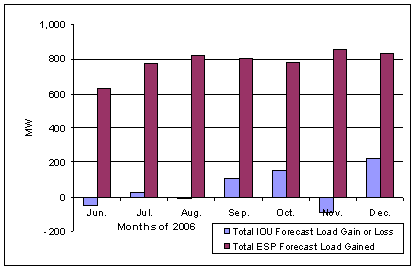
Figure 1 below depicts the magnitude of monthly load forecast adjustments as reported by the ESPs and IOUs. This is to demonstrate the diversity of load forecast adjustments. Four LSEs (one IOU and three ESPs) reported minimal adjustments of less than .05 MW in size, while five of the twelve ESPs reported 97 percent to 99 percent of the total ESP load forecast increases each month. Load forecast increases were not balanced by decreases, and ESPs were primarily responsible for the increases. As discussed above the load forecasts for some ESPs were reduced during the yearly forecast adjustments without corresponding increases in other LSE load. This unaccounted for load may be responsible for part of the upward adjustments in ESP monthly forecasts, but the magnitude of the adjustments exceeds that of the unaccounted for load, indicating that the yearly load forecasts underestimated ESP load while in general correctly estimating IOU load.
Figure 1 2006 Aggregate Load Forecast Adjustments Reported by LSEs, by Month Showing Load Gained or Lost
Source: Monthly load forecast adjustment filings submitted by LSEs to CEC.
4.2. 2006 System Resource Adequacy Requirements
For every month of 2006, CPUC-jurisdictional LSEs have satisfied their individual and collective system RAR. All LSEs satisfied RAR in aggregate for all peak months of 2006. The total MWs of RA resources7 procured exceeded the total System RAR by between 3 percent and 21 percent, depending on the month. Please note that the Total CEC Load Forecast is that applicable to the Monthly Filings, from Line 4 in Table 2.
During the forecasted peak month of August 2006, the CPUC's jurisdictional LSEs were collectively required to procure 46,891 MW of resources. Collectively, the LSEs procured 103 percent of the total System RAR, or 48,355 MW, which represents 1,464 MW in reserves beyond that required by the RA program. For the actual summer peak in July, CPUC jurisdictional LSEs were required to procure 43,168 MW of resources and demonstrated procurement of 48,111 MW. Procurement totaled 116 percent of the monthly RA obligation, and providing 4,943 MW of reserves beyond the RA program.
Table 3 2006 RA Filing Summary for CPUC Jurisdictional Entities (MWs)
Line |
Description |
Jun-06 |
Jul-06 |
Aug-06 |
Sep-06 |
1 |
CPUC jurisdictional load forecasts, after 2006 Monthly Load Forecast Adjustments |
35,589 |
39,546 |
42,802 |
38,063 |
2 |
Demand Response Reported in RA Filings (See Section 5.5) |
1,862 |
2,009 |
2,027 |
2,013 |
3 |
RAR applied to CPUC-Jurisdictional LSEs ([(RAR= Load Forecast - Demand Response) x 115%] |
38,786 |
43,168 |
46,891 |
41,458 |
4 |
Total RA Resources Procured |
46,918 |
48,111 |
48,355 |
46,760 |
5 |
Reserves procured above RAR |
8,132 |
4,943 |
1,464 |
5,303 |
6 |
Total RA Resources as percentage of RAR* |
121% |
111% |
103% |
113% |
7 |
Total RA Resources (Including DR) as a percentage of CPUC-Jurisdictional load forecast** |
136% |
126% |
118% |
128% |
Source: Aggregated LSE Monthly RA Filings. Note-DR is part of RAR calculation so it is not included in RA resources in Line 4.
* Line 6 = Line 4 divided by Line 3
** Line 7 = (Line 2 plus Line 4) divided by Line 1
4.3. Total RA Resources Available to CAISO in 2006
The CPUC's RA program was launched in 2006, and it provided the CAISO with access to significant quantities of capacity resources. CPUC-jurisdictional LSEs procured resources to meet load in all summer months, with total RA procurement ranging from 118 percent to 136 percent of CEC Load Forecast, or 3 to 21 percent above the RAR. The CAISO was able to call upon RA resources using the RA must-offer obligation (RA MOO). The availability of RA resources did not meet all CAISO needs and the CAISO procured resources using its Reliability Must Run (RMR) authority and the Federal Energy Regulatory Commission must-offer obligation (FERC MOO).
Across the CAISO, LSEs (both CPUC jurisdictional and non-CPUC jurisdictional) procured resources sufficient to meet the actual peak loads in all months. In July, capacity resources procured by all LSEs (CPUC jurisdictional and non-CPUC jurisdictional) totaled 53,355 MW of resources to meet 50,270 MW of peak load. Total procurement across the CAISO, with DR resources added in, gave the CAISO a six percent operating margin above the actual peak load during the heat storm. This margin was below the seven percent operating requirements of the CAISO on peak hours as established by WECC.
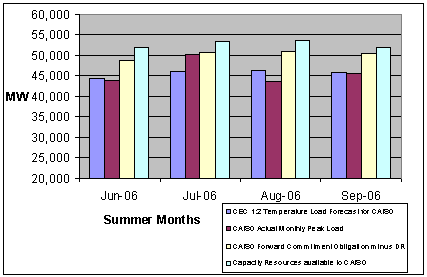
Figure 2 compares the total CEC forecast (1 in 2) for the CAISO, the CAISO actual peak load, and the total CAISO Summer Forward Commitment Obligation (including the obligation upon the CPUC jurisdictional entities) for the summer months of June through September, 2006. In all months, the procurement demonstrated through the CAISO's Forward Commitment Obligation exceeded the load forecast and the actual load.
Figure 2 Total CAISO Summer RA Obligation and Procurement vs. Actual Monthly Peak (MW)
Source: Aggregated data compiled from CAISO RCST Analysis
Table 4 demonstrates total procurement for all LSEs within CAISO as a percent of both the total procurement obligation across the CAISO and the peak load across the CAISO during the summer of 2006. The data represented in Table 4 is similar to the data used in Figure 2. Procurement across the CAISO ranged from 106% and 123% of peak demand, and between 103% and 106% of the total CAISO procurement obligation.
Not all resources can be called upon equally by the CAISO; there are sometimes operational and deliverability concerns regarding some resources that may cause system operating difficulties, even though procured resources may surpass actual load. Resources that may have operational concerns to the CAISO include intermittent resources, slow starting units, some types of Demand Response programs, liquidated damage contracts, and import contracts.
Table 4 Total CAISO Procurement as Percent of Total CAISO Obligation and Peak Demand
Line |
Summer 2006 Total Reliability Requirements Capacity Showing |
Jun. |
Jul. |
Aug. |
Sep. |
1 |
CPUC Jurisdictional LSEs |
46,918 |
48,111 |
48,355 |
46,760 |
2 |
Non-CPUC Jurisdictional LSEs |
4,863 |
5,244 |
5,211 |
5,093 |
3 |
Total CAISO RA Procurement |
51,781 |
53,355 |
53,566 |
51,853 |
4 |
Procurement as Percent of Total CAISO Procurement Obligation |
106% |
105% |
105% |
103% |
5 |
Procurement as Percent of Total CAISO Peak Demand |
118% |
106% |
123% |
114% |
Source: Aggregated RCST data
4.4. Summer 2006 Heat Storm
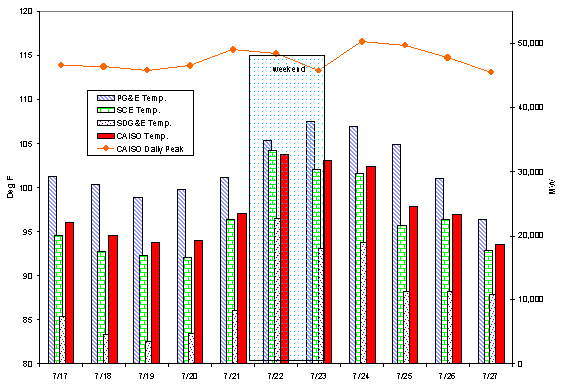
The mid-July statewide heat storm of 2006 resulted in record high peak demand throughout the state. The CAISO peaked on Monday, July 24, 2006 at 50,270 MW. High temperatures in both the northern and southern portions of the state characterize this period. The San Diego Gas and Electric (SDG&E) service area peaked on Saturday, July 22 when the temperature at Lindbergh Field reached 99 degrees. Temperatures in the SCE region also reached a peak on that Saturday, but with a large percentage of commercial and industrial customers closed on the weekend, it did not produce a system peak. Likewise, the temperature peak in the Pacific Gas and Electric (PG&E) service area occurred on Sunday, July 23. By Monday, July 24, 2006, temperatures had decreased slightly but not enough to avoid a record CAISO system peak. Figure 3 shows the temperatures and corresponding daily peaks during the heat storm.
Figure 3 CAISO July 2006 Loads and Temperatures
Source: CEC Data
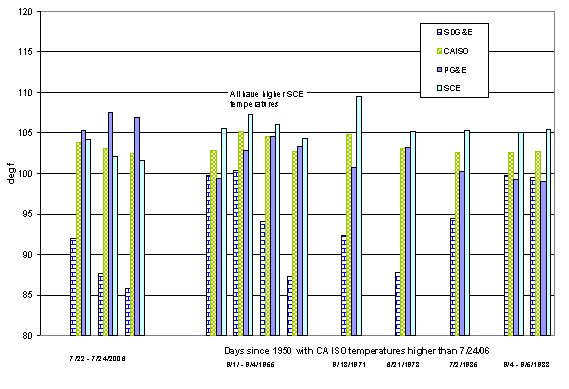
The CAISO system-wide temperatures of Monday, July 24, 2006, have only been exceeded in five of the last 56 years, shown in Figure 5. Temperatures on the hottest day (Saturday, July 22, 2006) have only been exceeded in two of the last 56 years. High temperatures in the SCE region drove CAISO system-wide temperatures in each of the other occurrences, whereas high temperatures in the PG&E region drove the 2006 heat event.
Figure 4 Historic Extreme Temperature Events by Service Area
Source: CEC Data
4.4.1. Evaluation of the CEC Peak Load Forecast for the CAISO
The CEC's current forecast of peak demand was adopted in June 2006. This forecast is higher than the 2005 Integrated Energy Policy Report (IEPR) forecast, adopted in September 20058, which served as the reference case for the 2006 resource adequacy year-ahead forecasts. The Energy Commission distributed the adjusted 2006 forecasts to LSEs in November 2005. The 2005 IEPR forecast was based on weather normalized 2004 utility peak information, the most current available at the time. In spring 2006, preparatory to the 2007 resource adequacy forecast adjustment process, staff acquired hourly load data from the investor-owned utilities (IOUs) and concluded that 2005 weather-normalized loads were significantly higher than forecast in all three IOU service areas. (Weather normalization is the process of estimating what loads would have been assuming average, or 1-in-2, weather conditions.) The Energy Commission published and adopted a revised forecast of 2007 peak demand for the IOUs in June 2006. This forecast (the "June 2006 Update") was, therefore, not used for the 2006 resource adequacy process, but is the basis for the 2007 resource adequacy forecasts under which LSEs are now operating.
While the CAISO and the individual utility peaks were record-breaking, Energy Commission staff assessed CAISO daily peaks as consistent with the expected load given the magnitude of the temperature. The Energy Commission forecasts demand by utility planning area, but because utility daily peaks are not available to staff on a daily basis, staff developed a proxy method using CAISO daily peaks to evaluate load trends as the summer progressed.
To track weather-adjusted loads through the summer, Energy Commission staff estimated the relationship between 2005 CAISO loads and temperatures using two weather variables. The first is the weighted average of maximum temperatures on three days. The weighting consists of 60 percent of the current day's maximum temperature, 30 percent of the previous day's maximum and ten percent of the second previous day's maximum. The lag is used to account for heat build-up over a three-day period. The second variable is a weighted average of daily maximum temperatures from nine weather stations in the CA ISO, weighted by the distribution of air conditioners in each climate zone. Staff applied the same methodology in the June 2006 Update to develop IOU-level forecasts. That methodology and the adopted forecast are described in detail in the Energy Commission publication, Staff Forecast Of 2007 Peak Demand.9
Figure 5 presents a comparison of actual 2006 summer daily peaks for the CAISO region and daily peaks predicted using the estimated 2005 CAISO temperature-load relationship and increased by the 2005 IEPR 2005-06 forecast growth rate of 1.55 percent. Figure 6 provides a scatter plot of the same information. While the methodology appears to over predict peak at lower temperatures, overall, the methods used to develop the June 2006 Update appear to predict the CAISO peak reasonably well, given the aggregate nature of the data used. This would suggest the Energy Commission's year-ahead forecast for 2006 is reasonably consistent with observed loads. The mean absolute percentage error of the predicted versus actual peak is 2.3 percent.
Figure 5 CAISO 2006 Predicted versus Actual Peaks
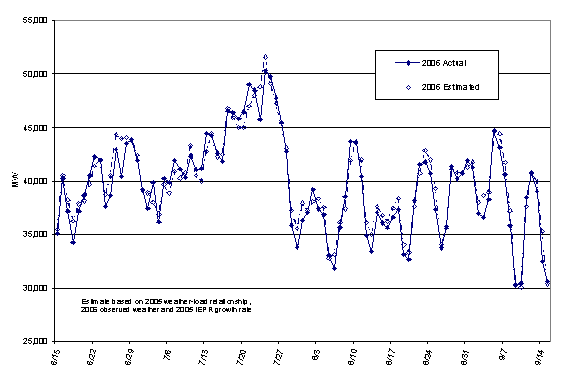
Source: CEC data. Actual Daily Summer Afternoon Peaks versus peaks estimated using 2005 relationship and 1.55% forecast growth
Figure 6 CAISO 2006 Predicted versus Actual Peaks Scatter Plot
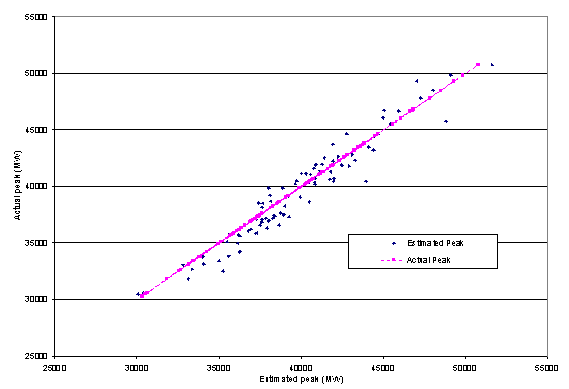
Source: CEC Data
The weather-normalized 2006 annual peak that Energy Commission staff estimated from the 2006 CAISO daily peaks also supports the Energy Commission's current forecast. Figure 7 shows estimated CAISO peaks using the 2006 temperature-load equation applied to each historic year's (1950-2006) actual temperature patterns. The predicted annual peak values are rank ordered from highest to lowest. The median value is the 1-in-2 (weather normalized peak) and the fifth highest is the 1-in-10 value. This method differs slightly from the method used to develop the Energy Commission forecasts, which builds the CAISO forecast from the utility-level forecasts, but the weather-adjusted peak from this method (47,301 MW) is less than one percent different from the forecasted peak derived from the June 2006 Update (47,603 MW). The 2006 1-in-2 CAISO peak projected in the 2005 IEPR was 46,107 MW, 1.3 percent less than the current Energy Commission forecast.
Figure 7 also shows the current 1-in-2 forecast plus a 15 percent planning reserve margin. The 15 percent planning reserve margin is higher than predicted loads from any temperature seen in last 56 years for the CAISO region, and 6.5 percent higher than a 1-in-10 event.
Figure 7 Weather-Normalized CAISO Loads and CEC Forecasts
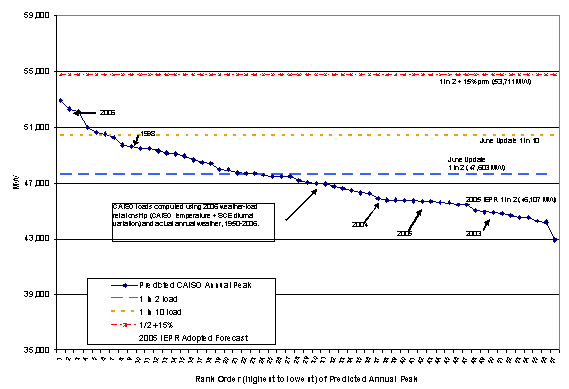
Source: CEC data
4.4.2. CEC Forecasts by Service Area
To further evaluate the reasonableness of the June 2006 forecast in light of the load experienced during the July 2006 heat storm, Energy Commission staff acquired 2007 hourly load data from each of the IOUs. Initial results for SCE and PG&E are discussed below; Energy Commission staff is still analyzing SDG&E loads and temperatures.
4.4.3. Southern California Edison Planning Area
Staff estimated the 2006 temperature response using 2006 hourly loads for the SCE transmission system area, the three-day-weighted daily maximum temperature, and a weighted daily temperature spread (daily maximum minus daily minimum). Figure 8 shows the distribution of predicted peaks using the peak temperatures that occurred in each of the last 56 years. The estimated load-temperature response for 2006 indicates lower load response at higher temperatures, but the estimated coefficients are not statistically different from those used to develop the June 2006 Update. The June 2006 Update forecast for 2006, using SCE's 2005 actual loads, was 22,791 MW. Applying the coefficients estimated from 2006 loads and temperatures produces an estimate of 1-in-2 loads of 22,447 MW. This is 1.5 percent lower than the June Update forecast, but again the difference is not significant.
Figure 8 SCE Predicted Loads Assuming Historic Temperatures
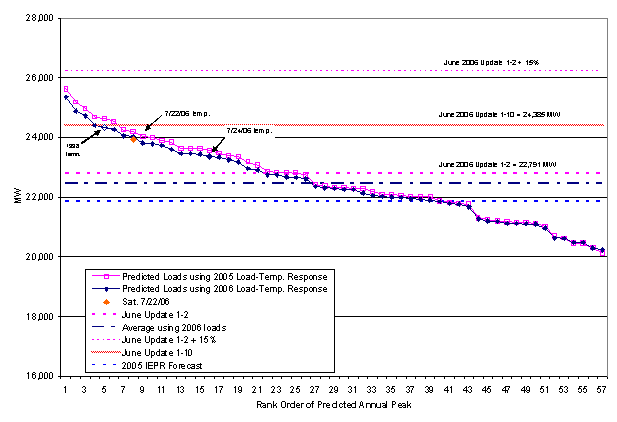
Source: CEC Data
The 2006 duration curve shows a predicted 2006 peak of 23,352, about a 1-in-5 event. This is based on the Monday temperatures. If the temperatures of July 22, 2006 had occurred on weekday, the predicted peak would be 24,000 MW, slightly less than a 1-in-10 event.
4.4.4. Pacific Gas and Electric Planning Area
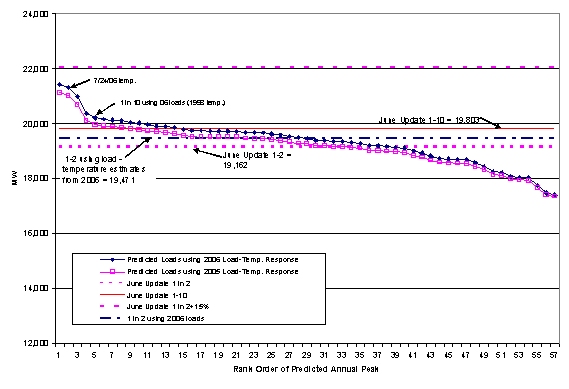
Staff estimated the 2006 temperature response using PG&E service area hourly loads and the three-day-weighted daily maximum temperatures. Figure 9 shows the distribution of predicted peaks using the annual peak temperatures that occurred in each of the last 56 years. The estimated load-temperature response for 2006 indicates slightly higher temperature response than forecast. The forecast for 2006 using PG&E's 2005 actual loads was 19,162 MW. Applying the coefficients estimated from 2006 loads and temperatures produces an estimate of 1-in-2 loads of 19,471 MW. This is 1.6 percent higher than the June Update forecast. This indicates an increase in the starting point for the next Energy Commissions forecast for the PG&E service area. Energy Commission staff are preparing revised forecasts for each utility planning area in the state as part of the 2007 IEPR proceeding. The Energy Commission will publish a staff draft forecast in May 2007.
Figure 9 PG&E Area Predicted Loads Assuming Historic Temperatures
Source: CEC Data
5. Counting Resource Adequacy Resources
During the development of the RA program, the Commission established counting conventions for the different resource types. To the extent that the counting conventions `over-count' resources, they detract from the PRM, and to the extent that resources `under-count', they add additional insurance to the PRM. This section introduces QC and RA resources, and explains the process on the development of the CAISO's master NQC list, the CAISO's revisions to the master NQC list for 2007, and issues that have arisen from the development of QC.
CPUC Staff analyzed the performance of wind and solar resources during the five peak days in the summer of 2006 (July 21st - 26th). Through our analysis of the performance of these resource types, CPUC Staff found that the counting conventions for measuring the generation of solar units during times of system need is more reliable than those for the generation of wind units. Wind units performed at 12 to 76 percent below NQC, and solar units, when discounting one of the five peak days, performed 12 percent below to 8 percent above NQC over the same period.
Demand response performance during the summer in July 2006 was also analyzed. Over the summer month of July 2006, the seven reliability "Day-Of" DR programs when called achieved a load drop of approximately 874 MW. This represented 80 percent of its DR allocation in the RA program. Within the same month of July 2006, the 13 price responsive "Day-Ahead" programs when called achieved a load drop of approximately 343 MW. This represented 79 percent of its DR allocation.
5.1. Introduction to Qualifying Capacity
QC is the amount of a resource's capacity that can be counted for resource adequacy compliance filings. QC counting conventions vary by resource type, as described throughout this section, but it is intended to reflect the expected capacity value that will be available to the CAISO during periods of system peak demand.
In 2006, LSEs were required to demonstrate they had contracts for, ownership control of, or allocations of QC in order to satisfy the forward commitment obligations required by the RA program. If an LSE had the rights to a resource's QC, then it could use the QC in its RA compliance filings. If a resource is used as part of the RA filing, it is subject to specific offer obligations under both the RA program and the CAISO's tariff. A combination of the CAISO's tariff provisions and the CPUC's RA product definition, including the must-offer obligation, is the backbone of the RA program.10
Specific formulas and methods for deriving QC values were adopted in D. 04-10-035 and further refined in D. 05-10-042.11 Prior to the first RA compliance filings in February 2006, the CAISO published a QC list for use by LSEs in their RA filings. Specific formulas and methods for deriving QC values, generally referred to as counting conventions, vary by types of resource (e.g. wind, solar, hydro, etc) Some types of resource counting conventions heavily discount the productive capacity of units in order to reflect operational uncertainty. For example, as an intermittent resource, a wind resource's QC is lower than a dispatchable natural gas unit with a similar nameplate rating. The counting conventions are discussed further below.
The commonly used industry performance measurement, Net Dependable Capacity (NDC), represents a unit's ability to produce electric power for specified periods of time. NDC is not used in the RA program because of concerns about generation at peak, especially involving intermittent units. NDC is the maximum capacity a unit can sustain over a specified period of time, modified for seasonal limitations, and less the unit capacity utilized for the unit station service or auxiliaries.
Issues have arisen with respect to QC counting conventions. They include the following:
· Units under partial contract with IOUs. In some cases, data gathered to determine a generating unit's QC only reflect a partial QC value for that unit. For example, a generating unit that with 100 MW of capacity may be under contract with an IOU for 50 MW of capacity. If data was only collected from the IOU and not the actual generator, the QC may have been calculated as a 50 MW capacity unit. Thus, the unit's full capacity value was not properly reflected in its QC value.
· QC values are to be static for each year. However, on occasion, modifications are needed to account for errors and other considerations that warrant an increase in QC. The process to evaluate requests to increase QC needs more clarity. This includes agencies that will receive data, review and verify data, and make decisions to change QC values consistent with CPUC decisions. The 2007 NQC list involved a collaborative effort that involved CPUC, CEC, and the CAISO. Going forward, we need to establish a process for evaluating and updating QC values.
· Aggregated qualifying facilities (QFs) - In some cases QFs on the CAISO NQC list are the aggregate of more than one unit. This leads to uncertainty because it can be difficult to verify which unit is under contract.
· Seasonal variation in resource production. Some resources deliver electricity mostly in the off peak months. For example, the QC counting conventions for a run of the river hydro resource is determined by the SO1 summer peak period, but this number may not accurately reflect QC during the rest of the year.
· Incomplete data. Some counting conventions require multiple years of data in order to establish a QC value. New units do not have sufficient historical data for the calculations and proxy data must be used. The rules for developing proxy data need to be more clearly defined.
5.2. Establishment of CAISO'S NQC Values List in 2006
The CPUC establishes the criteria for determining the types of resources that are eligible to provide QC and for calculating QC from eligible resource types. The CAISO publishes resource NQC values on its website.
Using the CPUC's QC rules as a starting point, the CAISO establishes NQC. NQC is the QC value reduced, as applicable, by: (1) testing and verification or (2) deliverability restrictions as determined by the CAISO.12
In December 2005, the CAISO requested that all generation owners within the CAISO control area and other generation owners with supply arrangements with LSEs within the CAISO control area provide the CAISO with QC data. The CAISO reviewed the QC submittals, compiled a list of NQC values, and posted the NQC values on the CAISO's website for public access. The CAISO refers to this list as the "Master NQC list.13 The CAISO has stated it will continue to publish an annual NQC list on or about July 1st each year for the following RA compliance year.
All units are subject to derates based on historical performance. Performance means whether or not the unit was available and performed if called upon under the RA must-offer obligation. CAISO has not yet developed procedures for derating QC values based on performance, so 2006 and 2007 QC values were not adjusted for performance.
5.2.1. Revisions to CAISO'S Master NQC List for 2007
On July 14, 2006, the CAISO updated the NQC list to be used for the compliance year 2007. 14 The update of the NQC list was completed for the following adjustments:
· Updated values for resources whose counting conventions include historical data (e.g. wind and solar without backup resources).
· Updated values for resources with erroneous or missing NQC that may have been listed in error in the current 2006 NQC posting. This update included modifications to the QC by the CAISO pursuant to its testing and verification authority under section 40.5.2 of its Tariff.
The Commission decided that LSEs need some certainty in resources QC value. Therefore, QC values published on the QC list, updated on an annual basis on or about July 1st, are not to be lowered for the next RA compliance year. For example the values contained in the NQC list published in July 2006 count for RA purposes in all 2007 RA compliance filings even if the unit becomes inoperable. At the same time, the Commission allowed units under construction (i.e. not on the QC list) to be counted in system RA filings, but not in monthly filings. Therefore, the RA program must develop a method of allowing for new units to be added to the QC list and counted during the RA year. The CAISO, for its part, has continued to update, modify, and reissue the NQC list as new information has become available.
5.3. QC for Thermal Generation Units
The counting conventions for thermal generation units are perhaps the most straightforward application of QC. The QC is defined as the maximum dependable capacity available from the unit. The QC identified for most thermal units on the QC list is simply the PMax, or the amount of MWs available when the unit is at its "maximum performance".
The capacity of thermal units is in part dependent on the ambient temperature at the generator site when the unit is in operation. Combustion turbine output is especially sensitive to the ambient temperature and these units have less capacity as the ambient temperature increases during peak summer periods.
5.4. QC for Wind and Solar Resources
Due to the uncertainties involved in forecasting the capacity value for intermittent resources, QC for wind and solar resources is based on historical production.
· For wind and solar in 2007, the QC values are based on their monthly historic performance during the Standard Offer 1 peak hours on noon to 6:00pm using a three-year rolling average,.
· For wind and solar in 2006, the QC values was based on QC data provided by generation owners within the CAISO control area and other generation owners with supply arrangements with LSEs serving load within the CAISO control area. In addition for 2006 only, three percent was added to the historical average for newer wind technologies.
However, a method for treatment of newer wind and solar facilities that lack three years of historical data has not been adopted. Going forward, the CPUC's RA program will need to adopt a uniform and consistent methodology of calculating QC for newer facilities that do not have enough historical data. As more wind and solar facilities come on-line, this will be an emerging need.
5.4.1. Comparison of Performance for Wind Generation Units during Five Peak Days vs. QC in July 2006 and 2007
In order to evaluate whether the QC methodology for wind units is understating or overstating the actual QC available during the peak period, CPUC Staff and CAISO worked together to analyze performance data from the wind and solar units during the five peak days of summer 2006, all of which occurred at the end of July. It is generally acknowledged that looking at only the five peak days is a very rough evaluation tool, but it is intended to be used to quickly identify whether there is major cause for concern. In our analysis, wind units provided significantly less actual generation at peak than the NQC value established by the counting conventions.
Table 5 depicts wind generation from 18 of the 20 largest wind units. Performance is measured by peak wind generation expressed as a percentage of its NQC in July 2006 and 2007. The analysis uses the one-hour average of generation of MW of wind units at peak during 3-4 pm over the peak days in July 2006. Two units were excluded because they were off-line and the NQC was adjusted to reflect that.
The NQC for the top 18 wind generating units was 608 MW for July 2006, while the actual generation of the units ranged from 145 MW to 533 MW. The performance relative to NQC was 32 percent on July 21, 24 percent on July 22, 55 percent on July 24, 33 percent on July 25, and 88 percent on July 26. July 26 was a particularly windy day that produced more wind generation than other days in July. NQC exceeded generation by 75 to 406 MW during the test period. While wind performance was 24-88 percent of NQC, Table 5 shows that NQC has been a more accurate performance metric than NDC.
Table 5 Comparison of Performance of Wind Units on Five Peak Days vs. QC (3-4PM) for 18 of 20 Largest Wind Units
Peak Day |
Total NDC MW Rating July 2006 in MW |
NQC July 2006 in MW |
NQC July 2007 in MW |
Peak Generation in MW |
Peak Generation - NQC in MW |
Performance as a percent of July 2006 NQC |
Performance as percent of July 2006 NDC Rating |
7/21/06 |
2,298 |
608 |
590 |
197 |
-411 |
32% |
9% |
7/22/06 |
2,298 |
608 |
590 |
145 |
-463 |
24% |
6 % |
7/24/06 |
2,298 |
608 |
590 |
336 |
-272 |
55% |
15 % |
7/25/06 |
2,298 |
608 |
590 |
202 |
-406 |
33% |
9 % |
7/26/06 |
2,298 |
608 |
590 |
533 |
-75 |
88% |
23 % |
Source: Source: Data provided by the CAISO. NDC is taken from CAISO Master List, and NQC is taken from CAISO NQC List.
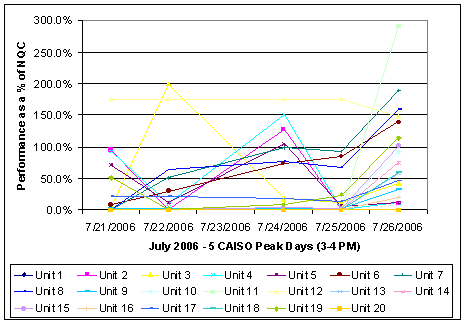
Figure 10 below depicts trend lines for the same wind units used in the analysis in Table 5 across the same five peak days in July. The trend lines shows performance results that demonstrate some uncertainty in the reliability of wind generation units during times of system need. Figure 10 includes all 20 wind units including two units that were off line.
Figure 10 Performance as a percentage of NQC for 20 Largest Wind Units during Peak (3-4 pm) on CAISO's Five Peak Days of 2006
Source: CAISO data.
5.4.2. Comparison of Performance for Solar Generation Units during 5 Peak Days vs. QC in July 2006
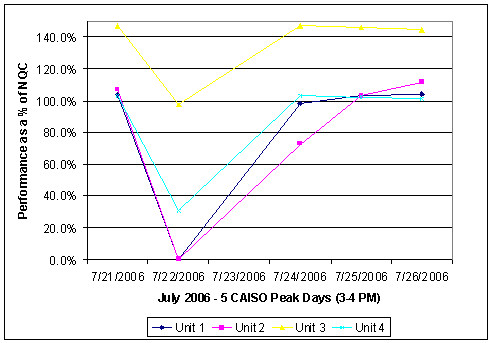
Table 6 depicts the performance of the four solar units currently on the NQC list. Performance is expressed by actual generation of all solar units as a percentage of their July 2006 NQC. We have also used the same peak days in July and provided data on the one-hour average of generation of MW of solar units during 3-4 pm. The NQC of Solar units was reasonably accurate on four out of the five peak days in July, but included one unit that consistently performed at a level higher than its NQC. Solar units performance compared to NQC was 106 percent on July 21, four percent on July 22, 88 percent on July 24, 104 percent on July 25, and 108 percent on July 26. On July 22nd, two units appeared to be off-line and one unit did not perform well. Actual generation compared to the solar units 2006 NQC ranged from -339 MW to +28 MW.
The NDC for the solar units is 466 MW compared with 352 MW of NQC. NQC for solar units is measured by actual historical performance during summer system peak. Generally, for solar units NQC is more accurate than NDC.
Table 6 Comparison of Performance of all Solar Units on Five Peak Days vs. QC (3-4 PM)
Peak Day |
Total NDC MW Rating, July 2006 |
NQC |
Generation of Solar Units |
Peak Generation - NQC |
Performance |
7/21/06 |
466 |
352 |
373 |
+21 |
106% |
7/22/06 |
466 |
352 |
13 |
-339 |
4% |
7/24/06 |
466 |
352 |
310 |
-42 |
88% |
7/25/06 |
466 |
352 |
366 |
+14 |
104% |
7/26/06 |
466 |
352 |
380 |
+28 |
108% |
Source: Data provided by the CAISO. NDC is taken from CAISO Master List, and NQC is taken from CAISO NQC List
Figure 11 depicts trend lines for the same solar units used in analysis in Table 6 across the same five peak days in July. The trend line demonstrates that when solar units are on-line, the units perform close to their NQC values.
Figure 11 Performance as a percentage of NQC for Solar Units during Peak (3-4 pm) on CAISO's Five Peak Days of 2006
Source: Data provided by the CAISO. 1 Hour Average of generation in MW of all solar units at peak for 3-4 pm
5.5. Demand Response Resources
Approximately 2,000 MW of Demand Response (DR) programs were allocated to LSEs for RA purposes in 2006 and 2007 and almost all of the allocations were used in the 2006 monthly RA filings. Of the 2,039 MW of DR allocated for RA in July 2006, 1,089 MW was derived from reliability programs and 950 MW was derived from price responsive programs. This was approximately 53 percent reliable and 47 percent price responsive out of the aggregate DR allocation for July 2006. In addition, the total enrolled DR in July 2006 for RA was approximately 2,322 MW. Of the 2,322 MW enrolled DR, 778 MW derived from day-ahead and price responsive programs and 1,544 MW derived from day-of and interruptible programs. Day-ahead represented 34 percent and day-of represented 66 percent of the total enrolled DR for RA in July 2006. Not all programs were called to drop load in our analysis that follows.
In a selective sample of DR program performance during the month of July 2006, approximately 104 events occurred requesting load drop from seven reliability DR programs and thirteen day-ahead DR programs. Generally, reliability and day-ahead DR programs performed at approximately 80 percent of its DR allocated in RA. DR allocations are up approximately 12 percent from 2006 to 2007, representing expansions to the DR programs. DR allocation in July 2006 was 2,039 MW and in the DR allocation in July 2007 is 2,286 MW.
5.5.1. DR Counting and Allocations
DR programs reduce load and therefore reduce the need for generation resources. There are two basic types of DR programs: reliability programs that are activated during periods of system stress, and price responsive programs where energy users are paid to reduce consumption when prices are high. Typically reliability DR programs are called when an emergency is called by the CAISO, and price responsive programs are called a day ahead. Reliability programs are designed to aid system reliability in times of system stress and are used to prevent blackouts. Therefore, reliability program participants tend to be very responsive to calls to reduce load. Reliability programs also include penalties for non-performance. Price responsive programs enroll many customers, but only a small subset will choose to drop load at any one time.
The CEC developed counting conventions based on historical performance of the DR programs15. DR allocations were based on a program specific forecast of expected load drop, not enrolled customers. Emergency program generally were forecasted to perform at or near enrollment, while economic programs were forecasted at significantly less than enrollment. In addition, SDG&E has a 25 MW clean back-up generation program that, at times, has been considered DR. It was considered DR for the RA program and was included in the 2006 and 2007 DR allocations.16 The CEC analysis also included the restrictions established in D. 05-10-042, DR programs must be dispatchable, have a 48-hour minimum availability requirement, and programs operate only two-hours per day are limited to 0.89 percent of monthly peaks.
Since the current DR programs are paid for by all customers through the public purpose charge, the DR counting rights are allocated to all LSEs on a load share basis. In 2006, the load share used for the allocation was derived from the CEC annual yearly load forecast for 2006.
LSEs may develop additional DR programs that are administered and paid for solely by their own customers; ESPs may also develop and administer DR programs that are not connected to any IOU. In these cases, the RA credit for those programs will be used by only the administering LSE, and not allocated to all LSEs.
5.5.2. Aggregated DR Data Reported in Compliance Filings
Table 7 below shows the aggregated amount of DR allocation to all LSEs for 2006; this was approximately 2000 MW. It also shows the amount of DR allocations used and unused; in June for example, LSEs left 60 MW unused. This oversight may have been due to the confusion among LSEs about how to use the DR allocations in their Year-Ahead and Monthly RA filings.
Table 7 Demand Response Program Allocations vs. Used in 2006 (MW)
June |
July |
August |
Sept. | |
DR allocated for use in RA filings |
1,921 |
2,039 |
2,039 |
2,040 |
Reported in RA Filings |
1,862 |
2,009 |
2,027 |
2,013 |
Unused Allocation as Reported in RA Filings |
59 |
30 |
12 |
27 |
Source Data: CPUC RA Monthly Compliance Files June-September as Reported by LSEs
5.5.3. Comparison of DR Performance in July 2006 vs. DR Resource Allocations
CPUC Staff and CEC worked together to analyze DR performance data from 2006. The month of July was selected because July represented the most number of DR events triggered during the summer months of 2006, as well as the system peak.
The RA program allocates load reduction capacity for 27 DR programs. Of these 27 DR programs 20 were called during the month of July 2006. Some DR programs are rarely called on by the CAISO for different reasons. Some DR programs can only be called during a stage one or higher emergency, while others are considered so valuable that the CAISO wishes to conserve them. One AC Cycling program was triggered twice in July but was not analyzed because we were unable to determine the maximum load drop. We emphasize here that the 20 programs analyzed in Table 8 below are not a random sample and the results can not be applied to all DR programs.
Table 8 classifies the 20 examined DR programs into two categories: (13) Day-Ahead / Price Responsive DR programs and (7) Day-Of / Reliability DR Programs. The table provides a comparison between DR allocated in RA with actual load drop as well as enrolled DR with actual load drop.
There were approximately 104 events in July that triggered at least one of the 20 different DR programs statewide. Some programs were only called upon once and other programs were called upon as many as twelve times. Table 8 compares performance of these programs against total enrollment and DR allocation in RA on a program specific basis. The total enrollment from the 20 programs that were called in July 2006 in Line 1 (1821 MW) was split between the two categories of programs: price responsive programs and reliability programs.
The total DR allocation for the 20 programs in Line 2 (1,524 MW) was also split between the two categories. Since not all programs were called the same number of times, performance is measured as the average load drop achieved over the events when each program was called. Average actual load drop for the price responsive programs was summed in Line 5 then divided by the enrollment from those 13 programs (Line 3) to compute performance as a percentage of enrollment (Line 6) and performance as a percentage of DR allocation (Line 4) to compute performance as a percentage of DR allocation (Line 7). The same was done for the 7 reliability DR programs in Line 8 through Line 12.
Table 8 Comparison of DR Program Allocation with DR Load Drop in July 2006
Line |
Number of Events Called in July 2006 / Number of Programs Called in July 2006 |
104 Events / 20 Programs |
1 |
Enrolled Demand Response in MW of 20 DR Programs Called on in July |
1,821 MW |
2 |
Total Demand Response Allocation for the 20 programs that were called in July 2006 |
1,524 MW |
3 |
Enrolled DR of the 13 Day-Ahead / Price Responsive DR Programs |
778 MW |
4 |
DR allocation of the 13 Day-Ahead / Price Responsive DR Programs |
435 MW |
5 |
Actual Load Drop of the 13 Day-Ahead / Price Responsive DR Programs |
343 MW |
6 |
Load Drop as a percent of Enrolled of the 13 Day-Ahead / Price Responsive DR Programs |
44 % |
7 |
Load Drop as percent of DR allocation of the 13 Day-Ahead / Price Responsive DR Programs |
79 % |
8 |
Enrolled DR of the 7 Day-Of / Reliable DR Programs |
1,043 MW |
9 |
DR allocation of the 7 Day-Of / Reliable Programs |
1,089 MW |
10 |
Actual Load Drop of the 7 Day-of / Reliable DR Programs |
874 MW |
11 |
Load Drop as a percent of Enrolled of the 7 Day-Of / Reliable DR Programs |
84 % |
12 |
Actual Load Drop as percentage of DR allocation of the 7 Day-of / Reliable DR Programs |
80 % |
Source: CPUC Data as Reported by IOUs for July 2006
5.5.4. QC from Demand Response Resources in 2007
For 2007, the IOUs have continued to expand the Demand Response programs. Table 9 compares enrollment in certain programs with DR allocations from those programs, broken down into the 3 IOU territories and into economic programs versus reliability programs. The table depicts 2,660 MW of enrollment in DR programs as of November, 2006. The DR allocation for August 2007 is approximately 2,286 MW and represents a 12 percent increase from the July 2006 DR allocation.
Table 9 Enrolled MWs in DR Program in California by IOU and August DR Allocation
Day-Of Emergency Programs as of Nov. 2006 (MW) |
Day-Ahead Economic as of Nov. 2006 (MW) |
2007 Policy Goal for Day-Ahead Programs (MW) |
TOTAL Enrolled MW, both types of DR Programs, August 2006 |
2007 August DR Allocation for RA purposes (MW) | |
PG&E |
348 |
573 |
972 |
921 |
667 |
SCE |
1,172 |
378 |
1,156 |
1,550 |
1,392 |
SDG&E |
105 |
85 |
223 |
190 |
227 |
Total |
1,624 |
1,036 |
2,351 |
2,660 |
2,286 |
Source: CPUC data as reported by IOUs and CEC DR Allocation Data 2007
In D.06-06-064, the Commission determined DR should count for Local RA to the extent feasible. SDG&E requested that DR in its area count for Local RA since its service area is also a local area. Therefore, SDG&E's DR programs were apportioned to all LSEs in its service area and allowed to count for 2007 Local RA. PG&E and SCE service areas are more complex and it was not feasible to count their DR programs for Local RA in 2007.
5.6. QC from Liquidated Damages Contracts
Consistent with the objectives of having a physical capacity-based RAR program, the RA eligibility of LD contracts is subject to sunset provisions and other limitations. In 2006, the RA program allowed two types of LD contracts to count towards meeting RA obligations; Department of Water Resources (DWR) LD contracts and existing non-DWR LD contracts
According to CPUC policy decisions, all DWR contracts are eligible to be counted toward fulfillment of RAR obligations until the expiration of those contracts, which is generally 2012. These contracts represent 6,000 MW of capacity statewide.
The RA program allows non-DWR LD contracts to count towards RA, phasing out incrementally by the end of 2008, as shown in the timeline in Table 10.
Table 10 LD Phase-Out Schedule Adopted in D.05-10-042, Section 7.4
Compliance Year |
Maximum LD Contract Limit (Expressed as a percentage of the LSE's RA Portfolio) |
2006 |
75% |
2007 |
50% |
2008 |
25% |
Source: CPUC Commission Decision D.05-10-042
LSEs could use LD contracts in its RA filings in 2006 to meet a maximum of 75 percent of their total RAR. As an aggregate non-DWR LD contracts totaled 12 percent to 13 percent of total resources procured between June and September 2006.
5.6.1. RA LD Summary for 2006-2012
The CPUC RA program rules do not allow new (executed after October 27, 2005) LD contracts to count towards an LSE's fulfillment of its RAR. Figure 12 shows the total amount of liquidated damages contracts (both DWR and non-DWR) that were reported by LSEs in the LD Templates filed in February, 2006. Together DWR and non-DWR LD contracts provided over 12,500 MW of capacity in 2006. The non-DWR contracts gradually sunset; they will not count for RA in 2009 and beyond. The DWR contracts continue beyond 2008, but they will gradually diminish as individual contracts expire in subsequent years. Eligible LD contracts decrease from 12,893 MW to 3,850 MW in 2009 representing a decrease of 70 percent.
The LSEs' LD contracts reported on their LD templates are not all listed in the Monthly RA Filings. Some contracts are in excess of the LD Phase-out Percentage and others are for non-peak hours. The DWR LD Contracts are combined with Unit Specific DWR contracts on the DWR page of the Monthly template; both types of LD contracts listed in the year ahead filings generally are also listed in the monthly filings. In August, 2006, for example, 12,582 MW of LD capacity is listed, split evenly between Non-DWR and DWR LD. In all, LD contracts represent around 25% of all resources listed in the monthly filings. A further breakdown of LD contracts into DWR and Non-DWR and a comparison to other resources is included in Table 18.
Figure 12 Liquidated Damages Contract Summary for 2006-2012
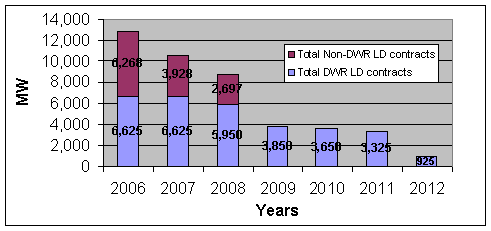
Source: LSE 2006 Year Ahead RA filings from February, 2006
5.7. Reliability Must Run Allocations for 2006
RMR resources are generation resources that the CAISO needs most to ensure local reliability. In 2006, there was no Local RAR, and the CAISO had over 10,000 MW of generation under RMR contracts.
There are two types of RMR Contracts: Condition 1 and Condition 2. Condition 1 contracts are allowed to operate in the market if not dispatched by the CAISO, and Condition 2 units are not allowed to operate in the market but are under the full control of the CAISO. Both types of RMR contracts are paid for on a system wide basis by all customers in the transmission area, but Condition 2 units receive a larger percentage of their costs from their RMR contracts.
Under the CPUC's RA program, Condition 1 units are allowed to sell their System RA credit to a third party, typically through a "wrap around" contract. Condition 2 units are not allowed to sell their System RA credit; instead the total amount of Condition 2 MWs is allocated to all LSEs that pay for a portion of those costs.
As shown in Table 11, LSEs collectively used most, but not all, of their full allocation of RMR credits. No LSE used more than its appropriate RMR allocation in its RA filings.
Table 11 LSE use of RMR Allocations in 2006 RA Filings (MW)
June |
July |
August |
Sept. |
October | |
2006 RMR Allocations |
1,226 |
1,231 |
1,231 |
1,231 |
1,231 |
2006 RMR Allocations |
10 |
5 |
5 |
5 |
5 |
Source: LSE Monthly RA filings to the CPUC.
5.8. Import Allocations for 2006
The CAISO allocated available import capacity to CPUC jurisdictional and non-CPUC jurisdiction LSEs to ensure the State was not relying on more imports than could be accommodated by the current transmission system. Throughout the summer of 2006, the CAISO allocated 8,410 MW out of 14,941 MW of import capacity to CPUC jurisdictional LSEs, while 5,502 MW was allocated to existing transmission contracts (ETCs). In their monthly RA filings, all LSEs in CAISO reported between 5,325 and 5,636 MW of import capacity. Table 12 shows the aggregated amount of import allocation provided to LSEs. It also shows the amount of import allocations used and the difference between the allocations and the amount used. During some months, actual imports arriving into the CAISO exceeded total import allocations significantly.
Table 12 Import Allocations vs. Used in 2006 (MW)
|
June |
July |
August |
Sept. |
Import Allocations provided to CPUC Jurisdictional LSEs for use in RA filings |
8,410 |
8,410 |
8,410 |
8,410 |
Import Allocations provided to non-CPUC jurisdictional LSEs |
1,029 |
1,029 |
1,029 |
1,029 |
Import Allocations provided for ETCs |
5,502 |
5,502 |
5,502 |
5,502 |
Total Import Capability |
14,941 |
14,941 |
14,941 |
14,941 |
Imports shown by CPUC jurisdictional LSEs |
-- |
-- |
-- |
-- |
Unit-Specific |
2,431 |
2,493 |
2,495 |
2,408 |
Non-Unit Specific |
392 |
416 |
416 |
503 |
DWR contracts |
1627 |
1627 |
1627 |
1627 |
Imports shown by non-CPUC jurisdictional LSEs |
-- |
-- |
-- |
-- |
Unit-Specific |
695 |
463 |
695 |
696 |
Non-Unit Specific |
394 |
326 |
403 |
347 |
Total Imports shown |
5,539 |
5,325 |
5,636 |
5,581 |
CPUC-Jurisdictional Allocations not used in RA Filings: |
3,960 |
3,874 |
3,872 |
3,872 |
Source: Aggregate data from RCST reports and CPUC RA Filings in 2006
5.8.1. Comparison of Import Allocations with Imports during Peak Periods
In order to evaluate whether the import allocation is understating or overstating the actual amount of resources available to the CAISO and CPUC Staff worked together to analyze some import performance data from 2006. The month of July was selected for presentation because July represented the peak load in 2006.
As shown in Table 13, the allocated imports in MW was 14,941 MW including ETCs for all of 2006. During peak (3-4 pm) on the five peak days of 2006, there were from 12,153 to 14,461 MW delivered into the CAISO. Table 13 is not intended to match Figure 13, as Table 13 does not net out exports, and Figure 13 represents net movement into the CAISO.
Table 13 Comparison of Import Allocation with Average Imports during Peak in July 2006
Peak Days of 2006 |
Total Imports (MW) Delivered During Peak Hour (3-4 PM) |
7/21/06 |
13,075 |
7/22/06 |
13,710 |
7/24/06 |
14,698 |
7/25/06 |
14,462 |
7/26/06 |
12,153 |
Source: CAISO OASIS data.
Import resources played an important role in the operation of the CAISO in the summer of 2006. Figure 13 illustrates the levels of imports delivered to the CAISO control grid over the course of summer, 2006.
Figure 13 ISO 2006 Summer Peak Loads and Imports and Time of Peak
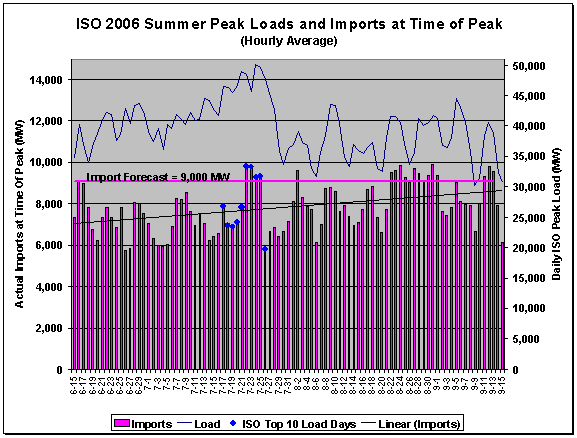
Source: CAISO data. Note that the totals represented here net out exports, and represent net flow into the CAISO
5.9. Maximum Cumulative Contribution (MCC) / Resource Buckets
The "MCC Counting Convention" is a "Top-down Approach" intended to encourage LSEs to procure capacity products that have maximum availability, but also accommodate products that have more limited availability of hours. Table 14 shows the definitions of the resource categories from the RA Filing Guide and the maximum cumulative contribution allowed from each resource category.
The MCC Counting Convention was necessary to accommodate energy contracts as part of RA. Accordingly, the MCC categories were built around standard energy contracts (e.g. 5x8, 6x16) rather than the availability of month long capacity. As RA becomes more established and LSEs procure capacity products, the MCC may need to be revised or eliminated for all but limited use resources.
Table 14 Summary of Resource Categories (Excerpt from the 2006 RA Filing Guide)
Category |
Resources may be categorized into one of the four categories shown below, according to their planned availability as expressed in hours* available to run or operate per month (hours/month): |
1 |
"Greater than or equal to" the ULR [Use Limited Resource] monthly hours as shown in the Phase 1 Workshop Report, Table "Number Hours ISO Load Greater than 90% of the Monthly Peak," p.24-25, last line of table, titled "RA Obligation," http://www.cpuc.ca.gov/word_pdf/REPORT/37456.pdf These ULR hours for May through September are, respectively: |
2 |
"Greater than or equal to" 160 hours per month. |
3 |
"Greater than or equal to" 384 hours per month. |
4 |
All Hours (planned availability is unrestricted) |
Source: D.05-10-042. The program is focused on availability during peak hours
LSE procurement was well below the maximum cumulative contribution allowed from each resource category. There were two LSEs that had resources excluded from the computations due to MCC restrictions ranging from 52 MW to over 300 MW depending on month. These excluded resources are not included in the totals in Table 15 below. The totals in Table 15 and Table 16 do not include the RMR Allocations, which were listed as a resource in the Monthly RA Filings but did not properly fit within the MCC buckets.
The goal of the MCC in the RA program is to alleviate over reliance on resources that cannot be counted on to serve outside of peak periods. The MCC method also created interim exceptions for limited availability contracts with specific resources or portfolios of resources and standard delivery attributes, limited availability call contracts with specific resources or portfolios of resources and non-standard dispatch attributes, and firm liquidated damages contracts for delivery within California. Table 16 and 17 illustrates the resource types provided by LSEs. Approximately 78 percent of reported resources were available in all hours (category #4). Conversely, the program allowed LSEs to supply 13.3 percent of RAR from use limited resources, but only one percent of RAR resources were use limited.
During our evaluation of the 2006 summer RA compliance filing, two LSEs had resources disqualified due to MCC restrictions. However, in no cases have the MCC restrictions affected RA compliance. In some cases, particularly in the case of LD contracts, LSEs have paired off peak and on peak contracts to create pairings that are then reported as unrestricted available resources. In the case of physical resources, however, there has been no tendency to pair up on peak and off peak unit specific resources.
Table 15 RA Capacity by Resource Category
Category 1 |
Category 2 |
Category 3 |
Category 4 |
All Categories | |
June |
318 |
2,200 |
7,665 |
35,601 |
45,784 |
July |
286 |
2,354 |
7,796 |
36,462 |
46,899 |
August |
296 |
2,429 |
7,809 |
36,596 |
47,129 |
September |
283 |
1,991 |
7,709 |
35,546 |
45,530 |
Source: CPUC Data of 2006 LSE Monthly RA Filings.
Table 16 RA Capacity in Percentage by Resource Category
Category 1 |
Category 2 |
Category 3 |
Category 4 | |
Maximum Cumulative |
13.3 |
18.6 |
30.1 |
100 |
June |
1 |
5 |
17 |
78 |
July |
1 |
5 |
17 |
78 |
August |
1 |
5 |
17 |
78 |
September |
1 |
4 |
17 |
78 |
Source: CPUC Data of 2006 LSE Monthly RA Filings.
5.10. Aggregate NQC Values 2006 and 2007
The aggregated NQC totals represented totals from the CAISO NQC list for 2006 and the CAISO NQC list for 2007. In compiling the totals, most facilities were given one static and year round QC value and some facilities such as wind and solar were given monthly QC values due to performance variations month over month. For those facilities that were given monthly QC values, for the purposes of having one aggregate total, we included its August QC value within the aggregated total.
· For compliance year 2006, the total aggregated NQC available was approximately 46,687 MW.
· For compliance year 2007, the total aggregated NQC is approximately 46,504 MW.
The NQC for 2007 is less than the NQC for 2006 by approximately 183 MW. The total NQC lowered between 2006 and 2007 due to the re-calculation of wind and solar resources and other NQC adjustments made by the CAISO on July 14, 2006 and updated on August 9, 2006. This change may be counteracted as some new resources come online but those resources are not yet reflected in the 2007 NQC list.
The NQC list as of August 9, 2006 is applicable for compliance year 2007. Going forward, the Commission has stated that the QC list is to be updated annually on or about July 1st each year for the next compliance year.
5.11. Units with Partial Commitments to more than one LSE
For CPUC-jurisdictional LSEs to meet RA obligations, they need to be able to purchase portions of RA Capacity that are of different sizes, corresponding to their loads and other resource commitments. To foster a liquid market, one element of success in the RA Program is a measure of how many units have sold capacity to more than one LSE, thus fostering tradable capacity products. The number of these partially committed units has remained fairly constant throughout 2006, but risen in January, 2007 as summarized in Table 17 below. In addition, as the number of partially committed units rise, communication between scheduling coordinators, LSEs, and CAISO will need to improve so that the NQC list is accurate.
Table 17 Number of Units with Partial RA Contracts to CPUC jurisdictional LSEs
Month |
Number of Partially Committed Units |
June, 2006 |
10 |
July, 2006 |
11 |
August, 2006 |
14 |
September, 2006 |
11 |
October, 2006 |
11 |
November, 2006 |
9 |
December, 2006 |
12 |
January, 2007 |
17 |
February, 2007 |
20 |
March 2007 |
21 |
April 2007 |
24 |
Source - CPUC Data of CPUC-jurisdictional LSE Monthly RA Filings
5.12. Summary of all RA Resources Available in 2006
The RA program requires LSEs to procure resources and make them available for reliability. Table 18 shows the mix of resources provide for June through September 2006. The overwhelming majority of resources were unit specific within the CAISO control area.
Table 18 Resources Available for 2006
Line |
Description |
June |
June % of Total Capacity |
July |
July % of Total Capacity |
August |
Aug. % of Total Capacity |
September |
Sept. % of Total Capacity |
1 |
Peak Demand (MW) [1:2 forecast by CEC] |
35,589 |
|
39,546 |
|
42,802 |
|
38,063 |
|
3 |
Demand Response listed in filing |
1,862 |
|
2,009 |
|
2,027 |
|
2,013 |
|
4 |
Demand Response available no more than 2 hours per day |
0 |
|
0 |
|
0 |
|
0 |
|
5 |
Forward Commitment Obligation for Month-Ahead Minus Demand Response (MW) |
38,786 |
|
43,167 |
|
46,891 |
|
41,458 |
|
6 |
Physical Resources in ISO Control Area |
29,754 |
63% |
29,491 |
61% |
29,736 |
61% |
28,202 |
60% |
7 |
Unit Contingent Resources from Outside the ISO Control Area |
2,431 |
5% |
2,493 |
5% |
2,495 |
5% |
2,408 |
5% |
8 |
Non-Unit Contingent Resources from Outside the ISO Control Area |
392 |
1% |
416 |
1% |
416 |
1% |
503 |
1% |
9 |
Non-DWR LD Contracts |
5,393 |
11% |
6,110 |
13% |
6,107 |
13% |
6,046 |
13% |
10 |
DWR LD Contracts |
6,625 |
14% |
6,475 |
13% |
6,475 |
13% |
6,475 |
14% |
11 |
DWR Unit specific contracts |
1,097 |
2% |
1,895 |
4% |
1,895 |
4% |
1,895 |
4% |
12 |
RMR Condition 2 Allocation |
1,226 |
3% |
1,231 |
3% |
1,231 |
3% |
1,231 |
3% |
13 |
Total RA Capacity |
46,918 |
|
48,111 |
|
48,355 |
|
46,760 |
|
14 |
RA Capacity Relative to 115% of RAR |
121% |
|
111% |
|
103% |
|
113% |
|
Source: Aggregated Monthly RA Filings
6. Use of RA resources by CAISO in 2006
The rules of the RA program work towards the goal of ensuring that capacity resources are available to the CAISO when they are needed. The CAISO may need to call upon resources because there is a local reliability need, there is large difference between the forecasted load and the actual load, or other grid reliability needs.
The RA program requires LSEs to supply RA resources that meet the RA product definition that includes a "must offer obligation" (MOO). With a few exceptions, the RA MOO applies to any RA resource that is included in LSE filings. Throughout the summer of 2006, the CAISO relied on the use of FERC MOO to meet needs during times of peak stress, illustrating the possibility that there were some reliability needs not met by the RA program and resources that LSEs brought to the CAISO. Outages played a part in the operation of the system, but notably there was a decrease in forced and scheduled outages during peak stress that amounted to between 23 percent and 28 percent overall during June and July. The magnitude relative to 2005 of these outages show that there was a decline in all months of scheduled outages from June through September, to provide the CAISO with sufficient resources to meet conditions created by the high summer heat.
This section examines the amount of non-RA resources used by the CAISO in 2006, and why the CAISO had to call upon non-RA resources to supplement the RA resources available to it. This section also looks at the historical outage rate and the offer of RA resources to the CAISO via Supply Plans.
6.1. Use of Must Offer Obligations (MOO)
Until the implementation of the RA program, the CAISO relied on a Must Offer Obligation (MOO) regulated by FERC in order to ensure that sufficient capacity was available to meet load during the course of the day. All resources under a Participating Generator Agreement must be willing to offer themselves to the CAISO when needed. The CAISO would grant waivers to generators when they were not needed, but during times of system stress the CAISO would deny a waiver of the FERC MOO. When a generator receives a denial of a MOO waiver request, that generator would then be available to the CAISO that day. The CAISO denies FERC MOO waiver requests from generators for a variety of reasons, but in general they are summarized system needs, zonal needs, or local needs. These denials are further broken down into transmission zones including NP26, SP26, and ZP26.
6.1.1. Use of MOO in Summer 2006
In 2006, with the implementation of the RA program, the FERC MOO process will gradually be replaced by the RA MOO process. Embedded in a generator's obligations when they enter into an RA contract with an LSE is an equivalent RA MOO that can be exercised when the CAISO sees a reliability need.
Figure 14,,illustrates CAISO's continued reliance on FERC MOO throughout the summer of 2006. Zonal needs for capacity in SP 26, as well as SCIT Procedure T-103 make up a large part of the need. System needs related to the M-432 operating procedure are also important. These three factors create the majority of the need for FERC MOO. The continued reliance on FERC MOO to such a degree and to meet these discreet needs signal the possibility that there may need to be refinements to the RA program in order to provide different resources, or different types of availability that more adequately fulfill the needs of the CAISO.
Figure 14 FERC MOO Waiver Denials, Summer 2006
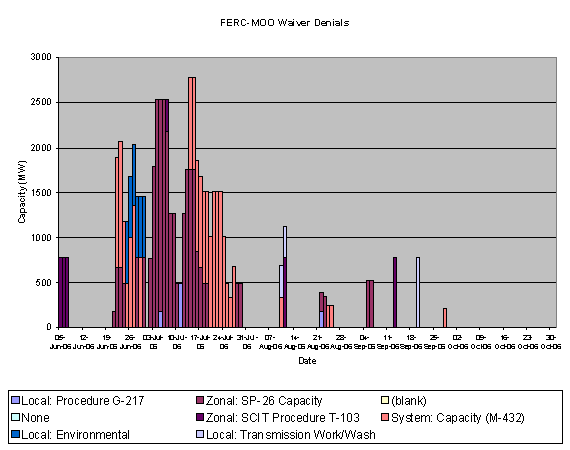
Source: CAISO FERC MOO Waiver Denial Report, December 18, 2006
6.2. Outage comparisons - Ambient, Forced, and Scheduled
Outages impacted the RA program during the course of 2006. Outages are classified as ambient, forced, or scheduled. Ambient outages represent a reduction in generating capacity due to performance in higher temperatures. As discussed in Section 5.3, performance of thermal units, particularly combustion turbines, is reduced in hot weather. Forced outages represent a reduction in generating capacity due to equipment failures. Scheduled outages represent a reduction in generating capacity due to related to planned maintenance and water management for hydro units. Table 19 illustrates the average capacity affected by the outages during the summer of 2005 and 2006, as well as a relative percentage increase or decrease. An analysis of outages in 2006 compared with historical data from 2005 demonstrates a significant decrease in both forced and scheduled outages in June and July, with an overall increase in ambient outages over 2005. Ambient outages may have increased in 2006 due to higher than forecasted weather effects. It is worth noting however that peak loads occurred in 2005 at nearly the same part of July as 2006, so the cycle of scheduled maintenance should have been comparable across the years.
Average curtailment due to scheduled outages decreased notably relative to the same months of 2005 through September, although forced outages began to increase in August and September relative to the average curtailment due to forced outages in the same months of 2005. Overall, average curtailment due to all three types of outages combined increased notably in May of 2006 relative to May of 2005, but the average curtailment due to outages decreased substantially or stayed fairly constant from June through September 2006, relative to the same months of 2005.
Table 19 Outages during summer months in MW
Ambient |
Forced |
Scheduled |
Average Total | |
May 2005 |
315 |
2,366 |
8173 |
10,854 |
May 2006 |
557 |
2,554 |
9,858 |
12,969 |
Percentage difference |
+77% |
+8% |
+21% |
+19% |
June 2005 |
313 |
2,313 |
4,554 |
7,180 |
June 2006 |
750 |
1,743 |
2,686 |
5,179 |
Percentage difference |
+140% |
-25% |
-41% |
-28% |
July 2005 |
394 |
3,911 |
1,848 |
6,153 |
July 2006 |
852 |
2,524 |
1,337 |
4,713 |
Percentage Difference |
+116% |
-35% |
-28% |
-23% |
August 2005 |
583 |
1,766 |
1,003 |
3,352 |
August 2006 |
774 |
2,212 |
588 |
3,574 |
Percentage Difference |
+33% |
+25% |
-41% |
+6.6% |
September 2005 |
740 |
1,913 |
2,611 |
5,264 |
September 2006 |
969 |
2,485 |
1,821 |
5,275 |
Percentage Difference |
+31% |
+30% |
-30% |
+0.21% |
Source: CAISO Data
7. Changes to the RA Program for 2007
The RA program in 2007 has additional elements that include the adoption of Local RAR and the adoption of reducing the use of RMR contracts. These additional elements are discussed in more detail below.
7.1. Adoption of Local RAR Program
Beginning in 2007, LSEs must demonstrate annually that they have acquired adequate generation capacity within defined, transmission-constrained areas. Taking another step towards full implementation of RAR, a new local procurement obligation was established and required for Commission jurisdictional LSEs. Additional key requirements and enforcement of local RAR made in D.06-06-064 applicable for compliance year 2007 are:
· LSEs shall demonstrate they have acquired 100 percent of their Commission determined year-ahead local procurement obligation for the calendar year of 2007.
· A waiver of penalties provision that relies in part on a threshold price of $40 per kilowatt-year. If an LSE demonstrates that a waiver is justified, it will pay for backstop procurement but will not be penalized.
· In the event that an LSE does not meet its local procurement obligation and the LSE has not been granted a waiver, it will be subject to a penalty of $40 per kW-year on the amount of its deficiency, in addition to backstop procurement costs.
7.2. Reduction in Use of RMR Contracts
The CPUC has stated a policy preference to minimize the use of RMR contracts and a policy preference that allows for the reliance on LSE-based procurement fostered through Local RAR, rather than the RMR process.17 RMR will remain a significant factor in 2007, and the Commission has recognized that the shift from predominant reliance on RMR to predominant reliance on LSE procurement will require a transition period.
Consistent with this objective, the CAISO completed its assessment of the RA capacity procured by the CPUC jurisdictional LSEs in terms of fulfilling its 2007 local area reliability services (LARS) criteria requirements. In the CAISO'S Board of Governors RMR Designations for 2007 meeting dated 10/18/2006, presented by Gary L. DeShazo, CAISO management has extended the contracts for 3,995 MW of RMR capacity for 2007. This represents a 5,876 MW reduction from 2006. The extension includes 2,753 MW because Local RA capacity was not procured and 1,242 MW for ancillary services not provided in Local RA contracts.18 Table 20 provides the CAISO's 2007 RMR designation summary.
PG&E |
SCE |
SDG&E |
Total | |
MW / Units |
MW / Units |
MW / Units |
MW / Units | |
2007 RMR Requirements Presented in September |
6,767 / 88 |
750 / 3 |
2,446 / 29 |
9,963 / 120 |
RMR Unit Capacity Displaced by Local RA Unit Capacity |
4,733 / 49 |
750 / 3 |
485 / 3 |
5,968 / 55 |
Required Capacity not Covered by Local RA |
792 / 16 |
-- / -- |
1,961 / 26 |
2,753 / 42 |
Local RA Capacity Requiring RMR Extension for "other" Reliability Services |
1,242 / 23 |
-- / -- |
-- / -- |
1,242 / 23 |
Final 2007 RMR Designations |
2,034 / 39 |
-- / -- |
1,961 / 26 |
3,995 / 65 |
Source: CAISO Board of Governors Presentation, 10/18/06
Figure 15 illustrates the LARS capacity trend between 1998 and 2007. This figure includes 2007 LARS required capacity approved by the CAISO Board in September 2006 and the final 2007 RMR unit designations after consideration of the capacity demonstrated in the Local RA showings. The CAISO management in conjunction with the Commission has made considerable progress in the reduction of RMR.
Figure 15 LARS Required Capacity Trend (1998-2007)
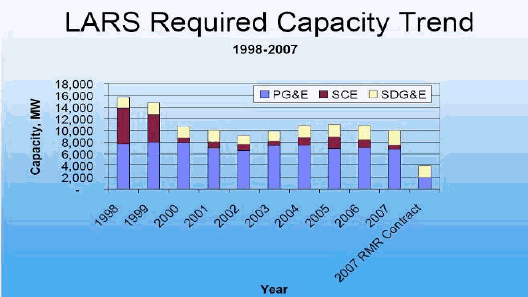
Source: CAISO, Gary DeShazo, Board of Governors Meeting presentation, 10/18/06.
Going forward into 2007, Commission recognized that the timing of LSEs procurement efforts to acquire needed resources must be closely coordinated with the expiration of RMR contracts. Decision 06-06-064 allowed Condition 2 RMR units to continue to count for Local as well as System RAR for 2007. The decision also allowed Condition 1 RMR units to count for Local but not System RAR for 2007.
CPUC Staff has already notified each LSE of the amount of RMR capacity that can be allocated to it as "RMR credit" in order to offset Local RAR for 2007. Commission will continue to accommodate the transition from an environment that relies mostly on CAISO procurement through the RMR process to one that relies on LSE procurement to meet local reliability needs.
1 As of February 1, 2007, no community choice aggregators (CCAs) have registered with the CPUC which is a first step to formation and operation of a CCA. All CCAs formed will be within the CPUC's jurisdiction regarding Resource Adequacy requirements and subject to the Resource Adequacy program described herein.
2 The staff report is part of the R.05-12-013 procedural record, and it is available for download here: http://www.cpuc.ca.gov/PUBLISHED/RULINGS/55065.htm. The 2006 RA Guides and Templates can be found as part of the Appendix.
3 The 2007 Year-Ahead RA Filing Guide and Template are available here: http://www.cpuc.ca.gov/static/hottopics/1energy/_060824_resourceadequacyletter.htm. The ED guidance on the 2007 Monthly RA process in November 2006 and it is available here: http://www.cpuc.ca.gov/static/hottopics/1energy/e48ed405-d85e-4593-a5da-7eaa59076acb.htm.
4 If the last day of the month is not a business day, then the filing date moves to the next business day.
5 Resolution E-4017 is available for download here: http://www.cpuc.ca.gov/WORD_PDF/FINAL_RESOLUTION/60545.PDF.
6 Commission Resolution E-4017, passed October 5th, 2006. Page 5
7 RA Resources include unit specific in-state physical generation, imports, LD contracts, Demand Response programs, and DWR contracts.
8 California Energy Demand 2006-2016 - Staff Energy Demand Forecast - Revised September 2005, Publication #CEC-400-2005-034-SF, http://www.energy.ca.gov/2005_energypolicy/documents/reports_pub_number.html .
9 June 2006, Publication # CEC-400-2006-008-SF, http://www.energy.ca.gov/2006publications/CEC-400-2006-008/CEC-400-2006-008-SF.PDF.
10 See section 6.1 of this report -Use of must offer obligation
11 The formulas and methods to derive QC values were developed from two resource adequacy workshops held in June of 2004 and June of 2005 as part of R.04-04-003.
12 CAISO FERC Electric Tariff, section 40.5.2-NQC, effective May 31, 2006.
13 For a list of the CAISO's NQC list for 2006, http://www.caiso.com/1796/179694f65b9f0ex.html.
14 Over the course of 2006, the CAISO has made numerous corrections to the NQC list. In D.06-07-031, the Commission clarified that for subsequent years, the QC list available as of July would be the QC list against which compliance was checked for the following compliance year.
15 See CEC Demand Response letter Attachment 2: 2006 Resource Adequacy Demand Response Impact Allocation Documentation
16 The SDG&E clean back-up generation program is not included in Commission DR program summaries, forecasts, and goals.
17 California Public Utilities Commission D.06-06-064, Section 3.3.7.1.
18 CAISO Board of Governors RMR Designations for 2007, Meeting dated 10/18/2006.
