Agenda ID # 2811
10/30/03
DRAFT
PUBLIC UTILITIES COMMISSION OF THE STATE OF CALIFORNIA
Telecommunications Division |
RESOLUTION T-16755 |
Carrier Branch |
October 30, 2003 |
R E S O L U T I O N
Resolution T-16755. Pinnacles Telephone Company (U-1013-C). General Rate Case filing in compliance with G.O. 96-A, Paragraph VI, and Decision Numbers 01-02-018 and 01-05-031.
By Advice Letter Nos. 188, 188A and 188B filed on December 23, 2002, April 11, 2003 and July 9, 2003, respectively. |
_________________________________________________________________
Summary
This Resolution addresses the General Rate Case (GRC) filed by Pinnacles Telephone Company (Pinnacles) through Advice Letters (AL) Nos. 188, 188A and 188B in compliance with Decision 01-05-031. Pinnacles proposes a) no changes to its basic rates or charges, b) an intrastate ROR of 10.00%, the same rate of return granted in its GRC filing in 1997, c) $401,342 in California High Cost Fund-A (CHCF-A) support for year 2004. This represents an increase in its CHCF-A draw for 2004 by 63.41% an increase of $155,737 from its 2003 draw of $245,605, and d) some minor tariff changes.
This resolution authorizes total intrastate revenue in the amount of $727,810 for Pinnacles for the test year 2004. This represents a reduction of $91,442 to Pinnacles' estimate of $819,252 for total intrastate revenue for 2004. The Total Intrastate Rate Base amount adopted for Pinnacles is $883,743 with an overall Intrastate Rate of Return of 10.00% for the test year 2004. Also authorized by this resolution is $300,400 CHCF-A support for Pinnacles for test year 2004. This amount represents an increase of $54,795 or a 26.18% increase from its CHCF-A 2003 support of $245,605. This increase is due to adjustments TD made to revenue, expense and rate base estimates.
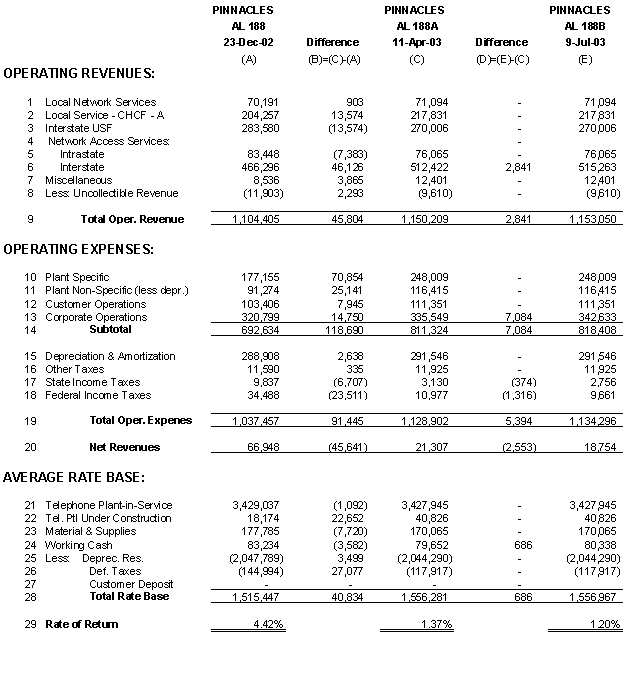
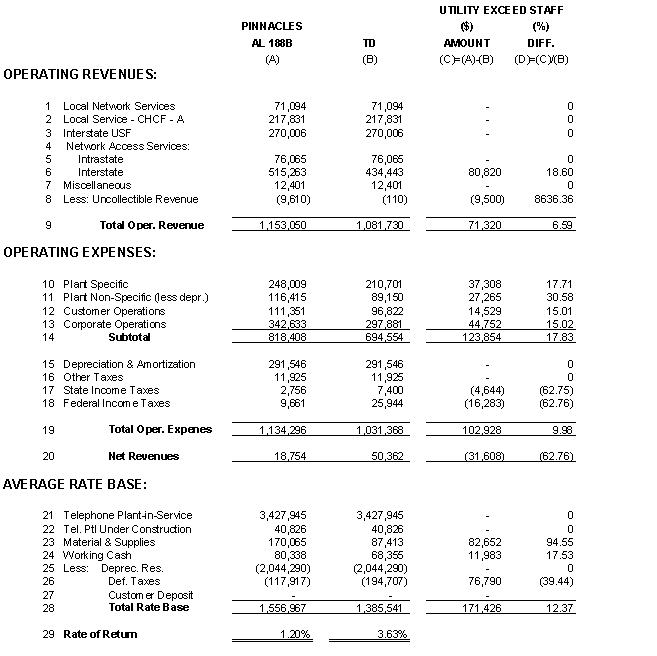
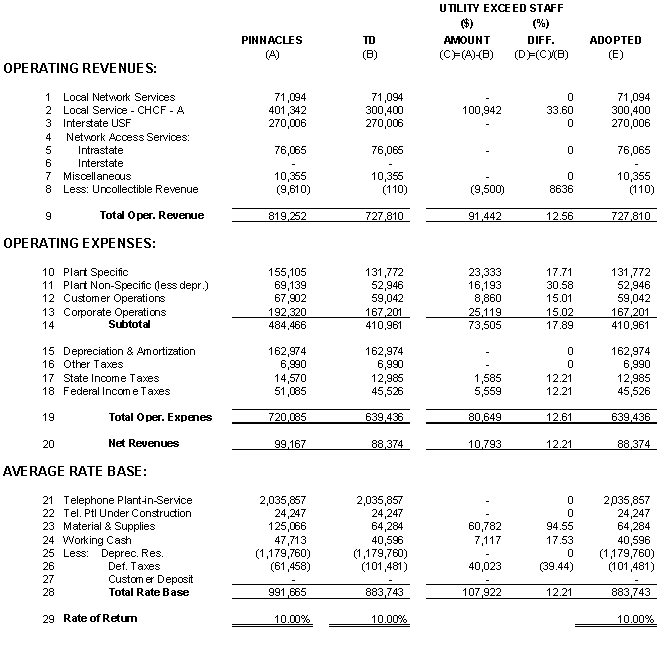
Appendix A shows Pinnacles' Test Year 2004 Total Company Results of Operations in ALs 188, 188A and 188B at present rates. Appendix B to this resolution compares the Telecommunications Division (TD) and the Pinnacles' AL 188B Test Year 2004 Total Company Results of Operations before any CHCF-A adjustment. Appendix C compares TD's and Pinnacles' AL 188B Interstate and Intrastate Results of Operations before any CHCF-A adjustment to reflect the 10.00% intrastate rate of return. Appendix D compares TD's and Pinnacles' AL 188B Intrastate Results of Operations estimates after Pinnacles' proposed CHCF-A increase and after TD's proposed adjustments. Appendix E shows TD's calculation of the Net-to-Gross Multiplier and the change in the gross intrastate revenue requirement based on an adopted intrastate rate of return of 10.00%.
Background
Pinnacles Telephone Company (Pinnacles), a local exchange telephone utility based in San Benito County, California, provides local exchange telephone service within the boundaries of the Idria and Pinnacles exchanges. Pinnacles serves approximately 275 access lines in its two telephone exchanges.
In D.01-05-031, the California Public Utilities Commission (CPUC) set in motion the waterfall1 provision in 2003 for seven2 small LECs if they did not each file a General Rate Case (GRC) by the end of 2002. Pinnacles filed Advice Letter No. 188 on December 23, 2002, with a Test Year of 2004. Pinnacles filed its last GRC in 1997 through AL No. 115, and its latest intrastate results of operations was authorized by Resolution T-16004 dated April 9, 1997.3
In AL 188, Pinnacles proposes $304,010 CHCF-A support in test year 2004. This is a $58,405 increase in the CHCF-A support which represents a 24.00% increase in year 2003 CHCF-A support of $245,605.
On April 11, 2003, Pinnacles filed AL No. 188A to include actual 2002 information. The 2002 data resulted in a change in the requested CHCF-A support. Pinnacles is
requesting $397,299 in CHCF-A support, which is a $93,289 increase from the original request.
On July 9, 2003, Pinnacles filed AL No. 188B to include Public Program Branch audit cost of $7,084 for this rate case. Pinnacles is requesting $401,342 in CHCF-A support, which is a $97,332 increase from the original request AL 188.
Notice/Protests
Pinnacles states that copies of the Advice Letter and Advice Letter Supplements were mailed to competing and adjacent utilities and/or other utilities. Notice of AL 188 was published in the Commission Daily Calendar of December 27, 2002 and notices of ALs 188A and 188B were published in the Commission Daily Calendar of April 18, 2003, and July 14, 2003, respectively. The ALs 188 and 188A filings were noticed to customers by bill insert on December 20, 2002 and May 1, 2003, respectively. AL 188B was not noticed to customers because only minor revisions were made to the filing. No protest to these Advice Letter filings has been received.
TD held a Public Meeting in Paicines on May 20, 2003, at which time Pinnacles was given an opportunity to explain its filing to its customers and its customers were given the chance to ask questions of Pinnacles and the TD staff. Pinnacles' customers were given notice of the Public Meeting through bill insert. No customers attended the Public Meeting.
Discussion
Results of Operations
Appendix A shows Pinnacles' Test Year 2004 Total Company Results of Operations through ALs 188, 188A and 188B at present rates.
Appendix B compares total company results of operations for test year 2004, as estimated by the TD and Pinnacles at present rates.
TD calculates in test year 2004 that Pinnacles will earn a total company overall rate of return of 3.63% at present rates as compared to Pinnacles' calculation of 1.20%. Since TD concludes Pinnacles is earning below the Commission's target of an overall rate of return of 10.00%, TD's estimates for Pinnacles reflect revisions to Pinnacles' estimates of revenues, expenses, and rate base as discussed below.
Total Operating Revenues
In determining the test year total company revenues, TD accepts Pinnacles' 2.02% percent increase used for access revenues that are derived from billings. Based on its review of access line growth and field inspection of the areas served by Pinnacles, TD accepts the 2.02% growth rate increase used by Pinnacles.
Pinnacles estimates local revenues by multiplying the forecasted units (e.g. number of subscribers and/or minutes of uses) by the tariff rates and charges. Local units were forecasted using historical growth information.
TD agrees that Pinnacles' model properly estimates Interstate Access Revenues as a function of the total company rate base and expense. The differences in the calculation of Interstate Access Revenues for Test Year 2004 results from differing estimates of Total Company Results of Operations between Pinnacles and TD estimates. TD's estimate of 2004 Interstate Access Revenue of $434,443 is $80,820 or 18.60% lower than Pinnacles' estimate.
Differences between Pinnacles' estimate of CHCF-A revenue and TD's estimate result from the goal of adopting 10.00% intrastate rate of return.
Uncollectibles
Uncollectibles are based on bad debts associated with local revenue and intrastate access revenues. Pinnacles estimates local debt at $110 and contends that it will remain consistent with historical figures. However, Pinnacles explains that the, "Bad Debt on Intrastate Access Revenue was historically part of the settlement process and as such was absorbed by the settlement pools. Now that Pinnacles is no longer in the settlement pool bad debt on intrastate access is a greater risk. This was highlighted by the recent bankruptcy [sic] of WorldCom and Global Crossing, which account for the large bad debt in 2002". Pinnacles assumes that the intrastate access bad debt it incurred in 2002 of $9,100 due to the bankruptcy will continue in 2004.
TD does not agree with Pinnacles' estimate of test year 2004 uncollectibles. Although Pinnacles' estimate for local bad debt of $110 reasonable, Pinnacles' uncollectible estimate of $9,500 for intrastate access revenue bad debt is not reasonable. The recent WorldCom and Global Crossing bankruptcies are a one-time occurrence and Pinnacles will not incur similar bad debt on an annual recurring basis. TD therefore, disallows $9,500 of bad debt associated with intrastate access revenue and estimates intrastate uncollectibles to be $110 for the test year 2004.
In the event that Pinnacles incurs similar access revenue bad debt as the result of continued bankruptcy filings by interexchange carriers and does not receive remedy from applicable court decisions, Pinnacles is then encouraged to seek remedy from the Commission for those lost revenue amounts. Pinnacles may not seek remedy from the Commission for those debts incurred due to bankruptcy filings until the bankruptcy proceedings have been finalized and monies dispersed, if any. This delay is required to avoid the potential of Pinnacles double recovering the bad debt it has incurred as the result of bankruptcy filings.
Total Operating Expenses
A comparison of TD's and Pinnacles' computation of total company operating expenses shows that overall Pinnacles' estimate is $1,134,296 or 9.98% higher than TD's estimate of $1,031,368 (Appendix B). The differences are discussed below.
For operating expenses, Pinnacles forecasted 2003 and 2004 expenses based on the following methodology. First, historical four-year average (1999 to 2002) percentages were developed for Labor (11.46%) and Non-Labor (4.63%) related expenses. Then the four-year average percentages were applied first to the 2002 sub-account details to generate 2003 forecast expenses. Pinnacles applied these percentages to sub-accounts for the Plant Specific, Plant Non-Specific, Customer Operations, and Corporate Operations expense categories, based on details of each sub-account (i.e., Labor: Salaries & Wages, Benefits; Non-Labor: Rents, Clearances, and Other). The same percentages were then applied to the 2003 forecast expense estimates to generate the 2004 Test Year expenses estimates. Pinnacles believes this methodology to be reasonable for a small company.
TD does not agree with Pinnacles' estimated labor related and other expenses growth rates. Instead, TD used Pinnacles' recorded years 2000, 2001 and 2002 labor and non-labor expenses and applied the constant dollar method to estimate Pinnacles' 2004 expenses. The constant dollar method is used to convert nominal dollars to inflation-adjusted figures. This is done by using the inflation factors for each year and compounding them to 2002 dollars. The constant dollar method is applied to benchmark the price of a basket of utility purchases in various years to a selected base year. While expenses have been increasing in nominal dollars, when one applies the constant dollar method and adjusts the recorded figures to base year constant dollars, there is less of a variance and in many cases, the inflation-adjusted figures remained relatively flat. TD used Pinnacles' recorded expense figures as reflected in the annual reports for the years 2000, 2001 and 20024 and then applied the recorded inflation factors for labor and non-labor
for each year.5
Both TD and Pinnacles include rate case expense ($90,000) which is amortized over 3 years in the Corporate Operation account.
Pinnacles also included rate case expense in the amount of $7,084 that it incurred due to an audit conducted by the Public Programs Branch. Since this audit does not occur annually, this rate case expense should be amortized over a three-year period. Three years are a reasonable period since CHCF-A funding remains at 100% only for the first three years after a GRC at which time the funding is automatically reduced 20%. Conceivably, a Small LEC could file a GRC after every three years to retain 100% CHCF-A support. Therefore, TD recommends that the rate case expenses in the amount of $2,361 ($7,084 amortized over three years) should be included in the 2004 test year.
In year 2002, Pinnacles implemented its first qualified pension plan. Pinnacles used the 2002 actual benefit amount of $120,530 and applied an escalation factor of 11.46% for 2003 and 2004 to derive the test year estimate of $149,725. This escalation factor is excessive, and instead TD used the ORA recommended labor escalation factors of 2003 and 2004 to derive its test year estimate of $125,275.
Taxes
The differences in the tax estimates between Pinnacles and TD are due to differences in each party's estimate of revenues and expenses. TD and Pinnacles both used a Corporate State Franchise Tax (CCFT) rate of 8.84% and a Federal Income Tax rate of 34.00%.
Rate Base
In computing plant in service, TD reviewed Pinnacles' 2002 annual report and examined the additions and retirements as reflected in the annual report vis-à-vis the data reflected in Pinnacles' submitted GRC proposal. TD reviewed Pinnacles' telephone plant in service (TPIS) and short term telephone plant under construction (1.2% of TPIS for 2002) estimates for 2004 and found them to be consistent with TD's growth forecast review.
Pinnacles calculated depreciation expense and accumulated depreciation by using the depreciation rates previously adopted by the Commission as part of its 1997 GRC. TD reviewed Pinnacles' depreciation rates and found them to be reasonable.
Pinnacles estimated the test year Materials and Supplies (M&S) amount by taking the ratio of the 2002 average M&S to the 2002 average TPIS. The 2002 ratio of 4.96% was then applied to the forecasted 2003 and 2004 TPIS to derive the 2004 M&S. TD however, disagrees with Pinnacles' methodology. Instead of using only a one-year data point to derive the ratio, TD took the five-year average (1998-2002) of M&S to TPIS. Since five years of historical data were available, TD used more data points to estimate a more reliable forecast. TD then applied the five-year average ratio of 2.55% to the forecasted TPIS to derive the 2004 M&S. Therefore, TD recommends that the average M&S of $87,413 (derived by applying 2.55% to the forecasted 2004 TPIS) be included as part of the 2004 test year rate base.
Pinnacles' Deferred Income Taxes (DIT) were estimated by the utility by taking the ratio of the 2002 average DIT to the 2002 average TPIS. A negative 3.44% ratio was then applied to the forecasted 2003 and 2004 TPIS to derive the 2004 DIT. TD, however, disagrees with Pinnacles' methodology. Instead of using only a one-year data point to derive the ratio, TD took a five-year average (1998-2002) of DIT to TPIS ratio. Since five years of historical data were available, using more data points to forecast from historical data will produce a more accurate forecast. TD then applied the five-year average ratio of negative 5.68% to its forecasted test year TPIS to derive the 2004 DIT. Therefore, TD recommends that the average DIT of negative $194,707 (derived by applying negative 5.68% to the forecasted 2004 TPIS) be included in the rate base.
Both TD and Pinnacles used the Simplified Method described in Standard Practice U-16 to calculate working cash. TD's estimate of intrastate working cash at $40,596 is 17.53% lower than that computed by Pinnacle (Appendix D). This difference is due to TD's lower expense estimates.
Except for Materials and Supplies, Working Cash and Deferred Income Taxes, TD accepts Pinnacles' other estimated rate base amounts for test year 2004.
Separations
Pinnacles provides both intrastate and interstate telecommunications services, subject to the regulation of the CPUC and FCC, respectively. Because Pinnacles' property serves both jurisdictions, the utility's expenses, taxes, investments, and reserves are allocated (separated) between interstate and intrastate services according to FCC rules. TD reviewed Pinnacles' separation factors and finds them to be reasonable. Appendix C compares Pinnacles' and TD staff's total company interstate and intrastate results of operations for test year 2004 using these separation factors.
Cost of Capital
Pinnacles requests an overall intrastate rate of return of 10.00%, the rate of return authorized by Resolution T-16004.
The Return on Equity for all rural ILECs would be the same since the systematic and non-diversifiable risks faced by all rural ILECs are similar. As a matter of practice, Decision D.97-04-036 in A.95-12-0736 adopted an "overall" rate of return of 10.00% for all rural ILECs. The risks faced by rural ILECs appear similar today as in the recent past, therefore TD recommends that the Commission approve Pinnacles' request for an overall rate of return of 10.00% at this time.
Net-to-Gross Multiplier
The net-to-gross multiplier indicates the unit change in gross revenues required to produce a unit change in revenues. Appendix E shows TD's computation of Pinnacles' net-to-gross multiplier. The net-to-gross multiplier of 1.66207 means that a change of $1,662 in gross revenue would be required to produce a change of $1,000 in net revenue. For Pinnacle, based on an Intrastate rate base of $883,742 and rate of return of 10%, TD estimates the intrastate revenue requirement change required an increase of $82,569
CHCF-A Support
D.01-02-018 approved Settlement Transition Agreements (STAs) between Pacific Bell and the small Local Exchange Carriers (small LECs). Monies that Pacific Bell paid the small LECs through toll and access pool settlements were replaced by authorized draws from the CHCF-A. The CHCF-A itself was originally established by D.85-06-115 as a means of subsidizing reasonable basic exchange rates for the customers of small LECs that adopted Pacific's statewide average toll, toll private line, and access charges (settlement pools). D.01-02-018 required the small LECs' replacement funding for the STAs be subject to the same rules that apply to current draws from the CHCF-A, namely, basic residential rates shall be increased to a ceiling equal to 1.5 times the urban rate as necessary, and both the means test and the waterfall provisions should apply.
TD calculated Pinnacles' CHCF-A support for test year 2004 at present rates to be $217,831 (Appendix B, column A). The CHCF-A 2004 support is derived from using Pinnacles' 2003 initial draw of $245,605, adding the $242,232 National Exchange Carriers Association, Inc. (NECA) estimated USF Federal support for 2003, and subtracting Pinnacles' projected 2004 USF Federal support of $270,006. Federal USF support is based on the 2004 projected payments for California Exchange carriers as filed by the NECA on October 1, 2003 with the Federal Communications Commission.
However, if Pinnacles is authorized to receive $217,831 in CHCF-A support, then based on TD's adjustments in revenues, expenses and rate base, Pinnacles' intrastate rate of return would be 4.38% (Appendix C, column F), which would be less than the 10.00% Commission's target. Therefore, for test year 2004, TD's computation of Pinnacles' adopted CHCF-A requirement is $300,400 based on its recommended revenues, expenses rate base and overall intrastate rate of return of 10.00% as shown in Appendix D, column E.
Proposed Tariff Changes
Pinnacles also proposes change in the following tariffs:
1. Include SBC California rates and charges for E9-1-1 to its Schedule No. A-20, E9-1-1 Emergency Service.
The current tariff does not have a specific money amount. It indicates that Pinnacles' rates, conditions, and charges are set forth in Pacific Bell's Schedule CAL. P.U.C. No. A9, Section 9.2.3. The proposed rates and charges will be those Pinnacles pays SBC California for maintaining the data base and tandem switching. TD finds Pinnacles' request to add the E9-1-1 rates and charges to Schedule No. A-20, E9-1-1 Emergency Service to be reasonable, and recommends the Commission should adopt Pinnacles' request.
2. Remove a statement in Schedule No. A-21, Inside Wiring Maintenance Service, concerning disconnection for nonpayment of Inside Wiring charges.
Special Conditions 4 in Schedule No. A-21, Inside Wiring Maintenance (IWM) Service reads: " Nonpayment of charges for IWM services are subject to disconnection of service."
D.00-11-015 eliminated Pinnacles' authority to disconnect basic residential and single line business, Flat Rate and/or Measured Rate service for nonpayment of any charges other than non-recurring and recurring charges for basic residential and single line business, Flat rate and Measured Rate service, including mandated surcharges and taxes calculated on same.
TD reviewed the current tariff and finds Pinnacles' request to remove Special Conditions 4 in Schedule No. A-21 to be reasonable. TD recommends Commission approval of Pinnacles' request.
3. Add references to Schedule No. B-6, Access Service for the CTF (California Teleconnect Fund) discounts for qualified entities and services.
The reference specifies that qualifying schools, libraries, government owned hospital and/or health clinics, and community based organizations shall be entitled to a discount for purchasing T-1, DS-3 or their functional equivalents and other such services that the Federal Communications Commission may determine are appropriate.
Pinnacles will be reimbursed from the CTF for the difference between tariff rate and the discounted rate.
TD reviewed Pinnacles' proposed tariff and finds Pinnacles' request to add CTF discounts for qualified entities and services to be reasonable. TD staff recommends Commission approval of Pinnacles' request.
4. Remove analog services in Schedule No. G-1, for which Pinnacles has no customers.
Pinnacles states that new customers, who want intraLATA Leased Line and Private Line Telephone Service, will be offered the rates and charges in Schedule No. B-6, Access Service.
TD reviewed Schedule No. B-6 and the utility proposed text changes. TD finds Pinnacles request to remove services for which there are no customers to be reasonable, because the Commission routinely approves these requests. (see Resolution No. T-9597, dated March 22, 1977 which authorizes the Executive Director to grant requests for the withdrawal of communications utility services for which there are no customers and where there are no customer requests for the services.)
TD recommends that the Commission approval these changes.
Comments
In accordance with P.U. Code Section 311 (g), TD mailed a copy of the original draft resolution on September 30, 2003 to Pinnacles and other interested parties. Comments received on a timely basis will be addressed in any final resolution.
Findings
1. Pinnacles filed its GRC by Advice Letter Nos. 188, 188A and 188B on December 23, 2002, April 11, and July 9, 2003, respectively for Test Year 2004 in compliance with Decision 01-05-031.
2. Pinnacles requests the following for test year 2004 (Appendix D, column A):
· No changes in its basic rate or charges;
· An intrastate ROR of 10.00%, the same return granted in its GRC filing in 1997, with a total intrastate rate base amount of $991,665;
· A California High Cost Fund-A (CHCF-A) support of $401,342 for 2004, representing an increase of $155,737 or 63.41% increase from the CHCF-A 2003 support of $245,605;
· Tariff revisions as described in the Discussion section of this resolution.
3. The Telecommunications Division recommends the following for Pinnacles for test year 2004 (Appendix D, column B):
· No changes in its basic rate or charges;
· An intrastate ROR of 10.00% with a total intrastate rate base amount of $883,743;
· A California High Cost Fund-A (CHCF-A) support of $300,400 for 2004, representing an increase of $54,795 or 22.31% increase from the CHCF-A 2003 support of $245,605;
· Tariff revisions as described in the Discussion section of this resolution.
4. The difference in estimates for Pinnacles and TD is the result of the use of different assumptions and methodologies for estimating revenues, expenses, and rate base.
5. The Commission finds TD's methodology in estimating revenues to be reasonable. The Commission therefore, adopts TD's recommended intrastate revenues as shown in Appendix D, column E).
6. The Commission finds TD's methodology of using the constant dollar method in estimating expenses to be reasonable and adopts TD's recommended test year 2004 total company expenses contained in Appendix B and intrastate expenses identified in Appendix D.
7. The Commission accepts TD's recommended overall intrastate rate of return of 10.00% for Pinnacles for test year 2004.
8. The Commission finds TD's recommended $300,400 CHCF-A support for Pinnacles for test year 2004 to be acceptable.
9. The Commission finds that Pinnacles' depreciation rates previously adopted by the Commission as part of its 1997 GRC to be acceptable for rate making purposes for test year 2004.
10. The Commission finds TD's methodology in estimating rate base to be reasonable. The Commission therefore adopts TD's recommended intrastate rate base as shown in Appendix D.
11. The Commission accepts TD's recommendation to approve Pinnacles' proposed tariff revisions outlined in the Discussion on section (Proposed Tariff Changes) of this resolution.
12. Commission approval is based only on the specifics of this Advice Letter.
THEREFORE, IT IS ORDERED that:
1. The intrastate revenues, expenses, and rate base amounts for test year 2004 identified in Appendix D, column (E) are adopted for Pinnacles Telephone Company.
2. The overall intrastate rate of return of 10.00% is adopted for Pinnacles for test year 2004.
3. Pinnacles Telephone Company's CHCF-A draw for year 2004 is $300,400.
4. The depreciation rates submitted by Pinnacles Telephone Company in support of its General Rate Case Advice Letter No. 188 are adopted for rate making purposes for test year 2004.
5. Pinnacles is granted authority to revise tariff changes described in AL Nos. 188, 188A and 188B. The revised tariff sheets submitted with AL No. 188 will be effective on January 1, 2004.
This Resolution is effective today.
I hereby certify that this Resolution was adopted by the Public Utilities Commission at its regular meeting on October 30, 2003. The following Commissioners approved it:
WILLIAM AHERN Executive Director |
APPENDIX A
PINNACLES TELEPHONE COMPANY
TOTAL COMPANY RESULTS OF OPERATIONS
AL FILINGS 188, 188A AND 188B
TEST YEAR 2004 AT PRESENT RATES
APPENDIX B
PINNACLES TELEPHONE COMPANY
TOTAL COMPANY RESULTS OF OPERATIONS
AT PRESENT RATES
TEST YEAR 2004
APPENDIX C
PINNACLES TELEPHONE COMPANY
RESULTS OF OPERATIONS AT PRESENT RATES
INTERSTATE AND INTRASTATE
TEST YEAR 2004

APPENDIX D
PINNACLES TELEPHONE COMPANY
INTRASTATE RESULTS OF OPERATIONS
AT ADOPTED RATE OF RETURN
TEST YEAR 2004
APPENDIX E
PINNACLES TELEPHONE COMPANY
NET-TO-GROSS MULTIPLIER
TEST YEAR 2004
1 The waterfall provision refers to the 6-year phase down of the CHCF-A funding level beginning in 1998, the year after the completion of a GRC. The funding levels are 100% of the for the first 3 years, i.e., 1998, 1999 and 2000; 80 % the fourth year, i.e., 2001, 50% the fifth year, i.e., 2002; and 0% thereafter.
2 The seven companies are Calaveras Telephone Company, Cal-Ore Telephone Company, Ducor Telephone Company, Foreshill Telephone Company, Hornitos Telephone Company, Kerman Telephone Company, and Pinnacles Telephone Company.
3 In Resolution T-16004, Pinnacles was granted the following: a general rate reduction of $24,535 for 1997, net revenue amount of $81,260, a rate base amount of $812,593, a Rate of Return of 10.00%. Effective May 1, 1997 through December 31, 1997, Pinnacles was required to refund monthly $4.28 for each Business line, $2.33 for each Residence line, $0.50 credit for each one-quarter mile for Off-Premises Extension Service, $1.46/line credit for overcharges to the 8.57% Billing Surcharge. These refunds expired December 31, 1997.
4 Form M Schedule I-1 (FCC Armis 43-02 Report Format) of Pinnacles' Annual Reports for 2000, 2001 and 2002.
5 TD used the Office of Ratepayers Advocates estimates of Non-Labor and Wage Escalation Factors for 2002-2004 from the January 2003 Global Insight U.S. Economic Outlook as follows:
Year |
Labor |
Non-labor |
2000 |
1.030 |
1.035 |
2001 |
1.030 |
1.000 |
2002 |
1.028 |
1.000 |
2003 |
1.016 |
1.006 |
2004 |
1.023 |
1.012 |
6 In D.97-04-036 the Commission authorized California-Oregon Telephone Company a 10.00% return on rate base for its 1997 test year as requested in A.95-12-073 (California-Oregon's 1997 General Rate Case application).
