3. Local RA for 2010
3.1. 2010 LCR Study
D.06-06-064 determined that a study of local capacity requirements performed by the CAISO would form the basis for this Commission's Local RA program. The CAISO conducts its LCR study annually, and this Commission resets local procurement obligations each year based on the CAISO's LCR determinations. As noted above, the CAISO issued its final LCR report and study results for 2010 on May 1, 2009.
The CAISO states that the assumptions, processes, and criteria used for the 2010 LCR study were discussed and recommended in a stakeholder meeting held on November 3, 2008, and that, on balance, they mirror those used in the 2007, 2008, and 2009 LCR studies. The CAISO identified and studied capacity needs for the same ten local areas as in the previous study: Humboldt, North Coast/North Bay, Sierra, Greater Bay, Greater Fresno, Big Creek/Ventura, Los Angeles Basin, Stockton, Kern, and San Diego.
The 2009 and 2010 summary tables in the 2010 LCR report, copied below, show that for all ten areas combined, the total LCR associated with reliability Category C declined from 27,915 megawatts (MW) in 2009 to 27, 727 MW in 2010. The existing capacity needed increased from 27,008 MW in 2009 to 27,075 MW in 2010. LCR needs decreased in the Sierra and Stockton areas mainly due to new transmission projects, and decreased in the Humboldt, Bay Area, Fresno, and Kern areas where the load trend is downward. LCR needs increased slightly in the North Coast/North Bay, Los Angeles Basin, and Big Creek/Ventura areas mostly due to load growth. The San Diego area LCR need increased partly because of load growth and partly because of the new Otay Mesa generating facility becoming the biggest single generation contingency in the area.
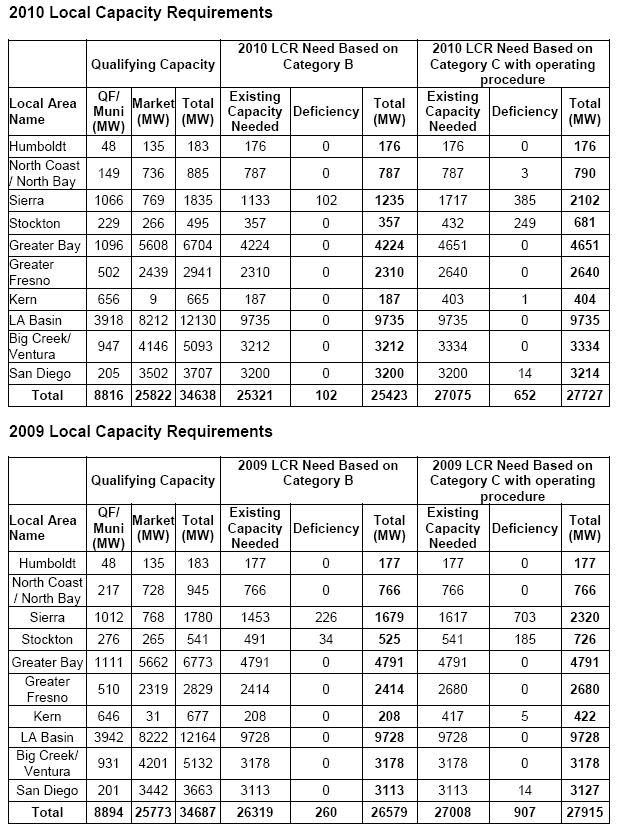
The comments reveal no disagreement with CAISO's LCR determinations for 2010. As we noted in D.08-06-031, it appears that past efforts towards greater transparency and opportunity for participation in the LCR study process have paid off in significant part, as reflected in the comments. We determine that the CAISO's final 2010 LCR study should be approved as the basis for establishing local procurement obligations for 2010 applicable to Commission-jurisdictional LSEs.
SCE noted that for the 2010 LCR study, the CAISO coordinated with the California Energy Commission (CEC) to obtain a revised 2010 peak load demand forecast that incorporates the effects of the current economic downturn. SCE urges continuation of this practice, and asks that we encourage such coordination going forward. DRA supports this recommendation. We concur that load forecasts should be as-up-to date as reasonably possible, consistent with the orderly administration of the RA program.
3.2. Local Procurement Obligations for 2010
D.06-06-064 adopted a framework for Local RA and established local procurement obligations for 2007 only. D.07-06-029 and D.08-06-031 established local procurement obligations for 2008 and 2009, respectively. We intend that Local RA program and associated regulatory requirements adopted in those decisions shall be continued in effect for 2010, subject to the 2010 LCRs and procurement obligations adopted by this decision.
In previous decisions, we delegated ministerial aspects of RA program administration to the Commission's Energy Division. The Energy Division should implement the local RA program for 2010 in accordance with the adopted policies and principles.
The 2010 LCR report sets forth two sets of LCRs associated with reliability options based on North American Electricity Reliability Council (NERC) Performance Level B and Performance Level C criteria. As the CAISO's report explains:
1. Option 1 - Meet Performance Criteria Category B.
Option 1 is a service reliability level that reflects generation capacity that must be available to comply with reliability standards immediately after a NERC Category B given that load cannot be removed to meet this performance standard under Reliability Criteria. However, this capacity amount implicitly relies on load interruption as the only means of meeting any Reliability Criteria that is beyond the loss of a single transmission element (N-1). These situations will likely require substantial load interruptions in order to maintain system continuity and alleviate equipment overloads prior to the actual occurrence of the second contingency.2. Option 2 - Meet Performance Criteria Category C and Incorporate Suitable Operational Solutions.
Option 2 is a service reliability level that reflects generation capacity that is needed to readjust the system to prepare for the loss of a second transmission element (N-1-1) using generation capacity after considering all reasonable and feasible operating solutions (including those involving customer load interruption) developed and approved by the CAISO, in consultation with the [Participating Transmission Owners (PTOs)]. Under this option, there is no expected load interruption to end-use customers under normal or single contingency conditions as the CAISO operators prepare for the second contingency. However, the customer load may be interrupted in the event the second contingency occurs.As noted, Option 2 is the local capacity level that the CAISO requires to reliably operate the grid per NERC, [Western Electric Coordinating Council (WECC)], and CAISO standards. As such, the CAISO recommends adoption of this Option to guide resource adequacy procurement. (2010 LCR Report, p. 15; emphasis in original.)
D.06-06-064 determined that the reliability level associated with Option 2 as defined in the 2007 LCR study should be applied as the basis for local procurement obligations for that year. The Commission stated that "[w]hile we expect to apply Option 2 in future years in the absence of compelling information demonstrating that the risks of a lesser reliability level can reasonably be assumed, we nevertheless leave for further consideration in this proceeding the appropriate reliability level for Local [resource adequacy requirements] for 2008 and beyond." (D.06-06-064, p. 21.) D.07-06-029 and D.08-06-031 adopted Option 2 as recommended by the CAISO for 2008 and 2009 local procurement obligations. There is no evidence or recommendation before us suggesting that assumption of the reduced reliability associated with Option 1 is reasonable for 2010. We therefore affirm the continued application of Option 2 to establish local procurement obligations for 2010.
To address supplier market power concerns, D.06-06-064 established an approach for aggregation of certain local areas for 2007. After determining each LSE's allocation of Local RAR for each local area based on its share of load in the investor-owned utility (IOU) distribution service area, the Commission determined that six local areas within the PG&E territory (Humboldt, North Coast/North Bay, Sierra, Stockton, Greater Fresno, and Kern) should be aggregated as one for purposes of RA compliance. D.07-06-029 and D.08-06-031 found that continuation of the aggregation approach for these six areas was reasonable for 2008 and 2009, respectively.
No party has raised a concern that reliability would be impaired by continuing the approach for 2010. We find it is reasonable to continue the previously adopted aggregation approach for 2010.
The LCR study identifies deficiencies in qualifying capacity resources in certain local areas. In the 2010 study, for performance Category C, the CAISO determined that such deficiencies exist in the Sierra, Stockton, Kern, and San Diego local areas. The total of such area deficiencies for 2010 is 652 MW.
Because it would not be "reasonable to require LSEs to procure capacity that, according to the LCR study, does not currently exist in an area," the Commission directed the Energy Division to calculate reduced LCRs for those areas. (D.06-06-064, at 21-22.) D.06-06-064 authorized this "blanket waiver" treatment of deficiencies for 2007 only, and subsequent decisions have approved such waivers on a year-to-year basis. We will again approve such blanket waiver of the local procurement requirement in the resource-deficient areas identified by the CAISO.
In the previous local RA decisions we have established local RA compliance filing procedures in coordination with the CAISO's Reliability Must Run (RMR) mechanism. To minimize unnecessary procurement, we established an iterative process whereby load-serving entities (LSEs) submitted preliminary showings in September that the CAISO would consider before making RMR commitments. The final compliance showings were made due on October 31, and the System RA compliance filing date was reset to October 31 as well.
In an April 14, 2009 stakeholder meeting, the CAISO advised stakeholders that its tariff requires it to identify collective effectiveness deficiencies in local capacity areas at least 60 days prior to the beginning of the RA compliance year, i.e., on November 2, 2009 for the 2010 compliance year. To make this identification, CAISO staff needs local procurement information submitted by Commission-jurisdictional LSEs. CAISO staff indicated to participants in that stakeholder meeting that the final local RA showings for 2010 would need to be advanced to early October. Although the CAISO did not submit a proposal to this Commission to change the historical filing procedure, AReM and SCE commented on the scheduling issue. In its reply comments, the CAISO stated that it agrees to issue a revised deficiency notice in mid-November that reflects the final procurement information provided by LSEs on October 31. The CAISO also asks that the Commission encourage all LSEs to submit as much procurement information as they have by no later than October 9, 2009 so that the CAISO can incorporate it into the November 2 Local Capacity Area deficiency notice. With this procedure, it is not necessary to significantly revise the filing dates that have been applied in the local RA program. We are informed by our Energy Division staff that a minor shift would better enable processing the information in the compliance filings.
Accordingly, for the 2010 compliance cycle, preliminary local procurement showings shall be made on September 18, 2009 and final compliance showings for both local RA and System year-ahead RA shall be due on October 29, 2009. In addition, we incorporate the CAISO's proposal to encourage advance reporting by October 9 by authorizing the Energy Division to initiate an optional supplemental reporting procedure for that purpose.
D.07-06-029 approved a procedure (Proposal 8) for integrating the Commission's RA and the CAISO's procurement procedures, and D.08-06-031 found that it would be reasonable and appropriate to implement the Proposal 8 procedure in 2009. We will again provide that this procedure should be implemented for 2010, with appropriate scheduling adaptations as determined by the Energy Division, and with the CAISO only designating units with 2009 RMR contracts that were not under RA contracts in the preliminary RA compliance filings.


