Preliminary Scoping Information
The scope of this proceeding will include all issues raised in this OII, but will not be limited to these issues. Any party may suggest related issues (i.e., issues involving the existing crossings at grade of city streets, county roads, or state highways) for Commission consideration, in accordance with the Commission's Rules of Practice and Procedure.3 .
The assigned Administrative Law Judge (ALJ) will, if necessary, convene a prehearing conference to develop a service list for this proceeding and to further delineate issues related to the scope and schedule of this proceeding.
This proceeding is categorized as quasi-legislative because it establishes a priority list affecting an entire regulated industry.
In OII 99-07-001, the Commission established a new procedure for adopting a two-year Priority list, due to statutory time limitations. For this proceeding to be completed in a timely manner, the Priority List established by this OII must serve for both fiscal years in the investigation. The Commission staff is authorized to revise the Priority List for 2012-2013 after the first FY, based upon input from Caltrans (removal of already funded projects) and issue a second, revised Priority List for 2013-2014. This process complies with the statutory deadline of S&H Code § 2452 that requires the Commission to certify an annual Priority List on or before July 1st of each FY.
Any party interested in participating in this OII who is unfamiliar with the Commission's procedures should contact the Commission's Public Advisor Office in San Francisco at (415) 703-2074 or (866) 849-8390 or e-mail public.advisor@cpuc.ca.gov; or in Los Angeles at (213) 576-7055 or (866) 849-8391, or e-mailpublic.advisor.la@cpuc.ca.gov. The TTY number is (866) 836-7825.
IT IS ORDERED that:
1. An investigation on our own motion is instituted for the purpose of establishing a new Grade Separation Priority List for fiscal years 2012-2013, and 2013-2014, of existing railroad grade crossings of public streets, roads, or highways most urgently in need of separation, and existing separation structures most urgently in need of alteration or reconstruction as required by California Streets and Highways Code § 2452.
2. The Executive Director must serve a copy of this Order Instituting Investigation on the following:
a. Every railroad corporation operating in California;
b. California Department of Transportation;
c. California Transportation Commission;
d. League of California Cities;
e. California State Association of Counties; and
f. Light Rail Transit Agencies.
3. Local agencies in California desiring to have a crossing separation project considered for inclusion in the Grade Separation Priority List for fiscal years 2010-2011, and 2011-2012, to be established under S&H Code Section 2452, shall file the original Grade Separation Nomination Form (GSN)-1 or GSN-2 nomination forms with two copies to:
California Public Utilities Commission
Attn: Rosa Muñoz, P.E.
Senior Utilities Engineer
320 West 4th Street, Suite 500
Los Angeles, CA 90013
4. Applications on GSN-1 Forms or GSN-2 may be mailed or delivered in person. All nominations are due to the California Public Utilities Commission in Los Angeles postmarked no later than Friday, October 21, 2011. Applications delivered in person are due no later than 4:00 p.m. on October 21, 2011. Applications postmarked or delivered after the deadline will not be processed. Applications are not accepted via fax.
5. Each party is also required to provide one copy of its nomination(s) to California Department of Transportation (Caltrans):
Caltrans - Division of Rail
Attn: Bruce Plowman, Chief
1120 N Street, MS 74
Sacramento, CA 95814
6. Each nomination shall include the following:
a. For existing crossings nominated for separation, a completed Nomination Form GSN-1 (Appendix 5).
b. For existing grade separation nominated for alteration or reconstruction, a completed Nomination Form GSN-2 (Appendix 6).
c. A legible location map of the project, on 8 ½" x 11" sheet of paper showing the existing railroads and roadway system.
d. Two current 8"x10" photographs of the crossing(s), one from each direction of approach, shall be included with the original nomination. Other nomination copies may contain photocopies of the photographs.
7. Data submitted in the nomination must be based on verifiable facts occurring on or before October 21, 2011. Speculative data involving events anticipated to occur at some time in the future will not be considered. Applications for separations of existing at grade crossings with estimated data (vehicle counts, train counts, blocking delay, etc.), other than the project costs, will not be processed or included on the Priority List.
8. Nomination(s) must not include multiple projects that are separate and distinct and clearly severable. The combining of severable projects precludes the Commission from effectively determining which projects are most urgently in need of separation or alteration as required by California Streets and Highways Code § 2452. All consolidation projects that involve two or more existing at grade crossings must satisfy these criteria to be considered.
9. All project proposals to eliminate existing grade crossings shall include, for each crossing: the crossing location, crossing geometrics, average daily vehicle and train volumes, blocking delay, speed limits, accident data, ecetera (see sections B through H of GSN-1 in Appendix 4). Applications that include missing or incomplete data will not be used for the priority evaluation.
10. A nominating party may elect to exclude pre-construction costs (engineering, right-of-way, preparation of environmental impact reports, and utility relocation) if those costs are less than the local agency's share of the total costs (California Streets and Highways Code § 2454). The nominating party may be required to submit evidence in support of the fact that the funds have been expended. To the extent that pre-construction costs are excluded from a project's cost for the purpose of a nomination, the costs as nonparticipating, that is, the railroad will not be required to contribute 10 percent of the excluded pre-construction costs.
11. In addition to submitting the GSN-1 or GSN-2, each party, or its representative, nominating a crossing for inclusion in the Priority List is required to appear in person at the hearings to present evidence concerning the nomination. Supplemental data may be submitted at the hearings in support of a nomination. The data may include facts not known at time of nomination. The California Public Utilities Commission staff must receive verification of all supplemental data no later than one week after the last scheduled day of hearings.
12. Appearance schedules will be mailed to the interested parties 10 days prior to the scheduled hearings, usually held in the California Public Utilities Commission offices in San Francisco or Los Angeles. All parties will be notified of the dates and locations of the hearings. Appearances will be limited to one witness in support of each project or railroad.
13. Parties anticipating the need for an allocation greater than $5,000,000 shall be prepared to present evidence at the hearings to justify the additional award. California Streets and Highways Code § 2454 (d)(1) states:
"(d) (1) Notwithstanding the provisions of Subdivision (a) to (c), inclusive, a single project in excess of five million dollars ($5,000,000), but not exceeding twenty million dollars ($20,000,000), shall be considered without specific legislative authority, if the project (A) is included in the Public Utilities Commission's priority list of projects scheduled to be funded, (B) eliminates the need for future related grade separation projects, (C) provides projected cost savings of at least 50 percent to the state or local jurisdiction, or both of them, by eliminating the need for future projects, and (D) alleviates traffic and safety problems or provides improved rail service not otherwise possible. Projects approved pursuant to this subdivision shall be funded over a multiyear period, not to exceed five years, and the allocation for any one of those years shall not exceed the amount prescribed by subdivision (c) for a single project."
14. Failure to supply all of the requested information or to appear before the Commission will constitute grounds for exclusion of a project from the Grade Separation Priority List.
This order is effective today.
Dated July 28, 2011, at San Francisco, California.
MICHAEL R. PEEVEY
President
TIMOTHY ALAN SIMON
MICHEL PETER FLORIO
CATHERINE J.K. SANDOVAL
MARK J. FERRON
Commissioners
GRADE SEPARATION PROGRAM
TITLE 21. Public Works
Division 2. Department of Transportation
Chapter 13. Grade Separation Projects -- Applications for Allocation or Supplemental Allocations (Register 2009, No. 20)
Article 1. Applications
§1552. Last Date to File.
April 1 of each fiscal year is the last date on which applications for allocation of grade separation funds in that fiscal year can be filed; provided, however, if April 1 is a Saturday, Sunday, or a State of California holiday, then the last date of filing shall be the next business day following April 1. Filing is accomplished by filing the application with the Department of Transportation in the manner hereafter stated.
§1553. Place to File.
The complete application in triplicate must be received in the Office of the District Director of Transportation, State of California, in the transportation district in which the applicant is located, no later than 4:00 p.m. on the last day for filing.
§1554. Contents of Application.
The complete application must include a written request for an allocation in a specified monetary amount along with copies of each of the following attached to it:
(a) All necessary orders of the Public Utilities Commission of the State of California. Necessary orders of the Public Utilities Commission include:
|
|
|
(2) A statement of the applicant's position on the annual priority list established by the Public Utilities Commission pursuant to Streets and Highways Code Section 2452; |
|
(b) All necessary agreements with the affected railroad or railroads fully executed by railroad or railroads and applicant. The necessary agreements with the railroad include:
|
(2) A description of the project on a plan setting forth the area and items of the project and the particular area and items of the project to which the railroad or railroads agree to contribute; |
|
|
(3) the percentage of railroad's or railroads' contribution to the cost of the area and items to which railroad or railroads agree to contribute; |
|
|
(4) Identification and estimated cost of the area and items to which railroad or railroads do not contribute; |
|
(c) A certified resolution by the applicant's governing body authorizing the filing of an application.
(d) Certified resolution by the applicant's governing body stating that all matters prerequisite to the awarding of the construction contract can be accomplished within two years after the allocation of the funds for the project by the California Transportation Commission.
(e) A certified resolution by applicant's governing body stating that sufficient local funds will be made available as the work of the project progresses.
(f) Copies of all necessary Environmental Impact Reports or Negative Declarations, with a certified Notice of Determination and approval or acceptance of these documents by the Lead Agency. In cases where an Environmental Impact Statement or Negative Declaration has been prepared for the project pursuant to the requirements of the National Environmental Policy Act of 1969 and implementing regulations thereto, such documents may be submitted in lieu of an approved Environmental Impact Report or Negative Declaration and Notice of Determination, provided the Environmental Impact Statement or Negative Declaration fully develops the factors required in Title 14, Section 15143, of the State Administrative Code including Title 20, Section 17.1(d)(2), of the State Administrative Code, and such Environmental Impact Statement or Negative Declaration has received Federal approval.
(g) General plan of the project, including profiles and typical sections.
(h) Project cost estimate, which is to be broken down to construction, preliminary and construction engineering, work by railroad forces, right of way costs, and utility relocation.
§1555. Project Limitation
Participation of the grade separation fund is limited to only that portion of the project which, in the determination of the California Transportation Commission, is necessary to make the grade separation operable and to effect the separation of grades between the highway and the railroad track or tracks, or necessary to effect the relocation of track or highway. Off-track maintenance roads shall be nonparticipating unless the existing access for maintenance purposes is severely impaired by the project. Participating items include, but are not limited to, approaches, ramps, connections, drainage, erosion control of slopes, such as ivy, iceplant, and rye grass, and preconstruction costs, such as right of way acquisition, preparation of environmental impact reports and utility relocation, necessary to make the grade separation operable. In any dispute as to scope of project or qualification of an item, the decision of the California Transportation Commission shall be conclusive.
§1556. Allocation Limitation
Initial allocation of grade separation funds by the California Transportation Commission shall be limited to that based upon applicant's estimate of cost of project specified by applicant and utilized by the Public Utilities Commission of the State of California in establishment of applicant's priority pursuant to Streets and Highways Code Section 2452 of the State of California. A planned project must be a complete and operable project, and effect the separation of grades, relocation of the highway or railroad, in order to qualify for an allocation.
Article 2. Supplemental Allocations
§1557. Last Date to File.
The last date on which an application for a supplemental allocation can be filed for the subsequent fiscal year is May 1 of the current calendar year. If May 1 is a Saturday, Sunday, or a State of California holiday, then the last date of filing shall be the next business day following May 1. A formal application must be filed by the applicant, accompanied with the project final report.
§1558. Place to File.
The complete application in triplicate must be received in the Office of the District Director of Transportation, State of California, in the transportation district in which the applicant is located, no later than 4:00 p.m. on the last day for filing.
§1559. Contents of Application
The application must include a written request for a supplemental allocation in a specified amount along with copies of each of the following attached thereto.
(a) A certified resolution by the applicant's governing body certifying that:
|
(1) Applicant has authority to make request for supplemental allocation; |
|
|
(2) The project has been completed and has been accepted by the governing body; |
|
|
(3) The actual and final cost of the project has been determined and is set forth in the supplemental application; |
|
|
(4) All costs set forth in the request for a supplemental allocation were necessary to make the grade separation operable and effect the separation of grades or the relocation of track or highway. |
|
|
(5) That railroad or railroads have contributed 10 percent of the cost of the project unless a lesser contribution is expressly provided by law. |
(b) Evidence that funds would have been allocated for the project had the actual cost been used by the Public Utilities Commission of the State of California in determining the project's ranking on the priority list.
(c) A final accounting of the cost of the project with a statement explaining in detail why the original allocation was not sufficient.
Note: Authority and reference cited: Sections 2450-2461, Streets and Highways Code; and City of San Marcos v. California Highway Commission, 60 Cal. App. 3d 383.
(END OF APPENDIX 1)
Formula For Crossing Nominated For Separation

Where: P - Priority Index Number
V - Average 24-Hour Vehicular Volume (1 point per vehicle)
T - Average 24-Hour Train Volume (1 point per train)
C - Project Cost Share to be Allocated from Grade Separation Fund (1 point per thousand dollars)
LRT - Average 24-Hour Light Rail Train Volume (1 point per train)
AH - Accident History (up to 3 points per accident)
SCF - Special Conditions Factor = BD+VS+RS+CG+PT+OF (up to 63 pts)
BD - Crossing Blocking Delay (up to 5 points)
VS - Vehicular Speed Limit (up to 5 points)
RS - Railroad Prevailing Maximum Speed (up to 7 pts)
CG - Crossing Geometrics (up to 17 points)
PT - Passenger Trains (up to 10 points)
OF - Other Factors: passenger buses, school buses, trains carrying hazardous materials trains and trucks, and community impact (up to 19 points)
C = Project Cost Share to be Allocated from Grade Separation Fund
Up to five million dollars per project will be allocated (S&H Code § 2454(c)(1) per fiscal year, unless the applicant is seeking multiple-year funding as prescribed in S&H Code § 2454(d)(1). Local agencies are eligible to receive up to $5 million each year, over a period of 5 years for a project. The total amount a project may receive is $20 million, not to exceed 80% of the cost, if an at-grade crossing is closed and the project meets other specific requirements. Up to fifteen million dollars ($15,000,000) to a single project maybe be allocated if that project is the highest ranking project on the priority list (S&H Code § 2454(c)(2)).
AH = Accident History (last 10 years from application filing due date)
The total AH score is the sum of points per accident awarded as follows for vehicle and pedestrian accidents involving trains at crossings with the Crossing Protection Factor (CPF) based on the crossing's warning devices:
Points per Accident = (1 + 2 x No. Killed + No. Injured) x CPF
STANDARD |
9 |
8 |
1 |
CPF |
1.0 |
0.4 |
0.1 |
Note 1: No more than three points shall be allowed for each accident prior to modification by the protection factor.
Note 2: Each accident is rated separately and modified by a factor based on the warning devices in existence at time of the accident.
Note 3: Pedestrian collisions with the train will be considered at the crossing, excluding all suicides.
SCF = Special Conditions Factor = BD+VS+RS+CG+PT+OF
BD = Blocking Delay by Train (The total time in which vehicular traffic is delayed to allow a train to pass at a crossing.) The blocking delay, for a typical day, is the elapse time in minutes when trains pass the crossing. The delay is measured from the point that the warning devices are activated at the crossing to the time after the train has cleared the crossing and the warning devices are reset. The BD points are the total delay time, valued in a range from 0 to 5 points.
VS = Vehicular Speed Limit - Posted Speed Limit
SPEED-MPH |
0-30 |
31-35 |
36-40 |
41-45 |
46-50 |
51+ |
POINTS |
0 |
1 |
2 |
3 |
4 |
5 |
RS = Railroad Maximum Speed
SPEED-MPH |
0-25 |
26-35 |
36-45 |
46-55 |
56-65 |
66-75 |
76-85 |
86+ |
POINTS |
0 |
1 |
2 |
3 |
4 |
5 |
6 |
7 |
CG = Crossing Geometrics - 0 - 17 points are awarded to each crossing based on the relative severity of physical conditions, i.e. grade, alignment, site distance, track skew angle, traffic signals, entrances and exits, etc.
PT = Passenger Trains - Additional points are given to projects that have passenger trains, including light rail transit, traveling through the crossing based on the following:
NO. OF TRAINS |
1-2 |
3-5 |
6-10 |
11-20 |
21-30 |
31-40 |
41-50 |
51-60 |
61-70 |
70+ |
POINTS |
1 |
2 |
3 |
4 |
5 |
6 |
7 |
8 |
9 |
10 |
OF = Other Factors- Other Factors are valued in a range from 0 to 19 points based on:
CATEGORY |
POINTS |
SCHOOL BUSES |
0-3 |
PASSENGER BUSES |
0-3 |
HAZ-MAT TRUCKS* |
0-3 |
COMMUNITY IMPACT |
0-10 |
*Hazardous material trucks must display the placard with a clearly visible diamond-shaped sign to be counted for this category.
Formula For Existing Separations Nominated For Alteration Or Reconstruction
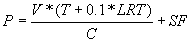
Where:
P - Priority Index Number
V - Average 24-Hour Vehicular Volume (1 point per vehicle)
T - Average 24-Hour Train Volume (1 point per train)
LRT - Average 24-Hour Light Rail Train Volume (1 point per train)
C - Project Cost Share to be Allocated from Grade Separation Fund (1 point per thousand dollars)
SF - Separation Factor = WC + HC + SR + AS + POF + AP + DE
WC - Width Clearance (up to 10 points)
HC - Height Clearance (up to 10 points)
SR - Speed Reduction (up to 5 points) AS - Accidents at or near structure (0.1 pt per accident)
POF - Probability of Failure (up to 10 points)
AP - Accident Potential (up to 10 points)
DE - Delay Effects (up to 10 points)
C = Project Cost Share to be Allocated from Grade Separation Fund
Up to five million dollars per project will be allocated (S&H Code § 2454(c)(1) per fiscal year, unless the applicant is seeking multiple-year funding as prescribed in S&H Code § 2454(d)(1). Local agencies are eligible to receive up to $5 million each year, over a period of 5 years for a project. The total amount a project may receive is $20 million, not to exceed 80% of the cost, if an at-grade crossing is closed and the project meets other specific requirements. Up to fifteen million dollars ($15,000,000) to a single project maybe be allocated if that project is the highest ranking project on the priority list (S&H Code § 2454(c) (2)).
SF = Separation Factor = WC+HC+SR+AS+PF+AP+DE
WC = Width Clearance is determined by bridge width (in feet) and the number of traffic lanes in existence (N):
If the Width is: |
POINTS |
Greater than or equal to 16'+12(N) |
0 |
Greater than 12' + 12(N) but less than 16' + 12(N) |
2 |
Greater than 8' + 12(N) but less than 12' + 12(N) |
4 |
Greater than 11(N) but less than 8'+12(N) |
6 |
Equal to 11(N) |
8 |
Less than 11(N) |
10 |
HC = Separation Height Clearance is determined by the height clearance from center of traffic lane and bridge (Underpass) or from top of rail and bridge (Overpass).
Underpass
Height (feet) Points
15' and above 0
14' but less than 15' 4
13' but less than 14' 8
Less than 13' 10
Overpass
Height (feet) Points
22.5' and above 0
20' but less than 22.5' 4
18' but less than 20' 8
Less than 18' 10
SR = Speed Reduction or Slow Order
Points
None 0
Moderate 2
Severe 5
AS = Accidents at or near the structure during the last 10 years from the application due date. The total AS points is determined by dividing the total number of occurrences by 10 and rounded off to the nearest tenth of a point (86 occurrences = 86/10= 8.6 points).
PF = Probability of Failure has a 10 point maximum taking structure age into account.
Points
Minimal/None 0
Slight 2-3
Moderate 4-6
Extreme 7-10
AP = Accident Potential - A maximum of 10 points is given for the geometrics at the separation like: road curvature, signage, and illumination.
Points
None 0
Slight 2-3
Moderate 4-6
Extreme 7-10
DE = Delay Effects - A maximum of 10 points is given to conditions that cause traffic delays at the separation like road bottlenecks, slow vehicle usage (trucks, agriculture equipment, lack of left or right turn lanes or other traffic congestion.
Points
None 0
Slight 2-3
Moderate 4-6
Extreme 7-10
(END OF APPENDIX 2)
STATE OF CALIFORNIA EDMUND G. BROWN JR., Governor

PUBLIC UTILITIES COMMISSION
320 WEST 4TH STREET, SUITE 500
LOS ANGELES, CA 90013
(213) 576-7078 FAX 576-7029
August 5, 2011
To: All Interested Parties
Re: Establishment of the Section 190 Grade Separation Priority List for fiscal years 2012-2013 and 2013-2014 under Section 2450 et seq. of the California Streets and Highways Code.
The Public Utilities Commission (Commission) issued an Order Instituting Investigation (OII) for establishing the Section 190 Grade Separation Priority List (Priority List) for fiscal year 2012-2013 and 2013-2014. The California Transportation Commission and the California Department of Transportation use the Priority List to allocate funds made available to the program to assist local governments in financing grade separations projects for existing at-grade crossings and grade separations in need of alteration or reconstruction.
If you wish to nominate a grade separation project for inclusion on the Priority List, you must complete and file a nomination application and participate in the Commission's OII. If you are interested, download the OII and appendices from our website at: http://www.cpuc.ca.gov/PUC/transportation/crossings/rrcrossingfundingprg.htm. Search for I.11-07-XXX.
The OII and appendices include an explanation and filing requirements for participating in the program, including a nomination form with instructions, and listing the criteria and formulas used to rank all nominations. All applications are due Friday, October 21, 2011.
For additional clarifications or comments, please contact me at rosa.munoz@cpuc.ca.gov , (213) 576-7078.
Sincerely,

ROSA MUÑOZ, PE
Senior Utilities Engineer
Rail Crossings Engineering Section
Consumer Protection & Safety Division
(END OF APPENDIX 3)
BEFORE THE PUBLIC UTILITIES COMMISSION OF THE STATE OF CALIFORNIA
Investigation for the purpose of establishing a list for the fiscal years 2012-2013 and 2013-2014 of existing crossings at-grade of city streets, county roads or state highways in need of separation, or existing separations in need of alterations or reconstruction in accordance with Section 2452 of the Streets and Highways Code. |
Investigation 11-07-XXX (Filed July 30, 2011) |
3 http://docs.cpuc.ca.gov/published/RULES_PRAC_PROC/105138.htm


