PUBLIC UTILITIES COMMISSION OF THE STATE OF CALIFORNIA
ENERGY DIVISION RESOLUTION E-4170
May 15, 2008
RESOLUTION
Resolution E-4170 Pacific Gas and Electric (PG&E) Company requests approval of a renewable resource procurement contract and an associated hedging strategy. This contract is rejected without prejudice.
By Advice Letter 3183-E filed on December 21, 2007.
__________________________________________________________
SUMMARY
PG&E's renewable contract does not comply with the Renewables Portfolio Standard (RPS) procurement guidelines and is rejected without prejudice
Pursuant to Public Utilities Code §399.16 and existing Commission rules for the RPS Program, PG&E's renewable contract does not comply with the Renewables Portfolio Standard (RPS) procurement guidelines. Specifically, the contract does not comply with D.07-11-025, which requires that certain non-modifiable terms and conditions are contained in all RPS contracts. This contract is rejected without prejudice.
Seller/ Generating Facility |
Type |
Term Years |
MW Capacity |
Annual Deliveries |
PPA Effective Date1 |
Facility Location |
Klickitat PUD No. 1/ White Creek2 |
Wind |
3.25 years |
50 MW3 |
147 GWh |
January 1, 2008 |
Klickitat County, Washington |
Confidential information about the contract should remain confidential
This resolution finds that certain material filed under seal pursuant to Public Utilities (Pub. Util.) Code Section 583, General Order (G.O.) 66-C, and D.06-06-066 should be kept confidential to ensure that market sensitive data does not influence the behavior of bidders in future RPS solicitations.
BACKGROUND
The RPS Program requires each utility to increase the amount of renewable energy in its portfolio
The California Renewables Portfolio Standard (RPS) Program was established by Senate Bill 10784 and codified by California Pub. Util. Code Section 399.11, et seq. The statute required that a retail seller of electricity such as PG&E purchase a certain percentage of electricity generated by Eligible Renewable Energy Resources (ERR). Originally, each utility was required to increase its total procurement of ERRs by at least 1 percent of annual retail sales per year until 20 percent is reached, subject to the Commission's rules on flexible compliance, no later than 2017.
The State's Energy Action Plan (EAP) called for acceleration of this RPS goal to reach 20 percent by 2010.5 This was reiterated again in the Order Instituting Rulemaking (R.04-04-026) issued on April 28, 2004,6 which encouraged the utilities to procure cost-effective renewable generation in excess of their RPS annual procurement targets (APTs)7, in order to make progress towards the goal expressed in the EAP. On September 26, 2006, Governor Schwarzenegger signed Senate Bill (SB) 107,8 which officially accelerates the State's RPS targets to 20 percent by 2010, subject to the Commission's rules on flexible compliance9.
CPUC has established procurement guidelines for the RPS Program
The Commission has issued a series of decisions that establish the regulatory and transactional parameters of the utility renewables procurement program. On June 19, 2003, the Commission issued its "Order Initiating Implementation of the Senate Bill 1078 Renewable Portfolio Standard Program," D.03-06-071.10 On June 9, 2004, the Commission adopted its Market Price Referent (MPR) methodology11 for determining the Utility's share of the RPS seller's bid price, as defined in Pub. Util. Code Sections 399.14(a)(2)(A) and 399.15(c). On the same day the Commission adopted standard terms and conditions for RPS power purchase agreements in D.04-06-014 as required by Pub. Util. Code Section 399.14(a)(2)(D). Instructions for evaluating the value of each offer to sell products requested in a RPS solicitation were provided in D.04-07-029.12
More recently, on December 15, 2005, the Commission adopted D.05-12-042 which refined the MPR methodology for the 2005 RPS Solicitation.13 Subsequent resolutions adopted MPR values for the 2005, 2006 and 2007 RPS Solicitations.14
In addition, D.06-10-050, as modified by D.07-03-046, further refined the RPS reporting and compliance methodologies.15 In this decision, the Commission established methodologies to calculate an LSE's initial baseline procurement amount, annual procurement target (APT) and incremental procurement amount (IPT).16
The Commission has established bilateral procurement guidelines for the RPS Program
While the focus of the RPS program is procurement through competitive solicitations, D.03-06-07117 allows for a utility and a generator to enter into bilateral contracts outside of the competitive solicitation process. Specifically,
D.03-06-071 states that bilateral contracts will only be allowed if they do not require Public Goods Charge (PGC) funds.18
In D.06-10-019, the Commission interprets D.03-06-071, stating that bilaterals are not eligible for Supplemental Energy Payments (SEPs), and that bilateral contracts must be deemed reasonable.19 Going forward, D.06-10-019 states that the Commission will look further at evaluation criteria for bilateral RPS contracts, including the issue of whether some RPS bilateral contracts should be eligible for SEPs, as SB 107 may allow.20 However, in the interim, utilities' bilateral contracts can be evaluated prior to establishing formal evaluation criteria.
Commission requires certain terms and conditions in all RPS power purchase agreements
On June 9, 2004, the Commission adopted standard terms and conditions (STCs) for RPS power purchase agreements as required by Pub. Util. Code Section 399.14(a)(2)(D). Of the fourteen STCs adopted in D.04-06-014, the Commission specified five that could be modified by parties, and nine that may not be modified or only modified in part. Two parties jointly filed a petition for modification on this decision, and subsequently an amended petition for modification. The Commission granted relief in substantial part in D.07-11-025, the "Opinion on Amended Petition for Modification of Decision 04-06-014 Regarding Standard Terms and Conditions.21
As a result of the D.07-11-025, the non-modifiable terms and conditions that must be in every RPS power purchase agreement include: CPUC Approval, RECs and Green Attributes, Eligibility and Applicable Law. The Commission also required that pending advice letters with contracts which have not yet been approved or rejected should be amended to comply with D.07-11-025. The Commission compiled the most updated STCs in D.08-04-009, and excluded the supplemental energy payments term, such that there are now thirteen STCs of which four are non-modifiable.
CEC determines eligibility criteria and delivery requirements for RPS facilities, including out-of-state facilities
The CEC, through its Renewables Portfolio Standard Eligibility Guidebook22 (Guidebook), has adopted guidelines for pre-certifying and certifying RPS eligible facilities located both in California and out-of-state.23 The CEC has also established delivery requirements for both in-state and out-of-state RPS facilities, pursuant to the provisions in Public Resources Code Section 25741, Subdivision (a). For RPS contracts that require CPUC approval, the Energy Commission provides written documentation addressing whether a proposed contract delivery structure would be eligible for the RPS.24
PG&E requests approval of a renewable energy contract and an associated hedging strategy
On December 21, 2007, PG&E filed Advice Letter (AL) 3183-E requesting Commission approval of a renewable procurement contract between PG&E and Public Utility District No. 1 of Klickitat County, Washington (Klickitat). The PPA, which results from bilateral negotiations, also includes an associated hedging strategy for which PG&E also seeks approval.
PG&E requests final "CPUC Approval" of Contract
PG&E requests the Commission to issue a resolution containing the findings required by the definition of "CPUC Approval" in Appendix A of D.04-06-014. In addition, PG&E requests that the Commission issue a resolution that finds the following:
1. Approves the PPA and the Hedging Strategy in their entirety, including payments to be made by PG&E pursuant to the PPA and Hedging Strategy, subject to the Commission's review of PG&E's administration of the PPA and Hedging Strategy.
2. Finds that any procurement pursuant to the PPA and the Hedging Strategy is procurement from an eligible renewable energy resource for purposes of determining PG&E's compliance with any obligation that it may have to procure eligible renewable energy resources pursuant to the California Renewables Portfolio Standard (Public Utilities Code Section 399.11 et seq.), D.03-06-071 and D.06-10-050, or other applicable law.
3. Finds that all indirect costs, as provided by Public Utilities Code section 399.15(d), associated with the procurement under the PPA and under the Hedging Strategy shall be recovered in rates.
4. Adopts the following findings of fact and conclusions of law in support of CPUC Approval:
a. The PPA and the Hedging Strategy are consistent with PG&E's approved 2007 Renewables Procurement Plan.
b. The terms of the PPA, including the price of delivered energy, are reasonable.
5. Adopts the following findings of fact and conclusions of cost recovery for the PPA and Hedging Strategy:
a. The Utility's cost of procurement under the PPA and Hedging Strategy shall be recovered through PG&E's Energy Resource Recovery Account.
b. Any stranded costs that may arise from the PPA are subject to the provisions of D.04-12-048 that authorize recovery of stranded renewable procurement costs over the life of the contract. The implementation of D.04-12-048 stranded cost recovery mechanism is being addressed in Rulemaking ("R") 06-02-013.
6. Adopts the following findings with respect to resource compliance with the Emissions Performance Standard ("EPS") adopted in R.06-04-009.
a. The PPA is not a long-term financial commitment subject to the EPS under Public utilities Code section 8340(j) because its term of contract is less than five years.
PG&E's Procurement Review Group participated in review of the contract
In D. 02-08-071, the Commission required each utility to establish a "Procurement Review Group" (PRG) whose members, subject to an appropriate non-disclosure agreement, would have the right to consult with the utilities and review the details of:
1. Overall transitional procurement strategy;
2. Proposed procurement processes including, but not limited to, RFO; and
3. Proposed procurement contracts before any of the contracts are submitted to the Commission for expedited review.
The PRG for PG&E consists of: California Department of Water Resources (DWR), the Commission's Energy Division, Natural Resources Defense Council (NRDC), Union of Concerned Scientists (UCS), Division of Ratepayer Advocates (DRA), Aglet Consumer Alliance (Aglet)25, Coalition of California Utility Employees (CUE) and The Utility Reform Network (TURN).
On May 30, 2007, PG&E provided its PRG with a description of its proposed PPA with Klickitat and the associated hedging strategy. Members of the PRG did not object to PG&E's decision to execute the PPA presented with this Advice Letter. However, in general, several PRG members have cautioned PG&E about executing out-of-state contracts for generation that require firming and shaping with "system power", prior to a full implementation of Assembly Bill (AB) 3226 and SB 107.
Although Energy Division is a member of the PRG, it reserved its conclusions for review and recommendation on the PPA to the resolution process.
NOTICE
Notice of AL 3183-E was made by publication in the Commission's Daily Calendar. PG&E states that a copy of the Advice Letters were mailed and distributed in accordance with Section IV of General Order 96-B.
PROTESTS
PG&E's AL 3183-E was timely protested on January 10, 2008 by the Division of Ratepayer Advocates (DRA). Specifically, DRA recommends the Commission reject PG&E's AL 3183-E without prejudice for the following reasons:
a. PG&E's contract with Klickitat is a tradable REC transaction, which the Commission has yet to authorize for RPS compliance
DRA argues that PG&E's transaction is a tradable REC because, "...it results in the exchange of Green Attributes between PG&E and Klickitat without delivery of any power from the renewable energy resource".
b. PG&E's PPA would set a tradable REC price prior to the Commission adopting rules for tradable RECs
DRA argues that were the Commission to approve a REC price here, it, "...would set an ambiguous precedent and send distorted price signals to the industry because there are yet no rules for understanding which elements of the transaction may be driving that price.
c. PG&E's PPA violates Commission adopted Standard Terms and Conditions as set forth in D.07-05-025
DRA argues PG&E's contract, which includes modified "non-modifiable" Standard Terms and Conditions, conflicts with Commission decisions because D.07-05-025 did not provide for exceptions to the Standard Terms and Conditions that the Commission determined should not be modified.
On January 17, 2008, PG&E responded to the protest from DRA. In response to DRA's protest, PG&E argues that its PPA with Klickitat represents a bundled energy transaction and not a tradable REC. Furthermore, PG&E states that its transaction meets the definition of "delivery" pursuant to SB 107 and is consistent with the CEC's delivery requirement for firmed and shaped deliveries from out-of-state facilities. PG&E disagrees with DRA's argument that approval of the transaction would set a precedent for REC pricing because the PPA's pricing terms and conditions are confidential. Finally, PG&E argues that the modifications it made to non-modifiable STCs were reasonable and do not constitute material changes.
DISCUSSION
Description of the project
The following table summarizes the substantive features of the PPA and hedging strategy.
Seller/ Generating Facility |
Type |
Term Years |
MW Capacity |
Annual Deliveries |
PPA Effective Date |
Facility Location |
Klickitat PUD No. 1/ White Creek |
Wind |
3.25 years |
50 MW |
147 GWh |
January 1, 2008 |
Klickitat County, Washington |
Contract Summary
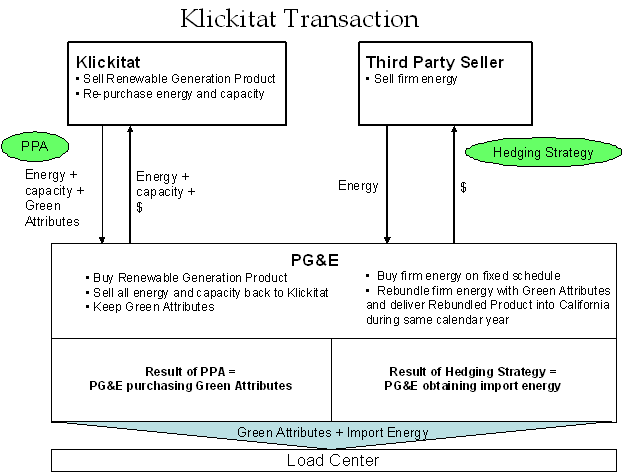
Through its PPA with Public Utility District No. 1 of Klickitat County, Washington (Klickitat), PG&E will purchase Klickitat's share of generation from an RPS-eligible wind facility, White Creek Wind Project I (White Creek).27 Throughout the three and a quarter year contract term, PG&E will purchase a bundled energy product from Klickitat and "immediately and continuously sell the energy and capacity back to Klickitat"; PG&E will retain the Green Attributes.28 PG&E will procure firm system energy from a third party, pursuant to a Hedging Strategy. PG&E will then match the Green Attributes with an equivalent volume of firm system power and deliver a re-bundled product into California. PG&E's PPA with Klickitat and associated Hedging Strategy (collectively, the Transaction) meets the CEC's RPS requirements for firmed and shaped energy deliveries.29
Consistency with Adopted Standard Terms and Conditions
The Commission set forth Standard Terms and Conditions to be incorporated into RPS agreements, including bilateral contracts, in D.04-06-014, D.07-02-011 (as modified by D.07-05-05730), D.07-11-02531 and D.08-04-00932. Standard Terms and Conditions (STC) were originally identified in confidential Appendix B of D.04-06-014 as "may not be modified". On November 16, 2007, the Commission adopted D.07-11-025, which reduced the number of non-modifiable terms from nine to four and refined the language of some of these terms in response to an amended petition for modification of D.04-06-014.33 The remaining non-modifiable STCs include "CPUC Approval", "RECs and Green Attributes", "Eligibility" and "Applicable law". On April 10, 2008 the Commission adopted D.08-04-009, which compiled RPS STCs into one decision.
"May Not be Modified" Terms
During the course of negotiations, the parties found it necessary to modify some of the non-modifiable standard terms to reach agreement, specifically, Applicable Law and Green Attributes. In support of its proposed PPA, PG&E argues that these modifications were necessary to reach an agreement and that the Commission should approve the Transaction based on "the reasonableness of the PPA as a whole, in terms of its ultimate effect on utility customers."34
The Commission-adopted non-modifiable terms, Applicable Law and Green Attributes are cited below.
o Green Attributes
Green Attributes. Seller hereby provides and conveys all Green Attributes associated with all electricity generation from the Project to Buyer as part of the Product being delivered. Seller represents and warrants that Seller holds the rights to all Green Attributes from the Project, and Seller agrees to convey and hereby conveys all such Green Attributes to Buyer as included in the delivery of the Product from the Project.
In AL 3183-E, PG&E declared that modifications were necessary to the non-modifiable standard term and condition for the conveyance of Green Attributes, because Klickitat has pre-existing agreements with multiple parties for rights to the output of the White Creek facility. PG&E seems to be interpreting the term `Project' in the adopted term to refer to the entire RPS generating facility, rather than solely the output PG&E and Klickitat have negotiated for under their PPA. PG&E's proposed PPA modified the Green Attributes STC to reflect that Klickitat must convey any and all Green Attributes equal to, but not greater than, Klickitat's portion of generation from the White Creek facility to PG&E.
o Applicable Law
Governing Law. This agreement and the rights and duties of the parties hereunder shall be governed by and construed, enforced and performed in accordance with the laws of the state of California, without regard to principles of conflicts of law. To the extent enforceable at such time, each party waives its respective right to any jury trial with respect to any litigation arising under or in connection with this agreement.
PG&E asserted that modifications to "Applicable Law" were necessary due to Klickitat's status as a Washington public utility district, specifically, because Washington statutes and case law clearly provide that Klickitat's powers and authorities to act as a public utility district are limited to those expressly granted by Washington statute. Therefore, PG&E said, the parties were required to provide that if PG&E commences a proceeding against Klickitat with respect to Klickitat's powers or authorities, such proceeding must be governed by Washington law and brought in Washington state court or federal court for the Western District of Washington.
In support of its request that the Commission accept the modified STC, PG&E stated that the modifications to Applicable Law, "do not impact the RPS-eligibility of the Renewable Generation Product or the Klickitat Transaction."35 Additionally, PG&E pointed out that for Klickitat to commence a legal course of action against PG&E, such proceeding must be governed by California law and brought in California state court or federal court for the Northern District of California.
While we agree with PG&E that the modified Applicable Law term does not render the Transaction or the underlying energy, per se, ineligible for RPS compliance, we are not persuaded that at this time we can know the "ultimate effect on ratepayers." Moreover, PG&E's PPA is in direct conflict with Commission decision, D.07-11-025.
D.07-11-025, Section 5.4 (emphasis added), states:
Current advice letters with contracts which we have not yet approved, however, should be amended to conform to the decisions herein. That is, for example, electric corporations with pending advice letters should file amendments to the advice letters, as necessary, showing that the contracts contain the language of the four non-modifiable STCs adopted herein. Further, all advice letters filed from today forward must contain the four non-modifiable STCs adopted herein, and be in conformance with all other STCs, as appropriate. Energy Division shall reject pending advice letters that are not in conformance.
For reasons stated above, we determine that PG&E's proposed PPA may not be approved as it violates a Commission decision, and therefore, AL 3183-E should be rejected without prejudice.
"May be Modified" Terms
During the course of negotiations, the parties identified a need to modify some of the modifiable standard terms in order to reach agreement. These terms had all been designated as subject to modification upon request of the bidder in Appendix A of D.04-06-014 and in D.07-11-025.
The Division of Ratepayer Advocates' protest is accepted in part
DRA protested PG&E's AL 3183-E on three points (1) the PPA is a tradable REC transaction, which is not currently eligible for RPS compliance, (2) the PPA would set a price for tradable RECs, and (3) the PPA violates the Commission's rules for Standard Terms and Conditions in RPS contracts. We deny without prejudice DRA's protest on item 1 and item 2, and accept DRA's protest on item 3.
PG&E's Klickitat Transaction is a tradable REC transaction
PG&E's AL 3183-E and response to DRA's protest argues that the CEC pre-approved the type of transaction that is described in PG&E's PPA with Klickitat and the associated Hedging Strategy. Specifically, PG&E points out that its proposed Transaction meets the guidelines outlined in the CEC's RPS Eligibility Guidebook.
The draft resolution E-4170 agreed with DRA's analysis, with clarification.36 Upon further consideration, however, we find that while firming and shaping contracts necessarily share some of the features of an unbundled REC transaction, they are currently eligible for RPS compliance under both SB 107 and the CEC's Guidebook.
As a result, we deny without prejudice DRA's protest that PG&E's AL should be rejected because it represents a tradable REC transaction. We recognize that the CEC's Guidebook is relied upon for negotiating contracts to comply with the RPS program. We clarify here; RPS contract structures, that rely on firming and shaping of out-of-state resources and meet the criteria identified in the CEC's Guidebook, shall be accepted for RPS compliance. A thorough examination of the issues related to the use of unbundled and tradable RECs for RPS compliance is taking place in R.06-02-012 and we do not wish to prejudge the outcome of that proceeding.
PG&E's Klickitat Transaction would set a price for tradable RECs
DRA argues that Commission approval of AL 3183-E would set a precedent for REC prices and impact future REC prices prior to a formal decision on rules governing tradable RECs for compliance.
In its response, PG&E argues that DRA's protest lacks merit because all terms and conditions related to price are confidential in the AL, and therefore would not influence future contracts or set precedent for REC prices in general.
Market sensitive portions of RPS ALs, including REC prices if identified, are submitted under the confidentiality protection of Publ. Util. Code Section 583 and General Order 66-C, to protect against the concerns raised by DRA. Accordingly, we deny DRA's protest on this issue without prejudice.
PG&E's PPA violates Commission's rules for RPS Standard Terms and Conditions
In its protest of AL 3183-E, DRA argues that important terms and conditions of PG&E's PPA violate State law and the Commission's enacted rules for implementing the RPS program, specifically, Standard Terms and Conditions.
PG&E does not claim that DRA's protest is erroneous, but states that DRA ignores the parties' reason for modifying certain non-modifiable STCs.37
In November 2007, the Commission adopted D.07-11-025 in response to an amended petition for modification of the Standard Terms and Conditions Decision, D.04-06-014. We discuss the results of this decision in relation to PG&E's AL 3183-E in the discussion section above, and therefore don't repeat the specific language here. The Commission is clear in its evaluation of the benefits and costs of requiring standard terms and conditions, non-modifiable and modifiable, and the contracting requirements for applicable RPS obligated LSEs. We agree with DRA and accept their protest that the PPA PG&E submitted for CPUC approval violates Commission decision requiring RPS STCs.
The Commission withholds its evaluation of the PPA's terms and conditions, including the contract price and Hedging Strategy
Because the Commission determines that PG&E's proposed PPA may not be approved at this time, we withhold any judgment of the PPA's terms and conditions, including price. The rejection of PG&E's AL without prejudice does not foreclose PG&E from resubmitting the PPA by advice letter in the future.
Confidential information about the contracts should remain confidential
Certain contract details were filed by PG&E under confidential seal. Energy Division recommends that certain material filed under seal pursuant to Public Utilities (Pub. Util.) Code Section 583 and General Order (G.O.) 66-C, and considered for possible disclosure, should be kept confidential to ensure that market sensitive data does not influence the behavior of bidders in future RPS solicitations.
COMMENTS
Public Utilities Code section 311(g)(1) provides that this resolution must be served on all parties and subject to at least 30 days public review and comment prior to a vote of the Commission. Section 311(g)(2) provides that this 30-day period may be reduced or waived upon the stipulation of all parties in the proceeding.
The 30-day comment period for this resolution has been reduced in accordance with the provisions of Rule 14.6 (b). Rule 14.6 (b) provides that the Commission may waive or reduce the comment period for a decision "where all the parties so stipulate." For the purposes of Rule 14.6(b), PG&E and DRA are the parties and have agreed to a shortened comment period.
This matter will be placed on the first Commission agenda 23 days following the mailing of this draft resolution. Comments shall be filed no later than 13 days following the mailing of this draft resolution, reply comments shall be filed no later than 20 days following the mailing of this draft resolution.
Comments were filed in a timely fashion on May 5, 2008 by PG&E, Division of Ratepayer Advocates (DRA), Southern California Edison (SCE), San Diego Gas & Electric (SDG&E), Center for Energy Efficiency and Renewable Technologies (CEERT), Horizon Wind Energy (Horizon), Iberdrola Renewables (Iberdrola), Constellation Energy Commodities Group, Inc. (CCG), NaturEner USA, LLC (NaturEner) and Public Utility District NO. 1 of Klickitat County, Washington (Klickitat). Reply comments were filed on May 12, 2008 by PG&E, SDG&E, DRA, SCE, CAlifornians for Renewabel Energy, Inc. (CARE), Klickitat and jointly by Western Power Trading Forum (WPTF) and Alliance for Retail Energy Markets (AReM).
We carefully considered comments which focused on factual, legal or technical errors and made appropriate changes to the draft resolution.
Parties comment that draft resolution commits legal error in its determination that PG&E's proposed contract represents an unbundled REC transaction
In their comments, PG&E, SCE, CEERT, SDG&E and CCG argue that the draft resolution commits legal error and circumvents the California Energy Commission's authority to determine RPS Eligibility. Specifically, these parties point out that the energy from the Klickitat Transaction would be delivered into California in accordance with the requirements of Public Resources Code § 25741(a), as implemented by the CEC in its RPS Eligibility Guidebook, (Guidebook), pages 21-26. They argue that compliance with the CEC's delivery rules conclusively demonstrates that the contract is a bundled energy transaction, not an unbundled REC transaction.
DRA, supporting the draft resolution, urges that we find the contract structure described in AL 3183-E to be an unbundled REC transaction. Since such transactions are not authorized for RPS compliance at this time, DRA argues that this contract should not be approved.
Parties arguments in favor of approving PG&E's Tranasction fail to take into account the statutory requirements for an unbundled REC transaction, if and when this Commission exercises its authority to allow such transactions to be used for RPS compliance. In a REC-only transaction (if authorized), just as in a bundled energy transaction, the electricity associated with the RECs must be "delivered to a [California] retail seller, the Independent System Operator, or a local publicly owned electric utility." Pub. Util. Code § 399.16(a)(3). Thus, delivery of the electricity into California consistent with the CEC's delivery requirements does not, in itself, determine whether the transaction is an unexceptionable PPA or an unauthorized unbundled REC deal.
DRA's argument, by contrast, gives little weight to the CEC's delivery requirements.
We note that this contract, and the comments on the draft resolution, have raised an important issue in the administration of the RPS program: what is the line of demarcation between firmed and shaped energy contracts with out-of-state generators and unbundled and/or tradable REC transactions with out-of-state generators. We do not attempt to resolve that issue definitively in this resolution. In the interest of moving the RPS program forward at a reasonable cost to ratepayers, and without imposing regulatory uncertainty on RPS-obligated LSEs and market participants, we clarify that PG&E's Transaction with Klickitat, on a structural basis, could be approved at this time. We emphasize that this clarification is not, and should not be taken as, authorization of the use of unbundled RECs for RPS compliance. This clarification also is not, and should not be taken as, an indication that we will approve any RPS contract labeled a bundled energy contract by the utility without examining the question of whether it may be an unbundled REC transaction. We intend to continue to analyze contracts raising this issue on a case-by-case basis, in accordance with RPS statute and rules as implemented by the CEC and this Commission. The draft resolution is modified accordingly.
Parties comment that the draft resolution would violate parties' due process rights
CEERT argues that the conclusion reached in the draft resolution would violate due process rights of the parties to proceeding R.06-02-012, where the Commission is examining the issues related to the use of unbundle and tradable RECs for compliance, and the rights of parties that have appropriately relied on the RPS-eligibility rules adopted in the CEC's Guidebook.38
CARE claims that its due process rights would be violated were the Commission to approve PG&E's AL 3183-E.39 In support of its claim, CARE points out that the Commission is considering a petition to modify D.07-09-040 that, if approved, would adopt policies to protect environmental standards, specifically, avian from harm by wind turbines.
We carefully considered CEERT's comments, which highlight the importance of not prejudging the outcome of Commission's REC decision, and modified the draft resolution accordingly. It is important to clarify that there have been no due process right violations. That is, parties were able to fully participate at the CEC during the development of its latest Guidebook, parties are participating in the REC proceeding (R.06-02-012) and this resolution will not decide anything beyond current RPS policy. We find that CARE's reply comments related to due process are not within the scope of this resolution.
Parties comment that the draft resolution would create regulatory uncertainty and hinder California's RPS Program and climate goals
PG&E, SDG&E, CEERT, Horizon, Iberdrola, CCG, NaturEner, WPTF, AReM and Klickitat argue that the draft resolution would adversely impact on the State's progress towards its 2010 RPS goal and broader climate goals. Specifically, these parties point out that a conclusion in the draft resolution that contradicts the CEC's RPS-eligibility guidelines would undermine the certainty of RPS policies, which is essential to achieving RPS goals. WPTF and AReM filed reply comments in support of these parties' concerns.
We carefully considered parties' comments and we agree that regulatory uncertainty undermines our ability to effectively implement RPS policy and will not benefit RPS program goals or ratepayers interests. We recognize that the CEC's Guidebook is relied upon for negotiating contracts to comply with the RPS program. We clarify here; RPS contract structures, that rely on firming and shaping of out-of-state resources and meet the criteria identified in the CEC's Guidebook, shall be accepted for RPS compliance. A thorough examination of the issues related to the use of unbundled and tradable RECs for RPS compliance is taking place in R.06-02-012 and we do not wish to prejudge the outcome of that proceeding. The draft resolution is modified accordingly.
If the Commission modifies the draft resolution, all matters DRA raised in its protest should be addressed
DRA supported the draft resolution, but clarified that in the event the Commission modifies the draft resolution, the Commission should address all aspects of their protest not addressed in the draft, i.e., that the PPA sets a precedential REC price and the PPA violates mandatory RPS Standard Terms and Conditions.40 41
PG&E argues in its reply comments that DRA's remaining protests provide no basis for rejecting the PPA. That is, PG&E says that because the PPA price is confidential, it will not set a price for RECs, and that the modifications STCs were necessary and reasonable.42 Klickitat's reply comments state that, "DRA is reading STC too expansively, and there is no conflict between STC 17 and PPA provisions stating that Klickitat PUD's power and authorities will be governed by Washington Law."43 44
 DRA is correct that a full review of its protest is necessary, given modifications to the draft resolution based on comments and reply comments. While we agree with PG&E that DRA's concerns about setting a price for RECs is unwarranted, we take issue with PG&E's and Klickitat's interpretation of the Commission's STC decisions. D.07-11-025 clearly states the purpose of having an Applicable Law term, that is non-modifiable, and the expectation of parties and Energy Division to comply with the requirements adopted in the decision. The draft resolution is modified accordingly.
CARE's comment, which questions the CEC's authority to determine whether PG&E's Transaction with Klickitat is RPS-Eligible, is misguided
In its reply comments, CARE claims that PG&Es proposed PPA constitutes an unbundled REC transaction because Klickitat is a non-jurisdictional government agency, for which the CEC has does not have regulatory authority over.45
CARE correctly points out that the CEC is authorized to verify retail sellers' compliance with the RPS Program, and in the case of PG&E's Transaction with Klickitat, PG&E is the "retail seller," and therefore, the CEC is authorized to determine eligibility.
PG&E's AL 3183-E conflicts with Publ. Util. Code § 25740
CARE's argues that PG&E's Transaction conflicts with RPS legislation and does not represent an eligible out-of-state firming and shaping transaction because there is no indication that the wind power would not be generated if PG&E had not entered into its agreement with Klickitat.46
CARE's comments identify important questions which concern RPS policy and implementation and we encourage them to raise these issues in R.06-02-012.
PG&E's AL 3183-E should be considered by application and not by advice letter
In its reply comments, DRA states that the draft resolution should not modified based on factual and policy assertions. DRA requests the Commission direct PG&E to use the application process in order to allow parties the proper opportunity to examine PG&E's proposed Transaction with Klickitat.47 CARE concurs with DRA's support of the draft resolution and makes a similar procedural request of the Commission. Specifically, CARE requests the Commission require an application for RPS contracts that involve "a local publically owned electric utility" as a counter party.48
The Commission recently addressed what was the preferred procedural vehicle for RPS contracts, and determined that, on balance, filing RPS contracts by advice letter is the preferred process. However, we do not abandon the Commission's regulatory process for considering legal matters. In D.07-02-011, we said that for an RPS contract that raises potentially disputed and important legal issues; an IOU may elect to file an application, a party may protest an advice letter and request the Commission require it withdrawn and filed by application or Energy Division may seek conversion on its own motion as an advice letter to an application. 49
Because we reject without prejudice PG&E's AL as it violates a Commission decision, DRA's request to have the Commission consider these issues by application does not need to be considered at this time. Still, we agree with DRA that some matters should addressed by application. In the future, we expect PG&E to use the application process when appropriate. Going forward, parties continue to have the option to request that an advice letter be considered via the Commission's application process.
FINDINGS OF FACT
1. The RPS Program requires each utility, including PG&E, to increase the amount of renewable energy in its portfolio to 20 percent by 2010, increasing by a minimum of one percent per year.
2. D.04-06-014 and D.07-11-025 set forth standard terms and conditions to be incorporated into each RPS PPA. Those terms were compiled and published by D.08-04-009.
3. The California Energy Commission is responsible for certifying the RPS-eligibility of renewable facilities that are located out-of-state and have their first point of interconnection to the WECC transmission system.
4. The California Energy Commission is responsible for verifying delivery from out-of-state facilities.
5. The Commission is responsible for determining the extent to which unbundled RECs can be used for RPS compliance.
6. PG&E filed Advice Letter 3183-E on December 21, 2007, requesting Commission review and approval of a renewable resource contract with Public Utility District No.1 of Klickitat County.
7. The Commission required each utility to establish a Procurement Review Group (PRG) to review the utilities' interim procurement needs and strategy, proposed procurement process, and selected contracts.
8. PG&E briefed its Procurement Review Group regarding this contract on May 30, 2007.
9. A protest to AL 3183-E was filed by the Division of Ratepayer Advocates on January 10, 2008 and PG&E responded to the protest on January 17, 2008.
10. The Commission accepts DRA's protest in part and denies without prejudice all other aspects.
11. The White Creek Wind Project I is operational and delivering under a long-term contract with parties other than PG&E.
12. PG&E's proposed PPA with Klickitat does not include the non-modifiable Standard Terms and Conditions required for all RPS contracts, pursuant to D.07-11-025.
13. The California Energy Commission has determined that the delivery structure of the Klickitat Transaction would meet the delivery requirements according to the California Energy Commission's current RPS-Eligibility Guidebook.
14. On May 5, 2008 comments on draft resolution E-4170 were submitted by PG&E, DRA, SCE, SDG&E, CEERT, Horizon, Iberdrola, CCG, NaturEner and Klickitat. On May 12, 2008, PG&E, DRA, SCE, SDG&E, CARE, Klickitat PUD, WPTF and AReM submitted reply comments.
CONCLUSIONS OF LAW
1. The RPS Program requires each utility, including PG&E, to increase the amount of renewable energy in its portfolio to 20 percent by 2010, increasing by a minimum of one percent per year.
2. The California Energy Commission is responsible for certifying the RPS-eligibility of renewable facilities that are located out-of-state and have their first point of interconnection to the WECC transmission system.
3. The California Energy Commission is responsible for verifying delivery from out-of-state facilities.
4. The Commission is responsible for determining the extent to which unbundled RECs can be used for RPS compliance.
5. The California Energy Commission has determined that the delivery structure of the Klickitat Transaction is RPS-eligible.
6. PG&E's proposed PPA violates D.07-11-025, which requires that all RPS contracts contain the four non-modifiable Standard Terms and Conditions set forth in D.07-11-025.
7. The Commission denies without prejudice, DRA's protest that PG&E's AL should be rejected because it represents a tradable REC transaction and that Commission approval of AL 3183-E would be set a precedent for REC prices and impact future REC prices.
8. The Commission accepts DRA's protest that the proposed PPA violates Commission's rules for RPS Standard Terms and Conditions.
9. D.04-06-014 and D.07-11-025 set forth standard terms and conditions to be incorporated into each RPS PPA. Those terms were compiled and published by D.08-04-009.
10. PG&E's proposed PPA conflicts with existing Commission rules for the RPS Program.
11. Certain material filed under seal pursuant to Public Utilities (Pub. Util.) Code Section 583 and General Order (G.O.) 66-C, and considered for possible disclosure, should not be disclosed. Accordingly, the confidential appendices, marked "[REDACTED]" in the redacted copy, should not be made public upon Commission approval of this resolution.
12. PG&E's proposed PPA conflicts with existing Commission rules for the RPS Program.
13. AL 3183-E should be rejected without prejudice.
THEREFORE IT IS ORDERED THAT:
1. AL 3183-E is rejected without prejudice.
2. This Resolution is effective today.
I certify that the foregoing resolution was duly introduced, passed and adopted at a conference of the Public Utilities Commission of the State of California held on May 15, 2008; the following Commissioners voting favorably thereon:
_______________
PAUL CLANON
Executive Director
MICHAEL R. PEEVEY
PRESIDENT
DIAN M. GRUENEICH
JOHN A. BOHN
RACHELLE B. CHONG
TIMOTHY ALAN SIMON
Commissioners
Appendix A
CEC Pre-Certification of Out-of-State Delivery
Klickitat Transaction
Generator |
White Creek Wind Project I (White Creek) |
RPS Resource |
Wind |
Source of Delivered Energy |
Import energy from a third party seller at COB |
Sink of Delivered Energy |
NP-15 (via COB) |
Description of banking and shaping arrangement |
o PG&E buys intermittent wind energy from Public Utility District No. 1 of Klickitat County, Washington (Klickitat) at the project bus bar, in volumes equal to Klickitat's share of White Creek's output (Renewable Generation Product). o Title to the energy and capacity (without the Green Attributes) (Non-Renewable Generation Product) is immediately sold back to Klickitat. o Pursuant to its Hedging Strategy, PG&E purchases fixed price import energy from a third party seller at COB under a WSPP Schedule C fixed schedule (current wholesale market protocol) to match expected annual amounts of Renewable Generation Product. o On a PG&E portfolio basis, the lesser of the Renewable Generation Product metered at the project bus bar and the imported energy purchased from a third party seller during the same calendar year will count for RPS compliance. |
Schematic diagram of banking/shaping |
See Attachment A |
Attachment A
1 The White Creek Wind facility achieved commercial operation on November 21, 2007. AL 3183-E, p. 4.
2 Klickitat procures 24.43% of the output from the White Creek Wind facility under a long-term energy purchase agreement AL 3183-E, p. 5.
3 The White Creek Wind facility has a total capacity of 204.7 MW. AL 3183-E, p. 2.
4 Chapter 516, statutes of 2002, effective January 1, 2003 (SB 1078)
5 The Energy Action Plan was jointly adopted by the Commission, the California Energy Resources Conservation and Development Commission (CEC) and the California Power Authority (CPA). The Commission adopted the EAP on May 8, 2003.
6 http://www.cpuc.ca.gov/Published/Final_decision/36206.htm
7 APT - An LSE's APT for a given year is the amount of renewable generation an LSE must procure in order to meet the statutory requirement that it increase its total eligible renewable procurement by at least 1% of retail sales per year.
8 Chapter 464, Statutes of 2006 (SB 107)
9 Pub. Util. Code Section 399.14(a)(2)(C)
10 http://docs.cpuc.ca.gov/word_pdf/FINAL_DECISION/27360.PDF
11 D.04-06-015; http://docs.cpuc.ca.gov/word_pdf/FINAL_DECISION/37383.pdf
12 http://docs.cpuc.ca.gov/WORD_PDF/FINAL_DECISION/38287.PDF
13 http://www.cpuc.ca.gov/word_pdf/FINAL_DECISION/52178.pdf
14 Respectively, Resolution E-3980: http://www.cpuc.ca.gov/WORD_PDF/FINAL_RESOLUTION/55465.DOC, Resolution E-4049: http://www.cpuc.ca.gov/word_pdf/FINAL_RESOLUTION/63132.doc, Resolution E-4110: http://www.cpuc.ca.gov/word_pdf/FINAL_RESOLUTION/73594.pdf
15 D.06-10-050, Attachment A, http://www.cpuc.ca.gov/WORD_PDF/FINAL_DECISION/61025.PDF as modified by D.07-03-046 http://www.cpuc.ca.gov/WORD_PDF/FINAL_DECISION/65833.PDF.
16 The IPT represents the amount of RPS-eligible procurement that the LSE must purchase, in a given year, over and above the total amount the LSE was required to procure in the prior year. An LSE's IPT equals at least 1% of the previous year's total retail electrical sales, including power sold to a utility's customers from its DWR contracts.
17 http://www.cpuc.ca.gov/PUBLISHED/FINAL_DECISION/27360.htm
18 SB 107 (Public Resources Code section 25473(b)(1)(F)) provides that, to receive SEPs, a project must have resulted from a competitive solicitation; see also § 399.13(e).
19 While SB 1036 (2007) reformed the SEP process, the restriction that eligible contracts must result from a competitive solicitation remains.
20 D.06-10-019 pp. 31-32.
21 http://docs.cpuc.ca.gov/WORD_PDF/FINAL_DECISION/75354.PDF
22 Renewables Portfolio Standard Eligibility, third edition, page 21-28 http://www.energy.ca.gov/2007publications/CEC-300-2007-006/CEC-300-2007-006-ED3-CMF.PDF
23 Out-of-state facilities are defined as located outside California and have their first point of interconnection to the WECC transmission system outside the state.
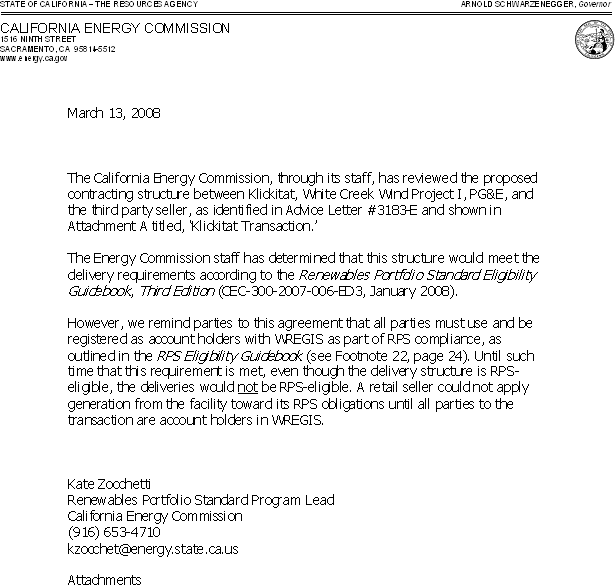
24 CEC staff submitted a letter to Energy Division which states that the contract structure described by AL 3183-E would meet CEC delivery requirements pursuant to its Guidebooks. See Appendix A. The diagram and transaction summary were provided by PG&E.
25 Aglet is no longer a member of PG&E's PRG group, but was during the time PG&E negotiated its contract with Klickitat.
26 AB 32 (Nunez), Stats. 2006, chapter 488.
27 The White Creek facility achieved commercial operation on November 21, 2007 and is delivering 100 percent of its generation to four buyers pursuant to a 20-year energy purchase agreement. Klickitat Public Utility District No. 1 receives 26 percent of the facilities output. http://www.cowlitzpud.org/pdf/WC_Q&A_07.pdf
28 AL 3183-E, page 2.
29 Renewables Portfolio Standard Eligibility, third edition, page 23
30 D.07-05-057 Order Modifying Decision 07-02-011 Regarding Definition of Green Attributes http://www.cpuc.ca.gov/word_pdf/FINAL_DECISION/68383.pdf
31 D.07-11-025, Attachment A http://docs.cpuc.ca.gov/WORD_PDF/FINAL_DECISION/75354.PDF
32 http://docs.cpuc.ca.gov/WORD_PDF/FINAL_DECISION/81269.PDF
33 On February 1, 2007, PG&E and SCE jointly filed a petition for modification of D.04-06-014. On May 22, 2007, a PD was filed and served. Prior to the PD being voted on by the Commission, PG&E and SCE filed an amended petition for modification of D.04-06-014.
34 AL 3183-3, page 16
35 Id.
36 The original draft resolution E-4170 determined that PG&E's proposed Transaction represented an unbundled REC transaction, not a tradable REC transaction as DRA stated in its protest.
37 PG&E response to DRA protest, pp. 9-10.
38 CEERT comments, pp. 4-5.
39 CARE reply comments, pp. 4-6.
40 DRA comments, p.1-2. Note: DRA inadvertently cites D.07-05-025, rather than D.07-11-025
41 DRA protest, p. 2.
42 PG&E reply comments, pp. 3-4.
43 Klickitat reply comments, p. 3. Note: Klickitat inadvertently cites D.04-04-027, rather than, D.07-11-025.
44 STC 17 refers to non-modifiable STC "Applicable Law"
45 CARE, reply comments, p. 3.
46 Id. pp. 6-7.
47 DRA reply comments, p. 1.
48 CARE reply comments, p. 9.
49 D.07-02-011, pp. 47-50.
