CPSD/RWC/DAR/SHK/vdl DRAFT Agenda ID #6993
Ratesetting
Decision _____________
BEFORE THE PUBLIC UTILITIES COMMISSION OF THE STATE OF CALIFORNIA
Application of the County of Kern for authority/order to convert the existing private at-grade highway-rail crossing of Patterson Road to a public crossing, CPUC Crossing No. 001B-396.00, DOT No. 750636E, near the community of Rosamond. |
Application 07-06-019 (Filed June 18, 2007) |
OPINION GRANTING COUNTY OF KERN AUTHORITY
TO MODIFY AND IMPROVE THE RAILROAD CROSSING OF PATTERSON ROAD ACROSS THE UNION PACIFIC RAILROAD
TRACK AND CONVERT TO A PUBLIC CROSSING
Summary
This decision grants the County of Kern's (County) request to alter and convert to a public crossing the existing private at-grade highway-rail crossing of Union Pacific Railroad Company's (UPRR) Mojave Subdivision railroad track and Patterson Road near the unincorporated community of Rosamond in Kern County.
Discussion
The existing private at-grade highway-rail crossing of Patterson Road is used to access multiple properties east of the UPRR track. As is minimally required of private crossings by General Order 75-D, it currently has a STOP sign and a Commission Standard 1-X private crossing sign on each approach to the track. The application states that Patterson Road provides the only access to the properties east of the railroad track. Train-vehicle collisions at this crossing in recent years have demonstrated the urgent need for safety improvements. In order to address the safety concerns, the application proposes to install Commission Standard 9 warning devices (automatic gate arm and flashing light signals), to improve the roadway, signage and markings, and to convert Patterson Road to a County maintained public roadway in the vicinity of the railroad track.
Following fatal train-vehicle collisions in 2000 and 2005, the Commission's Rail Crossings and Engineering Section (RCES) identified this crossing to be in urgent need of safety improvements. After determining that there was no valid contract for the maintenance of this crossing, RCES recommended to UPRR that the private crossing be eliminated. However, private parties including MSBH Land Company (MSBH), Delta Liquid Energy (DLE), Rosamond Community Services District (RCSD), and Southern California Edison (SCE) all stated that they require this crossing in order to conduct their businesses. During ongoing discussion of how to address the safety concerns, another incident occurred in December 2006. Since then, the private parties, County, UPRR, and RCES have worked closely to agree on appropriate improvements.
The current crossing has unrestricted access, there are multiple private parties that must utilize the crossing, and members of the general public use the roadway without permission. Therefore, it is appropriate that the roadway be configured and maintained for safe use by the public. The County has generally agreed to adopt and maintain the roadway through the railroad crossing once the roadway is improved to County minimum standards and the railroad crossing warning devices are improved. The parties that depend on access through the crossing will provide all funding for the necessary improvements.
The County and UPRR have entered an agreement to improve the crossing through installation of Commission Standard 9 warning devices. The agreement for funding this part of the project is referred to as the "Safety Improvements" agreement. It covers costs that must be paid to UPRR for the acquisition of right-of-way and the design and construction of the railroad crossing warning devices. The estimated project costs to be paid to UPRR to install the railroad crossing warning devices is approximately $228,885, and right-of-way costs approximately $17,980, for a total estimated cost of $246,865. There will be no cost related to the track surface because the concrete panels already in place are sufficient. The actual cost of the safety improvements will be split between the parties as detailed by the percentages below.
As of August 2007, the County expects that a separate agreement for funding necessary "roadway improvements" will be executed in the near future. These improvements include design and reconstruction of the roadway approaches within approximately 100 feet on each side of the track. It is expected to cost no more than $50,000. The actual cost of the roadway improvements will be split between the parties as detailed by the percentages below.
"Safety Improvements" Funding | ||
Contributor |
Split |
Estimated Contribution |
MSBH |
30% |
$74,059.50 |
DLE |
20% |
$49,373.00 |
RCSD |
30% |
$74,059.50 |
SCE |
20% |
$49,373.00 |
Total |
100% |
$246, 865 |
"Roadway Improvements" Funding | ||
Contributor |
Split |
Estimated Contribution |
MSBH |
30% |
$15,000 |
DLE |
20% |
$10,000 |
RCSD |
50% |
$25,000 |
Total |
100% |
$50,000 |
The application states that grade-separation is not practicable due to the roadway geometrics, particularly the proximity of the intersection with Sierra Highway which is located approximately 100 feet west of the track. The application also states that funding for a grade-separation would be difficult to obtain due to the low volume of roadway traffic. The application states that these factors make a grade-separation at this location very complex and cost prohibitive.
The crossing is currently an unmarked asphalt roadway, approximately 22 feet wide, crossing a single railroad track. The daily traffic volume along Patterson Road is estimated by the County to be 210 vehicles per day. The roadway speed limit is not posted, but traffic speeds are generally under 25 MPH. UPRR has reported that approximately 20 trains per day travel through the crossing at a maximum speed limit of 70 MPH. There have been three train-vehicle collisions at this private crossing since 2000, resulting in four fatalities and one injury.
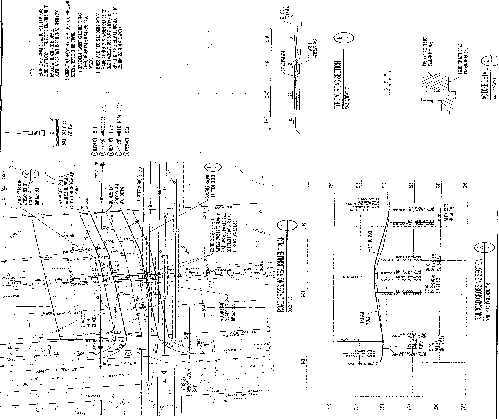
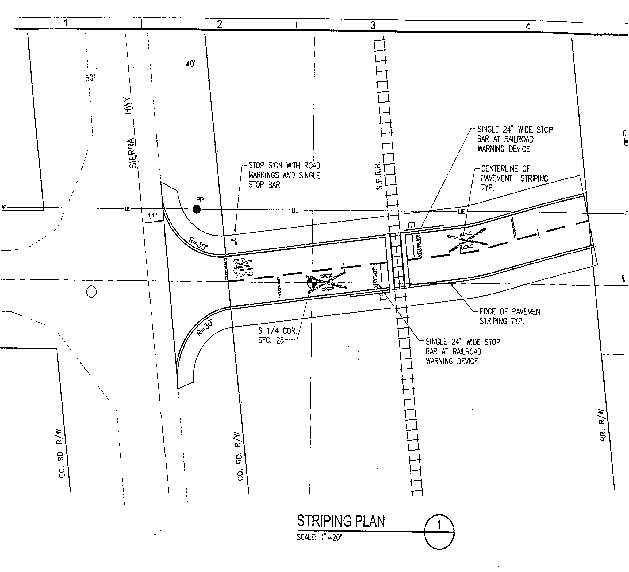
The County proposes to alter the crossing as outlined in its application and as shown in plans attached to the application and Appendix B of this Order, and as supplemented by the County's email of July 27, 2007 to RCES. The proposed alterations include the following:
· Installation of two Commission Standard 9 warning devices (automatic gate with flashing light signals, as defined in General Order 75-D), one on each approach to the track.
· Installation of standard highway-rail crossing signage and markings on each side of the track as required by the California Manual on Uniform Traffic Control Devices published by Caltrans (CA MUTCD). The items include advance warning signs (W10-1), RXR advance warning pavement markings, and stop lines.
· Installation of R8-8 "DO NOT STOP ON TRACKS" signs.
· Improvement (reduction) of the roadway grade on each approach to the track.
· Minor widening of the roadway to provide a minimum width of 24 feet within 100 feet along the roadway on each side of the track.
· Installation of at-least 20 feet of curb (Asphaltic Concrete dike) along the right shoulder on each approach to the crossing.
Environmental Review and CEQA Compliance
The California Environmental Quality Act of 1970 (CEQA, as amended, Public Resources Code Section 21000 et seq.) applies to discretionary projects to be carried out or approved by public agencies. A basic purpose of CEQA is to inform governmental decision-makers and the public about potential, significant environmental effects of the proposed activities. The Commission must issue a discretionary decision in order for the project to proceed (i.e., the Commission must approve the project pursuant to Section 1202 of the Public Utilities Code); therefore, the Commission must consider the environmental consequences of the project by acting as either a lead or responsible agency under CEQA.
The lead agency is the public agency with the greatest responsibility for supervising or approving the project as a whole.1 Here, the County is the lead agency for this project and the Commission is a responsible agency. As a responsible agency under CEQA, the Commission must consider the lead agency's environmental documents and findings before acting on or approving this project.2
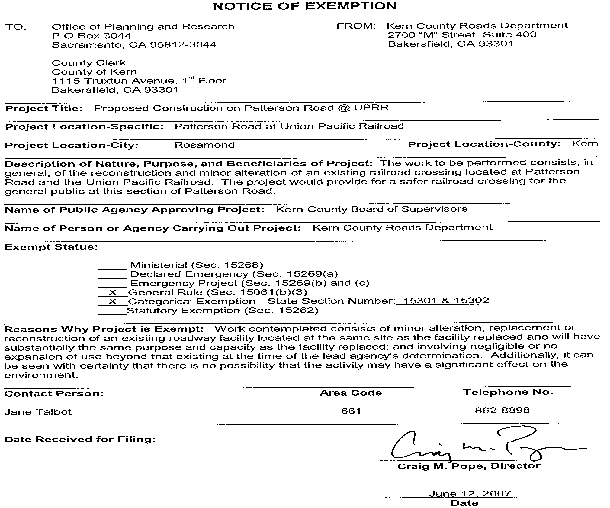
The County states that this project is a minor alteration of an existing railroad crossing and will have the same purpose and capacity as currently exists, and that this activity will not have a significant impact on the environment. It further states that this project is categorically exempt pursuant to CEQA Sections 15301 and 15302. A copy of the Notice of Exemption (NOE), dated June 12, 2007, is attached as Appendix C. The Commission has reviewed and considered the County's NOE and finds it adequate for our decision-making purposes.
Filing Requirements and Staff Recommendation
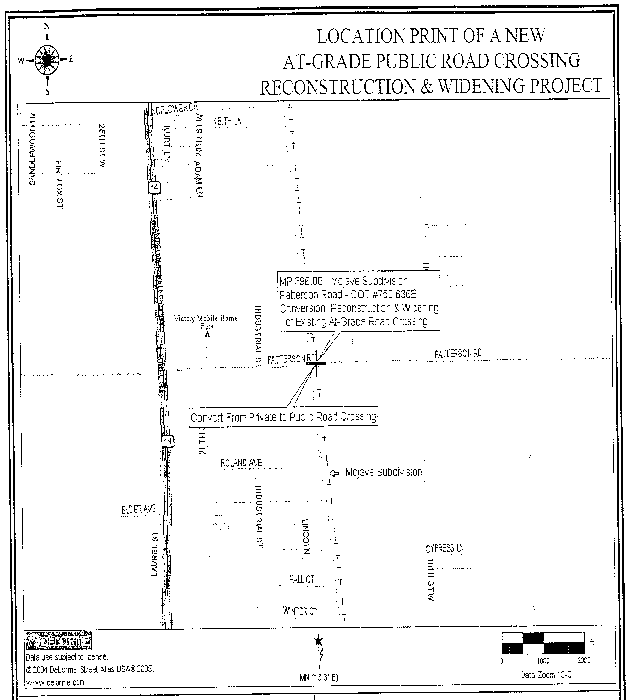
The application is in compliance with the Commission's filing requirements, including Rule 3.7 of Rules of Practice and Procedure, which relates to the construction of a public highway across a railroad. A vicinity map of the crossing location and a plan of the proposed alterations to the crossing are shown in Appendices A and B of this order.
RCES has visited the site, reviewed the application and analyzed the County's proposed alterations to the crossing. RCES recommends that the Commission grant the County's request.
RCES has worked closely with the County, UPRR, and current private-party users of this crossing to address the safety concerns of the private crossing. Funding is in place and procurement of the devices has already begun. RCES believes that the accident history (three train-vehicle collisions at this crossing since 2000, resulting in four fatalities and one injury) requires an expedited construction schedule for the County to construct the proposed safety improvements. Therefore, RCES recommends that the Commission should shorten the usual two-year authorization period to one year.
Categorization and Need for Hearings
In Resolution ALJ 176-3195, dated July 12, 2007, and published in the Commission Daily Calendar on July 13, 2007, the Commission preliminarily categorized this application as ratesetting, and preliminarily determined that hearings were not necessary. No protests have been received. Given these developments, it is not necessary to disturb the preliminary determinations made in Resolution ALJ 176-3195.
Waiver of Comment Period
This application is an uncontested matter in which the decision grants the relief requested. Accordingly, pursuant to Section 311(g)(2) of the Public Utilities Code and Rule 14.6(c)(2) of the Commission's Rules of Practice and Procedure, the otherwise applicable 30-day period for public review and comment is waived.
Richard Clark is the assigned Examiner in this proceeding.
Findings of Fact
1. Notice of the application was published in the Commission's Daily Calendar on July 13, 2007. There are no unresolved matters or protests; a public hearing is not necessary.
2. County requests authority, under Public Utilities Code Sections 1201-1205, to convert the private at-grade highway-rail crossing of Patterson Road to a public crossing.
3. The crossing is necessary in order to allow access to the properties along Patterson Road east of the UPRR railroad track.
4. Public safety requires that the railroad crossing warning devices, roadway signage, roadway markings, and the roadway itself be improved.
5. County is the lead agency for this project under CEQA, as amended.
6. County adopted an NOE for this project pursuant to CEQA.
7. The Commission is a responsible agency for this project, and has reviewed and considered the lead agency's NOE.
Conclusions of Law
1. The NOE is adequate for our decision-making purposes.
2. The application should be granted as set forth in the following order.
IT IS ORDERED that:
1. County of Kern (County) is authorized to alter and convert to a public crossing the existing at-grade private crossing of Union Pacific Railroad Company's (UPRR) Mojave Subdivision and Patterson Road, identified as CPUC Crossing No. 001B-395.90-X. The public at-grade crossing shall be identified as CPUC Crossing No. 001B-396.00.
2. The alterations to the crossing shall include:
· Installation of two Commission Standard 9 warning devices (automatic gate with flashing light signals, as defined in General Order 75-D), one on each approach to the track.
· Installation of two W10-1 advance warning signs, two RXR advance warning pavement markings, two stop line markings, and R8-8 "DO NOT STOP ON TRACKS" signs.
· Improvement (reduction) of the roadway grade on each approach to the track.
· Minor widening of the roadway to provide a minimum width of 24 feet within 100 feet along the roadway on each side of the track.
· Installation of at-least 20 feet of curb (Asphaltic Concrete dike) along the right shoulder on each approach crossing.
3. Construction and maintenance costs shall be borne in accordance with an agreement that has been entered into between County and UPRR (parties). Should the parties fail to agree, the Commission will apportion the costs of construction and maintenance by further order.
4. Within 30 days after completion of the work under this order, UPRR shall notify the Commission's Rail Crossing Engineering Section (RCES) that the authorized work is completed, by submitting a completed Commission Standard Form G titled Report of Changes at Highway Grade Crossings and Separations.
5. This authorization shall expire if not exercised within one year unless time is extended or if the above conditions are not complied with. Authorization may be revoked or modified if public convenience, necessity, or safety so require.
6. A request for extension of the one-year authorization period must be submitted to RCES at least 30 days before the expiration of that period. A copy of the request must be sent to all interested parties.
7. This application is granted as set forth above.
8. Application 07-06-019 is closed.
This order is effective today.
Dated ____________, at San Francisco, California.
APPENDIX A: VICINITY MAP
APPENDIX B1: CONSTRUCTION PLAN
APPENDIX B2: STRIPING PLAN
APPENDIX C: NOTICE OF EXEMPTION
1 CEQA Guidelines (Title 14 of the California Code of Regulations), Section 15051(b).
2 CEQA Guidelines, Sections 15050(b) and 15096.
