3. Summary of Utility Incentive Mechanisms
It is instructive to summarize each of the utilities' incentive mechanisms and their hedging activities to date as a starting point to better understand what steps the Commission should take in addressing the treatment of hedging in connection with the design of incentive mechanisms going forward. Our purpose is not to engage in a hindsight review, however, but rather to provide a framework for lessons learned as to how incentives for hedging have worked over the past three winters, and how those lessons may be applied in reforms that we implement going forward.
As of April 1, 2008, SoCalGas' Gas Acquisition Department is responsible for supplying core customers of SoCalGas as well as SDG&E, and procurement costs for the combined portfolio of both utilities will be under the SoCalGas GCIM structure. The SoCalGas GCIM program was originally approved in D.94-03-076 with many subsequent modifications and extensions. The GCIM was designed (a) to provide more efficient regulatory controls than its predecessor, i.e., annual reasonableness reviews; (b) to balance the interests of core customers and shareholders, and; (c) to give utilities market-based incentives to acquire gas at the lowest possible cost while taking on some associated risks.
To achieve the GCIM objectives, the Commission allows SoCalGas to use a number of cost-saving gas procurement methods such as the physical sale of gas to third parties and hub transaction activities.12 The GCIM provides for the measurement of gas purchasing performance by weighing actual performance against a "...benchmark cost of gas intended to emulate actual market conditions on a monthly basis." The GCIM provides for a tolerance band, or deadband, around the benchmark cost.
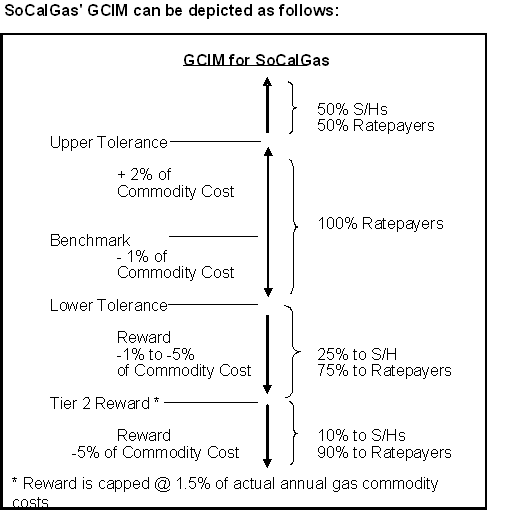
-5% Below
Commodity
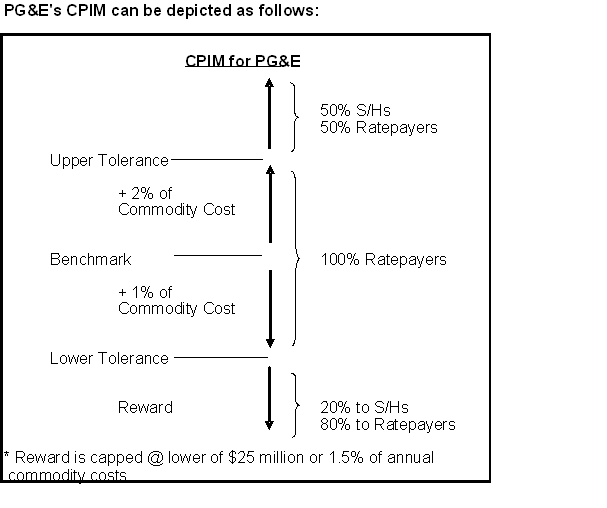
PG&E's Core Procurement Department manages its gas procurement costs under the CPIM, as approved in D.97-08-055,13 which established the methodology to recover core gas procurement costs. The CPIM provides a market-based measure of the performance of PG&E's Core Procurement Department, as a means for the Commission to ensure the reasonableness of costs incurred on behalf of core customers. The allowed monthly benchmark dollars over the annual CPIM period are compared to actual costs to determine PG&E's performance. A tolerance band is constructed around the benchmark, and is defined as a range of costs that is considered reasonable. If PG&E's actual gas costs, as measured against the CPIM benchmark are between the upper and lower limit specifications for the tolerance band, there is no shareholder reward or penalty for the CPIM period. If actual costs or savings fall outside the tolerance band, there will be sharing between ratepayers and PG&E shareholders of associated gains or losses that exceed the tolerance band.
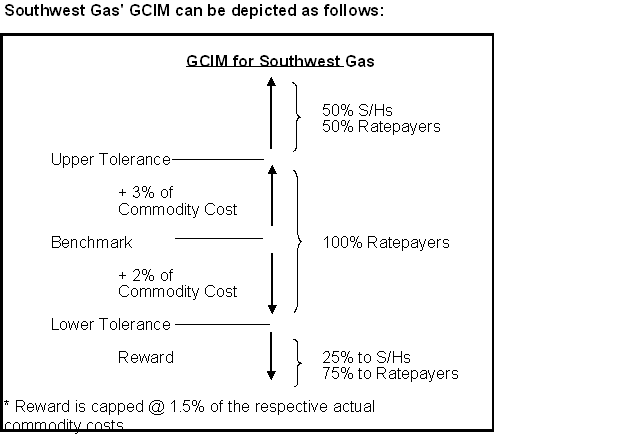
Pursuant to D.05-05-033, SWG first established its gas cost incentive mechanism. SWG's GCIM provides an objective standard by which to measure SWG's gas procurement performance, an incentive to lower overall gas costs, and a sharing of gas procurement benefits between ratepayers and SWG. Any actual savings or costs that exceed either the upper or lower tolerance bands are shared between shareholders and ratepayers, calculated as a percentage of the annual gas cost benchmark. The SWG GCIM also includes a storage capacity target14 and a "Volatility Mitigation Program" (VMP) which involves fixed price contracts entered into for price mitigation. The VMP purchases are flowed through, and thus have no impact on GCIM rewards or penalties.15 Transportation and storage costs are also flowed through and do not impact the GCIM.
12 Up until GCIM Year 11 (calendar year 2005), financial derivatives were completely included within the GCIM to reduce and effectively manage the cost of gas for its core ratepayers. In GCIM Year 12 and 13, SoCalGas performed its winter hedging outside of its GCIM, as authorized in D.05-10-043 and D.06-08-027, respectively.
13 The CPIM was based on the PG&E/ORA Post-1997 CPIM Agreement and PG&E's Supplemental Report Describing the Post-1997 CPIM.
14 The GCIM requires Southwest to have storage reserves filled to a target level of 80% of capacity by November 1, of each year. Failure to meet the 80% target requires Southwest to explain the variance to core customers in the annual GCIM filing.
15 VMP purchases are limited to 25% of the forecasted annual gas supply.


