Discussion
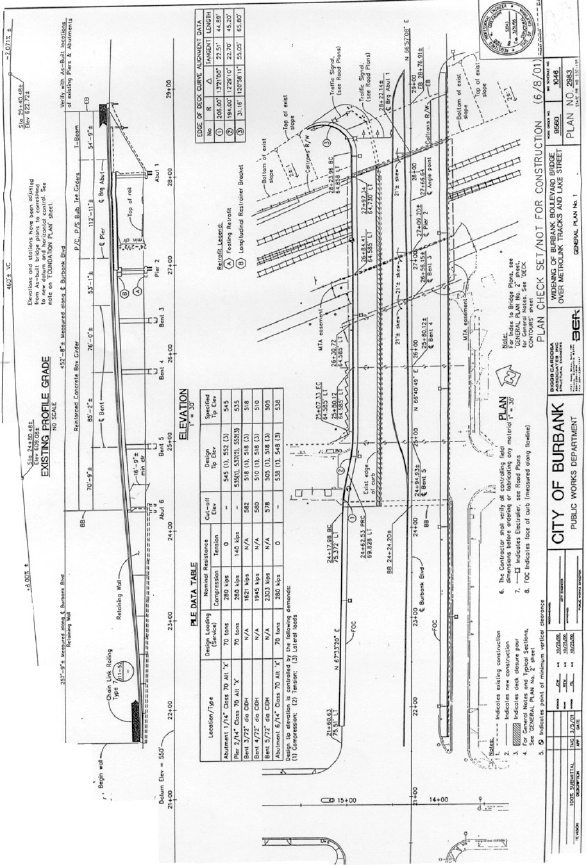
The existing overhead grade separation bridge structure was built in 1957 and carries Burbank Boulevard over the MTA main line tracks, formerly owned by the Southern Pacific Transportation Company, and Lake Street. The structure is approximately 78 feet in width and 453 feet in length, with one simple span of about 113 feet and four continuous spans that vary in length from about 53 feet to 85 feet. In 1996, the existing bridge underwent a seismic retrofit. This retrofit included abutment lumber blocking, steel column casting, and a bent cap retrofit.
The proposed project will widen the existing bridge structure approximately 30 feet to the north. Originally the widening was to be wedge shaped to transition from the existing alignment at the Interstate 5 (I-5) Freeway overcrossing to the new wider alignment at the Victory Boulevard intersection. However, upon California Department of Transportation review of the proposal, it was determined that the I-5 overcrossing would eventually be widened, and the Burbank Boulevard bridge should accommodate this ultimate alignment.
The widening will therefore be parallel, providing a total of 90 feet between existing curb face and new curb face. In order to match vertical and lateral stiffnesses, and to provide general deflection compatibility, the superstructure of the widened portion will match the superstructure of the existing bridge. The widened portion will consist of simple span precast-prestressed concrete bulb tee girders from Abutment 1 to Pier 2, and continuous cast-in-place mild reinforced box girder from Pier 2 to Pier 6. The widened portion will be supported by the construction of new substructure elements that will extend the existing substructure at the abutments, pier wall, and bents.
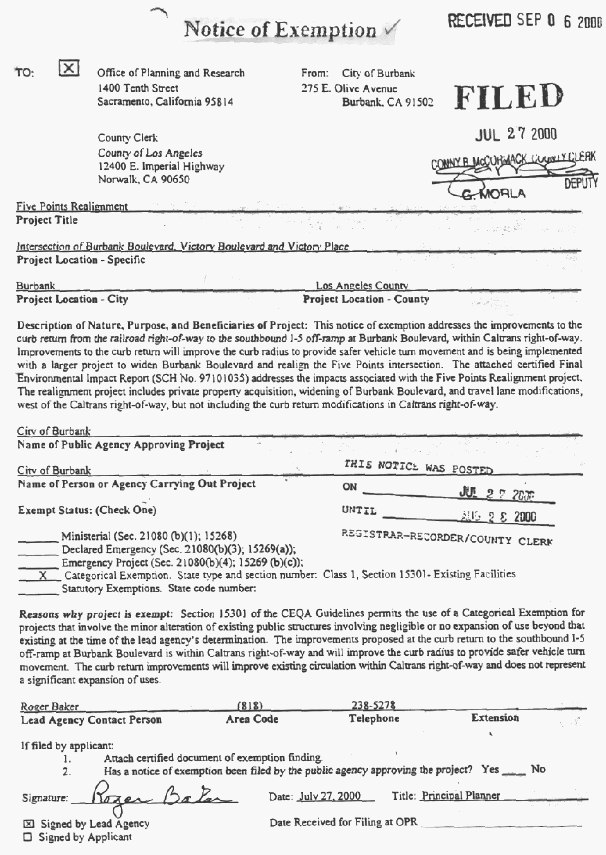
City is the lead agency for this project under the California Environmental Quality Act of 1970 (CEQA), as amended, Public Resources Code Section 21000 et seq. A Notice of Exemption was filed with the State Secretary of Resources - Office of Planning and Research on July 27, 2000. The City found the project categorically exempt from CEQA consistent with Section 15301 of CEQA Guidelines which provides a Categorical Exemption for projects that involve the minor alteration of existing public structures involving negligible or no expansion of use beyond that existing at the time of the lead agency's determination.
The Commission is a responsible agency for this project under CEQA. CEQA requires that the Commission consider that portion of the environmental consequences of a project within its area of expertise that is subject to its discretionary approval. In particular, to comply with CEQA, a responsible agency must consider the lead agency's environmental impact report or Negative Declaration prior to acting upon or approving the project (CEQA Guideline Section 15050 (b)). The specific activities that must be conducted by a responsible agency are contained in CEQA Guideline Section 15096.
The Commission has reviewed the City's Notice of Exemption. We are not aware of any information which would suggest the City's approval of a CEQA exemption was inappropriate in this instance. In addition, we believe this project is consistent with Commission Rule of Practice and Procedure 17.1(h) Categorical Exemptions, (B) Class 2 Exemptions, 2 Minor reconstruction or repair of railroad crossings or separations. Accordingly, we similarly find that no CEQA review is required for this project.
The site of the project has been inspected by the Commission's Rail Safety and Carriers Division - Rail Crossings Engineering Section staff. Staff examined the need for and the safety of the proposed overhead grade separation bridge structure widening and related railroad construction and recommends that the application be approved.
City requests that this order be made effective immediately due to the planned construction of bridge widening to begin in February 2002 with grant funding from the MTA.
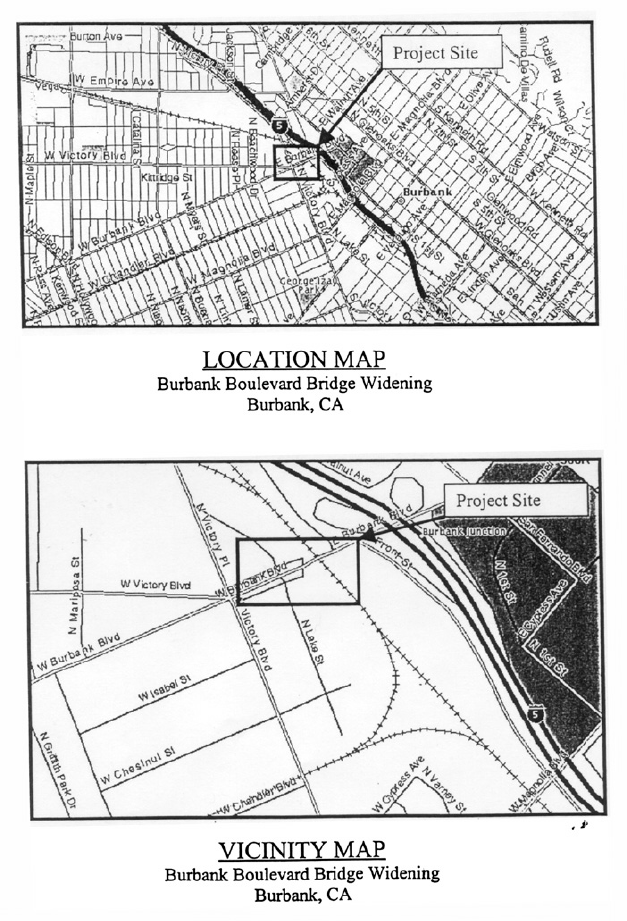
The application was found to be in compliance under the Commission's filing requirements, including Rule 39 of the Rules of Practice and Procedure, which relates to the widening, relocation or otherwise alteration of an existing crossing. A site map of the grade crossings is as shown on plans attached to the application and Appendix A.
In Resolution ALJ 176-3072, dated October 2, 2001, the Commission preliminarily categorized this application as ratesetting, and preliminarily determined that hearings were not necessary. Since no hearings were held, this preliminary determination remains accurate. The Commission's Rail Safety and Carriers Division recommends that this application be granted. Given these developments, public hearing is not necessary, and it is not necessary to disturb the preliminary determinations made in Resolution ALJ 176-3072.
This is an uncontested matter in which the decision grants the relief requested. Accordingly, pursuant to Public Utilities Code Section 311(g)(2), the otherwise applicable 30-day effective period for public review and comment is being waived.
1. Notice of the application was published in the Commission Daily Calendar on September 25, 2001. No protests have been received. A public hearing is not necessary.
2. City requests authority, under Public Utilities Code Sections 1201-1205, to widen the existing Burbank Boulevard overhead grade separation bridge structure over MTA's main line tracks in Burbank, Los Angeles County.
3. The Burbank Boulevard overhead grade separation will serve public need by providing a safe access route over the railroad tracks.
4. Public convenience, necessity and safety require the alteration of Burbank Boulevard overhead grade separation bridge structure.
5. City is the lead agency for this project under CEQA, as amended.
6. On July 27, 2000, City filed a Notice of Exemption (Appendix B) with the State Office of Planning and Research. City determined this project to be subject to CEQA Categorical Exemption, Class 1, Section 15301.
7. The Commission is a responsible agency for this project under CEQA and has reviewed and considered the lead agency Notice of Exemption.
8. Consistent with the lead agency's determination, we believe the proposed project is exempt from CEQA under Guideline Section 15301 as well as Commission Rule of Practice and Procedure 17.1(h)(B).
1. This order should be effective immediately as City wishes to commence construction of the project at the earliest possible date.
2. The application should be granted as set forth in the following order.
IT IS ORDERED that:
1. City of Burbank (City) is authorized to widen Burbank Boulevard Overhead grade separation bridge structure, identified as Crossing No. 101VY-11.37-A over the main line tracks of the Los Angeles County Metropolitan Transportation Authority (MTA).
2. Clearances shall be in accordance with General Order (GO) 26-D. Walkways shall conform to GO 118. Walkways adjacent to any trackage subject to rail operations shall be maintained free of obstructions and shall be promptly restored to their original condition in the event of damage during construction.
3. Construction and maintenance costs shall be borne in accordance with an agreement to be entered into between parties. A copy of the agreement, together with plans of the project approved by MTA, shall be filed with the Commission by City prior to construction. Should the parties fail to agree, the Commission will apportion the costs of construction and maintenance by further order.
4. Within 30 days after completion of the work under this order, City shall notify the Commission in writing that the authorized work was completed.
5. This authorization shall expire if not exercised within three years unless time is extended or if the above conditions are not complied with. Authorization may be revoked or modified if public convenience, necessity, or safety so require.
6. The application is granted as set forth above.
7. Application 01-09-023 is closed.
This order is effective today.
Dated February 7, 2002, at San Francisco, California.
LORETTA M. LYNCH
President
HENRY M. DUQUE
RICHARD A. BILAS
CARL. W. WOOD
GEOFFREY F. BROWN
Commissioners