Discussion
BNSF proposes to widen the existing railroad bridge at the existing Dale Street grade separation of BNSF's San Bernardino Subdivision main line from two tracks to three tracks. Dale Street is depressed below the railroad tracks. Dale Street will remain unchanged. BNSF will maintain clearances to conform to Commission General Order 26-D.
The widening of the Dale Street railroad bridge is necessary to accommodate the construction of a new third main line track on BNSF's San Bernardino Subdivision main line between the Cities of Commerce in Los Angeles County and Fullerton in Orange County. The third main line track will benefit the public by improving the efficiency and reliability of the State of California Department of Transportation (Caltrans) Pacific Surfliner intercity rail service and the Southern California Regional Rail Authority (SCRRA) commuter rail service between Los Angeles Union Station and Fullerton. The widening project also allows the City of Buena Park to construct a new commuter passenger station just to the west of the Dale Street railroad bridge.
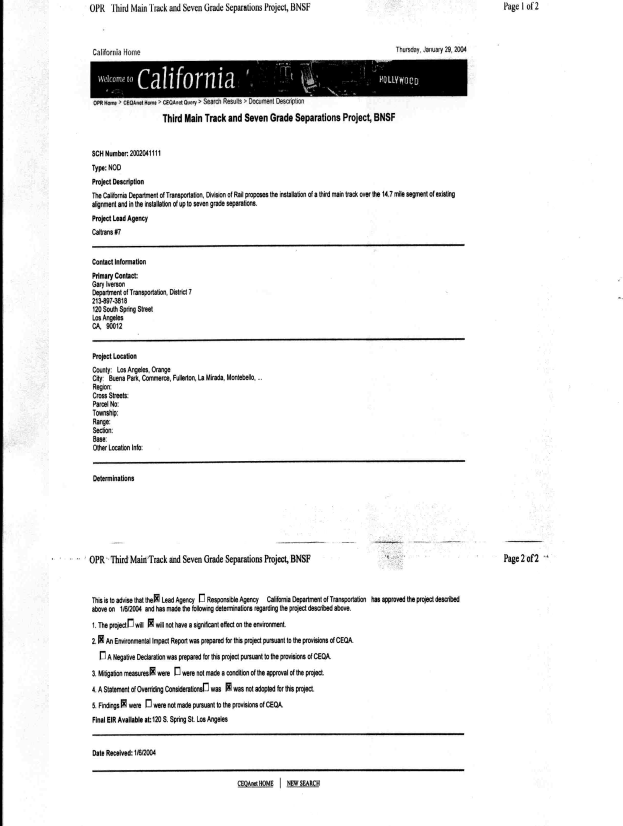
Caltrans is the lead agency for this project under the California Environmental Quality Act of 1970 (CEQA, as amended in 1982) as stated in Public Resources Code Section 21000 et seq. In March 2003, Caltrans prepared a Programmatic Environmental Impact Report (PEIR) for the "Third Main Track and Grade Separation Project on the" BNSF "East-West Main Line Railroad Track" project, State Clearinghouse (SCH) No. 2002041111, of which the Dale Street railroad bridge project is a part. On January 6, 2004, Caltrans filed a Notice of Determination (NOD) with the State Clearinghouse and determined that "the project will not have a significant effect on the environment." Attached to the order in Appendix A is a copy of the NOD. Mitigation measures were made a condition of the approval of the project. Findings were made pursuant to the provisions of CEQA.
The Commission is a responsible agency for this project under CEQA. CEQA requires that the Commission consider that portion of the environmental consequences of a project within its area of expertise that is subject to its discretionary approval. In particular, to comply with CEQA, a responsible agency must consider the lead agency's Environmental Impact Report or Negative Declaration prior to acting upon or approving the project (CEQA Guideline Section 15050(b)). The specific activities that a responsible agency must conduct are contained in CEQA Guideline Section 15096.
We reviewed the lead agency's environmental documents, including the PEIR, and found them adequate for our decision-making purposes. In considering these documents, we note that the PEIR developed and evaluated the proposed project alternative and the "No Project Alternative." The PEIR included an analysis of potential environmental impacts related to, among other items, air quality, geology and soils, hazards and hazardous material safety, hydrology and water quality, noise, and transportation and traffic. Safety, transportation, and noise are within the scope of the Commission's permitting process. The PEIR has statements pertaining to the environmental category or issue, the impact description, mitigation measures, and the impact after mitigation. Caltrans identified environmental impacts related to safety, transportation, and noise.
Caltrans identified one safety impact due to the routine transport, use or disposal of hazardous materials. To mitigate this impact, Caltrans proposed the delivery of all contaminated material encountered to a licensed treatment, disposal, or recycling facility; the establishment of specific thresholds of acceptable clean-up; limiting construction activities on major evacuation or emergency response routes within any affected communities; and the implementation of a monitoring and remediation program to identify any discolored soil or odors associated with petroleum contamination.
Transportation impacts include increases in traffic that is substantial in relation to the existing traffic load and capacity of the street system (i.e., result in a substantial increase in either the number of vehicle trips, the volume to capacity ratio on roads, or congestion at intersections) and that exceed a level of service standard established by the county congestion management agency. Additional possible impacts include substantial safety risks due to a change in rail patterns, inadequate emergency access, inadequate parking capacity, and conflict with adopted policies, plans, or programs supporting alternative transportation. To mitigate these impacts, Caltrans proposed, prior to initiating third main track construction or any grade-separation construction, to submit for approval to the affected cities a construction management plan. Caltrans also proposed that BNSF submit a parking plan to the affected jurisdiction for the railroad's construction staging and equipment storage sites that demonstrate adequate parking capacity.
Noise impacts include increased noise exposure from new noise sources and people exposed to severe noise levels. To mitigate these impacts, Caltrans proposed the following measures:
· Limit construction to certain hours.
· Utilize construction methods or equipment that will provide the lowest level of noise impact.
· Equip construction vehicles with properly operating and maintained mufflers or sound attenuation devices.
· Limit the amount of equipment that would be operating at the same time.
· Notify the community of the schedule, duration, and progress of the construction.
· Provide employees with adequate hearing protection devices.
· Install portable noise barriers at critical locations.
· Establish a noise/vibration complaint program.
· Reduce construction vibrations to a level below that which causes significant impact for the affected residence or facility.
In reviewing the PEIR, we find that with respect to issues within the scope of our permitting process, Caltrans, where possible, adopted feasible mitigation measures to lessen the potentially significant environmental impacts to less-than-significant levels. We will adopt Caltrans' findings and mitigations for purposes of our project approval.
The Commission's Consumer Protection and Safety Division - Rail Crossings Engineering Section (RCES) inspected the site of the existing railroad bridge at the Dale Street grade separation. After reviewing the need for and assessing the safety of the proposed project, RCES recommends that the Commission grant BNSF's request.
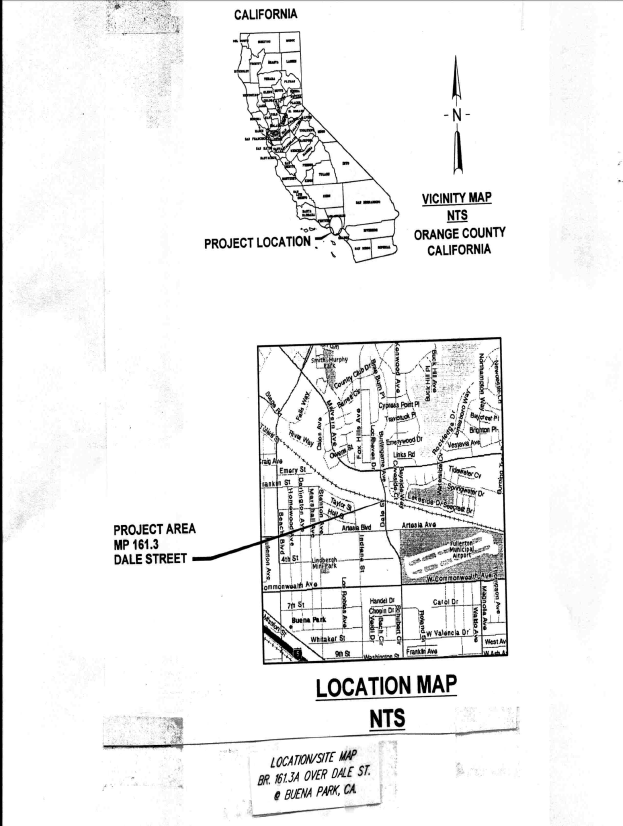
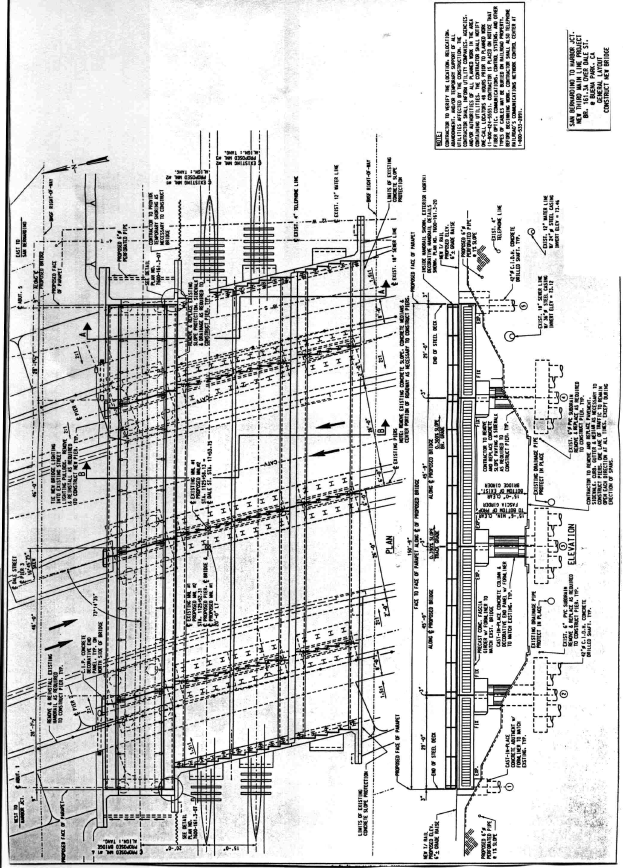
The Application is in compliance with the Commission's filing requirements, including Rule 39 of Rules of Practice and Procedure, which relates to the widening or relocation of an existing crossing. A site map and detailed drawings of the proposed widened railroad bridge of the existing Dale Street grade separation are shown in Appendix B attached to the order.
To proceed in an expeditious manner with the construction of the proposed widened railroad bridge of the Dale Street grade separation and BNSF's third main line track between the Cities of Commerce and Fullerton and to benefit the public upon the completion of the third main line track project, BNSF requests that the Commission waive the usual 30-day effective date of an order. We will make our order effective immediately.
In Resolution ALJ 176-3126, dated January 8, 2004, and published in the Commission Daily Calendar on January 9, 2004, the Commission preliminarily categorized Application 03-12-034 as ratesetting, and preliminarily determined that hearings were not necessary. Since no protests were filed, these preliminary determinations remain in effect. Given these developments, it is not necessary to disturb the preliminary determinations made in Resolution ALJ 176-3126.
This Application is an uncontested matter in which the decision grants the relief requested. Accordingly, pursuant to Public Utilities Code Section 311(g)(2), we waive the otherwise applicable 30-day period for public review and comment.
Assignment of Proceeding
Richard Clark is the assigned Examiner in this proceeding.
1. The Commission published Notice of Application 03-12-034 in the Commission's Daily Calendar on December 31, 2003. There are no unresolved matters or protests; a public hearing is not necessary.
2. BNSF requests authority, under Public Utilities Code Sections 1201-1205, to widen the existing railroad bridge of the existing Dale Street grade separation of BNSF's San Bernardino Subdivision main line from two tracks to three tracks in Buena Park, Orange County.
3. Public convenience, necessity, and safety require the widening of the widening of the existing railroad bridge of the existing Dale Street grade separation.
4. Caltrans is the lead agency for this project under CEQA, as amended.
5. Caltrans prepared a PEIR for this project. On January 6, 2004, Caltrans filed a Notice of Determination with the State Clearinghouse and determined that "the project will not have a significant effect on the environment." Mitigation measures were made a condition of the approval of the project. Findings were made pursuant to the provisions of CEQA.
6. The Commission is a responsible agency for this project, and has reviewed and considered the lead agency's PEIR and NOD.
7. Safety, transportation, and noise are within the scope of the Commission's permitting process.
8. For the approved project, the lead agency identified environmental impacts related to safety, transportation, and noise.
1. With respect to significant impacts from safety, transportation, and noise, we find that the lead agency adopted feasible mitigation measures, where possible, to substantially lessen the impacts to a less-than-significant level. We will adopt Caltrans' findings and mitigations for purposes of our approval. We also find that Caltrans reasonably concluded that, with mitigations, the project will not have a significant effect on the environment. We adopt Caltrans' NOD for purposes of our project approval.
2. The Application is uncontested and a public hearing is not necessary.
3. The Application should be granted as set forth in the following order.
IT IS ORDERED that:
1. The Burlington Northern and Santa Fe Railway Company (BNSF) is authorized to widen the existing railroad bridge of the existing Dale Street grade separation of BNSF's San Bernardino Subdivision main line from two tracks to three tracks in Buena Park, Orange County, at the location and substantially as shown by plans attached to the Application and Appendix B of this order, identified as CPUC Crossing No. 2-161.30-B.
2. BNSF and City of Buena Park (parties) shall maintain the widened railroad bridge in accordance with the construction and maintenance agreement executed by the parties for the original Dale Street grade separation.
3. Within 30 days after completion of the work under this order, BNSF shall notify the Rail Crossings Engineering Section in writing, by submitting a completed standard Commission Form G (Report of Changes at Highway Grade Crossings and Separations) of the completion of the authorized work.
4. This authorization shall expire if not exercised within three years unless the Commission extends the time or if the parties do not comply with the above conditions. The Commission may revoke or modify authorization if public convenience, necessity, or safety so require.
5. The Application is granted as set forth above.
6. Application 03-12-034 is closed.
This order becomes effective today.
Dated April 1, 2004, at San Francisco, California.
MICHAEL R. PEEVEY
President
CARL W. WOOD
LORETTA M. LYNCH
GEOFFREY F. BROWN
SUSAN P. KENNEDY
Commissioners