Discussion
OCTA was formed in 1991 through a consolidation of seven separate transportation agencies to develop and implement unified transportation programs and services for Orange County. It is governed by an 11-member Board of Directors, which consists of four county supervisors, six city council representatives, and one public member. A governor-appointed representative of the California Department of Transportation (Caltrans) also sits on the board in a non-voting capacity. SCRRA is a five-county joint powers authority created by Senate Bill 1402 of 1990, under Public Utilities Code Section 130255 pursuant to Government Code Section 6501 et al., to build and operate the Metrolink commuter rail system. OCTA is one of the five SCRRA member agencies and owns the right-of-way within the project limits, which were originally owned and operated by Atchison, Topeka, and Santa Fe Railway Company (AT&SF). The Burlington Northern Santa Fe Railway Company (successor to AT&SF) operates freight trains and the National Railroad Passenger Corporation (Amtrak) operates passenger trains over these tracks.
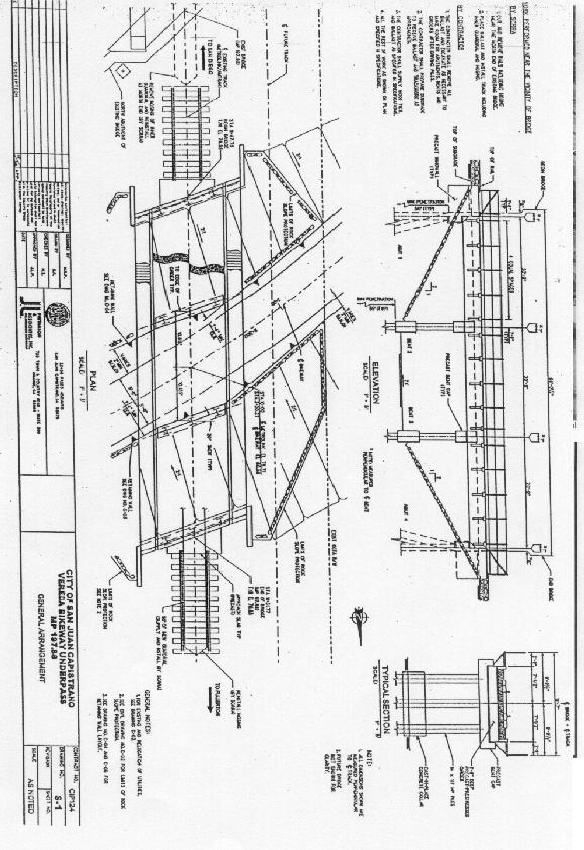
The pedestrian/bicycle underpass proposed to be built under a new railroad bridge is part of the Orange County Master Plan "Mountains to the Sea" bike trail. The trail begins at Doheny State Beach and, except for the underpass, continues approximately 15 miles upstream along San Juan Creek to the eastern City limit. OCTA provided the City with funds from its Federal Transportation Enhancement Act allocation for construction of the underpass. Ultimately, the trail will continue an additional 15 miles to Casper's Regional Park. The underpass will provide access to the downtown, schools and parks within the City. The underpass is proposed to provide the following benefits:
1. Pedestrians and bicyclists currently use a detour of two miles, which includes an at-grade highway-rail crossing on the Orange Subdivision at Del Obispo Street, one of the three busiest streets in the City. Construction of an improved undercrossing at this location will provide a more direct connection and increase public safety.
2. The proposed alignment for the trail is the most direct and safest alignment to be taken by trail users. The trail is included on the OCTA Commuter Bike Plan as it serves the San Juan Capistrano Multi-Model Transportation Center and is also included in the San Juan Capistrano Master Plan of Bike Trails.
3. By constructing the underpass (e.g. access ramps, approximately 600 feet of asphalt path, retaining walls, a drainage system, etc.), safety will be enhanced for all trail users and trains.
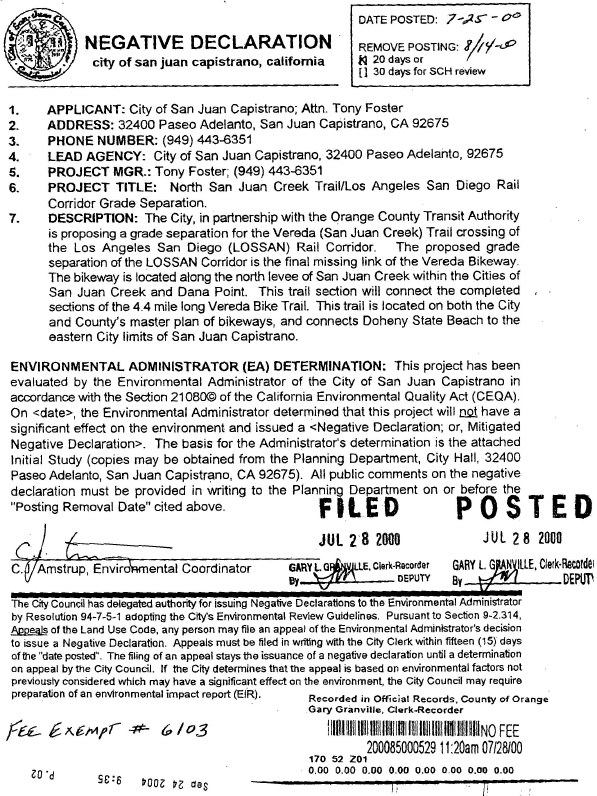
City is the lead agency for this project under the California Environmental Quality Act of 1970 (CEQA), as amended, as stated in Public Resources Code Section 21000 et seq. and Caltrans under the National Environmental Policy Act of 1969 (NEPA). In order to satisfy the CEQA requirements, on July 28, 2000 the City prepared and adopted a Negative Declaration. The Negative Declaration, a copy of which is included in Appendix A, found that the project would have no significant effect on the environment. Specifically, there would be no significant effects to specified environmental concern areas including, but not limited to, land use, community growth, population, housing, open space, recreation, agriculture, aesthetics, air quality, cultural resources, noise, and water.
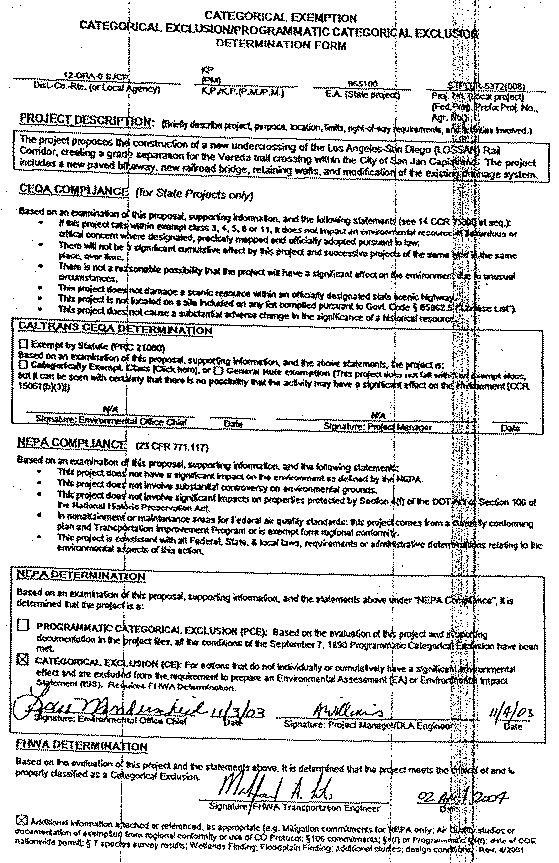
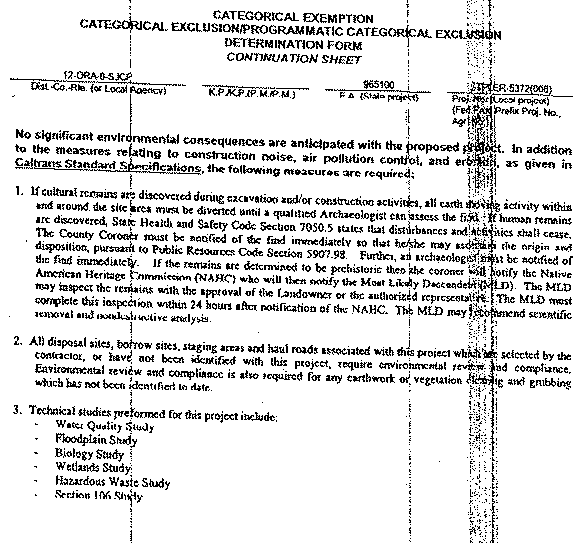
In order to satisfy the NEPA requirements, on November 4, 2003, Caltrans adopted a Categorical Exclusion for the project. The Categorical Exclusion, a copy of which is included in Appendix B, found that the proposed project is anticipated to have no significant environmental consequences.
Furthermore, on April 2, 2004, the Federal Highway Administration (FHWA) determined the project meets the criteria and is properly classified as a Categorical Exclusion; also shown in Appendix B.
The Commission is a responsible agency for this project under CEQA. CEQA requires that the Commission consider that portion of the environmental consequences of a project within its area of expertise that is subject to its discretionary approval. The specific activities that must be conducted by a responsible agency are contained in CEQA Guideline Section 15096.
The Commission reviewed and considered the lead agency's environmental documents and finds them adequate for our decision-making purposes. Based on these documents, we believe that the City, Caltrans and FHWA reasonably concluded that the project was exempt from CEQA and would have no significant effect on the environment.
The Commission's Consumer Protection and Safety Division - Rail Crossings Engineering Section staff (RCES) inspected the site of the proposed pedestrian/bicycle underpass. After reviewing the need for and the safety of the permanent pedestrian/bicycle underpass, RCES recommends that City's request be granted.
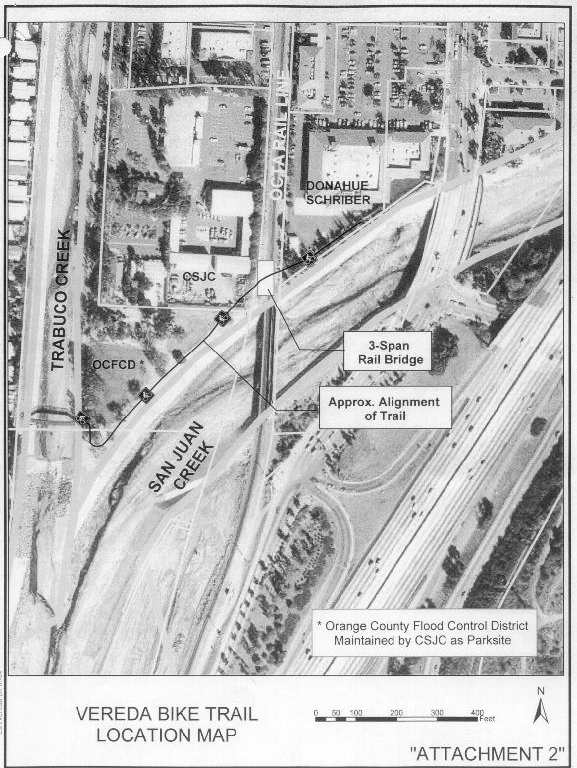
The application is in compliance with the Commission's filing requirements, including Rule 38 of Rules of Practice and Procedure, which relates to the construction of public highway across a railroad. A site vicinity map of the permanent pedestrian/bicycle underpass is shown in the application and in Appendix B attached to this order. The City requests that the 30-day period for public review and comment be waived since it is in jeopardy of losing its Federal Transportation Enhancement Act allocation
In Resolution ALJ 176-3137, dated August 19, 2004, the Commission preliminarily categorized this application as ratesetting, and preliminarily determined that hearings were not necessary. Since no protests were filed, this preliminary determination remains accurate and it is not necessary to revise the preliminary determinations made in Resolution ALJ 176-3137.
This is an uncontested matter in which the decision grants the relief requested. Accordingly, pursuant to Public Utilities Code Section 311(g)(2), the otherwise applicable 30-day period for public review and comment is being waived.
Assignment of Proceeding
Richard Clark is the assigned Examiner in this proceeding.
1. The Commission published a Notice of the Application in the Commission Daily Calendar on July 12, 2004. There were no unresolved matters or protests; a public hearing is not necessary.
2. City requests authority for a pedestrian/bicycle underpass under two tracks owned by OCTA and maintained by SCRRA at milepost 197.88 of SCRRA's Orange Subdivision in the City of San Juan Capistrano, Orange County.
3. The pedestrian/bicycle underpass is necessary to provide the most direct and safest alignment to be taken by the "Mountains to the Sea" bike trail to access the beach and east to the city limit.
4. Public convenience, safety and necessity require the pedestrian/bicycle underpass.
5. City is the lead agency for this project under CEQA, as amended.
6. On July 28, 2000, the City prepared and adopted a Negative Declaration finding that the project would have no significant impact on the environment.
7. Caltrans is the lead agency for this project under NEPA and adopted a Categorical Exclusion for the project, On November 4, 2003.
8. On April 2, 2004, the FHWA determined the project meets the criteria and is properly classified as a Categorical Exclusion.
9. The Commission is a responsible agency for this project and has reviewed and considered City's Negative Declaration, and Caltrans' and FHWA's Categorical Exclusion.
10. The Commission adopts the findings of the Negative Declaration and Categorical Exclusion for purposes of our project approval.
1. There are no unresolved matters or protests; a public hearing is not necessary.
2. The application should be granted as set forth in the following order.
IT IS ORDERED that:
1. City of San Juan Capistrano (City) is authorized to construct a pedestrian/bicycle trail grade-separated crossing at mile post 197.88 on Southern California Regional Rail Authority's Orange Subdivision in the City of San Juan Capistrano, Orange County, at the location and substantially as shown by plans attached to the application and Appendix B of this order, to be identified as CPUC Crossing No. 101OR-197.88-BD.
2. City shall notify the Consumer Protection and Safety Division's Rail Crossings Engineering Section in writing, by submitting a completed standard Commission Form G (Report of Changes at Highway Grade Crossings and Separations), within 30 days after completion of construction.
3. This authorization shall expire if not exercised within three years unless time is extended or if the above conditions are not complied with. The Commission may revoke or modify this authorization if public convenience, necessity, or safety so require.
4. The application is granted as set forth above.
5. Application 04-07-006 is closed.
This order becomes effective today.
Dated November 19, 2004, at San Francisco, California.
MICHAEL R. PEEVEY
President
CARL W. WOOD
LORETTA M. LYNCH
GEOFFREY F. BROWN
SUSAN P. KENNEDY
Commissioners
.