4. Analysis of Key Settlement Provisions
In this section, we analyze the key settlement provisions in light of the Commission requirement that in order to be approved, settlements must be "reasonable in light of the whole record, consistent with law, and in the public interest." Commission Rule 12.1(d).
4.1. Rate Increases
Settlement
As noted above, the settlement represents a compromise from rate increases that were in the 20-30% range in the original application (with the 59.1% increase proposed for the Chico district an anomaly). The rate increases in the settlement (including increases reflecting our decision adopting Cal Water's position on lot fees, as discussed later in this decision) are noted again below for reference:
Settlement, plus Cal Water position on lot fees |
||||||
District |
July 1, 2008 Proposed Increase, ($1,000) |
% Increase |
July 1, 2009 Proposed Increase, ($1,000) |
% Increase |
July 1, 2010 Proposed Increase, ($1,000) |
% Increase |
Chico |
$4,305.2 |
33.0% |
$812.3 |
4.7% |
$730.9 |
4.0% |
East Los Angeles |
$5,258.3 |
25.9% |
$774.7 |
3.0% |
$687.0 |
2.6% |
Livermore |
$3,099.2 |
25.2% |
$608.4 |
3.8% |
$555.5 |
3.4% |
Los Altos |
$3,821.6 |
21.7% |
$844.3 |
3.9% |
$775.9 |
3.5% |
Mid-Peninsula |
$4,083.9 |
17.8% |
$551.7 |
2.0% |
$456.1 |
1.7% |
Salinas |
$5,109.3 |
29.7% |
$2,855.7 |
13.2% |
$757.2 |
3.1% |
Stockton |
$4,107.3 |
15.9% |
$887.6 |
2.9% |
$771.6 |
2.5% |
Visalia |
$3,584.6 |
27.4% |
$3,232.7 |
20.4% |
$875.8 |
4.6% |
Note: 2009 and 2010 increases are estimated. Escalation increases are adjusted based on recorded changes in CPI. |
||||||
Note: First year Salinas increase includes phase-in surcharge of 0.0955 per ccf. This surcharge would be for three years. |
||||||
Note: First year Visalia increase includes phase-in surcharge of 0.0818 per ccf. This surcharge would be for three years. |
||||||
These increases remain substantial, and we are not unmindful of the impact they will have on customers. However, we are also concerned that the infrastructure of water utilities we regulate, including Cal Water's, is aging and will require significant infrastructure planning and investment in future years. Cal Water must begin now to construct these upgrades so that the utility continues to serve customers safely and reliably.
It is also impossible to ignore that health care and retirement expenses will increase as the Baby Boom generation reaches retirement age and health care costs nationwide continue to balloon. Much of Cal Water's rate increase relates to these unavoidable expenses. While Cal Water will ask its retirees to bear more of its health care costs in the future, in a competitive economy such as California's, it cannot escape the obligation to provide benefits to its employees and retirees.
Finally, Cal Water must add a number of new employees to comply with various regulatory requirements. New water quality requirements and the Sarbanes Oxley Act of 2002 account for many of the new proposed hires.
This is the first decision adopted after the Commission's new rate case plan decision, D.07-05-062. That decision directed Class A water utilities to engage in several new initiatives designed to carry out the Commission's Water Action Plan requirements of (1) safe, high quality water; (2) highly reliable water supplies; (3) efficient use of water; and (4) reasonable rates and viable utilities, and the Plan's objectives to: (1) maintain the highest standards of water quality; (2) strengthen water conservation programs to a level comparable to those of energy utilities; (3) promote water infrastructure investment; (4) assist low-income ratepayers; (5) streamline Commission regulatory decision-making; and (6) set rates that balance investment, conservation, and affordability. We would expect to see rate increases of some magnitude in the early GRC applications filed after our rate case plan went into effect.
It is our hope that the rate of increases will abate as time passes, but we cannot ignore that the state's water systems are aging and will require long-term planning and many upgrades to extend their usefulness in the 21st century. Water is our most basic commodity, and infrastructure is expensive to maintain and upgrade. We will scrutinize rate increases for reasonableness, but we cannot ignore the long-term needs of the water systems of the utilities we regulate.
We find the rate increases in the settlement agreement to be reasonable in light of the foregoing considerations.
4.2. New Employees
Settlement
The settlement agreement allows Cal Water to hire 59 new employees at the General Office level (17 employees over DRA's pre-settlement recommendation). As noted above, Cal Water's existing General Office workforce is 239 employees, so the increase is a considerable 39% over current numbers.
The following is a table the parties provide of the requested General Office staffing additions pursuant to the settlement:
Table 1 - General Office Incremental Positions
Job Title |
Department |
Year Included in Rates |
Conservation Manager |
Conservation |
2008 |
Communication Specialist |
Corporate Communications |
2008 |
Administrative Asst. - Torrance Engineering |
Engineering |
2008 |
Electrical (SCADA) Technician |
Engineering |
2009 |
GIS Technician |
Engineering |
2009 |
Hydraulic Modeling Engineer |
Engineering |
2009 |
New Business Technician |
Engineering |
2009 |
SCADA Computer Systems Operator |
Engineering |
2009 |
Electrical/Mechanical Technician |
Field Maintenance |
1 included in 2008, 4 in 2009 |
Travelling Meter Mechanic |
Field Maintenance |
1 included in 2007, 1 in 2009 |
Audit Coordinator |
Finance/Accounting |
2009 |
Budget Analyst |
Finance/Accounting |
2009 |
Corporate Cashier |
Finance/Accounting |
2009 |
Cost Accountant |
Finance/Accounting |
2008 |
Director of Finance |
Finance/Accounting |
2007 |
Financial/Business Systems Analyst |
Finance/Accounting |
2008 |
Revenue Accountant |
Finance/Accounting |
2008 |
Senior IT Auditor |
Finance/Accounting |
2009 |
Senior Tax Accountant |
Finance/Accounting |
2009 |
Mobile Telecommunications Specialist |
Information Systems |
2009 |
Safety Trainer |
Operations |
2009 |
Diversity Supplier Manager |
Purchasing/Stores |
2009 |
Rate Case Manager |
Rates |
2008 |
Cross-connection Inspector or Flushing Foreman |
Special Programs |
8 included in 2008, 11 in 2009 |
Trainee |
Special Programs |
5 included in 2009 |
Administrative Staff Clerk |
Water Quality |
2008 |
Assistant Chemist |
Water Quality |
2009 |
Environmental Affairs Project Manager |
Water Quality |
2009 |
Quality Assurance/Quality Control Officer |
Water Quality |
2008 |
Water Quality Project Manager |
Water Quality |
1 included in 2007, 2 in 2009 |
The settlement also allows Cal Water to add approximately 22 additional employees at the district level,12 according to the following table:
Table 2 - District Payroll Additions
District |
Payroll Additions |
Year |
Chico |
CSR 2 |
2008 |
CSR 3 |
2008 | |
UW/Relief CPO |
2008 | |
Operation Maintenance Worker |
2008 | |
E. Los Angeles |
Administrative Assistant |
2008 |
1/2 CSR |
2008 | |
CPO |
2008 | |
Serviceperson/Inspector |
2008 | |
Visalia |
1/2 New Business Supervisor |
2008 |
CSR 3 |
2008 | |
CSR 3 |
2008 | |
Operation Maintenance Worker |
2008 | |
Operation Maintenance Worker |
2008 | |
Flat to Meter Conversion |
||
Chico Based Group |
Field Supervisor |
2008 |
Chico (62.4%) |
Foreman |
2008 |
Marysville (32.1%) |
OMW |
2008 |
Willows (5.5%) |
1/2 CSR 3 |
2008 |
Visalia-Based Group |
1/2 Field Supervisor |
2009 |
Visalia (89%) |
Foreman |
2009 |
Selma (11%) |
OMW |
2009 |
Serviceperson/Inspector |
2009 | |
1/3 CSR 3 |
2009 |
Discussion
At the General Office level, the settlement represents a compromise in virtually every area of Cal Water's business. While we might scrutinize each position for reasonableness, we decline to micromanage Cal Water's business at this level of detail. We agree that the new positions are focused in areas where Cal Water has increased responsibilities going forward - in the area of conservation; accounting and internal controls (to implement the rigorous requirements of Sarbanes-Oxley); the company's unidirectional flushing and cross-connection programs (discussed later in this decision); and water quality. We also agree that Cal Water's proposed new trainee program, albeit much smaller than proposed in the application, is a meaningful approach to training the next generation of water managers as the Baby Boom generation retires.
We expect Cal Water to fill these positions promptly. As DRA pointed out in pre-hearing testimony, to the extent Cal Water does not fill positions we authorize, it can be an indication that the positions were not necessary. Cal Water adequately explained why previously requested positions were not filled, but it should continue to do so. DRA may and should weigh in on this issue in the next GRC if it finds that Cal Water is not doing a good job of filling positions we authorize. We also appreciate that the settlement phases in hiring of the General Office positions so that the process of hiring them is more orderly.
The district level employee additions are also reasonable. The 22 positions Cal Water requested in its initial application was a modest request, and the settlement, while not a reduction, reflects the fact that the initial request was reasonable. Cal Water will also phase in the new positions over 2008-2009 to mitigate rate impacts.
Thus, we find that the settlement is reasonable as to the number of employees added both at the General Office level and in the districts.
4.3. Conservation Budgets
Settlement
DRA and Cal Water agree to conservation budgets that are significantly higher than the expenditures Cal Water has made on conservation activity in prior years. The following are the application and settlement budgets:
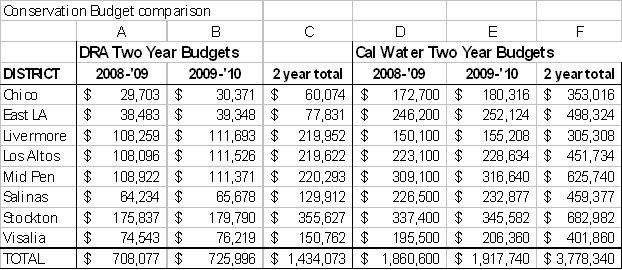
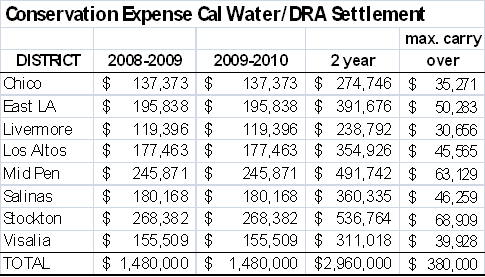
The settlement includes one-way balancing account treatment that requires Cal Water to refund all but the "max carry over" amounts shown in the table above if it does not spend its full budget.
Protest
Mangold is concerned that the settlement simply sets budgets for conservation programs without providing for forecast and measurement of savings and other conservation planning. He is also concerned that the settlement endorses a "one size fits all" approach that sets conservation budgets at a percentage of revenue in a district, rather than tailoring budgets to needs within a particular district.
Discussion
The budget in the settlement agreement - $1,480,000 for the Eight Districts for 2008-2009 and 2009-2010 - is somewhat lower than the $1,860,398 Cal Water proposed in its application for 2007-2008.13 Because Mangold focuses on the Mid-Peninsula district, we will do so as well to illustrate how the settlement increases conservation budgets. The following are comparison figures for the Mid-Peninsula district:
Cal Water Conservation Budget/Expenses14 |
||||||
Application (proposed for 2007-08) Mid-Pen15 |
Settlement Mid-Pen 2008-0916 |
2002 Expense Mid-Pen |
2003 Expense Mid-Pen |
2004 Expense Mid-Pen |
2005 Expense Mid-Pen |
2006 Expense Mid-Pen |
$309,085 |
$245,871 |
$25,588 |
$26,961 |
$35,824 |
$46,441 |
$75,929 |
As one can see from the foregoing table, both the application and the settlement represent considerable budget increases from prior years.17 The increases in other districts are comparable, as demonstrated in the two tables above showing the initial proposals of both Cal Water and DRA, and the settlement amounts.
Nonetheless, we approve the settled increase in water conservation budgets. One of the objectives of our 2005 Water Action Plan was to increase water conservation programs to levels comparable to those of energy utilities.18 The Water Action Plan proposes several measures to accomplish this goal, including greater consumer education on how to reduce water use, implementation of the California Urban Water Conservation Council's19 "Best Conservation Management Practices," rate design to encourage conservation, and possible decoupling of water utility sales from earnings. All of these goals are aimed at increasing water conservation by customers of water utilities such as Cal Water. See also Order Instituting Investigation to Consider Policies to Achieve the Commission's Conservation Objectives for Class A Water Utilities, I.07-01-022 (Water Conservation OII).
In view of the Water Action Plan's goal to increase water conservation, we would expect to see significant increases in water utility conservation budgets. By the same token, we need to be realistic about a water utility's ability to spend new conservation funding wisely if it has had small budgets in the past. Prior to entering into its settlement with Cal Water, DRA raised this concern:
[Cal Water] has historically under-spent in the Mid-Peninsula District with regards to conservation expenses. Compared to the last CPUC adopted conservation budget of $91,600 for 2005-2006, [Cal Water] has under-spent in the Mid-Peninsula District by $31,500.20
Cal Water's conservation budget in the Mid-Peninsula will increase significantly - from $75,929 in 2006 to $245,871 in the 2008-2009 fiscal year. Standing alone, this increase would give us pause given Cal Water's past history of under-spending. However, the settlement also builds in a reporting process and other accountability measures to ensure that Cal Water spends the money budgeted on cost effective conservation. Cal Water will, consistent with the decision in its last GRC, provide a measurement and evaluation proposal within 90 days, and Cal Water will also file conservation reports in accordance with D.07-12-055.21
In order to implement this provision of the settlement agreement, we will require the following: Ninety days after the decision in this application, Cal Water shall file with the Commission's Division of Water and Audits a new conservation budget based on the DRA/Cal Water conservation program budget settlement. In addition, Cal Water shall include a measurement and evaluation proposal. Subsequently, on an annual basis Cal Water shall file a measurement and evaluation report with DRA and the Division of Water and Audits. We leave it to the Divisions' discretion how to respond to the reports, although we expect the Water Conservation OII to result in further conservation reporting requirements. The first measurement and evaluation report shall include conservation program activities for 2008/2009. The first measurement and evaluation report shall be filed on September 1, 2009.
On March 18, 2008, Cal Water submitted a "Conservation Budget and Measurement and Evaluation Report" for its conservation activities in connection with D.07-12-055, which discusses contents of the measurement and evaluation report. Cal Water shall, with its measurement and evaluation proposal for the districts at issue in this proceeding, use the March 18, 2008 submission as a basis for its proposal, and include any changes ordered in connection with D.07-12-055/A.06-07-017 et seq. and incorporated after the March 18, 2008 submission. Cal Water may also modify its March 18, 2008 measurement and evaluation report if it sees fit, as long as the proposal is consistent with any orders made in this proceeding or in any other proceeding related to water conservation, such as I.07-01-022, the Water Conservation OII.
The one-way balancing account treatment DRA and Cal Water have agreed upon will also protect ratepayers in the event Cal Water under-spends its conservation budget in any of the Eight Districts. Any funds not spent over a set amount will revert to ratepayers, subject to the following conditions. First, any unspent funds will be amortized in the next GRC. Second, the maximum carryover for each of the Eight Districts will be limited, as set forth in the final column of the table entitled "Conservation Expense Cal Water/DRA Settlement," above.
However, we must stress that business as usual in the area of conservation is not appropriate. We expect Cal Water to enhance its conservation activities as described in our Water Action Plan and our Water Conservation OII. Thus, we expect to see Cal Water spend at or near budgeted levels on sound conservation measures for the Eight Districts at issue, and will monitor its action to make sure such conservation occurs.
4.4. Water Quality
Settlement
Cal Water and DRA ask that the Commission make a finding that Cal Water meets all applicable water quality standards in the Eight Districts. The settlement agreement states that:
DRA made an extensive examination of Cal Water's testimony and exhibits and concluded in its reports that Cal Water meets state and federal water standards in seven districts. DRA was not originally able to agree that Cal Water meets standards in the Salinas district. This opinion was based on open issues identified by DRA in an October 29, 2007 Department of Public Health (DPH) inspection report of the Salinas system.22
After trading data requests and responses about the DPH report, DRA and Cal Water reached agreement that Cal Water is complying with state and federal water quality standards in the Salinas district.
Protest
Mangold asks that we "temper" any finding as to the adequacy of Cal Water's water quality in the Eight Districts by a finding that long term water supply should be investigated in the Mid-Peninsula district. Mangold's key concern is that Mid-Peninsula, which receives all of its water from San Francisco's Hetch Hetchy project, must begin to look for other sources as San Francisco's own supply becomes constrained.
Discussion
We agree with Mangold that Cal Water should be engaged in long-term water supply planning in all of its districts, including the Mid-Peninsula district. However, we made provision for water utilities to engage in such planning in our recent rate case plan decision, D.07-05-062, Appendix A, pp. 28 - 29. There, we stated that:
Any water utility filing a GRC on or after July 1, 2008 must submit a long-term, 6-10 year Water Supply and Facilities Master Plan to identify and address aging infrastructure needs.
Thus, Cal Water must engage in long term planning with its first GRC filed after July 1, 2008. We expect any plan it submits with its next GRC for the Mid-Peninsula district to address the water supply concerns Mangold raises. However, Mangold's concern about water supply planning does not militate against approval of the DRA-Cal Water settlement here.
With regard to the DRA-Cal Water settlement request that we find Cal Water's water quality adequate in the Eight Districts, we are reluctant to do so at this time for one key reason. The water rate case plan, D.07-05-062, required the Commission's Division of Water and Audits to retain its own expert to make an independent assessment of water quality in the districts under consideration in a GRC. In a September 14, 2007 ruling, the assigned ALJ directed that such an expert carry out the water quality assessment, but the Division of Water and Audits was unable to retain an expert and therefore did not act on the ruling.
This is the first Cal Water GRC since the Commission issued the Water rate case plan. While DRA-Cal Water agree, pursuant to their settlement agreement here, that there are no material water quality problems in the Eight Districts, we are not prepared to so find without an independent expert evaluation. Indeed, as we noted in D.07-12-055, Cal Water's last GRC decision, DRA's role does not extend to certifying that Cal Water meets applicable water quality requirements:
In its opening brief, DRA addresses the expanded role it intends to take in reviewing the water quality information in each GRC application. This role, however, will not extend to rendering an opinion on whether or not a utility complies with all water quality regulations. DRA views its role as evaluating the impact of GRC application proposals and considering the economics of proposed capital investments to assure that ratepayers receive the lowest possible rates, consistent with reliable and safe service levels.23
Thus, we reject this aspect of the settlement agreement. We do so not because we have evidence of water quality problems, but rather because we lack the necessary documentation to make such a finding. It is our expectation that the Division of Water and Audits will implement the requirement of review by an expert in the next round of GRCs.
4.5. Infrastructure Planning - Surcharge
Settlement
In its application, Cal Water proposed a surcharge, the Infrastructure Investment Surcharge Mechanism (IISM), to cover the cost of infrastructure upgrades for the Eight Districts. Under the proposal, Cal Water sought to be granted a simplified process for making rate increases using a streamlined advice letter filing limited to GRC-authorized capital improvement projects. Cal Water also requested flexibility to substitute one capital project meeting an infrastructure need with another project. DRA objected to the surcharge on the grounds that Cal Water had not adequately fleshed out the program, and suggested it be re-filed as a stand-alone application.
DRA and Cal Water agreed in settlement on a pilot process to alleviate Cal Water's concern with the delay in implementing rate base offsets resulting from the current Tier 3 advice letter process. Under the settlement, Cal Water's rate base offsets, while still filed under the Tier 3 advice letter process, will be effective immediately, subject to refund with interest if the Commission finds the offset is unreasonable when issuing its Resolution on the advice letter. DRA may continue to protest any such advice letter filing in the usual manner. Cal Water will ask the Commission to review the pilot process in its next GRC filing.
In exchange, Cal Water will drop its IISM proposal from this GRC, but may revive it in its next GRC. Any revision will address, in detail, the concerns and requests for additional information DRA raised in its testimony on the IISM in this proceeding. The parties will also meet with the Division of Water and Audits to discuss the current advice letter process.
Discussion
The Scoping Memo for this proceeding identified infrastructure planning as one of the issues on which to focus. We expect Cal Water to engage in long-range planning to upgrade its infrastructure, and will be interested in seeing Cal Water's more detailed proposal - with responses to DRA's concerns - in the next GRC.
In the interim, we are satisfied that the pilot program is reasonable, given that it gives us the authority to order refunds with interest if a particular rate base offset is inappropriate. In its next GRC filing, Cal Water's request for review of the pilot process shall do the following, at a minimum: (1) list the rate base offsets in the pilot, with citation to the advice letter and Resolution numbers, description of the item, and dollar impact, (2) identify the issues raised in any protest filed with regard to a particular advice letter, (3) identify any advice letter found to be subject to refund after a review by the Commission, and (4) explain the basis for the refund.
4.6. Additional Commission Review for Infrastructure Projects
Settlement
The settlement provides that 23 of the utility's proposed capital projects will be excluded from the company's revenue requirement until they are completed and in service. Cal Water will be required to file rate base offset advice letters after completing each project. According to the parties' joint motion for approval of the settlement, allowing Cal Water to recover the costs of these projects through a rate base offset advice letter filed after the utility completes each project will balance the interests of the public for rate certainty and the interests of the company in recovering the revenue requirement of its investments.
Discussion
We have approved prior settlements between DRA and Cal Water in which Cal Water agreed to the same rate base offset procedure.24 We do so again here. The list of projects covered by the settlement appears as Attachment A to this decision.
4.7. Workers' Compensation
Settlement
The parties' settlement with regard to workers' compensation costs reflects the recommendation of DRA to treat workers' compensation expense on a pay-as-you-go (PayGo) basis. Cal Water agrees that it will continue the PayGo method if the Commission orders it.
Cal Water's pre-settlement proposal was to amortize over a seven year period an accrued liability in the workers' compensation account for past injuries. DRA criticized this method because instead of basing workers' compensation costs on the "well-established" pay-as-you-go (PayGo) methodology that is consistently used by the Commission, Cal Water was proposing to change to an accrual basis and to include the amortization of past liabilities for which payments had not yet been made. The Cal Water method would more than triple workers' compensation costs. DRA recommended continuation of the PayGo methodology for recovering workers' compensation insurance costs.25
Discussion
We agree that Cal Water should continue to use the PayGo method of accounting for workers' compensation insurance costs. Cal Water has not established that a change is warranted, and therefore we agree that the status quo should be maintained. We therefore approve the settlement between Cal Water and DRA on this issue.
4.8. PBOPs
Settlement
Cal Water and DRA settled on PBOP costs of $4.346 million and $4.602 million for calendar years 2008 and 2009, respectively. The single test year 2008-2009 averages these values. DRA and Cal Water agreed that Cal Water, going forward, should recover from ratepayers and fully contribute into its PBOP independent trusts its accrual of costs incurred pursuant to Financial Accounting Standards (FAS) No. 106, Employers' Accounting for Postretirement Benefits Other Than Pensions.
The costs agreed to in the settlement include recovery and funding of Cal Water's deferred accrual of a regulatory asset over a fifteen year period. In agreement with DRA's testimony, Cal Water adjusted its requested PBOP costs to assume that retirees will reimburse 50% of incurred medical costs in the future.
Discussion
We recently authorized Cal Water to recover, over a 15-year period, the past regulatory asset for PBOPs. D.08-03-021; see also D.92-12-015 (setting forth a formula for companies to use in calculating their PBOP regulatory asset). However, D.08-03-021 did not deal with how Cal Water should account for future PBOP obligations. Cal Water's application here sought to increase rates to fund its future PBOP obligations.
DRA initially protested Cal Water's approach to PBOPs, asserting that Cal Water's forecast assumptions were unreasonable because they were out of range with other utilities offering the same benefits and with actual experience.26 DRA also filed a motion for summary adjudication in this proceeding, alleging that the issues Cal Water were seeking to address in this case were already pending in the case that culminated in D.08-03-021, and should be dismissed from this case. The ALJ never ruled on the motion because the parties subsequently reached their settlement. Cal Water and DRA assert that their PBOP settlement is consistent with D.08-03-021.
We find that the settlement is reasonable on the PBOPs issue. DRA was in error when it claimed that the issue of PBOP accrual going forward would be resolved in the proceeding culminating in D.08-03-021, as it now acknowledges. Cal Water and DRA have agreed to PBOP actuarial estimates based upon a review of the assumptions made by Cal Water's actuary and assumptions proposed by DRA. The settlement represents a fair balancing of assumptions about the amount of cost Cal Water will bear in the future, and we therefore approve it.
4.9. Other Settled Issues
The following is a discussion of the other key issues covered by the Cal Water-DRA settlement.
4.9.1. Limit on Ratepayer Funding of Certain Meals, Dues and Moving Expenses for Cal Water Employees
Settlement
In its application, Cal Water sought to have ratepayers fund certain of its employees' meals, dues, moving and related expenses as part of its "nonspecific" expenses under the Administrative and General Expense category. DRA protested that the amount of the charges was too high, while Cal Water asserted that they reasonably related to their workers' employment. For each of the Eight Districts, the parties settled the matter by adopting DRA's position for company dues, employee dues and community service, and half of DRA's adjustments for meals.
Discussion
While the settlement amounts at issue here are modest, we believe it is important to limit ratepayer funding of certain employee perks and company activities that do not relate directly to their service to ratepayers. While Cal Water may believe it is essential to employee morale and retention, or to its business as a utility, to use ratepayer funding for such activities, we scrutinize such requests carefully. By the same token, we have on occasion stated that such amounts, if reasonable, are recoverable from ratepayers.
SoCalGas states that such items as service recognition dinners, employee picnics/Disneyland, administrative support for employee clubs/activities, employee retirement administration activities and employee communications costs are employee benefits.
. . .
We do not agree with DRA that these items are a charitable contribution, direct or indirect. These are an employee benefit which, if reasonable, should be allowed as a ratemaking expense.27
By the same token, the Division of Water and Audits' Standard Practice U-26, entitled "Adjusting and Estimating Operating Expenses of Water Utilities" (July 2002), available on the Commission's website at http://docs.cpuc.ca.gov/Published/Graphics/17098.PDF, provides the following:
[Water companies'] [d]ues, donations and contributions to charitable and service organizations are generally disallowed [as part of their Administrative and General Expense]. Dues to recognized technical organizations are generally allowed.
In view of the fact-specific nature of our scrutiny of such expenses, we find the settlement - which adopts DRA's position on some issues and half of DRA's reductions on others - to be within the range of reasonableness, and approve it.
4.9.2. Rate Relief to Certain Livermore Customers Who Pay Rates Based on 1-Inch Connection Necessary for Fire Protection
Settlement
In its application, Cal Water asked for a change to its "fire protection special conditions" for residential customers in its Livermore district. It noted that the City of Livermore had required residential sprinkler systems on all new construction for many years, and that these systems required a 1-inch metered connection. However, customers in that district might not otherwise require a 1-inch meter for their water consumption needs. The 1-inch charge is 250% of the standard 5/8 x 3/4 inch service. In recognition of the fact that these customers have larger meters than required for water consumption, Cal Water has allowed these customers to pay the 5/8 x 3/4 service charge, plus a small surcharge to cover the additional cost of a larger meter. However, this special condition has been limited to lots of up to 10,000 square feet in area. Thus, Cal Water asked us to remove the 10,000 foot limit.28
The settlement adopts Cal Water's proposal to remove the 10,000 foot lot size limit.29 In addition, DRA asked in testimony that Cal Water take steps to identify customers in the other districts in this GRC who are paying for 1 inch metered service solely to meet fire protection requirements imposed by the local government, and provide customers who request it an opportunity to pay the smaller meter service fee.30
In the settlement, Cal Water agreed to make a proposal in its next GRC to address customers outside the Livermore district.31 In advance of that proposal, Cal Water "will research its customer information database, contact cities, and/or conduct sample studies to determine the potential applicability of a '1-inch residential plus fire service' rate in its other districts."32
Mangold concurs with the settlement, but suggests that Cal Water also review tariffs to determine who has such service. Cal Water does not respond to this suggestion, which we find reasonable and incorporate by this reference into the settlement agreement.
The parties assert that the settlement as to Livermore is in the public interest because it ensures that Livermore customers will pay a metered service charge that is consistent with their actual usage, regardless of lot size. Customers whose usage is commensurate with a 5/8 x 3/4 inch meter connection will pay for such usage.
Discussion
We agree that it is appropriate for Livermore customers - and customers in other districts - to pay rates that reflect their actual usage, even if they must have larger meters to ensure adequate fire protection. We also agree that Cal Water should apply this adjustment to affected customers, if any, in other districts.
Cal Water shall commence its study of other districts within 60 days of the effective date of this decision, and shall present its proposal for other affected districts in the first GRC application filed after the 60 days expire. In addition to the items Cal Water agrees to review in the settlement agreement, it should also review tariff filings to locate customers with 1-inch fire protection service, as Mangold suggests.
In its GRC application, Cal Water shall explain how it will account for the cost under-recovery, if any, related to installing and maintaining large meters for fire protection while collecting rates for smaller meter service.
4.9.3. Phase-In of Rate Increases for the Visalia and Salinas Districts to Mitigate Rate Shock
Settlement
The settlement includes a provision to phase in the test year increase for the Visalia and Salinas districts. Cal Water will collect the deferred portion of the increases in subsequent years as a surcharge. The parties claim the phase-in will mitigate rate shock to customers in these two districts by enabling customers to adjust to the rate increase over several years and providing them with an opportunity to offset the rate increases by conserving water.
As Cal Water explained in its application,33 the increase for Salinas is significant for three principal reasons: (1) capital investment to upgrade aging infrastructure, construct new water supply facilities, and treat wells for nitrates, iron, manganese and other regulated constituents ($4.2 million revenue requirement); (2) increase in allocation of the cost of company benefits (an increase common to all districts; $1.6 million); and (3) purchased water costs because Cal Water has added more basin water wellhead treatment facilities ($0.7 million).
Visalia's increase is due primarily to infrastructure upgrades, including new wells and boosters to ensure adequate supply, replacement of facilities on State Highway 62 due to Caltrans street widening, and compliance with a 2004 state law that requires meters on all service connections by 2025. The revenue requirement attributable to these items is $5.2 million according to the application. The Visalia district also has increases due to allocation of company benefits, and new district payroll (to provide service to the growing customer base, and hire new field and customer service staff).
As Cal Water explained in its application, in order to earn the requested overall return of 8.66%, a 49.3% increase would be required for the Salinas district.34 The phase-in mitigates the impact of this increase significantly. Similarly for Visalia, if the revenue requirement in the application were to be reflected in rates in the first year, ratepayers would experience a 64.9% increase in that year in order for Cal Water to earn the requested overall return of 8.66 %.35 Cal Water thus requested a phase-in of rates in its application, and the parties agreed upon the phase-in in the settlement.
Discussion
The Commission has in the past ordered a phase-in of water rate increases to mitigate rate shock.36 Here, Cal Water requested the phase-in on the ground that the rate increase impact would cause rate shock if implemented all in one year. Further, a water company may not increase its rates above the amount noticed to customers,37 and the notice Cal Water gave in Salinas and Visalia assumed a phase-in.
We find the phase-in to be reasonable, especially given the size of the increases in Salinas and Visalia. The rate shock that would result if we did not approve the phase-in would be significant. Thus, we approve the settlement
agreement on this issue, and order the rate phase-in the Cal Water and DRA settled upon, as follows:
District |
July 1, 2008 Proposed Increase, ($1,000) |
% increase |
July 1, 2009 Proposed Increase, ($1,000) |
% Increase |
July 1, 2010 Proposed Increase, ($1,000) |
% Increase |
Salinas |
$5,109.3 |
29.7% |
$2,855.7 |
13.2% |
$757.2 |
3.1% |
Visalia |
$3,584.6 |
27.4% |
$3,232.7 |
20.4% |
$875.8 |
4.6% |
4.10. Vehicle Replacements
The Scoping Memo listed the pace of Cal Water's vehicle replacements as an issue for consideration in this case. When Cal Water initially filed its application, it proposed to replace dozens of vehicles on a schedule adopted by the Commission in D.96-06-034, 1996 Cal. PUC LEXIS 724. DRA proposed longer retirement schedules.
As the case proceeded, Cal Water agreed with DRA that the vehicle replacement schedules the Commission adopted in its last Cal Water GRC decision, D.07-12-055,38 should apply here. Those schedules acknowledge the durability of today's vehicles and provide for replacement less frequently than was the case in the past.
We agree that the updated schedule adopted in D.07-12-055 and D.06-01-025 is appropriate here, and no party now disagrees. Cal Water shall use the new schedules in subsequent GRCs unless the Commission adopts a different schedule.
4.11. Cost Allocation for Unregulated Contracts
In Cal Water's last GRC, A.06-07-017 et seq., Cal Water's offering of an unregulated service called Extended Service Protection (ESP) was the subject of much discussion. Therefore, the Scoping Memo included an examination of the issue. However, since the assigned Commissioner issued the Scoping Memo, the Commission issued D.07-12-055, providing guidance for Cal Water on how to pursue the issue in light of its finding that the ESP program was not properly offered under the Commission's excess capacity and affiliate transaction rules and Pub. Util. Code § 453(a). (See D.07-12-055, § 5.5.) Cal Water will be filing an application addressing the ESP program as part of its compliance with D.07-12-055, and we therefore need not deal with the issue here.
12 Settlement § 4.2.1.2.
13 Ex. 45, p. 2 (Conservation Programs, Testimony of David Morse).
14 Id.
15 Settlement, p. 23.
16 Ex. 201, p. 3-13 (DRA Mid-Peninsula Report).
17 In protesting Cal Water's initial water conservation proposals, DRA opposed calculating budgets based on a percentage of Cal Water's water revenues, and, as they explain in Attachment B to this decision, the settled amounts are not based on such a percentage.
18 Water Action Plan, Dec. 15, 2005, p. 7, available at ftp://ftp.cpuc.ca.gov/PUC/hottopics/3water/water_action_plan_final_12_27_05.pdf.
19 The Council coordinates statewide urban water conservation.
20 Ex. 201, p. 313.
21 That decision requires the following reporting:
Cal Water shall file a conservation budget and measurement and evaluation proposal for each district within 90 days of the effective date of this decision and then make ongoing reports and budget proposals on at least an annual basis. D.07-12-055, mimeo., p. 13.
22 Settlement § 2.1.2.
23 D.07-12-055, mimeo., p. 7 (emphasis added).
24 See, e.g., D.04-04-041, Ordering Paragraph 6, and D.07-12-055, Ordering Paragraph 8.
25 Ex. 209, p. 3-27.
26 Ex. 210, p. MRL-1 (Testimony of Mark Loy).
27 D.90-01-016, 1990 Cal PUC LEXIS 15, at *142.
28 See Ex. 204, pp. 12-13 (DRA Livermore Report).
29 Settlement § 5.1.1; Motion, p. 15.
30 Ex. 204, pp. 12 - 14.
31 Motion, p. 15.
32 Settlement § 5.1.1.
33 Ex. 44, p. 11.
34 Ex. 24, p. 6 (Salinas Results of Operation).
35 Ex. 29, p. 6 (Visalia Results of Operation).
36 See, e.g., D.05-09-004, 2005 Cal PUC LEXIS 356 at *49 (Cal Am Water Company/Felton); D.93-02-012, 1993 Cal PUC LEXIS 68 at *50-51 (Park Water Company/Apple Valley Ranchos); see also D.87-09-038, 1987 Cal PUC LEXIS 207 at *4-5 (Cal Water/Visalia; phase-in required where company "slept on its rights").
37 See, e.g., D.95-08-011, 1995 Cal PUC LEXIS 617 at *6-7 (Twin Valley Water Company; the figure contained in the notice limited the size of the maximum permissible increase).
38 The Commission also applied the longer schedules in D.06-01-025.


