I. Scope of Issues the Commission Should Address
· The GRC traditionally has been a proceeding to examine the utility's costs and operations as part of the overall process of determining utility rates. It should also be a forum to address major policy issues. In SCE's GRC, the Commission should adopt a policy outlook for the medium- to long-term (i.e. for the next 10 years), including whether to continue PBR-style regulation.
A. Safety and Reliability
· Are there safety and reliability standards? If so, are they adequate, necessary, up-to-date, and relevant? How does SCE stand compared to national averages and benchmarks? What standards should the Commission adopt to hold SCE accountable?
· Current PBR Standards
o Outage Duration
To encourage continued improvements in service reliability, the PBR contains an initial benchmark standard for Average Customer Minutes of Interruption (ACMI) of 59 minutes in 1997. This benchmark declines by two minutes in each subsequent year. This benchmark has a deadband of six minutes on each side of the benchmark. The Commission will impose no penalty if Edison achieves an average below 55 minutes for the period 1997 through 2001. Performance is measured by a rolling two-year average. Rewards and penalties occur at a rate of $1 million per minute over and above the deadband, with a maximum of $18 million for both duration and frequency.
o Per AL 1619-E/1619-E-A, SCE has proposed for 2002 an outage duration benchmark of 51 minutes with a deadband of +/- 6 minutes.
o Outage Frequency
10,900 annual interruptions, with a deadband of 1,100 on each side of the benchmark. Performance is measured by a rolling two-year average. Symmetrical rewards and penalties occur at a rate of $1 million per 183 interruptions, with a maximum of $18 million for both duration and frequency. No mechanism for tightening standard over time.
o Per AL 1619-E/1619-E-A, SCE has proposed for 2002 an outage frequency benchmark of 9482 with a deadband of +/- 1100 interruptions.
o Employee Health and Safety
This component of the distribution PBR rewards or penalizes Edison for its performance in employee health and safety. The standard consists of a ratio index of the total number of accidents and illnesses per 200,000 hours worked or per 100 employees. The specific benchmark is a value of 13.0 with a deadband of 0.3. An incentive of about $555,000 for each 0.1 increase/decrease in the index is assessed, with a maximum reward or penalty of $5 million.
o Per AL 1619-E/1619-E-A, SCE has proposed for 2002 a health and safety benchmark of 9.5 with a deadband of +/- 0.3.
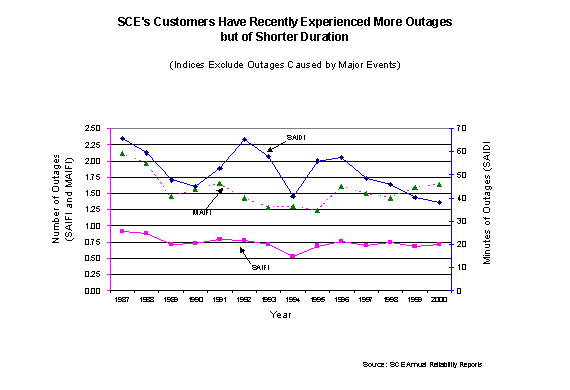
o SCE's System Reliability Has Been Mixed: Year 2000 Results Better than the Late 1980s but not as Good as the mid-1990s.
MAIFI is the Momentary Average Interruption Frequency Index, which measures the average number of momentary outages (those shorter than 5 minutes) per customer, per year.
SAIFI is the System Average Interruption Frequency Index, which measures the average number of sustained outages (those lasting 5 minutes or longer) per customer, per year.
SAIDI is the System Average Interruption Duration Index, which measures the average duration (in minutes) of sustained outages per customer, per year.
A Major Event is defined as: (1) the event caused by earthquake, fire, or storms of sufficient intensity to give rise to a state of emergency being declared by the government; or (2) any other disaster not mentioned above that affects more than 15% of the system facilities or 10% of the utility's customers. (See D.96-09-045, Appendix A, Section C.) Major events are excluded from these outage measures to remove the affects of natural disasters, therefore being more indicative of the reliability of the utility's electric system under normal conditions.
· Are there program standards to control and plan maintenance? How does this happen?
· Are necessary maintenance programs being deferred or ignored? Should the utility perform planned scope of work versus budget?
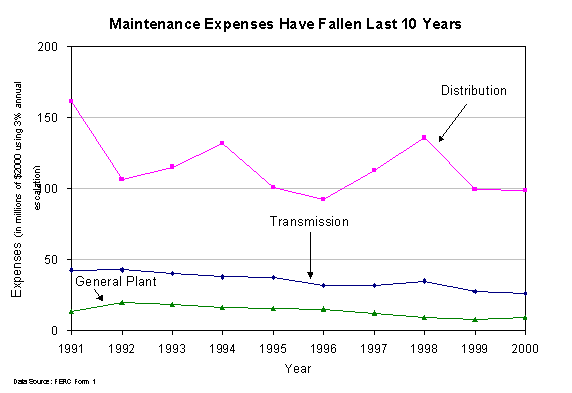
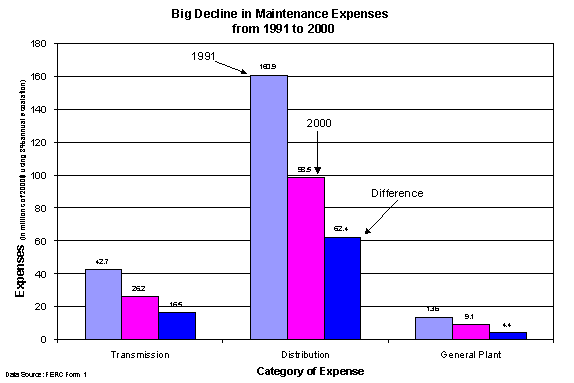
o The Commission Should Investigate Why Maintenance Expenditures Have Fallen While Plant Has Increased.
o Is the Current Level of Maintenance Spending Adequate?
· How much money has been set aside for undergrounding projects (Rule 20)? How much of it has been spent? Has real money been set aside and spent elsewhere? How should SCE balance safety versus scenic requirements?
Investment Planning
· Are there established evaluation criteria? What is the Commission's vision for Edison's future? (e.g. preference for build versus buy?)
· How should SCE be planning for procurement and new generation?
· Is there a central group for investment planning? What is SCE's capital and O&M budgeting process, and how does management prioritize and decide on expenditures given the resources available?
· What is, and what should be, the degree of integration of Generation, Transmission, and Energy Efficiency in SCE's resource planning?
Customer Service
· Is SCE responding in a timely and appropriate manner to customers' complaints, requests, and phone calls? Are they meeting necessary deadlines?
· What is their accessibility? Do they have local offices? Is their web site user friendly?
· SCE uses a customer survey program to measure customer satisfaction. Is it unbiased?
· In 1996, the Commission adopted SCE's 1992 historical customer satisfaction standards of 64% being "completely satisfied" or "delighted" with a 3% deadband as the PBR benchmark for customer satisfaction. Does this standard need to be updated? Is there anything that should be added and/or removed?
· Current PBR Standards
o Each year, Edison, in conjunction with an outside consulting firm, conducts a survey to measure customer satisfaction in four service areas: field services and meter reading; local offices; telephone centers; and service planning. In each of the areas surveyed, the utility asks a variety of questions, including a question as to the respondent's overall satisfaction with the specific service provided. Customers choose among six satisfaction categories with the top two being "completely satisfied" and "delighted." The utility is rewarded or penalized $2 million for each percentage point above or below the historic performance standard 64%, with a deadband of three percent on each side of the benchmark.
o The utility can be rewarded up to $10 million through this mechanism, but will not receive a reward if ten percent of customers fall in the bottom two of the six response categories surveyed.
o In addition, Edison can be penalized up to $10 million if performance in any one of four survey areas falls below 56%.
o Per AL 1619-E/1619-E-A, SCE has proposed for 2002 a customer satisfaction benchmark of 69% with a deadband of +/- 3%.
D. Utility Operations
o Is URG managed and dispatched to benefit ratepayer interests?
o Transition issues: How should contracts from the DWR portfolio be managed along with URG?
o How are, and how should, capital addition decisions be made?
o Land and Plant: Used and useful for utility operations?
o Service offerings: Is SCE's suite of offerings comparable to other utilities'? Is it what the Commission wants offered? How do SCE's offerings interact with related services by unregulated firms?
Proposed Scope of Testimony
In addition to the traditional review aimed at understanding how the utility spends its money now, testimony should include focused analysis and specific recommendations on these issue areas.
· Safety and Reliability
o Research safety and reliability standards in other states
o Characterize SCE's safety and reliability record in recent years, with emphasis on trends
o Review, analyze, and summarize the results of SCE's current PBR standards
o Develop and propose recommendations on safety and reliability standards for SCE after current PBR expires
o Make recommendations on appropriate level of maintenance expenditures, and parts of system where maintenance should be targeted
· Investment Planning
o Make recommendations for overall Commission policy on utility role in resource procurement over next ten years - for example, build vs. buy
o Make recommendations for how Edison's utility planning and investment group(s) should be structured and overseen by the Commission
o Make recommendations for Commission oversight of actual utility investments
o Research history of investment planning by California utilities
o Characterize SCE's current approach to generation, distribution, transmission, and demand-side planning, including how it develops its capital and O&M budgets and evaluates potential projects
o Make recommendations on how SCE's approach should change based on Commission policy goals, including those relating to Integrated Resource Planning and procurement planning.
o Review SCE's land-use and land management practices, especially with respect to environmental impacts and use of utility lands for unregulated activities by SCE, its affiliates, or third parties
· Customer Service
o Research customer satisfaction standards in other states
o Review, analyze, and summarize the results of SCE's current PBR standards
o Make recommendations on need for neighborhood customer service centers
o Make recommendations on customer satisfaction standards for SCE after its current PBR expires.
_ Standards should not be survey-based alone, but should include performance metrics on response times, number of repeat calls/complaints, times for callback, percentage of complaints resolved to customer's satisfaction, and other measurable and enforceable performance
_ Recommendations should include analysis of need for local offices, effectiveness of website, and responsiveness to web-based customer contacts
· Utility Operations
o Develop and present comprehensive understanding of current utility URG operations, dispatch criteria, and mechanisms for handling DWR contracts
o Make recommendations on dispatch/operations standards and practices to ensure ratepayer benefit - least cost, most reliable
o Develop and present comprehensive understanding of current SCE practice with respect to planning of capital additions, especially in generation and transmission.
o Using data developed in hydro divestiture CEQA review, plus additional SCE data sources, develop and present comprehensive database of SCE land and plant, and current utility use.
o Develop and present comprehensive view of current SCE service offerings, and related offerings by other utilities and unregulated firms.
o Make recommendations to ensure adequate CPUC oversight of service offerings, to ensure ratepayer benefit.