STATE OF CALIFORNIA ARNOLD SCHWARZENEGGER, Governor

PUBLIC UTILITIES COMMISSION
505 VAN NESS AVENUE
SAN FRANCISCO, CA 94102-3298
Draft Resolution No. W-4679
Agenda ID #7451
March 11, 2008
TO: Parties to Del Oro Water Company's Stirling Bluffs District's General Rate Increase:
Enclosed is a draft Resolution W-4679 of the Division of Water and Audits. It will be on the Commission's April 10, 2008 agenda. The Commission may act on the resolution or it may postpone action until later.
When the Commission acts on the draft resolution, it may adopt all or part of it as written, amend, or modify or set it aside, and prepare a different resolution. Only when the Commission acts does the resolution become binding on the parties.
Parties to this matter may file comments on this draft resolution. Original and 2 copies of the comments, with a certificate of service, should be submitted to:
Division of Water and Audits, Third Floor
Attention: Steven Haine
California Public Utilities Commission
505 Van Ness Avenue
San Francisco CA 94102
Parties may submit comments on or before March 31, 2008. The date of submission is the date the comments are received by the Division of Water and Audits. Parties must serve a copy of their comments on all persons on the service list attached to the draft Resolution, on the same date that the comments are submitted to the Division of Water and Audits.
Comments shall be limited to five pages in length plus a subject index listing the recommended changes to the draft resolution, a table of authorities and appendix setting forth the proposed findings and ordering paragraphs.
Comments shall focus on factual, legal, or technical errors in the draft Resolution. Comments that merely reargue positions taken in the advice letter or protests will be accorded no weight and are not to be submitted. Late submitted comments will not be considered.
/s/ RAMI S. KAHLON
Rami S. Kahlon, Director
Division of Water and Audits
Enclosures: Draft Resolution W-4679
Certificate of Service
Service List
DRAFT
Agenda Item #7451
WATER/RSK/JPT/SHI/jlj
PUBLIC UTILITIES COMMISSION OF THE STATE OF CALIFORNIA
DIVISION OF WATER AND AUDITS RESOLUTION NO. W-4679 Water and Sewer Advisory Branch April 10, 2008
(RES. W-4679), DEL ORO WATER COMPANY - STIRLING BLUFFS DISTRICT. ORDER AUTHORIZING A GENERAL RATE INCREASE TO PRODUCE ADDITIONAL ANNUAL REVENUE OF $19,614 OR 18.5% IN TEST YEAR 2007.
SUMMARY
By draft Advice Letter filed on January 22, 2007, Del Oro Water Company (Del Oro), a Class B water utility, requested a general rate increase for its Stirling Bluffs district for test year 2007. This resolution authorizes an increase of $19,614, or 18.5%, relative to revenue at present rates, for a 10.75% return on rate base for test year 2007.
BACKGROUND
By draft Advice Letter filed on January 22, 2007, Del Oro Water Company - Stirling Bluffs District (DOWCSB) requested authority under Section 454 of the Public Utilities Code to increase revenues by 12.77% or $14,032, for an 11.5% return on rate base for test year (TY) 2007. The purpose of the rate increase is to recover increased operating expenses and to provide an adequate rate of return on plant investment. DOWCSB's present rates became effective on May 11, 2007 per Res.W-4644, which authorized an interim rate increase of 2.4%. DOWCSB was last authorized a general rate increase in 2004 per Res.W-4471.
Located approximately 30 miles northeast of Chico, DOWCSB's service territory includes Stirling City and adjoining areas in Butte County. As of February 15,
2008, DOWCSB had 160 active metered service connections and no flat rate
connections, serving approximately 400 residents.
DOWCSB derives its water supply from the Hendricks Canal, an untreated surface water source owned by the Pacific Gas & Electric Corporation (PG&E). Surface water at the Hendricks Canal intake is elevated 500 feet by a pump to a treatment facility where the water undergoes processing to meet state and federal safe drinking water standards. The processed water is stored in a 168,000-gallon wooden storage tank and is then supplied to DOWCSB's customers by gravity. DOWCSB's annual consumption averages approximately 80 acre-feet or 26,000,000 gallons, giving the storage tank slightly over two days of potable water supply in case of supply or treatment interruptions. The remaining untreated water in the canal that was not diverted by the intake pump flows downstream, where a portion of it ends up as inter-district sales by DOWCSB to Del Oro's Paradise Pines, Lime Saddle, and Magalia districts, as explained below.
By agreement with PG&E, DOWCSB is allowed to withdraw up to 365 acre-feet from the Hendricks canal for consumption within the district. The agreement permits DOWCSB to sell any remaining untreated water from the 365 acre-feet allotment to other Del Oro districts, with the stipulation that DOWCSB will only incur purchased water cost for water actually sold to the other districts but not for water consumed within DOWCSB.
NOTICE, PROTESTS, AND PUBLIC MEETING
A notice of the proposed rate increase was mailed by DOWCSB to each customer on May 1, 2007. The notice was also published in the May 5, 2007 edition of a local newspaper, the Paradise Post. The Division of Water and Audits (Division) received letters of protest against the proposed increase from two customers.
The Division's staff and Del Oro representatives held a public meeting on June 6, 2007 at the Community Hall in Stirling City. Eighteen customers attended the meeting. The Division's staff explained to the participants Commission rate-setting procedures, and Del Oro's Director of Community Relations explained the justifications behind the proposed rate increase. The rest of the meeting consisted of comments and questions by the ratepayers. The comments were mostly acrimonious in nature and stemmed from the ratepayers' strong dissatisfaction over what they perceived to be frequent and inequitable surcharges arising from the balancing account on the inter-district water sales.
DISCUSSION
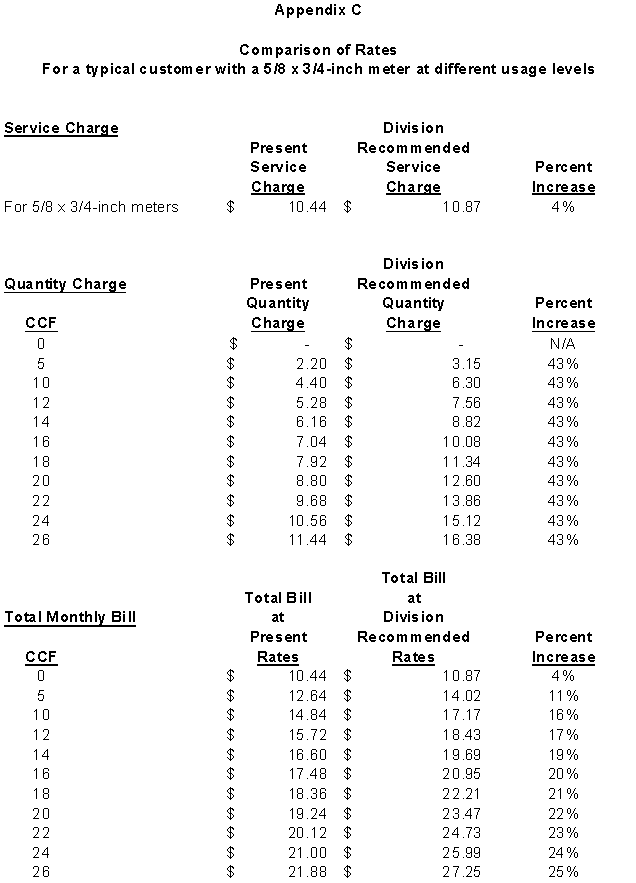
This resolution authorizes an increase of $19,614, or 18.5%, in revenue for a 10.75% return on rate base for test year 2007. Appendix C shows the rate impact for a customer with a 5/8 x 3/4-inch meter at different usage levels.
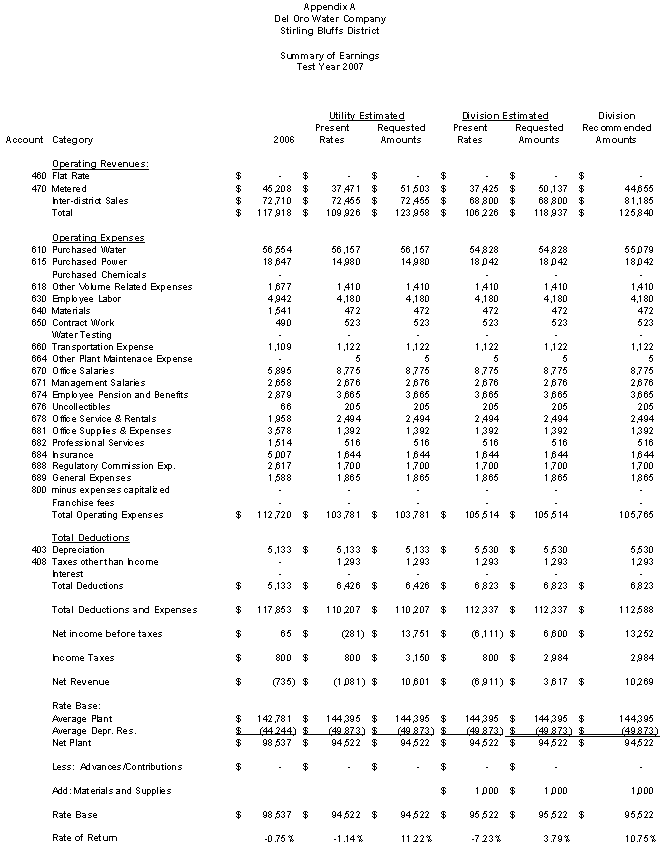
The Division performed an independent analysis of DOWCSB's summary of earnings. Appendix A shows DOWCSB's and the Division's estimates of the Summary of Earnings for test year 2007.
Inter-district Water Sales
Revenues from the inter-district sales of untreated water from the Hendricks Canal have in recent years amounted to over 60% of DOWCSB's gross revenues, and in the last three years contributed an average of $12,990 per year to DOWCSB's net revenues before tax. Furthermore, as the water in the inter-district sales is always sold at a markup over cost, net proceeds from the sales always help to offset DOWCSB's expenses and keep DOWCSB's rates lower than they would have been otherwise. This point was widely misunderstood by the customers during the public participation meeting.
The unit cost at which DOWCSB charges other districts for the inter-district sales consists of: a variable water cost for the water purchased from PG&E, a wheeling cost paid to Vandergrift for the water's traversal over the Vandergrift property, and a fixed markup over these two costs that DOWCSB retains as net profit. DOWCSB incurs no pumping expense, volume-related expense, or other operational expenses on this water as it flows, assisted only by gravity, at the Hendricks Canal diversion point to the other districts. Only the PG&E and Vandergrift cost components are recorded in the purchased water cost item in the summary of earnings statement. Since DOWCSB derives its revenues entirely from the metered sales to its customers and the inter-district sales, any increase in DOWCSB's total required revenues not correspondingly reflected in the inter-district sales will have to be shifted in equal amounts to DOWCSB's customers. The net effect of this revenue shifting is that any rate increase facing DOWCSB's customers will be greatly magnified by the fact that the inter-district sales account for the bulk of DOWCSB's revenues on both the gross and the net basis. In other words, a relatively small deficiency on a large number (the inter-district sales) will have to be made up by a large percentage increase on a small
number (the intra-district sales to DOWCSB customers), resulting in a greatly magnified increase in rates to the DOWCSB customers.
In the original GRC filing workpapers submitted to the Division, DOWCSB employed the same markup used in the 2004 GRC, in effect freezing the net revenues derived from the inter-district sales. As originally presented to the Division, the filing workpapers requested a 12.8% increase in total gross revenues, but the magnification effect to DOWCSB customers would result in a rate increase facing an average customer to approximately 40%. At the revenue levels recommended by the Division, if the unit cost was kept constant, DOWCSB would see an overall increase of 14% in gross revenues, but the magnification effect would translate the increase facing an average customer to an unacceptable 58% increase in rates. Such a magnitude of increase would effectively render infeasible any consideration of low-income assistance to be funded by a surcharge on the non-low-income customers.
The obvious solution to this magnification effect is to increase the markup in the unit cost such that the total increase in unit cost is comparable in percentage terms to the rate increase facing DOWCSB's customers. This is precisely the way the numbers in the last column in the Summary of Earnings page (Appendix A) are presented. In Appendix A, at the Division's recommended amounts:
1. The markup for the inter-district sales will increase from $79.4 per acre- foot to $132.01 per acre-foot, for a 66.3% increase;
2. The total unit cost for inter-district sales will, on average, increase from $297.84 to $351.45 per acre-foot, for an 18% increase. The actual total unit cost will remain highly variable due to the variable nature of the PG&E water cost component, but the markup will be fixed at $132.01.
3. The estimated annual net profit the inter-district water sales generate will increase from $13,973 to $26,106, for an 87% increase;
4. DOWCSB will see a 18.5% increase in total gross revenues; and
5. The total monthly bill for an average customer will rise by 19% prior to the introduction of any surcharges necessary to fund a low-income assistance program.
Balancing Account Treatment of Inter-district Water Sales
In the general rate case of 2004, the Commission authorized DOWCSB to establish a full-cost balancing account on the inter-district water sales. The balancing account and the resulting surcharges were frequently misunderstood by the customers and caused much controversy during the public meeting. Since its inception in 2004, the balancing account has resulted in two surcharges and no instances of surcredit. The balancing account treatment, when used in conjunction with an earnings test, has allowed DOWCSB to keep the combined collected revenues from fluctuating wildly from year to year due to fluctuations in the inter-district water sales. The surcharges are merely a reflection of the fact that the last GRC in 2004 turned out to have overestimated profits from the inter-district sales, resulting in customer's water rates established in the 2004 GRC being artificially lower than they should have been. The balancing account was created with the premise that either an overestimation or an underestimation could have occurred and authorized a mechanism to retroactively correct any overestimation of profits in the inter-district sales through surcharges without altering the underlying authorized rate of return. The opposite scenario of an underestimation in profits would have resulted in customer rates being artificially higher than they should have been, resulting in refunds to the customers through surcredits. The balancing account, therefore, ensures that DOWCSB will neither over-collect nor under-collect in relation to the authorized revenues and, when used in conjunction with an earnings test, also ensures that DOWCSB's realized rate of return conforms to the authorized rate of return. In summary, the balancing account treatment of inter-district sales has no long-term net effect on the rates that DOWCSB customers face. It furthermore serves to reduce fluctuations in DOWCSB's revenue stream. To the extent that the balancing account treatment results in a more stable revenue stream that enhances the health and stability of the Del Oro Water Company, it also confers benefit on DOWCSB ratepayers.
Low-Income Assistance Program
Public Utilities Code § 739.8 directs the Commission to consider programs to provide rate relief for low-income ratepayers. The Water Action Plan adopted on December 15, 2005, further signaled the Commission's intention to make low-
income rate assistance a primary rate design objective. As the Commission has no universal requirement currently in effect to compel water utilities to offer low-income assistance, its implementation is considered on a case-by-case basis.
In determining the feasibility of a low-income assistance program for DOWCSB, the Division took into account the following factors:
1. Percentage of all DOWCSB customers projected to participate in the program;
2. Size of discount offered to the low-income assistance program participants;
3. Projected rate impact on the non-participating customers due to implementation of the program; and
4. Funding mechanism for the program.
In designing a low-income assistance program, care will be needed to ensure that any discount offered to low income ratepayers does not result in a disincentive for them to conserve water by driving down the quantity charge. One proposal is to offer the discount only on the service charge, while keeping the quantity rate intact (See Assessment of Water Utility Low-Income Assistance Programs published by the Division in October, 2007). The surcharge would be commensurate with meter size, calculated using the same meter ratios and meter equivalents method described in Rate Design for Water and Sewer System Utilities Including Master Metered Facilities (Standard Practice U-7-W) that was used to derive the service charge. As a preliminary feasibility test for a low-income assistance program, the Division chooses a program that offers a 30% discount on the service charge to low-income customers.
In line with currently authorized water utility low-income assistance programs, the Division adopted the income eligibility guidelines published annually by the Energy Division applicable to the CARE program (California Alternative Rate for Energy) available to energy customers. The income guidelines used in the CARE programs are based on 200% of the federal poverty income guidelines at different household sizes.
Using household income data from the 2006 U.S. Census American Community Survey, the Division estimates that approximately 41% of the households in Butte County qualify for low income assistance using the 200% poverty level income guidelines established for CARE. Statewide participation rate of eligible
low income energy customers in the CARE program has hovered around 72%. Assuming the same 72% participation rate by 41% of the total customers who are eligible, it is estimated that approximately 30% of the total customers would participate. At the rates and discounts recommended by the Division, this would produce an average monthly discount of $3.66 per participating customer and a monthly surcharge of $1.53 per non-participating customer, producing an overall billing differential of $5.19 or an effective discount of 21% that the low income customers will receive off the total monthly bill. The Division deems this estimated surcharge of $1.53 an acceptable burden on the non-participating customers, as it compares favorably with low-income program surcharges at other water utilities regulated by the Commission.
The Division therefore recommends that DOWCSB be ordered to file a Tier-3 advice letter within 60 days of the effective date of this resolution to propose a low-income assistance program to offer a discount to its low-income customers. The precise details of an actual program may deviate from the one the Division chose as a feasibility test. The Division will review proposals to be submitted by DOWCSB to ensure that the objective of water conservation is preserved. DOWCSB should also propose a memorandum account to track expenses incurred in the provision of the rate assistance program as well as the amount of discounts provided.
Rate of Return on Rate Base
By July 1, 2007, Del Oro Water Company had retired the majority of its long-term debts, and, in so doing, Del Oro's debt/equity mix was changed substantially from 44%/56% to 3%/97%. This had a corresponding effect on the recommended rate of return, since it is generally calculated as the weighted average of returns on Del Oro's outstanding long term debts and the market return on equity for companies of comparable size and risk to Del Oro's. Using a purely weighted average approach, the rate of return would jump from 9.40% (assuming the old debt/equity ratio) to 11.01% (using the new debt/equity ratio). The Division instead recommends that a 10.75% rate of return be adopted in an effort to balance ratepayer interest and to recognize Del Oro's efforts to purchase troubled small water utilities.
Purchased Power Expense Balancing Account
A full-cost balancing account for DOWCSB's purchased power expense was established in the 2004 GRC. The Division recommends that DOWCSB be ordered to resolve balances in this account at the same time that DOWCSB files
advice letters to resolve balances in the inter-district water sales balancing account, since the latter account has historically incurred bigger balances and has triggered more frequent filings than the former.
Service Charge
DOWCSB currently expends approximately 50% of its revenues on fixed cost items. The Division's Standard Practice U-7-W, recommends that a Class B water utility should recover up to 50% of the fixed costs through its service charge. Using this 50% recovery ratio, the Division then used the meter ratios and meter equivalents method described in Standard Practice U-7-W to derive the service charge for different meter sizes.
Quantity Rate
To derive the quantity rate, the service charge revenues are first subtracted from the total revenues. The resulting amount represents the amount to be recovered from the quantity charge. The quantity rate is then obtained by dividing this number by the amount of water projected to be sold to DOWCSB customers in test year 2007.
Water Conservation
Through the Water Action Plan adopted on December 15, 2005, the Commission signaled its intention to encourage utilities to adopt aggressive water conservation measures. Del Oro's conservation program consists largely of an educational page on its website showing the water loss rates of leaking faucets and a table showing how modifications in the manner of usage during daily activities such as showering, toilet flushing, tooth brushing, and outdoor watering, etc. can have a profound impact on water consumption. While the Division finds the information on the webpage valuable, this educational effort is only effective to the extent that the information on the webpage can be disseminated broadly to water users. Although an increasing number of customers have begun to utilize Del Oro's website to pay their bills online, the overall customer exposure to the conservation information webpage is questionable. The Division concludes that the effectiveness of this education effort can be enhanced at reasonable cost by the use of regular bill inserts to convey the same information. However, as Del Oro currently uses a postcard billing format, any requirement for Del Oro to send out bill inserts would force it to incur a material expense by converting to an envelop format. The Division, therefore, makes the following recommendations:
1. DOWCSB should be ordered to modify the postcard bill to include conservation information, and
2. DOWCSB should be ordered to include a conservation information insert whenever DOWCSB mails out an annual Consumer Confidence Report.
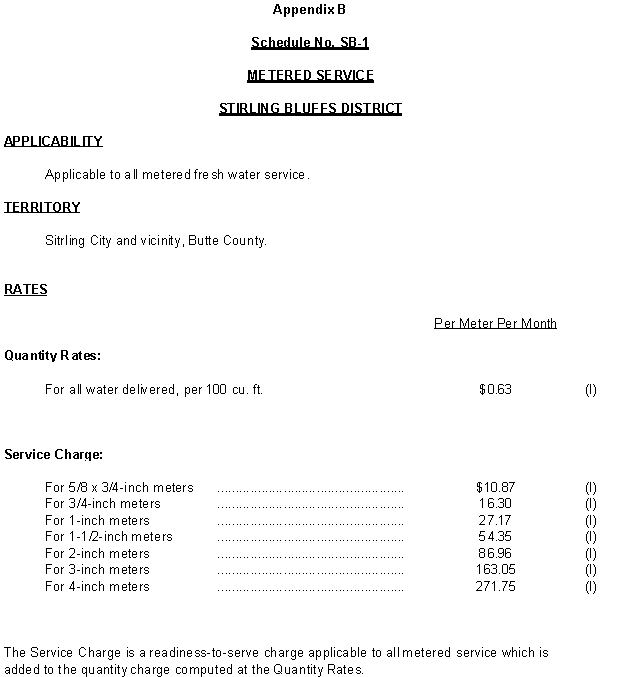
Lastly, at the rates recommended by the Division, all customers will see a 4% increase in the service charge, while the quantity charge rate will increase by 43%. The resulting rate structure (Appendix B) should send a strong economic signal to DOWCSB customers to conserve water (Appendix C).
COMPLIANCE
DOWCSB is currently providing water service to its customers according to the standards of General Order 103. DOWCSB has regularly filed annual reports with the Division. There are no outstanding Commission orders requiring system improvements.
COMMENTS
Public Utilities Code Section 311(g) (1) provides that this resolution must be served on all parties and subject to at least 30 days public review and comment prior to a vote of the Commission. Section 311(g) (2) provides that this 30-day period may be reduced or waived upon the stipulation of all parties in the proceeding.
The 30-day comment period for the draft of this resolution was neither waived nor reduced. Accordingly, the draft resolution was mailed to parties for comments.
FINDINGS
1. The Division's recommended summary of earnings (Appendix A) is reasonable and should be adopted.
2. The rates recommended by the Division (Appendix B) are reasonable and should be adopted.
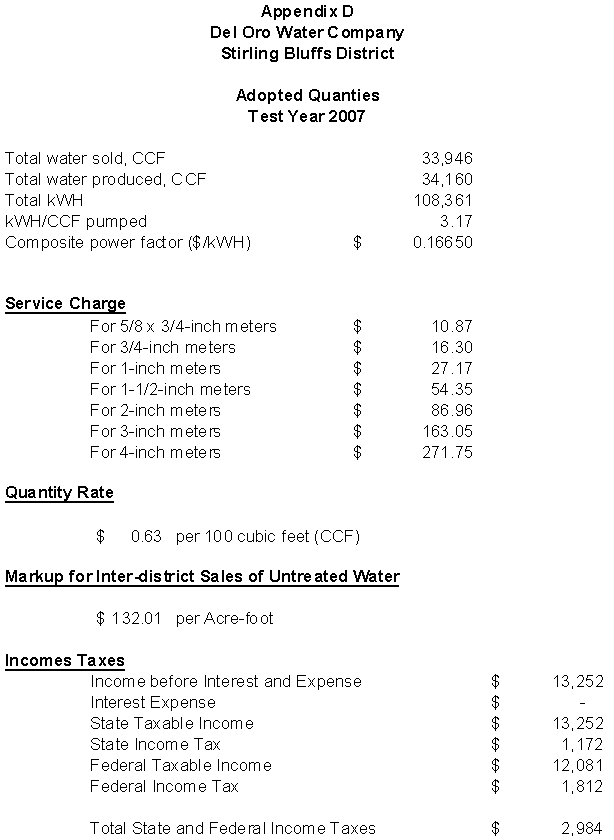
3. The quantities (Appendix D) used to develop Division's recommendations are reasonable and should be adopted.
4. The rate increase authorized herein is justified and the resulting rates are just and reasonable.
5. The amount of increase authorized herein is justified and the resulting rates are just and reasonable.
6. Within 60 days from the effective date of this resolution, Del Oro Water Company - Stirling Bluffs district should be required to file an advice letter to establish a low-income assistance program that offers a discount to qualified low-income customers. The eligibility criteria will be modeled after the CARE programs available to energy customers.
7. Del Oro Water Company - Stirling Bluffs district should be required to resolve balances in the purchased power balancing account at the same time that it files advice letters to resolve balances in the inter-district water sales balancing account.
8. Del Oro Water Company - Stirling Bluffs district should be required to modify the postcard billing statements to include, where practicable, information on water conservation. Del Oro Water Company - Stirling Bluffs district should also be required to include conservation information insert when it mails out its annual Consumer Confidence Report on water quality.
THEREFORE IT IS ORDERED THAT:
1. Authority is granted under Public Utilities Code, Section 454, for Del Oro Water Company - Stirling Bluffs district to file an advice letter incorporating the Summary of Earnings and revised rate schedules attached to this resolution as Appendices A and B, respectively, and concurrently to cancel its presently effective rate Schedule No. SB-1, Metered Service. The effective date of the revised rate schedule shall be 5 days after the date of filing.
2. Del Oro Water Company - Stirling Bluffs District is authorized to increase annual revenues by $19,614, or 18.5%, for a rate of return of 10.75% on rate base for test year 2007. This results in test year 2007 revenue of $125,840.
3. The quantities (Appendix D) used to develop the Division's recommendations are adopted.
4. Del Oro Water Company - Stirling Bluffs district is ordered to resolve balances in the purchased power balancing account at the same time that it files advice letters to resolve balances in the inter-district water sales balancing account.
5. Within 60 days from the effective date of this resolution, Del Oro Water Company - Stirling Bluffs district is required to file an advice letter to establish a low-income assistance program that offers a discount to qualified low-income customers. The eligibility criteria will be modeled after the CARE programs available to energy customers.
6. Del Oro Water Company - Stirling Bluffs district is required to modify the postcard billing statements to include, where practicable, information on water conservation. Del Oro Water Company - Stirling Bluffs district should also be required to include conservation information insert when it mails out its annual Consumer Confidence Report on water quality.
7. This resolution is effective today.
I certify that the foregoing resolution was duly introduced, passed, and adopted at a conference of the Public Utilities Commission of the State of California held on April 10, 2008; the following Commissioners voting favorably thereon:
PAUL CLANON
Executive Director
CERTIFICATE OF SERVICE
I certify that I have by mail this day served a copy of Draft Resolution W-4679 on all parties in this filing or their attorneys as shown on the attached list.
Dated March 11, 2008, at San Francisco, California.
/s/ JOSIE L. JONES
Josie L. Jones
NOTICE
Parties should notify the Division of Water and Audits, Public Utilities Commission, 505 Van Ness Avenue, Room 3106, San Francisco, CA 94102, of any change of address to insure that they continue to receive documents.
|
SERVICE LIST DRAFT RESOLUTION W-4679 |
|||||
| Roma O'Neill P. O. Box 236 STIRLING BLUFFS CA 95978 16975 Manz |
|
Mike Batz General Delivery STIRLING BLUFFS CA 95978 |
Tracy Kertson General Delivery STIRLING BLUFFS CA 95978 | |||
Al Gaither P. O. Box 155 MAGALIA CA 95978 |
Don Litton General Delivery STIRLING BLUFFS CA 95978 |
|
Sharon Townsend P. O. Box 132 STIRLING BLUFFS CA 95978 | |||
Ren Gonzalez P. O. Box 56 STIRLING BLUFFS CA 95978 |
Jim Eisan General Delivery STIRLING BLUFFS CA 95978 |
Lori Batz General Delivery STIRLING BLUFFS CA 95978 |
||||
Madelyn Henry General Delivery STIRLING BLUFFS CA 95978 |
C. A. Hilgeman General Delivery STIRLING BLUFFS CA 95978 |
Cheryl Hacker General Delivery STIRLING BLUFFS CA 95978 | ||||
Gary & Marilyn Connor General Delivery STIRLING BLUFFS CA 95978 |
George Hackett General Delivery STIRLING BLUFFS CA 95978 |
|
Joseph Moore General Delivery SSTIRLING BLUFFS CA 95978 | |||
Steve Smelden General Delivery STIRLING BLUFFS CA 95978 |
Carol A. Lewis General Delivery STIRLING BLUFS CA 95978 |
PPatricia McCoy PP. O. Box 218 SSTIRLING BLUFFS CA 95978 | ||||
Robert S. Fortino President Del Oro Water Co., Inc. Drawer 5172 CHICO CA 95927 |
||||||
