ULTS Trust Administrative Committee
Meeting Agenda
August 5, 2004 (Thursday)
10:00 AM
505 Van Ness Avenue, Technical Training Room_
SAN FRANCISCO, CA 94102
Teleconference: 877-780-7587 / Passcode: 242672#
1. Introduction |
10:00 |
|
2. June 30, 2004 Meeting Minutes: Committee will review and approve June 2004 meeting minutes prepared by the Telecommunications Division (TD). |
10:05 |
pp. 2-5 |
3. Marketing Programs: TD reports on the status of the 2003 ULTS Marketing programs and the 2004 ULTS Marketing contract (RFP 03PS5427). |
10:15 |
p. 6 |
4. FCC's Income Verification Requirement: Committee will discuss the impact on the California ULTS program. |
10:45 |
p. 7 |
5. VoIP: TD updates on the status of Commission proceeding I.04-02-007. |
11:15 |
|
6. Conflict of Interest: Committee will discuss the impact of SB 1653. |
11:30 |
p. 8 |
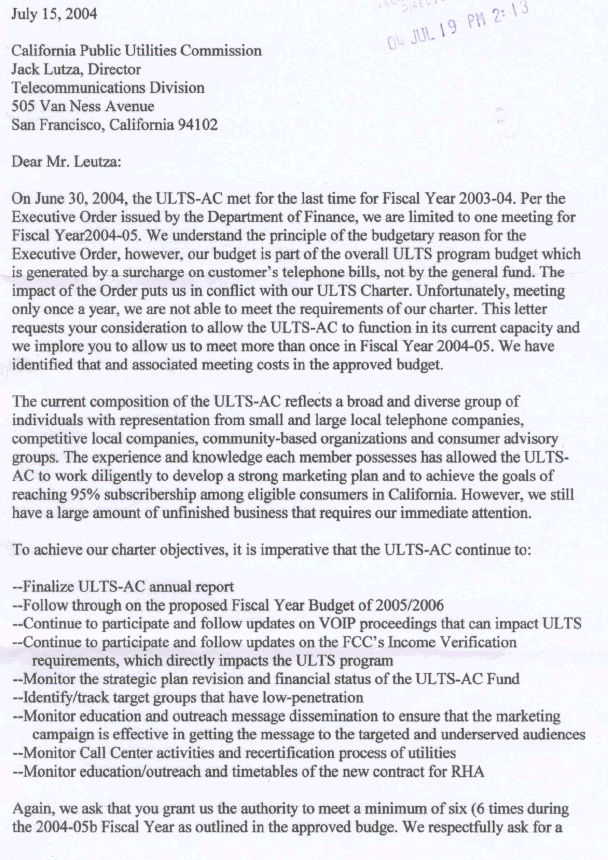
7. Meetings for FY 2004-05: Committee will discuss its July 15, 2004 letter and TD's response. |
11:45 |
pp. 9-11 |
8. 2003 Annual Report: Committee will review and approve the 2003-04 Annual report to be submitted to the CPUC pursuant with Charter § 4.b. |
12:00 |
pp. 12-16 |
9. Liaison Reports: a. TD reports on the status of the Strategic Plan revision. b. Fiscal Office updates the Committee on the financial status of the ULTS AC Fund. c. Legal Division updates the Committee on the developments of conflict of interest resolution. |
12:30 |
|
10. Public Comments |
12:45 |
|
11. Future Meeting Dates: The Committee will establish meeting date(s) for FY 2005-06. |
13:00 |
|
12. Adjournment |
Meeting Minutes
Of
Universal Lifeline Telephone Service Trust Administrative Committee
Date: June 30, 2004
Location: California Public Utilities Commission
505 Van Ness Avenue, Training Room
San Francisco, CA 94102
Members Present:
Mateo Camarillo, Chair (joined the meeting at 11AM)
Mike Gipson, Vice-Chair
Ken McEldowney
Lyle Millage
Joel Tolbert
Jeffrey Mondon
Marlene Hebert
Members Absent:
Ana Montes
Liaisons Present:
Hassan Mirza, Telecommunications Division (TD)
Judy Cooper, Communications and Public Information Division (CPID)
Kevin Feizi, Telecommunications Division (TD)
Eric Van Wambeke, Telecommunications Division (TD)
Others in Attendance:
Taura O'Lariscy, Richard Heath & Associates
Susan Bogue, Richard Heath & Associates
Bettina Cardona, FONES4ALL (Teleconference)
1. Introduction
Mike Gipson called the meeting to order at 10:10 am. A roll call was made and a quorum was in attendance.
2. June 2004 Meeting Minutes
Ken McEldowney moved approval of the June 2004 meeting minutes. Joel seconded the motion. Lyle Millage abstained because he did not attend June meeting. There was no further discussion. The minutes were approved.
3. Marketing Programs
On meeting agenda item Marketing Program, Kevin Stated that Karen informed her before the meeting that marketing contract is in its normal process with the Department of General Services and she was waiting for their response. Mike asked that reporting on the status of the Marketing Contract be added to the agenda of the next ULTSAC meeting.
Judy updated the Committee on the Marketing Contract. She informed the members that RHA was awarded the contract as the lowest bidder.
4. FCC Income Verification Requirement
Jeffrey opened the discussion noting that FCC issued an Order requiring income verification for Lifeline customers. He stated the point that needs to be cleared is who is to do verification, is it state agency, or carrier. Ken initially moved to make a motion for the ULTSAC to recommend to the Commission to ask FCC to consider a waiver on the income verification. Ken believed that any thing that adds extra requirements for new emigrants or senior citizens to enroll the Lifeline program would erode the gains of past few years. Joel referring to past studies commissioned by the former ULTS Marketing Board and by carriers stated that there was a need for a more proactive position and there should to be alternative recommendations made to the Commission. Ken withdrew his motion. No further action taken. This is issue to be carried over to the next meeting.
5. Meetings for FY 2004-05
In response to the Committee members to see if they could have more than one meeting a year, Judy states that Commission staff would have to go to the Department of Finance (DOF) for an exemption from their [DOF] ruling and she was of the opinion that it [DOF approving additional meetings] will not happen.
Judy gave some constructive criticism of the wordings of the ULTSAC chairman's letter sent to the Commissioners and the Commission president (copies of the letter was attached to the June meeting package). In this letter regarding limiting the board to one meeting a year, Mateo claimed, "the composition of our board is a diverse representative group not found in the PUC staff. Judy challenged his assertion with a few examples. The committee members had further exchange of thoughts on the subject.
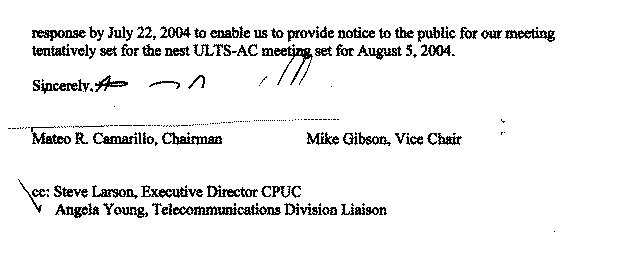
Judy Suggest that the ULTSAC, citing the board unfinished business, sent a letter to TD Director and the Executive Director asking for more meetings in coming fiscal year. Joel move to make a motion that the ULTSAC sends a letter to the TD Director and the Commission Executive Director to in turn, send a letter to the appropriate departments outlining the ongoing and unfinished business of the UTLSAC and on those grounds, to request an exemption from limitation set on number of meeting ULTSAC could have the coming fiscal year. Ken seconded the motion and with no further discussion the motion passed unanimously. The members directed the chair and vice chair to draft a letter and send the draft to Angela ULTSAC. Angela will send draft to members, then each member can send her/his comments to Angela and she in turn, will compile the comments and send it back to members. Judy stated Members couldn't partake in a group email dialogue because it constitutes a meeting.
6. Commission VoIP Proceeding (I. 04-02-007)
Eric updated the ULTSAC committee on the proceeding. He indicated that VoIP providers do not contribute to paying surcharges and fees related to access charges, public programs. They do not provide 911 service either. VoIP carriers claim they are information service providers and according to Internet Tax Freedom Act, if it is decided that they are in fact information service providers, then any of these funds that would been going to the public program supporting the ULTS would evaporate. Another concern has to do to consumer protection in line with passed consumer bill of rights. Eric stated although on the comments that were received in response to OII in question, there was no consensus but in general, for the most part public agencies and consumer oriented agencies are for regulations and providers of the service are against regulating the service.
7. Solutions Summit
Mateo updated the Committee on the meeting he attended in Sacramento. The meeting was on Voice over IP and Universal Lifeline that basically covered issued related to public service programs, E 911, 911, and services to Deaf and Disabled. So it was more of an informational meeting. Jeffrey added that there were representative of various entities such as consumer groups, wireless, wire lines, and Telecommunications companies. Commissioner Kennedy was also there.
8. Liaisons Report
Kevin informed the committee that the Legal Division and Fiscal Office liaisons were not available to attend the meeting. The committee urged the presence of the liaisons if they were scheduled.
On the Strategic Plan revision, Kevin stated as of the last day of Angela's working day, there was no comment received from the members.
Judy reported that she did not received comments on the draft of the Annual Report of the ULTS AC from the Committee members as of the date of the meeting. Angela provided Judy with her suggested changes such as some acronyms. Judy stated that none of these minor changes would have significant impact on the content of the report. Joel stated that he forwarded his comments to Angela. He also gave a hard copy to Judy. Judy will collect all comments from any committee members and incorporate them in the report. She will send the final copy to Angela for distribution to the members.
Additionally, Judy mentioned that ULTSAC members at one point would be reviewing the [Telco] Consumer Bill of Rights, which is available through the Commission's Website.
Further, she added that Public Advisors Office is in charge of recruiting for vacant positions on the Committee pending resolution of conflict of interest issue.
9. Public Comments
Taura of RHA updated the Committee members on what RHA will do in their upcoming contract.
RHA previous contract was extended through June 30, 2004 and the new one will start as of July 1, 2004. RHA is aiming at reaching 18,000 transfers this year comparing to 15,000 for the previous year. RHA anticipates that non-telephone /non-ULTS subscriber ratio be more in the 50-50 range rather than 80-20. There are extra languages to be covered this year such as Somalian, and Russian in addition to those listed in the brochures.
In response to Mateo's inquiry on whether RHA and CBOs made an effort to educate the customers about pre-paid phone cards, Taura stated that RHA did so and further added that phone cards are not good for services such as 911 and call backs although they could be used for long distance calls.
10. Future Meeting Dates
Next meeting is set for August 5, 2004.
11. Adjournment
Ken moved to make a motion to adjourn, Mike seconded and the meeting came to close at 1:10 PM.
Richard Heath & Associates, Inc. 2003-04 Call Center Activities Report:
http://www.cpuc.ca.gov/static/industry/telco/public+programs/ults.htm
FCC ORDER 04-87
On June 22, 2004, the Federal Communications Commission (FCC) released Order FCC 04-87 modifying the federal Lifeline/Link-up programs. The modifications are to be implemented by states by July 22, 2005.
Federal Lifeline/Link-Up program modifications include but are not limited to:
· Expanding the federal default eligibility criteria to include an income-based criterion at 135 % of Federal Poverty Guideline;
· Adding the Temporary Assistance for Needy Families (TANF) and the National School Lunch's free lunch program (NSL) to the existing list of means-tested programs1 eligible for the federal default program-based criteria;
· Requiring eligible telecommunications carriers (ETCs) in states that lack dispute resolution procedures to notifying customers 60 days in advance of their impending loss of Lifeline/Link-Up;
· Encouraging states that currently do not employ auto-enrollment to consider other states with auto-enrollment as models for future implementation.
· Requiring states, including federal default states, to adopt certification procedures to document income-based eligibility for their income-based Lifeline/Link-Up programs.
Entire Order is available at:
http://hraunfoss.fcc.gov/edocs_public/attachmatch/FCC-04-87A1.pdf
BILL NUMBER: SB 1653 INTRODUCED
BILL TEXT
INTRODUCED BY Senator Johnson
FEBRUARY 20, 2004
An act to amend Section 87100 of the Government Code, relating to the Political Reform Act of 1974.
LEGISLATIVE COUNSEL'S DIGEST
SB 1653, as introduced, Johnson. Conflicts of interest.
Existing law, the Political Reform Act of 1974, prohibits a public official from making, participating in making, or in any way attempting to use his or her official position to influence a governmental decision in which he or she knows or has reason to know he or she has a financial interest.
This bill would make technical, nonsubstantive changes to this provision.
The Political Reform Act of 1974, an initiative measure, provides that the Legislature may amend the act to further the act's purposes with a 2/3 vote of each house and compliance with specified procedural requirements.
This bill, which would declare that it furthers the purposes of the act, would therefore require a 2/3 vote.
Vote: 2/3. Appropriation: no. Fiscal committee: no.
State-mandated local program: no.
THE PEOPLE OF THE STATE OF CALIFORNIA DO ENACT AS FOLLOWS:
SECTION 1. Section 87100 of the Government Code is amended to read:
87100. No public official at any level of state or local government shall make, participate in making, or in any way attempt to use his or her official position to influence a governmental decision in which he or she knows or has reason to know he or she has a financial interest.
SEC. 2. The Legislature finds and declares that this bill furthers the purposes of the Political Reform Act of 1974 within the meaning of subdivision (a) of Section 81012 of the Government Code.
STATE OF CALIFORNIA ARNOLD SCHWARZENEGGER, Governor

PUBLIC UTILITIES COMMISSION
505 VAN NESS AVENUE
SAN FRANCISCO, CA 94102-3298
July 23, 2004
Mateo Camarillo
4977 Kensington Drive
San Diego, CA 92116
Re: Universal Lifeline Telephone Service Trust Administrative Committee
Dear Mr. Camarillo:
I have received your letter dated July 15, 2004 requesting permission for the Universal Lifeline Telephone Service (ULTS) Trust Administrative Committee (Committee) to meet 6 times during fiscal year 2004-05. As stated in my March 25, 2004 response to your February 6, 2004 letter, the ULTSAC's committee expense budget for FY 2004-05 has been reduced to one meeting to comport with the Department of Finance's Budget Letter 03-02 limiting all State advisory bodies' meeting to one annually. This revised budget has been incorporated in the Governor's Budget May Revision. Although the State's FY 04-05 budget remains unresolved as of this day, I do not believe that the ULTSAC Fund's budget will be further revised to reflect costs of additional meetings as requested in your letters. Again, I thank you and your colleagues for the commitment and devotion in serving on this Committee.
Sincerely,
/s/ John M. Leutza, Director
Telecommunications Division
ANNUAL REPORT OF THE UNIVERSAL LIFELINE TELEPHONE SERVICE TRUST ADMINISTRATIVE COMMITTEE (ULTS-AC)
FOR THE PERIOD FEBRUARY 1, 2003 THROUGH JUNE 30, 2004
Submitted by: Mateo Camarillo, Chairman ULTS-AC
Marlene Hebert, ULTS-AC Member
UNIVERSAL LIFELINE TELEPHONE SERVICE TRUST -
ADMINISTRATIVE COMMITTEE
Pursuant to PUCode 277(a) the ULTS-AC was established to serve as an advisory committee to the California Public Utilities Commission (CPUC). The role of the ULTS-AC is to advise the CPUC regarding the development, implementation and administration of the Universal Lifeline Telephone Service Trust (ULTS) program to ensure lifeline telephone service is available to the people of the State as provided by Assembly Bill 1348 (AB 1348), and subsequently modified by Senate Bill 669 (SB 669).
The Moore Universal Telephone Service Act.
AB 1348 was to ensure the availability of affordable basic local telephone service to all qualifying low-income households in California. This bill became law in September 1983 and is known as Article 8. Universal Telephone Service, Public Utilities Code Section 871.
The ULTS program provides subsidized basic telephone service to qualifying residential subscribers. Under the ULTS program, a ULTS customer may select any carrier from those that provide residential local exchange service in the customers area. The ULTS program is funded by a surcharge, as determined by the CPUC, on the end of the user's bill for intrastate telecommunications services. There are approximately 3.0 million subscribers who receive subsidized telephone service through their local telephone service provider. These customers pay half the cost of basic telephone service.
ULTS Marketing Board (ULTSMB)
Pursuant to Decision 96-10-066 the ULTSMB was established as the entity responsible for developing designing and implementing a competitively neutral marketing strategy for the ULTS program. The intent of the Decision was to provide basic telephone service to all qualifying low income households in California. The ULTSMB was to assist the CPUC's goal of attaining 95 percent subscribership amongst all eligible customer subgroups in California.
The annual budget was limited to $5 million and the CPUC directed the ULTSMB to devote 80 percent of its marketing and education budget to campaigns designed to bring basic telephone service to qualifying households without telephone service. The remaining marketing and education budget of 20% was to be used to close the gap between the total number of households with telephone service who qualify for the ULTS program and the number of those households that actually use the program.
The ULTSMB contracted with a marketing firm to establish an outreach campaign that would educate customers and promote awareness of the ULTS program to low-income households and increase the number of subscribers in the program. In November 1999 phase one of the campaign started and was known as "Connect California". A public advertisement phase commenced in April 2000 and was completed in October 2000. During that time a ULTS call center was established to help facilitate customer access to local telephone service providers in a competitively natural manner or of the customers choice in order to establish service. The call center was staffed by telephone representatives who assisted customers with any questions relating to the ULTS program. Additionally, representatives were available in seven languages for the non-English speaking customers identified as part of the target audience.
Senate Bill 669 (SB 669) implemented changes to the ULTSMB relative to the program administration of the ULTS. Under SB 669, the existing ULTSMB was disbanded and the new ULTS-AC board was created. This bill required that the administrative responsibilities for the ULTS program become the responsibility of the CPUC. Oversight of the ULTS program was assigned to the CPUCs Telecommunications Division (TD). Therefore, the role of the ULTS-AC under the SB 669 became an advisory role.
ULTS-AC
By Commission Decision 02-04-059 the restructuring of the ULTS program was completed and the establishment of the new ULTS-AC commenced effective February 1, 2003. As stated above, the CPUC's TD is the program administrator overseeing the ULTS contract administration and marketing activities with advice from the ULTS-AC in its new advisory capacity.
During this transition, the ULTS-AC continues to implement the Scope of Work, and the Goals and Objective of the ULTSMB Plan. Moreover, in November 2003, the ULTSAC made significant modifications to the original Plan which have carried over and have been implemented as part of the current ULTS marketing program administered by RHA and Associates with oversight by the TD. The current composition of the ULTS-AC reflects a broad diverse group of individuals with representation from small and large local telephone companies, competitive local companies, consumer-based organization and consumer advocacy groups. The experience and knowledge that each member possesses has allowed the ULTS-AC to work diligently to develop a strong marketing plan and to achieve our goals of reaching 95% subscribership among all eligible consumer in California.
The ULTS-AC continues to ensure that the ULTS program targets all eligible low-income segments of the population of California including, but not limited to African American, Cambodian, Chinese, Filipino, Hispanic, Hmong, Korean, Laotian, Vietnamese, Native Americans, Seniors, social agency and welfare recipients. To achieve this, it is imperative that the ULTS-AC working with TD continues to:
· Track and report monthly the activities of the marketing,
education and Call Center program for ULTS
· Track enrollment data
· Verification of households who qualify for ULTS, but may not be subscribed for ULTS
· Identify target groups that have low-penetration rates
· Identify target audience reached/successful outreach efforts
· Monitor education and outreach message dissemination to ensure that the campaign is effective in getting the messages to the audience
· Provide cost analysis relating to media buys and outreach methods overall by target group per capita
· Report and monitor Call Center activities
· Coordinate with telephone service carriers to include enrollment by zip code or other geographic areas and by other demographic elements if available
· Track telephone service carrier re-certification process to ensure ULTS customers recertify based on their personal income qualifications each year
· Continue to modify and update all education and outreach material in language specific form with correct and consistent information
· Monitor timeline and activities of CBOs
· Ensure that objectives and implementation methods are effective and feasible
· Identify any problems with the marketing campaign and make recommendations as expeditiously as possible
ULTS-AC Goals and Objectives for Fiscal Year 2004-05:
· Meet regularly under the Provisions of Bagley-Keene Open Public Meeting Act
· Follow procedures mandated by Charter
· Provide recommendations and changes to ULTS Marketing Plan
· ULTS to provide recommendations to TD on R.03-04-003
· Monitor and evaluate CBO education and outreach. Identify any targeted audience changes
· Closely monitor CPUCs Conflict of Interest Concerns Relative to the impact on ULTS-AC members
· Review and monitor ULTS-AC Budget
· Discuss and access Senate & Assembly Bills impact on ULTS
· Continual interaction with ULTS Program Contractor, RHA and Associates
· Monitor legislative activities that may impact ULTS or consumers in California
· Submit yearly ULTS budget for review and approval by Commission resolution
· Review possible Consumer Bill of Rights issue integration with ULTS
By Executive Order from the Department of Finance, the ULTS-AC is being precluded from meeting 12 times per year. Instead, our ability to meet has been limited to meeting six (6) times per year. This Executive Order has placed severe constraints on the ULTS-AC and precludes the ULTS-AC from advancing forward the goals and objectives set forth above, and precludes the ULTS-AC in finalizing proposed plans, and approving unfinished business. Additionally, the unresolved issues of conflict of interest should be resolved as expeditiously as possible.
1 These programs include Medicaid, Food Stamps, Supplemental Security Income, Federal Public Housing Assistance, the Low-Income Home Energy Assistance Program, Bureau of Indian Affairs General Assistance, Tribally-Administered Temporary Assistance for Needy Families, Head Start, and the National School Lunch Program's free lunch program in tribal lands.