ALJ/KK2/gd2/avs DRAFT Agenda ID #11311 (Rev. 2)
Ratesetting
8/23/2012 Item 46
Decision PROPOSED DECISION OF ALJ KIM (Mailed 6/1/2012)
BEFORE THE PUBLIC UTILITIES COMMISSION OF THE STATE OF CALIFORNIA
Application of Southern California Edison Company (U338E) for Approval of its 2012-2014 California Alternate Rates for Energy (CARE) and Energy Savings Assistance Programs and Budgets. |
Application 11-05-017 (Filed May 16, 2011) |
And Related Matters. |
Application 11-05-018 Application 11-05-019 Application 11-05-020 |
DECISION ON LARGE INVESTOR-OWNED UTILITIES' 2012-2014 ENERGY SAVINGS ASSISTANCE (ESA) (FORMERLY REFERRED TO AS LOW INCOME ENERGY EFFICIENCY OR LIEE) AND CALIFORNIA ALTERNATE RATES FOR ENERGY (CARE) APPLICATIONS
DECISION ON LARGE INVESTOR-OWNED UTILITIES' 2012-2014 ENERGY SAVINGS ASSISTANCE (ESA) (FORMERLY REFERRED TO AS LOW INCOME ENERGY EFFICIENCY OR LIEE) AND CALIFORNIA ALTERNATE RATES FOR ENERGY (CARE) APPLICATIONS 11
1.1. Adopted Budgets for 2012-2014 Energy Savings
Assistance and California Alternate Rates for
Energy Programs 55
1.2. Key Highlights of 2012-2014 Energy Savings
Assistance Program 77
1.3. Key Highlights of 2012-2014 California Alternate
Rates for Energy Program 1414
2. Overview and Background 1818
3.1. Integration of Low Income Programs with
Other Utility Demand-Side Programs 3434
3.2. Leveraging Low Income Programs 4242
3.2.3. Leveraging with California Department of
Community Service and Development (CSD) 4444
3.3. Program Design and Delivery Model 5252
3.4. Marketing Education and Outreach (ME&O) 6666
3.5. ESA Program and Cost-Effectiveness 7070
3.6. Approved ESA Program Measures 7878
3.6.2. ESA Program Measure Cost-Effectiveness Test 7979
3.6.3. IOUs' ESA Program Measure Portfolio Proposals 8282
3.6.4. Parties' Positions 8585
3.6.4.5. CHPC, NCLC, NHLP (CHPC et al.) 8787
3.6.5.1. Retirements and Add Back Measures 9090
3.6.5.1.1. Attic Insulation (PG&E) 9090
3.6.5.1.2. Envelope and Air Sealing Measures
(PG&E, SCE, and SoCalGas) 9494
3.6.5.1.3. Water Conservation Measures (PG&E) 9696
3.6.5.1.4. Furnace and Water Heater Repair/Replacement (PG&E, SoCalGas, and SDG&E) 9999
3.6.5.1.5. Cooling Measure (SCE) 107107
3.6.5.1.6. Heat Pumps for Single Family Climate Zone 15, Multifamily Climate Zone 15 (SCE) 107107
3.6.5.1.7. Room Air Conditioner for all Housing Types
in Climate Zones 10, 13, 14, 15 (SCE) 107107
3.6.5.1.8. Room Air Conditioner for all Housing Types
in Climate Zone 10 (SDG&E) 108108
3.6.5.1.9. Cooling Measures - Proposed for Retirements (PG&E and SDG&E) 109109
3.6.5.1.10. Duct Test and Seal - Proposed for Retirement (PG&E, SoCalGas, and SDG&E) 112112
3.6.5.1.11. Central Air Conditioner Service (SCE) 114114
3.6.5.1.12. Evaporative Coolers Maintenance - Proposed
for Retirement (SCE) 118118
3.6.5.1.13. Evaporative Cooler Cover - Proposed for
Retirement (SDG&E) 118118
3.6.5.1.14. Tankless Water Heater - Proposed for
Retirement (SoCalGas) 118118
3.6.5.2. New 2012-2014 Measures 119119
3.6.5.3. Other 2012-2014 Measures 120120
3.7. Current Modified 3 Measure Minimum Rule
(Modified 3MM Rule) 122122
3.7.2. SCE's Request to further Change the
Modified 3MM Rule 124124
3.7.3. Other IOUs' Position 125125
3.7.4. Other Parties' Comments 125125
3.7.5. Additional Comments by the IOUs 127127
3.7.5.1. SCE's Response to December 2011 Ruling 127127
3.7.5.2. PG&E's Response to December 2011 Ruling 128128
3.7.5.3. SDG&E's Response to December 2011 Ruling 129129
3.8. Refrigerator Replacement Criteria 134134
3.9. Compact Fluorescent Lamps (CFLs) 135135
3.10. Multifamily (MF) Housing Segment 138138
3.10.2. IOUs' Multifamily Housing Segment
Strategy Proposals 140140
3.10.3. Multifamily Comments and
Proposals of NCLC, CHPC, and
NHLP (NCLC et al.) and TELACU et al. 142142
3.10.3.1. Multifamily Comments and Proposals of
NCLC et al. 142142
3.10.3.2. Multifamily Comments and Proposals of
TELACU et al. 145145
3.10.4. IOUs' Responses to NCLC et al.'s and
TELACU et al.' Proposals 148148
3.10.4.1. IOUs' Responses to NCLC et al.'s Proposal 148148
3.10.4.2. IOUs' Responses to TELACU et al.'s Proposal 150150
3.10.5. Other Parties' Comments on
Multifamily Segment Issues and Proposals 151151
3.10.5.5. The Joint Parties 153153
3.10.6.3. Multifamily Segment Strategies 159159
3.10.6.4. Comprehensive Multifamily Segment
Strategies Formulation and Implementation 166166
3.11. Workforce Education and Training (WE&T) 170170
3.11.2. IOUs' Post Statewide WE&T
Needs Assessment Position 172172
3.11.3. Parties' Positions 175175
3.11.3.2. Brightline and Green for All (G4A) 175175
3.11.3.4. Joint Parties 177177
3.11.4. IOUs' Responses to Other Parties 178178
3.11.4.2. SoCalGas and SDG&E 178178
3.11.5.1. Statewide WE&T Needs
Assessment Recommendations 179179
3.11.5.2. Proactive WE&T Needs
Assessment and Planning 180180
3.11.5.3. Focuses for ESA Program WE&T 181181
3.11.5.4. Preliminary Reports and WE&T
Working Group 183183
3.11.5.5. General Energy Efficiency WE&T Coordination 185185
4. CARE Program and Budget 188188
4.1. Proposed and Adopted CARE Budgets 188188
4.2. CARE Administrative Expenses - Outreach
Budget Component 189189
4.3. CARE Administrative Expenses - Cooling Centers 196196
4.4. CARE Categorical Eligibility and Enrollment,
Post Enrollment Verification, and Re-certification 204204
4.4.1. Categorical Eligibility and Enrollment 205205
4.4.2. Post Enrollment Verification 205205
4.4.2.1. SCE's Post Enrollment Verification Proposal 206206
4.4.2.2. PG&E's Post Enrollment Verification Proposal 207207
4.4.2.3. SoCalGas' Post Enrollment
Verification Proposal 207207
4.4.2.4. SDG&E's Post Enrollment
Verification Proposal 208208
4.4.3. Other Parties' Positions 208208
5. Pilots, Studies, and other Miscellaneous Proposals 228228
5.1. Overview and Background 228228
5.2. Pilots and Studies 230230
5.2.1. CHANGES Pilot Program 230230
5.2.2. CARE Customer Choice Pilot Proposal
(Choice Pilot) and Split Incentive Study
Proposal (Split Incentive Study) 232232
5.2.3. Opower, Inc. Home Energy Report Pilot 233233
5.2.4. PC Tablet Proposal 234234
5.2.4.1. Other Parties' Comments and Positions 236236
5.2.4.2. IOUs' and EEC's Costs and Savings Estimates 236236
5.2.5. SCE's Energy Education/Energy Education
Evaluation Study and SoCalGas'
Leave-behind Energy Education DVD 242242
5.2.5.1. Parties' Comments and Positions 242242
5.2.6. Next Impact Evaluation Study and Report 246246
5.2.6.2. 2009-2011 Impact Evaluation 246246
5.2.6.3. IOUs' Proposals 248248
5.3. Miscellaneous Administration and Delivery Proposals 262262
5.3.1. Calculating Eligible Population 262262
5.3.1.1. IOUs' Positions 264264
5.3.1.2. Other Parties' Positions 264264
5.3.1.3. IOUs' Responses 265265
5.3.2. CARE and ESA Program Eligibility and
Federal Poverty Guideline 267267
5.3.3. Customers with Disability 270270
5.3.4. Natural Gas Appliance Testing Policy 270270
5.3.4.1. DRA's Recommendation 270270
5.3.4.2. CHPC et al.'s Position 270270
5.3.4.3. SoCalGas' and SDG&E's Position 271271
5.3.4.4. PG&E's Response 272272
5.3.5. ESA Program Contractor
Reimbursement/Charge Back 274274
5.3.5.1. EEC's Position 274274
5.3.5.2. IOUs' Propositions 275275
5.3.6. Annual Family Electric Rate Assistance
(FERA) and CARE Income Eligibility
Letter Release Date 279279
5.3.7 Studies and Reports Completion Due Date 279279
5.3.8. Mid-Cycle Program Changes by Tier 2
Advice Letter/Move Quarterly Public
Meetings to Annually/New Method to
Update P&P Manual and
WIS Manual/Working Groups 280280
5.3.8.1 Other Parties' Comments and Positions 281281
5.3.9. 2015-2017 Application Due Date and Projected
2015-2017 Guidance Document Due Date 287287
5.3.10. Customer Referral Incentive/Contractor
Referral Incentive/Contractor CommonUniforms/Enrollment Kit 288288
5.3.11. SoCalGas' Customer Assistance
Representative Positions 289289
6. General Administration 292292
6.1. Evaluation, Measurement and Verification (EM&V) Process 292292
6.2. Fund Shifting Rules 295295
6.4. Final Budget Augmentation for CARE and
ESA Programs 2012-2014 300300
8. Comments on Proposed Decision 306306
8.1. Climate Zones 10 and 13 and Cooling Measures 307307
8.2. Cooling Measures, Climate Zones 10 and 13 and
Health/Death Risk Argument 307307
8.3. Leveraging with CSD 308308
8.4. SCE and Reporting Practices 309309
8.5. ESA Program Services to Catalina Island Gas Customers 310310
8.6. CARE Implementation Advice Letter 311311
8.7. Continuation of Capitation Fee for
ESA Program and Expansion to All Homes 311311
8.8. Continuation of ESA Program Income Verification/Self-Certification/Categorical Eligibility Program 312312
TABLE OF APPENDICES AND DESCRIPTION
Appendix A ESA and CARE Program 2012-2014 Budget Summary
Appendix B ESA Program Authorized Budget-PG&E
Appendix C ESA Program Authorized Budget-SCE
Appendix D ESA Program Authorized Budget-SDG&E
Appendix E ESA Program Authorized Budget-SoCalGas
Appendix F ESA Program Projected Homes to be Treated
Appendix G ESA Program Budget Impacts Calculation
Appendix H Approved Measures-PG&E
Appendix I Approved Measures-SCE
Appendix J Approved Measures-SDG&E
Appendix K Approved Measures-SoCalGas
Appendix L Pilot & Studies Budgets
Appendix M CARE Program Authorized Budgets
Appendix N CARE Program Budget Impacts Calculation
DECISION ON LARGE INVESTOR-OWNED UTILITIES' 2012-2014 ENERGY SAVINGS ASSISTANCE (ESA) (FORMERLY REFERRED TO AS LOW INCOME ENERGY EFFICIENCY OR LIEE) AND CALIFORNIA ALTERNATE RATES FOR ENERGY (CARE) APPLICATIONS
1. Summary
Today, we approve approximately $5 billion to continue our two energy-related low income programs, the Energy Savings Assistance (ESA) (formerly known as Low Income Energy Efficiency (LIEE)) and the California Alternate Rates for Energy (CARE) Programs for Pacific Gas and Electric Company (PG&E), Southern California Edison Company (SCE), San Diego Gas & Electric Company (SDG&E), and Southern California Gas Company (SoCalGas), (collectively IOUs or Utilities) for the 2012-2014 program cycle. The ESA Program budget now exceeds $1 billion, and the CARE Program budget total is just under $4 billion for the Utilities' next program cycle.
The ESA and CARE Programs are the Commission's two main low income energy assistance programs administered by the IOUs. Both programs are funded by non-participating ratepayers as part of a statutory "public purpose program surcharge" that appears on their monthly utility bills.1 For each budget cycle, the Commission approves budgets for and directs the IOUs' administration of the ESA and CARE Programs for the next program cycle. The Commission also monitors these programs to ensure that they deliver the benefits envisioned in the California Long-Term Energy Efficiency Strategic Plan (Strategic Plan); that the ESA Program effectively evolves into a resource program that garners significant energy savings in our state, while providing an improved quality of life for California's low income population;2 and that the CARE Program continues its current and successful course of effectively providing the necessary assistance to those eligible customers.
We realize that while the ESA Program is a low income program that contributes to the quality of life of low income communities, we confirm that, at its core, it is an energy efficiency program. Thus, the program must be directed, administered and delivered in a manner so as to yield significant energy savings. To achieve optimal energy savings, the ESA Program must be administered cost-effectively to yield maximum energy savings at reasonable costs.
We also recognize that due to the economic recession, the need for the assistance and relief provided through the CARE Program is more critical now than ever, and the challenge for the Commission in this decision is to make certain the CARE Program is efficiently and effectively administered and delivered in ways that ensure that the benefits (CARE discount rate) are delivered to the maximum number of eligible households3.
As we approve these sizable ratepayer funded program budgets, we also remind ourselves of our duty to those ratepayers and are committed to the careful oversight of the IOUs' administration of these programs in the upcoming cycle, as well as monitoring the attendant management and expenditure of those funds we direct.
In this decision, we examine the ESA Program and its next program cycle. In doing so, we are guided by the 2005 Commission and California Energy Commission's Energy Action Plan4 (Action Plan) as well as our Strategic Plan5 which set forth:
... a roadmap for energy efficiency in California through the year 2020 and beyond. It articulates a long-term vision and goals for each economic sector and identifies specific near-term, mid-term and long-term strategies to assist in achieving those goals.6
... [The] goal is for California's energy to be adequate, affordable, technologically advanced, and environmentally-sound ...[C]ost effective energy efficiency is the resource of first choice for meeting California's energy needs. Energy efficiency is the least cost, most reliable, and most environmentally sensitive resource, and minimizes our contribution to climate change.7
Particularly in these challenging economic times, we must remain steadfast in our vision and remind ourselves of the vision that the Commission adopted for the low income communities in our Strategic Plan that "By 2020, 100 percent of eligible and willing customers will have received all cost-effective [Energy Savings Assistance Program] ... measures."8 This vision was also echoed and codified by the legislature.9 To realize that vision, Strategic Plan sets these goals for the ESA Program:
1. By 2020, all eligible customers will be given the opportunity to participate in the ESA Program.
2. The ESA Program will be an energy resource by delivering increasingly cost-effective and longer-term savings.10
In this decision, as we also examine the CARE Program and its next program cycle, we acknowledge the progress the CARE Program has made over the past cycle including the IOUs' showings of impressively high penetration rates during the 2009-2011 program cycle of reaching, more or less, the 90% CARE penetration goal set in Decision (D.) 08-11-031 by the Commission.
1.1. Adopted Budgets for 2012-2014 Energy Savings Assistance and California Alternate Rates for Energy Programs
This decision acts on the 2012-2014 ESA and CARE applications of the four major investor-owned utilities, PG&E, SCE, SDG&E, and SoCalGas, (collectively IOUs or Utilities). We adopt the following ESA and CARE budgets for the IOUs:
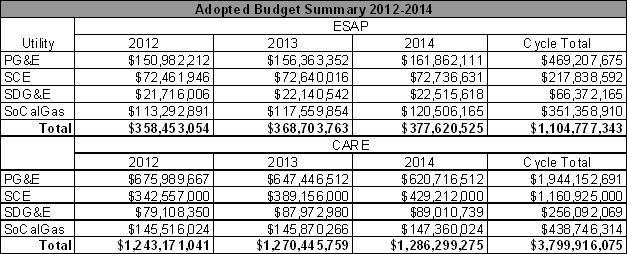
2008 was the year we set these programs on their current and broad directions with D.08-11-031 for program cycle 2009-2011. Today, with this decision, we embark on the next phase of this proceeding and a challenging and working program cycle, 2012-2014, to actively fine tune these successful programs toward continued program successes.
To do so, we (1) resolve numerous poised issues in this decision based on the record of this proceeding, including the directions and budgets necessary to continue the ESA and CARE Programs during the 2012-2014 program cycle, and (2) direct several of the more complex issues be further investigated, examined, explored, debated and brought back to the Commission through the frameworks we set in this decision during the second phase of this proceeding, including the working groups and studies.
The issues that will be examined further during the second phase of this consolidated proceeding are: a comprehensive multifamily segment strategy (see Section 3.10.6.4. of this decision) including the review of potential expedited enrollment process, ESA Program cost-effectiveness methodology (see Section 3.5.4. of this decision), several critical low income program studies and reports (see Sections 5.2.5, 5.2.6 and 5.2.7.) as well as review of any pilot program evaluation and several other working groups ordered in this decision (see Sections 3.5.4., 3.11.5.4., 3.11.5.5., and 5.3.8.).
1.2. Key Highlights of 2012-2014 Energy Savings Assistance Program
In this decision, we begin with the general and broad directions we set out in D.08-11-31 following the Strategic Plan and begin to further refine the ESA Program. As a mature and largely successful program, the Commission finds it imprudent to make whole-sale changes to this program, unless the proposed changes are likely to yield significantly more benefits and the costs associated with those same changes are outweighed by those likely benefits to be attained. We note, it is not the intent of the Commission to redesign and overhaul program each program cycle nor would such administrative and delivery disruptions and program uncertainty truly benefit the overall program goals or the low income population this program must serve. The approach, going forward therefore, will be to build upon the successes to date while actively refining the program to enhance program success, based on the experiences and lessons we learned during the preceding program cycle.
We do so, with forward looking vision, smarter and streamlined program implementation, by increasing consistency and coherence in delivery of demand side programs, and by promoting and encouraging creativity, innovation and efficiency through tailored, adaptable and flexible program delivery.
Forward looking: As we look to the remaining eight years of the ESA Program, toward 2020, we must approach our next set of strategies with that ultimate overall vision and we should plan, set and take purposeful actions with such forward looking vision.
Smarter and streamlined: Rather than focusing solely on new ideas and pilots, we must not lose sight of the ESA Program success to date and work together to share the numerous best practices, lessons learned and focus on creative and innovative ways to continue to do things better and refine program components to heighten program success.
Consistency and coherence: The ESA Program approach going forward must achieve consistency, where possible, with the Commission's demand side programs to effectuate a cost-effective, efficient, integrated and coherent delivery of those programs.
Tailored: The approach going forward must comprise of purposeful program strategies that understand the low income communities and must be tailored to that remaining ESA Program eligible and untreated households.11
Adaptable: The ESA Program is squarely in the throes of the ever changing landscape of energy, with countless local, State and federal governmental and non-governmental programs and efforts directed at energy use, energy savings, energy education, and other energy-related efforts. The ESA Program must look to and creatively integrate, leverage and partner with those efforts, wherever possible.
Flexible: The IOUs and other ESA Program stakeholders have achieved great program success and have gained incredible experience in the low income communities while implementing the ESA Program for over two decades. We have learned that the IOUs seem to work best when they are given guidance and directions with discretion rather than rigid prescriptive directions. Such approach should continue.
With that, some key highlights of the changes we make to the ESA Program for 2012-2014 are:
Integration: The IOUs are reminded and directed to continue all their ongoing integration efforts amongst the IOUs' ESA Program, CARE Program, Energy Efficiency programs, Demand Response programs, California Solar Initiative, and any other of the IOUs' demand side programs.
Leveraging: We approve the IOUs' proposed leveraging efforts and direct the IOUs to continue their current leveraging efforts, with the exception of the California Advanced Homes Program. We also direct the IOUs to proactively explore, find and take advantage of all potential leveraging opportunities for the ESA and CARE Programs with other programs offered in California by coordinating actual program delivery to promote long term enduring energy savings and cost efficiency. Going even a step further, the IOUs must actively share their successful leveraging models and to try and duplicate the successes of other IOUs' leveraging efforts, where possible.
The IOUs are directed to begin immediate coordination with the Energy Division to convene and begin discussions, on as-needed frequency, with California Department of Community Services and Development (CSD) to develop and implement an effective leveraging plan between the ESA Program and CSD and shall continue their current efforts of utilizing dual providers for ESA and CSD in program delivery, where feasible. For this 2012-2014 cycle, the IOUs shall focus their leveraging effort with CSD in refining the data sharing activities with CSD's Low Income Home Energy Assistance Program (LIHEAP)/Weatherization Assistance Program (WAP) and to devise a CSD leveraging plan.
Marketing, Education & Outreach (ME&O): We encourage the IOUs to use ESA and CARE Programs' ME&O strategies that embrace and recognize the importance of community, local, regional, ethnic as well as ethnically-owned media as ways of effectively reaching and penetrating some of the most difficult to reach pockets of the low income communities. The IOUs should track and report on the progress of these outreach efforts in their annual report, and the reporting should indicate specific activities and contracts, actual expense, as well as qualitative and quantitative attributes of resulting enrollment from each effort, to illustrate which efforts result in effective outreach and penetration of the most difficult to reach pockets of the low income communities.
We direct the IOUs to continue to conduct their current overall ESA and CARE Programs' ME&O efforts as directed in this decision but to anticipate and make some ME&O mid-cycle adjustments to participate in and align with the overall statewide ME&O activities resulting from
D.12-05-015, the recently issued guidance decision in the general energy efficiency docket, Rulemaking
(R.) 09-11-014. We direct the IOUs to file their statewide ME&O applications incorporating low income programs' ME&O issues by August 3, 2012 as ordered in D.12-05-015.
Program Delivery and Design: Without overhauling the ESA Program delivery model, we direct the IOUs to implement the delivery enhancements we approve in this decision based upon lessons learned to date and the recommendations from the 2009 Process Evaluation Report, including review and update of the property owner waiver and co-pay forms. The property owner waiver and co-pay forms should be simplified, made uniform among the IOUs and made available in languages other than English, if there is sufficient need justifying such expenditure. Once fully implemented, SCE should report to the other IOUs on the effectiveness of its integrated schedule manager and routing tool for possible statewide adoption. These process and delivery enhancements should help the ESA Program (1) move towards paperless operations, and (2) provide outreach and assessment contractors with more information before getting into a home to better prepare and enable them to understand that household and tailor measures to the household, while also reducing visits, wherever feasible, to complete installations in a single visit.
The IOUs are directed to integrate their Home Energy Efficiency Surveys programs and the California Integrated Customer Energy Audit Tool into the ESA Program so that ESA contractors can use this information for easier enrollments and assessments.
Working Groups (ESA Program WE&T Working Group and Mid-Cycle Working Group): Within 60 days of the effective date of this decision, the Energy Division is directed to form an ESA Program WE&T Working Group and a Mid-Cycle Working Group to review those components of the Commission's ESA and CARE Programs to make recommendations for refinements to improve, wherever possible, the design, administration, delivery and ultimate success of these programs. Final Report and Recommendation by the ESA Program WE&T Working Group and Mid-Cycle Working Group are due July 15, 2013.
Cost-effectiveness Working Group: Within 60 days of the effective date of this decision, the Energy Division is directed to form an ESA Program Cost-effectiveness (CE) Working Group. By February 15, 2013, the Energy Division must issue a white paper on the subjects of the ESA Program's cost-effectiveness methodology as well as framework.
By March 15, 2013, the CE Working Group shall convene a minimum of two public workshops, and by July 15, 2013, the CE Working Group shall submit to the assigned Administrative Law Judge (ALJ) its Final Proposal and Recommendation. The ALJ thereafter shall circulate the Recommendation for comments to the service list of this proceeding. The final Recommendation for any proposed revised cost-effectiveness methodology and framework must be forward looking and shall take into account the ESA Program goals and the goals of the Strategic Plan.
Refrigerator Replacement Criteria: We approve the proposed change to the ESA Program refrigerator replacement criteria from pre-1993 units to pre-1999 units.
Eight Immediate Multifamily Segment Strategies: As the first prong of a parallel, two-pronged approach, we direct the IOUs to immediately begin improving their penetration of the multifamily segment of the low income population, with the eight immediate Multifamily Segment Strategies, including additional measure offerings. The IOUs are directed to immediately roll out the following strategies: (1) Whole Neighborhood Approach; (2) Property Owner Waiver Update; (3) Updated Marketing Approach to Multifamily Homes; (4) EUC/MIDI/MFEER Coordination; (5) Single Point of Contact; (6) Same Day Enrollment, Assessment, and Installation; (7) Streamline Practice and Service Delivery; and (8) Providing Feasible Measures for Multifamily Segment Including Retention of Certain Measures Proposed for Retirement for program cycle 2012-2014.
Comprehensive Multifamily Segment Strategies: As the second and complementary part of this parallel, two-pronged approach, we direct the IOUs to take the following planning activities during the second phase of this proceeding toward developing a set of comprehensive Multifamily Segment Strategies. The IOUs must establish a consultant budget, authorized at $400,000, and provide a framework and directions to contract a consultant for immediate and full examination of the Multifamily Segment issue to devise a full set of comprehensive Multifamily Segment Strategies. Specifically, the IOUs are directed to begin developing and advancing more long-term and comprehensive multifamily segment strategies as ordered in this decision. A consultant shall be hired, and final report is due prior to June 14, 2013, with recurring stakeholder workshops held throughout and leading to its development.
Expedited Enrollment Proposal, Housing Subsidy and Income Definition: In addition to the two-pronged multifamily approach we order in this decision and while the multifamily consultant process during the second phase of this proceeding is underway, the Commission intends to further examine and develop an informed record regarding NCLC's proposed multifamily expedited enrollment process, including identifying and examining relevant legal and operational hurdles (e.g., housing subsidy and definition of income, and potential need for memorandum of agreement or understanding with other potential partner agency(ies)), toward development of feasible expedited enrollment process. The ALJ has already made an expedited request for staff's legal analysis and recommendation to lay the foundation for this examination and anticipates issuance of a ruling setting briefing schedule after the decision is issued.
Energy Education Study: We approve the request for a $300,000 for shared energy education evaluation study by the IOUs.
Leave-Behind Energy Education DVD: We approve SoCalGas' request for $65,000 for leave-behind energy education DVDs.
New Joint Impact Evaluation: We approve and authorize a budget and framework for the joint Impact Evaluation, as proposed and described in SCE's testimony, and direct that the Energy Division and the IOUs take all actions reasonably necessary to ensure that by no later than August 31, 2013, the Final Impact Evaluation Report is posted on Energy Division's Public Download Area website: http://www.energydataweb.com/).
New Low Income Needs Assessment Study: We direct and authorize a budget and framework for an updated Low Income Needs Assessment Study and direct that the Energy Division and the IOUs take all actions reasonably necessary to ensure that by no later than August 31, 2013, the Final Needs Assessment Study is posted on Energy Division's Public Download Area website: ( http://www.energydataweb.com/).
IOUs' Quarterly Public Meetings: The IOUs' Quarterly Public Meetings which had initially been mandated by D.06-12-038, shall be modified as follows: (1) The IOUs are relieved of the Quarterly Public Meetings ordered in
D.06-12-038; (2) The IOUs shall convene a minimum of one public meeting per year, within 60 days of their filing of the annual report, and other public meetings as deemed necessary by the IOUs, the Energy Division, the ALJ, or the Commission; and (3) In the upcoming 2012-2014 program cycle, IOUs are directed to use the IOUs' public meetings as a forum to host the working groups ordered in this decision.1.3. Key Highlights of 2012-2014 California Alternate Rates for Energy Program
In this decision, we reexamine the CARE Program. We are at the heels of great program success over the past cycle including the IOUs' showings of impressively high penetration rates during the 2009-2011 program cycle of reaching, more or less, the 90% CARE penetration goal set in D.08-11-031 by the Commission. Some of the major lessons learned during the last program cycle suggest that the CARE Program experiences an extremely high attrition rate and the program design may need to be tightened to ensure the CARE discount rate and subsidy are not being unlawfully diverted to ineligible customers at the expense of the ratepayers.
With that, in this decision, we update the CARE Program in several respects and some key highlights of the changes we make to the CARE Program for 2012-2014 are:
Enrollment Review: We retain the 90% CARE penetration target we established in D.08-11-031. However, we emphasize, that in this cycle and going forward, the IOUs shall enhance their Post Enrollment Verification as directed in this decision and direct their CARE enrollment activities toward ensuring and delivering the CARE Program benefits to only those eligible customers for whom it was designed.
Aggressive and Tailored Outreach: We recognize and therefore direct the IOUs to employ more focused and aggressive outreach strategies to maintain and increase the current penetration rates to offset the number of customers lost through attrition factors, and to further streamline the program administration toward cost-effectively identifying, targeting and reaching the remaining hardest to reach CARE eligible population.
Categorical Eligibility and Enrollment Program: The IOUs are directed to retain and follow our current Categorical Eligibility and Enrollment Program to continue to allow continued ease of access for enrolling customers into the CARE Program. The IOUs are also directed to jointly review and submit, by Tier 2 Advice Letter, a list of proposed categorical eligibility low income programs with income thresholds consistent with the CARE and ESA Programs annually by January 31st, and the Energy Division will review the proposed list and issue an annual letter listing approved categorical eligibility programs along with the annual CARE income guideline letter on April 1st each year.
Post Enrollment Verification: The IOUs are directed to develop and implement interim and long term stratified probability Post Enrollment Verification models as directed in this decision to cost-effectively identify and income verify those enrollees who have the probability of being ineligible in the program, while tailoring the models to each of the IOUs' territory that incorporate basic probability factors, inputs, populations and costs. Each IOU shall develop and begin implementing its interim probability model within 60 days of this decision. The IOUs are directed to track, monitor and report the number and specific reasons for each CARE customer de-enrolled during the Post Enrollment Verification process (e.g. customer non-response to the IOUs' request for income verification, deemed ineligible for the program, etc.) as well as how that customer was initially enrolled in the CARE Program (e.g., capitation agency, self-certification, categorical enrollment, etc.). Each IOU shall, based on the lessons learned through implementation of the interim models, devise a long term Post Enrollment Verification probability model as well as optimal verification rate and submit them for review by September 2013, by Tier 2 Advice Letter.
Re-certifications: All CARE re-certifications shall require income documentation verification for renewal. No customers shall be allowed to self-recertify without providing income documentation. As an exception to this rule, in lieu of income documentation, CARE customers who have been income verified by a qualifying categorical eligible low income program may recertify by submitting proof of enrollment in an approved categorical eligibility program.
Cooperation with Income Verification Process: We approve SCE's request for CARE customers who fail to respond to an income verification request be barred from self-certified re-enrollment in the CARE Program for 24 months. However, if at any time during the 24 months a de-enrolled customer verifies income eligibility, they must be placed back on the CARE rate. After 24 months, those de-enrolled customers may be able to enroll in CARE by again self-certifying their household and income eligibility. To ensure consistency statewide, all of the IOUs are directed to implement this CARE Program rule change proposed by SCE.
Capitation Fee Increase: We approve an increase in the capitation fee from "up to $15.00" to "up to $20.00" for each new CARE enrollment for program year 2012-2014, and similarly approve that increased capitation fee cap to apply statewide to all IOUs.
CARE High Usage Customers: We approve PG&E's proposed CARE Program changes, as modified below, to address the electric users on the CARE rate whose usage exceeds 400% of the baseline in any monthly billing cycle, and direct all of the electric IOUs (PG&E, SCE, and SDG&E) to implement the statewide program changes, which includes the following new rules:
(1) 600% or more above baseline users: CARE electric customers with electric usage above 600% of baseline in any monthly billing cycle will have 90 days to drop usage substantially or be de-enrolled and barred from the program for 24 months. In addition, to continue to stay in the program, these customers must undergo Post Enrollment Verification and apply for the Energy Savings Assistance Program within 45 days of notice. We also direct the IOUs to develop an expedited appeals process so that customers with legitimate high usage can demonstrate the need for their usage levels.
(2) 400% - 600% baseline users: CARE electric customers with electric usage at 400%-600% of baseline in any monthly billing cycle must undergo Post Enrollment Verification and, if not previously enrolled in the program, apply for the ESA Program within 45 days of notice.
2. Overview and Background
According to the KEMA Final Report on Phase 2 Low Income Needs Assessment, dated September 7, 2007,12 (KEMA Needs Assessment), one in three of California's households, or approximately 4.1 million of the 12.53 million households in California are low income households. For more than two decades, the two Commission's low income energy assistance programs, the Energy Savings Assistance (ESA) (formerly known as Low Income Energy Efficiency or LIEE) and the California Alternate Rates for Energy (CARE) Programs, provided and continue to provide significant relief in reducing the hardships of low income families across California.
The ESA Program began in the 1980s as a direct assistance program provided by some of the IOUs, and was formally adopted by the legislature in 1990.13 This program has for many years been referred to by its common title "the Low Income Energy Efficiency Program" or "LIEE Program." In 2010, it was renamed, and it is now referred to as the Energy Savings Assistance Program or the ESA Program.
The Commission, in the California Long-Term Energy Efficiency Strategic Plan (Strategic Plan),14 affirmed that the ESA Program is a resource program designed to garner significant energy savings in California. Thus, in D.08-11-031, the Commission gave unequivocal direction to the IOUs that the ESA Program "must evolve into a resource program that garners significant energy savings in our state while providing an improved quality of life for California's low income population."15
The ESA Program has also been designed to provide an improved quality of life16 for the low income population by delivering no-cost17 home weatherization services and efficiency measures to low income households to help: (1) conserve energy; (2) reduce their energy costs; and (3) improve their health, comfort, and safety. Installing no -cost energy efficiency measures helps those customers reduce their energy consumption by delivering energy savings while also producing bill savings and reduced energy consumption.
In addition, the ESA Program provides information and energy education that promote energy-efficient practices and behaviors and is part of a long term energy savings investment toward educating energy saving behaviors for future generations of energy users. The ESA Program's goal for its energy education component is to ensure long term energy savings by effectively raising awareness and changing the culture of energy consumption in low income communities.
The ESA Program is administered by the IOUs. Each IOU in its respective service territory is responsible for the installation of energy savings measures and providing quality assurance to the Commission. The approved ESA Program measures are generally selected based on cost-effectiveness evaluation and vary by IOU territory and other factors, such as climate zone and housing type. The ESA Program's cost-effectiveness approach is designed to ensure that most efficient use is made of finite ratepayer funds to yield optimal ESA Program success and energy savings.
Today we can report that the ESA Program has made great strides in the recent years and is now several steps closer to the Commission's Strategic Plan18 vision that by 2020, 100 percent of eligible and willing customers will have received all cost-effective low income energy efficiency measures. The IOUs have vigilantly administered the ESA Program over the years and have successfully treated over 1 million low income households and gained 16,132,316 kilowatt hour (kWh) savings and 232,979,182 therms savings during the 2009-201119 program years. These successes are in part due to the program's focus on the programmatic cost-effectiveness as well as cost-effectiveness of installed measures, promoting and encouraging workforce, education and training, using smarter, flexible and creative approaches towards outreach (including a whole neighborhood approach), and, where appropriate, focusing on customers with high energy use, burden and insecurity. Lastly, the program has been successful by putting a greater emphasis on long term and enduring savings rather than quick fixes.
Many of these ESA Program strategies should therefore continue, where appropriate, as they have proven effective in the program. Moving forward, however, we are committed to even greater program successes. We are not satisfied with a good program but will work to build even better program and envision some additional strategies to do this and to help anticipate and overcome some difficult new challenges, including:
(1) how to strike the proper balance between achieving cost effective energy savings versus providing health, comfort, and safety benefits;
(2) how to effectively leverage and integrate the program with other utility core energy efficiency programs and other State, Federal and local programs to streamline and improve program delivery and achieve maximum energy efficiency savings;
(3) how to deliver energy education in a manner that yields optimal energy efficiency benefits and forms long term conservation behaviors;
(4) how to better reach and serve the remaining eligible low income population, including those residing in low income multifamily households;
(5) how to develop an effective strategy to meet the workforce, education and training needs to support the most effective and readied workforce to yield success of the program by 2020;
(6) how to streamline the program to ensure program dollars are spent most efficiently and effectively to yield maximum success of the program; and
(7) how to refine the program in a way towards removing unnecessary barriers and improving its effectiveness based on lessons learned to date.
To proactively begin to tackle these challenges in this cycle, in this decision we initiate several significant efforts during the second phase of this proceeding, including several working groups, studies and other constructive and collaborative efforts. Each of these efforts along with the various monitoring, tracking and reporting requirements ordered in this decision are specifically designed to lay the foundation for meaningful program review and improvements where needed in the years to come.
The CARE Program is a low income energy rate assistance program that dates back to 1980s and is aimed at providing eligible low income households with a 20% discount on their electric and natural gas bills. Over the years and particularly through the recent economically challenging times, the CARE Program has delivered the much needed energy-related bill savings through CARE discount rate to a significant number of low income households, as illustrated by the last program cycle's CARE enrollment figures.
We attribute this CARE Program success to the commitment and cooperation amongst the IOUs and all of the stakeholders who, together, streamlined and fine-tuned every aspect of the program's components toward achieving the 90% penetration target rate as directed in D.08-11-031. As of December 2011, the IOUs submitted reports showing very high CARE Program penetration rates, as shown below.
CARE Enrollments and Penetration Rate (December 2011)
IOU |
Participants Enrolled |
Eligible Participants |
Penetration rate |
PG&E |
1,532,692 |
1,699,660 |
90.2% |
SCE |
1,437,537 |
1,451,325 |
99% |
SoCalGas |
1,716,495 |
1,847,296 |
92.9% |
SDG&E |
308,596 |
362,551 |
85.1% |
Much of the CARE Program success has been achieved by increasing the enrollment efficiencies through streamlining the screening, eligibility, and retention of participants in the CARE Program without substantial increase in the CARE outreach budget in the last budget cycle. Looking ahead however, the CARE Program does face some challenges. With the lessons learned over the years, however, we are well poised to tackle them here.
For the 2012-2014 budget cycle, we will maintain the 90% CARE penetration goal. However, in this cycle and going forward, the Commission directs the IOUs to update their activities to focusing and improving their strategies to aggressively implement their outreach efforts to maintain and increase the current penetration rates, wherever feasible.
As this program does experience high attrition rates and to maintain and even build on the current penetration rates, the IOUs must aggressively and creatively outreach to enroll more customers each program year to offset the number of customers lost through various attrition factors. Such aggressive strategies must also be designed to ensure that the CARE Program serves the maximum number of eligible households while ensuring those enrolled in the program are in fact eligible. We also will focus on strategies to further streamline the program administration toward cost-effectively identifying, targeting and reaching the remaining CARE eligible population.
Some suggest that much of the remaining percentage of the CARE eligible households may be unwilling or unlikely to participate in CARE Program. We recognize and acknowledge that the per-household efforts and associated costs to identify, target and reach the remaining CARE eligible population (ranging from 1% in SCE territory to approximately 15% in SDG&E territory) will invariably be more difficult and costly.
In D.07-12-051 and our Strategic Plan, we stated our long-term vision for the ESA Program, as follows:
By 2020, 100% of eligible and willing customers will have received all cost effective Low Income Energy Efficiency measures.20
With that, in 2008, we issued D.08-11-031 to set the ESA Program on its current course with general framework. Likewise, in D.08-11-031, the Commission set a 90% penetration goal for the CARE Program for program cycle 2009-2011. During the 2009-2011 program cycle, we made significant progress towards that long-term Strategic Plan vision and learned a great deal from the myriad of studies and pilots. Also during the 2009-2011 program cycle, the stakeholders informed the Commission on the intricacies of the operational constraints and the experiences they gained through their varying roles as well as implementation trials, errors and successes on the administration and delivery of the programs. In this decision, we use this information to fine tune the ESA and CARE Programs in this upcoming 2012-2014 program cycle.
On March 30, 2011, the Assigned Commissioner issued an Assigned Commissioner's Ruling (Guidance Ruling) providing guidance to the IOUs for their upcoming 2012-2014 CARE and ESA Programs and Budget applications (Applications). The Guidance Ruling also directed the IOUs to file the Applications by May 15, 2011, and to immediately roll out the new Energy Savings Assistance Program title and logo, which was part of the recommendation that resulted from the statewide marketing education and outreach efforts.
The IOUs filed their Applications on May 15, 2011, and for the 2012-2014 program cycle. The IOUs proposed the following ESA and CARE Program budgets and goals:
IOU Proposed Budgets 2012-2014 | ||||
Utility |
ESAP | |||
2012 |
2013 |
2014 |
Cycle Total | |
PG&E |
$137,904,000 |
$167,525,000 |
$173,422,000 |
$478,851,000 |
SCE |
$53,289,000 |
$59,859,000 |
$58,235,000 |
$171,383,000 |
SDG&E |
$22,044,929 |
$22,462,163 |
$22,832,030 |
$67,339,122 |
SoCalGas |
$99,909,056 |
$82,121,475 |
$84,178,885 |
$266,209,415 |
Total |
$313,146,984 |
$331,967,638 |
$338,667,915 |
$983,782,537 |
Utility |
IOU Proposed Number of Homes to be Treated | |||
2012 |
2013 |
2014 |
Total Cycle | |
PG&E |
125,000 |
125,000 |
125,000 |
375,000 |
SCE |
68,200 |
77,000 |
74,800 |
220,000 |
SDG&E |
20,000 |
20,000 |
20,000 |
60,000 |
SoCalGas |
129,106 |
100,249 |
100,249 |
329,604 |
Total |
342,306 |
322,249 |
320,049 |
984,604 |
The IOUs proposed the following CARE Program budgets for 2012-2014 program cycle:
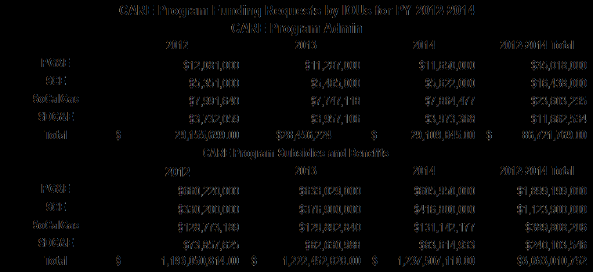
The Commission's Division of Ratepayer Advocates (DRA), National Consumer Law Center (NCLC), The East Los Angeles Community Union, Association of California Community and Energy Services, and Maravilla Foundation (collectively, TELACU et al.), California Housing Partnership Corporation (CPHC), The Donald Vial Center on Employment in the Green Economy, NRDC, The Greenlining Institute (Greenlining), Synergy Companies (Synergy), the Energy Efficiency Council (EEC) filed protests and responses. The IOUs filed replies.
On July 21, 2011, the assigned Administrative Law Judge (ALJ) issued a ruling consolidating all of the Applications into a consolidated proceeding and setting a consolidated prehearing conference (PHC) hearing.
Two PHCs were held on August 8, 2011 and September 6, 2011. On September 26, 2011, the Assigned Commissioner and ALJ jointly issued the Scoping Memo Ruling setting the scope and schedule for the consolidated proceeding, explicitly anticipating the need for a bridge funding decision in the ESA and CARE Programs to cover January 1-June 30, 2012 while reviewing some of the more complex issues raised by the parties in the consolidated proceeding. The Scoping Memo Ruling ordered eight workshops on the following issues to begin laying the groundwork to review studies and reports from the preceding cycle with the stakeholders and begin preliminarily examining and assessing the merits and status of the issues:
Workshop #1 [Overview of Lessons Learned]: Review of major ESA and CARE Programs related studies, pilots and reports since D.08-11-031, including (1) Final Report on Low Income Energy Efficiency Program, 2009-2010 Process Evaluation (The 2009 Process Evaluation), and (2) Final Report on Impact Evaluation of the 2009 California Low Income Energy Efficiency Program (The 2009 Impact Evaluation).
Workshop #2 [Review of ESA Program]: Review of overall effectiveness of the ESA Program in reaching the energy saving Strategic Plan goals, and cost effectiveness of ESA Program, including examination of potential barriers to energy savings, methods of removing barriers to energy savings and review of delivery models.
Workshop #3 [Cost Effectiveness Methodology and Measures]: Discussion and review of cost effectiveness at the measure level, including discussion on cost effectiveness methodology and what and how measures are added, deleted, etc.
Workshop #4 [Multi-Family Sector Issues]: Review of multifamily sector needs, proposals, and any related operational and legal concerns.
Workshop #5 [Workforce, Education and Training]: Review of workforce, education and training issues, including review of current contractor selection and bidding process.
Workshop #6 [Outreach and Enrollment]: Review of current ESA Program outreach and enrollment practices/efforts and ways to improve them to reach the Strategic Plan goals, including any energy education proposal.
Workshop #7 [Review of CARE Program]: Review of current CARE Program, including re-certification, categorical eligibility, high usage customers and CARE Program complaint and oversight.
Workshop #8 [Working Groups, Pilots and Studies]: Review of potential ongoing working groups, pilots and studies to improve the ESAP and CARE Program in the near-term and longer term, including standardizing Utilities' various reports.
In October 2011, the parties participated in all eight ordered workshops. On November 9, 2011, the assigned ALJ issued a ruling tentatively setting the evidentiary hearing dates, adjusting the proceeding schedule and directing parties to file statements of material disputed facts. On November 9, 2011, the ALJ also issued a ruling to recirculate the March 30, 2011 Guidance Ruling and related attachments and the updated Energy Division template for the presentation of pilot proposals.
As anticipated in the September 26, 2011 Scoping Memo Ruling, on November 10, 2011, we adopted a bridge funding decision21 for the IOUs to expend an amount not to exceed 50% of their respective 2011 budget levels, from January 1, 2012 until June 30, 2012 to continue their ESA and CARE Programs until the Commission adopts a decision on the IOUs' ESA Program and CARE Program Budget Applications for 2012-2014.
On December 23, 2011, the ALJ issued a ruling cancelling the tentative evidentiary hearing dates and revising the proceeding schedule.
On December 28, 2011, the ALJ issued a ruling seeking comments from the parties on 39 detailed questions (December 2011 Ruling), as a follow-up to the October 2011 workshops to create a record on certain issues, where feasible. In January 2012, detailed comments and responses were filed by San Francisco Community Power (SFCP), TELACU et al., Center for Accessible Technology (CforAT), Brightline Defense (Brightline), Green for All (G4A), Proteus, Inc. (Proteus), SDG&E22, PG&E, SoCalGas, SCE, The Utility Reform Network (TURN), Niagara Conservation Corporation (Niagara), EEC, La Cooperativa De Campesina (La Cooperativa), The Black Economic Council, National Asian American Coalition, and the Latino Business Chamber of Greater Los Angeles (collectively, the Joint Parties), DRA, CHPC, National Housing Law Project (NHLP), NCLC, Greenlining, California Large Energy Consumers Association (CLECA), NRDC, and Opower, Inc.
On January 26, 2012, the Assigned Commissioner and the ALJ issued a joint Amended Scoping Memo Ruling revising the schedule for the consolidated proceeding.
In February 2012, opening briefs were filed by SoCalGas, SDG&E, PG&E, SCE, CforAT, SFCP, Greenlining, CHPC, NCLC, NHLP, TURN, Niagara, DRA, TELACU et al., Joint Parties, CLECA, NRDC, and EEC. Reply briefs were filed by PG&E, CforAT, Greenlining, CHPC, NCLC, NHLP, TURN, Niagara, TELACU et al., Joint Parties, NRDC, and Brightline.
On February 16, 2012, the ALJ issued rulings identifying and admitting all testimonies served in the consolidated proceeding and certain data requests and reference documents.
On June 21, 2012, we adopted a second bridge funding decision approving a month-to-month extension of bridge funding, starting July 1, 2012 to continue the ESA and CARE Programs until the Commission adopts a decision on the IOUs' ESA Program and CARE Program Budget Applications for 2012-2014.23 That month-to-month bridge funding decision is currently in effect.
In the following sections of this decision, we resolve majority of the issues, including the authorization of overall budgets, necessary to continue the ESA and CARE Programs during the program cycle 2012-2014. We also establish working groups and a framework for the several significant issues we must consider during the second phase of this consolidated proceeding.
3. ESA Program
During the 2009-2011 program cycle, the IOUs treated well over a million low income homes24 and produced approximately 233,000,000 kWh and over 16,000,000 therms in energy savings.25 The IOUs estimate they would treat over 980,000 homes in the 2012-2014 program cycle, 1/3 of the total estimated numbers of homes remaining to be treated till end of 2020. This 1/3 projected homes to be treated estimate accounts for the fact that there are three program cycles remaining until 2020, including this 2012-2014 cycle, to meet the 2020 100% vision. (See table below for the IOUs' projections.)
IOUs' Figures for
PY 2009-2011 Homes Treated v. PY 2012-2014 Homes Projected for Treatment26
2009-2011 Cycle Homes Treated |
2012-2014 Cycle Homes Projected for Treatment | |||||
IOU |
2009 |
2010 |
2011 |
2012 |
2013 |
2014 |
PG&E27 |
81,308 |
133,329 |
128,071 |
125,000 |
125,000 |
125,000 |
SCE |
62,624 |
121,868 |
93,771 |
68,200 |
77,000 |
74,800 |
SDG&E |
20,924 |
21,593 |
22,575 |
20,000 |
20,000 |
20,000 |
SoCalGas |
83,493 |
120,358 |
161,020 |
129,106 |
100,249 |
100,249 |
CYCLE TOTALS |
1,050,934 |
984,604 | ||||
Some notable lessons learned from the last program cycle are that:
1. The ESA Program is armed with a more experienced and poised administration and workforce, ready and "fully ramped up" in most of the IOUs' territories. During the last program cycle, the treated homes numbers steadily climbed, and in some instances, more dramatically climbed, to confirm this observation; and
2. The IOUs' impressive 2011 treated homes figures also illustrate that the ESA Program has the capacity to treat more homes than the above conservative 2012-2014 projections proposed by the IOUs.
Projection of Remaining Homes to be Treated by IOUs for PY 2012-202028
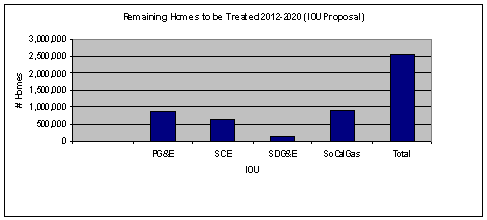
It seems reasonable to proactively anticipate that as we near the 2020 date, the final remaining homes to be treated will be increasingly tougher to identify, target and perhaps even more costly to treat. That said, we challenge the IOUs in this program cycle with the strategies, directions and significant budgets we provide in this decision to take advantage of the current program momentum and available workforce to find smarter ways (e.g., integration, leveraging, etc.) to treat significantly more than their proposed and projected number of homes to be treated during the 2012-2014 cycle. Based on our observations of the IOUs' successes during the last cycle, this challenge is reasonable, and such a raised goal is fully in the IOUs' reach. By treating more homes in the 2012-2014 than currently projected, the IOUs would be ready to apply even more focus to tailor their programs to the remaining and more difficult to reach untreated low income households during the final two cycles, 2015-2017 and 2018-2020.
This decision adopts a goal of homes to treat during the 2012-2014 cycle that forwards our ultimate goal of treating all eligible and willing homes by 2020. However, the number of homes to be treated annually by each IOU (shown in Appendices A and F) are included as benchmarks to monitor their annual progress toward achieving the total homes-treated goals adopted for each IOU for this three-year cycle.
Some parties suggest that perhaps the ESA Program should place less emphasis on the homes treated figures. Instead those parties argue that energy savings and bill savings should be given higher profiles/priorities in the ESA Program's design and delivery model. We remind these parties that this is an issue we resolved only a few years ago, when we ambitiously vowed in our adoption of Strategic Plan to "By 2020, 100 percent of eligible and willing customers will have received all cost-effective [Energy Savings Assistance Program] ... measures."29 Then again, in 2008, we adopted these ESA Program goals in D.08-11-031.
With those goals we previously adopted, it is reasonable and necessary to track the number of homes treated as that is one of the main ESA Program goals we set out. With those same goals, it is also reasonable and necessary to maintain the current program design and delivery model that establish both program- and measure-based cost-effectiveness mechanisms, discussed in Sections 3.6.2 (Measure Cost Effectiveness Test) and 3.7 (modified 3MM Rule) of this decision.
That said, in the second phase of the proceeding, we intend to carefully examine the Program's cost-effectiveness methodology (Section 3.5.4); we are also taking at detailed review at the low income multifamily segment to understand and devise comprehensive strategies (Section 3.10.6.4); we are also looking at assessing the California's low income population energy and measure needs in the new Needs Assessment Study (Section 5.2.7); and we are proactively undertaking several other studies and working groups. These efforts are the proper necessary next steps to meaningfully inform the Commission as to if and/or how the current Program approaches may and/or should be modified, if at all, to reach the program goals and best serve the low income population.
3.1. Integration of Low Income Programs with Other Utility Demand-Side Programs
Integrating demand side program offerings has been an objective of the Commission since 2007.30 We reemphasize and direct the IOUs to continue all their ongoing integration efforts amongst the IOUs' ESA Program, CARE Program, Energy Efficiency programs, Demand Response programs, California Solar Initiative, and any other of the IOUs' demand side programs.
The current general Integrated Demand Side Management Taskforce (IDSM Taskforce) efforts, being undertaken in the general energy efficiency docket pursuant to D.09-09-047, are more broadly focused. We therefore direct the IOUs and the Energy Division actively work with the ISDM Taskforce during this cycle to ensure that ESA Program and low income population's concerns are adequately injected and considered in the ISDM Taskforce's efforts. We also direct the IOUs to develop and plan to submit an ESA Program integration plan with their next cycle applications including a timetable for introducing any refinements and/or additional low income specific integration activities toward ultimately achieving full program integration stage during the 2015-2017 cycle.
Since 2007, the Commission has provided consistent direction to the IOUs to streamline the disparate approaches and offerings of energy efficiency, demand response, and distributed generation programs, where appropriate, toward a more integrated format. On October 19, 2007, the Commission issued D.07-10-032 outlining its objective of achieving maximum savings by providing integrated customer demand-side programs. The Commission reaffirmed this policy and program guidance specifically for the ESA Program in D.07-12-051, including the following integration goal:
... [ESA] programs should be integrated with other energy efficiency programs to allow the utilities and customers to take advantage of the resources and experience of energy efficiency programs, promote economies of scale and scope, and improve program effectiveness.31
Specifically, we directed the IOUs in their ESA Program to "emphasize long term energy savings that ... are, to the extent cost effective and practical, integrated with other demand-side programs, such as energy efficiency programs, solar installations, demand response and other programs."32 In D.07-12-051, the Commission specifically directed the IOUs to integrate the ESA Program "with other demand-side programs, such as energy efficiency programs, solar installations, demand response and other programs."33
In D.09-09-047, a decision in the general mainstream energy efficiency docket, the Commission directed the IOUs to establish the IDSM Taskforce to coordinate, influence, and work with other utility staff and subject matter experts.34 That taskforce was directed to develop a clear plan for how they would interact with the utility market sector and with workforce, education and training and emerging technology programs; engage external subject matter experts, outside stakeholders, and Commission staff on the taskforce; and disseminate best practices and lessons learned to promote demand side integration. Specifically, in that proceeding, the IOUs were directed to:
· Pursue integrated marketing, education, and outreach for demand side programs to better leverage ratepayer funding for more effective results by developing marketing messages that offer bundles of DSM programs targeted to specific customer groups as well as a statewide integrated marketing plan.
· Initiate integrated pilot programs to test integrated marketing strategies.
· Promote operational improvements (i.e., integrated audits recommending the full range of DSM options available to the customer).
· Promote optimization via emerging technologies that support integration at the customer's site, test integrated cost-effectiveness and attribution methodologies.
· Develop an online integrated tool that includes several characteristics such as comprehensiveness (including gas and electric DSM technologies and integration optimization technologies), site-specific, verifiable, and compatible with the statewide California Solar Initiative program.
Energy Division was directed to supervise an independent third party evaluator to assess the success of the IDSM Taskforce efforts in the 2010-2012 general energy efficiency portfolio to develop lessons learned for consideration of DSM integration efforts in future program cycles.
Consistent therewith, in D.07-12-051, the Commission directed the IOUs to integrate the ESA Program with other Energy Efficiency programs administered by the IOUs. D.08-11-031 explicitly reaffirmed the need for integration and set clear definitions, metrics, strategies and reporting requirements for such integration efforts envisioned for the ESA Program. To that end, in D.08-11-031, the Commission defined the term "integration" in the context of the ESA Program, as follows:
Integration constitutes an organization's internal efforts among its various departments and programs to identify, develop, and enact cooperative relationships that increase the effectiveness of customer demand side management programs and resources. Integration should result in more economic efficiency and energy savings than would have occurred in the absence of integration efforts.
The Commission, in D.08-11-031, also set forth the below metrics to evaluate an integration effort noting that an integration effort must accomplish at least two of the following four goals to be deemed successful:
(i) Interdepartmental Coordination: Increased coordination in work efforts between departments within the utility. This type of integration results in cost and/or resource savings as well as one or both of the following:
a. Consolidation of work efforts; and
b. Elimination of overlapping and/or repetitive tasks.
(ii) Program Coordination: Increased coordination between multiple programs managed by the utility. This type of integration results in cost and/or resource savings as well as one or both of the following:
a. Increased services provided to customers; and
b. Greater number of customers served by a program.
(iii) Data Sharing: Increased information and data sharing between departments within the utility and/or multiple programs managed by the utility. This type of integration results in cost and/or resource savings as well as one or both of the following:
a. Greater number of customers served; and
b. Consolidation of work efforts.
(iv) ME&O Coordination: Consolidation of marketing, education and outreach for multiple programs managed by the utility. This type of integration results in cost and/or resource savings as well as any or all of the following:
a. Greater number of customers reached;
b. More cost effective marketing, education and/or outreach to customers; and
c. Elimination of customer confusion.
In their Applications and all of the responses to the December 2011 Ruling, the IOUs provided details of their active and continuing integration efforts, which are further elaborated in the various reports issued by the IDSM Taskforce.
There is a general agreement among the parties that the integration of the ESA Program with the Energy Efficiency, Demand Response and Distributed Generation efforts provides more opportunities for energy savings and greater occasion for low income customers to save money, energy, and improve their health, comfort and safety.
However, several parties questioned the pace and/or direction of the IDSM Taskforce efforts, especially as they affect the ESA Program and the low income communities. For instance, TELACU et al. point out that many low income customers in particular do not understand the concept of demand response and therefore many of them are not participating in the programs such as the air conditioner cycling program because, "[t]o date little if any effort has been focused on providing low income, hard-to-reach, non-technical ratepayers with appropriate information" on the program.
NRDC states that integration can only move forward if the Commission provides a clear policy of aligning the ESA Program's success metrics, and cost-effectiveness tests with those of other demand-side programs.
TURN believes there is not yet enough information about issues such as the specific barriers to participation faced by low income customers and the extent to which low income customers are currently participating in programs such as air conditioner cycling. TURN suggests the IOUs develop integrated marketing targeted to low income customers and recommends we focus on information gathering during the 2012-14 cycle.
La Cooperativa states that "ESAP should be redesigned as an evolving program of services and smart infrastructure producing a wide array of benefits to qualified low income customers" and the organization supports a redesigned integrated delivery model with "... a single service provider to offer and install all demand side measures, rate assistance services and efficiency education even though each service may be sponsored by different utilities."
We re-emphasize our stated objective for integration of programs and direct the IOUs to continue all their ongoing integration efforts among the IOUs' ESA Program, CARE Program, Energy Efficiency programs, Demand Response programs, California Solar Initiative, and any other IOU demand side programs. We acknowledge the parties' concerns that low income communities and the ESA Program present unique concerns relative to integration and that there must be due consideration given to how effectively and appropriately the ESA Program can realize a thoughtful integration with those other programs.
TELACU et al. make an excellent point that some low income customers may not understand the concept of demand response, and that could prove to be a notable barrier for success of the integration effort for the low income communities. As suggested by many parties in this proceeding, we believe that the solution to such barriers lie in the effective delivery of information, specifically tailored to low income communities. This is an important point, since the overall approach currently taken in the IDSM Taskforce is often without much consideration of the low income population's more particularized concerns, including certain participation barriers (e.g. distrust, language and cultural barriers, etc.).
That said, rather than having to "start from scratch" by developing new programs and pilots just for ESA Program integration, we can combine the lessons learned from our experiences to date with overall direction and efforts of the IDSM Taskforce and explore more low income segment specific program enhancements, consistent with the overall integration goals. Such efforts could include refining the IOUs' current ESA Program integration efforts or adding new integration activities, where appropriate.
We therefore direct that the IOUs and the Energy Division actively work with the ISDM Taskforce in the general energy efficiency proceeding to ensure that ESA Program and low income population concerns are adequately injected and considered in that Taskforce's efforts.
We also direct the IOUs to develop and plan to submit ESA Program integration plan with their next cycle applications including a timetable for introducing any refinements and/or additional low income specific integration activities toward ultimately achieving full program integration stage during the 2015-2017 cycle. The plan should also include, at a minimum, a specific list of activities that the ESA Program must engage in and when, a plan for any needed training for ESA Program providers, a research plan, any additional metrics needed to measure success, an evaluation plan and a list of regulatory changes and attendant funding that would be needed.
We require the IOUs to continue their tracking and reporting to update the Commission on the status of their ESA Program specific integration efforts, using the general guidance we set forth in D.08-11-031 and to devise and refine such efforts, as necessary. To minimize unnecessary or otherwise duplicative reporting, the IOUs are directed to coordinate their filings and streamline, wherever possible, to avoid unnecessary duplications in the energy efficiency docket and the ESA Program docket. The IOUs are directed to continue to present the results of their integration and ISDM Taskforce efforts in their annual reports submitted to the Commission each May. In cases where the ESA Program's integration effort does not meet at least two of the above four goals, the IOUs shall provide a reasonable explanation in their annual report.
We direct the Energy Division to review the reports and work with the IOUs to enhance integration during the cycle if our metrics are not met. The IOUs are directed to cooperate with the Energy Division's guidance or recommendations on the integration efforts, as appropriate. Energy Division shall make recommendations to the Commission if the IOUs' integration efforts are failing to meet the above metrics, and the IOUs shall cooperate with the Energy Division, as necessary, to follow through with the Energy Division's request for assistance in development of recommendations.
The IOUs are directed to find and take advantage of all leveraging opportunities for ESA and CARE Programs with other programs offered in California, as discussed here.
We defined leveraging in D.08-11-031, as follows:
...an IOU's effort to coordinate its ... [ESA Program] with programs outside the IOU that serve low income customers, including programs offered by the public, private, non-profit or for-profit, local, state, and federal government sectors that result in energy efficiency measure installations in low income households.
During the past program cycles, we learned that the IOUs' leveraging efforts resulted in partnerships and other collaboration with non-IOU sources, and most importantly, resulted in dollar savings, energy savings and benefits, and/or increased program enrollment. We required these efforts be demonstrable to ensure that only those leveraging efforts that yield direct benefits to low income households and the ESA Program overall are undertaken. Specifically, we required the IOUs' leveraging projects to meet one or more of the following three objective criteria:
(1) Increase energy savings;
(2) Result in new customer enrollments; or
(3) Reduce program costs.
In setting forth a strategic direction for energy efficiency, D.07-10-032 emphasized the need to leverage resources by looking beyond the boundaries of utility territories, Commission jurisdiction, and even other non-Commission energy efficiency programs. In D.07-12-051, the Commission reiterated this same emphasis for the ESA Program and required the IOUs to think outside the box to broaden the scope of their efforts and coordinate with other agencies and businesses in designing, delivering and implementing the ESA Program.
In the Strategic Plan, we again set the strategy of increasing collaboration and leveraging of other low income programs and services as one of the key tools toward making the ESA Program an energy resource. We direct the IOUs to work with various participants in the industry to identify key areas where data sharing is possible and advantageous; seek legislative changes to ease barriers to data sharing between agencies; and develop partnerships with community organizations and other agencies to leverage resources available from local governments, federal, state, and private funding sources.
3.2.3. Leveraging with California Department of Community Service and Development (CSD)
One of the most obvious leveraging opportunities the Commission previously identified was and still is the federal Low Income Home Energy Assistance Program (LIHEAP) and the Department of Energy (DOE) Weatherization Assistance Program (WAP), administered by the California Department of Community Services and Development (CSD).
On March 17, 2009, the Commission and CSD executed a Memorandum of Understanding (MOU) with the mutual goal of effective leveraging to decrease duplications and increase the total number of low income households in California treated under both programs through increased coordination between the agencies. Among other efforts, the Commission and CSD agreed to facilitate collaboration between the IOUs and the Local Service Providers to accomplish one or more of the following objectives:
· Promote education, information sharing and collaboration between the administrators and providers of both programs to facilitate awareness of opportunities for leveraging and coordination;
· Minimize the differences between the ESA Program and LIHEAP and DOE's WAP programs in eligibility and allowable measures;
· Coordinate outreach and related activities of each program to maximize the penetration and impact in low income communities and among vulnerable populations;
· Develop a universal eligibility and intake assessment form;
· Develop a database of information about administration, scheduling and service delivery that both ESA Program providers and Local Service Providers can use to coordinate services to eligible homes where possible and coordinate funding streams to maximize the number of energy saving and health and safety measures installed in low income households;
· Develop a referral and/or credit system between the programs;
· Develop and implement pilot projects for partnerships that can be replicated throughout the state, that demonstrate measurable outcomes; and
· Develop and implement data logging projects to measure energy consumption, renewable energy generation and carbon emissions.
Following the signing of the MOU and based upon the reviews of the IOUs' reports, we learned that progress has been less than ideal due, in part, to the following factors:
· Data sharing among the IOUs and corresponding Local Service Providers proved difficult with different tracking systems, software and data reporting requirements; and
· CSD was unable to give this leveraging issue its highest priority as the American Recovery and Reinvestment Act of 2009 suddenly awarded CSD a huge increase in funds for efficiency services to deploy in a short 2-3 year timeframe, requiring CSD to redirect staffing resources to those activities and away from the MOU leveraging process-improvement targets.
Despite the challenges we experienced during this last program cycle, the Commission is still committed to the important objectives of the MOU.
PG&E proposes to continue leveraging resources with LIHEAP/WAP by continuing to coordinate the ESA Program's modified 3 Measure Minimum Rule (modified 3MM Rule), supporting federal legislation, and continuing the refrigerator leveraging program. PG&E proposes strategies to change the ESA Program and LIHEAP/WAP home weatherization rules concerning ways to qualify a home for treatment. PG&E expresses its willingness to waive the modified 3MM Rule with the Commission's approval, which would allow households, referred from LIHEAP/WAP, to receive additional measures feasible under the ESA Program, and to work with CSD and the DOE so that this rule may be waived for LIHEAP/WAP agencies receiving referrals from PG&E.
PG&E also proposes to continue its successful refrigerator leveraging program with LIHEAP/WAP providers. Under this program, interested LIHEAP/WAP agencies that are not ESA Program contractors may contract with PG&E to provide refrigerators to eligible low income PG&E customers. By providing the refrigerator under ESA Program funding, the LIHEAP/WAP agencies can cost-effectively offer more services to more households. PG&E will pay for the replacement refrigerators and recycling at the same negotiated discount cost that it pays for refrigerators under the ESA Program.
Additionally, in 2010, PG&E implemented a leveraging pilot (the Avenues Weatherization Project) with Community Resource Project, Inc. and Sacramento Municipal Utility District and proposes to work with CSD and the Commission to initiate more efficient leveraging strategies.
SCE proposes no new efforts other than to continue its current course. Over the 2009-2011 program years, SCE has provided LIHEAP/WAP contractors the ability to utilize SCE's ESA Program workflow database (Energy Management Assistance Map System or EMAPS) to identify previously serviced customers with an enhancement to the Duplicate Measure Research Inquiry (DMRI) function. This has streamlined processes and has helped contractors avoid visiting a previously participating customer's home.
SCE states that until CSD establishes a database of all households treated and measures installed, coordination cannot effectively be implemented between the two agencies' programs. SCE also notes that because the Commission has no jurisdiction over CSD, this database coordination plan has been and will be exceedingly difficult without CSD's cooperation. SCE requests that the IOUs be afforded a place at the table in future discussions about this issue between the Commission and CSD.
SCE proposed, for the 2009-2011 program cycle, to leverage the ESA Program with the mainstream energy efficiency California Advanced Homes Program (CAHP), where SCE would pay the full incremental cost of installing higher-efficiency equipment, such as 16.0 SEER Heating Ventilation and Air Conditioning (HVAC) systems and refrigerators in units designated by the builder for low income occupants meeting the ESA Program's income guidelines. SCE found this leveraging effort to be unsuccessful due in large part to changed economic conditions resulting in a near stoppage of residential new construction in SCE's service area. Due to the ongoing slowdown in residential construction, SCE does not propose to continue this initiative in the 2012-2014 program cycle. SCE also seeks approval to provide appliances at no cost to LIHEAP providers, consistent with its 2009-2011 practices.
With respect to CSD, SoCalGas proposes to continue to participate in discussions toward developing a data sharing framework. SoCalGas states that it was successful in creating a LIHEAP/WAP leveraging model by working closely with select LIHEAP/WAP agencies that also provide ESA Program services, and implementing the developed framework. SoCalGas intends to expand the LIHEAP/WAP leveraging model, not only to continue leveraging available resources, but to also assist SoCalGas in meeting the modified 3MM Rule and increasing customer enrollment.
Two of SDG&E's contractors received federal energy efficiency funds and have been able to expand their outreach efforts through the CSD programs, allowing for additional leveraging across the ESA Program and CSD programs as these agencies have funding available to provide more measures and services to customers. SDG&E states that its collaboration with these contractors has allowed for more customers to receive as many measures as possible between the programs, while increasing transparency and reducing the number of customer home visits.
In general, the IOUs and the ESA Program contractors are to be commended for the diverse leveraging efforts they each undertook during the 2009-2011 program cycle. Each of the IOUs worked with and around various constraints, employed versatility and creativity, and figured out different ways to stretch the ESA Program dollars through these successful leveraging efforts. As for some that were not as successful and have experienced some setbacks, the IOUs should still take away the lessons learned from those efforts.
With that, as proposed by the IOUs, we approve and direct the IOUs to continue their current leveraging efforts through the program 2012-2014, except CAHP. We approve SCE's request to discontinue its current efforts to leverage the ESA Program with CAHP. Moreover, in this cycle, we challenge and direct the IOUs to go even a step further:
· To share successful leveraging models and to try and duplicate the successes of other IOUs' leveraging efforts; and
· To actively explore new opportunities and coordinate actual program delivery to promote long term enduring energy savings and cost efficiency.
We reiterate that the leveraging efforts and associated benefits must be measurable. We will continue to measure the success of each leveraging effort, by employing the three criteria we set forth in D.08-11-031:
(i) Dollars saved. Leveraging efforts are measurable and quantifiable in terms of dollars saved by the IOU (Shared/contributed/ donated resources, elimination of redundant processes, shared/contributed marketing materials, discounts or reductions in the cost of installation, replacement, and repair of measures, among others are just some examples of cost savings to the IOU).
(ii) Energy savings/benefits. Leveraging efforts are measurable and quantifiable in terms of home energy benefits/ savings to the eligible households.
(iii) Enrollment increases. Leveraging efforts are measurable and quantifiable in terms of program enrollment increases and/or customers served.
We will continue to require that the IOUs measure each of the existing and proposed leveraging efforts listed in their Applications using these metrics and continue to report the status of each in their annual reports provided each May to the Commission. The IOUs, therein, shall identify the level to which the proposed leveraging efforts meet each criterion, to the extent possible, and in cases where the leveraging effort or relationship does not meet a criterion, shall provide a reasonable explanation and discussion of the lessons learned. Energy Division shall make recommendations to the Commission if the IOUs' leveraging efforts are failing to meet the objective metrics we establish here. The IOUs shall cooperate with the Energy Division, as necessary, to assist the Energy Division in making its recommendations.
In the current landscape of so many exciting energy efficiency efforts, these types of leveraging efforts are essential, and even critical, to transforming the ESA Program into a more effective resource program that yields household energy benefits to the low income community while also creating cost savings for the IOUs and ratepayers. As identified in the Strategic Plan, successful leveraging is one of the goals that will in the end, help streamline and improve customer identification and program delivery. We therefore provide the above criteria to act as guide posts and to encourage and support the continued and improved beneficial leveraging partnerships, where appropriate.
Looking at the accomplishments during the 2009-2011 program years, the IOUs' leveraging strategies are generally on the right track, but there is always room for improvements to achieve optimal leveraging with CSD and many other new and existing governmental and non-governmental programs.
D.08-11-031 initiated the execution of the MOU between the Commission and CSD which memorialized the shared commitment to effectively leverage and coordinate between both the state and local levels as well as facilitating collaboration between the IOUs and the local service providers. D.08-11-031 also directed the IOUs to address the database sharing issue and to use whatever means available to them to close data gaps,35 but to date, little has been accomplished.
Some of the same barriers continue to exist today as they did three years ago where service providers still do not always know if a household has had any previous weatherization treatment until they arrive at the home. This wastes time, effort and outreach resources. Based on the record and the IOUs' reports, this limited leveraging progress with CSD in 2009-2011 program cycle does not appear to be entirely due to the IOUs' lack of effort. As SCE correctly points out, CSD has yet to develop a central database with the pertinent information, or at least one that has been shared with the IOUs. As such, we cannot place full responsibility on the IOUs to gather information that does not exist for them.
Moving ahead, the IOUs, CSD, and the Commission must reiterate and reinvigorate a joint commitment to the programmatic goals to leverage and cooperate as outlined in our 2009 MOU. As stated in the Applications, the IOUs will continue their current efforts of utilizing dual (CSD and ESA Program) providers in program delivery. The IOUs, not currently utilizing dual (CSD and ESA Program) providers in program delivery, should explore ways to do so in the next cycle, where feasible. In this program cycle, the IOUs shall focus their leveraging efforts with CSD in refining the data sharing activities with LIHEAP/WAP and to devise a CSD leveraging plan, which at a minimum includes:
1. Entering into agreement with CSD to develop a comprehensive statewide database system or bidirectional data sharing exchange that will enable the identification of households served under the LIHEAP/WAP program; and
2. The design and implementation of a partnership effort that will effectively combine the resources and benefits of the LIHEAP/WAP programs with those of the ESA Program.
The IOUs are directed to begin immediate coordination with the Energy Division to convene and begin discussions, on an as-needed frequency, with CSD representatives to aide in this invaluable leveraging opportunity and to develop and implement an effective leveraging plan between the ESA Program and CSD's programs. While the focus this cycle should remain on data sharing activities, the IOUs should also use these discussion opportunities with CSD representatives and the Energy Division to leverage the ESA Program's lead safety practices and training, where feasible, with those of CSD.
The IOUs' Applications largely propose continuing the current ESA Program design and delivery model as one which provides prescriptive, direct-install measures for income qualified customers. The current model involves outreaching and marketing to potential customers, determining and enrolling eligible customers and assessing their households for eligible cost-effective measures in compliance with program rules, installing measures, and in some instances, inspecting those installations at a later time.
This model has been designed specifically to give the necessary guidance to the contractors while also affording contractors, including the assessment contractors, a level of flexibility and operational discretion to best adapt their program delivery to each household. This model allows the assessment contractors to assess each household to determine and tailor measures offerings for individual households in accordance to program rules as well as to devise and deliver tailored energy education. Utilizing each IOU's sophisticated workflow database, installation contractors are then dispatched to customer households to install energy efficiency measures.
Most importantly, this delivery model may have some critics but this model has been designed specifically to reach our ambitious Strategic Plan goals and commitment to "By 2020, 100 percent of eligible and willing customers will have received all cost-effective [Energy Savings Assistance Program] ... measures."36 It tracks the number of homes treated as that is one of the main ESA Program goals we set out and establishes both program- and measure-based cost-effectiveness mechanisms, discussed in Sections 3.6.2 (Measure Cost Effectiveness Test) and 3.7 (modified 3MM Rule) of this decision.
We also note, the myriad of efforts we direct during the second phase of the proceeding are proper necessary next steps to meaningfully inform the Commission as to if and/or how the current Program design and delivery approaches may and/or should be modified, if at all, to reach the program goals and best serve the low income population.
In its protest, DRA questions whether the current ESA Program design and delivery model, using the traditional comprehensive whole house approach, can adequately deliver enough benefits at the household level to make the program sufficiently cost-effective. DRA therefore suggests that there should be a discussion of other potential program delivery models or approaches that may better suit the mix of products and services proposed in this program. DRA believes the Applications do not explore and discuss the advantages of other potential delivery approaches as compared to the ESA Program delivery approach and that the record therefore should be developed to explore alternative delivery approaches with regard to the merits of other potential delivery approaches.
As a possible alternative model, DRA's opening testimony proposes a "Tangible Bill Saver" design and delivery model. In general, DRA suggests that since the most tangible benefits provided by the ESA Program are bill savings, and that the program design should perhaps be reviewed with this in mind to allow the IOUs to increase delivery of measures such as lighting, refrigerator replacement and water conservation for the 2012-2014 cycle, while at the same time restricting the delivery of measures that provide very low bill savings to only high energy users and/or extreme climates. DRA believes that its proposed model should yield higher, more tangible bill savings. As part of this proposed model, DRA proposes that we replace the modified 3MM Rule with a savings target schema that tailors, by household, a measure mix that delivers an estimated energy savings rate of 4% of that household's average annual CARE use. To do this, DRA proposes utilizing energy audit software in the ESA Program to facilitate this energy savings analysis and delivery.
DRA's proposed model anticipates that the ESA Program outreach and assessment contractors install more measures during the initial outreach and assessment visit, including domestic hot water measures, lighting measures, and possibly other measures, such as smart power strips, etc. DRA also suggests that the Commission determine if and when utilizing energy audit software, modeling or diagnostic tools would be merited to improve savings for participants. In addition, DRA recommends that the IOUs "borrow" from their own approved Whole House Retrofit program approaches such as utilizing the Home Energy Efficiency Surveys (HEES)37 as an entry point to identify opportunities for energy efficiency improvements and develop additional criteria based on energy usage and/or climate zone. In its opening brief, DRA also notes that "there may be other measures" that should also be included in the package of "Tangible Bill Savers" than those DRA had referenced to date.
In its response to the December 2011 Ruling, DRA clarifies that the outreach and assessment contractors retraining to implement DRA's proposed program model could occur in conjunction with the IOUs' proposed expansions of outreach worker tasks (i.e., Smart Meter technology education, etc.). DRA, noting SDG&E's difficulties in teaching outreach specialists about the In-Home Display (IHD) Pilot38 and delivering that information to ESA Program customers, modified its proposed alternative delivery model such that outreach specialists and the installation contractors would be sent to the home for a joint initial assessment visit.
NRDC generally supports the IOUs' overall movement away from the paper-based operation of the ESA Program, as set forth in their Applications, as well as DRA's proposal which puts "refocus" on bill savings relative to costs.
In their reply testimony, TELACU et al. argue that DRA's proposed model would "effectively dismantle the current program, turning it in to an appliance delivery service" that omits consideration of non-energy benefits, including job creation, economic development, and greenhouse gas (GHG) reductions. TELACU et al. assert that since "a substantial portion of unit costs" are associated with finding and qualifying ESA Program eligible homes, there is little program savings in shifting to the current delivery model to DRA's proposed model with a 4% energy savings threshold. TELACU et al. continue that the cost of requiring DRA's proposed energy audit diagnostic tool will also add costs (of roughly $120-$360, or up to $800) to the cost of treating a household, which then further confounds the program cost effectiveness issue. TELACU et al. point out that DRA completely fails to consider these significant logistical and operational issues in their proposal.
In their response to the December 2011 Ruling, TELACU et al., also share and underscore the concerns of EEC, explaining that outreach and enrollment contractors do not have the specialized skills and licensing needed to install measures, as even showerhead installation can require repair skills.
In its opening testimony, EEC contends that the ESA Program has an undue reliance on paperwork and that further paperwork reduction is necessary. EEC, therefore, recommends Commission's authorization for (1) the purchase of related hardware and expenses from program funds to further the use of paperless forms, (2) the development of a leave behind energy education DVD, and (3) energy education and CFLs be allowed at the time of enrollment regardless of the modified 3MM Rule.
EEC, in its reply testimony, opposes DRA's proposal to modify the ESA Program delivery schema to the proposed "tangible bill savers" model, arguing that the layoffs and reorganization required by DRA's proposal would be cataclysmic for the current ESA Program workforce. Furthermore, EEC contends that the proposed "tangible bill savers" model with its 4% energy savings design would introduce disruption and delays into the program from restructuring and retraining that would be necessary, and as proposed, would leave out energy savings measures.
In their response to the December 2011 Ruling, EEC agrees with TELACU et al. and explains that outreach and enrollment contractors do not have the specialized skills and at times, the licensing required to install measures. They both indicate that the sales skills of outreach and assessment contractors do not overlap with installers. Both groups note that the DRA's proposed model also does not address licensing requirements and that delivering and installing refrigerators at the time of enrollment is infeasible.
In its opening testimony, TURN recommends that the Commission require that the IOUs use the same contractors for overlapping territories and that the IOUs expand contractors' skill sets so that one contractor can perform additional weatherization and retrofit services. TURN also recommends the Commission consider certain concepts recently introduced by the Local Government Sustainable Energy Coalition (LGSEC), which includes a "Cash for Energy Savings" program39 providing rebates equal to the electric and natural gas energy bill savings.
In its reply testimony, TURN supports DRA's "refocus" on bill savings relative to costs. TURN supports a program model that provides those least bill saving measures only to customers with higher energy use and/or live in extreme climates. TURN supports DRA's recommendation that the ESA Program use modeling or diagnostic energy audit software and reduce overall paperwork requirements in the program.
In response to the December 2011 Ruling, TURN recommends that utility billing and energy use data required for the DRA's "tangible bill saver" model should be provided to the contractor enrolling customers prior to the installation of any measures so that contractor could perform (or be trained to perform) this analysis prior to these initial installations.
In its brief, TURN restates its recommendation in support of the program model that utilizes (1) paperless enrollments, (2) use of energy audit software, and (3) same contractors be used in the IOUs' overlapping territories. TURN also introduces a new suggestion of having one contractor install all energy efficiency measures at one visit.
In its reply testimony, the Joint Parties generally support DRA's proposed "tangible bill savers" model.
In their opening testimonies, the IOUs indicate that they plan to integrate several service improvements gleaned from the lessons learned during the previous program cycle and the various studies into the program. Such improvements include: using customer testimonials in marketing efforts, revising property owner waiver forms for easier program access, instituting standardized pre-appointment letters or calls to remind customers of installation appointments, and reducing the overall program paperwork requirements, among other new initiatives.
In its reply testimony, SCE argues that instead of instituting energy audit software as proposed by DRA as part of the "tangible bill savers" model, it would be more appropriate for the ESA Program to use the California Integrated Customer Energy Audit Tool (CA-ICEAT) that is currently under development by the IOUs to be hosted on each IOU's website and would be free of charge.
In their response to the December 2011 Ruling, SCE argues that their current service model already delivers easy-to-install measures such as CFLs, smart power strips, etc. at the time of assessment and enrollment. SCE agrees with EEC that it is simply infeasible to install measures such as refrigerators during an initial visit.
SoCalGas' reply testimony argues that DRA's request to focus program delivery on high usage customers runs counter to directives in D.08-11-031 that customers not be segmented by energy use in the direct installation of measures. SoCalGas notes that it would take additional funding and at least six months to rewrite current contracts, retrain contractors, and update its current Home Energy Assistance Tracking (HEAT)40 database to implement DRA's proposal.
SDG&E's reply testimony too argues that DRA's request to focus program delivery to high usage customers runs counter to directives in D.08-11-031 that customers not be segmented by energy use in the direct installation of measures. In their response to the December 2011 Ruling, SDG&E reiterates the Commission directive of providing all eligible measures to all customers and adds that the ESA Program database currently used is designed as a workflow management system for the current program delivery schema and that integrating energy consumption data into that database would be complex and costly.
In their response to the December 2011 Ruling, PG&E also emphasizes that it is infeasible to install refrigerators during an initial visit. While PG&E does not note any potential problems with retraining its Energy Specialists, with the exception of refrigerators, PG&E does project that it would need an unknown amount of additional funding for its Training Centers to significantly revamp its training requirements to adapt to DRA's proposed "tangible bill savers" model.
We agree that the ESA Program, as with all mature programs and changing times, can always benefit from design and delivery improvements. We therefore commit to an ongoing focus on program improvements, and one of several steps we initiate in this proceeding was to fully engage the stakeholders and tap into their expertise through proceeding participation and through that effort the proceeding record has seen historic, robust and informative contributions from each of the stakeholders.
As a next step, we have ordered three significant working groups. Two of those groups are charged with reviewing issues designed specifically to better inform the Commission on the ESA Program design and delivery improvements going forward. Mid-cycle Working Group's charge includes an ongoing program review and improvements. Cost-effectiveness Working Group will be reviewing the ESA Program's approach to cost-effectiveness in balancing and prioritizing competing values in the ESA Program which will likely impact program design and delivery.
Additionally, we are reviewing the ESA Program, its program measures, the needs of the low income population, etc. in several studies to better inform the Commission on how best the Commission can direct the ESA Program toward the Commission's Strategic Plan goals and deliver the ESA Program to meet the low income population's true needs.
Finally, there are several program delivery improvements recommended in the 2009 Process Evaluation of the ESA Program that the ESA Program should incorporate immediately. As discussed below, we are persuaded by those recommendations.41 The 2009 Process Evaluation correctly describes the ESA Program as "a mature program with protocols at each step of the process: marketing and outreach, enrollment and assessment, installation, and inspection" and recommends several areas where some improvements can be made, as follows:
· The IOUs should look into creating forms and updating databases to allow for more robust descriptions of customer homes so that enrollment and assessment contractors can better document special circumstances or potential problems in a home in order to better prepare the installation contractors for their initial visit and reduce the chance for a second visit.
· The IOUs should consider further upgrades to their databases to potentially allow contractors to edit information after uploading it.
· The IOUs that share territories should look into using single intake forms and list the same requirements for proof of income.
These recommendations also coincide with some key points made by the parties to this proceeding that (1) the program should move towards paperless operations, and (2) the program should provide outreach and assessment contractors with more information before getting into a home to better prepare and enable them to understand that household and tailor measures to the household, while also reducing visits, and wherever feasible, complete installations in a single visit.
We direct the IOUs to implement the above 2009 Process Evaluation recommendations. Such efforts should include review of the property owner waiver and co-pay forms. As we point out in 3.10.6.3 of this decision, the property owner waiver and co-pay forms should be simplified, made uniform among the IOUs and made available in languages other than English, if there is sufficient need justifying such expenditure. Furthermore, once fully implemented, SCE should report to the other IOUs on the effectiveness of its integrated schedule manager and routing tool42 for possible statewide adoption.
We also direct the IOUs to review the training curriculum and licensing requirements of the outreach and assessment contractors to evaluate and report to the Energy Division, each IOU's projected budget necessary to train and otherwise enable those contractors in their initial visit, to install simple measures such as smart power strips to income qualified customers who have passed the modified 3MM Rule.
In its present form, we do not approve with the DRA's "tangible bill savers" model proposal which would overhaul the current ESA Program design and delivery model. First and foremost, as SoCalGas and SDG&E correctly point out, DRA's request to focus ESA Program delivery to high usage customers, by its proposed "tangible bill savers" model, goes directly against our own directives in D.08-11-031 that customers not be segmented by energy use in the direct installation of measures. Moreover, as the parties note, there are too many operational and licensing concerns that DRA's proposal fails to fully explore and address. Some of the notably overlooked aspects of the DRA's proposal, such as the retraining and skill sets of the current workforce and licensing requirements are significant issues and without full consideration of those concerns, DRA's delivery overhaul proposal is premature to even begin to consider it as a potentially viable alternative delivery model, let alone one that would better serve the ESA Program.
Furthermore, we must acknowledge that the IOUs and the parties who implement the ESA Program have unequivocally spoken and confirmed that the current workforce cannot reasonably be expected to execute DRA's "4% tangible bill saver" model in this cycle because such a program concept/model is such a significant departure from the current model.
Finally, as pointed out by the IOUs and several other parties, the current ESA Program database is designed as a workflow management system for the current program delivery schema toward reaching the 2020 Strategic Plan goals. To abruptly switch that format to the "tangible bill savers" model type of delivery format would cause huge delivery disruption to the ESA Program customers and require complex and costly administrative efforts. At the very least, such transitional efforts would include integration of energy consumption data into that database, developing new training models and retraining the enrollment contractors, and increasing licensing requirements for those enrollment contractors. To then finally roll out this new delivery model, perhaps following many months disruption and inconvenience to the ESA Program, ESA Program customers and the lives of many hard working Californians (including their families) who currently deliver the ESA Program each day under the current delivery schema, is unacceptable.
Based on the foregoing, we find that DRA has not demonstrated and we are not convinced of the sufficient showing of need or the benefits of such overhaul at this point in the proceeding to justify the foreseeable and anticipated disruption to the program and the workforce. In addition, DRA's proposal impacts the current overall ESA Program cost-effectiveness framework, being reviewed through the Cost-effectiveness Working Group, and even touches on what we must learn from, inter alia, the New Impact Evaluation Study and the New Low Income Needs Assessment Study, all of which is being ordered in the second phase of this proceeding. These efforts will inform the Commission and therefore aid us in thoughtfully refining the delivery approach, as appropriate.
We agree, in part, with some of the components of the DRA's "tangible bill saver" model concept. First, we should explore how we should prioritize and/or approach bill saving and energy saving in the overall ESA Program cost-effectiveness framework and approach, as part of the Coast-effectiveness Working Group efforts. Second, we also agree with part of DRA's recommendation and therefore direct the IOUs to integrate their HEES programs and the CA-ICEAT into the ESA Program so that ESA contractors can use this information for easier enrollments and assessments.
We have gained significant experience over the years in how to reach the low income communities, both effectively and cost effectively, which enables us to ultimately reach more low income customers to deliver the program benefits. Through the IOUs' creative and innovative outreach efforts during prior program cycles, one of the most notable barriers in effective penetration was identified as lack of trust in the low income communities which was further compounded by cultural and language barriers that stifled the low income communities' understanding of the ESA and CARE Programs.
To overcome these barriers and to reach the hardest to reach low income customer segments, we found that community, local and ethnic contacts, community leaders and venues often helped facilitate the breakdown of those trust barriers. We therefore believe that an effective media outreach efforts in the low income programs should likewise include community, local and ethnic media to better engage these communities and be tailored to the particular low income communities that are the hardest to reach. This can be done by effectively combining the IOUs' current efforts with, inter alia, the use of the community, local, regional, ethnic and ethnically-owned media, such as newspapers, radio, and television.
Consistent therewith, the IOUs' ME&O strategies should embrace and recognize the importance of community, local, regional, ethnic as well as ethnically-owned media as ways of effectively reaching and penetrating some of the most difficult to reach pockets of the low income communities. There are ready and available tools that are clear and direct gateways to many of these low income communities to help tear down some of these identified barriers. The IOUs should track and report on the progress of these outreach efforts in their annual reports, and the reporting should indicate specific activities and contracts, actual expenses, as well as qualitative and quantitative attributes of resulting enrollment from each effort. We direct the IOUs to continue to conduct their current ME&O efforts as directed in this decision.
Similarly, the Commission also encourages the IOUs to utilize, where appropriate, community based organizations as a resource in the outreach efforts. Many community based organizations have proven track records within the low income communities and have earned the low income communities' trust. Information from those trusted community based organizations with proven track records will therefore likely be received in that community with more trust and confidence since it is coming from local and trusted community sources. Such coordination with community based organizations will also yield the added benefit of creating jobs within those communities. As such, the Commission supports those efforts to partner with community based organizations that have proven track records with the IOUs' outreach efforts and a trusted grassroots presence in the community.
We find the above ME&O approach completely consistent with the Legislature's long standing support for encouraging greater economic opportunity for women, minority, and disabled veteran business enterprises.43 Likewise, we find the above ME&O approach consistent with our continued commitment we set forth in General Order 156 as well as its amendment, in support of encouraging greater economic opportunity for women, minority, and disabled veteran business enterprises.44
In addition, in the recent years, Commission has stressed the need for the IOUs to integrate and coordinate marketing messages for customers. In D.07-12-051 and D.08-11-031, the two preceding low income energy efficiency proceeding dockets, the Commission took detailed steps, aligned with the general energy efficiency proceeding dockets, to direct the IOUs to integrate statewide energy efficiency and demand response marketing by reducing redundancies in marketing efforts and to have one contract with a single marketing agency for both statewide marketing campaigns.
Between 2009 and 2010, the Commission engaged in a careful evaluation of prior statewide marketing and branding efforts as well as market and demographic research to understand how best to encourage energy awareness as well as energy efficiency action. Much of this work and research is still extremely relevant to tailoring education and outreach messages to certain communities and groups.
Residential (including low income) and small business consumers are also typically, as a group, less informed about the particulars of program offerings available from the IOUs and third parties to help meet their energy needs. Part of the Commission's goal for some time with our statewide ME&O efforts, particularly in the most recent energy efficiency and demand response program and budget proceedings, is to develop one integrated approach that includes multiple demand-side options depending on the needs of the consumer.
Our ultimate plan is a unified approach to statewide ME&O. Yet our efforts to deliver an integrated statewide message have been hampered by differing program cycles and proceedings among energy efficiency, demand response, distributed generation, and low income programs, among other reasons.
To help bring these efforts together under one umbrella with one unified statewide ME&O approach, the Commission, for the first time in D.12-05-015, directed the IOUs in its general energy efficiency docket, Rulemaking (R.) 09-11-014, to file separate Applications outlining their approach to statewide ME&O for all demand-side programs as well as generalized energy education (Statewide ME&O Applications). We recognize that some programs such as low income programs will need to retain substantial program specific ME&O direction with tailored program specific strategies. However, we also realize that some overall alignment with the statewide ME&O activities is both necessary and beneficial.
At this time, we direct the IOUs to carefully balance the program specific ME&O needs, comply with the current statewide ME&O course and directions in D.12-05-015, prepare and file of their statewide ME&O applications by August 3, 2012 as ordered in Ordering Paragraph (OP) 117 of D.12-05-015 and remain poised to follow any other applicable ME&O directions by the Commission, applicable to the low income programs. The IOUs are directed to ensure that such filings meaningfully incorporate low income programs' statewide ME&O needs, concerns and issues consistent with the directions in this decision and any future directions in this proceeding. In the meantime, we direct the IOUs to continue to conduct their approved ME&O efforts for the ESA and CARE Programs so not to lose any momentum and progress being made through the current and ongoing low income ME&O efforts.
For each utility, the proposed and adopted ME&O budgets are set forth and attached in Appendix B-E to this decision.
Following the Strategic Plan, in D.07-12-051 and D.08-11-031,45 the Commission outlined the current cost-effectiveness framework for the ESA Program, including overall cost-effectiveness methodology applying a measure based analysis with two tests, threshold values and exceptions for certain circumstances. Consistent therewith, for this 2012-2014 cycle, we direct the IOUs to continue the current course and focus on providing cost-effective measures within this ESA Program cost-effectiveness framework, as discussed below.
The Commission, in D.02-08-034, first established its overall methodology for the ESA Program cost-effectiveness analysis, set forth applicable general principles, and adopted two tests. The first was the Modified Participant Cost (PCm) Test, a test that emphasizes measures benefits to participating customers and the total costs of the ESA Program, and the other was the Utility Cost Test (UCT), a test that measures a utility's resource costs and the resulting benefits, including non-energy benefits of the program.46 Both tests incorporate non-energy benefits47 as well as direct energy-related benefits.
Based on the two tests and measure-based evaluation, in D.08-11-031, the Commission held a measure is deemed to have "passed" the ESA Program cost-effectiveness test if its benefit-cost ratio, according to the UCT and PCm tests, is greater than or equal to the 0.25 benefit-cost ratio benchmark for that utility. The Commission also noted that, under certain circumstances, exceptions would be made. Parties have consistently questioned this measure based evaluation approach as well as the overall cost-effectiveness framework and have raised concerns that the Commission re-examine them.
During the last program cycle and in this current proceeding, some parties raise the concern that the current benefit-cost methodology does not adequately reflect the social equity values promoted by the ESA Program, such as health, comfort and safety. Others also suggest benefit-cost calculations should give more consideration to avoided costs and non-energy benefits, such as environmental benefits in addition to energy savings over the life of a measure's installation. Some parties suggest potential refinements to the current methodology such as adopting a portfolio based cost-effectiveness analysis instead of the current measure-by-measure analysis. There are yet others who question the overall effectiveness of the current cost-effectiveness framework as a way of achieving significant energy savings.
On October 24, 2011, the Commission held a workshop on this topic. The workshop yielded robust and thoughtful discussion among the parties. Most parties, in their responses to the December 2011 Ruling, restated that the cost-effectiveness framework currently used to evaluate the ESA Program measures needs to be revisited. In essence, while parties acknowledge that the ESA Program has been an energy resource program, as set forth in the Strategic Plan, and that achieving significant energy savings is an essential part of such cost-effectiveness framework, they also argue that it is an equity program. That the current framework inadequately factors in the equity considerations.
The parties are timely raising this fundamental and ripe issue in this proceeding. The ESA Program has a 20-year history and began as pure equity program (direct assistance programs). Over time, the Commission introduced in the ESA Program the resource emphasis with the goal of achieving energy savings. In our recently adopted Strategic Plan and again in D.08-11-031, we reiterated our direction that the ESA Program "must evolve into a resource program that garners significant energy savings in our state while providing an improved quality of life for California's low income population."48
This ESA Program directional evolution now brings us to the current program with dual purposes/objectives of energy savings and equity factors. While the current ESA approach attempts to strike a proper balance of those factors, it is time for the Commission to thoroughly review this issue, examine the findings and recommendations from the second phase of the proceeding activities, and based thereon provide guidance and update program, striking the needed balance on these challenging aspects of the program.
Toward refining the ESA Program's current cost-effectiveness framework, if appropriate, the Commission will endeavor to explore ways of stretching the limited ratepayer funds toward (1) producing significantly more energy savings than today and (2) also significantly increasing the low income households' energy bill savings than today. We also will endeavor to review and refine the cost-effectiveness framework to ensure that it strikes a proper balance between the dual program purposes of energy savings and equity factors.
As several parties rightly point out, there is no magic formula in striking this balance between energy savings and numerous, and often difficult to value, equity factors (including non-energy benefits). With the number of parties to this proceeding, each would suggest different outcome based on their different views of what factor or factors should be given priority or prominence in this balancing effort. However, we are committed to exploring this issue in depth in the second phase of this proceeding by examining the current framework, review alternatives, reviewing low income population's true needs, etc. in various second phase activities.
The parties generally support the concept of a working group, to be led by the Commission's Energy Division, and formed to fully explore this issue in depth toward formulating a cost-effectiveness framework that balances and recognizes the ESA Program as both a resource and an equity program. Most parties agree such an in-depth review should be undertaken during the 2012-2014 cycle to yield a report, findings and recommendations to be ready in time for 2015-2017 cycle applications preparation.
3.5.4. Working Group on Cost - Effectiveness
Methodology Review
Because the program stakeholders bring decades of program implementation expertise as well as invaluable program insight and perspective to the proceeding, we must accord these stakeholders' comments due deference. Based on their comments, we therefore find that the current cost-effectiveness framework used in the ESA Program should be reviewed in this cycle. This review can only help the program by better informing the Commission and the parties and perhaps even lead to thoughtful and meaningful change, if such change is found to be needed to garner greater energy savings and provide greater health, safety and comfort benefits to the low income community in the most cost-effective way possible.
Moreover, this review is the logical next step following the completion of 2010 study and report titled Non-Energy Benefits: Status, Findings, Next Steps, and Implications for Low Income Program Analyses in California (NEB Study).49 The NEB Study set the stage for our review of how health, safety and comfort related non-energy benefits could and should be approached by the Commission in the future. Until now, health, safety and comfortable benefits have largely been approached as an exception to the CE Test (as add back measure). In our review, we should reevaluate this approach and consider potential alternative approaches.
While there was little agreement among parties about the merits of their varying proposals and what specific changes should be made, there does seem to be a consensus among parties on the questions that a working group should examine the ESA Program's cost-effectiveness methodology to review the following:
(i) What type of cost-effectiveness framework should the ESA Program use? Should the cost-effectiveness analysis of the ESA Program be determined by cost-effectiveness evaluation of the entire program? Should such cost-effectiveness analysis be done solely at the individual measure level to evaluate the cost-effectiveness of the individual measure to determine the approval of individual measure? Should such analysis be done using some type of hybrid approach, looking at both the cost-effectiveness of the program and its measures? Should such analysis be done using any other potential approach? And if so, what and how?
(ii) Should the Commission continue to use the Modified Participant Test (PCm) and the Utility Cost Test (UTC) to measure the ESA Program cost-effectiveness, or should the Commission instead (or additionally) use the Total Resource Cost (TRC) test? Do these tests require any modification to be better suited for use by the ESA Program?
(iii) Should all measures, both equity (including health, safety and comfort measure) and resource measures, be subject to cost-effectiveness analysis? How do we define which measures are considered resource measures and which are considered equity measures? Should they be treated differently? Should we have specific goals or metrics for equity measures? How should those goals or metrics be defined?
(iv) What is the appropriate role of non-energy benefits, including equity factors such as health, safety and comfort issues, in the cost-effectiveness analysis for the ESA Program? Which cost-effectiveness tests should include which non-energy benefits? How should the various non-energy benefits be measured and treated? Are there additional non-energy benefits which should be included, or current non-energy benefits which should be excluded?
We find this working group approach reasonable and sound, and we direct the Energy Division to promptly allocate resources toward convening the ESA Program cost-effectiveness working group (CE Working Group). The CE Working Group should comprise of the IOUs' representatives, Energy Division staff and representatives from other interested parties in the ESA Program proceeding. To manage the size and therefore productivity as well as to achieve balance and optimize the benefits of the cost-effectiveness expertise among parties, the CE Working Group should be made of no more than two representatives from each segment of the parties (contractors, community based organizations, DRA, consumer advocates, other special interest groups), and one representative from each IOU, that have the expertise in the issues relating to cost-effectiveness tests and methodology.
The process the CE Working Group will use to develop a proposal and recommendation for a feasible cost-effectiveness framework will be as follows:
1. The Energy Division will take the lead role in the CE Working Group.
2. In addition to one representative from each of the IOUs in the CE Working Group, The Energy Division will send a request to the service list of this proceeding to solicit the remaining CE Working Group members as soon as practicable after this decision is issued to form the CE Working Group consistent with the directives in this decision, including the directions for the makeup of the CE Working Group. In response, no more than two representatives from each segment of the parties (Contractors, community based organizations, DRA, consumer advocates, other special interest groups) should be nominated and those nominees should have expertise and/or knowledge to be able to contribute substantially to the CE Working Group process.
3. The Energy Division will select the members of the CE Working Group based on its review of the industry representatives who can provide helpful insight and expertise on the subject, subject to reasonable guidelines established by the ALJ, to ensure the CE Working Group's size and composition do not work against thoughtful and meaningful discussion and examination of the issues.
4. By February 15, 2013, the Energy Division staff, in coordination with the CE Working Group, will issue a white paper on the subject of the CE Working Group.
5. The white paper will examine the suggestions and comments made by parties in this proceeding and outlined in this decision, and present a proposal and recommendation for a revised cost-effectiveness framework for parties to comment on.
6. CE Working Group shall review all comments and thereafter develop a final proposal and recommendation for a revised cost-effectiveness framework.
7. By March 15, 2013, the CE Working Group shall convene a minimum of two public workshops. Additional workshops or meetings may be held at Energy Division's discretion.
8. By July 15, 2013, the CE Working Group shall submit its Final Proposal and Recommendation (Recommendation) to the ALJ. The ALJ thereafter shall circulate the Recommendation for comments to the service list of this proceeding. The final Recommendation for any proposed revised cost-effectiveness framework should be forward looking and shall take into account the ESA Program goals and the goals of the Strategic Plan.
9. If adequate cost-effectiveness justification consistent with the overall Strategic Plan vision supports such Proposal and Recommendation for cost-effectiveness framework, it may thereafter be adopted in a decision with directions to the IOUs to use the framework as they design their portfolio for subsequent program applications for program cycle 2015-2017.
The Strategic Plan requires that ESA Program serve as an energy resource for California, while continuing to enhance low income customers' quality of life. Goal 2 of the Low Income Residential Segment of the Strategic Plan explicitly provides that the ESA Program be an energy resource by delivering increasingly cost-effective and longer-term savings.50 These are competing program objectives that need to be balanced.
To better balance these competing objectives, in the second phase of this proceeding, we are reviewing the ESA Program cost-effectiveness framework and methodology through the CE Working Group process outlined in the forgoing section. The CE Working Group is specifically tasked to examine and begin to develop a record for the foundational elements and discussions to set the stage for more informed direction for the ESA Program's long term vision toward striking the proper balance between achieving cost effective energy savings versus providing health, comfort, and safety benefits.
Until changes, if any, are made to the current cost-effectiveness framework, in this 2012-2014 budget cycle, the IOUs must continue to diligently ensure installation of the list of measures we approve today which is based on the current cost-effectiveness framework.
D.08-11-031 set out the current measure-by-measure cost-effectiveness test (CE Test) for the ESA Program to determine whether a specific measure is cost effective (taking into account the housing type as well as climate zone) and set forth an approach to screening each measure for cost-effectiveness. The IOUs followed that CE Test and applied it to each measure they propose for the ESA Program measure portfolio for approval here in their 2012-2014 ESA Program measure portfolios. Today, we adopt and apply the same methodology, outlined in D.08-11-031, for this cycle for evaluating cost-effectiveness of each proposed measure (taking into account the housing type as well as climate zone), including when we grant exceptions to such CE Test as follows:
CE Test: Measures that have both a PCm and a UCT benefit-cost ratio greater than or equal to 0.25 (taking into consideration the housing type and climate zone for that measure) for that utility pass the CE Test and shall be included in the ESA Program. This rule applies for both existing and new measures.
Two exceptions to CE Test are:
(1) Existing measures that have either a PCm or a UCT benefit-cost ratio less than 0.25 (taking into consideration the housing type and climate zone for that measure) is deemed to have passed the CE Test and shall be retained in the ESA Program; and
(2) Existing and new measures with both PCm and UCT test results less than 0.25 (taking into consideration the housing type and climate zone for that measure) for that utility may be included in the ESA Program for health safety and comfort reasons as add back measures, by first securing Commission's approval for such exception; and all approved add back measures are subject to additional reporting requirements.51
Under the add back measures provision, 2 above, we allow the IOUs to offer certain measures that fall below the 0.25 threshold, with additional attendant reporting requirements to track and report to better inform the Commission on those add back measures' impact to the program budget and energy savings.
The additional reporting we require for the add back measures will occur in two steps. First, within 30 days of the effective date of this decision, the IOUs shall forecast, for 2012-2014 (per year and for the full three year period), for all add back measures included in the program the following:
1. The housing type and climate zone;
2. The quantity of each add back measure the IOU anticipates installing in 2012-2014 in each by climate zone;
3. The budget of each add back measure; and
4. The energy savings impacts of each add back measure, based on the assumption that installation of measures that do not already exist in a home will increase, rather than decrease, energy usage.
Second, the IOUs would also report in their annual reports, due in May of each year, the actual figures in each of the foregoing four categories. If the add backs will compromise the IOUs' ability to meet the 2020 Strategic Plan goal that 100% of eligible and willing customers will have received all cost effective ESA Program measures, they should include a narrative in their annual reports on how they propose to address the shortfall in other parts of their ESA Program.
The IOUs propose to add new measures that pass the CE Test, retire other measures that do not meet the CE Test, and propose several add back measures, as detailed below.
Proposed New Measures (PG&E)
Thermostatic Shower Valve Measure |
Passes the 0.25 CE Test Threshold |
Smart Air Conditioner Fan Delays |
Passes the 0.25 CE Test Threshold |
1993-1998 Refrigerator Replacements |
Passes the 0.25 CE Test Threshold |
Microwaves |
Passes the 0.25 CE Test Threshold |
Proposed Measures to be Retired (PG&E)
Duct Test and Seal (DTS) |
Failed CE Test Threshold and show very low savings in the 2009 Impact Evaluation |
Proposed Add Back Measures (PG&E)
Attic Insulation |
2009-11 status quo basis with addition of climate zone 14 for single family. |
Envelope and Air Sealing Measures |
In all Climate Zones and housing types. Includes outlet cover plate gaskets, attic access weatherization, door weather-stripping, caulking and minor home repairs. Although they provide low savings, they are also low-cost. |
Water Conservation Measures |
In all housing types for multifamily. Includes low-flow showerheads, water heater blankets, water heater pipe insulation, and faucet aerators. Exceeded the CE threshold for all housing types except multifamily. These measures are Low-cost and are often the easiest to provide measures available to multifamily. |
Furnace and Water Heater Repair/Replacement |
These two measures have never been cost-effective, and have always been included for homeowners based on comfort, health and safety. Furnaces and water heaters are repaired or replaced when the existing measure fails natural gas appliance test and is in a hazardous condition. PG&E proposes to continue this safety element for homeowners. |
Proposed New Measures (SCE)
Smart Power Strips |
Measure eliminates "vampire load" which is estimated to account for 4%-11% of a household's total energy usage. This measure is Inexpensive, simple to install, and require no landlord approval. |
Variable-Speed Pool Pumps |
SCE proposes to replace existing pool pumps with highly efficient variable-speed pool pumps. |
Proposed Measures to be Retired (SCE)
Evaporative Coolers Maintenance |
During the 2009-2011 program cycle, SCE offered evaporative cooler maintenance to customers to help ensure the units previously installed by SCE would continue to operate at peak efficiency and operate effectively throughout the expected life span of the units. In the 2012-2014 program cycle, SCE will retire this measure in order to focus delivery of program services to customers who have not received services through the ESA Program in order to continue progress toward achieving the Commission's Programmatic Initiative. |
Air Conditioner Service |
SCE intends to retire the Central Air Conditioner service measure by which ESA Program contractors go back to maintain Central Air Conditioners previously installed by the ESA Program. This retirement will help to maintain program costs while still allowing for the continued replacement of the oldest, most inefficient Central Air Conditioners. |
Proposed Add Back Measures (SCE)
Envelope and Air Sealing |
Provides health, safety, and comfort benefits, and reduces infiltration. |
Room Air Conditioner |
For all housing types in climate zones 10, 13, 14, and 15. |
Central Air Conditioner |
For single family climate zones 14-15, and multifamily in climate zone 14. |
Heat Pumps |
For single family climate zone 15, multifamily climate zone 15. |
Proposed New Measures (SoCalGas)
Thermostatic Shower Valve Measure |
Reduces hot water flow to a trickle when the water temperature reaches a specific temperature, resulting in energy savings and decreased water usage. |
Proposed Measures to be Retired (SoCalGas)
Tankless Water Heater |
Failed CE test, installation costs can be significant and also the yearly maintenance of the system is burdensome for low income customers. Also poses onerous installation and maintenance requirements heavily outweigh the long-term benefits. |
Duct Seal and Test |
Failed CE test in all climate zones and dwelling types. SoCalGas notes that the elimination of this measure increases the challenge of meeting the modified 3MM Rule, But anticipates only minimal impacts to program delivery based on the frequency of installations. |
Proposed Add Back Measures (SoCalGas)
Furnace and Water Heater Repair and Replacement |
Provides health, safety, and comfort benefits, and reduces infiltration. |
Envelope and Air Sealing Measures |
Provides health, safety, comfort benefits, and reduces infiltration. Additionally, removing these measures will negatively impact SoCalGas' ability to meet the 3MM rule, specifically for multifamily. |
Proposed New Measures (SDG&E)
Smart Power Strips |
SDG&E proposes the inclusion of the smart strip measure into the mix of measures currently authorized by the Commission for the ESA Program. The smart strip will allow customers to shut off vampire loads on electronic devices with one switch. The relevant cost effectiveness of the measure is shown in Attachment A-7. |
Proposed Measures to be Retired (SDG&E)
Central Air Conditioner |
Failed CE test in all climate zones and dwelling types. In addition, this measure is being retired rather than added back, because during the 2009-2010 program years, there were no low income households that required a Central Air Conditioner. |
Duct Testing and Sealing |
Failed CE test in all climate zones and dwelling types. In addition, this measure is being retired rather than added back, because during the 2009-2010 program years, its expenditures only 1% of the total program expenditures. |
Evaporative Cooler Cover |
Failed CE test in all climate zones and dwelling types. In addition, this measure is being retired rather than added back, because of low customer demand. During the 2009-2010 program years, no evaporative coolers were installed in the program. |
Proposed Add Back Measures (SDG&E)
Furnace and Water Heater Repair and Replacement |
Provides health, safety, and comfort benefits. |
Room Air Conditioner |
For single family, multifamily climate zone 10 provides health, safety, and comfort benefits. |
EEC, in its protest, recommends increasing the minimum required R-value52 level to receive attic insulation from R-19 to R-38, under the program; likewise, EEC proposes to increase the program cap which sets the maximum allowed for installation of the attic insulation. EEC contends that its research found no program where the recommended level of ceiling insulation is adequate at R-12. EEC instead claims that most programs they found require the home to be insulated to an R-value of 38 to receive a rebate or performance payment.
EEC recommends air sealing and envelope measures for all housing types, and recommends that all IOUs add this measure back in all climate zones where it was removed in the 2009-2011 cycle. Likewise, EEC recommends water conservation measures for all housing types, regardless of whether it passes the CE Test.
EEC opposes retirement of Duct Testing and Sealing arguing that it is a measure required by the California Energy Commission (CEC) to be Title 24 compliant when installing a new furnace. EEC also opposes retirement of central and room air conditioning measure. EEC recommends directing PG&E to offer furnace tune up and clean as a measure and recommends lifting the current program cap of 5 CFLs per household and reinstitution of installing CFLs during the enrollment and education stage of the process.
TELACU et al. recommend adding back all measures being proposed by the IOUs to be retired.
NRDC opposes the retiring of any measures as proposed by the IOUs, and urges the Commission to revisit the methodology for how measures are introduced, retired, and evaluated for their cost-effectiveness. NRDC recommends that PG&E be directed to add smart power strips to its program. NRDC also recommends that Duct Testing and Sealing should be considered separately and the IOUs' Weatherization Installation Standards (WIS) manual should be updated to match Title 24 standards. NRDC supports a change to the current prohibition of using the ESA funds to work on heating and hot water systems in tenant housing, while recognizing that the ESA Program may not or should not shoulder the full replacement costs for such measure, if they are allowed in the program.
Synergy recommends that SoCalGas be required to add back infiltration measures in climate zones where the measure did not rate high enough in multifamily dwellings. Synergy recommends increasing the levels of the minimum threshold requirements for receiving attic insulation, up to a minimum of R-value of R-38, from R-12, under the program; likewise, Synergy proposes to increase the program cap which sets the maximum allowed for installation of the attic insulation. Synergy recommends that all IOUs should add: (1) air sealing and envelope measures for all housing types, and all climate zones where it was removed in the 2009-2011 cycle, and (2) water conservation measures for all housing types, regardless of whether it passes the CE Test.
Synergy opposes retirement of Duct Test and Seal and Central and Room Air Conditioner.
CHPC et al.'s recommendation centers on measures and other concerns relating to the multifamily segment of low income population. In general, CHPC et al. seeks Commission's revision of various aspects of the ESA Program to include measures for multifamily units such as:
· Whole-building, investment-grade energy audits;
· HVAC-Heating Systems, repair and replacement: (Boiler/heater repair and replacement, Heating pipe insulation, Boiler plant controls, Boiler blankets, Heat pumps);
· Thermostats and Thermostatic Radiator Valves;
· Water Heater, repair and replacement: (Domestic hot water heater repair and replacement, Domestic Hot Water Pipe Insulation, High Efficiency Pump Motors/Heating Loop Pump, Recirculation Controls, Water Heater blankets);
· Common Area Lighting; and
· Roof/Attic Insulation.
DRA recommends that air sealing and envelope measures which produce very low bill savings and have low health, safety and comfort benefits should only be allowed for high energy users and/or users in extreme climate zones. DRA recommends the refrigerator replacement criterion should be modified to pre-2001 levels, not pre-1999 levels as proposed by the IOUs in their Applications. DRA recommends that smart power strips should be introduced by PG&E, SCE, and SDG&E as pilots until the next Impact Evaluation provides a more consistent and accurate estimate, because the energy savings estimates provided by SCE (29.35 kWh) and SDG&E (75.00 kWh) vary and may not be accurate. DRA supports the addition of high efficiency forced air units (FAU) to all IOUs' portfolios based on SoCalGas pilot results. DRA recommends approval of repair and replacement of non-operable furnaces and water heaters in renter-occupied households, so long as landlords are required to contribute 50% of the cost of these measures in tenant occupied dwellings. DRA recommends that homes with potential for lighting savings receive a larger number of the current types of CFLs.
Niagara supports including ultra-high efficiency (1 gallon or less) showerheads, faucet aerators, and toilets to the program as approved measures.
TURN opposes any retirement of measures, but recommends that while a full menu of measures should be available, only measures that make reasonable economic sense be installed.
D.08-11-031 adopted the current CE Test for determining whether a specific measure is cost effective (taking into account the housing type as well as climate zone) and set forth an approach to screening each measure for the ESA Program, including some exceptions. While the parties seem to object to most of the proposed retirement of several measures that do not meet the current CE Test, the essence of their objections seem to lie with the underlying ESA Program cost-effectiveness methodology, CE Test and the overall vision of the portfolio which are being reviewed in the next phase of this proceeding. We, therefore, reserve these objections for further review and consideration in a potential subsequent decision in the context of our cost-effectiveness framework review. In the meantime, in this decision, we address the specific measures at issue in the upcoming cycle, so that the IOUs are able to proceed with uninterrupted implementation of the ESA Program for the 2012-2014 cycle.
PG&E proposes to add back the attic insulation measure. This measure did not pass the CE Test in PG&E service territory. In part, PG&E attributes this to the low savings figures from the 2009 Impact Evaluation Study. PG&E speculates that another reason for such low savings may be based on low income customers' energy use pattern. PG&E refers to the 2007 KEMA Needs Assessment and other research to illustrate that low income energy users generally wear warmer clothes instead of turning up their heat and similarly turn to less layers to cool down instead of turning on cooling measures.
We recognize that bill and energy savings and related non-energy benefits to the low income household associated with attic insulation measure are variable. In fact, those benefits are directly linked to the amount of energy use, which varies from household to household. That said, those household with more energy uses will receive and see more discernible energy and bill savings through a lower bill when provided such measure.
Conversely, those households that do not use significant energy by heating or cooling in an effort to save money on their bills, even if they are provided the same insulation measure, will not see significant bill and energy savings benefits (reflected in their bills). In the end, however, all those households should receive and feel the direct non-energy benefit of increased comfort due to the decreased draft. As noted by PG&E, we question whether the non-energy benefits for attic insulation may be greater than what is captured in the current cost-effectiveness analyses. PG&E therefore proposes attic insulation that was included in the 2009-2011 ESA Program be retained in the 2012-2014 cycle.53
EEC and Synergy both recommend raising the ESA Program's minimum R-value to receive attic insulation from R-19 to R-38, as well as increasing the maximum level to be installed under the program. They state that R-12 is not considered an adequate level of insulation by the CEC standards, Department of Energy (DOE) standards or the insulation and energy conservation industry.54 Moreover, both parties claim that they cannot find any program where the recommended level of ceiling insulation is deemed adequate at the R-12 threshold. They assert that most programs require a home be insulated to an R-value of 38 to receive a rebate or performance payment.
Although the attic insulation measure does not meet the CE Test, we are persuaded that PG&E should be allowed to add back attic installation in the climate zones and housing types approved for the 2009-2011 program year with the addition of climate zone 14 for single family homes. We agree that one of the contributing factors leading to this measure not accruing or showing large energy savings may be due of the low energy consumption of low income customers for heating and cooling.
Because attic insulation is a measure whose savings derive specifically from energy use, it does make sense that we may not be able to see all the savings benefiting from its installation, including the direct non-energy benefits of increased comfort due to the decreased draft. In addition, we agree that the non-energy benefits for attic insulation may be greater than what is captured in the current CE Test and analysis. For the 2012-2014 ESA Program, we therefore approve adding back this measure in the housing types and climate zones as previously approved in the 2009-2011 and also approve adding back this measure in climate zone 14 for single family homes in PG&E's service area.
With regard to increasing the minimum standards of the installation of attic insulation, we deny EEC's and Synergy's proposal. We find tEEC's and Synergy's claim that the IOUs' installation standards are not in line with the CEC and DOE standards somewhat misleading. The Commission has reviewed the ceiling insulation criteria in the following standards: IOUs' WIS Manual, CSD Weatherization Installation Standards (CSD WIS Manual), and the Title 24 Building Energy Efficiency Standards Residential Compliance Manual. Upon this review, we understand that all three standards specify the same minimum "Total R-values," which are: R-30 in climate zones 2-15, and R-38 in climate zones 1 and 16.
The only difference between the programs lies in the "threshold" at which retrofit ceiling insulation is added. The IOUs' and CSD's standards, although having different thresholds, both utilize cost-effectiveness analyses to determine at what existing R-values it is feasible to add insulation. Title 24 does not state a threshold. It requires ceiling insulation to be brought up to the specified "Total R-values" but only when an alteration of the attic occurs (as in a new installation). Below is the summary of the comparison:
Standards Comparison Summary
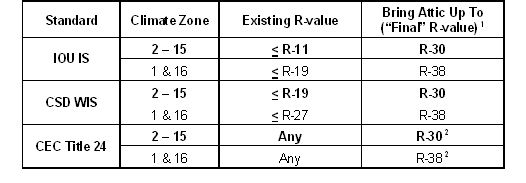
1 "Final" R-value is the R-value of the existing insulation plus R-value of added insulation.
2 These Title 24 minimum R-values are required only when insulation is installed as part of an Addition or Alteration. Retrofit weatherization programs do not involve attic alteration, so there is no Title 24 requirement to add insulation.
Installation at current levels greater than R-11 to bring the final R-value to R-30 for climate zones 2-15 or installation at levels greater than R-19 for climate zones 1 and 16 has shown not to be cost effective in the ESA Program. It may also significantly increase program expenditures. We recognize that the IOUs and CSD currently utilize different "thresholds" at which an attic insulation retrofit can be performed and that the ESA Program and CSD utilize different cost-effectiveness methodology as well as different program standards. We further recognize that each program operates with differing budgetary priorities and allowances for such measures. Nonetheless, the IOUs should revisit the cost-effectiveness analyses used to determine whether there is adequate justification to raise the current R-values to be in line with the CSD standards. Such consistency in standards, where appropriate, will lend itself to improved leveraging between ESA Program and CSD going forward.
Therefore, at this time we do not accept changing the current standards but direct the IOUs to review its cost-effectiveness as part of their next round of annual updates to the IOUs' WIS Manual. Any potential changes in the R-value threshold should be brought forth to the Commission as a recommendation from the Mid-cycle Working Group and a proposed new or revised measure standard in the next budget application cycle.
3.6.5.1.2. Envelope and Air Sealing Measures (PG&E, SCE, and SoCalGas)
PG&E, SCE, and SoCalGas propose that the Air Sealing and Envelope measures be added back, for many of the housing types and climate zones, even though they do not pass the program's current CE Test. This measure group includes the following individual elements: outlet cover plate gaskets, attic access weatherization, door weather-stripping, caulking and minor home repairs. Minor home repairs are predominantly door jamb repair or replacement, door repair, and window putty. These measures, as proposed, are approved as add back measures.
EEC and Synergy both recommend that these be approved as added back measures for all housing types, and that they be expanded to all climate zones. DRA, on the other hand, believes that such measures produce relatively low bill savings and opine, in their view, that they produce very low health, safety and comfort benefits. As such, DRA argues that such measure should only be provided to high energy users and/or users in extreme climate zones.
While these measures fall below the current CE Test threshold, and statistically show lower energy savings, we are persuaded that they are often relatively lower-cost, easy to install, and they may yield other hard to quantify non-energy benefits of adding to the health, comfort and safety of a low income household with reduced draft in the home and reduced heat loss and energy waste due to the benefits of these measures. The difficulty with measures such as these is how to measure and gauge the level of health, safety and comfort benefits conferred to the customers. This is the challenge we are looking forward to reviewing in the second phase of this proceeding.
What we do know is, in general, these measures are mid-range measures, viewed from a cost perspective. They cost anywhere from $200-$300 per installation depending on the IOU. Some lower costs measures include lighting and some minor domestic hot water measures which are generally under $100 per installation. Much higher cost measures are central systems, attic insulation, and refrigerators which could cost anywhere from $700-$4000+ per installation, (depending on IOU and measure).
In adding this measure back to the current cycle measure portfolio, we also look to better meet the level of low income population's real need. According to the IOUs' applications, the majority of the low income population and the dwelling units they occupy served would need and be eligible for this measure. PG&E estimates that they would be providing this measure to almost 100% of their homes treated target for the 2012-2014 cycle. SoCalGas estimates approximately 95%, SDG&E estimates approximately 65%, and the only exception would be SCE, estimating only approximately 1% of their homes treated target. However, for SCE, this measure only accounts for 0.47% of the measures costs.
On balance, we are persuaded that the low income population we are committed to serving and the dwelling unit types the program is designed to treat predominately needs this measure. We are persuaded that there may be hard to quantify non energy benefits to this population that can be delivered with this measure. We are further persuaded that, approving this measure would also have the ancillary benefit of assisting the IOUs toward reaching more multifamily units by easing the potential barrier in meeting the 3MM rule. We also note that as part of the traditional "Big Six" weatherization measures that are the foundation of low income programs throughout the country, these measures provide proven and worthwhile benefits to this population and should continue to be provided to all qualifying customers as proposed by PG&E, SCE, and SoCalGas. We therefore approve Envelope and Air Sealing measures as add back measure.
PG&E proposes to add back water conservation measures (low-flow showerheads, water heater blankets, water heater pipe insulation, and faucet aerators). These measures, as proposed, are approved as add back measures for PG&E.
These measures exceed the 0.25 cost-effectiveness threshold for all housing types and pass the CE Test, except in multifamily housing type, in PG&E's territory. PG&E believes that these measures should be available to qualifying multifamily housing type. PG&E contends these water conservation measures are generally low-cost and are often the only measures available to multifamily housing type. PG&E contends that if such measures are not made available to low income multifamily housing type, under the 3MM rule, the ESA Program may essentially be unavailable to many of PG&E's low income customers residing in multifamily housing.
EEC and Synergy recommend that the Commission approve water conservation measures for all housing types, regardless of CE Test. Niagara proposes that the Commission require ultra-high efficiency (1 gallon or less) showerheads, faucet aerators, and toilets in the program.
Although water conservation measures do not pass the CE Test in PG&E territory for multifamily housing type, we understand the same measures pass the CE Test in other IOUs' territories for both single family and multifamily housing types. We also note that often these measures prove to be low-cost and easy to install, and assist the IOUs in meeting the modified 3MM Rule, which is discussed in section 3.7.1 to this decision, to treat many homes that otherwise would not be eligible. Therefore, given our commitment to serving more multifamily housing units, we approve the PG&E's proposal to add back the water conservation measures for its multifamily households and approve other IOUs' existing water conservation measures which pass the CE Test to be provided to all qualifying customers, including those in multifamily households. Consistent with this approval, we also approve faucet aerators for multifamily households in SoCalGas' territory. This action will help all the IOUs meet the modified 3MM Rule and reach multifamily customers more easily.
We do not approve providing only the ultra-high efficiency measures as proposed by Niagara. Without further evidence on how this would affect the ESA Program budget, homes to be treated, change in energy savings goals from the current water conservation portfolio mix, and the overall cost-effectiveness of the program, we are not persuaded by the value of Niagara's proposal and therefore reject it.
We note, pursuant to a prior low income decision, D.07-12-050, the IOUs have already begun their review of the water-energy nexus issue, formed a partnerships with water agencies55 and completed some pilot programs and reviews.56 The final evaluation and report of those pilot programs, Embedded Energy in Water Pilot Programs Impact Evaluation: Final Report, dated March 9, 2011 (Embedded Energy Report), found that most of the pilot program evaluations provided useful information about embedded energy savings to inform future analyses of cost-effectiveness and program continuation.57 However, the Embedded Energy Report also found notable data limitations.
Since the Embedded Energy Report, the CPUC continues to work closely with the water Utilities to investigate promising energy efficiency programs and policies to reduce energy used in the delivery and treatment of water utility service. Consistent with that direction, as next step in this ESA Program, the cost-effectiveness methodology is under review and the new ESA Program Impact Evaluation study and report is ordered this decision. These efforts should complement one another and help lay additional foundation for more meaningful evaluation of this complex water-energy nexus issue at a later time.
3.6.5.1.4. Furnace and Water Heater Repair/Replacement (PG&E, SoCalGas, and SDG&E)
PG&E, SoCalGas and SDG&E propose to add back furnace and water heater repair/replacement measures for eligible owner-occupied homes. These measures do not pass the CE Test but have historically been approved as add back measures on health, safety and comfort basis. These measures, as proposed, are approved as add back measures.
Consistent therewith, for PG&E, furnace and water heater repair/replacement measures for eligible owner-occupied homes should be included for all housing types to ensure that they may be replaced wherever feasible, in electric and gas fueled homes. While these measures were not part PG&E's original measures list and application, PG&E in its comments since acknowledged the inadvertent omission. The current policy applicable to these measures, in owner-occupied homes, is that they would be added back for all housing types and climate zones.
Therefore, these measures are approved, and we direct PG&E to update their measures list to add back furnace and water heater repair/replacement measures for in eligible owner-occupied homes for all housing types, and for both electric and gas fueled homes.
With regards to the tenant-occupied homes, or specifically renter-occupied multifamily units, CHPC et al. propose that the Commission reverse its prior decisions and mandate the inclusion of heating, cooling, and hot water systems as well as common area and other whole-building energy efficiency improvements as ESA Program eligible measures for multifamily units. CHPC et al. state that excluding multifamily and rental units from heating system and hot water system repair and replacement creates an unnecessary and discriminatory distinction among classes of ESA Program-eligible households.
Similarly, they argue that this policy ignores a significant energy efficiency opportunity that can reduce GHG emissions and defeats the whole-building approach before it has begun. CHPC et al. also contend that not allowing such heating and hot water systems to multifamily units would miss "energy savings opportunities" and that in virtually all climate zones, improvements to one or more central systems can save considerable amounts of energy, improve household comfort, health and safety and be cost-effective. CHPC et al. therefore propose several central systems58 be approved in the ESA Program for multifamily units.
NRDC also supports removing the prohibition of using ESA funds for heating and hot water systems in multifamily rental units; however, NRDC does not support a schema that would have the ESA Program be the sole source to fully fund such costly central system measures.
In response to the December 2011 Ruling, the IOUs provide some examples of estimated costs for providing just the repair or replacement of functioning furnaces and water heaters in the multifamily units,59 as proposed by CHPC et al.:
Annual Cost |
2012-2014 Total Cost | |
PG&E |
$ 4,900,000.00 |
$ 14,700,000.00 |
SDG&E |
$ 940,000.00 |
$ 2,820,000.00 |
SoCalGas |
$ 8,033,333.33 |
$ 24,100,000.00 |
Total |
$ 13,873,333.33 |
$ 41,620,000.00 |
CHPC et al. also present their more comprehensive cost estimates using their own cost-effectiveness methodology60 for the various measures they propose for the multifamily units, as follows61:
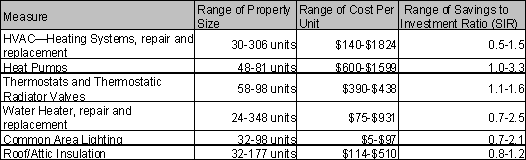
DRA recommends a compromise solution. Similar to NRDC's recommendation that ESA Program should not fully fund such measures, DRA suggests that the Commission consider extending SDG&E's current co-pay policy for refrigerators and air conditioner replacements, which require the landlord to contribute 50% of the cost of the appliance, to be applied to replacements of water heaters and furnaces in tenant-occupied dwellings.
According to the IOUs, providing these central measures (e.g. repair or replace functioning furnaces and water heaters) at no-cost to multifamily units would cost an additional $41.6 million over the 2012-2014 program cycle. This represents a 31% budget increase from the currently proposed HVAC and Domestic Hot Water budgets (from $134 million to $175 million over the 2012-2014 program years). In fact, projecting from CHPC et al.'s own estimates, the costs could be substantially greater if looking towards the higher end of the data provided.62 For instance, the inclusion of centralized heating, cooling, and hot water system measures in multifamily rental units can be as low as $215 per unit to as high as $2800 per unit. In addition, these substantial estimates only account for measure costs for each multifamily building, and do not account for any of the costs associated with administration, installation or other attendant program costs which may also be quite significant and undefined as yet.
We are not persuaded by the evidence that allowing such measures for multifamily rental units would in fact be cost effective or that it would yield the benefits to the multifamily tenants as stated. We are also not persuaded that adequate showing has been made that we should reverse our prior position, to not allow these measures in multifamily rental units, on this extraordinarily costly issue. With the current record of this proceeding, we simply cannot justify including centralized heating, cooling, and hot water system measures in renter-occupied multifamily rental units, which in turn would significantly deplete the available ESA Program budget otherwise dedicated to other cost effective measures and qualifying low income customers. That said, we are committed to revisiting all of these issue during the second phase of this proceeding.63
Based on the numerous comments in this proceeding, we feel it necessary to clarify a legal misinterpretation of the Commission's position on the issue of furnace repair and replacement or water heater repair and replacement work in renter-occupied multifamily units. The below should eliminate undue confusion of the current Commission's position as we launch in to the second phase of this proceeding.
Until now, the Commission had consistently recognized that furnace repair and replacement or water heater repair and replacement work in renter-occupied units as the legal responsibility of the landlord, consistent with our conclusions in D.07-12-051 and D.08-11-031. In those decisions, we found that in rented housing, those should not be the responsibility of ratepayers but in fact should remain the responsibility of the landlord, consistent with landlord's habitability responsibility.64 In addition, the Commission was mindful and extending due deference to the policy rationale for Civil Code Section 1941.1 and confirmed that as matter of general social and public policy, the landlord should be held responsible for the such upgrades and habitability of a rental unit when they provide such a rental unit for compensation to a tenant. Furthermore, the Commission also viewed the extraordinary programmatic costs associated with furnace repair and replacement or water heater repair and replacement work in renter-occupied units as that which, as matter of policy, should remain with those landlords, rather than have those costs be transferred to the ratepayers. Finally, the broader context for the Commission's past decisions to not expend ESA funds to upgrade these central systems in these units is also because the Commission already provides necessary incentives (also funded by ratepayers) for such property owners at the present time through other non-low income energy efficiency programs.
Disregarding much of the above reasoning, history, context and record on the issue, some parties have continually oversimplified and confused the issue and claimed that because the Civil Code does not explicitly prohibit ratepayer funds from being expended toward providing upgrades to renter-occupied units, the Commission therefore should logically expend ratepayer funds in such endeavor to aid landlords to provide habitable rental units.
Those parties are, in part, correct. The Civil Code Section 1941.1 merely creates landlords' legal responsibility to maintain habitable rental property. It does not create an explicit prohibition that ratepayer funds cannot be used to provide assistance to the landlords to ensure habitable rental units. It also does not prohibit the use of ratepayer funds to provide assistance to the landlords to invest in energy efficient rental units.
That said, those parties are making quite a leap in reasoning in incorrectly suggesting that the Commission has therefore been provided with adequate legal and policy reasoning and justification to reverse the Commission's prior position that such extraordinarily costly measures should now be the responsibility of the ratepayers, instead of the landlords.
With the above clarification, the multifamily consultant work during the second phase of this proceeding should begin to lay the foundation for a more informed, record-based and thoughtful deliberation by the Commission on this issue. Such a review will include examination of some significant public policy considerations, including whether it is the ratepayers who should now start to bear the cost of what has traditionally been the a landlords' responsibility. Additional areas for detailed review may involve other programmatic, budgetary and ratepayer implications, some of which may be outside the scope of this proceeding and overlapping with the general energy efficiency proceeding. For instance, among many foundational questions that the multifamily consultant's work should help answer are:
· Do the Commission's non-low income energy efficiency incentive and rebate programs, currently available to these property owners, provide a sufficient incentive for these landlords to undergo such major centralized system upgrades? If not sufficient, what is an appropriate and effective incentive or rebate level?
· Do the financing mechanisms/options being considered in the Commission's non-low income energy efficiency incentive and rebate programs provide a viable solution for these landlords for such major centralized system upgrades?
· Does the Commission currently have adequate justification to reverse its prior clear directives that such measures "are and should be" the landlord's responsibility as matter of law and public policy and not the ratepayers in the context of the low income program?
Depending on the outcome of the multifamily consultant work during the second phase of this proceeding, the Commission would be in a far better position to determine: (1) whether the Commission should reverse its prior position; (2) what, if any, changes to the low-income and general energy efficiency programs may be justified; and (3) how such changes could be framed and implemented, including potential financing options.
Therefore, until we are able to further review the multifamily segment issues in the second phase of this proceeding, we only approve water heater repair and replacement, and furnace repair and replacement in owner-occupied households, as previously approved.
SCE proposes to add back Central Air Conditioner for single family households in climate zones 14 and 15, and for multifamily households in climate zone 14 as an add back measure for health, safety and comfort reasons. SCE also proposes to continue their current co-pay requirement of $500 per unit for central HVAC. These are uncontested measures. Consistent with our prior determinations for approval of measures for health, safety and comfort reasons, we approve these measures for those climate zones.
3.6.5.1.6. Heat Pumps for Single Family Climate Zone 15, Multifamily Climate Zone 15 (SCE)
SCE proposes to add back heat pumps for all housing types in climate zone 15 for health, safety and comfort reasons. SCE also proposes to continue their current co-pay requirement of $500 per unit for Heat Pumps. We approve adding back heat pumps for in all housing types in climate zone 15 for SCE consistent with our prior determination that health, safety and comfort reasons for these climate zones justify approval of these measures for this climate zone. The Commission also approves SCE's request to continue their current co-pay requirement of $500 per unit for Heat Pumps.
3.6.5.1.7. Room Air Conditioner for all Housing Types in Climate Zones 10, 13, 14, 15 (SCE)
SCE proposes to add back Room Air Conditioner for all housing types in climate zones 14 and 15. We approve adding back Room Air Conditioner for all housing types in climate zones 14 and 15, consistent with our prior determination that health, safety and comfort reasons for these climate zones justify approval of these measures for those climate zones.
We also approve adding back Room Air Conditioner for all housing types in climate zones 10 and 13. This approval of Room Air Conditioner for all housing types in climate zones 10 and 13 will be solely for this program cycle with the understanding that we are reexamining and updating the energy savings figures in this cycle in a new Impact Evaluation Study and concurrently reexamining the cost-effectiveness approach used in this program during this cycle. That cost-effectiveness approach review would also include examination of non-energy benefits, equity measures, and health, safety and comfort issues which all cumulatively will relate to how the Commission will view this measure in the future cycles. In addition, we also will be examining this issue in the Low Income Needs Assessment during this cycle to determine how providing this measure meets the needs of this population in these climate zones and whether it should be approved for future cycles. All of those second phase activities will rightly set the stage for a more informed deliberation of how the Commission should look at these non-extreme climate zones with microclimates that affects and triggers the potential need for these measures.
3.6.5.1.8. Room Air Conditioner for all Housing Types in Climate Zone 10 (SDG&E)
SDG&E proposes to add back Room Air Conditioner for all housing types in climate zone 10 in their territory. We approve adding back Room Air Conditioner for all housing types in climate zone 10, as proposed by SDG&E, based on our reasoning set forth in section 3.6.5.1.7, above.
3.6.5.1.9. Cooling Measures - Proposed for Retirements (PG&E and SDG&E)
PG&E proposes to retire Room and Central Air Conditioners in all climate zones and dwelling types which failed the CE Test and show very low savings in the 2009 Impact Evaluation. SDG&E proposes to retire Central Air Conditioners, which failed the CE Test, in all climate zones and dwelling types. In addition, specific to Central Air Conditioners, it is an exorbitantly costly measure which is being proposed for retirement by both PG&E and SDG&E rather than being proposed as an add back measures because during the 2009-2011 program years, there were so few low income households that required a Central Air Conditioner (see below tables).
PG&E 2009-2011 Room Air Conditioner (AC) Units Installed Figures

PG&E 2009-2011 Central Air Conditioner (AC) Units Installed Figures

SDG&E 2009-2011 Central Air Conditioner (AC) Units Installed Figures

Several parties, including EEC, Synergy, TELACU et al., NRDC and TURN, have voiced some serious concerns about retiring these measures. While we are not entirely persuaded, in part, the concerns stem the foundational data from 2009 Impact Evaluation showing what those parties opine to indicate inaccurate and low energy savings data for these measures. Based thereon, they seek the Commission to deny these requests to retire these measures until after the completion of upcoming Impact Evaluation ordered in this decision which may show higher energy savings for these measures and therefore further justification to retain them in the program.
As it stands and based on the 2009 Impact Evaluation data and current CE Test, these measures, including Central and Room Air Conditioners, do not pass the current program CE Test, nor does the record of this proceeding provide adequate basis to justify making an exception for health, safety and comfort reasons as we have before with other measures. Even looking to the health, comfort and safety reasoning, the climate zones within these PG&E and SDG&E's territories where these measures are being proposed for retirement are not considered to be as extreme in temperature, as climate zones 14 and 15 where these measures have traditionally been found to meet health, comfort and safety needs.
Moreover and particularly with the Central Air Conditioners, the prohibitive cost, and as illustrated above, combined with the fact that they have been infrequently been installed during the past three years indicate that there seems to be little need for this measure for this population. In turn, we can infer that the low income population will experience minimal impact within PG&E's and SDG&E's climate zones, if such low-demand and high cost Central Air Conditioners are retired, as proposed. In fact, SDG&E specifically noted that they are not considering having these measures as an add back specifically because so few homes required them.
Based thereon, PG&E's and SDG&E's proposed retirement of these cooling measures, in these less-extreme climate zones, is approved, with following two exceptions. The first is more a clarification that PG&E is permitted to continue to replace central air conditioners dual packs where they are being replaced as part of a qualifying furnace replacement. We agree that by not replacing central air conditioners in these limited circumstances would limit otherwise qualifying furnace replacements that are qualified. With regards to the claim to any savings derived from this replacement, the Commission approves this request for PG&E to claim any savings (however minimal) that would accrue through replacing central air conditioners dual packs in these circumstances.
The second exception is discussed in Sections 3.6.5.1.5-3.6.5.1.8 above, and consistent with our discussion in those sections, Central AC for all housing types in climate zones 14 and 15 are approved, Room Air Conditioner for all housing types in climate zones 14 and 15 are approved, and Room Air Conditioner for all housing types in climate zones 10 and 13, are approved for this cycle only.
3.6.5.1.10. Duct Test and Seal - Proposed for Retirement (PG&E, SoCalGas, and SDG&E)
PG&E, SoCalGas, and SDG&E propose to retire the Duct Test and Seal measure. This measure failed the CE Test in all climate zones and dwelling types, and is being proposed for retirement rather than added back because it accounts for a very small portion of the portfolio (1% of the total program expenditures).
EEC and Synergy oppose retirement of Duct Test and Seal measure and recommend that either the IOUs will have to capture all Duct Test and Seal installations under the furnace repair and replacement program and not report the energy savings for this measure or list the measure separately and report those savings. Secondly, they argue that virtually all programs, whether rebate or performance based, require the ducts to be tested and sealed if necessary in order for participants to receive the rebate or performance payment. As anecdotal support for this assertion, EEC and Synergy refer to the IOUs' rebate programs as well as Energy Upgrade California. Currently, the ESA Program allows for duct testing and repairs as needed when there is no repair and replacement. Our review of the California Energy Commission (CEC) Title 24 requirements indicate that if a repair and replacement of an HVAC system is completed in a single family unit, CEC does require Duct Test and Seal, but only in some of the climate zones (climate zones 2 and 9-16).
EEC agrees that the IOUs' current practice with regards to Duct Test and Seal is consistent with Title 24 standards, with regard to what action triggers the test.65 However, EEC argues Title 24 is not necessarily controlling, in part because, it only applies to situations where a building permit is required (e.g. major repair or replacement) and does not capture instances of minor repair, maintenance or adjustments which also yields energy savings. Moreover, EEC contends, Title 24 is not on energy efficiency or conservation retrofit measures. Therefore, EEC recommends that this measure remain in the program until an evaluation can be completed based on its energy saving merit and not Title 24 standards and that for greater savings to be achieved, evaluations need to be completed based on sealing between 15% and 28% as well as removing the "test only" measure from the sealing evaluation.
We are not convinced that for greater savings to be achieved, the threshold at which you would actually seal the ducts needs to be lowered. Under Title 24, when duct testing and duct sealing is required, final duct leakage must be in conformance with the following criteria: Primary Duct Leakage Options: 1) Measured duct leakage shall be less than 15% of fan flow, or 2) Measured duct leakage shall be reduced by more than 60% compared to measured duct leakage prior to the alteration. Therefore the final duct leakage reduced to 15% or less remains, as it is consistent with Title 24 standards, and although sealing between 15% and 28% may have some benefit, we are not convinced that these benefits would outweigh the costs, considering that the savings at the current levels are already shown to be minimal.
Based thereon, the Commission denies EEC's request to change the threshold. However, while a New Impact Evaluation is undertaken we deny PG&E, SoCalGas, and SDG&E's proposal to retire the Duct Test and Seal measure. We require that PG&E, SoCalGas, and SDG&E add back the Duct Test and Seal measure consistent with the climate zones and housing types that were approved in the 2009-2011 cycle.
Furthermore, the IOUs are directed to file the additional reporting requirements for these add backs consistent with that outlined in Section 3.6.2 of this Decision. Any additional funding aside from the budget augmentations already accounted for in this decision will be reviewed and incorporated into the approved budget to augment the budget in a subsequent decision, if such budget augmentation is later determined necessary, in compliance with section 6.4 of this decision. Duct Test and Seal costs and savings values shall continue to be reported as is, and separate from the furnace repair and replacement program.
SCE proposes to retire the Central Air Conditioner service measure by which ESA Program contractors go back to maintain Central Air Conditioners previously installed by the ESA Program. While SCE contends this proposed retirement will help maintain program costs while still allowing for the continued replacement of the oldest, most inefficient Central Air Conditioners, we deny SCE's request and direct this measure be retained for the reasons discussed below.
Heating Ventilation and Air Conditioning (HVAC) is a key component of the Big/Bold Strategies adopted by the Commission in 2007.66 The intent of the initiative was to fundamentally reshape commercial and residential HVAC market. The Commission, with input from HVAC industry stakeholders, created four high level goals aimed at reshaping the HVAC sector in California. Making quality HVAC installation and maintenance the norm at all levels of the market is one of those four goals. To further that goal, the IOUs have established teams that have designed HVAC quality maintenance (QM) programs for the residential HVAC market.
With this backdrop, SCE is presently proposing to eliminate its current central air conditioning unit service offering from the ESA Program. In view of the Commission's Strategic Plan goals for HVAC, and the current Commission's efforts to advance QM through mainstream energy efficiency programs, we believe the Central Air Conditioner service offering in the ESA Program should be aligned with those initiatives and made consistent whenever possible. Therefore, we direct SCE to retain this measure in the ESA Program.
We also direct the IOUs to work with the Energy Division and consult with their mainstream energy efficiency HVAC QM program staff to investigate approaches to align, coordinate, or integrate these ESA offerings with the mainstream HVAC QM program. To design and implement a HVAC QM program on a statewide basis in low-income communities will require further review, as set forth below.
The IOUs shall, within 120 days from the effective date of this decision, submit a final report to the ESA Program and general energy efficiency proceeding service lists documenting their findings with regard to the feasibility of aligning these programs and, if feasible and appropriate, how they would propose to modify their ESA offerings to conform to the Commission's HVAC QM objectives (Final Report). The IOUs shall have first secured public comment on the Final Report, and if appropriate, have also held a workshop to address any outstanding issues.
Within 180 days from the effective date of this decision, the IOUs shall file, (1) if necessary, a Tier 2 Advice Letter seeking to modify their Central Air Conditioner service offering and budgets or propose new program designs in accordance with the findings of their Final Report and in response to stakeholders' feedback; or (2) a report to the Energy Division Director explaining the rationale for their decision not to file a Tier 2 Advice Letter.
The IOUs shall consider the following central issues in the Final Report:
(1) Duct Test and Seal: Duct Test and Seal is a logical component of any comprehensive HVAC QM program, however recent evaluations from the 2006-2008 mainstream energy efficiency program cycle raised serious questions about the cost-effectiveness of Duct Test and Seal as a standalone measure and about the effectiveness of past program designs. In this decision we have denied Duct Test and Seal as a standalone measure, and only allow it only in conjunction with an HVAC installation or only in those climate zones and dwelling types under conditions when required under Title 24. In this report, we ask whether it is appropriate to consider Duct Test and Seal as a measure in conjunction with the maintenance service the ESA Program. If not, what is an appropriate package of maintenance measures for the low income market segment?
(2) Market segment: How should HVAC maintenance programs be designed and targeted to the single-family and multifamily market segments?
(3) Maintenance service delivery: The mainstream HVAC QM program provides specialized training and requires participating contractors to utilize trained technicians that follow certain service protocols. ESA Program contractors would need to either (a) receive similar training for their own technicians or (b) partner with contractors who have trained staff, or (c) the Commission would need to devise other appropriate approaches ensure HVAC QM is executed in the field. Which program deliver model makes the most sense for the ESA Program?
(4) Funding: Who should pay for repair and ongoing maintenance? Since these systems are only offered to owner occupied low income homes, should this be offered at a 100% subsidy, co-pay or are there other approaches to consider?
Furthermore, the IOUs are directed to file the additional reporting requirements for these add backs consistent with that outlined in Section 3.6.2 of this Decision. Any additional funding aside from the budget augmentations already accounted for will be reviewed and incorporated into the approved budget to augment the budget in a subsequent decision, if such budget augmentation is later determined necessary.
3.6.5.1.12. Evaporative Coolers Maintenance - Proposed for Retirement (SCE)
During the 2009-2011 program cycle, SCE offered Evaporative Cooler Maintenance to customers to help ensure the units previously installed by SCE would continue to operate at peak efficiency and operate effectively throughout the expected life span of the units. In the 2012-2014 program cycle, SCE proposes to retire this measure. The retirement of this measure is approved in order for the IOUs to focus delivery of program services to customers who have not received any service through the ESA Program to date and to continue progress toward achieving the Commission's Programmatic Initiative.
3.6.5.1.13. Evaporative Cooler Cover - Proposed for Retirement (SDG&E)
SDG&E proposes to retire the evaporative cooler cover measure. This measure failed CE Test in all climate zones and dwelling types and is being proposed for retirement rather than added back because of low customer demand. SDG&E reports that during the 2009-2010 program years, no evaporative cooler covers were installed in the program. Due to the measure's failing the CE Test as well as the infrequency for such service installations, SDG&E's proposal to retire evaporative cooler covers is approved.
3.6.5.1.14. Tankless Water Heater - Proposed for Retirement (SoCalGas)
SoCalGas proposes to retire the Tankless Water Heater measure. Not only does this measure fail the CE Test, the installation costs proved to be significant and the yearly maintenance of the system is burdensome for low income customers who are shouldered with the maintenance obligations of this measure. The costs therefore heavily outweigh the benefits. We therefore approve this proposed retirement.
The IOUs propose the following new measures to be added to the 2012-2014 ESA Program measure portfolios. All these measures pass at least one of the three criteria of the CE Test and are shown to result in energy savings at a reasonable cost, are easy to install, as well as help in treating more renter-occupied multifamily households. The Commission approves these newly proposed measures in the housing types and climate zones for program year 2012-2014, as proposed by the IOUs.
· PG&E: Thermostatic Shower Valve Measure, Smart Air Conditioner Fan Delays, and Microwaves;
· SCE: Smart Power Strips and Variable-Speed Pool Pumps;
· SoCalGas: Thermostatic Shower Valve Measure; and
DRA recommends that smart power strips should be introduced by PG&E, SCE, and SDG&E as pilots until the next Impact Evaluation provides a more consistent estimate, because the energy savings estimates provided by SCE (29.35 kWh) and SDG&E (75.00 kWh) vary and may not be accurate.
The estimates provided by SCE and SDG&E differ, and we agree that this measure should be one that is further evaluated in the next Impact Evaluation. However, even at the energy saving levels provided, this measure still passes the CE Test. Therefore, we do not find DRA's proposal that this measure first be piloted persuasive. Accordingly, this measure as recommended by SCE and SDG&E is approved and added to the portfolio mix for the 2012-2014 program years.
NRDC recommends that PG&E add smart power strips into their portfolio. We agree with several parties and even PG&E that argue the smart power strips could be an excellent, energy saving measure to add into its ESA Program portfolio. Data provided by the Utilities that have added this measure into their portfolio generally support this. However, the accuracy of those same data have been called into question by DRA, and the energy savings values and the cost effectiveness of this measure does seem to inexplicably vary significantly from IOU to IOU ( SCE reports saving levels at 29.35 kWh and SDG&E at 75.00 kWh). So EEC correctly contends that this measure is not climate zone specific, not housing type specific, and not weather dependent. However, we do agree with PG&E that before we require PG&E to add this measure to their portfolio, we first must understand the costs and energy savings estimates in the PG&E service territory. Therefore, we direct PG&E to file, within 60 days of the effective date of this decision, (1) the CE values for this measure for each of the different housing types and climate zones that they cover, to see if they pass the CE Test, and (2) an estimate for the costs, energy savings values, as well as the projected quantity (by housing type and climate zone) of this measure to be installed for each program year. Those projections will be reviewed and incorporated into the approved budget to augment as necessary.
DRA recommends that the High Efficiency Forced Air Unit should be added to the IOUs' portfolios based on the 2009-2011 SoCalGas pilot results. SoCalGas did not include these piloted Forced Air Units, in part, because since that time, new and more efficient Forced Air Units have been introduced into the market. SoCalGas estimates adding the measure would add an additional $1.7 million to its 2012-2014 budget.
However, as NRDC correctly points out, the record lacks cost-effectiveness values for this measure of each of the gas fueled IOUs. Thus, DRA's request for the IOUs to add this measure is one step premature. The next logical step instead would be for the IOUs to evaluate the cost-effectiveness of this measure for each of the IOUs, develop program cycle cost estimates/projections, and submit them for Commission's review and decision, if the cost-effectiveness analysis supports approval of the measure, during the second phase of the proceeding.
Therefore, the gas IOUs are to file, within 60 days of the effective date of this decision, (1) the cost-effectiveness values for this measure for each of the different housing types and climate zones that they cover, to see if they pass the CE Test, and (2) an estimate for the costs, energy savings values, as well as the projected quantity (by housing type and climate zone) of this measure to be installed for each program year. Based on the foregoing, we will not require the IOUs to include these specific units into the program until further data and CE values are brought forth to the Commission for evaluation.
Appendices H-K reflect and itemize the IOUs' approved measures lists for 2012-2014. The measures are segregated by climate zones67 as well as by housing type. Measures we approve as add back measures are subject to additional monthly and annual reporting requirements for add back measures described above, in Section 3.6.2 of this decision.
To the extent the IOUs have proposed to add back or otherwise add proposed new measures to the ESA Program for 2012-2014 program cycle in their Applications that fail the CE Test and/or we did not expressly approve the proposed measures in this decision, such measures are not approved. The IOUs shall make appropriate revisions to the Statewide Policy and Procedures Manual by incorporating the Appendices H-K therein.
In planning for the 2015-2017 program cycle and applications, we direct the IOUs to continue to apply the same cost-effectiveness methodology used in this 2012-2014 cycle to their 2015-2017 ESA Program, unless the Commission provides a different direction.
3.7. Current Modified 3 Measure Minimum Rule (Modified 3MM Rule)
The Strategic Plan has established a clear focus on cost effective energy efficiency measures and requires that "by 2020, 100% of eligible and willing customers will have received all cost effective ... [ESA Program] measures."68 To make the ESA Program a resource program that delivers significant energy savings, while also contributing to the quality of life of low income customers, the Commission has established the current measure-based evaluation framework and CE Test, with some exceptions. Generally speaking, those measures that pass the CE Test, meet or exceed the 0.25 threshold under either or both PCm and UCT tests. In addition to the CE Test, the Commission also has in place the modified 3MM Rule to further the ESA Program's programmatic cost-effectiveness.
This current modified 3MM Rule had its start in D.01-03-028. The Commission was persuaded by some of the IOUs' recommendations and recognized that it would not be reasonable from a programmatic cost-effectiveness standpoint for the IOUs to treat homes that needed only a "few measures." The Commission therefore determined that it would be imprudent to indiscriminately treat all homes, including those that needed only a few measures, as such efforts would take away from the overall budget to be spent on households that have not yet received any energy efficiency measure installations. That rule became known, over the years, as the three measure minimum rule (3MM Rule). The 3MM Rule prohibited the IOUs from installing measures in a home that does not require at least three measures.69
As part of the last program cycle applications for 2009-2011, some of the IOUs proposed eliminating the 3MM Rule, citing, among other barriers, challenges in being able to treat income qualified homes, including renter-occupied multifamily households that may require less than three measures. In D.08-11-031,70 the Commission rejected the IOUs' proposal to eliminate the 3MM Rule and instead modified the 3MM Rule by creating an exception in response to those concerns to allow the IOUs to treat home needing less than three measures, "as long as the total energy savings achieved by either measure or measures combined yield(s) energy savings of at least either 125 kilowatt-hours (kWh)/annually or 25 therms/annually." As a result, that 3MM Rule then evolved to what we have come to refer to today as the "modified 3 Measure Minimum" or the modified 3MM Rule.
D.08-11-031, noting the rising outreach, enrollment and other programmatic costs, emphasized that programmatic cost-effectiveness is crucial to the ESA Program's success, and that a mechanism such as the modified 3MM Rule is necessary to make the most of the finite ESA Program funds toward treating maximum number of households. With the modified 3MM Rule, the Commission ensured a base level of energy savings and ensured that the ESA Program remains in compliance with the goal of achieving long-term and enduring energy savings and increased leveraging opportunities with LIHEAP/WAP and other external measure installation programs. In addition, the new energy savings threshold ensured increased program-level cost effectiveness and measure provision to all eligible and willing customers.
3.7.2. SCE's Request to further Change the Modified 3MM Rule
In SCE's 2012-2014 Application, SCE requests further modification to the modified 3MM Rule to again allow for yet another exception to the rule to permit the installation of CFLs at the time of home assessment regardless of whether that household meets the modified 3MM Rule. SCE contends, before 2009, its contractors were able to install CFLs at the time a home was assessed without being required to meet the 3MM Rule through an exception that was made in the Statewide Policy and Procedure Manual because CFLs were deemed highly cost-effective and quick to install.
SCE's states that its request is consistent with Code Section 2790(b)(2) which states, "The commission shall direct any electrical or gas corporation to provide as many of these measures as are feasible for each eligible low-income dwelling unit." SCE argues that CFLs continue to be highly cost-effective and feasible in nearly all cases. SCE believes providing interested income-eligible customers, who do not meet the modified 3MM Rule with at least one measure will build support for the ESA Program as participating customers proceed to network with friends.
SCE believes customer expectations and enthusiasm for the ESA Program can be raised to help build positive brand awareness by returning to the prior policy on CFL installations. Therefore, SCE requests the Commission to direct the IOUs to update the Statewide Policy and Procedure Manual to incorporate this CFL policy change for 2012-2014.
PG&E, SDG&E, and SoCalGas71 are not proposing any revisions to the modified 3MM Rule.
DRA states that the current modified 3MM Rule can become a loophole for measures that generate lesser savings. It could also permit a household be counted as "treated" even if these measures deliver little or no bill savings, and create ambiguity regarding the achieved energy savings per household. DRA therefore argues that using an energy savings threshold such as the DRA's "tangible bill savers" model would assure that minimum energy savings targets are satisfied regardless of the number of measures installed.
DRA therefore proposes to replace the modified 3MM Rule, which is premised on counting the numbers of measures, with an approach of establishing a threshold of minimum energy savings to be set to 4% of the average CARE customer's previous year usage levels for each utility. DRA proposes that this new energy savings threshold approach will promote greater program efficiency and larger energy savings per household. DRA believes that contractors would aim to meet the energy savings threshold for each household and for each fuel separately.
EEC recommends that bundling in-home services (income qualification, home assessment, energy education and CFL installation) is the most cost effective way of delivering energy efficiency services to low income customers. EEC believes that the modified 3MM Rule denies the provision of in-home energy education and CFL installation and overlooks a unique leveraging opportunity. Moreover, EEC believes this program rule is in conflict with the Commission's policies. EEC therefore recommends instituting the policy to allow the installation of CFLs during the enrollment and education process as well as lifting any program cap for CFLs that could be installed in each participating household.
TELACU et al. state that the modified 3MM Rule is arbitrary and unduly limits the number of household that can be treated. They propose eliminating the rule completely and allowing all income eligible customers to receive energy education and CFLs regardless of the modified 3MM Rule.
SCE contends that during the 2009-2011 program cycle, over 278,000 households received energy education services and were assessed for eligible energy efficiency measures. Of these households, an estimated 180,000 (65%) either met the modified 3MM Rule or exceeded the minimum kWh savings threshold. The remaining 35% either had no eligible measures recommended through the assessment or had less than three measures recommended, and therefore they were ineligible to receive any measures. Because it is likely at least one CFL could be installed in each remaining customer dwelling, SCE states that almost all 98,000 homes should be considered as failing to meet the modified 3MM Rule.
For program years 2012-2014, SCE projects that up to 93% of homes in SCE's territory will meet the modified 3MM Rule by qualifying for and receiving a smart power strip and five CFLs. Excluding CFLs from the restrictions of the modified 3MM Rule would therefore enable SCE to install CFLs in the remaining 7% of homes, corresponding to a 7.53% increase in quantity (from 1,115,096 CFLs to 1,199,028) and inventory and labor cost (from $7,810,135 to $8,397,995) over a full three year 2012-2014 cycle. SCE installs an average of roughly 4.5 CFLs per home, and does not expect a significant increase in the average number of CFLs installed per home if the five CFL cap was eliminated.
Even though SCE believes that their contractors can implement DRA's 4% threshold proposal, SCE claims that while the proposal would resolve the issue pertaining to CFLs, it raises other concerns. SCE states that no threshold at all is preferable to the current modified 3MM Rule or DRA's proposed minimum savings threshold. SCE argues that under DRA's proposal, if electric measures are identified that would produce a 6% savings in electricity usage and gas measures are identified that would produce a 2% savings in gas usage, the ESA Program contractor would not be able to install the gas measures. DRA's proposal would therefore deny the incremental gas measures to customers in this instance or electric measures in an opposite instance, which would serve merely to deny additional energy saving measures to customers when service providers will already be returning to the customer's home to install additional measures.
SCE's position is that contractors should have much more flexibility to determine whether a measure installation should be deemed feasible in the ESA Program cost-effectiveness paradigm and whether to install such measures during the assessment and enrollment visit or a return visit. SCE believes the contractors should be able to make those decisions without being encumbered to meet the modified 3MM Rule.
PG&E states that it cannot specifically estimate the percentage of homes that are initially enrolled in ESA Program and later determined ineligible for any services because they do not meet the modified 3MM Rule. However, PG&E does have records which show that up to 16% of homes that were enrolled or received energy education during 2009-2011 cycle ended up not receiving any ESA Program services due to several different reasons72 including a determination that the household did not meet the modified 3MM Rule.
PG&E believes that allowing CFLs to be provided as an exception to the modified 3MM Rule, as proposed by SCE, could cost the program an additional $1.8 million on average per year. PG&E contends that an additional $3.6 million per year or $10.7 million would be needed over the three year period if the current 5 CFLs per household cap is lifted. PG&E's estimate is based on a 10 CFL maximum and based on application cost per measure per year.
As for SCE's proposal, SDG&E contends that based on its 2009-2011 data, less than 1% of homes enrolled ended up not qualifying for any ESA Program services because they do not meet the modified 3MM Rule. There were only approximately 800 instances in the three year period where the modified 3MM Rule was cited as a reason for disqualifying a household from being treated by the program. SDG&E estimates, based on an average of four CFLs installed per enrollment, additional CFL costs of approximately $22,10073 for the 2012-2014 program cycle would be expected if CFLs were excluded from having to meet the modified 3MM Rule, as SCE has proposed.
SDG&E argues that in order to meet DRA's 4% energy savings threshold proposal, an average ESA Program customer with a monthly consumption of 4,800 kWh and 415 therms of annual consumption would need to have savings of 192 kWh and 16.6 therms per year to participate. SDG&E contends the only measures in the program with reasonable cost-effectiveness are refrigerators, torchiere light fixtures, attic insulation, and furnace standing pilot change outs, and moving to the DRA's proposed 4% energy savings threshold would effectively eliminate many customers with moderate to low consumption from participating in the program unless they were eligible for a refrigerator replacement. SDG&E points out that customers who might benefit from low cost measures and tailored energy education would not be served under this proposal. SDG&E also notes that enrollment/assessment contractors have limited customer information and that they do not have customer energy consumption data. SDG&E contends that current contracts would need to be revised to include treatment of this customer data and the secure data transfer process and requirements. As such, SDG&E believes that the contractors are not set up to perform the energy savings analysis required to implement the 4% energy savings threshold.
As for SCE's proposal, SoCalGas estimates that approximately 2.7% of households that enrolled in the ESA Program during 2009-2011 ended up not qualifying for any services because they did not meet the modified 3MM Rule.
SoCalGas shares SDG&E's concerns and states that the contractors would not be able to readily implement DRA's proposed 4% energy savings threshold in lieu of the current modified 3MM Rule. SoCalGas points out that the energy savings threshold for single fuel gas utility may exclude some homes where the modified 3MM Rule is feasible but the energy savings could be less than the 4%. SoCalGas also notes that the fluctuations in the annual CARE customer energy usage data could further complicate and impact SoCalGas' ability to service homes each year if the projected energy savings and feasible measure combinations do not meet the energy savings thresholds proposed in DRA's 4% approach. SoCalGas additionally emphasizes that there are funding and timing considerations (which have not fully been assessed by SoCalGas) which are necessary in order to make such program changes (i.e. changes to operations and database to incorporate annual consumption data, etc.). Lastly, SoCalGas echoes SDG&E's position that the contractors are not currently poised and able to implement this 4% threshold proposal and to do so would require time and additional contractor training to conduct an assessment using this new approach.
For SDG&E and SoCalGas, the 2009-2011 estimates of customers that did not meet the modified 3MM Rule are quite low (less than 1% for SDG&E and about 2.7% for SoCalGas). PG&E cannot accurately estimate the percentage of enrolled customers that did not meet the modified 3MM Rule, but estimates that it is embedded within the 16% that fall into the six categories: 1) customer refusal, 2) contractor unable to reach customer to schedule measure installation, 3) contractor unable to get a signed property owner waiver, 4) customer over income limit, 5) incomplete enrollment paperwork, and 6) customer did not meet the modified 3MM Rule. Based on 2009-2011 enrollment results, SCE estimates that approximately 35% of their customers either qualify for no measures or less than three. It seems that the modified 3MM Rule has posed the greatest challenge for SCE, though exactly how much is unclear as SCE claims it does not specifically track this figure.
Summary of the IOUs' Modified 3MM Rule Concerns
IOU |
Estimated % of enrolled customers not meeting modified 3MM Rule |
Annual Cost to provide CFLs to those customers not meeting modified 3MM Rule |
Annual Cost differential if the cap of 5 CFLs per home is removed |
SCE |
35% currently but includes those that qualify for no measures or less than 3; but expect that approx 7% will not meet the modified 3MM Rule in 2012-2014 (pending the approval of smart power strips)
|
$195,953.33 |
$ -
|
PG&E |
16% but includes 6 categories: customer refused, contractor unable to reach customer to schedule measure installation, unable to get a signed property owner waiver, customer over income, incomplete enrollment paperwork, and/or did not meet the modified 3MM Rule.
|
$1,800,000.00 |
$3,600,000.00 |
SDG&E |
<1%
|
$7,366.67 |
$ - |
SoCalGas |
2.70%
|
$ - |
$ - |
However, looking forward, with the approval of smart power strips as a new measure addition to SCE's portfolio, SCE projects that this issue becomes less significant as only 7% of homes will be unqualified based on the modified 3MM Rule. Based on the data provided by the IOUs and having approved the smart power strip,74 we are not convinced that the modified 3MM Rule creates a significant barrier in any of the IOUs' territories, as presented by some of the parties. Now more than ever with program costs rising ever so rapidly, we find value in the modified 3MM Rule consistent with our finding in 2001 that a provision to ensure overall programmatic cost-effectiveness toward cost-effectively treating all eligible and willing customers as envisioned by the Strategic Plan.
As proposed by SCE, providing CFLs, but no other measures for homes that fail the modified 3MM Rule, we would simply be touching these households on the surface and increasing program costs (effectively lowering the overall programmatic cost-effectiveness) while simultaneously permitting a household be counted as "treated" even if these measures deliver little in bill savings. If we are to truly approach the ESA Program as an energy resource program, we cannot myopically focus on the number of households treated, while completely ignoring bill and energy savings. We therefore find SCE's proposal to change the policy to allow CFLs alone to be contrary to ESA Program goals. We provide further discussion on CFL issues as well as the overall context within which this issue must be viewed in Section 3.9 of this decision.
In principle, we agree with DRA that the focus should be on promoting more efficient and larger energy savings per household. In fact, DRA's 4% energy savings threshold proposal to strive at deeper energy savings per household raises excellent policy objectives that we should work towards. However, we cannot support it at this time because of the operational complexities it presents have not been fully developed nor analyzed, making the proposal premature. Furthermore, the IOUs and other parties have indicated they are not able to readily overhaul the current program delivery framework and workforce requirements to implement such a bill saver delivery model.
Based on the foregoing, we make no changes to the modified 3MM Rule, as modified in D.08-11-031 and clarified in D.09-06-026, and we: (1) deny SCE's proposal to install CFLs at the time a home is assessed without being required to meet the modified 3MM Rule, (2) deny SCE's proposal to count a home as "treated" with the delivery of only CFLs and/or energy education without complying with the modified 3MM Rule, (3) deny DRA's proposal to replace the modified 3MM Rule with a 4% Threshold delivery model, (4) deny EEC's recommendation of instituting the policy to install CFLs during the enrollment and education process as well as lifting the cap of 5 CFLs per household, as further discussed and clarified in Section 3.9 of this decision, and (5) deny TELACU's proposal to eliminate the modified 3MM Rule altogether and allow all income eligible customers to receive energy education and CFLs regardless of the modified 3MM Rule requirement.
Lastly, what we learned from the last program cycle about the energy education component of the ESA Program is that it needs to be studied to determine whether we are delivering effective energy education that is received and retained. The latest Process Evaluation found significant disparity in type and overall quality of the messaging/energy education delivered across the IOUs' territories. We discuss this concern further in Section 5.2.5.2 of this decision. Therefore, without better understanding how to deliver an effective energy education to this population through the energy education study ordered in this decision, inter alia, as well as ascertaining quantifiable and associated energy savings figures, it is premature to consider energy education as a standalone measure applicable towards the modified 3MM Rule, at the present time, as it is being proposed here.
In their Applications, PG&E, SCE, and SDG&E request to change the ESA Program refrigerator replacement criteria from pre-1993 units to pre-1999 units. In their opening testimony, DRA proposes an even more aggressive update to the refrigerator replacement criteria and argues that the second revision of the Federal Appliance Standard in 2001 supports expanding the proposed criteria from pre-1993 to include pre-2001 refrigerators.
For the 2012-2014 cycle, PG&E indicates that replacing pre-2001 refrigerators may cost the program an additional $30 million dollars, while for SDG&E and SCE, they estimate an additional $1.4 million and roughly $20 million dollars respectively would be needed to expand the criteria. In sum, DRA's expanded proposal could cost roughly $52 million and would propose to replace an additional 65,000 refrigerators over the next three-year period.
We find the additional expense of roughly $17.5 million annually for DRA's proposal is excessive and the demonstrable energy savings may not fully justify the associated costs. Additionally, as indicated in DRA's opening testimony, some pre-2001 units already meet the 2001 Federal Appliance Standard and are energy efficient.
Moreover, the costs to require the IOUs to develop, field, and maintain a database of refrigerators that fail to meet the 2001 Federal Appliance Standard are unknown. As the Refrigerator Degradation Study75 has found, developing such a list may be impractical and there are questions as to the ESA Program workforce's ability to field such a list or tool in an effective and reliable manner.
Therefore, we believe the IOUs' request to change the refrigerator replacement criteria from pre-1993 units to pre-1999 units is a more reasonable option, and therefore, we approve it.
SCE requests that a cap on CFLs not be reinstated. As a point of clarification, there is no current statewide CFL cap in place, since the 2010 updates to the Policy and Procedures Manual, Sections 2.9 and 7.3.14. Thus, this issue is moot. However, consistent with our determination in D.08-11-031, we require the IOUs to install all CFLs they give to ESA Program customers. With the risk of CFLs being given away to customers that end up not being installed, (D.08-11-031 estimated that more than 30% of CFLs given away to customers are not installed), we cannot continue to allow giveaways, especially in uncapped quantities as requested by some parties. Neither customers nor Californians as a whole will benefit from the energy savings light bulbs contribute to the program if they are never installed. The ESA Program will continue to remove old bulbs after installing CFLs, unless a customer asks to keep the old bulbs.
SCE also seeks the Commission's approval to expire the $6.90 per CFL cap adopted in D.08-11-031. SCE contends this CFL price cap figure is no longer feasible in 2012-2014. PG&E supports SCE's request for the Commission to approve expiration of the $6.90 per CFL cap. EEC agrees with SCE to expire the per CFL cap of $6.90 stating that the cost for CFLs has risen significantly over the past three years and the IOUs need the flexibility to manage their programs and adjust material costs appropriately as needed. EEC also agrees with SCE that there should not be a quantity cap on the CFLs given.
We find the request to expire the CFL price cap of $6.90/bulb somewhat incomprehensible. D.08-11-031 implemented this price cap based on the then average cost per bulb plus the estimated cost for overhead/ warehousing/ installation/ transportation, and ordered the IOUs to immediately coordinate their light bulb purchasing (through bulk purchases or other similar low cost arrangements), warehousing and transportation so that all receive the lowest possible price per bulb, and did not approve any CFL budget for bulbs that IOUs do not install, (giveaways). Given the advancement, technology and the plethora of supply of CFLs in the market today, the existing price cap seems to be sufficient.
On the other hand, we do acknowledge that overhead costs have changed, and agree that the IOUs do need the flexibility to manage their programs and adjust material costs. Therefore, we will expire the per CFL cap of $6.90. However, we note that the costs of this measure will be closely monitored, along with all other ESA Program measure costs, and that as we try to move this program to be more cost effective, we expect over time that the IOUs will gain more efficiency and that we would see a decreasing trend in these measures costs and program costs.
The Strategic Plan sets forth the Commission's vision for the lighting market with regard to support for basic Compact Fluorescent Lamps (CFLs):
Utilities will begin to phase traditional mass market Compact Fluorescent Lamps bulb promotions and giveaways out of program portfolios and shift focus toward new lighting technologies and other innovative programs that focus on lasting energy savings and improved consumer uptake.76
While there has been some debate over the value of CFLs, their cost-effectiveness and associated energy savings, we have found that CFLs continue to provide low income customers the opportunity for significant energy savings in a relatively cost effective manner because they are relatively inexpensive, and we can still capture energy savings by switching low income customers from high energy use incandescent bulbs to CFLs.77
Likewise, in D.12-05-015, in R.09-11-014, our general energy efficiency proceeding, it is acknowledged that we should not ignore available cost -effective savings that basic CFLs can still provide. In that decision, the IOUs in the mainstream energy efficiency proceeding are therefore being directed to propose upstream rebates in the Basic Lighting subprogram for basic CFLs, during the next cycle.78
Consistent with the Strategic Plan which envisioned phasing out support for basic CFLs, we are directing the IOUs in the general energy efficiency proceeding, in D.12-05-015, to propose a much smaller basic CFLs program for the transition period as a step toward the phasing out process envisioned by the Strategic Plan.
Here, we follow the general approach we are taking in our general energy efficiency proceeding, D.12-05-015. We, therefore, direct the IOUs to take note of Section 10.1.2 in that decision and coordinate their ESA Program activities in the 2012-2014 cycle consistent with the directions and approaches we provided in D.12-05-015, where appropriate.
In their Applications, SoCalGas, SCE, and PG&E generally acknowledge some of the challenges they experienced and that the multifamily segment of the low income population has been, to varying degrees, underserved and has seen some barriers in entry to the ESA Program. DRA does not disagree with claims that perhaps the ESA Program poses some barriers as it interfaces the low income multifamily segment and suggests that, despite such potential barriers, this segment has not been significantly underserved. Based in part thereon, DRA recommends the issue of better serving multifamily properties (in proportion to their occurrence in the overall low income population) be given lower priority than those households with high-energy burden, high-energy insecurity, or high-energy usage.79
During the October 21, 2011 workshop and the two PHCs as well as the testimonies, briefs, and other filings, the parties have vigorously debated the nature and magnitude of how the low income multifamily segment has or has not been underserved and how it may be better served by the ESA Program. With that backdrop, CHPC et al.'s opening brief makes the following observation:
...after years of running successful programs, the utility companies have picked much of the lower-hanging fruit and now need to serve the harder-to-reach customers as well as achieve deeper savings in each building they serve... and passage of... Assembly Bill 32 has amplified the need for intensive energy efficiency efforts across California.80
CHPC et al.'s above observation correctly focuses and orients us to the Commission's two ultimate goals for the low income programs, and in turn correctly puts this multifamily segment issue in perspective today. At issue is not just the treatment of the multifamily segment, but instead the overall vision and goals of reaching all eligible low income households by 2020, and the effective design and implementation of the ESA Program as envisioned. Thus, if a segment of the low income population is underserved or could be better served, then the ESA Program must undertake reasonable efforts to remedy that identified concern. In the end, such conscious and proactive efforts to understand the remaining untreated low income households are necessary for this program to realize the lofty goal of reaching the 100% eligible and willing households by 2020.
While much of the debate centered on the treatment of the multifamily segment, the proposed solutions, ideas, pilots and program critiques all bring attention to how the ESA Program can more effectively be administered, to providing all feasible measures and delivering the health, safety and comfort benefits of this program to the low income community. It is fair to say all the parties are, in good faith, engaged in this proceeding in an effort to improve the delivery of the program, and we encourage and direct the parties to continue to remain engaged on this issue as we further examine this issue in the second phase of this proceeding.
3.10.2. IOUs' Multifamily Housing Segment Strategy Proposals
In the Applications, most of the IOUs81 recognize the need and propose to increase their focus in this coming cycle on the multifamily housing segment. The IOUs' proposals for the 2012-2014 program cycle, include coordination of the ESA Program with Energy Upgrade California (EUC) and the Middle Income Direct Install (MIDI) programs in accordance with the Strategic Plan. Specifically, the IOUs propose coordination amongst those programs such that, for multifamily dwellings, the IOUs would first administer the ESA Program to treat low income multifamily households and thereafter refer the remainder of the work to EUC. The work that is completed by the EUC program would then include those additional measure installations in units and areas not authorized to be treated under ESA Program but that such work would be coordinated and completed in a timely and subsequent visit with the property manager actively engaged in such effort.
In its reply testimony, PG&E reiterates that integration of the ESA Program and its EUC multifamily strategy is the most efficient and effective route to treat multifamily households and that information gleaned from the PG&E Segmentation Study will help better target marketing and outreach to customer segments, including multifamily housing.
SCE, in its reply comments, opines that there is no need to emphasize on multifamily households in the ESA Program and therefore opposes expanding ESA Program incentives, which are no-cost to low income households, to cover costly common area measures to benefit the non-low income multifamily property owners.
SDG&E proposes its plan to streamline multifamily household participation in ESA Program by simplifying the property owner authorization form and to work directly with multifamily landlords to obtain program authorization. SDG&E also disputes some parties' claims that measure offerings are unequal across housing types, arguing that instead, measure offerings are determined by household occupancy type as dictated by the Commission.
In their reply testimony, SDG&E and SoCalGas reiterate that other IOU programs, including the Multifamily Energy Efficiency Rebate (MFEER) program and EUC are currently in place and should be utilized to help non-low income multifamily property owners fund their tenant occupied furnace repair and replacements instead of relying on the ESA Program's limited no-cost giveaways.
3.10.3. Multifamily Comments and Proposals of NCLC, CHPC, and NHLP (NCLC et al.) and TELACU et al.
NCLC protests all four IOUs' Applications and urges the Commission to revise the IOUs' ESA Program to include: (1) targeted outreach to owners of multifamily properties; (2) program redesign that allows for "one-stop" applications; (3) full integration of any ESA Program and other programs for which the owner and tenants may be eligible; (4) use of an energy audit tool that is appropriate for use in larger, multifamily buildings; (5) inclusion of all cost-effective measures including work on heating and hot water systems; and (6) a review of the income eligibility rules with the goal of removing any unnecessary barriers.
CHPC's protest echoes much of NCLC's protest, specifically requesting that the Commission direct the ESA Program to: (1) adopt a whole house approach to multifamily buildings; (2) reverse the relevant portions of prior decisions and mandate the inclusion of heating, cooling, and hot water systems as well as common area and other whole-building energy efficiency improvements as ESA Program eligible measures for multifamily rental buildings; (3) establish ESA Program Categorical Eligibility for buildings and units in properties listed on the federal WAP list of eligible properties given the similarity of eligibility standards; (4) require the establishment of a single point of contact for participants to access ESA Program resources as well as all other utility energy efficiency resources that potentially could be combined; and (5) expand ESA Program marketing, outreach and education efforts (including establishing a nominal "referral fee") to focus on multifamily building owners and managers-particularly to those buildings with predicted populations of qualifying households.
NCLC et al., in their joint testimony, offer further detail on the requests for the ESA Program to: (1) remove "housing subsidies" as an income source in regards to program enrollment; (2) adopt an expedited enrollment process for multifamily properties currently used by HUD-DOE WAP; (3) adopt a whole-building approach by removing prohibitions on heating and hot water systems replacements in multifamily rental housing; and (4) require the IOUs to offer a single point of contact for multifamily rental housing owner/operators for ESA Program and other energy efficiency offerings.
NCLC et al.'s reply testimony also offers several critiques of TELACU et al.'s pilot proposal (discussed in detail below) including: (1) many of the groups' initial proposals do not need piloting; (2) the TELACU et al.'s pilot is too small in scope and budget; (3) its "charge back" for pre-installation audits that do not lead to 20% energy savings is inappropriate and will be a barrier for participation; (4) the adherence to the current practice of making central "furnace and domestic hot water heaters for building owners" ineligible for ESA Program assistance will hinder the pilot; (5) a 20% energy savings threshold is too difficult for multifamily buildings to attain; (6) the pilot's Energy Efficiency Manager position should be an IOU employee or direct contractor; (7) the pilot administration should be competitively bid; (8) the market assessment and database portion of the pilot is unnecessary; and (9) the pilot will take too long to address AB 75882 objectives. The reply testimony goes on to outline other states' multifamily energy efficiency housing programs as more comprehensive in measure offerings and program design and argues that those should serve as a model for the ESA Program.
In response to the December 2011 Ruling, NCLC et al. elaborated that the ESA Program should fund following measures:
· Whole-building, investment-grade energy audits.
· HVAC-Heating Systems, repair and replacement:
Boiler/heater repair and replacement
Heating pipe insulation
Boiler plant controls
Boiler blankets
Heat pumps
· Thermostats and Thermostatic Radiator Valves
· Water Heater, repair and replacement:
Domestic hot water heater repair and replacement
Domestic Hot Water Pipe Insulation
High Efficiency Pump Motors/Heating Loop Pump
Recirculation Controls
Water Heater blankets
· Common Area Lighting
· Roof/Attic Insulation
To be eligible for the new measures, NCLC et al. propose above:
a. The owner must agree to a whole-building, performance-based approach that is projected to result in at least a 20 percent reduction in energy consumption.
b. At least 66 percent of units must be occupied by households who income-qualify for ESA Program.
c. The multifamily building owner must enter into an agreement committing to not raise rents and otherwise ensure that the benefits received by the owner will accrue primarily to the tenants, in a manner similar to the requirements imposed by CSD WAP. These owner commitments should continue for a reasonable period after completion of the energy efficiency work.
As proposed, the amount of ESA Program assistance should be limited to:
· A per-building cap for whole-building audits of no more than $100 per income eligible unit, up to a maximum of either the actual cost of the audit or $15,000, whichever is less.
· A per-building cap for all energy measures (excluding the audit) of no more than a pre-set amount per income-eligible unit.
3.10.3.2. Multifamily Comments and Proposals of TELACU et al.
In their initial protest, TELACU et al. too agreed that the ESA Program presents some barriers for the low income multifamily segment from participating in the program, and that those barriers should be examined. However, TELACU et al. opposes any proposal for "carve out" of program funds solely for the investor/owners of the assisted, deed restricted housing segment.
Instead, TELACU et al., in their opening testimony, provide a graduated multi-phased ($21.2 Million/6,800 unit or $3.2 Million/1,700 unit) Multifamily Segment pilot proposal aimed at addressing various aspects of the coordinated ESA Program multifamily housing delivery issues raised by NCLC and CHPC. TELACU et al.'s pilot83 proposes to "address the market intelligence, policy and programmatic barriers that have limited penetration in the multifamily housing sector" by comprehensively leveraging existing ESA, EUC, MIDI and other IOU Energy Efficiency programs. TELACU et al.'s pilot is a non-measure pilot that proposes to investigate the feasibility of combining existing IOUs' incentive programs (ESA, mainstream energy efficiency, MFEER, and EUC programs) and to find ways to effectively leverage those with other non-IOU program funds (PACE-Commercial, DOE WAP, LIHEAP, etc.) as well as owner financing into a unified program for saving energy in multifamily developments.
The pilot proposes to utilize a multifamily energy efficiency manager who will provide effective coordination and access to information regarding all available funding sources to help cover the investment costs in extensive measures targeted at delivering deeper energy savings that are not covered by the ESA Program funding for these measures will come from EUC and other energy efficiency rebate programs. As proposed, this pilot envisions four phases as follows:
Phase 1: (Small Scale Pilot Installation/Program Incentives of 1,700 units for an ESA budget of $1,020,000 and Comprehensive EUC Audits of 42 Buildings with an EUC budget of $315,000) - Small Scale Pilot will serve roughly 1,700 units with this delivery model and will provide 42 buildings with an EUC comprehensive audit and measures.
Phase 2: (Evaluation and Modification: Development of Market Segmentation Database ($200,000), Interim Pilot Phase 1 Evaluation Report ($175,000), and Development of Multifamily Program Installation and Policy and Procedures ($125,000)) - Phase 2 will see the $200,000 development of the Market Segmentation Data Warehouse that will provide investors and regulators with data to better develop energy and assisted housing policy and assist the Commission in developing a methodology for revised future allocation of energy costs to owners (annual Utility Allowance provided for units) and provide Utilities with a more detailed and accurate way of segmenting and profiling energy savings potential within the existing multifamily housing stock. Phase 2 also develops a $175,000 Phase 1 Interim Pilot Evaluation Report and the $125,000 Multifamily Program Installation and Policy and Procedures manual.
Phase 3: (Large Scale Pilot: Installation/Program Incentives of 6,800 units for an ESA budget of $4,080,000 and Comprehensive EUC Audits of 168 Buildings with an EUC budget of $1,260,000) - The phase 3, Large Scale Pilot, will ramp up the services to 6,800 multifamily units and audits of 168 buildings.
Phase 4: Comprehensive Evaluation and Reporting Phase (Final Pilot Report ($125,000), EM&V ($250,000), and Administrative Costs Budget ($547,500)) - This final phase includes Comprehensive Evaluation and Reporting will include a Final Pilot Report and $250,000 for an Evaluation, Measurement, and Verification plan that will compare (by climate zone, size, vintage, and other characteristics) the number and type of measures installed on a per unit and per building basis between typical ESA Program installations and the piloted program.
3.10.4. IOUs' Responses to NCLC et al.'s and TELACU et al.' Proposals
SDG&E, SoCalGas and SCE support the NCLC et al.'s recommendation of single point of contact schema for the integration of ESA Program and other IOUs' mainstream energy efficiency offerings. Conversely, SDG&E, SoCalGas, and SCE oppose the NCLC et al.'s recommendation to use ESA Program funds for common area measures in multifamily housing as it is not practical for an IOU to establish requirements84 similar to the DOE's Weatherization Assistance Program (WAP) to ensure such improvements benefit individual tenants.
SCE also opposes other aspects of NCLC's proposal. SCE argues that housing subsidies should remain as a source of income in determining customer eligibility for the ESA Program. SCE contends that all buildings with a tenant eligibility rate of 66% to 80% would receive ESA Program benefits at 66%-80% of the total measure installation cost rather than the current full subsidized level. SCE's proposes its current multifamily ESA offerings are proportional and equitable. SCE believes NCLC et al.'s recommendations need to be considered within the context of IOU integration initiatives underway in ESA and mainstream energy efficiency programming.
PG&E's opening brief supports the single point of contact concept and refers to the EUC-ESA Program multifamily pilot program in R.09-11-014, arguing that the results of that pilot should be reviewed before implementing any ESA Program changes in respects to multifamily segment.
SCE supports TELACU et al.'s opposition to any potential budget "carve-out" for the investors/owners of assisted deed-restricted multifamily housing.
SDG&E argues that the number of buildings to be targeted in the TELACU et al.'s pilot proposal in its territory is too large and disproportionate to its territory size and that any such pilot should be implemented through the IOUs' current programs instead of creating yet another pilot program that will cause customer confusion. SDG&E also states that if the Commission were to authorize a multifamily pilot, it should be competitively bid.
SoCalGas is generally supportive of the TELACU et al.'s multifamily pilot proposal but stresses that it would need to evaluate the results of the pilot's Phase 1 and 2 before making recommendations on Phase 3.
PG&E is generally supportive of the TELACU et al.'s multifamily pilot proposal with several proposed changes, including: (1) measures not currently offered by the ESA Program should be subject to a rebate or co-pay to cover the cost of the measure; (2) the "data warehousing" component of the pilot is premature and unnecessary; (3) the pilot has higher installation costs than in the traditional ESA Program and such cost factor should be addressed; (4) that some type of energy education or collateral be provided to pilot participants; and (5) that only contractors approved in a specific program (i.e. ESA, EUC, etc.) should be permitted to perform installations in the pilot.
3.10.5. Other Parties' Comments on Multifamily Segment Issues and Proposals
In its opening testimony, DRA notes that multifamily buildings are the easiest places to implement the whole neighborhood type of approach. While not all IOUs actually track the effectiveness of their property owner waiver forms to determine which practices work best, DRA believes the IOUs should develop a better property owner waiver and should follow SDG&E's lead in tracking the number of property owner waivers that had been signed as a metric to determine the effectiveness of their multifamily building strategies.
Furthermore, DRA proposes that rather than funding additional multifamily pilot proposals to answer questions about energy savings, expedited enrollment and `one-stop' program integration, the Commission should instead review the variety of recently completed multifamily projects performed under other state and federal programs. Lastly, DRA argues that the IOUs have historically served multifamily households in proportion of their percentage of all low income households and that claims of under-serving this demographic are unfounded.
DRA's reply testimony asks the Commission to maintain the prohibition on replacing furnaces and hot water heaters in multifamily dwellings until better information about energy savings opportunities associated with these installations is available. DRA later retracts its prior position and instead argues that the ESA Program should fund only installations where tenants pay the energy bill and the investment grade audit that includes either heating or hot water measures should predict at least 20% savings.
TURN proposes: (1) "relaxing" the ESA Program's cost-effectiveness methodology for easier collaboration with EUC; (2) the ESA Program should look to local government programs for implementation with EUC; (3) SCE use segmentation study results to make EUC and the ESA Program neighborhood approaches more effective; (4) pilot a "cash for energy savings" program as was done by Los Angeles County in the EUC program; and (5) support a single point of contact for ESA Program and EUC integration. TURN supports certain aspects of NCLC et al.'s recommendation of a single point of contact, proposed multifamily rental whole-building performance-based approach that includes heating and hot water measures, and general effort to focus more attention to the multifamily housing sector and the barriers in the low income multifamily market. TURN's opening brief supports TELACU et al.'s multifamily pilot proposal.
CforAT's reply brief "generally supports the proposals of NCLC/CHPC/NHLP regarding effective enrollment and treatment of multi-family residences."85
In its reply testimony, G4A comment that while they do not have an opinion on the fielding of a multifamily pilot program, the Commission should: (1) set clear guidelines and hiring criteria for participating contractors; (2) prevent any perception of conflict of interest in the contracting process; and (3) consider a third-party administrator to implement any multifamily pilot.
The Joint Parties support certain aspects of NCLC et al.'s recommendation of a single point of contact, proposed multifamily rental whole-building performance-based approach that includes heating and hot water measures, and general effort to focus more attention to the multifamily housing sector and the barriers in the low income multifamily market.
In the opening brief, the Joint Parties recommend that the ESA Program do the following: (1) lift its prohibition of replacing working heating and hot water appliances in tenant occupied multifamily households; (2) provide a single point of contact for building owners/property managers to access utility financed energy efficiency programs; (3) expedite enrollment for tenants in multifamily properties (in both assisted and market-rate housing); and (4) integrate ESA Program direct install measures with other applicable efficiency programs, rebates, incentives and financing options in one application and enrollment process (to enable whole building retrofits and upgrades).
NRDC generally supports: (1) a single point of contact for ESA Program and other energy efficiency programs' integration; (2) that housing subsidies not be considered as a source of income under ESA Program rules; and (3) an expedited enrollment process for multifamily housing properties as proposed by NCLC et al. NRDC is generally supportive of the TELACU et al.'s multifamily pilot proposal and believes the proposed changes are well-founded and should be expanded to the larger program. Additionally, NRDC argues that the $10.1 million project ramp up portion of Phase 3 (which treats up to 6,800 units for a cost of up to, comprehensive EUC audits, installations and program incentive delivery, and conclusion) of TELACU et al.'s multifamily pilot be scaled up in terms of unit goals and measure offerings.
NRDC agrees with the Joint Parties and CforAT, and recommends that the ESA Program: (1) lift its prohibition of replacing working heating and hot water appliances in tenant occupied multifamily households; (2) provide a single point of contact for building owners/property managers to access utility financed energy efficiency programs; (3) expedite enrollment for tenants in multifamily properties (in both assisted and market-rate housing); and (4) integrate ESA Program direct install measures with other applicable efficiency programs, rebates, incentives and financing options in one application and enrollment process (to enable whole building retrofits and upgrades).
In D.06-12-038, we directed the IOUs in their future ESA Program budget applications to include participation goals in population sectors or segments, with budgets designed to meet those goals. This requirement is in line with Code Section 2790(d),86 which reads, "Weatherization programs shall use the needs assessment pursuant to Code Section 382.1 to maximize efficiency of delivery."
Likewise, again in D.07-12-051, the Commission held that "[t]he complementary objectives of ... [ESA] programs will be to provide an energy resource for California while concurrently providing low income customers with ways to reduce their bills and improve their quality of life."87 In order to meet these objectives, we directed the IOUs to devise goals determined by population segments.
Most recently, in the update to the Strategic Plan, we stated:
Approximately one-third of all [Californian] households live in multi-family structures.... About one-third (approximately 4 million) of [those] ... households qualify for low income energy efficiency [ ] programs extended to households with annual income less than or equal to 200 percent of federal Poverty Guidelines.88
The IOUs have filed the 2012-2014 Applications with proposals generally consistent with these prior directions, including the goals based approaches and with proposals for their strategies for the multifamily segment. The Commission's Energy Division too have been reviewing the IOUs' progress in penetrating the multifamily segment and continuously looking for ways to ease any barriers faced by the multifamily segment of the low income population and entry into the ESA Program.
The 2007 KEMA Low Income Needs Assessment Report and its findings, state that 43% of all low income households reside in multifamily dwelling types (with 5 or more units). While some parties dispute the assumptions, scope, methodology and therefore the resulting accuracy of some of the findings, we will look to that estimate as a basic starting point to begin the discussion, until that figure is updated. Irrespective of the exact percentage, this segment of the low income community comprises a significant portion of the overall low income population we must serve.
First, we recognize that the IOUs have time and again updated their strategies each program cycle toward reaching their full penetration goal by 2020 and employed creative ways to do so. However, we recognize today that the ESA Program can certainly be improved to better serve this multifamily housing segment and the overall low income residential segment. We will direct the IOUs to do so going forward.
We note that in the course of this proceeding, through the Applications, PHCs, opening and reply testimonies, and comments responsive to the December 2011 Ruling, the IOUs and all the parties presented many concerns, objections, insights, information, approaches and even pilot proposals for the Commission to examine various potential barriers that might prevent eligible customers residing in multifamily units from enrolling in the ESA Program. Citing the IOUs' data reported in their annual reports, DRA's opening brief, Table 6, also illustrates that in comparing the IOUs' 1997-2006 multifamily homes treated figures89 to the IOUs' 2007-2010 multifamily homes treated figures, with the exception of SDG&E, each IOU's multifamily homes treated figures dipped during the last program cycle.
· PG&E dropped from 27% multifamily homes treated in 2000-2006 timeframe to 18% multifamily homes treated in 2007-2010 timeframe;
· SCE dropped from 45% multifamily homes treated in 1997-2006 timeframe to 23% multifamily homes treated in 2007-2010 timeframe;
· SoCalGas dropped from 36% multifamily homes treated in 1997-2006 timeframe to 25% multifamily homes treated in 2007-2010 timeframe; and
· SDG&E increased from 49% multifamily homes treated in 1997-2006 timeframe to 54% multifamily homes treated in the 2007-2010 timeframe.
Thus, perhaps lessons learned and best practices could be shared to understand these trends and to begin to reverse them. Moreover, these numbers and trends suggest that we need to better understand the field of eligible population and particularly this multifamily segment to be able to devise effective strategies to reach them. If the ESA Program is not effectively reaching the multifamily segment or the overall eligible low income population, then that has to be identified, understood and addressed in the time remaining as we near 2020. Thus, during the 2012-2014 period, we will examine this issue to devise a full set of comprehensive multifamily segment strategies, as discussed in Section 3.10.6.3 of this decision.
As for some of the more costly measures being proposed for multifamily buildings (e.g. furnace repair and replacement), we discuss significant, legal, policy and programmatic implications of such measure in great detail in Section 3.6.5.1.4 of this decision. In short, we must act cautiously. The ESA Program is a ratepayer funded program with an annual expenditure in excess of $300 million and a goal to reach 7% of California's low income population each year. Without looking carefully at this issue in the second phase of this proceeding, the current budget realities do not allow us to increase the ESA Program's no-cost measure offerings to include such costly replacements of working central systems in tenant-occupied multifamily buildings - especially since other Commission and non-Commission programs are available to do so.
Indeed, from NCLC et al.'s own figures, provided in response to the December 2011 Ruling, a decision to include the NCLC's proposed 14 new (see Section 3.10.3.1 of this decision) measures can increase program costs from $1,324 to $5,399 per unit in addition to the costs of current multifamily rental measure offerings. Extrapolating these new measure costs to the ESA Program's historic averages of multifamily unit treatments, such new program elements could increase the IOUs' budgets by hundreds of millions of dollars annually.
These are hundreds of millions of ratepayers' dollars we must collect from other ratepayers and must expend with due caution. Thus, while we fully appreciate that the multifamily sector presents an area with a sizeable energy savings potential, we are not confident that limited program funds can now be expanded to cost-effectively replace operating central systems, such as heating and domestic hot water systems in rental properties.
As for some parties' proposal that the ESA Program provide expensive investment grade energy audits to multifamily rental properties without clearly identifying either the costs of such audits or how or which of the IOUs' program would pay for such audits, we again note caution. Lacking a full understanding of the costs and attendant benefits, such proposals are premature and cannot be thoughtfully evaluated at this time. Moreover, with competing audit tools available in the multifamily sector, the ESA Program, as a ratepayer funded program should require significant public engagement before the selection of one audit tool over another can be made.
Meanwhile, we appreciate and applaud the committed, thoughtful and informative ideas, discussions and insights the parties brought into this proceeding to inform and aid the Commission on this important issue. While there is not yet a consensus on how to tackle this issue, we see the need for attention to this segment and we see several immediate strategies the IOUs and the parties proposed and which we can pursue here as set forth below.
As the first of this parallel, two-pronged approach, the IOUs are directed to immediately roll out the eight Multifamily Segment Strategies described below, including additional approved measure offerings to multifamily households we approve in this decision specifically to enhance penetration of this segment. Furthermore, the IOUs are directed to simultaneously begin developing and advancing more long-term and comprehensive multifamily segment strategies as discussed in Section 3.10.6.4 of this decision.
Based upon the IOUs' and the parties' proposals and comments, as well as the 2007 KEMA Needs Assessment Report and 2009 Process Evaluation, we find the following to be immediately feasible strategies and efforts to be deployed as soon as practicable. These are strategies that should ultimately ease the barriers of entry into the ESA Program and in turn yield greater overall energy savings from this program and increase overall penetration rate as well.
Strategy 1 - Whole Neighborhood Approach: As recommended in the 2009 Process Evaluation Report90 and as proposed and acknowledged by several parties, a whole neighborhood approach, if tailored properly, can be an effective tool for the multifamily segment. The IOUs are therefore directed to implement multifamily segment strategies based on the whole neighborhood approach, whenever practicable, to reduce the travel time and costs of efficiently reaching the maximum number of eligible multifamily households.
The whole neighborhood approach to ESA Program implementation should result in more efficient and cost-effective program delivery which eases scheduling difficulties and reduces the burden the report program participation places on low income multifamily customers. The 2009 Process Evaluation found that while the whole neighborhood approach did not yield successes in many contexts of ESA Program delivery for a variety reasons, the contractors suggested that the whole neighborhood approach worked more successfully in the context of multifamily buildings. The following describes in detail a particularly successful approach, reported in the 2009 Process Evaluation Report, to engaging multifamily customers using this strategy:
First, the contractor distributed door hangers advertising the program. Next, the firm set up tents in which tenants present qualifying documentation to enroll in the program. In a single day, qualifying individuals received energy education in groups of 10; assessment crews identified measures for installation, and installation crews completed measure installation. The respondent further noted that such events were particularly successful when combined with customer giveaways or raffles.91
We direct the IOUs to incorporate such whole neighborhood approach strategy as part of the IOUs' multifamily segment strategy, where applicable.
Strategy 2 - Property Owner Waiver Update: As observed by the parties and the 2009 Process Evaluation Report, one of the key barriers to penetrating the multifamily segment appears to be associated with the challenges of getting the needed property owner waiver form for these multifamily properties. As generally proposed by SDG&E, in its effort to streamline multifamily household participation in the ESA Program, the IOUs should coordinate with each other and develop a uniform and simplified property owner authorization form. The IOUs are then directed to use that simplified form to work directly with multifamily landlords and property managers to obtain the needed authorization. The simplified and streamlined property owner waiver form should, at the very least, address the following concerns to ease the entry into ESA Program:
(i) Eliminate potential duplications wherein ultimately only one form would be necessary for properties served by multiple IOUs; and
(ii) Eliminate, to the extent feasible, the need for multiple forms for multifamily dwellings being served by more than one IOU program through the integration and leveraging efforts.
Also, as part of this simplifying and streamlining effort, we direct the IOUs to align all attendant co-pay costs for currently permitted multifamily measure offerings amongst the IOUs. The IOUs are also directed to work with multifamily stakeholders to clarify owner obligations in the ESA Program property owner waiver forms and to develop, where needed, simplified property owner waiver forms in different languages when a need for such is identified. Lastly, the IOUs should immediately begin tracking completed property owner waiver rates among household types, as recommended by DRA.
Strategy 3 - Updated Marketing Approach to Multifamily Homes: Targeted outreach to owners of multifamily properties is one of the elements of NCLC et al.'s recommendations. DRA correctly proposes and we direct the IOUs to utilize the recent lessons learned from the Segmentation Studies to update and target their marketing to multifamily owner/operators.
Consistent therewith, many contractors in the 2009 Process Evaluation reported reaching out to property owners directly in their own program marketing activities. Contractors reported such efforts to engage with property owners and managers as very beneficial because it can open opportunities to gaining approval to provide services to multiple customers and multiple properties. The 2009 Process Evaluation Report notes anecdotal benefits to this approach while also noting that such approach may prove to be costly. Thus, this strategy is merely a tool being offered to the contractors to use to roll out an effective whole neighborhood approach to the low income multifamily segment, where appropriate.
Strategy 4 - EUC/MIDI/MFEER Coordination: The IOUs' proposal to formally coordinate the ESA Program with EUC and the MIDI programs is approved, and such effort should be further coordinated with the Multifamily Energy Efficiency Rebate (MFEER) program.
Strategy 5 - Single Point of Contact: The concept of single point of contact to coordinate the varying IOU programs for the multifamily segment was recommended in different forms by varying parties. Relative to the IOUs' internal programs, the proposed concept of single point of contact is approved. The IOUs are directed to offer a single point of contact for multifamily rental housing owner/operators for ESA Program and other energy efficiency programs offerings by the IOUs. During this cycle, the IOUs should explore ways to expand this single point of contact concept to include, where appropriate, coordinate with other non-IOU efficiency or housing renovation programs (e.g. CSD or other local government programs).
Strategy 6 - Same Day Enrollment, Assessment, and Installation: The 2009 Process Evaluation Report also found that the contractors who had employed the approach of performing measure installations on the same day as enrollment and assessments could expedite program processes, improve customer experience by reducing customer inconvenience, and eliminate the potential need for additional appointments. Many of those contractors reported that such expedited same-day approaches were effective in multifamily complexes or other situations in which multiple customers live in similar types of households thus allowing for ability to anticipate and plan for those households' measure needs. For instance, a contractor noted that a same-day approach worked well in apartment buildings in which multiple units frequently qualified for similar measures.92 In concert with the whole neighborhood approach strategy (Strategy 1) as well as tailored multifamily marketing and coordination strategies (Strategies 2-6) we set forth for in the preceding sections of this decision, the IOUs are directed to employ such an expedited same day process, whenever practicable.
Strategy 7 - Streamline Practice and Service Delivery: As recommended in the 2009 Process Evaluation Report, the IOUs shall immediately begin streamlining their practices and efficiencies in service delivery to the low income multifamily segment that may be available without the need for lengthy or cumbersome program redesign or budgetary increases. The IOUs should take all reasonable efforts therefore to promote and share the IOUs' best practices of utilizing group outreach and enrollment and group energy education for eligible households living in multifamily complexes.
Strategy 8 - Providing Feasible Measures for Multifamily Segment Including Retention of Certain Measures Proposed for Retirement for Program Cycle 2012-2014: The following measures proposed for retirement by the IOUs in their 2012-2014 Applications shall be retained and these ESA Program measures shall be made available for renter occupied multifamily units:
· Attic insulation
· Air Sealing/Envelope Measures
· CFLs and Hardwire lighting
· Hot water conservation measures
· Water heater blankets
· Water heater pipe insulation
· Pre-1999 refrigerators
· Furnace clean and tune
Effective implementation of Strategy 4, above, should further complement measure offerings for the multifamily segment. For instance, other IOUs' programs (including MFEER) offer rebates for multifamily properties for the below list of measure offerings which will further complement the ESA Program measures:
· Central System Natural Gas Water Heater
· Central System Natural Gas Boilers for Water and Space Heating
· Natural Gas Storage Water Heater
· Energy-efficient Electric Storage Water Heaters
· Central Natural Gas Furnace
· Central Natural Gas Furnace with Built-In Variable-Speed Motor (VSM)
· Energy-efficient Package Terminal Air Conditioners and Heat Pumps
· High-efficiency Clothes Washers
· High Performance Dual-pane Windows
· Attic and/or Wall Insulation
· Energy Star Room Air Conditioner Replacement Multiple-Speed or Variable Speed Motor (VSM)
· Ducted Evaporative Cooling System Level 1 and Level 2
· Package Terminal Air Conditioner (PTAC) and Package Terminal Heat Pump (PTHP)
With the coordinated delivery of the measures offered in the above complementary programs funded through those various ratepayer funds, most, if not all, of the energy efficiency needs of multifamily buildings should be met.
3.10.6.4. Comprehensive Multifamily Segment Strategies Formulation and Implementation
As the second part of a parallel, two-pronged multifamily segment approach, the IOUs are directed to begin developing and advancing more long-term and comprehensive multifamily segment strategies as outlined below. The IOUs are directed to pursue a Multifamily Segment Study ordered in this decision below. The budget for this Multifamily Segment Study is not to exceed $400,000. The IOUs are directed to pay for the contract, but otherwise shall involve the Energy Division at the earliest possible time in the request for proposal and bid evaluation process so that independence is assured. The IOUs, along with the Energy Division staff will evaluate the bids, and the Energy Division shall make the final determination on the contractor selection. The process shall also follow the structure outlined in Resolution E-4237.
Within 30 days of the effective date of this decision, the Energy Division and the IOUs are directed to hold a one-day public workshop to garner input from interested stakeholders and parties on the development of the third party consultant request for proposal (RFP) for a Multifamily Segment Study.
Within 60 days of the effective date of this decision, with public and stakeholders' input, the IOUs and Energy Division are directed to develop and release the joint statewide RFP for a third party Multifamily Segment Study consultant (Consultant).
The IOUs and Energy Division are directed to co-manage and oversee the Consultant once retained. The IOUs and Energy Division are directed to take all reasonable actions to ensure award of contract for the Multifamily Segment Study, within 100 days of the effective date of this decision. The IOUs and Energy Division are directed to take all reasonable actions to ensure ample public review of the Consultant's work after the contract is awarded and a final recommendation is timely presented, as ordered in this decision. At a minimum, the Multifamily Segment Study and related Consultant's work shall include the following:
1) Gather data on the state's multifamily housing stock and ownership profiles, including a statewide demographic and programmatic assessment of California's low-income multifamily housing stock (by each IOU territory):
2) Catalogue multifamily energy efficiency programs, including Commission programs and those administered by other government agencies, Utilities and organizations within the state of California, as well as recent and ongoing multifamily energy efficiency programs administered in other jurisdictions across the country;
3) Evaluate and further examine comments, objections and proposals from parties to the proceeding in the context of the ESA Program decisions, the current Commission directions and Strategic Plan;
4) Review existing Commission's multifamily programs within the overall context of the ESA Program;
5) Review other recently completed multifamily projects performed under other state programs;
6) Conduct field studies, as needed;
7) Review and investigate the cost and budget implications of a multifamily program implementation;
8) Review and investigate coordination concerns related to any new delivery methods that streamline the ESA process with external financing and energy efficiency options such as how a single point of contact will be responsible for coordinating IOU-administered energy efficiency, renewable, incentive, and financing programs as well as non-IOU- administered, external multifamily efficiency, renewable, incentive, and finance programs in California;
9) Identify available energy efficiency financing options, and develop a funding and implementation schema utilizing the variety of energy efficiency programs available for multifamily housing owner/operators;
10) Develop overall recommendations for multifamily strategies looking toward the 2020 vision of 100% penetration;
11) Hold public meetings to obtain, document, review and consider all stakeholders' input;
12) Deliver a draft report by April 1, 2013, which will be circulated for comments; and
13) By June 14, 2013, prepare and ultimately propose a feasible long-term multifamily treatment strategy (Final Report) for the ESA Program.
The Final Report shall be submitted to the ALJ and shall summarize all of the key findings, address public and stakeholders' comments and input, recommend the proposed comprehensive long term multifamily segment strategies and best-practices, taking into account the IOUs' implementation and any interagency constraints, all operational and fiscal constraints, all relevant coordination issues with other agencies and programs and overall program budgets. This Final Report is due prior to June 14, 2013, with recurring stakeholder workshops held throughout and leading to its development. The Final Report shall include recommendations on:
1) How the ESA Program can be modified to better meet the needs of its low income multifamily residents;
2) How multifamily segment measure offerings should be modified (including central system needs) and develop possible co-pay or financing frameworks that comply the ESA cost-effectiveness approach; and
3) How to modify the current service delivery approach to address multifamily energy efficiency programming concerns, based on:
_ Past studies and other programs, develop targeted and integrated outreach and marketing to low income multifamily housing owner/operators; and
_ An understanding of the issues faced by contractors who will participate in the new approach to the low income multifamily housing segment, including training, certifications, service workflow, etc.
Upon receipt of the Final Report and recommendations, the ALJ may convene an evidentiary hearing at that time. Alternatively, if the ALJ deems the recommendations to be reasonably sound, the ALJ shall issue a ruling directing the IOUs to prepare and submit implementation action plans on those programming recommendations from the Multifamily Segment Study.
While the multifamily consultant process is underway, the Commission intends to further examine and develop an informed record regarding NCLC's proposed multifamily expedited enrollment process, including identifying and examining relevant legal and operational hurdles (e.g., housing subsidy and definition of income, potential need for memorandum of agreement or understanding with other potential partner agency(ies)), toward development of feasible expedited enrollment process. The ALJ has already made an expedited request for staff's legal analysis and recommendation to lay the foundation for this examination and anticipates issuance of a ruling setting briefing schedule after this decision issues.
In D.07-12-051, the Commission stated that the ESA Program strategies, in general, should "include specific training strategies for reaching disadvantaged communities [and] the IOUs should also work with community stakeholders to assist them in the development of training strategies."93 The Strategic Plan also set forth two broad WE&T goals: (1) establish energy efficiency education and training at all levels of California's educational systems, and (2) ensure that minority, low income and disadvantaged communities fully participate in training and education programs at all levels of the energy efficiency industry.
Following the direction we set in the Strategic Plan, D.08-11-031 challenged the IOUs to devise and implement outreach and training efforts to teach minority, low income, and other disadvantaged communities the skills needed to succeed at jobs that support the ESA Program by acting "as a catalyst to change by implementing several foundational activities that are necessary to accurately identify specific WE&T needs and recommendations for action."94 With this direction, however, we also stressed that the IOUs are but one link in the overall chain of a statewide WE&T strategy. In the chain, there are stakeholders supporting action toward developing "green jobs" with other funding and training coming from taxpayers, community-based and nonprofit organizations, educational institutions, the business community, and labor organizations.
In D.09-09-047, the Commission, in approving the 2010-2012 Energy Efficiency Portfolios and Budgets, reaffirmed the Strategic Plan's vision for WE&T programming and implementation. That decision further clarified the Commission's direction on the completion of the Statewide Workforce, Education, and Training (WE&T) Needs Assessment to study "critical workforce needs" and to identify "opportunities to help identify and fulfill those needs through collaboration and fund sharing." D.09-09-047 also called for the Statewide WE&T Needs Assessment to include a "detailed inventory of...workforce education and training programs across the state and [the identification of] collaborative opportunities to make the three-year portfolio of IOU training programs responsive to [Statewide WE&T] Needs Assessment findings."
The California Workforce Education and Training Needs Assessment for Energy Efficiency, Distributed Generation, and Demand Response, California Workforce Education and Training Needs Assessment for Energy Efficiency, Distributed Generation, and Demand Response, dated March 3, 2011, (Statewide WE&T Needs Assessment), has recently been completed. While there were few tangible recommendations specifically applicable to the ESA Program because the study was not specifically focused on developing recommendations for the ESA Program, there was one significant recommendation we found timely and applicable to the ESA Program:
...for fully subsidized low income programs, modify program objectives to include workforce outcomes. Assess current workforce outcomes and if they are not adequate, use high-road agreements and sector strategies to pilot incorporation of the new national DOE skill standards and certifications or other strategies to improve both energy efficiency and workforce outcomes.95
The recently completed Statewide WE&T Needs Assessment and 2009 Process Evaluation Report, inter alia, also note that the ESA Program implementers' pay structure may potentially be leading to poor installations and in turn, diminished energy savings as a result.96 The Statewide WE&T Needs Assessment also recommends that ratepayer dollars should be invested in improving worker skills rather than promoting competitive markets that drive costs (and wages) down to below a living wage standard.
PG&E contends its present WE&T program is reasonable and that requiring the IOUs to alter their relationships with contractors, community based organizations, and Community Colleges would be unduly costly and therefore detrimental to the purpose of the ESA Program. PG&E also claims that requiring the IOUs to incorporate WE&T goals into the contractor selection process for the ESA Program would be costly and unnecessary. Lastly, PG&E contends that requiring the IOUs to track increasing amounts of data that are not essential for program delivery will result in unnecessary added costs to ratepayers.
While PG&E recognizes that its program provides many jobs across its service area, PG&E does not believe that green job creation and training should be core components of the ESA Program. PG&E also notes that there are a finite number of jobs in the program, and training too many workers for the number of jobs that exist is not fair to people looking toward the promise of employment. PG&E also claims that it currently provides appropriate trainings to prepare its ESA Program workforce to understand program rules and to implement the program appropriately and is pleased to work with community and technical colleges to help develop energy efficiency assessment and installation certification or curricula.97 Finally, PG&E generally objects to data gathering concerning wages and quality of contractor performance and contends that the ESA Program work quality and training is not in question.98
SCE contends its 2012-2014 Application complies with the Commission's WE&T directives in the Strategic Plan and contends its program in 2012-2014 will maintain a steady workforce. SCE in its testimony describes the training it currently provides to contractors and particularly community based organizations that are situated in low income and disadvantaged communities, and that it provides jobs within these communities.99 In its current Application, SCE is proposing to provide additional training to its current suite of courses that will not only increase the effectiveness of its ESA service providers, but will also provide skills that can create additional employment opportunities for workers in the ESA Program.100
SCE's expanded training catalog would focus on computer-based training for advanced computer skills, effective communication, and customer service skills. All of the developed skill sets would not only be applicable for the employees' current jobs, but could also be transferred to other fields thereby creating a potential new career path for individuals working in the ESA Program. To increase trainee knowledge, SCE also proposes creating workshops that will educate participants about the regulated electric industry, and how energy efficiency programs are structured within this environment in order to enhance the energy education component of the ESA Program.101
To ensure high-quality installations and maximize energy savings, SCE also plans to provide additional technical training related to the installation of measures and delivery of services provided under the ESA Program. In sum, SCE does not support any changes to its current plans and current ESA Program relationships with contractors, community based organizations, or community colleges.
SCE objects to the changes proposed by some parties that include specified hiring goals, data tracking requirements, contractor selection criteria, and sourcing outreach jobs currently fulfilled in many cases by community based organizations from specific training programs. These changes would likely result in significant increased costs, which would be detrimental to the overall program. SCE correctly notes the IOUs are currently under no requirement under the Strategic Plan to integrate the ESA Program into their Sector Strategy Action Plans as outlined in the Joint IOUs' WE&T Advice Letter, as being suggested by some of the parties.102
SCE suggests the WE&T Taskforce meetings currently underway in the general energy efficiency dockets are a potentially logical venue for interested stakeholders to collaborate on WE&T-related matters in energy efficiency.
Finally, in response to the proposed decision, SCE requests that Energy Division or the IOUs should manage the WE&T working group and each IOU should have representation on the working group.
DRA recommends that the IOUs be directed to track and improve workforce training and job standards and that the Commission require the IOUs to develop more explicit labor standards such as wage floors in order to ensure the success of the ESA Program in recruiting workers from low income and disadvantaged communities. In turn, DRA contends this could lay the ground works toward creating opportunities for economic improvement for these workers.
Initially, in their opening testimonies, Brightline and G4A proposed significant workforce reporting, hiring, and contracting changes to be mandated by the Commission on the IOUs. Some of these recommendations asked that the Commission require the IOUs to: (1) incorporate WE&T goals as an integral part of the selection process for ESA contractors; (2) refine partnerships with community colleges and community-based organizations to offer sector-based training and transferrable credentials; and (3) track data and document progress towards achieving WE&T goals.
In response to the December 2011 Ruling, Brightline and G4A suggest that they do not feel the IOUs' Sector Strategy Action Plans identified in their 2010-2012 Statewide WE&T Program Modifications Advice Letters meet the WE&T needs outlined in the Strategic Plan for two reasons, namely: 1) few details are given about the ESA Program WE&T improvements in the letters, and 2) while the IOUs describe a sector strategy to meet many of the training goals called for in the Strategic Plan, they fail to plan for transition into "rewarding careers in energy services."
In their reply brief, Brightline and G4A also support the plan that DRA has set forth to track and improve workforce training and job standards and support DRA's recommendation that the Commission require the IOUs to develop more explicit labor standards such as wage floors in order to ensure that the success of the ESA Program in recruiting workers from low income and disadvantaged communities.
Brightline and G4A also support all recommendations to track data related to how workers are paid, what wages workers are paid, what benefits workers are offered, where workers are recruited from (e.g. low income status or targeted communities), and how many workers are hired from training programs.
G4A, in its reply testimony, responds to TELACU et al. G4A contends that fluctuating workloads in ESA Program does not negate the need for ESA Program specific workforce training and standards, nor does the need for cost-effectiveness invalidate the need for wage floors or living wages within the program. G4A concurs with DRA that at a minimum, the Commission should require the IOUs to ensure all ratepayer funded jobs adhere to minimum wage standards. Additionally, G4A indicates that within the current bidding and selection process, some contractors can pay beyond minimum amounts without cutting into their ability to install measures for the cost required by the IOUs and that this warrants further exploration. The Donald Vial Center, via the G4A's reply testimony, counters TELACU et al.'s and Richard Heath and Associates, Inc.'s claims that the Statewide WE&T Needs Assessment "seriously mischaracterizes the low income programs" by indicating that the report clearly delineated the non-low income market (which is heavily regulated and policy driven) from the mainstream, rebate-driven residential market. G4A opines that the Commission should 1) set clear guidelines and hiring criteria for participating contractors, 2) prevent any perception of conflict of interest in the contracting process, and 3) consider a third-party administrator to implement any multifamily pilot.
In reply testimony, the Joint Parties voiced support for Brightline's and G4A's recommendation to require the IOUs to track data and document progress towards WE&T goals and also propose that the IOUs focus WE&T efforts to diverse business enterprises with annual revenues of $1 million or less.
EEC concludes that mandated wage floors and additional requirements for "non-ESA" related training would lead to increased program costs and a decreased number of households served.
In their reply testimony, Brightline proposes its own $100,000 WE&T pilot proposal in conjunction with the San Francisco Office of Economic and Workforce Development (SF OEWD). This Brightline pilot proposal would train 25 low-income residents for entry-level positions as Weatherization Specialists and Energy Specialists.
PG&E, in its reply testimony, reiterates that PG&E adheres to all Commission rules on contractor selection, that the ESA Program does not have specific WE&T goals, that PG&E is already engaged in WE&T sector-strategies, and that for Brightline and G4A's claims of poor quality installations in the ESA Program are unfounded.
SoCalGas and SDG&E in their reply testimony reiterated commitment to the Strategic Plan and voiced opposition to the Joint Parties' request that WE&T efforts be focused to diverse business enterprises with annual revenues of $1 million or less as unnecessary, excessively restrictive and burdensome.
SCE's reply testimony restates its position that revamping the IOU-community based organization-contractor relationship process is costly, unnecessary and would reduce the number of homes treated by the program. SCE argues that while many of the goals advocated by Brightline and G4A may be laudable, they have not been tested adequately in the marketplace and will drive program delivery costs higher and may impair the ability of community based organizations and contractors to operate other programs and services they provide to communities by mandating different hiring strategies, salaries and benefits for employees that work on different contractor projects. SCE also argues that increased WE&T tracking data would be onerous and costly to both the IOUs and to contractors.
The Statewide WE&T Needs Assessment made a significant and timely recommendation for the ESA Program:
...for fully subsidized low income programs, modify program objectives to include workforce outcomes. Assess current workforce outcomes and if they are not adequate, use high-road agreements and sector strategies to pilot incorporation of the new national DOE skill standards and certifications or other strategies to improve both energy efficiency and workforce outcomes.103
While a few anecdotal accounts of contractor performance issues were raised by some of the parties and the 2009 Process Evaluation Report,104 we acknowledge that there is not enough evidence to suggest there to be a program-wide performance concern or that ESA Program delivery by the IOUs and contractors fall below any performance standard. Moreover, there was no evidence in the record to suggest that the IOUs and the contractors are violating health, safety, labor or wage laws to begin directing they comply with such existing laws.
That said, the above recommendation merely suggests reviewing "workforce outcomes" and "skill standards and certifications or other strategies" to improve those outcomes and taking actions as appropriate upon such review. That is a good program WE&T approach for the ESA Program. To know the state of the current workforce, the needs of that workforce and the quality of their performance in the ESA Program is just the beginning of effectively managing the program workforce, the needs of that workforce, and the quality of the products being produced by that workforce.
Moving away from the past approach of responding reactively to the ESA Program workforce's needs as they arise, in this cycle, we will begin to approach WE&T issues proactively by actively overseeing, assuring quality work, anticipating and planning for future workforce needs of the ESA Program through the three remaining program cycles heading to the Strategic Plan target. The record of this proceeding reflects the limited information and data being collected and reviewed and available to illustrate the reality of the current ESA Program workforce. Likewise, there is little indication of a forward looking anticipation and planning for the ESA Program's workforce needs of tomorrow.
Instead of objecting to additional data collection and claiming it as unnecessary burdensome and costly, the IOUs should proactively collect, review and act on those same information to manage the workforce needs of today as well as plan for tomorrow. As a program funded entirely by ratepayers, the IOUs' ESA Program-specific WE&T plan for the remaining three cycles creates potential opportunities for job creation, incubation, or development for displaced and disadvantaged workers. We therefore strongly encourage the IOUs to explore all opportunities and thoughtfully plan for and take full advantage of any such opportunity, wherever it makes sense, and do so consistent with the broad WE&T goals of the Strategic Plan.
The programmatic and legislated goal of the ESA Program is to weatherize low income households and help reduce the energy burden experienced by these vulnerable populations. To that end, we find that there is a nexus between the quality of ESA Program delivery (proper enrollments, assessments, installations, etc.) and the quality of the ESA workforce. Since maintaining the highest quality workforce is synonymous with the goal of an ever-effective ESA Program delivery model, the IOUs must make every effort to understand its workforce to adjust, support, empower and otherwise manage it in a way that yields the highest quality of service and outcomes.
The Commission's most urgent charge in the ESA Program is realizing the Strategic Plan105 vision that by 2020, 100 percent of eligible and willing customers will have received all cost-effective low income energy efficiency measures. Keeping that vision in the foreground, the Commission and the IOUs should therefore view this WE&T issue with a broader perspective of successfully meeting the ESA Program needs for the next three cycles but with the focus towards:
(1) Assessing the education and training needs, if any, of the existing ESA Program workforce in yielding effective and quality program outcomes;
(2) Providing the support and framework for the necessary training and education for the existing ESA Program workforce to yield effective and quality program outcomes, including providing the workforce with the necessary lead safety and other similar safety training;
(3) Determining what ESA Program workforce needs will be for the remaining three cycles, until 2020;
(4) Anticipating and planning for in the workforce needs to support the ESA Program in the remaining three cycles, until 2020;
(5) Exploring ways to leverage (with green jobs programs, community-based and nonprofit organizations, educational institutions, the business community, and labor organizations, etc.) wherever possible and incorporate teaching minority, local, low income, disabled, displaced, and other disadvantaged communities the skills needed to meet the ESA Program needs, where feasible;
(6) Considering possible pilot programs (as recommended in the Needs Assessment) to test new quality standards for ESA Program weatherization projects accompanied by necessary training, increased pay for performance for contractors, and links to job placement for completing the training then initiate the evaluation below; and
(7) Participating and maintaining alignment to the extent possible with the IOUs' statewide WE&T efforts.
By doing so, we will effectively raise ESA Program delivery performance by beginning to be more mindful and elevating the quality of the workforce's performance toward achieving ESA Program delivery success which will also foster mindful job creation, incubation and training, without unduly interfering with the IOUs' contracting and operational discretion needed to effectively manage the workforce and contracts.
The above focused direction should not be viewed as a condemnation of the IOUs' or the ESA Program contractors' current performance by any means. It is simply our recognition of the critical role of the hard working ESA Program workforce and a framework and a roadmap to enable the ESA Program to better understand and manage its current and anticipated workforce needs and effectuate added social benefits of creating and/or supporting employment for minority, low income, and other disadvantaged communities with the skills necessary to meet the ESA Program needs.
To that end, the IOUs are directed to immediately begin collecting the following data in these seven WE&T areas: (1) contractor and subcontractor contract terms (competitive bid, direct award, etc.); (2) contractor and subcontractor compensation schemes (hourly, piecemeal, salaried, etc.); (3) number of inspection failures and the types of failures (including the number of enrolled customers later deemed ineligible, number of incorrectly assessed households and instances of measure installation inspection failures); (4) level and type of IOU training (including lead safety training) and screening (including background check) these specific contractors have completed; (5) customer feedback for these contractors, positive and negative; (6) demographic data of the current ESA workforce, including minority, local, low income, disabled, displaced, and other disadvantaged communities; and (7) the IOU's assessment of any other needs of the existing workforce to meet the current and future ESA Program demands. This is a good starting set of data to begin to review this ongoing issue and further directional adjustments will be made based upon outcome of the WE&T Working Group activities.
By February 1, 2013, each IOU is directed to submit a report showing each IOU's preliminary findings and summary of WE&T data collected in the seven WE&T areas for program year 2012 to begin assessing its workforce, education and training needs, if any, of the existing ESA Program workforce in yielding effective and quality program outcomes. While each IOU is directed to submit a separate report, the IOUs should work together to develop a single, uniform reporting template.
With the IOUs' reports (IOUs' Reports) containing the above information, the WE&T Working Group, led by Energy Division, and generally organized and administered under sections 3.11.5.4, 3.11.5.5, and 5.3.8 of this decision shall evaluate the data submitted and develop and present recommendations addressing the aforementioned seven areas and another other recommendations on significant WE&T issues the Working Group finds necessary for review as part of the next step going forward. Additionally, the IOUs are directed to work with the Energy Efficiency WE&T Working Group to share any pertinent overlapping information from the ESA Program WE&T Working Group efforts.
(a) By April 1, 2013, the ESA Program WE&T Working Group shall prepare and submit a progress report of its findings and recommendation(s), if any. If no agreed upon recommendation(s) is/are reached, the working group shall submit a progress report nonetheless of its activities since inception and a detailed description of the status of its efforts with justification showing good cause for any additional and estimated time it may require;
(b) Unless directed otherwise by the ALJ, the ESA Program WE&T Working Group shall, by no later than July 15, 2013, submit to the ALJ its final report of findings and recommendation(s), if any. If no agreed upon recommendation(s) is/are reached, the working group shall submit a progress report nonetheless of its activities since inception and detailed description of the status of its efforts; and
(c) The term of the ESA Program WE&T Working Group expires 45 days after its final report and recommendations are submitted to the ALJ.
In the context of the general energy efficiency proceeding, D.09-09-047, and in response to the Statewide WE&T Needs Assessment, the IOUs have already begun the preliminary work of splitting trade and professional level categories of trainings to consider Sector Strategy application. The low income weatherization industry was identified in the Advice Letters filed in response to D.09-09-047 as an industry that could benefit from a Sector Strategy review and possible refinement by the IOUs' WE&T Programs. WE&T efforts in the low income programs should not operate completely independent of efforts underway in response to D.09-09-047 and that both advances should progress in parallel, while coordinating efforts whenever possible.
As part of the general energy efficiency WE&T efforts, the IOUs have drafted their plans of action, namely to use the current mainstream energy efficiency filing period to identify specific goals and objectives for targeting sectors that support general Credentials and Certifications Sector Strategy goals and objectives. The IOUs have also pre-identified opportunities to organize existing energy efficiency courses into series and presented that they will pursue development of a certification strategy on a coordinated statewide basis leveraging the expertise and resources of other partnership organizations with similar goals and objectives.
In the ESA Program proceeding, the IOUs are therefore directed to follow, and where appropriate, provide the ESA Program's weatherization and outreach job classifications and courses. The IOUs are also directed to submit cost estimates and budget categories associated with the integration of the ESA Program into the mainstream Energy Efficiency WE&T sector strategy efforts and shared funding where applicable.
Furthermore, in the filed Advice Letters in response to D.09-09-047, the IOUs have identified a plan of action to use a Sector Strategy approach around the inclusion of disadvantaged workers to attain strategies that improve awareness of Energy Center training resources among these worker populations and drive results that show reasonable participation. In this decision, the IOUs should be reminded that ESA Program participants are a potential pool of easily identifiable disadvantaged worker populations and that a marketing collaboration of both the ESA Program and Energy Center training opportunities could be fruitful for both programmatic goals and promote cost savings.
Brightline's last minute WE&T pilot proposal is denied as it is untimely, fails to include a comprehensive pilot implementation or evaluation plan, is ill-defined as it lacks serious goals, outcomes, metrics for success, and does not incorporate lessons learned from the 2009-2011 ESA Program WE&T Pilot.106 We encourage parties to work with the IOUs to find ways to explore leveraging possibilities for such efforts.
The Joint Parties' proposal that the IOUs focus WE&T efforts to diverse business enterprises with annual revenues of $1 million or less is denied as it is vague, ambiguous, excessively restrictive and burdensome for the IOUs to implement. Moreover, there is no information in the record indicating its needs are justified.
4. CARE Program and Budget
In this decision, we approve the IOUs' proposed 2012-2014 CARE Program budgets, with some modifications. As part of the 2012-2014 CARE Applications, the IOUs seek an approximately 19% increase in their overall administrative expenses from the budget authorized for 2009-2011 program cycle.
We expected and find that the IOUs' budget needs have increased because of various factors including the higher costs of reaching each new customer as IOUs' CARE penetration rates climb. Some of these escalating costs are also attributed to increased postage and mailing costs over the recent years, higher capitation fees for contractors as the program expands, and more individualized reasons, including the additional need for supervision and oversight of the program as penetration rates increase. The IOUs' increased budget proposals also account for the gearing up of their outreach efforts during this cycle to offset the anticipated high attrition rate the IOUs experience in CARE Program in order to maintain the current penetration rates.
Based thereon, we find the proposed budgets reasonable and approve the IOUs' proposed CARE budgets, with some reductions as summarized and discussed below.

For each utility, the proposed and adopted CARE budgets are summarized and attached in Appendix A and are detailed on the attached Appendix M to this decision.
We note, while we retain our past 90% CARE penetration target outlined in D.08-11-031, we direct the IOUs to focus their efforts during this cycle on aggressive outreach activities and other program enhancements ordered in this decision, designed to ensure the integrity of the CARE Program, as discussed below.
4.2. CARE Administrative Expenses - Outreach Budget Component
In the Applications, the IOUs request a total outreach budget of $42 million, an increase of approximately 8% over the 2009-2011 cycle. PG&E requests an authorization to spend $1 million to inform CARE customers of a new Tier 3 rate that was implemented for CARE customers on November 1, 2011.
DRA proposes a significant downward adjustment to the outreach portions of the IOUs' CARE administrative budgets since the IOUs plan only to maintain, rather than increase, their penetration rates in the upcoming cycle. DRA objects to the proposed CARE budget increases for PG&E, SCE and SoCalGas and argues that they are unreasonable in light of the substantially fewer additional projected enrollments for the 2012-2014 program cycle.
DRA also opposes PG&E's request for authorization to spend $1 million to inform CARE customers of a new Tier 3 rate that was implemented for CARE customers on November 1, 2011. While DRA has supported, and continues to support, special notifications to CARE customers in advance of bill increases to alleviate the volatility that can make it difficult for CARE customers to pay their bills, DRA does not support funding the notice to CARE customers subsequent to the delivery of the increased bill.
DRA, in its response to the December 2011 Ruling, explained that to develop its alternative recommended CARE Outreach budgets, DRA first estimated how many customers would enroll in the CARE Program. Then it calculated the average cost per enrollee. DRA recommends connecting the outreach costs to penetration rates because program administrators should not continually require more funding when CARE penetration has reached its goal, as DRA believe it has. DRA notes that it is mindful that not only do the IOUs mass-market the CARE Program though the CARE outreach budget, but they also duplicate these efforts through their overall general customer information campaigns pursuant to recent directives in other proceedings. Finally, as more and more residential customers enroll in CARE, DRA opines the outreach efforts should be easier as the CARE Program becomes better advertised.
In contrast to DRA's position, the Joint Parties first recommended tripling the outreach and enrollment budget for each IOU for both ESA and CARE Programs and in subsequent testimony recommended doubling of such budgets instead. The Joint Parties recommended the original tripling of CARE administration outreach funding based on increased costs associated with the outreach efforts (e.g. higher gas costs, etc.). In addition, the Joint Parties recommend outreach be conducted in Tagalog or Taglish and any other South East Asian or Pacific languages.
The Joint Parties argue that by doubling the IOUs' outreach and enrollment budget, the IOUs can focus on paying community based organizations sustainable wages and focus more marketing efforts towards the hardest-to-reach customers through door-to-door campaigns.107
Greenlining supports the Joint Parties' request that PG&E should include Tagalog as one of the languages it conducts outreach in and also suggests that SDG&E and SoCalGas consider adding Tagalog to the languages in which they will communicate with CARE (and ESA Program) customers.
In the 2012-2014 budget cycle, PG&E's plan is to maintain the current volume of households on the program at its current CARE penetration rate of 90 percent. To do so, PG&E believes it will need to acquire new households at approximately the same rate as in the 2009-2011 program cycle. This projection is based on PG&E's experience that a substantial number of new enrollments would be needed each year in order to maintain the current program volume and the penetration rate, accounting for the expected attrition rate which continues to be a significant factor.
Table 2-1 in PG&E's testimony demonstrates that in the 2012-2014 program cycle, attrition is projected to be approximately 371,000 households per year. Table 2-2 in PG&E's testimony demonstrates that the majority (51%) of this attrition is due to closed accounts, with 32 percent estimated to come from failure to recertify and 17 percent from ineligible or Post Enrollment Verification failure.
At the end of program year 2011, PG&E reported that 409,000 new CARE enrollments will have been added during the 2009-2011 program cycle-at a net increase of 34,000 CARE customers. PG&E attributes this low net increase to the high levels of attrition noted above. For the 2012-2014 program cycle, PG&E therefore will be required to enroll 387,000 new households per year in order to maintain a 90 percent penetration rate, while accounting for the attrition rate experienced in the past cycle.
Taking the attrition factors into account, DRA's proposed outreach budget of $4,700,000 for the 2012-2014 program cycle would result in a severe decrease of the penetration rate as PG&E would not have the funds to enroll the necessary number of CARE customers (see table in section 4.2.5 of this decision).
In response to concerns about the CARE Tier 3 Rate outreach plan, PG&E noted that Phase I of the comprehensive, multi-lingual, Tier 3 Electric Rate Outreach Campaign was conducted in September-October 2011, educating customers before the new rate went into effect on November 1, 2011. The campaign consisted of a number of initiatives, including English and Spanish bill inserts to all CARE electric customers, direct mail and email in seven languages, and distribution of the communication piece through internal and external partners. In PG&E's 2012-2014 CARE Application, PG&E seeks authorization for an additional funding in 2012 to conduct Phase II of the Tier 3 Electric Rate Outreach Campaign, to remind customers about this change before the summer months, when CARE customers are likely to be most affected by the new rate.
SCE contends DRA's proposal is unfounded and will result in a significant decrease in enrollments and the inability of SCE to continue to operate administrative portions of the CARE Program. SCE's outreach budget is not used exclusively for new enrollment activity. Rather, similar to PG&E, it includes funding for efforts critical to maintaining SCE's current penetration rate. Consistent therewith, in its Application, SCE proposes to continue using its call center operations organization to continue enrolling eligible customers on the CARE rate and charge incremental expenses to the CARE Program budget during the 2012-2014 program cycle.
SDG&E disagrees with the assertion made by DRA that SDG&E does not justify its increased CARE outreach budget and its recommendation that the outreach budget should instead be reduced to a 15% increase or at a cost of $24.00 per enrollment. SDG&E asserts that DRA provides no foundation for its recommended reduction and it should, therefore, be rejected by the Commission.
SDG&E points to its Application, Multi Lingual Multi Cultural Outreach, Outreach to Disabled Communities, and CARE Outreach Application and Community Outreach Collateral Material represents efforts to support more aggressive, targeted approaches for reaching the most hard-to-reach customers. SDG&E therefore planned for the costs associated with targeted, in-language outreach initiatives. These costs are significantly higher than traditional outreach such as automated phone campaigns, direct mail, or email campaigns.
SoCalGas has identified hard-to-reach customers as a priority for the 2012-2014 program cycle and argues that communicating with hard-to-reach customers will require additional resources, but because these customers represent some of SoCalGas' most vulnerable customers, the additional resources are appropriate. Both traditional and innovative tactics will be required, e.g., increasing multi-lingual translations of print collateral, increased attendance at community events, use of advocates within targeted communities, multi-format collateral (such as Braille and large-font format as discussed below), multi-format mass media (such as closed captioned and/or sign language), and more. SoCalGas will continue to build relationships with organizations, such as the Braille Institute and the California Council of the Blind. SoCalGas will also be translating its Customer Assistance Programs pamphlet into Braille. Moreover, in 2012, SoCalGas will be translating more and more material into large font formats.
The IOUs provide more than adequate justifications in support of their respective CARE outreach budgets and correct assertions made in DRA's testimony. The IOUs also identify aggressive and necessary outreach efforts to combat the attrition rate and to reach the hardest to reach CARE customers and initiatives that are expected to impact outreach expenditures including CARE capitation fee increase, data sharing requirements as outlined in D.11-05-020, marketing campaigns and communication in new languages, and outreach to customers with disabilities.
We believe that DRA's recommendation to substantially reduce the IOUs' outreach budgets would have a tragic effect on the outreach efforts the CARE Program requires this coming cycle. DRA's proposed outreach figures as compared to the IOUs' proposed outreach budgets to carry out the needed outreach are set forth below. These are not minor reductions but are significant and will hamper the IOUs' ability to maintain the CARE penetration rate.
2012-2014 IOUs' Proposed CARE Outreach Budget versus DRA Proposal
PG&E |
SDG&E |
SCE |
SoCalGas | |
IOUs' Proposed |
$18,470,000 |
$6,652,933 |
$6,305,000 |
$11,505,188 |
DRA Recommended |
$4,700,000 |
$4,421,000 |
$1,359,000 |
$4,114,000 |
Variance |
- $13,770,000 |
- $2,231,933 |
- $5,944,100 |
-$7,391,188 |
We have learned that the CARE population is constantly changing, rendering the aggressive outreach efforts as proposed by the IOUs necessary in order to enroll and retain eligible customers in the CARE Program.
We find the proposed increases in CARE administrative costs and budgets are warranted and supported by the attrition figures and the challenges faced by the IOUs. We agree with the IOUs that it costs more to reach customers once penetration levels increase, since the customers that are easiest to reach are already enrolled in the program. We find it reasonable that increased penetration requires additional staffing and management, raises capitation payments, and increases associated with re-certification costs.
We therefore approve the IOUs' CARE outreach budgets108, as proposed, with minor reductions. As for PG&E's request for funding in 2012 to conduct Phase II of the Tier 3 Electric Rate Outreach Campaign, reminding customers about this change before the summer months, we agree with DRA on this issue that subsequent notification is unnecessary, and therefore, this request is denied.
As each electric IOU funds cooling centers differently, we address the cooling center issue separately in the following section of this decision.
The cooling center budgets proposed by SCE, PG&E, and SDG&E in their Applications are outlined in the table below. Consistent with prior program cycles, SDG&E and PG&E are requesting to fund the centers as part of CARE administrative expenses, while SCE is requesting continued funding for its cool centers through a recovery account apart from CARE.
Overview of IOUs'
Authorized 2009-2011 Cooling Center Budgets compared to Proposed 2012-2014 Cooling Center Budgets
Utility |
# of Cooling Center Facilities |
Authorized D.08-11-031 |
Projected Expenses 2012-2014 |
SCE |
20 |
$2,300,000 |
$2,300,000 |
PG&E |
65 |
$1,200,000 |
$708,000 |
SDG&E |
119 |
$162,000 |
$177,000 |
SCE requests approval of its 2012-2014 program budgets, plans and ratemaking for the Cool Center program. Specifically, SCE requests:
· Approval of $767,000 in 2012; $768,000 in 2013; and $776,000 in 2014 for Cool Center program administration and implementation;
· Consistent with Advice Letter 2011-E and D.06-12-038, as modified by D.07-06-004, and as authorized in D.08-11-031, SCE proposes to continue to record the 2012-2014 Cool Center program expenses to the Public Purpose Programs Adjustment Mechanism (PPPAM)109 by modifying Preliminary Statement, Part FF, PPPAM, to record up to $767,000 in 2012; $768,000 in 2013; and $776,000 in 2014 as incremental Cool Center program costs associated with implementing the 2012, 2013, and 2014 Cool Center programs; and
· SCE proposes that the Commission modify the PPPAM to record all incremental Cool Center program-related expenses incurred during the summers of 2012 and 2013 and 2014, not to exceed $767,000 in 2012; $768,000 in 2013; and $776,000 in 2014.110
SDG&E partners with the Aging and Independence Services of San Diego County to administer the Cool Zone program in SDG&E's service territory. The program's purpose is to encourage seniors and disabled persons to visit local designated air conditioned public sites to stay cool during summer months. For program years 2012-2014, SDG&E plans to continue to support the County of San Diego's Cool Zone program as one of its' CARE outreach efforts and has budgeted $57,456 for PY2012, $59,122 for PY2013 and $60,778 for program year 2014 for the same services as those approved by the Commission for program cycle 2009-2011, which represent 9% increase from the previous program cycle.111
PG&E's Cooling Centers are facilities opened to the public and operated during hot summer months to provide shelter from heat as the use of Cooling Centers can reduce the risk of experiencing heat-induced ailments for the targeted population of elderly and low income citizens. PG&E's Cooling Centers Program worked with local governments to support their existing cooling centers, to educate targeted customers on heat preparedness, and to publicize the location and accessibility of Cooling Center locations within PG&E's service area.
PG&E requests the following estimated budget to continue its Cooling Center Program: $229,000 for program year 2012, $236,000 for program year 2013, and $243,000 for program year 2014. These figures reflect PG&E's Cooling Center budget decreases to adjust to previous cycle expenditure.112
Commission Resolutions113 approved Advice Letters to fund Cool Centers as pilots for SCE and SDG&E in 2004 and subsequently for PG&E in 2007. Each resolution directed those IOUs to provide outreach materials to cool center attendees and to track program enrollment. SDG&E and PG&E were directed to record cool center expenses as part of CARE outreach. SCE was granted permission to record its costs in a separate Cool Center Program Memorandum Account (CCPMA) and seek recovery of these costs in its April 1, 2005 ERRA reasonableness application.114
D.05-04-052 authorized cool centers funds for SCE and SDG&E as part of CARE outreach115 and barred certain expense categories including rent, utilities, insurance, janitorial services, other overhead costs, transportation (bus passes, vehicle rental, fuel costs), staffing at Cool Centers, or snacks and beverages.
In part due to the budgetary and operational implications of these cooling center programs resulting from the preceding bridge period activities and some anticipated directives in this decision, some of the IOUs have filed comments to the original proposed decision and have made following updated requests:
SCE requests approval to fund its 2012 Cool Center program based on the $768,000 proposed in SCE's application, and fund the 2013 and 2014 programs at the levels outlined in this decision ($105,000 per year) to allow SCE sufficient time to modify its program and comply with its 2012 contracts.
SCE also requests an Energy Division-led process to determine the level and scope of required cooling center reporting and an extension of the report due date by approximately one month, from November 15 to December 21 annually. Additionally, SCE requests approval to include its annual cooling center report with its monthly Low-Income Assistance Programs report.
SDG&E requests that tracking of enrollments continue to be at the program level, using only one source code to track enrollments generated by all Cooling Center program efforts and requests an additional $20,000 for its Cool Zone budget to cover the costs of the additional tracking and reporting requirements resulting from this decision which were not anticipated when it filed its Application in May 2011.
During prior budget cycles, PG&E, SDG&E and SCE have each funded cooling center activities very differently. During the 2009-2011 budget cycle, SCE supported approximately 20 cooling centers; PG&E supported approximately 65 centers; and SDG&E supported approximately 119 cool zone facilities. The Applications filed by PG&E and SDG&E describe existing partnerships with local government entities, specifically financial support is provided to city and county agencies to fund cooling centers, while SCE works primarily with community based organizations and faith based organizations to provide similar services.
With substantially fewer cooling centers and less leveraging partnerships, SCE's cooling center budget has been substantially higher than PG&E and SDG&E. SCE's proposed cooling center budget represents approximately 36% of its next cycle CARE outreach cost, in comparison to PG&E's and SDG&E's respective proposed budgets which are approximately 4% and 3% of overall outreach costs.
Recommendations outlined in SCE's 2009 Cool Center Program Evaluation also adds to our concern by illustrating instances where cooling centers were found to be costly to operate, overstaffed, under attended, lacked actual outreach efforts, and were not strategically located or noticed, which all provide further evidence that utilization of third parties to operate cooling centers increase expenses without increasing benefits.
To better understand the costs and benefits of these efforts and to achieve the goal of actually providing relief from heat and high energy bills to California's low income residents during extreme heat conditions while ensuring ratepayer funds are appropriately managed, the IOUs are directed to track and report information by cooling center facility including, attendance, low income program enrollments, and itemized expenses. As requested by SCE, this information is to be provided annually, no later than December 21st of each year, following the conclusion of cooling center activities which end on October 15th each year. The IOUs are further directed to describe the energy education and marketing materials provided at each cooling center facility in these cooling center reports. These cooling center reports should be submitted to the Energy Division as standalone reports and are not to be included as part of the Utilities' monthly reports.
The Commission may, upon review of the reports, determine whether or not to continue or otherwise augment cooling center budgets for subsequent program years. The IOUs are also directed to post on their websites a list of designated cooling center locations as well as days and hours of operation. Furthermore, PG&E, SDG&E, and SCE are directed to coordinate with local government agencies to establish and streamline emergency notification and cooling center designation processes, avoid duplication of services, and ensure exemptions for cooling centers from rotating outages.
The proposals by PG&E and SDG&E to continue to fund the cooling centers as part of their CARE Administration budgets and SCE's request to utilize a separate memorandum account under ERRA for funding are reasonable and therefore granted. At this time, since the IOUs have not presented specific plans to add additional facilities or service during the 2012-2014 program cycle, the Commission authorizes the IOUs' proposed cooling center budgets, at the modified levels.
The approved cooling center budgets are reduced from the proposed levels and reflect exclusions based on D.05-04-052. These include apparent expenses designated for categories associated with rent, utilities, insurance, janitorial services, other overhead costs, transportation (bus passes, vehicle rental, fuel costs), staffing at cool centers, or snacks and beverages as we previously indicated as inappropriate cooling center expenditures under D.05-04-052.
Furthermore, SCE's proposal to spend $30,000 to conduct a subsequent evaluation of its cooling center program is denied. The IOUs are readily able to track relevant information and review the cooling centers reports to gain the necessary information, and such funds would be more appropriately spent on statewide evaluation and coordination efforts aimed to better align the cooling center funds and activity among the IOUs and with similar services provided by local, state and federal agencies. The approved cooling center budgets for PG&E and SDG&E amount to approximately 2% of authorized outreach cost, while SCE's authorized budget amounts to approximately 5% of its outreach expenses. SCE is encouraged to work with the other IOUs, community based organizations and faith based organizations to identify alternate funding approaches to minimize cost while maximizing the number of quality cooling center locations.
In this cycle, SCE should review its cooling center activities, follow PG&E's and SDG&E's leveraging models, and explore ways to coordinate and leverage, where appropriate, its cooling center activities with other cooling centers or similar activities in its territory, operated by governmental and non-governmental entities. Such coordination and leveraging should be geared to better serve the same low income community needing cooling center service, eliminate waste and duplicative efforts and resources, and stretch the limited funding dollars. SCE is therefore directed to explore cooling center activities to update its cooling center program, eliminate duplication and waste, where possible.
SDG&E's request for an additional $20,000 for tracking and reporting is denied, as the current record does not justify additional authorization.
Since the CARE/ESA Program Bridge funding decision, D. 11-11-010, authorized 2012 cooling center spending at 2011 levels for SCE, PG&E and SDG&E until the issuance of this decision, we now confirm the authorized 2012 cooling center spending at 2011 levels for SCE, PG&E and SDG&E to complete 2012 and also authorize prorated annual amounts for 2013-2014. The prorated budgets are outlined below and in Appendix M.
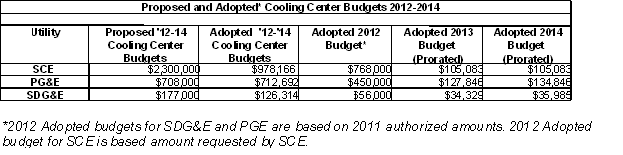
4.4. CARE Categorical Eligibility and Enrollment, Post Enrollment Verification, and Re-certification
The CARE Program provides two ways for a potential enrollee to enroll in the program, (1) Categorical Eligibility and Enrollment process and (2) self-certification process. The Categorical Eligibility and Enrollment process enables low income customers to enroll in the CARE Program through an expedited process such that if the applicant is enrolled in one of the approved low income programs that has already verified the applicant's income, then by providing such proof, they are automatically deemed eligible for and enrolled in CARE. Similarly, the self-certification process allows the CARE applicants to enroll by attesting to their income eligibility. In both instances, income verification occurs after the enrollment; and that verification process is referred to as Post Enrollment Verification.
The IOUs, in their Applications, have identified a concern and presented evidence that the Categorical Eligibility and Enrollment process may lead to CARE subsidies being diverted from legitimate CARE eligible customers and ratepayers to some potential ineligible households, in part, because some of the programs on the Categorical Eligibility and Enrollment Program have different income requirements. Parties also note that the second of the two CARE enrollment process, the self-certification process, likewise may lead to enrollment of potentially ineligible households.
In their Applications, PG&E, SDG&E, and SoCalGas request the Commission reexamine the various programs used in the Categorical Eligibility and Enrollment Program. The Categorical Eligibility and Enrollment Program permits a low income customer to be deemed income qualified and therefore eligible for the CARE Program benefits if they happen to be enrolled in one or more of the pre-approved listed governmental low income programs. It assumes that the other approved low income assistance program has already verified that customer's income and that verified income level is aligned with the CARE income threshold of 200% federal poverty guideline. The IOUs however contend that many of the programs pre-approved for the Categorical Eligibility and Enrollment Program currently have income levels, definitions of income, and other income eligibility criteria that are not in alignment with the CARE income threshold. The IOUs have therefore proposed that the Commission hold a workshop with the goal of adding and removing some of the public service programs from the current Categorically Eligibility and Enrollment Program pre-approved list.
The IOUs, in their Applications, also uniformly propose to begin increased Post Enrollment Verification for the categorically enrolled customers because they have found in their experience, a significant number of self-submitted income information from those customers who have enrolled via the Categorical Eligibility and Enrollment Program show actual incomes at a higher household income levels than currently permitted by the CARE Program.
Currently, the IOUs perform Post Enrollment Verifications at the annual rates ranging from as low as 1.63% for SCE to 10.55% for PG&E.116 Of those reviewed through the IOUs' Post Enrollment Verification processes, a significant percentage (ranging from 38.62% for SCE to 60.94% for PG&E) are de-enrolled for a variety of reasons.117 Certainly, this data does not necessarily show that all those de-enrolled are, in fact, ineligible. However, this data combined with IOUs' historic observations and program experiences that showed that many of these customers' actual incomes have shown to be higher than currently permitted by the CARE Program, causes some concern. We therefore agree with the IOUs that this process needs improvements in order to ensure the continued integrity of the program.
To address this concern, SCE requests an additional $5 million for increased Post Enrollment Verification, an automated verification stratified selection model, internal file sharing with the ESA Program and SCE's Energy Assistance Fund to share program verifications, to create a centralized database for customer communications/program letters, and to enhance the CARE/FERA application and related systems to allow customers the ability to select preferred method for future communications. SCE proposes to increase CARE verifications to 5% of participating customers annually in the 2012-2014 program cycle. Additionally, SCE requests that for CARE customers who fail to respond to an income verification request, those customers be barred from any self-certified re-enrollment in the CARE Program for 24 months. However, if at any time during the 24 months, those customers verify their income eligibility, they are to be placed back on the CARE Program. After the 24 month period, those customers de-enrolled will be able to enroll in CARE by self-certifying their household and income eligibility.
PG&E proposes to modify certain elements of its re-certification and Post Enrollment Verification processes as well as the method by which customers are selected for Post Enrollment Verification. These modifications may increase the number of requests processed, however PG&E did not specifically detail the proposed modifications. PG&E seeks approval to allow its network of Community Outreach Contractors to receive up to $18.00 fee for Post Enrollment Verification assistance. PG&E has also proposed adoption of a standard income verification document for users between 400 and 600 percent of baseline which may require these customers to provide a state or federally verified form of income proof, such as the household's annual tax returns. This proposal is discussed in detail in section 4.5 of this decision.
SoCalGas proposes to require Categorically Enrolled customers to provide income documentation during the Post Enrollment Verification process and to de-enroll customers from the program if their total household income exceeds the CARE Program guidelines. SoCalGas' CARE Program intends to modify the Post Enrollment Verification selection process and will increase the number of income verification requests and is requesting an additional full time employee to support this effort.
SDG&E requests authorization to require categorically enrolled customers to provide income documentation, in addition to providing proof of participation in one of the categorical programs, when and if randomly selected for post-enrollment verifications.
SFCP seems generally supportive of the need to tighten the oversight over the CARE enrollment and funds and presents information that between 2000 and 2009, CARE expenditures in PG&E's service territory jumped by almost 2,222 percent, from $27 million to $481 million.118 SFCP also cites statistics that show that electricity consumption paid for through the CARE Program have almost tripled over the past decade in PG&E's and SCE's service territories.119
Most other parties oppose any tightening of the Categorical Eligibility and Enrollment Program, but prefer to examine that issue in workshops to explore ways to address gaps in the current process. DRA, CforAT, and Greenlining express that they do not agree in limiting Categorical Eligibility and Enrollment Program but are in favor of workshops on the issue. DRA indicates that Categorical Enrollment eliminates administrative costs for both CARE and ESA Programs by reducing efforts needed to income qualify households and DRA is supportive of SCE's efforts for internal file sharing with ESA/EAF to share program verifications.120 TURN's reply testimony also opposes the IOUs' request to limit Categorical Eligibility and argues that the number of CARE customers Categorically Enrolled whose income exceeds the CARE income limits "is insignificant" and that there are administrative savings associated with categorical enrollment.
In their reply testimonies, SoCalGas, SDG&E, and PG&E clarify that they do not seek elimination of Categorical Eligibility and Enrollment program and that they are instead seeking program alignment with Code Section 739.1 4121 and CARE Program administration that ensures that CARE discount rates are received only by those lawfully intended to receive them.
After more than 20 years of outreach and enrollment efforts, the CARE Program has a growing subsidy expected to exceed $3.6 billion dollars in the 2012-2014 cycle. Under the current enrollment and verification approach and projections, CARE participation/penetration rate is reaching (and may exceed) 100% of the CARE eligible population within many of the IOUs' territories.
On one hand, we can attribute these high penetration figures as showing the progress we have made in outreaching to the low income community. Those figures also confirm that CARE Program is much needed in California and that the program is largely successful.
Conversely, those same figures also raise some concerns as pointed out by the IOUs. In fact, those high penetration figures and related increased budgets cause us to mindfully monitor the program activities, as the stewards of ratepayer funds, to look for ways to improve how we deliver the program even better than we are doing now.
Accordingly, over the course of the past several years, we have been monitoring the CARE enrollment processes and the following the increasingly growing CARE subsidy costs and budgets while also seeing these high CARE penetration rates. The reality is that we have not seen those similarly high penetration numbers in the ESA Program, although the ESA Program has an identical income eligibility threshold. We understand that the two programs are different in several respects which likely attributes to some of the differences in those penetration figures.
However, as the CARE Program increases in size and budget, the importance of ensuring that only eligible customers are enrolled also increases. As stewards of the ratepayer funds, we therefore must ensure that CARE funds and programs are effectively managed and administered to ensure the benefits reach only the intended eligible customers.
To that end, the IOUs and the parties have identified some concerns in the CARE Program process and proactively proposed some solutions to address them, in their Applications, by, inter alia, heightened Post Enrollment Verification efforts during the 2012-2014 cycle.
Moreover, the 2009 Process Evaluation Report indicates that ESA Program outreach leads are often generated directly from CARE enrollment lists, but that those leads often do not lead to cost-effective enrollments for the ESA Program. Instead, "[ESA Program] contractors found that some CARE participants were
not eligible for ... [ESA Program] because their income could not be verified or was too high."122 This indicates that any perceived or projected CARE administrative savings (via Categorical Enrollment Process) may even be lower or negated by other costs borne by these programs - including referral costs, costs to pursue unsuccessful leads that result in ineligible enrollments, leads that result in no enrollment at all, and costs associated with discount subsidy had been diverted to these ineligible customers at the expense of the ratepayers.
SoCalGas estimates the costs of a new policy requiring customers to include income documentation during re-certification to be $3.57 million annually. SDG&E estimates costs of a new policy requiring customers to include income documentation during re-certification will be a one-time cost of $120,000 and $420,000 annually. SCE estimates costs of a new policy requiring customers to include income documentation during re-certification will be $4 million annually. PG&E estimates costs of a new policy requiring customers to include income documentation during re-certification will be $4 million annually.
PG&E has estimated the cost of a single Post Enrollment Verification at $5.22, with a Post Enrollment Verification rate of 25% of enrolled CARE customers projecting to cost $2 million annually resulting in $105 million in CARE subsidy savings annually. SCE has estimated the cost of a single Post Enrollment Verification at $10.15, with a Post Enrollment Verification rate of 25% projecting to cost $3.6 million resulting in $35.3 million in CARE subsidy savings annually. SDG&E has estimated the cost of a single Post Enrollment Verification at $6.50, with a Post Enrollment Verification rate of 25% projecting to cost $420,000 annually but has not provided estimated figure of CARE subsidy savings. SoCalGas has estimated the cost of a single Post Enrollment Verification at $6.04, with a Post Enrollment Verification rate of 25% projecting to cost $2.4 million to $3.9 million annually resulting in $30.1 million in annual CARE subsidy savings.
As shown below, the IOUs have uniformly confirmed in their comments that their projections of subsidy savings support and justify administrative costs of additional income verification of CARE customers, up to 25%.
Summary of IOUs' Projections123
SCE |
|||||
PEV Rate |
5% |
10% |
15% |
20% |
25% |
Cost |
$731,563 |
$1,463,126 |
$2,194,688 |
$2,926,251 |
$3,657,814 |
Subsidy Savings |
$7,060,972 |
$14,121,944 |
$21,182,915 |
$28,243,887 |
$35,304,859 |
Savings Factor |
$9.65 |
$9.65 |
$9.65 |
$9.65 |
$9.65 |
PG&E |
|||||
PEV Rate |
5% |
10% |
15% |
20% |
25% |
Cost |
$400,000 |
$800,000 |
$1,200,000 |
$1,600,000 |
$2,000,000 |
Subsidy Savings |
$21,000,000 |
$42,000,000 |
$63,000,000 |
$84,000,000 |
$105,000,000 |
Savings Factor |
$52.50 |
$52.50 |
$52.50 |
$52.50 |
$52.50 |
SoCalGas |
|||||
PEV Rate |
5% |
10% |
15% |
20% |
25% |
Cost |
$785,070 |
$1,570,140 |
$2,355,210 |
$3,140,280 |
$3,925,350 |
Subsidy Savings |
$6,023,160 |
$12,046,320 |
$18,069,480 |
$24,092,640 |
$30,115,800 |
Savings Factor |
$7.67 |
$7.67 |
$7.67 |
$7.67 |
$7.67 |
SDG&E124 |
|||||
PEV Rate |
5% |
10% |
15% |
20% |
25% |
Cost |
$96,737 |
$177,530 |
$244,463 |
$344,450 |
$419,910 |
Subsidy Savings |
|
|
|
|
|
Savings Factor |
|
|
|
|
|
DRA, TURN and other parties appropriately point out that Categorical Eligibility program process results in CARE administrative savings. That is a valid point and should be factored in in crafting a solution to the concern here. However, as noted above in the IOUs' projections, the estimated subsidy savings to the CARE Program associated with the tightening of the Post Enrollment Verification process are astoundingly high and may justify the necessary expenditures.
Based on the record, we find that we should retain our Categorical Eligibility and Enrollment Program, with some modifications, to continue to allow ease of access for enrolling into the CARE Program. Based on the IOUs' projected administrative costs and the subsidy savings reflected in their comments during the proceeding, we also find that requiring increased Post Enrollment Verifications of CARE customers as well as several other program changes detailed here are justified, reasonable and necessary starting point to begin ensuring that only the eligible customers stay enrolled in the program.
We also find these additional program controls are needed and we discuss them further in the subsequent sections of this decision. In general, the IOUs are directed to: (1) within 60 days, devise and institute targeted and heightened interim income verification model, framework and rates; (2) track, monitor and report on the IOUs Post Enrollment Verification activities; (3) by September 1, 2013 and based on all of the IOUs' Post Enrollment Verification activities and experiences, devise and propose a long term verification model, framework and rates for Commission's approval; (4) submit updated categorically eligible programs lists annually to ensure the programs that remain in the Categorical Enrollment and Eligibility have income verification processes and thresholds consistent with the CARE Program; and (5) take all reasonably necessary actions to ensure the program integrity.
These additional program controls should address the overall concern identified by IOUs to adapt the program rules to ensure that the enrollees of the CARE Program are, in fact, eligible to enroll and receive the CARE Program subsidy by tightening the Post Enrollment Verification process while also factoring in the need to achieve maximum administrative savings, wherever feasible. Therefore, we conclude that there is no need for a workshop on the Categorical Eligibility and Enrollment Program.
Categorical Eligibility and Enrollment: All previously approved categorical enrollment programs are to be retained, for now. However, by January 31st of each year, the IOUs are directed to jointly review and submit, by Tier 2 Advice Letter, an updated list of categorical eligible low income programs for the upcoming year. The list must propose to retain and add categorically eligible programs for enrollment in low income programs, as appropriate, and must include only programs with income thresholds consistent with the CARE and ESA Programs.
These approved lists will be updated annually and be used to implement the Categorical Eligibility and Enrollment Program for CARE and ESA Programs, for the upcoming fiscal year. As appropriate, the IOUs may also propose to eliminate programs, which do not employ income thresholds consistent with the CARE and ESA Programs. The IOUs' updated proposed list must be filed through a Tier 2 Advice Letter process, and the Energy Division will issue an annual approval letter (with the approved updated list of programs in the Categorical Enrollment Program) along with the updated annual CARE income guidelines letter on April 1st each year.
The Categorical Eligibility and Enrollment Program is to be retained for the enrollment of new CARE customer enrollments only.
CARE Re-certification: All CARE re-certifications will require income documentation for renewal. No customers shall be allowed to self-recertify without providing income documentation. As an exception to this rule, in lieu of income documentation, CARE customers who have been income verified by a qualifying categorical eligible low income program may recertify by submitting proof of enrollment in an approved categorical eligibility program.
Interim and Long Term Post Enrollment Verification Approach: A reasonable alternative to a 100% Post Enrollment Verification rate in the CARE Program is stratified probability sampling and modeling. Generally, such method of sampling involves the division of a population into smaller groups known as strata. The strata are formed based on members' shared attributes or characteristics. Then a random sample from each stratum is taken in a number proportional to the stratum's size when compared to the population. These subsets of the strata are then pooled to form a random sample.
Through such stratified probability sampling and modeling, we may be able to cost-effectively target the probably ineligible CARE enrollees and yield similar results as a 100% verification rate, that is, to identify those that are ineligible, and ensure that only eligible customers are enrolled in the CARE Program. At the same time, such modeling can deliver more administrative savings by requiring administrative expenditures that are far less than the 100% verification approach.
The record in this proceeding demonstrates that some of the IOUs are already actively employing various tailored and verification probability modeling tools in their service territories. An analysis of these probability models demonstrates that these have proven to be reasonable and cost-effective alternatives to 100% Post Enrollment Verification, by targeting Post Enrollment Verification efforts only to those customers most likely to be ineligible for the CARE Program.
Accordingly, the IOUs are directed to begin an immediate development of an interim targeted Post Enrollment Verification probability model by incorporating following basic factors in their modeling as well as any other territory specific factors:
· High energy use (including customers with usage above 400% baseline in any monthly billing cycle and above)
· Annual bill amounts
· Household size
· PRIZM or ZIP code
· Enrollment method
· Previously indicated customer ineligibility
· Customers previously de-enrolled from the CARE Program
Within 60 days of this decision, the IOUs are each directed to, based on its past post enrollment verification records and experiences, develop and implement an interim Post Enrollment Verification model, at a reasonable rate that each IOU deems reasonably necessary to: (1) ensure meaningful size in sampling to yield the necessary results to aid in the development of effective long term probability models for the Utilities; (2) ensure the integrity of the CARE Program; (3) provide assurance that CARE discount rates are received only by those lawfully intended to receive them; (4) remove any fraud and abuse; and (5) properly factor in the potential program disruptions as well as administrative costs. This interim verification rate, for each of the IOUs, shall apply to all enrolled CARE customers, including self-certified and categorically enrolled CARE customers. This interim verification rate shall not exceed 200% of the IOU's 2011 post enrollment verification rate. If an IOU finds that it requires that its interim verification rate must exceed 200% of the IOU's 2011 post enrollment verification rate to meet the criteria set forth above, the IOU may submit a Tier 2 Advice Letter seeking approval of such rate and demonstrating its justifications.
The IOUs are directed to closely track, monitor and review the data from the implementation of the interim probability model and incorporate lessons learned into the designing the long terms probability models for review by the Energy Division.
By September 1, 2013, the IOUs are directed to design and propose, via a Tier 2 Advice Letter process, a long term probability model framework, including an optimal Post Enrollment Verification rate tailored to each IOU, to cost-effectively identify CARE enrollees who have the probability of being ineligible in the program, while tailoring the model to the IOUs' specific territory that take into account the basic probability factors, populations and administration costs.
In their long term probability model proposals, the IOUs must set forth justifications based on the lessons learned during the interim probability model implementation. Energy Division will determine whether the design presents the best modeling and Post Enrollment Verification rate for each of the IOUs to ensure that CARE enrollments are comprised of only the eligible households.
The IOUs are also directed to explore and employ all reasonable methods of easing the documentation presentation by the enrollees during the Post Enrollment Verification, such as being able to submit documentation via email, facsimile transmission, etc.
Tracking and Reporting: The IOUs are directed to report in their annual reports, the Post Enrollment Verification results, including a summary of what reasons account for each de-enrollment during the Post Enrollment Verification process and whether the probability model is yielding optimal results by de-enrolling ineligible customers from the CARE Program and ensuring that CARE Program discounts are not diverted to ineligible population.
In addition to tracking the number and reason for each CARE customer de-enrolled during the Post Enrollment Verification process (either through customer non-response or deemed ineligible for the program), the IOUs are directed to begin tracking information concerning those de-enrolled and ineligible customers and how they were initially enrolled in the CARE Program (e.g. capitation agency, self-certification, categorical enrollment, etc.).
Cooperation with Income Verification Process: We approve SCE's request for CARE customers who fail to respond to an income verification request be barred from self-certified re-enrollment in the CARE Program for 24 months. However, if at any time during the 24 months a de-enrolled customer verifies eligibility, they will be placed back on the CARE rate. After 24 months, those de-enrolled customers may be able to enroll in CARE by again self-certifying their household and income eligibility. To ensure consistency statewide, the other IOUs are directed to implement identical CARE Program rules.
CARE Capitation Fee: We support the movement towards ensuring that CARE enrollments are reserved to only those that meet the income qualification guidelines. We approve PG&E's request to allow CARE capitation contractors to aid in the Post Enrollment Verification process for an "up to $18.00" per capita fee, and direct all other IOUs to institute similar outreach programs. The IOUs are also directed to develop and field a uniform audit protocol for CARE Post Enrollment Verification capitation contractors.
Information Technology Program Upgrade: SCE's requests for $2.9 million in information technology program upgrades and $2.1 million for increased verification processing, for a total of $5 million. These requests are reasonable and are therefore approved. SCE as well as other IOUs may need to seek authorization to augment their budgets to reflect the increased Post Enrollment Verification direction ordered in this decision.
In its Application, PG&E requests specific CARE Program rule changes to address high electric users enrolled in the CARE Program, using 400% or above the baseline usage, and potentially receiving CARE discount rates unlawfully. PG&E proposes to: (1) require customers with energy usage above 600% of baseline be de-enrolled from the CARE subsidy program if they cannot drop their usage within 180 days; and (2) customers with usage levels between 400% and 600% must undergo Post Enrollment Verification and participate in the ESA Program or be de-enrolled from the CARE Program. PG&E has also proposed the adoption of a standard income verification document for users between 400% and 600% of baseline which may require these customers to provide a state or federally verified form of income proof, such as the household's annual tax returns. PG&E estimates that these new methods will have a one-time cost of $73,000 in the 2012 CARE Program and requests authorization for said budget.
PG&E found that the top 1.2% of its electric users account for 12% of overall electric usage and its record shows that $84.5 million in CARE subsidies support these small number of users. For SCE and SDG&E, 0.7-0.92% of their CARE electric residential customers had annual usage during 2010 between 400% and 600% of baseline, and 0.1-0.2% of their CARE electrical customers had usage over 600% of baseline.
In their testimonies, Greenlining, CforAT, and TURN have offered modifications to PG&E's potential CARE Program rule changes including the requirement that customers with usage above 600% undergo Post Enrollment Verification within 45 days of receiving notice and agreement to participate in the ESA Program within 45 days of notice (the same rules would apply for customers with usage of 400% to 600%). Some have asked PG&E to provide such customers with in-depth notices in multiple languages and formats and an ability to appeal their CARE participation de-enrollment. NRDC supports these proposed modifications to PG&E's proposal.
SCE has stated that any high usage program rules changes be made applicable statewide.
SoCalGas requests exclusion from any adoption of PG&E's CARE high usage proposals since as a gas-only utility, SoCalGas does not have similar issues.
During the 2009-2011 program cycle and in this proceeding, the parties, members of the public, print media and even the legislature have brought forth this issue as a significant concern. A workshop was held in this proceeding in October 2011 wherein this issue was further examined. Parties provided anecdotal evidence that a small number of customers may be using the CARE rates to subsidize unlawful activities such as marijuana growing operations and the legislature and media have similarly reported these concerns.
Naturally, CARE funds should be set aside solely for eligible customers and for lawful purposes only. We have been working toward tightening the CARE Program and its administration and in doing so any misuse, abuse or potentially fraudulent allocation of CARE funds is carefully monitored and reconciled.
Based on the foregoing, we find that PG&E's proposed CARE Program changes to address the high electric users with over 400% baseline usage on the CARE rate are reasonable and timely. We approve it, with modifications, and also require implementation statewide for all electric IOUs. The statewide program changes should include:
600% or more above baseline users: CARE electric customers with electric usage above 600% of baseline in any monthly billing cycle will have 90 days to drop usage below 600% baseline in any monthly billing cycle or be de-enrolled and barred from the program for 24 months. In addition, to continue to stay in the program these customers must undergo Post Enrollment Verification and apply for the ESA Program within 45 days of notice, and, if not previously enrolled in the program, apply for the ESA Program within 45 days of notice. To the extent possible, all notifications must be accessible to customers with disabilities and to customers without English language proficiency, and must include information on the Medical Baseline program and the IOUs' appeal process.
Within 30 days of this decision, the IOUs must develop an expedited appeal process for those customers who may believe that they have been wrongfully de-enrolled to allow them the process to submit an appeal of the de-enrollment documenting their concerns and demonstrating their usage as "necessary, basic and legitimate household energy usage." If the IOUs' appeal process does not effective resolve the customer's appeal, the customer may seek the Commission's Energy Division assistance by contacting the Energy Division's Director and Energy Division Director will make the determination on whether there is reasonable justification demonstrating "necessary, basic and legitimate household energy usage."
Once that determination is made, such customer may be re-enrolled upon the customer's agreement to participate in Post Enrollment Verification and energy efficiency/savings efforts by participating in the ESA Program. Some examples of justified legitimate "necessary, basic and legitimate household energy usage" includes multiple income qualified households residing in a single residence and customers with documented and necessary medical equipment which require and justify the high usage.
400% - 600% baseline users: CARE electric customers with electric usage at 400%-600% of baseline in any monthly billing cycle must undergo Post Enrollment Verification and, if not previously enrolled in the program, apply for the ESA Program within 45 days of notice. To the extent possible, all notifications must be accessible to customers with disabilities and to customers without English language proficiency, and must include information on the Medical Baseline program and the IOUs' appeal process. All CARE customers with usage above 400% of baseline in any monthly billing cycle who do not complete Post Enrollment Verification requests or have incomes found to be higher than allowed in the program, will be de-enrolled from the program and barred from re-enrolling in the CARE Program for 24 months.
Medical Baseline Program Referral: The ESA Program contractors who visit these high usage households are to be trained to make referrals to the Medical Baseline program.
ESA Program Cooperation: If a high usage CARE electric customer required to participate in the ESA Program as a condition of their continued enrollment in CARE, fails to keep at least one of the two appointments made with an ESA Program contractor or fails to provide access to any portion of the metered property in question, or refuses to allow a post-participation quality control inspection, that customer will be de-enrolled from the CARE Program and barred from re-enrolling in the CARE Program for 24 months.
Post Enrollment Verification: The electric IOUs should develop and field a standard income verification document for these instances which may require customers to provide a state or federally verified form of income proof, such as the household's annual tax returns.
In its Application, PG&E requests an increase of the capitation fee from up to $15.00 to up to $18.00 for each new enrollment for program year 2012-2014.125 The main justification for PG&E's request for a capitation fee increase is that because PG&E has exceeded the 90 percent CARE penetration rate, PG&E anticipates some added barriers in reaching the last of the remaining eligible customers. In addition, PG&E also notes the costs of fuel have risen considerably in recent years, making the Community Outreach Contractor outreach program more expensive to conduct. We approve PG&E's request, as modified and discussed below.
4.6.2. Joint Parties' Request for Increase in Capitation Fee and More
The Joint Parties, in their testimony, propose a significantly broader proposal relating to the capitation fee which includes (1) increasing the capitation fee to $20 for each enrollment or more, and (2) providing capacity building grants to community based organizations so they can provide hourly wages of $20 per hour plus administrative costs for their outreach staff. In their part, they echo the similar increased costs (mileage reimbursement, insurance, etc.)126 as noted by PG&E to support their proposed capitation fee increase and grant concept. In their subsequent comments, the Joint Parties increased that proposed capitation fee increase figure from $20 to $25 in some instances, when community based organizations enroll customers through a door to door campaign events.127
D.01-06-010 and D.02-01-040 authorized a capitation fee of up to $12.00 for each new CARE enrollment to compensate the community based organizations for the incremental increased costs incurred by the community based organizations that are directly associated with the signing up process, for which that the community based organizations do not get a separate compensation by their other primary funding sources. That cap was increased in D. 06-12-038 and has remained at the current "up to $15.00" per enrollment level since 2006. Confirming the intent and purpose of the capitation fee, CforAT correctly notes in their comments that "enrolling low income clients in CARE is not a task that requires dedicated staff" but one of many efforts being offered in the overall process by these organizations to provide assistance to the clients.128 Thus, while CforAT was not opposed to and in fact welcomed any potential additional funding via an increased capitation fee, CforAT did not specifically seek a capitation fee increase nor provided added justification for the Joint Parties' proposals.
As to the Joint Parties' proposals (to increase capitation fee from $20 to $25 or a "large" additional capacity building grant for the community based organizations to pay "$20 per hours plus administrative costs" to the staff), we are not persuaded. There are aspects to their proposals we find inaccurate, misleading, vague, ambiguous and therefore unreliable.
For instance, in support for their proposals, the Joint Parties minimize the fiscal ramifications by misstating that "the CARE capitation fee ranges from $15-$18, depending on the IOU." Pursuant to D.06-12-038, the IOUs are currently only authorized to pay "up to $15" per new enrollment, not $15-$18. The Joint Parties also incorrectly contend that their proposed CARE capitation fee is only approximately 10% more than what PG&E presently pays. The Joint Parties proposal to increase the capitation fee to $20 and $25 respectively are significant and are in fact 33% and 66% higher than the current capitation fee cap of $15. These may simply be calculation errors made by the Joint Parties, but it undermines the reliability of the proposals. Likewise, the Joint Parties' grant proposals are not well defined nor are the costs adequately presented, analyzed or justified as necessary within the current CARE Program. Based thereon, the Joint Parties' proposals are denied.
As for PG&E's request to increase the capitation fee from "up to $15.00" to "up to $18.00" for each new CARE enrollment for program year 2012-2014, we find the request reasonable and justified. We are persuaded by PG&E that there are additional expenses and barriers associated with reaching and enrolling the remaining eligible customers and that reasonably justifies the reasonable capitation fee increase from "up to $15" to "up to $18" per enrollment, consistent with the prior rate of increases the Commission previously adopted.
In addition, in this decision we have challenged the IOUs as some of them have proposed in their Applications to carefully monitor and strategically intensify their outreach and enrollment efforts to increase the enrollments and to begin to strategize on how to reach the remaining hardest to reach of the low income communities in anticipation of the challenges we expect in the last two program cycles (2015-2017 and 2018-2020) before 2020. To allow for additional and potential strategic capitation fee needs associated with the new aggressive directions we provide in this decision, we authorize an additional cushion increase of $2 in capitation fee to total of "up to $20" to allow to be used for the enrollment of the hardest to reach customers in this program cycle, as the IOUs find necessary and consistent with the directions we provide in this decision.
While not all of the IOUs sought increase in capitation fee cap, we recognize that the inflationary factors and barriers associated with being at near-full penetration rates are issues that may prove imminent for the other IOUs. Likewise, the additional and potential strategic capitation fee needs associated with the directions we provide in this decision affect all of the IOUs. In view thereof, we will approve an increase in capitation fees to "up to $20 per enrollment" to be applied to all IOUs.
5. Pilots, Studies, and other Miscellaneous Proposals
The Commission has always encouraged creativity and innovation in the design and delivery of the ESA and CARE Programs. During the 2009-2011 cycle, however, we experienced numerous delays and budget overruns relating to the approved pilots and studies. We also found that, even during and after the pilots or studies were completed, they may not have been carefully monitored and overseen. Furthermore, we have noticed that the resulting findings had not been timely and/or effectively compiled, reported or otherwise communicated across all of the IOUs and stakeholders to truly yield optimal benefits of such efforts in informing the Commission and the stakeholders for all future changes concerning the ESA and CARE Programs.
Based on these experiences and as we approve these historic ratepayer funded budgets in this decision, we cannot help but be cautious enough in our review and consideration of the parties' multitude of proposals. Therefore, we have carefully examined each proposal to ensure that we authorize only those pilots, studies and other proposals that are well thought out, justified and presented with sufficient detailed and meaningful framework for a pilot proposal, and specifically designed to further and meet the goals of the ESA and CARE Programs.
Again, as we have done in prior decisions, we remind and direct the IOUs to meet, collaborate and/or coordinate actively with Energy Division staff, the other IOUs, and other stakeholders to review the results of any pilot, study or other proposal we approve in this decision. With this proviso, we approve and authorize the following proposals and deny others. Even if not specifically denied, any proposal not expressly approved or authorized is deemed denied.
The following are the budgets we approve for pilots, studies and other proposals we approve for 2012-2014:
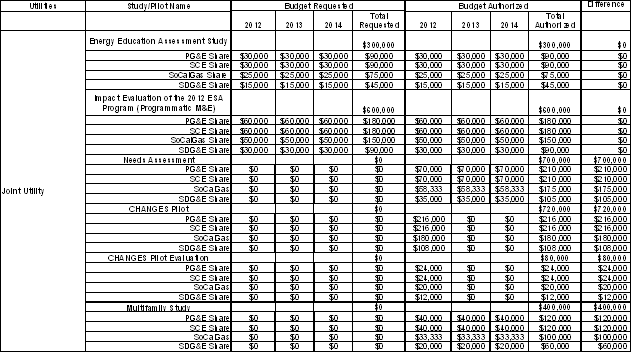
The projected pilot budget for 2012-2014 is approximately $800,000, which includes the Community Help and Awareness with Natural Gas and Electricity Services (CHANGES) Pilot and related evaluation. The combined projected studies budget for 2012-2014 is $2,000,000.
During the 2012-2014 funding cycle, we are particularly intent on heightening the scrutiny of all pilots, studies and proposals we approve, authorize and evaluate. We also raise the accountability for both the timing and deliverables resulting from the authorized pilots, studies and proposals so that the ESA and CARE Programs receive benefits from these initiatives without undue delay.
Below, we review the positions of the parties, approve or disapprove individual and/or joint pilot programs, studies, and other miscellaneous proposals, and provide general guidance for the implementation, reporting, and assessment of these activities.
On November 19, 2010, the Commission issued Resolution CSID-004 and approved a one-year in-language pilot program referred to as CHANGES and authorized its funding through the CARE Program budget. The CHANGES pilot program launched in February of 2011 and began providing energy-related (electric and natural gas) education, resolution of needs and disputes, and outreach services for limited English proficient consumers in their preferred languages through an existing statewide network of community based organizations.
On November 10, 2011, the Commission issued Resolution CSID-005 and authorized continued CARE Program funding for the CHANGES pilot program and extended the duration of the CHANGES pilot program to allow time for additional data collection and pilot evaluation, as well as time to review and address the appropriateness of continued authorization of CARE Program funding, if any, to this pilot through this current proceeding. In Resolution CSID-005, we directed the Consumer Service and Information Division (CSID) and the Energy Division, along with an independent consultant, to review 12 months of data collected concerning this pilot program to determine its ability to effectively assist limited English proficient consumers and evaluate the benefits of this pilot's use of CARE funds. A final report based on that evaluation was ordered to be submitted to the ALJ in this proceeding, by July 15, 2012, for the Commission's review, consideration and decision in the fall of 2012. Under CSID-005, the funding for this pilot is set at a level not to exceed $60,000 per month, from CARE funds, not to exceed $720,000 collectively for 2012.
On March 9, 2012, both Directors of the Energy Division and CSID submitted, and electronically served, a joint request letter pursuant to the Commission's Rules of Practice and Procedure, Rule 16.6, to the Executive Director, Paul Clanon, of the Commission, and the service list of R.10-02-005 and this proceeding, requesting an extension of time for the due date of the final evaluation report ordered in CSID-005 from July 15, 2012 to September 1, 2012. The basis for the joint request letter was that the CSID and Energy Division had encountered unforeseen circumstances during the contracting process and the requested additional time was needed to complete the needed evaluation and submit the final evaluation report. On March 12, 2012, the Executive Director, Paul Clanon, granted the requested extension of time for the due date of the final evaluation report ordered in CSID-005 from July 15, 2012 to September 1, 2012.
We intend to revisit the issue of continued CARE funding of CHANGES pilot program in a subsequent decision in the second phase of this proceeding, expected in the fall 2012 after the independent consultant's final evaluation report is submitted and reviewed. The evaluation of the CHANGES pilot program will be completed consistent with the current Energy Division's pilot evaluation procedures and cannot exceed a total of $80,000 collectively from the IOUs' CARE Program Measurement and Evaluation (M&E) budget at an amount not to exceed 10% of the total pilot budget.
5.2.2. CARE Customer Choice Pilot Proposal (Choice Pilot) and Split Incentive Study Proposal (Split Incentive Study)
SFCP, in its opening testimony proposed a pilot program and a study: the Customer Choice Pilot and Split Incentive Study. The Customer Choice Pilot proposal seeks Commission's authorization for $3 million to allow 900 CARE customers a choice to redirect a portion of their CARE subsidy to purchase energy efficient appliances, in lieu of their CARE discount. The Split Incentive Study proposal seeks Commission's authorization for $200,000 to study third-party ownership of energy efficient appliances to review the split-incentive barriers in multi-tenant settings.
Many parties commented on these proposals. SCE, SoCalGas, SDG&E, TURN, and DRA all have raised concerns and have opposed these proposals.129 We too share those concerns. Notably, the Customer Choice Pilot proposal failed to include a comprehensive pilot implementation or evaluation plan, and, as proposed, it lacks serious goals and outcomes. There are no proposed measures for the pilot's success, and overall, the proposal is ill-defined and redundant of some of the current ESA Program offerings and efforts. Similarly, the Split Incentive Study proposal also lacks defined study goals. In their responses to the December 2011 Ruling, SFCP modified some elements of the original proposals, e.g. to include a survey regarding measures. However, these modifications further confused the scope and size of the study being proposed.
Overall, SFCP's proposals are incomplete, ill-defined and redundant of current ESA Program efforts. Therefore, we do not approve SFCP's proposed Customer Choice Pilot, and we do not approve SFCP's proposed Split Incentive Study.
Opower, Inc. submitted a proposal for a pilot program which involves a two-year deployment of home energy reports to 200,000 ESA Program customers at a cost of $10-$15 per customer for at an estimated 1.5-3.5% in per customer energy savings.130 The total proposed pilot cost and budget requested would be $500,000 - $750,000. NRDC supports this pilot.131 Several other parties, including TELACU et al., SCE, SoCalGas, SDG&E, and TURN have raised various objections and concerns about this pilot proposal.132
At a first glance, with the cost of $10-$15 per participant and with estimation of per customer energy savings levels of 1.5-3.5%, Opower, Inc.'s pilot proposal seems cost effective, and promising. In fact, Opower, Inc. has current Home Energy Report pilots in both PG&E and SDG&E territories (for their mainstream customers) and the results of those pilots are waiting to be evaluated. Thus, rather than to authorize, fund and initiate yet another pilot program and potentially duplicate ongoing piloting efforts, it makes better sense to revisit this proposal and/or issues raised by this proposal when those evaluation results are in.
Furthermore, Opower, Inc. is only one of several companies that can provide home energy reporting, and we must be mindful that any ratepayer funded pilot project should be competitively bid to ensure the best cost, innovative design, fairness and transparency.
Based on the foregoing, we do not approve the Opower, Inc.'s proposal. Once the findings of the current mainstream Opower, Inc.'s pilot programs are concluded and formally evaluated, the Commission may revisit this proposal and then direct the IOUs to permit a competitively bid behavior-based energy efficiency pilot for the ESA Program.
The 2009 Process Evaluation Report recommended that the IOUs work with contractors to determine cost-effective ways to use tablet PCs that enable quick in-home data entry, electronic signatures, and scanning or uploading of digital photos of customer documents to an online ESA Program database. The recommendation concluded the use of the same kind of tablet PCs across the IOUs would enable them to make the enrollment and assessment process smoother for contractors working in multiple territories. The recommendation suggested the IOUs may also want to re-examine the current practice of requiring contractors to both electronically enter data and provide paper copies of enrollment and assessment forms. The recommendation also noted that a review of forms could also reduce some of the redundancy of customer and contractor data requested on multiple application forms.
PG&E explains that its program database supports the laptop or tablet interfaces and PG&E presently does not dictate but instead allows contractors to determine what equipment to use as long as data is entered daily. PG&E updates data collection forms annually as needed, and also reviews the priority, expense and feasibility of database enhancements regularly. Many types of data regarding the home are already collected for its program data files, including photos and other supporting documentation.
SCE plans to expand its current tablet PC technology to all contractors. SCE opines that this will streamline the enrollment processes for the customer as it will minimize duplicative and unsuccessful visits. Through the tablet PC technology, SCE presents that its customer service experience has been improved in two ways: the customer benefits from a more efficient enrollment process and the customer is ensured that the information gathered is complete and correct.
SCE however notes that the cost for the tools needed by ESA Program service providers is an appropriate contractor expense, and that all costs associated with delivering services including such costs as labor, fuel, vehicles and in this case, tablet PCs, are embedded in the reimbursement rates the IOUs negotiate with contractors. SCE goes on to state that, as is the case with other tools needed to deliver program services, the responsibility to provide tools to service provider employees to perform their jobs should remain with the service providers. Additionally, SCE suggests that the technology should yield significant savings to both SCE and contractors which in turn should result in no increased fees.
To improve and facilitate customer enrollment, SoCalGas proposes to continue to increase automation of customer data by increasing the use of tablet PCs by its Outreach Specialists. According to SoCalGas, automation will reduce paperwork and increase the availability of near real time customer information (such as PRIZM codes and past participation data) during appointment setting and canvassing activities. Likewise, the use of tablet PCs will also enable quick in-home data entry, electronic signatures, and scanning or uploading of required customer documents to the online HEAT database. SoCalGas also agrees that use of the tablet PCs will increase the productivity of its Outreach Specialists, by increasing efficiencies and reducing enrollment time.
NRDC generally supports the IOUs' efforts to streamline program delivery and encourage all of the IOUs to transition to paperless customer enrollment. NRDC specifically supports SCE's proposal to expand the use of tablet PCs to all contractors and to the inspection process moving forward. EEC likewise recommends that the Commission should require the use of paperless enrollments wherever feasible and the Commission should authorize the purchase of related hardware and source those expenses from program funds.
In response to the December 2011 Ruling, the IOUs provided some very preliminary and rough costs and cost savings estimates relating to the PC tablet proposal.
SCE explains that the costs to purchase computer-related hardware will vary depending on the type of equipment purchased. The equipment package utilized by SCE for testing and training, which includes the tablet, portable thermal printer, and mobile scanner cost approximately $1,100. The cost to maintain the hardware is similar to the cost of maintaining a regular PC/laptop. There is no cost, except minimal labor cost (time to download software is less than 15 minutes) to enable the paperless tool. SCE estimates a resultant savings in the 2012-2014 program of approximately $200,000 recognizing the additional monetary savings may be observed in other areas.
PG&E estimates (using information provided from SCE) the costs to purchase and maintain, including administration costs, of enabling paperless via PC tablets/notebook computers for the three years is $4.9 million or $1.63 million per year. PG&E estimates that there could be a cost savings of as much as $122,000 per year in reduced printing and administrative costs. As the tablets are incorporated into each contractor's business, PG&E would hope and expect to see cost savings at the measure level as contractors are able to reduce overhead costs associated with data entry. PG&E would also hope to see immediate customer enrollment cost savings due to the planned reduction of printing costs. At the measure level, PG&E would hope to see cost savings in the 2013 program year which would allow for time to roll out the tablets and verify performance in 2012.
SDG&E provides an estimate of $340,000. It is unclear what that estimate includes exactly and whether that is a per year or per cycle cost estimate; however, SDG&E explains that it is still in the evaluation phase of potentially going completely paperless and is not poised to provide credible cost estimates without further research. SDG&E provides an estimated cost savings of $48,000 annually or approximately $144,000 over the 2012-2014 program cycles. This estimate only includes a reduction in printing costs. The estimate does not include potential savings to contractors and IOU program staff may realize since it is not known how the use of the equipment will impact contractors' internal processes. Savings that would be realized will occur in two areas: elimination of the costs of forms and the data entry not required by contractor personnel. These costs savings would be reflected in the General Administration category of the ESA Program budget.
In August 2011, SoCalGas implemented the use of tablet PCs as part of its Go Green initiative and has proposed, in its Application, to increase the use of tablet PCs during the 2012-2014 cycle to support data collection, reduce customer visits, and minimize hard copy documentation collection. SoCalGas' estimated fixed costs to purchase tablet PCs including any related equipment is approximately a one-time cost of $3,120 per tablet with recurring costs related to maintaining the tablet PCs and equipment, including, but not limited to, HEAT system upgrades, paper, and wireless charges at an average of $1,753 per tablet PC per year. The estimated recurring costs do not include additional charges related to the increase storage costs for storing electronic records related to tablet PC efforts.
SoCalGas' estimated savings for fully implementing the use of Tablet PCs for SoCalGas' current Go Green initiative are not estimated to occur until 2015 based on preliminary estimates of the costs of purchasing the tablets and associated equipment. These savings estimates are based on the number of enrollments projected in SoCalGas' 2012-2014 Application filing and its current model for implementing its Go Green initiative. SoCalGas will work on exploring other methods of executing the Go Green initiative in an effort to achieve savings at a faster rate than projected under its current delivery model. However, currently estimated avoided costs savings are $226,000 in 2015 and $1.24 million annually after 2015. SoCalGas expects to see savings in the General Administration (because there would be avoided costs related to not having to increase the workforce to address the large volume of paperwork associated with increased enrollment goals) and Outreach and Assessment (because there would be a potential reduction in full document enrollments).
Aside from the obvious reduction in paper usage, SoCalGas explains some other benefits from the use of the tablet PCs include: (1) the value to Outreach Specialist of having access to real time data on a potential customer during canvassing activities; (2) the benefit of having the tablet onsite to obtain copies of documents for the customer file which will reduce overall enrollment time and reduce data entry errors; and (3) overall efficiency and improved accuracy in one time enrollment entry to minimize time spent and errors made in re-processing invoices for payments for both contractors and SoCalGas.
EEC estimates a full equipment setup, including a notebook computer, scanner, printer and WiFi network card would cost around $1250 per unit. EEC estimates implementation will bring with printing, shipping, storing, and administration cost savings by reducing documents associated with the programs. Based on 2010 estimated costs, and using PG&E as an example, EEC estimates that contractors may save the program $1,454,400 (with PG&E's savings an additional $182,029 and $195,614 in general administration costs), which would translate into approximately $13.74 saved per home.
Each party has provided vastly different estimates for the cost of such PC tablets (and their ongoing maintenance) as well as the estimated potentials for savings to be achieved from their implementation. The range for the purchase and maintenance of such equipment starts from $1,100 up to an amount four times greater. And while all parties generally acknowledge that there are savings and efficiencies to be gained, there is also a significant spread in the savings estimates to the overall program from $48,000 in program and administration cost savings for SDG&E to the $1.8 million for PG&E in total program savings as estimated by EEC. The estimates also vary vastly from one utility to the next. Thus, at this time, it is difficult to truly evaluate the net benefit to the efficiency of the program delivery that can be gained from approving this proposal based on such preliminary and inconsistent set of information. Moreover, the savings estimates provided have only been accounted for on the IOU program side, without more definitive estimates of program and measure savings from the contractors end.
It is reasonable to infer that the implementation of such equipment would not only result in IOU program administration and outreach savings but also savings at the measure level as contractors are able to reduce overhead cost associated with data entry. However, these estimates were not provided. Additionally, the time savings on the customer side have not been documented nor accounted for.
Based thereon, while we can surmise that technology will yield some savings, we must conclude at this time that the proposal is overly vague and the cost and savings estimates provided are not reliable enough for the Commission to fully assess how such a proposal would impact the program budgets and what amount if, any, the Commission should authorize for such proposal. At best the record is incomplete on to conduct any basic cost-benefit evaluation. Without more detailed and accurate data, we cannot fully understand, justify and therefore approve the wholesale purchase of the PC tablets for contractors and approve that such a large expenditure should be borne by the ratepayers and the ESA Program.
Most compelling of the argument is SCE's argument. We agree with SCE that the cost for the tools needed by service providers to provide ESA Program services is an appropriate contractor expense. All costs associated with delivering services, including labor, fuel, vehicles and in this case, tablet PCs, are embedded in the reimbursement rates to contractors and should continue to be a contractor expense. As is the case with other tools needed to deliver program services, the responsibility to provide tools to service provider employees to perform their jobs should remain with the service provider.
While the cost of the tablets may or may not currently be embedded in the costs associated with delivering services today, the costs of these tools should be treated similar to all other contractor expenses, embedded in the reimbursement rates to service providers. The Commission believes that this should be viewed as a contractor expense. Additionally, we disagree with TELAC et al. that the benefits of the PC tablets and efforts toward going paperless are purely borne by the IOUs and not the ESA contractors. As SCE has pointed out, and the Commission agrees, these tablets provide significant benefits to contractors, including decrease in costs by eliminating the need to enter data currently collected by the assessor on paper onto the Utilities' databases, decrease in time and cost to prepare, store, and invoice with fewer errors than paper enrollment, and decrease in post-enrollment work preparation and carbon footprint due to unnecessary travel.
Based thereon, for now, the funding for PC tablets should remain as it is and be assumed as part of the contractors' expenses. We support the movement towards going paperless, and we believe the IOUs and contractors can do that without the approval of this PC tablet proposal to be funded by the ESA Program. The PC tablet proposal is denied.133
5.2.5. SCE's Energy Education/Energy Education Evaluation Study and SoCalGas' Leave-behind Energy Education DVD
Both the 2009 Process Evaluation and 2009 Impact Evaluation found deficiencies in the consistency and quality of energy education being delivered in the ESA Program by each of the IOUs.134 In their Applications, the IOUs request $300,000 to implement an Education Assessment and Needs Analysis Study to identify ways to optimize and/or improve the educational component of the ESA Program and examine the current and potential value of this energy education. SoCalGas has also indicated that they intend to spend an additional $65,000 to develop a multimedia DVD energy education tool that will be reviewed with the customer during enrollment and be left with the customer for future reference.
In their opening testimonies, EEC asks that energy education be provided at the time of customer enrollment and not be dependent on whether that household qualifies for ESA Program measures under the modified 3MM Rule. TELACU et al. recommends that all income-qualified customers should be eligible to receive energy education and CFLs regardless of the modified 3MM Rule. In support of providing energy education, irrespective of whether a customer qualifies under the modified 3MM Rule, DRA indicated that in 2009, approximately one-third of SCE's 63,000 ESA Program participating households received only energy education and no other measures.
In the reply testimonies, PG&E and NRDC support EEC's and TELACU et al.'s recommendation to continue to provide energy education and CFLs to all income-verified customers regardless of the modified 3MM Rule. NRDC further asserts that energy education should be deemed a reimbursable measure, where in instances where contractors provide in-home education to a potential or prospective customer but that customer later never receives any measures, that contractor should still get reimbursement for the delivered energy education. SDG&E noted in its reply testimony that if all IOUs are required to develop an energy education DVD, their cost would be roughly $400,000.
We approve the IOUs' request for a $300,000 shared energy education evaluation study. What we learned from the 2009 Process Evaluation was that less than a third of the participants surveyed reported they believed the energy education component left a lasting impact; and the disparity in type and overall quality of messaging/energy education delivered varied significantly across the IOUs' territories. Similar to the lessons we learned with the trials and tribulations of Whole Neighborhood Approach in this program during the last cycle, the latest Process Evaluation Report gives us much reason to pause to figure out how to effectively refine and deliver the energy education so that the message is received and retained by this population.
While the scope and details of the authorized energy education study must be finalized during the design phase, at a minimum, we direct that the evaluation should test whether and how the current energy education program could be improved to yield actual energy and bill savings and how to effectively deliver the energy education toward the lasting behavioral change in the low income household. The energy education study should aim to explore how to measure success of such education. The study must include a field study component to help assess the benefits the current energy education offerings, and include a before and after test period and household bill analysis that measures any actual energy- and bill- savings.
We also direct that an experimental group be added to this energy education study consisting of CARE participants with monthly usage of 200%-400% of baseline, and the new and existing education could be tested on this experimental group to study any actual energy and bill savings gleaned from energy education. The study should also look at all feasible methods of aligning and integrating ESA Program energy education with information from other demand-side programs offerings including the IOUs' California Integrated Customer Energy Audit Tool (CA-ICEAT) hosted, free of charge, on each IOU's website.
This study will be invaluable in determining whether there are energy - and/or bill-savings associated with ESA Program energy education and whether this justifies energy education be considered a cost-effective, standalone measure. Without quantifiable energy and bill savings figures or other program benefits from such efforts, energy education cannot yet be considered a standalone measure, at this time. Once the energy education evaluation is completed, the IOUs can then petition for energy education to be counted as a measure - but only if the education component demonstrably results in actualized, independent energy and/or bill savings or other program benefits from such efforts.
The budget for this energy education study is not to exceed $300,000. The IOUs shall pay for the contract, but otherwise shall involve the Energy Division at the earliest possible time in the request for proposal and bid evaluation process. The IOUs, along with the Energy Division staff will evaluate the bids, and the Energy Division shall make the final determination on the contractor selection. The process shall also follow the structure outlined in Resolution E-4237. The IOUs and the Energy Division must take all necessary and reasonable actions to ensure that by August 31, 2013, the Energy Education Study and Report is completed, in order for the results to be incorporated into the CARE & ESA 2015-2017 program cycle applications process.
In the meantime, the IOUs are restricted to provide energy education only to income-verified customers who have passed the modified 3MM Rule. Moreover, as SCE's interpretation of pages 203-204 in D.08-11-031 conflicts with the Statewide Policy and Procedure Manual (Section 4.4) on when education can be provided, we will make the following clarifications:
· At this time, households that receive energy education and no other measures are not to be defined as a "treated" home.
· All energy education provided should be "tailored" to cover the measures installed (e.g. proper use of evaporative coolers, information about measure-specific demand side programs, etc.)
· Without quantifiable energy savings, energy education cannot (at this time) be considered a standalone measure.
SoCalGas' request for $65,000 for a leave-behind energy education DVD is reasonable and we approve it. We do not approve TELACU et al., Joint Parties, NRDC's and other parties' shared suggestion that all income-verified customers should be given energy education and CFLs at the time of enrollment regardless of the modified 3MM Rule.
The 2009 Impact Evaluation presents results for the ESA Program (formerly LIEE) for program year 2009. As discussed below, various parties have objected to different aspects of the 2009 Impact Evaluation Report with an emphasis on objections to various assumptions and evaluation methodologies used, arguing that the results underestimate and otherwise present inaccurate energy savings figures. While the particulars of the parties' objections and merits thereof are not in total agreement, the IOUs generally agree that another impact evaluation could be helpful, and we agree. As discussed below, we direct and approve the IOUs to conduct a new impact evaluation report as discussed below.
The IOUs commissioned the 2009 Impact Evaluation at the Commission's direction, and the Energy Division assisted in the commissioning and management of this evaluation. The evaluation team was led by ECONorthwest, with extensive analytical and data collection assistance provided by West Hill Energy & Computing, Wirtshafter Associates, Michaels Engineering, Quantum Market Research, and John Stevenson from the University of Wisconsin Survey Research Center.
The primary objectives of the 2009 Impact Evaluation was to evaluate the program year 2009 impact, by: (1) estimating first year gas and electric energy savings and coincident peak demand reduction; (2) estimating savings in aggregate and also by measure and by housing type; and (3) exploring additional billing regression models and attempt to improve the savings estimates for certain key measures, including evaporative coolers, furnace repair, and furnace replacements.
A billing analysis was chosen for estimating savings supplemented by additional data collected via phone surveys and on-site audits to provide context on how energy is used within low income households targeted by the program. The billing analysis and the results of the data collection were combined to produce estimates of first-year electric and gas for the 2009 program year ESA Program measures. This study was designed to be consistent with the California Energy Efficiency Evaluation Protocols: Technical, Methodological, and Reporting Requirements for Evaluation Professionals, adopted by the Commission on June 19, 2006.
A range of analysis options for evaluating the specific measures covered in the ESA Program were considered, including an engineering analysis and simulations of whole building energy use. The engineering option was not viable because it required access to detailed pre-installation data at each home, the time for pre-metering had already passed for program year 2009 and developing alternative estimates for all ESA Program measures would have been prohibitively expensive. Also, the ESA Program tracking data does not include sufficient detail regarding the pre-installation conditions of the home to apply engineering methods.
Estimating savings using simulations of whole building energy use was also eliminated as an option as it too was prohibitively expensive and not likely to produce superior results. A regression-based billing analysis was the only viable alternative given the characteristics of the program, available data, evaluation timeframe, and the budget.
2009 Impact Evaluation and Energy Savings Results:
· PY2009 estimates are lower than those found in the PY2005 evaluation, even though the same general method for estimating savings was used in both evaluations.
· PY2009 electric savings decreased approximately 22% compared to PY2005, with the largest decrease occurring in SCE's service territory.
· PY2009 gas savings decreased almost 50% from PY2005, but as a share of consumption, it is similar to PY2005 (from 3% to 4% of consumption).
The impact estimates derived are within the range found in previous studies.
The IOUs have used the 2009 Impact Evaluation results in their 2012-2014 Applications to calculate energy savings, and according to the IOUs, using the those savings estimates did not result in any measures being taken off the eligible list. The IOUs have proposed a future joint impact evaluation that will include a more robust evaluation of calculating savings.
EEC & Synergy: EEC's and Synergy's protests clarify that the 2009 Impact Evaluation's Report fails to accurately recognize the non-energy benefits associated with the installation of some measures such as evaporative coolers and furnaces provided to customers through the ESA Program. While they acknowledge that in fact these measures are new appliances that these customers are now using which they did not have nor use before, the focus should be on the fact that the benefits are serving the elderly, neediest, and the general low income population. As a result, the 2009 Impact Evaluation should be touting the success of providing such services to the most needy, not removing measures from the program and walking away from those who need the service most.
In addition, EEC and Synergy seem to object to the 2009 Impact Evaluation's approach of using single individual measure evaluation as a way to evaluate the program. Instead, they opine that the whole house should be serviced for a more comprehensive final retrofit and this program too should be approaching evaluation from more of a whole house approach perspective.
EEC and Synergy note such an impact evaluation study should clearly express the importance of attic insulation and duct testing in a comprehensive ESA Program effort and the importance of considering lifecycle savings, even if this is not a direct function of the requested impact evaluation.
TELACU et al.: TELACU et al.'s protest states the results of the study appear problematic for policy making, both because of data issues and because of conflicts between cost-effectiveness and goal-setting. TELACU et al. refer to the Joint community based organizations' consulting economists' firm, JBS Energy, that reviewed the draft report and suggest that a problem might have arisen because the evaluation study may have screened out large users, the very people who could save significant amounts of energy from insulation and other weatherization measures.
TELACU et al. note the initial screen removed anyone using over 1500 kWh of electricity in any month or over 100 therms of gas in any month. As a result of screening out these large energy usage customers, TELACU et al. assert that the ECONorthwest report found that the average base usage of customers served by low income programs - before conservation - was almost 25% less in the 2009 study than in the earlier 2005 study. Because of the smaller initial usage, savings were also therefore smaller. TELACU et al. suggest that this result by itself is suspect unless it can be explained by the ECONorthwest's analysts. TELACU et al. further note that it is unlikely that the population of low income customers receiving services actually uses 25% less in 2009 than those served in 2005 and that it is more likely that the change in defining eligible customers had this effect.
TELACU et al. also explain that ECONorthwest subsequently re-ran its analysis to include high users, and found that average savings actually went down. In other words, including high users in the sample presumably reduced average savings per household. The only explanation is that higher users saved less not only percentagewise but in absolute terms than lower users. TELACU et al. therefore assert that this makes little sense and question ECONorthwest's explanations. TELACU et al. claim that the regression analysis is extremely sensitive to outliers and bad data yield bad results, regardless of whether legitimate large users are excluded or skewed data are included. Similarly, TELACU et al. reiterate that a regression method of measuring savings is a standard methodology, but when it produces purportedly strange results like those presented, it renders a report unusable for policy making until it is examined and necessary corrections are made.
Moreover, TELACU et al. argue that there is a serious underestimation of electric savings resulting from insulation and other weatherization activities paid for by the gas Utilities. TELACU et al. also note the problem is bigger for SoCalGas than for PG&E (a dual fuel utility) but affects both Utilities. In neither the 2005 nor the 2009 Impact Evaluation studies did the analysts consider electric savings resulting from insulation and other weatherization activities paid for by SoCalGas. The bulk of the electricity savings will be reaped by SCE, but considerable amounts will accrue to Southern California municipal utilities and a small amount by PG&E (in parts of Santa Barbara and San Luis Obispo Counties). Similarly, TELACU et al. claim PG&E and the analysts are ignoring electric savings accruing to SMUD and other municipal utilities that arise from PG&E's gas weatherization programs. As a result, TELACU et al. claim the statewide savings from weatherization are being underestimated; making this program appear less cost-effective than it really is; and it is affecting program design.
TELACU et al. also suggest the 2009 Impact Evaluation overlooked the water savings from Domestic Hot Water (DHW) measures, as their embedded electricity costs, were not included. TELACU et al. found that with all the work being done trying to measure embedded electricity savings in water, leaving water savings out of low income energy efficiency DHW programs was is not reasonable.
Finally, TELACU et al. contend, in addition to the calculation of the amount of savings, one more key item should to be considered is cost-effectiveness analysis. Low income programs, such as ESA Program, reduce CARE subsidies paid by all other customers. While this is a transfer payment within the Total Resource Cost test, it is not a transfer from the participant to other customers (as would be participant bill savings in excess of marginal costs), but is a transfer that reduces costs paid by other ratepayers. Reducing CARE subsidies provides a reason beyond equity both to continue low income programs even if they are not fully cost-effective and to consider targeting larger electric users because the electric CARE subsidy reduction is larger for large customers due to tiered electric rates.
DRA: DRA states the differences between the energy savings estimates provided in the draft and the final 2009 Impact Evaluation Report should be investigated and the reasons should be fully considered in designing any changes to the ESA Program. DRA also suggests the IOUs should use savings estimates from the previous 2005 Impact Evaluation generally while selectively choosing savings estimates from the 2009 Impact Evaluation and/or DEER data estimates as estimates from the 2009 Impact Evaluation are derived from very small samples, are inconsistent with other external studies, or were likely to have been skewed by the illogical screens applied to the records.
PG&E, in its reply to protests, explained that because various parties have raised concerns about the results from the 2009 Impact Evaluation, the IOUs are proposing that an additional Impact Evaluation study be prepared in the next program cycle. In the interim, PG&E believes that there is no substantial change or limitation in the measures being proposed by PG&E resulting from that study. Therefore, PG&E continues to propose all measures that had been determined to meet the minimum cost -effectiveness threshold in 2008 be retained, with the exception of room air conditioning, central air conditioning and Duct Test and Seal. Air conditioning measures were installed in a limited subset of PG&E's customers' homes in certain geographical areas and will no longer be installed under PG&E's proposal. In addition, Duct Test and Seal is also a measure that appears to have minimal heat and energy savings as documented in the 2009 Impact Evaluation Study.
PG&E agrees that the upcoming Impact Evaluation will provide additional data for the IOUs and parties to again evaluate the cost-effectiveness of the various components of the ESA Program process. Thus, while it could be argued that other additional measures should be removed from the program, the prudent path would seem to involve making only minimal changes until a future Impact Evaluation can be performed, compared and contrasted with the 2009 Impact Evaluation study.
SCE agrees that the 2009 Impact Evaluation showed lower estimates of energy savings for reasons that are not fully understood. In addition, the 2009 Impact Evaluation produced cooling measure savings that are not useful for SCE's measure selection or screening in a cost -effectiveness analysis. Savings for Room Air Conditioners were reported as being equivalent to savings for Central Air Conditioners. Savings estimates were not produced for other measures and in some cases, savings for measures in certain housing types and climate zones are not available. As a result, SCE has maintained Central Air Conditioners in its portfolio as an add back measure.
SCE concurs with DRA that the analytical framework for selecting measures for the ESA Program can be improved. However, SCE disagrees with DRA that these issues will readily be resolved in one year as estimated by DRA. An Impact Evaluation typically requires approximately two years to complete. Therefore, even under DRA's proposed schedule, a new Impact Evaluation will not be completed in time to inform measure selection and program composition for this program cycle.
SCE also makes the point concerning reporting of electric energy savings for measures installed by SoCalGas. Conversely, gas savings may also accrue for certain SCE measures. SCE believes that such issue that can be considered when performing the next Impact Evaluation.
We recognize that there are concerns from the parties regarding the results as well as the methodology used in this 2009 Impact Evaluation. However, we want to reiterate that this study was conducted through an open and public process, with input from stakeholders being proactively sought out. There were numerous opportunities during public workshops and written comment periods after such workshops were held, for parties to provide feedback on the draft research plan, the methodology, the sample size, the initial study results, etc. The parties that have provided comments in this proceeding criticizing the 2009 Impact Evaluation were all a part of this process leading to the final 2009 Impact Evaluation and had representatives that attended the workshops leading thereto.
Thus, we find it disappointing that substantive comments and significant objections and concerns, about flawed assumptions regarding the 2009 Impact Evaluation and its plan are being lodged only after the 2009 Impact Evaluation is finalized and not during the 2009 Impact Evaluation's draft and public review and comment processes.
In any event, to the extent practicable, the parties' comments and objections to the 2009 Impact Evaluation results have been addressed by the 2009 Impact Evaluation's consultant who provided responses to the parties' objections as well as explanations and justifications for the differences in the 2009 Impact Evaluation as compared to the 2005 Impact Evaluation. The final 2009 Impact Evaluation also clearly sets forth the following explanations for the lower saving results relative to the 2005 Impact Evaluation to which many parties have objected:
· The lower 2009 savings relative to 2005 may be a reflection of the inherent difficulty in estimating savings from a billing regression model for residences where expected savings values are a small fraction of total energy use and where there can be substantial variation across households and program years (such as economic conditions) that cannot be entirely controlled for in the model.
· Some of the lower impact estimates may be a sign of diminishing savings available. Program savings may be less because the most opportune homes have already been treated and households have over the years adopted some of the measures, such as CFLs, previously supplied.
· A change in weather conditions relative to 2005 is a third possible explanation of the lower impact estimates. A closer examination of the weather conditions in the current evaluation indicates that a shift in participation to milder climate conditions may explain at least some of the decrease in estimated savings relative to the 2005 impact evaluation. This was evidenced by a substantial shift in participation to milder climate zones for some weather-dependent measures as well as lower heating degree days (HDDs) experienced in the current evaluation for some high usage customers installing these measures.
We further address some of the parties' concerns below. With respect to the objections raised by EEC and Synergy concerning heating measures, we largely find those objections moot. All of the heating measures have been added back in all climate zones and housing types as well as cooling measures in the extreme climate zones.135 These measures, along with other add back measures proposed by the IOUs may not pass the CE Test, perhaps due to the lower energy savings estimates provided by the 2009 Impact Evaluation, or possibly due to other inputs into the equation, but ultimately are not affected because they are being added back for health comfort and safety reasons. Therefore, PG&E and SCE are correct that there is no substantial change or limitation in the measures being proposed in this upcoming cycle resulting from the 2009 Impact Evaluation.
As for the objection as to the single measure evaluation approach used in the 2009 Impact Evaluation, it is unclear what specific change to the 2009 Impact Evaluation the parties are proposing. What we do understand is that estimating savings using simulations of whole building energy, as proposed, was an approach considered in the 2009 Impact Evaluation, but later eliminated as an option because it was prohibitively costly and not likely to produce superior results. Therefore a billing regression to estimate impacts for the majority of measures covered in the 2009 program year was used instead.
As for the various parties' contention that the 2009 Impact Evaluation should perhaps have screened out the outliers and that using the results with the outliers produced the underestimation of energy savings for some measures, we will note once again that no substantial changes or limitations in the IOUs' upcoming measures offerings have been made as a result of the 2009 Impact Evaluation. We therefore find such objection to be moot for this upcoming 2012-2014 cycle and suggest those concerns be looked at in the upcoming Impact Evaluation study that will be completed during this cycle in preparation for the next cycle.
As for TELACU et al.'s concern that Domestic Hot Water measures (and their embedded electricity usage) are not included, the IOUs have proposed, and we are approving, the water conservation measures as an add back into the program. Therefore, this is also a moot point.
DRA and other parties have raised various objections concerning the merits of the evaluation framework and methodology used for the 2009 Impact Evaluation. We will note that irrespective of the merits of these objections, measures have been added back for health, comfort and safety reasons.
In all, we find the 2009 Impact Evaluation results to be generally sound, given the parameters and scope of the work. However, we do agree with parties that a more robust evaluation may be beneficial and that another impact evaluation should be conducted during the 2012-2014 cycle. We therefore approve the IOUs' Impact Evaluation proposal, as described in SCE's testimony in Appendix A, Attachment A-9. The upcoming Impact Evaluation is approved with following conditions:
(1) Energy Division's Demand-Side Management Branch should share oversight and review of the evaluation plan and results of the study in collaboration with the IOUs, consistent with the evaluation, measurement and verification (EM&V) processes we set out in D.10-04-029. In D.10-04-029, the Commission laid out the EM&V processes for the 2010-2012 mainstream energy efficiency program cycle. Specifically, the Commission directed the IOUs to submit their evaluation projects for Energy Division approval prior to implementation. We expect the IOUs to adhere to this same process here;
(2) The draft research plan for the approved Impact Evaluation study and all relevant documents, including draft versions of an interim and/or final report, should be posted to Energy Division's document-sharing website (https://energydivision.basecamphq.com/login), and the project would feature its own Project Coordination Group that may facilitate review among the IOUs and Energy Division staff;
(3) The draft research plan and draft interim and/or final report will be shared publicly by also being posted to the Energy Division's Public Download Area website ( http://www.energydataweb.com/). This website will be used to solicit and post public comment on the IOUs' and Energy Division's evaluation plans and reports;
(4) The IOUs' ESA Program Impact Evaluation study, as proposed and approved here, should look for opportunities to leverage existing Energy Division or the IOUs' studies in their mainstream energy efficiency programs. Collaboration may be possible for evaluation or other research projects currently in the field and future studies such as the Residential Appliance Saturation Survey (RASS) and the California Lighting and Appliance Saturation Survey (CLASS), in order to inform the project and produce more robust results. Leveraging existing studies may reduce evaluation costs and open opportunities to understand the whole residential market potential for energy efficiency; and
(5) By no later than August 31, 2013, the Final Impact Evaluation Report must be posted Energy Division's Public Download Area website ( http://www.energydataweb.com/).
The budget for this Impact Evaluation is not to exceed $600,000, and we direct that it be funded by the ESA Program budgets, and the four IOUs shall pay for the contract with equal split: PG&E: 25%; SCE: 25%; SCG: 25%; and SDG&E: 25%.
Many parties have raised various objections during this proceeding concerning the merits of the evaluation framework and methodology used for the 2009 Impact Evaluation. This is New Impact Evaluation, as was the 2009 Impact Evaluation, is a public process and each of you must take responsibility to participate and actively comment during all phases leading to Final Impact Evaluation. It will be too late for you to criticize that Final Impact Report after that process ends.
Conversely, we remind that IOUs to ensure that the process fully revisits all of the objections faced by the 2009 Impact Evaluation and properly address those issues, where appropriate.
Several parties, including CforAT, DRA, TURN, La Cooperativa and Greenlining, have called for a new Low Income Needs Assessment to be conducted during this funding cycle, based upon Code Section 382(d) which provides that the Commission conduct such reviews "periodically" to "consider whether existing programs adequately address low-income electricity and gas customers' energy expenditures, hardship, language needs, and economic burdens." They are correct to note that both the economic conditions facing California and the energy market have changed substantially since 2007 when the last assessment was conducted.
Numerous subject specific studies have been completed in the 2009-2011 cycle. In addition, several significant issues are being reviewed during the second phase of this proceeding through the consultant and working group processes (e.g. WE&T, Multifamily, Energy Education, Impact Evaluations, Process Evaluations, Needs Assessment, CSD leveraging efforts, etc.), as ordered in this decision. Given the circumstances, a well scoped needs assessment study could complement those efforts and could lay the foundation for and assist the Commission in review of the 2015-2017 program cycle applications. We therefore believe that a new and targeted needs assessment should be conducted during the 2012-2014 cycle.
The scope of such a study shall include, but is not limited to:
1. Development of baseline estimates of the potential eligible, willing and remaining population for the CARE and ESA Programs, as well as methods for tracking changes over time;
2. Identification of needs that exist, needs that are being met136, and needs that are not met by the existing CARE and ESA Programs;
3. Identification of service gaps not being addressed by the existing CARE and ESA Programs;
4. Identification of barriers that cause service gaps in the CARE and ESA Programs; and
5. Recommendations on appropriate and effective methods for meeting energy-related needs in light of these potential barriers in the CARE and ESA Programs.
The Final Needs Assessment Report shall address:
1. How many households are eligible for the CARE and ESA Programs;
2. How many households are enrolled in the CARE Program and have recently participated in the ESA Program;
3. What is the eligible, willing and remaining population for the CARE and ESA Programs;
4. Whether the current ESA and CARE Program's targeting, outreach, enrollment and verification processes are effective, and how can they be improved;
5. The main reasons why customers choose not to participate in the CARE and ESA Programs;
6. The ESA Program measures that are most needed among eligible households;
7. The ESA Program measures that serve the most benefit to eligible households based on the ESA Program eligible population's energy need, behavior and household characteristics;
8. The available energy savings potential from the ESA Program;
9. Whether the CARE and ESA Programs are reaching the appropriate targets, and if there are any significant under- or over-served segments; and
10. Whether the CARE and ESA Programs are achieving their maximum potential program benefits, and what strategies should be used toward this end.
The budget for this Needs Assessment is not to exceed $700,000. While the Needs Assessment Study will benefit both the CARE and ESA Programs, it is primarily designed to lay the foundation for numerous ESA Program issues; therefore we direct that it be funded by the ESA Program budgets, and as is the usual split for co-funded studies between the four IOUs, the IOUs shall pay for the contract with the following split: PG&E: 30%; SCE: 30%; SCG: 25%; and SDG&E: 15%.
The IOUs shall involve the Energy Division at the earliest possible time in the request for proposal and bid evaluation process. The IOUs, along with the Energy Division staff will evaluate the bids, and the Energy Division shall make the final determination on the contractor selection. The process shall also follow the structure outlined in Resolution E-4237. The IOUs and the Energy Division must take all necessary and reasonable actions to ensure that by August 31, 2013, the Final Needs Assessment Report is completed, in order for the results to be incorporated into the CARE and ESA 2015-2017 program cycle applications process.
First and foremost, the Commission extends deep appreciation for the passionate and thoughtful participation by the parties in this proceeding that will form the foundation for even greater success in the ESA and CARE Programs in the upcoming program cycles. Some proposals are timely, reasonable and poised for resolution. However, not all issues are so readily poised for resolution and will benefit from further research, development and/or collaboration in the months ahead amongst the stakeholders and parties. Therefore, we approve and authorize the following proposals and deny others. Even if not specifically denied, any proposals not expressly approved and authorized are deemed rejected.
In calculating the eligible low income population, the IOUs used the joint utility methodology adopted by the Commission in D.01-03-028. Eligibility estimates for the ESA Program were developed concurrently with the CARE Program estimates according to the joint utility methodology that is used to annually estimate the number of customers eligible for ESA and CARE Program services, for each utility area, and for the state as a whole. The IOUs then escalated the 2010 estimate by one percent annually to obtain the number of estimated eligible ESA Program customers as of 2020. The Commission adopted a one percent escalation rate to account for customer growth in D.08-11-031. The 2020 estimate is then further adjusted by: (1) deducting customers who are unwilling or unable to participate; (2) deducting homes that have been already treated through the ESA Program during 2002-2011; and (3) deducting actual and projected LIHEAP/WAP activity through 2020. After making the above deductions, the IOUs identified the homes that are estimated to require treatment in 2012-2020 in order to meet the Commission's programmatic initiative. And because the 2012-2014 program cycle consists of three of the remaining nine years to achieve the Commission's Programmatic Initiative, the IOUs then take one-third of the 2012-2020 homes remaining to be treated as their goal to obtain the number of homes that are to be treated during the 2012-2014 cycle.
Regarding the unwillingness and inability to participate factor,
D.08-11-031 authorized a 5% unwillingness factor to establish the homes treated goal for the 2009-2011 program cycle. The basis for the 5% unwillingness factor adopted was the 1,530 responses to the survey question in the Household Energy Needs Survey section of the 2007 KEMA Phase II Low-Income Needs Assessment. In this cycle, the IOUs have proposed that the Commission adopt a 15% unwillingness factor for 2012-2014 cycle based on data gathered by SCE. During the 2009-2010 program cycle, SCE had tracked the number of homes that ended up not being able to participate in the ESA Program for a variety of reasons. From this figure, SCE concluded that approximately 24% of SCE's eligible low income customers were unwilling or unable to participate in ESA Program for various reasons. Moreover, other IOUs used the SCE's figure to suggest that the 5% unwillingness factor is underestimated and have proposed to increase the unwillingness factor from 5% to 15% or 19%, further discussed below.
PG&E, SCE, and SDG&E have all projected a 15% unwilling or unable to participate factor while SoCalGas proposes a 19% unwilling or unable to participate factor.
Greenlining believes that further investigation is needed and wishes to ensure that increasing the estimate of unwilling or unable customer will not result in failure to reach the goals for full implementation of the ESA Program by 2020.
EEC states that the IOUs' "unwilling to participate" numbers are too aggressive and inaccurate.
NRDC states that any proposed modification to the 5% unwillingness factor should be based on evidence limited only to customers identified as unwilling or uninterested in the program. While they do not support the proposed increase of 15% or even 19%, the NRDC wonders if these proposed high figures reflect and illustrate that income documentation to be a key barrier to participation in the ESA Program. So rather than relieve the IOUs from an obligation to serve customers who cannot overcome this barrier, NRDC encourages the Commission to authorize the IOUs to employ new strategies to reach customers identified as unlikely to participate in the program as currently structured.
DRA recommends that the Commission deny the IOUs' requests to deduct 15% (PG&E, SDG&E, and SCE) and 19% (SoCalGas) from the estimate of the households remaining to be served, and recommends that the Commission retain a 5% deduction.
TURN agrees with Greenlining's recommendation that the ESA Program should "strive for higher enrollment" and advises the Commission to reject the IOUs' proposal to expand the "unwilling" category to include "ineligible" households.
In its reply testimony, SCE states that DRA mischaracterizes SCE's testimony. SCE proposed an additional category to include customers, "Unable to Participate - After initiating contact with enrollment contractor, customer is unable to provide documentation, such as income or owner's authorization." The mischaracterization is important, SCE contends, because DRA asserts that instead of increasing the percentage of unwilling customers, the Commission should order rule changes to the installation criteria for measures in terms of modifications to the modified 3MM Rule, natural gas appliance testing, and measures for single fuel utilities.
SCE also contends DRA's proposed rule changes do not resolve the issue at hand for customers who are unable to participate because they are unable to provide documentation related to proof of income or the property owner's authorization to install measures. SCE took a conservative approach in developing its estimates and believes the estimates are reasonable for 2012-2014. Should policy changes and data collection reflect different trends during the 2012-2014 program, revised estimates can be presented for the 2015-2017 program cycle. Therefore, SCE argues the Commission should approve SCE's 15% adjustment for customers unwilling or unable to participate.
Additionally, SoCalGas maintains that its estimate is accurate since it developed its estimates for unwilling and ineligible customers based on customer feedback as reported by contractors as a means of further refining estimates applicable to its service territory. For example, SoCalGas used a weighted average from 2009 and 2010 data trends to project that 19% of customers will be unwilling or ineligible to participate in the ESA Program.
SDG&E also states that the parties fail to offer any factual basis for rejecting its proposal. Rather, their objections are based on statements such as "its too aggressive and inaccurate" and "that the estimates may be more dependent on the practices used by Utilities and its service contractors." Yet, SDG&E's proposed revision to the unwillingness factor is based on factual information tracked during 2009-2010 and was based on better information than what was available during the Applications for the 2009-2011 program cycle. Therefore, SDG&E requests that the Commission adopt its proposed revision to the "unwillingness factor."
In D.08-11-031, the Commission weighed these concerns and adopted 5% of the given population from each annual eligible population estimate as the unwilling population.137 D.08-11-031 also indicated that future estimates of willingness may be more precise and may be considered for future budget cycles, however, at this time the Commission still does not have adequate data to modify this figure. However, the new Needs Assessment being conducted pursuant to this decision in the upcoming months should inform the Commission on this issue for the upcoming 2015-2-017 program cycle.
The IOUs and commenting parties including DRA, TURN, Greenlining, NRDC, and EEC do not agree regarding the percentage of customers that are unwilling and/or unable to participate in low income programs. The IOUs have proposed increases in their 2012-2014 Applications from 5% to 15% (19% in the case of SoCalGas). Most of the parties oppose the IOUs' proposed increase and support the current 5% unwillingness factor adopted in D.08-11-031 which is consistent with 2007 KEMA report findings. Additional information and evidence is required in order to determine whether the increase proposed by the IOUs is reasonable.
The IOUs are directed to track and report customer unwilling/unable percentages during the 2012-2014 budget cycle. In addition, the IOUs are directed to document the reasons why customers are unwilling and/or unable to participate in the program during the 2012-2014 program cycle. This information will be evaluated to determine the reasonableness of the IOU's joint proposal to increase the unwillingness factor for future program cycles.
Therefore, the Commission rejects the IOUs proposed increases of the unwillingness factor and require that current 5% unwillingness factor continue be used for 2012-2014.
5.3.2. CARE and ESA Program Eligibility and Federal Poverty Guideline
The Joint Parties propose the Commission use the Census Bureau's new poverty figures to take into account housing, food subsidies, geographic differences, transportation costs, and medical costs rather than the current methodology used to calculate poverty levels in determining low income customer's income eligibility in the CARE Program. The Joint Parties contend that such new methodology, used in the Census,138 should be utilized by the Commission in this cycle in order to more accurately define poverty and provide services to those who need it most.139 TURN supports Joint Parties' request for a workshop to address this topic.
The Commission's CARE Program customer income eligibility is set forth in Code Section 739.1(b)(1) which provides:
The commission shall establish a program of assistance to low-income electric and gas customers with annual household incomes that are no greater than 200 percent of the federal poverty guideline levels, the cost of which shall not be borne solely by any single class of customer. The program shall be referred to as the California Alternate Rates for Energy or CARE Program. The commission shall ensure that the level of discount for low-income electric and gas customers correctly reflects the level of need.
The Joint Parties' request assumes that the Commission uses an elaborate poverty calculation separate from the Census data. However, it is Code Section 739.1(b)(1) which defines how the Commission determines the CARE income threshold (poverty level) and the Commission does so by taking the latest Census figure each year and doubling that as required by statutory direction. There is no methodology or mystery here. If the above statutory threshold is an issue, the solution is legislative. The Commission does not have the authority to modify this requirement absent legislative updates. Therefore, the Commission rejects the proposals to review the issue of redefining its poverty guideline. Likewise, we reject the request for workshops to address replacement of the federal poverty guideline requirement with the Supplemental Poverty Measure as proposed by TURN on similar grounds.140
While reviewing this federal poverty guideline issue however, we noticed a discrepancy in the current administration of this very issue that we are correcting now in this decision. The Commission's Energy Division issues the annual CARE eligibility letters to all of the IOUs based upon the latest federal poverty guideline data released. In them, until last year, one-person households were lumped in with two-person households in eligibility calculation. The result was that if a customer were a one-person household, that customer would qualify for the ESA and CARE Programs since the eligibility threshold was the same as a two-person household.
Energy Division will ensure that all future annual CARE eligibility letters comply with the Code Section 739.1(b)(1) mandate.
In their opening testimony CforAT supports the continuation of the current 15% enrollment goal established in D.08-011-031 for the segment of low income population with disability, with some refinements in the identification process. SCE in its reply testimony supports maintaining the 15% disability penetration goal and allowing an optional customer questionnaire. We approve the proposed continuation of the 15% enrollment goal; however, we will not address any specific refinements to the IOUs' enrollment process. We do not intend to micromanage the IOUs implementation efforts as some discretion is critical for the IOUs to maintain and effectively administer the overall program. Instead we direct the IOUs and CforAT to work cooperatively to resolve those logistical concerns toward effectively enrolling this segment of low income population with a disability.
DRA's recommendation seeks to reform the current natural gas appliance testing policy to establish a landlord co-pay system. DRA contends such a co-pay system would expedite the repair and replacement of natural gas appliance test failures for "red tagged" appliances similar to a co-pay system used for refrigerators and air conditioners.
CHPC et al. contend that the prohibition on heating and hot water system replacements and repairs in renter occupied households under D.08-11-031 may be hindering important energy efficiency savings that could otherwise be obtained. In that decision, the Commission decided that no furnace repair and replacement or water heater repair and replacement work shall occur in violation of D.07-12-051 which decided that heating and water heating in rented housing are the responsibility of the landlord under § 1941.1 of the California Civil Code.
SoCalGas disagrees with CHPC et al.'s assertion that D.08-11-031 which prohibits "heating and hot water replacements and repairs ... may be hindering important energy efficiency savings that could otherwise be obtained." SoCalGas contends that aside from the ESA Program, the Energy Upgrade California (EUC) energy efficiency program is an adequate and existing alternative program established to encourage landlords to upgrade furnaces and water heaters and realize energy efficiency savings.
Pursuant to the EUC program, SoCalGas notes the landlords would receive an incentive to replace inefficient furnaces and water heaters with new, more efficient ones. SoCalGas explains that the difference between the proposal of CHPC et al. and SoCalGas is that under SoCalGas' EUC program, landlords will need to pay for the purchase of the equipment, although at a lower cost due to the incentive provided by SoCalGas' EUC energy efficiency program. In contrast to CHPC et al.' proposal for the ESA Program to provide such upgrades at no cost to the landlord, SoCalGas fully supports this incentive avenue for landlords to pursue energy efficiency savings which is consistent with the Commission directives that the landlord (and not ratepayers) be responsible for the replacement of functioning furnace and water heaters.
Therefore, SoCalGas and SDG&E argue that their proposed integration with other energy efficiency programs and/or the TELACU et al. pilot to provide landlord incentives to replace furnaces and water heaters would be a better alternative than having ratepayers bear the entire costs of these measures, as DRA or CHPC et al. propose. Similarly, SDG&E considers that its proposed integration with other energy efficiency programs to provide landlord incentives to replace furnaces and water heaters is a better alternative to having utility ratepayers bear the entire costs of these costly measures.
PG&E contends that its policy is to only replace furnaces when the furnace or hot water heater is not working properly and is in an unsafe condition, failing the natural gas appliance test. There are no other instances when furnaces are replaced by PG&E. If the Commission elects to include such costly measures that are not otherwise available through the current ESA Program in the context of multifamily housing pilot program, PG&E recommends that these measures be available through rebated costs borne by the landlords with both the low income tenants and the landlords realizing greater energy efficiency and lower costs. Even so, PG&E requests that costs be fully considered to be sure that the ESA Program is adequately budgeted to cover any increase in the number of measure units forecast.
California Civil Code Sections 1941.1 (c) and (d) specifically require the landlord to provide heating and hot water in tenant occupied dwellings. In D.08-11-031, we concluded that "no furnace repair and replacement or water heater repair and replacement work shall occur in violation of our holding in D.07-12-051 that heating and water heating in rented housing are the responsibility of the landlord."
In its testimony and responses to the December 2011 Ruling, DRA references the various co-pay policies of the electric Utilities have established for refrigerator and air conditioner replacements and recommends adoption of SDG&E's 50% co-pay amount to apply to water heater and furnace replacements in tenant occupied dwellings.
DRA's co-pay policy proposal is inconsistent with Commission policy, existing program rules, fails to consider program's policy implications and does not recognize landlord obligations with respect to heating and hot water under Section 1941.1 of Civil Code. In addition, such proposal also ignores the program fiscal implications and would require upward adjustments to the IOUs' proposed budgets, as noted by PG&E, at substantial expense to the ratepayers. According to the estimates provided by the IOUs, in response to the December 2011 Ruling, an additional $20.8 million in funding would be required during the 2012-2014 program cycle in order to support DRA's proposal.
IOU |
Annual Estimate |
Projected Expense 12-14 Cycle |
PG&E |
$4.9M |
$14.7M |
SDG&E |
$940k |
$2.82M |
SoCalGas |
$7-9M |
$24.1M $41.62M X (50%) = $20.8M in ratepayer funds |
The IOUs correctly reference existing programs such as EUC and the MFEER, in their testimonies, as both appropriate and viable alternatives to such co-pay proposal. We too agree that these other programs are better suited and equipped to upgrade inefficient appliances while offering rebates and incentives to landlords. Statewide Energy Efficiency programs such as EUC and MFEER are designed specifically to achieve energy savings. As a result, costs are appropriately distributed, eliminating the need to burden ratepayers with additional program expenses for which they are not ultimately responsible.
The current program policy and procedures, prior decisions, the Commission's interpretation and application of Civil Code Section 1941.1, and available alternatives through existing statewide programs suggest that DRA's recommendation/proposal is imprudent and unnecessary.
We therefore deny DRA's proposal to establish a co-pay system for gas appliances to expedite repair and replacement of natural gas appliance test failing ("red tagged") appliances including furnaces and water heaters.
In their testimony, EEC raised a potential concern for the Commission's consideration that service providers can only explain the program requirements and ask the customer to provide the documents but cannot compel a customer to provide all income documents upon enrollment. Therefore they should not be held responsible if, upon an audit or further inspection, that customer is found to not qualify for the program after already receiving services. EEC explains that, currently, the service provider is liable, resulting in a "charge back" to the contractor who enrolled and installed the services for that home.
EEC states that service providers can ask the customer to provide income documents but cannot compel the customer to provide all income documents required upon enrollment. If a customer only provides a portion of their income documents or provides inaccurate information, service providers have no way of knowing and should not be held responsible. EEC suggests that the CARE Program does not chargeback the customer after they fail an audit or further verification, and therefore neither should the ESA Program.
EEC recommends that all customers should be required to watch a brief DVD video about of the requirements to participate in the ESA Program and such DVD be provided to customers in addition to the current practice of signing several enrollment forms. Thereafter, if the customer fails an audit, the IOUs can support the service provider knowing they did their part in explaining the program properly and the Commission can support the IOUs knowing due diligence was done. EEC believes the Commission should authorize the IOUs a line item in the budget and authorize an IOU Program Manager to approve reimbursement for measures installed in good faith to ineligible customers.
In response to the December 2011 Ruling seeking more detailed explanation and magnitude of the potential issue raised by EEC, the IOUs provided the following comments.
SCE estimated the percentage of homes enrolled in SCE's ESA Program that have been later deemed not eligible and therefore resulting in a chargeback is less than 0.5%. Based on its experience, SCE elaborated and explained the reasons for why this 0.5% no longer qualifying include:
· Customer received a special needs replacement refrigerator (side-by-side or bottom freezer), but proof of disability did not meet program requirements. Since the contractor is responsible for obtaining valid proof of disability prior to installing a side-by-side or bottom freezer, a chargeback is required.
· The contractor installed an evaporative cooler but did not verify if the customer's home owners association approved the installation. Since the contractor is responsible for verifying approval by the home owners association, a chargeback is required.
· A customer received a measure but the proper documents are not on file. For example, a renter was eligible for a refrigerator and the contractor performed outlet grounding without a completed property owner waiver. Because the contractor is responsible for obtaining a property owner waiver, a chargeback is required.
· The contractor completes an installation while a customer account is inactive. Because the contractor is responsible for verifying that the account is active at the time of installation, a chargeback is required.
PG&E estimates that in 2009-11 cycle, 308 homes out of the recorded 341,193 enrolled homes, or less than 1% of enrolled customers, received services and were later deemed ineligible resulting in a chargeback to the service provider. Based on its experience, PG&E elaborated and explained the reasons for this less than 1% no longer qualifying include:
· Customers that were determined to be over income threshold for the ESA Program during audits of contractor paperwork by RHA (PG&E's ESA Program prime administrator), or PG&E.
SDG&E too estimates that less than 1% of the homes that are enrolled in its ESA Program received services and measures but end up not qualifying because they are later deemed ineligible resulting in a chargeback to the service provider. Based on its experience, SDG&E elaborated and explained the reasons for this less than 1% no longer qualifying include:
· Customer did not provide sufficient income documentation to prove their eligibility; and
· Not meeting the Three Measure Minimum rule.
Based on SoCalGas' 2009-11 results, 7.3% of homes were enrolled in SoCalGas' ESA Program and received services and measures but were later deemed ineligible resulting in a chargeback to the service provider. Based on its experience SoCalGas elaborated and explained the reasons for this 7.3% no longer qualifying include:
· Documentation issues for customer file (incomplete documentation, missing signatures, missing correct income documentation, addresses do not match records in customer file, etc.).
· Home does not meet the three measure minimum requirements due to the condition of the home (e.g. major repairs are required before measures are feasible for installation), combustion ventilation and air issues exist in the home which prevent infiltration measures from being installed, and/or the customer refuses the installation of one or more measures.
We understand that ESA Program service providers can only ask the customers to provide them with accurate information and documentation. We also agree that they cannot compel the customers to provide all income documents required upon enrollment and that service providers have no way of knowing when customers only provide a portion of their income documents or provide inaccurate information. The Commission is sympathetic to this concern. However, based on the data provided from the IOUs, the frequency in which this issue occurs is less significant than as suggested by EEC.
PG&E, SCE and SDG&E all state that these chargebacks occur less than 1% of the time and cite reasons for the instances of the chargebacks as largely relating to the quality of service providers' due diligence. As for the occurrences of these incidences in SoCalGas' service territory, they are more frequent at 7.3%, and again the same service providers' due diligence is cited as part of the cause. But without further information, it is unknown as to why this occurs more frequently in SoCalGas' territory. Aside the from service providers' due diligence, other factors resulting in chargebacks could include the audit/inspection rate, the variety in different contractors utilized in each IOU, selection criteria for homes to be audited, etc. With the data provided by the IOUs and the parties in this proceeding, we cannot clearly define how significant this issue is from IOU to IOU, if at all.
What we do understand are the reasons provided by the IOUs for why the service provider was charged back. Based on the IOUs' data, we find that the reasoning does not support the suggestion by EEC (where the customer is not upfront and neglectful of providing full income documentation); but rather in most instances, it is due to the contractor not collecting all the documents required in order to provide that specific service or measure. In all these instances, the chargeback to the service providers seem reasonable.
The Commission has the responsibility to ensure that only those qualified for the program are serviced. The need to mitigate potential fraud in the program is becoming ever so important, and allowing for EEC's proposal to be approved may lead to a potential loophole for errors as well as provide a perverse incentive for service providers to be less vigilant in their enrollment efforts and more aggressive in their installment efforts as many measures as possible, even if the home in question may not qualify. We also are not convinced that a DVD is necessarily the answer at this time. We therefore deny EEC's proposal to authorize a line item in the budget to approve reimbursement for measures installed when the customer is deemed not to qualify.
5.3.6. Annual Family Electric Rate Assistance (FERA) and CARE Income Eligibility Letter Release Date
Resolution E-3524, adopted February 19, 1998, required the Director of the Energy Division to communicate new annual income levels no later than May 1st of each year. In their Applications, SDG&E and SoCalGas request that the Commission move its CARE annual income letter release date from May 1st to April 1st each year to afford adequate lead time for the IOUs to update their computer generated and web-based forms. No party has commented on this proposal. SDG&E's and SoCalGas' request is reasonable. The FERA update also should be simultaneously released by Energy Division with the CARE letter by April 1st of each year. We approve this request and direct Energy Division to release the CARE annual income letter by April 1st each year and to eliminate duplication, simultaneously release the FERA update.
In their Applications, SDG&E and SoCalGas request that the Commission require that the final reports for any pilot or study conducted during the previous program cycle be issued a minimum of three months prior to the due date of the low income assistance program budget applications. This issue was not addressed by any party in comments. During the 2009-2011 budget cycle, the late findings from the pilots and studies from the last program cycle caused a clear domino effect on the rushed review and rushed efforts to incorporate all of the lessons learned from them into the Applications initiating this current consolidated proceeding.
We share this concern. In fact, we believe three months prior to the IOUs' filing of their next set of low income assistance program budget application affords insufficient lead time. As experience has shown us, more than three months lead time is necessary. First, the Commission will need time to review all reports and determine and provide meaningful pre-application guidance to the IOUs, and the IOUs, in turn, will need and should be afforded adequate time to incorporate the findings from any report into their applications.
As for the studies, the IOUs have jointly proposed only two studies with proposed completion dates in 2013 and 2014. In addition, this decision authorizes a new Low Income Needs Assessment. We note each study's schedule is determined when the scope is being designed and managed and that the IOUs, as active members in the study advisory teams, and as the holders of study contracts, are a large part of this process. We therefore direct the IOUs to actively and cooperatively design, direct and manage the contracts in a way to ensure due dates for the final reports at the time of bidding and later while the scope is being developed.
Thus, we direct the filing of all final reports for any pilot or study conducted during this program cycle by the dates ordered in this decision.
5.3.8. Mid-Cycle Program Changes by Tier 2 Advice Letter/Move Quarterly Public Meetings to Annually/New Method to Update P&P Manual and WIS Manual/Working Groups
In their Applications, the IOUs request that the Commission allow Tier 2 Advice Letters for program changes rather than the Petition for Modification (PFM) process. The IOUs generally argue that the Commission's PFM process is time consuming and consequently does not facilitate the IOUs' abilities to make timely and needed mid-cycle adjustments to the CARE and ESA Programs. In the IOUs' proposed Tier 2 Advice Letter process, if the proposed adjustments and program changes require an increase in the authorized budget, the IOUs propose to incorporate the budget increases in its Annual Update to the Public Purpose Surcharge filed in October of each year.
PG&E has also asked that in order to comply with water utility data sharing required by R.09-12-017, the Commission allow the IOUs to seek additional funding in this area through a Tier 2 Advice Letter in the event that any unforeseen substantial costs are incurred.
SDG&E, SoCalGas, and PG&E have requested that the Quarterly Public Meetings be moved from quarterly to annually as while they support the concept of these meetings as a means of soliciting public input, the meetings have been poorly attended and not proven to be viable. SoCalGas proposes that the annual meetings or another public meeting, similar to those conducted for the Statewide WIS Manual updates, replace the current requirement of a Commission decision for mid-program cycle adjustments to make timely and needed adjustments to the CARE and ESA Programs.
Most parties are generally silent on the IOUs' proposal to forego the Quarterly Public Meetings and instead conduct one annual meeting. Only Greenlining argues that the proposal to replace the Quarterly Public Meetings requires more investigation.
NRDC, in its opening testimony proposes a possible solution in marrying several different proposals/requests in this proceeding, including the IOUs' proposal to forego the Quarterly Public Meetings and instead conduct one annual meeting. NRDC proposes, instead of the Quarterly Public Meetings, the Commission should convene an advisory group, which NRDC refers to as a working group. Such a group would facilitate incorporation of best practices across the IOUs and would be comprised of representatives of each of the IOUs, ESA Program contractors, community based organizations, DRA, Energy Division, an environmental organization and a consumer advocacy organization. Additionally, NRDC recommends that such a group could operate as a subcommittee of the Low Income Oversight Board (LIOB) to provide additional oversight and avoid duplication.
In reply testimony, DRA, the Joint Parties, SoCalGas, SDG&E, and SCE are generally supportive of the NRDC's advisory group or working group concept. However, the IOUs do not support the concept of the working group's role overlapping with that of the LIOB. Several parties, including DRA,141 agree that an ongoing working group, as a concept, would be critical in moving the ESA Program forward from the current scaled-up ESA Program.
First, the IOUs' concern that they need authorization to file Tier 2 Advice Letters to recover costs associated with data-sharing with water utilities in compliance with D.11-05-020 is unnecessary. The IOUs have already been granted that authority. In fact, those Tier 2 Advice Letters must also report on the corresponding costs borne by partnering water utilities that are filed in accordance with R.09-12-017.
As for the IOUs' request for Tier 2 Advice Letter process for general mid-cycle changes to the CARE and ESA Programs, we find the request ambiguous. Without specifically identifying what particular mid-cycle issues are anticipated, we do not see the need and the IOUs have not provided a convincing justification for such a mid-cycle process that the current decision and PTM process do not afford.
Relatedly, we have found the need, as discussed in Section 6.4 of this decision, that a PTM should be filed by the IOUs to allow our review what overall program cycle budget augmentations are being sought and why.
Concerning the Quarterly Public Meetings, however, we appreciate the IOUs' sharing of its experiences and the parties' foregoing comments and feedback on process improvements. The record in this proceeding and the 2009-2011 budget proceeding, A.08-05-022 et al., confirm that the IOUs have repeatedly found the Quarterly Public Meetings, particularly the final Quarterly Public Meeting of each year unnecessary or otherwise more burdensome than beneficial.
The Quarterly Public Meetings were initially mandated by D.06-12-038142 with the main purpose of allowing public access to the IOUs and a public forum to "facilitate program improvements" as set in that 2006 decision. That was six years ago, and we now find those Quarterly Public Meetings have understandably lost focus and direction over the years. Such efforts take away from, instead of adding to, the improvement in delivery of these very important programs while diverting IOUs' and stakeholders' strained resources and attention away from core efforts.
On the other hand, in reviewing these issues in light of the current Applications and the issues raised by them, we believe the parties have delivered various program and process improvement ideas and proposals that could ideally be hosted and facilitated using similar public forum. As we have seen, the workshops in this proceeding have been quite useful - affording education, public debate, sharing of expertise and insights and yielding often informative discussions.
Based thereon, we agree with the IOUs' proposal that they should be relieved of the Quarterly Public Meetings as previously ordered in D.06-12-038. However, we also note that similar public meetings can be revamped once again to become an active tool for the CARE and ESA Programs, as they were originally envisioned but with a new focus provided in this current decision.
Based on the foregoing, we do not approve the IOUs' request for a Tier 2 Advice Letter process for mid-cycle program changes. We do approve the IOUs' request concerning the Quarterly Public Meetings, as modified in this decision. The IOUs are relieved of the Quarterly Public Meetings ordered in D.06-12-038. Instead, the IOUs shall convene a minimum of one public meeting per year, within 60 days of their filing of the annual report, and other public meetings as deemed necessary by either the IOUs, the Energy Division, the ALJ, or the Commission.
In the upcoming 2012-2014 program cycle, we will test the IOUs' meetings as a forum to host the working group concept generally proposed by NRDC, as modified and set forth below:
(a) Unless we have specified otherwise in other parts of this decision, within 60 days of the effective date of this decision, Energy Division is charged with the task of soliciting and putting together the following working groups:
(i) a Cost-Effectiveness (CE) Working Group, as outlined and discussed in section 3.5.4 of this decision;
(ii) a WE&T Working Group, as outlined and discussed in sections 3.11.5.4 and 3.11.5.5 of this decision;
(iii) a Mid-Cycle Working Group, and other(s) as Energy Division determines necessary and appropriate for this program cycle. (The charge for the Mid-Cycle Working Group will be to review: (1) Weatherization and Installation (WIS) Manual Updates143; (2) Statewide Policy and Procedure Manual Updates; (3) Streamlining of the IOUs' Reporting Requirements; (4) The IOUs' Best Practices; (5) General Mid-cycle Program and Process Improvements; and (6) Potential 2015-2017 Application and Cycle Issues, including whether the next cycle applications could benefit from bifurcation of CARE Program issues from ESA Program Issues144);
(b) Unless we have specified otherwise in other parts of this decision, the size and makeup of a particular working group will be determined by Energy Division with the direction of the ALJ to yield a fair, informed, balanced and productive review and exploration of the issues that the working group must review;
(c) The IOUs shall host, notice, facilitate and provide public working group meetings, as needed and requested by each of the working group during 2012-2013 program years;
(d) The IOUs should continue to equitably rotate the responsibility of facilitating these meetings, recording minutes and ensuring recommendations, reports and other progress reports are submitted to the proceeding service list and the Commission for review and consideration for inclusion in the record, subsequent Rulings and/or Decisions;
(e) These newly structured IOUs' public meetings can either be solely dedicated to a particular topic or working group or could accommodate more than one topic or working group, as needed, to address the needs of the working groups authorized in this decision;
(f) Unless we have specified a different schedule and deadlines for the particular working group, in other parts of this decision, each working group must, by no later than February 15, 2013, submit to the ALJ, the working group's progress report of findings and recommendation(s), if any. If no agreed upon recommendation(s) is/are reached, the working group shall submit a progress report nonetheless of its activities since inception and a detailed description of the status of its efforts in each of the subject areas it is charged to review in this decision with justification showing good cause for any additional and estimated time it may require;
(g) Unless we have specified a different schedule and deadlines for the particular working group, in other parts of this decision, each working group must, by no later than July 15, 2013, submit to the ALJ, its final report of findings and recommendation(s), if any. If no agreed upon recommendation(s) is/are reached, the working group shall submit a progress report nonetheless of its activities since inception and detailed description of the status of its efforts in each of the subject areas it is charged to review in this decision; and
(h) The terms of all working groups expire 45 days after its final report and recommendations are submitted to the ALJ.
5.3.9. 2015-2017 Application Due Date and Projected 2015-2017 Guidance Document Due Date
In their Applications, SDG&E and SoCalGas request that the Commission change the usual due date for the budget ESA and CARE applications from May to July, making the next cycle applications due date July 1, 2014. This request is reasonable and therefore approved.
In addition, SDG&E and SoCalGas request that the 2015-2017 Guidance Document be issued by the Commission by no later than December 31, 2013. While we understand the concerns underlying this request, the timing of 2015-2017 Guidance Document is affected by myriad of preceding studies and reports as well as other Commission's activities, in and outside of this proceeding, all of which inform the Commission. As such, setting of a firm date is infeasible. However, assuming necessary studies and reports are timely completed, the IOUs should reasonably expect that the Commission would issue 2015-2017 Guidance Document, setting forth guidance for the 2015-2017 program and budget applications for CARE and ESA Programs, by January, 2014.
That said, the IOUs are directed to assist and use the Mid-cycle Working Group as a way to review the current IOUs' reporting requirements with an eye to streamline and reduce unnecessary and redundant reporting as well as make recommendations to update the application process to make any related process improvements, including whether in the Commission should consider bifurcating the CARE proceeding from ESA proceeding in its review of next cycle application.
5.3.10. Customer Referral Incentive/Contractor Referral Incentive/Contractor Common Uniforms/Enrollment Kit
SoCalGas requests $2,500,000 and SDG&E requests $2,250,000 to implement a Customer Reward program that offers a grocery gift card or similar reward, up to $50 per enrolled customer, who refer other successfully enrolled customers in the ESA Program. SDG&E also requests $130,275 to allow its installation contractors a $15 referral fee to encourage increased ESA Program customer enrollments. SoCalGas also requests $15,000 to encourage its contractors to wear common uniforms, including an ESA Program brand name and logo, which will assist customers in easily identifying Outreach Specialists or Installation Crews as representatives of the ESA Program. Lastly, SoCalGas requests $10,000 to develop a new Enrollment Kit to assist the Contractor Outreach Specialists in demonstrating potential ESA Program offerings in order to "get in the door."
In their opening testimony, DRA strongly opposes SDG&E's budget request for these customer incentives on the grounds that bill savings are incentive enough for participation and SDG&E has not demonstrated the need for these customer incentives in order to reach SDG&E's projected customer enrollment for 2012-2014 program cycle.
In its reply testimony, SDG&E contends that cancelled or missed appointments cost the ESA contractors and program when contractor crews come to a customer home and the customer does not show up for the appointment. By offering a nominal stipend to the customer, SDG&E believes customers will view the overall program offering as having greater value. In their reply testimony, the Joint Parties opposes DRA's position and instead support SDG&E's request to provide gift cards as an appointment incentive.
We agree in part with DRA in that without better showing of how much the ESA Program will benefit from such incentive programs, it would be imprudent to invest the funds in such efforts at this time. The funding for incentive programs requested by SDG&E and SoCalGas for this budget cycle, as proposed, are denied as unreasonable and the benefits to the program tenuous and unproven. SoCalGas' proposal for Common Uniform and Enrollment Kit and proposed costs are reasonable and therefore approved.
5.3.11. SoCalGas' Customer Assistance Representative Positions
In their Application, SoCalGas requests authority to recover $3.1 million in overhead costs associated with proposed Customer Assistance Representative positions to be created using meter readers displaced by the installation of advanced meters. In their opening comments, the Utility Workers Union of America (UWUA) Local 132 voiced support for SoCalGas' budget request. EEC questioned the possible impact of the new CAR positions on the existing network of community based organizations.
In D.10-04-027, the Commission's Decision on Application of Southern California Gas Company for Approval of Advanced Metering Infrastructure, we augmented SoCalGas' meter reader retention and retraining budget by $1 million to a total of $1,117,000. SoCalGas was directed to utilize this budget to extend severance, vocational training, and other transitional opportunities to affected meter reading employees. SoCalGas currently has funds remaining to provide educational and career development opportunities for displaced meter readers employed by SoCalGas.
We find that SoCalGas' request for an additional $3.1 million for reader reassignment via the ESA Program will not increase the ESA Program's cost-per-enrollment and is therefore reasonable and approved.
In their Application, SoCalGas estimates that there would be $90,000 in CARE IT costs for the first data sharing effort with a water utility and $25,000 for each additional collaboration effort. Any on-going IT labor costs would be small and should be included as part of the regular CARE IT maintenance budget.
As explained in D.11-05-020, the IOUs were directed to anticipate incurring one-time implementation costs to establish data sharing. The IOUs were directed to include the information technology and administrative costs associated with data sharing, not already included in rates, in the low income budget contained in the program applications for 2012-2014. Likewise, the IOUs were directed to include their costs incurred in 2011 and not already included in rates to be included in the low income budget Application for 2012-2014.145
As data sharing has yet to occur, SoCalGas' request is denied. Instead, to recover costs associated with water utility data sharing, SDG&E, SoCalGas, PG&E, and SCE are directed to file a Tier 2 Advice Letter. These Tier 2 Advice Letters must also report on the corresponding costs borne by partnering water utilities that are filed in accordance with D.11-05-020.
D.06-12-038 directs the IOUs to file, by or before October 15 of each year, their annual estimates of customers eligible for the CARE Program. On February 16, 2012, the IOUs finally filed their latest annual estimates of customers eligible for the CARE Program (CARE Filing) which was originally due on October 15, 2011. The IOUs sought and received three prior approvals for those extensions to accommodate issues including but not limited to the unavailability of critical data, additional complexity due to factors related to partial transition to Census 2010 data geography among the various data sources, and vendor and Census Bureau adjustments to changing geographies - i.e., changes in block, tract, city, and zip code tabulation area definitions from 2000 to 2010 Census blocks.
In years prior, the IOUs similarly experienced the need for extension from October 15 deadline due to unavailability of certain critical data before the October 15th due date. Based on their experiences, in the CARE Filing, the IOUs request that this deadline be changed to December 31 of each year which they project as more feasible annual due date with the exception of unique issues that may arise during post-Census transition years.
This request is reasonable and therefore approved. The annual estimates of customers eligible for the CARE Program will now be due by December 31 of each year.
6. General Administration
6.1. Evaluation, Measurement and Verification (EM&V) Process
Unless the Commission specifies otherwise, Energy Division's Demand-Side Evaluation Group will share in oversight and review of the all studies, pilots and evaluations ordered in this decision and that role will be shared in collaboration with the IOUs, consistent with the general EM&V processes we adopted and set out in D.10-04-029. In D.10-04-029, the Commission laid out the EM&V processes for the 2010-2012 energy efficiency program cycle.
Specifically, the Commission directed the IOUs to submit their evaluation projects for Energy Division approval prior to implementation. We expect the IOUs to adhere to this same process when evaluating pilots and any other activities ordered in this consolidated proceeding. This includes compliance with Commission's direction in D.10-04-029, which laid out guidelines for stakeholder input and Energy Division review and approval of IOU-led energy efficiency evaluation projects. Specifically, evaluation projects will be posted to the public document website ( www.energydataweb.com) as well as Energy Division's internal file-sharing website (https://energydivision.basecamphq.com/login). In this manner, stakeholders and Energy Division will provide comment on and review of IOU evaluation project research plans, draft reports, and other documents integral to the evaluation project(s).
We firmly believe the success of California's energy efficiency efforts is ultimately tied to effective EM&V. In D.05-01-055, we established the administrative structure for energy efficiency activities, under which the Energy Division was assigned management and contracting responsibilities for EM&V projects. Over the last several years, the Energy Division has overseen an unprecedented scope of EM&V activity in order to estimate energy savings resulting from the mainstream energy efficiency utility portfolios, and to evaluate program effectiveness, among other purposes.
ESA Program EM&V activities shall be planned and implemented to achieve the following core objectives in order to support the Commission's oversight function of ensuring the efficient and effective expenditure of ratepayer funds within the energy efficiency portfolios. All activities should be undertaken to meet the overarching goals of clarity, consistency, cost-efficiency, and timeliness. The core objectives are:
· Savings Measurement and Verification - Measurement and verification of savings resulting from energy efficiency measures, programs, and portfolios serve the fundamental purpose of developing estimates of reliable load impacts delivered through ratepayer-funded efficiency efforts. Measurement and verification work should reflect a reasonable balance of accuracy and precision, cost, and certainty, and be designed for incorporation into in procurement planning activities.
· Program Evaluation - Evaluation of program-specific qualitative and quantitative measures, such as the program performance metrics discussed earlier in this decision and process evaluations, serves a key role in providing feedback for the purposes of improving performance and supporting forward-looking corrections to utility programs and portfolios. In order to maximize return on ratepayer dollars, program evaluations must be completed on a timeline which informs mid-course corrections and/or program planning for the following cycle.
· Market Assessment - In a constantly evolving environment, market assessments are an essential EM&V product needed to set the baseline for strategic design and improvement of programs and portfolios. Saturation studies, surveys of emerging technologies and other such analyses which inform estimates of remaining program potential and forward-looking goal-setting are key aspects of market assessment.
· Policy and planning support - Consistent with prior program cycles, it is essential to reserve funding to support overarching studies and advisory roles which support Commission policy goals. Over the last program cycle this has been inclusive of potential and goals studies, maintenance of the DEER database, developing databases of best practices for program design and delivery, program design mix, and other means which support the Commission's oversight role, but do not fall under the core EM&V categories described above.
· Financial and Management audit - Supporting the Commission's oversight function of ensuring the efficient and effective expenditures of ratepayer funds within the utilities' energy efficiency portfolios is another objective of EM&V activities. Rigorous financial and management audits overseen by Commission staffs.
In restating our overarching goals for EM&V, our intent is to guide EM&V activities over the upcoming program cycle.
D.08-11-031 sets forth the applicable rules for fund shifting in the ESA and CARE Programs, which has been clarified and modified by D.10-10-008 (Fund Shifting Rules). Specifically, SCE proposes a change to the Fund Shifting Rules for carrying funds forward or backward within the authorized 2012 - 2014 program cycle. SCE suggests that such movement of funds should not be considered fund shifting if the funds that are carried forward or backward remain within the budgeted category or subcategory. SCE therefore requests the Commission to issue policy direction that addresses carrying funds forward or backward within a program cycle independently from guidance provided for shifting funds among categories or subcategories
In their respective Applications, PG&E, SDG&E, and SoCalGas do not request any change in the Fund Shifting Rules. Instead, PG&E, SDG&E, and SoCalGas request authorization to continue the fund shifting flexibility by retaining the existing Fund Shifting Rules.
We are not persuaded by SCE of any need justifying the proposed change to the Fund Shifting Rules. We only recently issued D.10-10-008, and thus far the Fund Shifting Rules seem to generally meet the fiscal management and oversight needs of the Commission while affording the flexibility the IOUs require. In fact, our review of the proceeding records for A.08-05-022 et al. (2009-2011 ESA and CARE Budget Applications) and this current proceeding, A.11-05-017 et al., do not demonstrate that the application of the Fund Shifting Rules have caused any ill-effect on the administration and management of the CARE and ESA Programs. Instead, the application of the Fund Shifting Rules effectively caused the IOUs to review and manage the budgets, and in several instances, bring to light fund shifting issues that required the Energy Division or ALJ's attention.
Our conclusion is further bolstered by the PG&E, SDG&E, and SoCalGas' Applications, wherein no change to Fund Shifting Rules is proposed, and in fact those other IOUs support the current scheme as meeting their needs. Moreover, we are even more convinced that rules such as the Fund Shifting Rules are necessary in proper fund management and administration as evidenced by several recent fund shifting issues in the CARE and ESA Programs. Some of the issues arose in the context of pilots and other fund management oversight issues resulting in need for last minute shifting of funds.
Following the various fund shifting requests that were filed by the IOUs and rulings issued by the ALJ facilitating the shifts, where appropriate, at the end of the prior budget cycle 2009-2011, in proceeding A.08-05-022 et al., we reaffirm the Fund Shifting Rules, as a necessary oversight and management tool. We further remind and direct the IOUs to devise and implement more careful management of all funds authorized in the ESA and CARE Programs, including all pilots and studies.
With pilots and studies, especially with their tighter scope of the tasks and timeframe, the budget augmentation should occur exceptionally rarely. In those rare and extraordinary instances, some fund shifting may be justified where reallocation is needed to prevent overspent funds. If a pilot is approved to be administered by a party other than a utility, the duty to carefully manage all pilot programs and funds extends to that party and Fund Shifting Rules should be viewed only as an option under extraordinary circumstances.
D.10-10-008 clarified D.08-11-031 in response to a petition to modify Decision 08-11-031 filed by SCE. We have not been persuaded by SCE's request to change the Fund Shifting Rules. SCE's request to modify the Fund Shifting Rules is denied. We therefore authorize and direct the IOUs to continue to follow the fund shifting rules, as outlined in D.08-11-031 and modified in D.10-10-008, in the CARE and ESA Programs in the 2012-2014 program cycle, as follows:
a. COMMITMENT OF FUTURE FUNDING FOR LONG-TERM PROJECTS: For those long-term projects that require funding beyond the current budget program cycle and that will not yield savings in the current cycle, if applicable, the IOUs may anticipatorily commit funds for such projects for expenditure during the next program cycle, under strict limitations as follows:
(1) The IOUs shall seek authorization for such long-term projects and current and future cycle funding commitment by itemization of each long-term project in the utility portfolio plan, including an estimate of the total costs broken down by year and an estimate of associated energy savings, if any;
(2) The IOUs shall seek authorization and commitment of all funding for long-term projects in the current program cycle and actually encumber such funds in the current program cycle;
(3) All contracts with any and all types of implementing agencies and businesses must explicitly allow completion of long-term project related work beyond the current budget program cycle;
(4) The amount of next cycle funds encumbered for long-term projects may not exceed 20% of the current program cycle budget;
(5) The IOUs shall separately track and report all long-term projects and obligations, including all information regarding funds encumbered and estimated date of project completion until such project is completed; and
(6) Energy savings for projects with long lead times shall be calculated by defining the baseline as the codes and standards applicable at the time the building permit for the project is issued.
b. ESA PPROGRAM FUND SHIFTING AND LIMITATIONS: The IOUs are permitted to shift funds under the following conditions in the ESA Program.
(1) Within 2012-2014 Budget Cycle: Except for the shifting of funds described in subsection b(3) below, the IOUs are permitted to shift funds from one year to another within the 2012-14 cycle without prior approval.
(2) Fund Shifting Between 2012-2014 Budget Cycle and Future Budget Cycle:
i. "Carry back" Funding: Except for the shifting of funds described in subsection b(3) below, the IOUs are permitted to shift and borrow from the next budget cycle, without prior approval of such fund shifting, if (a) the next cycle budget portfolio has been approved by the Commission; and (b) such fund shifting is necessary to avoid interruptions of those programs continuing into the next cycle and for start-up costs of new programs; and
ii. "Carry forward" Funding: The IOUs are permitted to carry over all remaining, unspent funds from program year to program year or budget cycle to budget cycle and shall include all anticipated carry over funds in the upcoming budget applications.
(3) Administrative Law Judge's Prior Approval: For any shifting of funds, within or out of cycle, except for "carry forward" funding considered by the Commission through budget applications, the Administrative Law Judge's prior written approval is required if any of the following applies:
i. Shifting of funds into or out of different program categories including, but not limited to: (a) administrative overhead costs, (b) regulatory compliance costs, (c) measurement and evaluation, and (d) the costs of pilots and studies;
ii. Shifting of funds into or out of Education subcategory;
iii. Shifting of funds between gas/electric programs; and/or
iv. Shifting of funds totaling 15% or more of the total current annual ESA Program budget.
(4) The IOUs shall secure prior written approval of the fund shift from the Administrative Law Judge when required by subsection b(3) above, of this ordering paragraph, by filing a motion pursuant to Article 11 of the Commission's Rules of Practice and Procedure. Upon showing of good cause, the Administrative Law Judge may issue a ruling approving the requested fund shift. The IOUs, in the motion, must show good cause by setting forth the following:
i. The reason(s) why such fund shifting is necessary;
ii. The reason(s) why such motion could not have been brought sooner; and
iii. Justification supporting why the proposed shifting of funds would promote efficient, cost effective and effective implementation of the ESA Program.
(5) The IOUs shall track and maintain a clear and concise record of all fund shifting transactions and submit a well-documented record of such transactions in their monthly and annual reports relevant to the period in which they took place.
c. CARE FUND SHIFTING AND LIMITATIONS: The IOUs are permitted to shift CARE funds in the same manner as they did in the 2009-2011 budget cycle, but shall report all such shifting.
The Energy Division should continue to conduct its review of all of the IOUs' monthly and annual reports and submit any concerns to the ALJ if the IOUs are not meeting the directives and goals of this decision and of the ESA Program especially regarding aspects of the Strategic Plan. If the ALJ determines there is merit to the Energy Division report update noting concerns, the issue should be raised to the Commission and we reserve the right to change the funding we allocate in this decision if we determine that the IOUs are not meeting the requirements of this decision and the Strategic Plan.
6.4. Final Budget Augmentation for CARE and ESA Programs 2012-2014
There are program changes directed in this decision that may result in some need to augment the IOUs' ESA and CARE Program budget authorizations to comply with and carry out the some of the unanticipated directives in this decision. The IOUs shall immediately review the decision, and within 60 days from the date of this decision, the IOUs shall submit by filing a petition to modify this decision under the Commission's Rule 16.4, any and all updated budget augmentations, testimonies and attendant updated tables (for measures NOT already accounted for in this decision's approved budget) for approval by the Commission.
The IOUs have already requested additional budgets for some of the unanticipated directives set forth in this decision that were unforeseen at the time they filed the applications. SCE requested additional budget for the add back of Central Air Conditioner maintenance measure; SDG&E requested additional budget for HVAC measures; and SoCalGas requested additional budget for Domestic Hot Water, Enclosure, and HVAC measures as well as a budget increase for Inspections. The proposed budgets for these measures are reasonable. Therefore, the Commission approves these increases and those adjustments have already been made in this decision to the approved budget tables and figures. However any other approved add back measures not submitted as part of the original IOUs' budget applications, and not accounted for in this decision, should be submitted for review.
In addition to the additional budgets sought for the above unanticipated approval of measures, SoCalGas and SDG&E, in their comments to the proposed decision and long after the filing of their applications in May of 2011, request additional budget augmentation of over $55 million for various budget categories detailed below due to a general unforeseen upward trend in these costs:
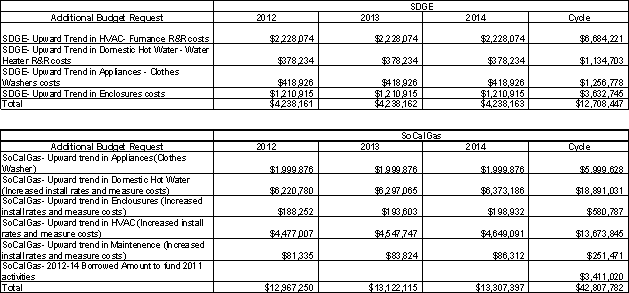
There is insufficient information, testimony or record available to evaluate SoCalGas' and SDG&E's requests and the justifications of such increases. Therefore, the Commission denies SoCalGas' and SDG&E's requests at this time. Instead, within 60 days, SoCalGas and SDG&E shall file a petition to modify this decision under the Commission's Rule 16.4, with any and all attendant justification and support, including new budget tables, and supporting testimony for such increase.
Any additional funding will be reviewed and incorporated into the approved budget to augment the total program cycle budget in a subsequent decision, if such budget augmentation is later determined reasonable and justified.
7. Conclusion
After decades of lessons and growth, both the CARE and ESA Programs have achieved tremendous accomplishments and have now reached full maturity. For that, we applaud the IOUs and the stakeholders who made the programs what they are today. With the backdrop of significant progress and with the reminder of our Strategic Plan vision, the Commission examines the IOUs' Applications for 2012-2014 program cycle and face issues unique to mature programs and the ever changing landscape of energy.
Today, we approve the CARE and ESA Programs, budgets and the homes treated goals for 2012-2014 program cycle:
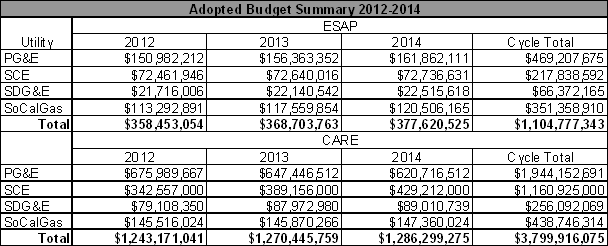

On the ESA Program side, we resolve numerous programmatic issues in this decision based on the record of this proceeding, by, inter alia, setting out clear directions on Integration issues, ME&O issues, Leveraging issues, WE&T issues, aggressive Eight Immediate Multifamily Segment Strategies, etc.. For this cycle, and based on our observations of the IOUs' successes during the last cycle, the adopted number of homes treated above should be viewed as the minimum number of homes to be treated this cycle, and we strongly urge and challenge the IOUs to exceed their projected 1/3 of the remaining homes for treatment by the end of the 2012-2014 cycle146.
On the CARE Program side, we resolve numerous programmatic issues and update the programs in ways to ensure the integrity and continued success of the program by, inter alia, refining the Categorical Eligibility Program for continued ease of access for CARE enrollees, directing improvements to the Post Enrollment Verification process and approach, increasing CARE capitation fee cap, etc..
We also direct several of the more complex and largely interconnected issues be further investigated, examined, explored, debated and brought back to the Commission through the frameworks we set in this decision during the second phase of this proceeding, including the working groups and several significant studies. Those second phase issue are: a comprehensive multifamily segment strategy (see Section 3.10.6.4. of this decision) including the review of potential expedited enrollment process, ESA Program cost-effectiveness methodology (see Section 3.5.4. of this decision), several critical low income program studies and reports ( see Sections 5.2.5, 5.2.6 and 5.2.7.) as well as review of any pilot program evaluation and several other working groups ordered in this decision (see Sections 3.5.4., 3.11.5.4., 3.11.5.5., and 5.3.8.). Each of these efforts along with the myriad of monitoring, tracking and reporting requirements ordered in this decision are also specifically designed to lay the foundation for meaningful program review and improvements where needed in the years to come.
We note, all of these second phase activities anticipate and are specifically designed and necessary for laying a proper informational foundation for meaningful review of several premature but extremely complex programmatic and policy issues that have been untimely argued and debated in this proceeding up to this point. For example, to better balance the ESA Program changing and competing objectives, in the second phase of this proceeding, we are reviewing the ESA Program cost-effectiveness framework and methodology through the CE Working Group process outlined in the forgoing section.
In fact, the CE Working Group is specifically tasked to examine and begin to develop a record for the foundational elements and discussions to set the stage for more informed direction for the ESA Program's long term vision toward striking the proper balance between achieving cost effective energy savings versus providing health, comfort, and safety benefits. We are also ordering a new Impact Evaluation and low income population's Needs Assessment Study. All these and other efforts interrelate and are deigned to bring together better understanding of the low income community's needs and program elements to inform the Commission so that a thoughtful review of the low income programs can begin toward finding that right balance and move to changes, where appropriate.
On a related note, we direct the parties to engage in this upcoming phase of the proceeding in good faith and participate in it in constructive, timely and cooperative manner. The Commission's Energy Division has been entrusted with extraordinarily challenging task of leading and overseeing most of these voluminous and complex second phase efforts. With the extremely short second phase timeframe, only way these efforts will be productive and yield meaningful results is for the parties to aid the Commission's Energy Division's lead role and work all together as a team.
To the extent this decision does not explicitly approve certain aspects of the IOUs' ESA and CARE Applications, they are not approved today.
8. Comments on Proposed Decision
The proposed decision of the ALJ in this matter was mailed to the parties in accordance with Code Section 311 and comments were allowed under Rule 14.3 of the Commission's Rules of Practice and Procedure. Comments and reply comments were filed by parties. They were considered, and where appropriate, revisions to the proposed decision have been made and are reflected throughout this decision. Additionally, corrections and stylistic edits have also been made and are reflected throughout this decision. Finally, a few miscellaneous issues that warrant further discussion and clarification that were raised in the comments and reply comments to the proposed decision or that which came to our attention since the publication of the original proposed decision on May 4, 2012, are also discussed below.
In response to the parties' comments to the proposed decision, this decision allows, for this cycle only, an approval to add back Room Air Conditioner for all housing types in climate zones 10 and 13. We remind the parties that our approval of Room Air Conditioner for all housing types in climate zones 10 and 13 is solely for this program cycle with the understanding that we are reexamining and updating the energy savings figures in this cycle in a new Impact Evaluation Study and concurrently reexamining the cost-effectiveness approach used in this program during this cycle. That cost-effectiveness approach review would also include examination of non-energy benefits, equity measures, and health, safety and comfort issues which all cumulatively will relate to how the Commission will view this measure in future cycles. In addition, we also will be examining this issue in the Low Income Needs Assessment during this cycle to determine how providing this measure meets the needs of this population in these climate zones and whether it should be approved for future cycles. All of those second phase activities will rightly set the stage for a more informed deliberation of how the Commission should look at these non-extreme climate zones with microclimates that affects and triggers the potential need for these measures.
8.2. Cooling Measures, Climate Zones 10 and 13 and Health/Death Risk Argument
In reviewing this cooling measure issue for climate zones 10 and 13, we must correct EEC's and other parties' erroneous suggestion that disallowing this measure would have increased the risk of health/death in these climate zones due to their temperatures. This suggestion is misleading. The Commission, thoroughly reviewed this issue in D.09-11-009, and as we explained therein, the Commission's ESA Program is designed to provide the Room Air Conditioner or Central Air Conditioner measures only to customers who already have a working, albeit inefficient, air conditioner. Thus, those affected population already have functioning cooling measure, inefficient perhaps, in place to address their cooling needs. This program would either allow or disallow mere upgrades of these measures that are inefficient. Again we note, the ESA Program is not and was never intended as a free air conditioner giveaway program to all low-income customers.
Leveraging with ESA Program with LIHEAP/WAP programs administered by CSD is an outstanding concept and a direction to which the Commission is committed. In their comments, SoCalGas supports the direction that the Utilities should begin immediate coordination with the Energy Division to convene and begin discussions with CSD and the Utilities to facilitate leveraging opportunities and to develop and implement an effective leveraging plan between the ESA Program and CSD. Recognizing some past challenges that impeded the leveraging and data sharing efforts with CSD, SoCalGas has committed to endeavor to resolve any such issues during the upcoming utility meetings with CSD and the Energy Division. SCE notes a compatible CSD customer database could take advantage of such software development and provide the ability to track ESA/CSD treated homes and measures. In the interim, SCE too commits to continue to offer ESA appliances to LIHEAP contractors for installation in ESA Program eligible homes. With the ESA Program paying for the appliance cost and CSD paying for the installation cost, this type of coordinated leveraging could result in a win-win situation for both the programs and the low income community. Additionally, SCE will be playing a significant role in providing database access to LIHEAP contractors to track the treating of LIHEAP homes and measures installed. Given the benefit of free appliances, CSD may potentially cover LIHEAP contractor costs for input and administrative duties.
That said, there are some significant budgetary constraints CSD is now facing in the upcoming budget period. This reality prompts us to recognize that constraint and therefore not to over project ESA and LIHEAP/WAP program leveraging activities that can be realistically be realized in this upcoming ESA Program cycle. This decision therefore reflects a cautious commitment to work with CSD in this upcoming program cycle to leverage our programs.
TURN's recommendation that the IOUs would be directed to report on the leveraging activities to the Mid-Cycle Working Group has some merit, as fitting well within two of the topics already identified as within the Mid-Cycle Working Group's purview: "IOUs' Best Practices" and "General Mid-cycle Program and Process Improvements." However, instead of setting this item as that Working Group's immediate priority, we will allow that working group to set its own priority of issues to tackle during this cycle and to expect that the working group members and the IOUs will work cooperatively to share data during that process to make those efforts meaningful. Parties and working group may seek the ALJ's guidance through what should be professional and cooperative working group processes.
DRA recommends that SCE be ordered to change its past reporting practices and to follow reporting practices consistent with the other IOUs. DRA points out that three of the four IOUs in this proceeding currently report their annual revenue and program expenditures to the Commission via Advice Letters in their Annual Electric True-Ups and in their Annual Gas Public Purpose Program Surcharge filings. SCE is the exception in that it reports that information to the Commission as a separate request contained in its annual Energy Resource Recovery Account (ERRA) Application. DRA is correct. Such different methods of reporting the same type of information to the Commission adds confusion and serves no practical purpose. The method of reporting that same information should be uniform across the Utilities. DRA therefore recommends that SCE be ordered to report that information to the Commission via an Advice Letter and that that Advice Letter be served on the service list in this proceeding.
We agree with DRA's recommendation concerning SCE's inconsistent reporting practice which needs to be resolved to bring consistency in reporting. DRA's proposal for uniform reporting is valid and deserves exploration. We, however, recognize that there is a history as to how that inconsistency came to be and that a solution to eliminating that inconsistency may be through and by coordination with another pending proceeding, A.11-04-001 (which addresses ERRA). We therefore direct Energy Division and the Mid-Cycle Working Group to review this item such that the inconsistency can be eliminated as soon as practicable. The Mid-Cycle Working Group is also directed to review and explore ways to align SCE's cool center accounting procedures which are currently reported as part of ERRA.
SCE provides gas service through its distribution system of propane/butane to customers on Catalina Island. D.06-12-038 authorized SCE to use ESA Program funds to install gas measures in homes occupied by low-income customers on Catalina Island. SCE has requested approval to continue offering all Energy Savings Assistance Program services to its customers on Catalina Island. SCE estimates that several hundred households on Catalina Island are eligible for services147. SCE's request to continue these efforts is granted as it is reasonable and consistent with direction and authorization previously provided in prior Commission D.06-12-038.
SCE proposes to file an Advice Letter within 90 days of the effective date of the decision, requesting a reasonableness determination on the activities and budgets required for SCE to implement the directives of this decision. SCE further proposes the Advice Letter also include an implementation timeline for each modification in order to implement all the CARE directives in this decision.
We reject SCE's proposal to submit an Advice Letter to implement the CARE directives outlined in this decision is unnecessary and therefore not justified. This decision provides adequate guidance and direction to the IOUs as it relates to CARE initiatives during upcoming program cycle. SCE and the other IOUs are directed and encouraged to consult with and seek additional guidance from Energy Division Staff as needed during the transition from the existing bridge fund period to the new program cycle.
8.7. Continuation of Capitation Fee for ESA Program and Expansion to All Homes
SoCalGas' and SDG&E's request the Commission expressly authorize continuation of its ESA Program outreach efforts to pay capitation fees to CBOs to enroll Limited English Proficient and disabled customers and seniors into the ESA Program. Both Utilities are authorized to continue payment of capitation fees as outlined and approved in the respective advice letter filings submitted in March 2010148 and subsequently approved by the Commission.
SDG&E's request to expand its current its ESA capitation program for outreach to the limited English proficiency, seniors, and disabled Community to include all households is rejected. SDG&E is authorized to continue existing practices as previously approved in Advice Letter 2140-E/1922-G and supported in D.06-12-038. Capitation fees for low income programs were supported in prior Commission D.06-12-038 with added emphasis on leveraging opportunities within the disabled community.
Based on the 2011 annual reports for both SDG&E149 and SoCalGas150, we find that the existing practices are sufficiently effective toward achieving the established program goals and further expansion unjustified.
8.8. Continuation of ESA Program Income
Verification / Self-Certification / Categorical Eligibility Program
SDG&E, in this proceeding, also raised potential income verification process related concerns in the ESA Program. Relatedly, as discussed in section 5.3.5 of this decision, the parties also raised the issue of potential charge backs, when the contractors are left to pay for ESA Program measures in homes that that are later found to ineligible during the income verification process. In response, some of the Utilities suggest possible pre-certification (income verification) of homes before any ESA Program measures are installed to avoid such scenarios.
The ESA Program currently allows different enrollment processes. It allows a targeted self-certification process whereby SDG&E and SoCalGas are directed to use the census tract data to identify neighborhoods with 80% of the households at or below 200% of the federal poverty guideline. In these areas, SDG&E and SoCalGas are permitted to suspend income documentation requirements and instead enroll customers in the ESA Program through a self-certification process.151 Continuation of this approach was approved for SDG&E and SoCalGas in the 2009-11 budget cycle and expanded to include targeted self-certification and enrollment for PG&E and SCE in areas of their service territory where 80% of the customers are at or below 200% of the federal poverty guideline. The main intent of this effort was to assist the IOUs in meeting the programmatic initiatives to serve the eligible population.152
In addition to the above targeted self-certification process, the ESA Program also allows categorical eligibility as another enrollment procedure designed to ease enrollment processes. With categorical eligibility, customers who can provide documents proving participation in one of several state or federal programs do not need to provide additional income documentation in order to qualify for program enrollment.
In this decision, we make no changes and approve the continuation of self-certification for the ESA Program in areas where 80% of the households are at or below 200% of the federal poverty guideline. Consistent with prior Commission decisions, we also approve continuation of categorical enrollment of ESA Program in these targeted areas.
9. Assignment of Proceeding
Timothy Alan Simon is the assigned Commissioner and Kimberly H. Kim is the assigned Administrative Law Judge in this proceeding.
1. According to the KEMA Needs Assessment, one in three of California's households or approximately 4.1 million of the 12.53 million households in California are low income households.
2. In D.07-12-051 and the Strategic Plan, the Commission stated its long-term vision for the ESA Program: "By 2020, 100 percent of eligible and willing customers will have received all cost-effective [Energy Savings Assistance Program] ... measures."
3. The Strategic Plan, adopted by the Commission, establishes two goals for the ESA Program including that: (a) By 2020, all eligible customers will be given the opportunity to participate in the ESA Program; and (b) The ESA Program will be an energy resource by delivering increasingly cost-effective and
longer-term savings.
4. The CARE Program is a low income energy rate assistance program that dates back to 1980s and is aimed at providing eligible low income households with a 20% discount on their electric and natural gas bills.
5. This decision follows an extensive record that precedes it, including Applications, protests, detailed prepared testimonies, briefs and ruling responses, the parties' oral input at the PHCs and various studies and reports prepared by or on behalf of the IOUs, the Commission, and parties to the proceeding.
6. The parties to the proceeding contributed thoroughly and meaningfully through testimonies, comments and other filings to help advise the Commission and the Utilities on ways to achieve our ultimate vision such that (a) the ESA Program effectively evolves into a resource program that garners significant energy savings in our state, as envisioned in the Strategic Plan, while providing an improved quality of life for California's low income population; and (b) the CARE Program continues its current and successful course of effectively providing the necessary assistance to those eligible customers.
7. While some parties claim that there should have been an evidentiary hearing held, they did not raise any disputed issues of material fact that were ripe and poised for hearing.
8. The issues raised by the parties requesting hearings focused on several issues which the Assigned Commissioner and the ALJ concluded to be not hearing ready and therefore required further exploration in the months to come, during the second phase of this consolidated proceeding, following this decision and as directed in this decision.
9. In D.07-12-051, the Commission held that "[t]he complementary objectives of the ESA Program will be to provide an energy resource for California while concurrently providing low income customers with ways to reduce their bills and improve their quality of life."
10. In D.08-11-031, the Commission announced and affirmed a clear direction to the IOUs that the ESA Program "must evolve into a resource program that garners significant energy savings in our state while providing an improved quality of life for California's low income population."
11. The ESA Program measures offered are generally selected based upon cost-effectiveness evaluation and vary by IOU territory and other factors, such as climate zone and housing type.
12. The ESA Program's cost-effectiveness approach is designed to ensure that the most efficient use is made of finite ratepayer funds and yield optimal ESA Program success and energy savings.
13. The ESA Program has made great strides in the recent years and has treated over 1 million low income homes and gained 16,132,316 kilowatt hour (kWh) savings and 232,979,182 therms savings during the 2009-2011 program years.
14. The ESA Program successes are in part due to the program's focus on the programmatic cost-effectiveness as well as cost-effectiveness of installed measures, promoting and encouraging workforce education and training, using smarter, flexible and creative approaches towards outreach (including a whole neighborhood approach), and, where appropriate, focusing on customers with high energy use, burden and insecurity.
15. Some notable lessons learned from the last program cycle in the ESA Program are that:
(a) The ESA Program is armed with a more experienced and poised administration and workforce, ready and "fully ramped up" in most of the IOUs' territories. During the last program cycle, the treated homes numbers steadily climbed, and in some instances, more dramatically climbed, to confirm this observation; and
(b) The IOUs' impressive 2011 treated home figures also illustrate that the ESA Program has the capacity to treat more homes than the conservative 2012-2014 projections proposed by the IOUs.
16. Based on our observations of the IOUs' successes during the last cycle, the adopted number of homes targeted to be treated should be viewed only as the minimum target goal number of homes to be treated this cycle, and we strongly urge and challenge the IOUs to exceed their total projected program cycle target of treating 1/3 of the remaining homes by the end of the 2012-2014 cycle.
17. By treating more homes in the 2012-2014 cycle than currently projected, the IOUs would be ready to apply more focus to tailor their programs to the remaining and more difficult to reach untreated low income households during the final two cycles, 2015-2017 and 2018-2020.
18. In D.08-11-031, the Commission determined that Code Section 2790 does not contain the language "all feasible measures."
19. In D.08-11-031, the Commission determined that it is most cost effective for an IOU to install all feasible measures once it incurs the expense and expends the effort to reach eligible customers and also determined that "all feasible measures" does not mean all measures.
20. Integrating demand side program offerings has been an objective of the Commission since 2007.
21. In D.07-12-051, the Commission reaffirmed this policy and program guidance specifically for the ESA Program, including the following integration goal that "... [the ESA Program] should be integrated with other energy efficiency programs to allow the utilities and customers to take advantage of the resources and experience of energy efficiency programs, promote economies of scale and scope, and improve program effectiveness."
22. In D.08-11-031, the Commission determined that "integration" constitutes an organization's internal efforts among its various departments and programs to identify, develop, and enact cooperative relationships that increase the effectiveness of customer demand side management programs and resources and should result in more economic efficiency and energy savings than would have occurred in the absence of integration efforts.
23. D.08-11-031 explicitly reaffirmed the need for integration and specified clear definitions, metrics, and strategies and reporting requirements for such integration efforts envisioned for the ESA Program.
24. The general IDSM Taskforce's efforts are currently being undertaken in the general energy efficiency docket pursuant to D.09-09-047.
25. There is a general agreement among the parties in this proceeding that the integration of the ESA Program with the IOUs' Energy Efficiency, Demand Response and Distributed Generation efforts provides more opportunities for energy savings and greater occasion for low income customers to save money, energy, and improve their health, comfort and safety.
26. In D. 08-11-031, we defined leveraging as "... an IOU's effort to coordinate its ... [ESA Program] with programs outside the IOU that serve low income customers, including programs offered by the public, private, non-profit or for-profit, local, state, and federal government sectors that result in energy efficiency measure installations in low income households."
27. In D.08-11-031, the Commission required these efforts be demonstrably successful to ensure that leveraging efforts yield direct benefits to low income households and the ESA Program overall by meeting one or more of the following three objective criteria: (1) increase energy savings, (2) result in new customer enrollments, or (3) reduce program costs.
28. During the past program cycles, we learned that the IOUs' leveraging efforts resulted in partnerships and other collaboration with non-IOU sources, and most importantly, resulted in dollar savings, energy savings and benefits, and/or increased program enrollment.
29. One of the most obvious leveraging opportunities the Commission previously identified was and still is the federal LIHEAP and the DOE WAP, administered by CSD.
30. On March 17, 2009, the Commission and CSD executed a MOU with the mutual goal of decreasing duplications and increasing the total number of low income households in California treated under both programs through increased coordination between the agencies.
31. Among other efforts, the Commission and CSD agreed to facilitate collaboration between the IOUs and the local service providers.
32. Despite the challenges we experienced during this last program cycle, the Commission is still committed to the important objectives of that MOU.
33. In the current landscape of so many exciting energy efficiency efforts, these types of leveraging efforts are essential, and even critical, to transforming the ESA Program into a more effective resource program that yields home energy benefits to the low income community while also creating cost savings for the IOUs and the ratepayers.
34. Looking at the accomplishments during the 2009-2011 program years, the IOUs' leveraging strategies are on the right track, but there is still room for improvements to achieve optimal leveraging with CSD and many other programs.
35. Some of the same barriers continue to exist today as they did three years ago where service providers still do not always know if a house has had any previous weatherization treatment until they arrive at a home. This wastes time, effort and outreach resources.
36. The current ESA Program design and delivery model provides the necessary guidance to the contractors while also affording contractors, including the assessment contractors, a level of flexibility and operational discretion to best adapt their program delivery to each household.
37. This model allows the assessment contractors to assess each household to determine and tailor measures offerings for individual households in accordance to program rules as well as provide tailored energy education.
38. Following an assessment by the assessment contractor and utilizing each IOU's sophisticated workflow database, the installation contractors are then dispatched to customer households to install tailored energy efficiency measures.
39. The ESA Program can still benefit from some design and delivery improvements.
40. The Commission has time and again stressed the critical importance of integrated demand side management and the need for the IOUs to integrate and coordinate marketing messages for customers.
41. The Strategic Plan mandates a single statewide ME&O program that combines low income and non-low income energy efficiency messages, uses a single program name and tagline, and targets all eligible communities.
42. In D.07-12-051 and D.08-11-031, the two preceding low income energy efficiency proceeding dockets, the Commission took detailed steps, aligned with the general energy efficiency proceeding dockets, to direct the IOUs to integrate statewide energy efficiency and demand response marketing by reducing redundancies in marketing efforts and to have one contract with a single marketing agency for both statewide marketing campaigns.
43. Between 2009 and 2010, the Commission engaged in a careful evaluation of prior statewide marketing and branding efforts as well as market and demographic research to understand how best to encourage energy awareness as well as energy efficiency action.
44. Our ultimate plan is a unified ME&O approach.
45. Yet our efforts to deliver an integrated message have been hampered by differing program cycles and proceedings among energy efficiency, demand response, distributed generation, and low income programs, among other reasons.
46. To help bring these efforts toward a unified ME&O approach under one umbrella with one unified approach, the Commission has set some directions in D.12-05-015, in R.09-11-014, our general energy efficiency proceeding.
47. In D.08-11-031, the Commission determined that ethnic marketing is a key way of reaching language minorities and communities of color.
48. Through the IOUs' creative and innovative outreach efforts during prior program cycles, one of the most notable barriers in reaching the low income segment was identified as lack of trust in the low income community which was further compounded by cultural and language barriers which stifled the low income communities' understanding of the ESA and CARE Programs.
49. To overcome these barriers and to reach these harder to reach low income customer segments, an effective media outreach therefore should include local and ethnic media to better engage these communities and be tailored to those low income communities we are striving to reach.
50. Local, regional, ethnic as well as ethnically-owned media are ready and available tools that are clear and direct gateways to many of these low income communities to help tear down some of those barriers.
51. The Commission also encourages the IOUs to utilize, where appropriate, community based organizations as a resource in outreach efforts.
52. Many community based organizations have proven track records within the low income communities and have earned the low income communities' trust.
53. Information from such community based organizations therefore is received in that community with more trust and confidence since it is coming from local and trusted community sources.
54. Such coordination with the community based organizations will also yield added benefit of creating jobs within those communities.
55. With the backdrop of the over two decades of program experience, the Strategic Plan, D.07-12-051 and D.08-11-031, the Commission has devised the current cost-effectiveness framework for the ESA Program, including overall cost-effectiveness methodology applying a measure based analysis with two tests, threshold values and some exceptions.
56. The Modified Participant Cost (PCm) Test emphasizes measures benefits to participating customers and the total costs of the ESA Program, and the Utility Cost Test (UCT) measures utility's resource costs and the resulting benefits, including non-energy benefits of the program.
57. Both tests incorporate non-energy benefits as well as direct energy-related benefits.
58. In D.08-11-031, the Commission, using those two tests and measure-based evaluation, held that, for the ESA Program, a measure is deemed to have "passed" the ESA Program cost-effectiveness test if its benefit-cost ratio, according to the UCT and PCm tests, is greater than or equal to the 0.25 benefit-cost ratio benchmark for that utility.
59. In D.08-11-031, the Commission also noted that under certain circumstances, exceptions would be made for measures that do not pass the current cost-effectiveness tests.
60. Leading to and since D.08-11-031, the parties have consistently questioned this measure based evaluation approach as well as the ESA Program's overall cost-effectiveness framework and have raised concerns that the Commission reexamine them.
61. On October 24, 2011, the Commission held a workshop on this topic which yielded robust and thoughtful discussion amongst the parties.
62. The December 2011 Ruling sought comments from the parties, which included four specific questions directed at the stakeholders, dealing with various aspects of the general ESA Program's current cost-effectiveness framework.
63. Most parties, in their responses, restated that the cost-effectiveness framework currently used to evaluate ESA Program measures needs to be revisited.
64. D.08-11-031 set out the current measure-by-measure cost-effectiveness test (CE Test) for the ESA Program to determine whether a specific measure is cost effective (taking into account the housing type as well as climate zone) and set forth an approach to screening each measure for cost-effectiveness.
65. Today, we adopt and apply the same methodology, outlined in D.08-11-031, for this cycle for evaluating cost-effectiveness of each proposed measure (taking into account the housing type as well as climate zone), including when we grant exceptions to such CE Test, as follows:
(a) CE Test: Measures that have both a PCm and a UCT benefit-cost ratio greater than or equal to 0.25 (taking into consideration the housing type and climate zone for that measure) for that utility pass the CE Test and shall be included in the ESA Program. This rule applies for both existing and new measures.
(b) Two exceptions to CE Test are:
(i) Existing measures that have either a PCm or a UCT benefit-cost ratio less than 0.25 (taking into consideration the housing type and climate zone for that measure) is deemed to have passed the CE Test and shall be retained in the ESA Program; and
(ii) Existing and new measures with both PCm and UCT test results less than 0.25 (taking into consideration the housing type and climate zone for that measure) for that utility may be included in the ESA Program for health safety and comfort reasons as add back measures, by first securing Commission's approval for such exception; and all approved add back measures are subject to additional reporting requirements.
66. Under the add back measures provision of the ESA Program's CE Test, the Commission recognizes and prioritizes the equity needs of the ESA Program customers and allow the IOUs to offer certain measures that fall below the 0.25 threshold, with additional attendant reporting requirements to track and better understand those add back measures' impact to the program budget and energy savings.
67. In addition to the CE Test, the Commission also has in place its modified 3MM Rule to further the ESA Program's programmatic cost-effectiveness of the program delivery.
68. In D.01-03-028, the Commission adopted the 3MM Rule and determined that it would be imprudent to indiscriminately treat all homes, including those that needed only a few measures (because they are sufficiently energy efficient), as such efforts would take away from the overall dollars to be spent on homes that have not yet received any energy efficiency upgrades (and not as energy efficient).
69. D.08-11-031 and D.09-06-02 established the modified 3MM Rule by creating an exception in response to some concerns; and under the modified 3MM Rule, the IOUs are permitted to treat homes needing less than three measures, "as long as the total energy savings achieved [in that home] by either measure or measures combined yield(s) energy savings of at least either 125 kilowatt-hours (kWh)/annually or 25 therms/annually."
70. D.08-11-031, noting the rising outreach, enrollment and other programmatic costs, emphasized that programmatic cost-effectiveness is crucial to the ESA Program's success, and that a mechanism such as the modified 3MM Rule is necessary to make the most of the finite ESA Program funds toward treating maximum number of households.
71. Based on the data provided by the IOUs and having approved the smart power strip, we are not convinced that the modified 3MM Rule creates a significant barrier in program delivery as presented by some of the parties.
72. Now more than ever, with program costs rising ever so rapidly, we find value in the modified 3MM Rule consistent with our finding in 2001 that a provision to ensure households receive a minimal level of measures is necessary to maintain overall programmatic cost-effectiveness.
73. While there has been some debate over the value of CFLs, as well as its cost-effectiveness and associated energy savings, we have found that CFLs continue to provide low income customers the opportunity for energy savings in a relatively cost effective manner, because they are relatively inexpensive, all low income households use and need lighting, and we can still capture some energy savings by switching low income customers from high energy use incandescent bulbs to CFLs.
74. As we noted in D.08-11-031, 20%-30% of CFLs given away to customers are not installed and we conclude that we cannot continue to allow such wasteful giveaways.
75. The Strategic Plan sets forth the Commission's vision for the lighting market with regard to support for basic CFLs and directs the Utilities to "begin to phase traditional mass market Compact Fluorescent Lamps bulb promotions and giveaways out of program portfolios and shift focus toward new lighting technologies and other innovative programs that focus on lasting energy savings and improved consumer uptake."
76. During the October 21, 2011 workshop and the two PHCs as well as the testimonies, briefs, and other filings, the parties have vigorously debated the nature and magnitude of how the low income multifamily segment has or has not been underserved and how it may be better served by the ESA Program.
77. While much of the debate centered on the potential program barriers affecting the treatment of the multifamily segment, the proposed solutions, ideas, pilots and program critiques all bring attention to how the ESA Program can more effectively be administered, to providing all feasible measures and delivering the health, safety and comfort benefits of this program to the low income community.
78. We note that in the course of this proceeding, through the Applications, PHCs, opening and reply testimonies, and comments responsive to the December 2011 Ruling, the IOUs and all the parties presented many concerns, objections, insights, information, approaches and even pilot proposals for the Commission to examine various potential barriers that might prevent eligible customers residing in multifamily units from enrolling in the ESA Program.
79. Citing the IOUs' data reported in their annual reports, DRA's opening brief, Table 6, also illustrates that in comparing the IOUs' 1997-2006 multifamily homes treated figures to the IOUs' 2007-2010 multifamily homes treated figures, with the exception of SDG&E, each IOU's multifamily home treated figures dipped during the last program cycle.
_ PG&E dropped from 27% multifamily homes treated in 2000-2006 timeframe to 18% multifamily homes treated in 2007-2010 timeframe;
_ SCE dropped from 45% multifamily homes treated in 1997-2006 timeframe to 23% multifamily homes treated in 2007-2010 timeframe;
_ SoCalGas dropped from 36% multifamily homes treated in 1997-2006 timeframe to 25% multifamily homes treated in 2007-2010 timeframe; and
_ SDG&E increased from 49% multifamily homes treated in 1997-2006 timeframe to 54% multifamily homes treated in the 2007-2010 timeframe.
80. If the ESA Program is not effectively reaching the multifamily segment or even the overall eligible low income population, then that has to be identified, understood and addressed in the time remaining as we near 2020.
81. While there is not yet a consensus on all the various ways to increase penetration of this multifamily segment, there is a need for attention to this segment.
82. There are eight immediate strategies that the IOUs can roll out to immediately begin improving the penetration rate for multifamily segment.
83. Meanwhile, during the second phase of the proceeding, a full set of comprehensive multifamily segment strategies can be formulated through the consultant process.
84. While the multifamily consultant process is underway, during the second phase of this proceeding, the Commission also intends to further examine and develop an informed record regarding NCLC's proposed multifamily expedited enrollment process, including identifying and examining relevant legal and operational hurdles (e.g., housing subsidy and definition of income and potential need for memorandum of agreement or understanding with other potential partner agency(ies)), toward development of feasible expedited enrollment process.
85. In D.07-12-051, the Commission stated that the ESA Program strategies, in general, should "include specific training strategies for reaching disadvantaged communities [and] the IOUs should also work with community stakeholders to assist them in the development of training strategies."
86. The Strategic Plan also set forth two broad WE&T goals: (1) establish energy efficiency education and training at all levels of California's educational systems, and (2) ensure that minority, low income and disadvantaged communities fully participate in training and education programs at all levels of the energy efficiency industry.
87. In D.08-11-031, the Commission challenged the IOUs to devise and implement outreach and training efforts to teach minority, low income, and other disadvantaged communities the skills needed to succeed at jobs that support the ESA Program by acting "as a catalyst to change by implementing several foundational activities that are necessary to accurately identify specific WE&T needs and recommendations for action."
88. With this direction, however, D.08-11-031 also stressed that the IOUs are but one link in the overall chain of a statewide WE&T strategy. In the chain, there are stakeholders supporting action toward developing "green jobs" with other funding and training coming from taxpayers, community-based and nonprofit organizations, educational institutions, the business community, and labor organizations.
89. The Statewide WE&T Needs Assessment made a recommendation we found timely and applicable to the ESA Program:
...for fully subsidized low income programs, modify program objectives to include workforce outcomes. Assess current workforce outcomes and if they are not adequate, use high-road agreements and sector strategies to pilot incorporation of the new national DOE skill standards and certifications or other strategies to improve both energy efficiency and workforce outcomes.
90. While a few anecdotal accounts of contractor performance issues were raised by some parties and the 2009 Process Evaluation Report, we acknowledge that there is not enough evidence to suggest there to be a program-wide performance concern or that ESA Program delivery by the IOUs and contractors fall below any performance standard.
91. There was no evidence in the record to suggest that the IOUs and the contractors are violating health, safety, labor or wage laws to begin directing they comply with such existing laws.
92. The Statewide WE&T Needs Assessment's recommendation suggests reviewing "workforce outcomes" and taking actions as appropriate upon such review, which is a good program WE&T approach for the ESA Program.
93. To know the state of the current workforce, the needs of that workforce and the quality of their performance in the ESA Program is just the beginning of effectively managing the program workforce, the needs of that workforce, and the quality of the products being produced by that workforce.
94. The record of this proceeding reflects the limited information and data currently being collected and reviewed and analyzed to understand the present reality of the ESA Program workforce.
95. Likewise, there is little indication of a forward looking anticipation and planning for the ESA Program's workforce needs of tomorrow.
96. As a program funded entirely by ratepayers, the IOUs' ESA Program-specific WE&T plan for the remaining three cycles creates potential opportunities for job creation, incubation, or development for displaced and disadvantaged workers
97. We find there is a nexus between the quality of ESA Program delivery (proper enrollments, assessments, installations, etc.) and the quality of the ESA workforce.
98. The CARE Program has made incredible progress over the past program cycle including the IOUs' showings of very high penetration rates during the 2009-2011 program cycle of reaching, more or less, the 90% CARE penetration goal set in D.08-11-031 by the Commission.
99. In D.08-11-031, the Commission acknowledged that a CARE penetration goal of 100% may not be attainable because of the difficulty in identifying and reaching certain customers as well as some portion of the low income customer segment that are unwilling to participate.
100. Some have estimated much of the approximate remaining 10% percent of CARE eligible households may be unwilling or unlikely to participate in the CARE Program.
101. We therefore recognize and acknowledge that the per-household efforts and associated costs to identify, target and reach the remaining CARE eligible population (ranging from 1% in SCE territory to approximately 15% in SDG&E territory) will invariably be more difficult and costly.
102. Much of the successes in the CARE Program have been achieved without substantial increase in the CARE outreach budget in the last budget cycle and by increasing the enrollment efficiencies through streamlining the screening, eligibility, and retention of participants in the CARE Program.
103. Some of the major lessons learned during the last program cycle suggest the CARE Program experiences extremely high attrition rate and the program design may need to be tightened so to ensure that CARE funds (discount rates and subsidy) and programs are effectively managed and administered to ensure the benefits reach only the intended eligible customers.
104. The CARE Program experiences high attrition rates, and to maintain and even build on the current penetration rates, we must aggressively outreach to enroll more customers each program year to offset the number of customers who we lose through various attrition factors.
105. For the 2012-2014 budget cycle specifically, we recognize and therefore will focus on strategies to aggressively carryout outreach efforts to maintain and increase the current penetration rates, wherever feasible.
106. For the 2012-2014 budget cycle, we also will focus on strategies to further streamline the program administration toward cost-effectively identifying, targeting and reaching the remaining hardest to reach CARE eligible population.
107. The IOUs' total proposed outreach budget of $42 million is an increase of approximately 8% over the 2009-2011 cycle.
108. The proposed increases in CARE administrative costs and budgets are warranted and supported by the attrition figures and the challenges faced by the IOUs in the coming cycle.
109. During prior budget cycles, PG&E, SDG&E and SCE have each funded cooling center activities very differently.
110. During the 2009-2011 budget cycle, SCE supported approximately 20 cooling centers; PG&E supported approximately 65 centers; and SDG&E supported approximately 119 cool zone facilities.
111. The Applications filed by PG&E and SDG&E describe existing partnerships with local government entities, specifically financial support is provided to city and county agencies to fund cooling centers, while SCE works primarily with community based organizations and faith based organizations to provide similar services.
112. SCE's cooling center budget has been substantially higher than PG&E and SDG&E while the number of facilities in SCE's territory has remained the lowest.
113. SCE's proposed cooling center budget represents approximately 36% of its CARE outreach cost, in comparison to PG&E's and SDG&E's respective proposed budgets which are approximately 4% and 3% of overall outreach costs.
114. Recommendations outlined in SCE's 2009 Cool Center Program Evaluation also adds to our concern by repeatedly pointing out instances where cooling centers were found to be costly to operate, overstaffed, under attended, lacked outreach efforts, and not strategically located or noticed, which all provides further evidence that utilization of third parties to operate cooling centers increases expenses without increasing benefits.
115. The IOUs, in their Applications, have identified a concern and presented evidence that the Categorical Eligibility and Enrollment process may lead to CARE subsidies being diverted from legitimate CARE eligible customers and ratepayers to some potential ineligible households.
116. Other parties also note that the second of the two CARE enrollment process, the self-certification process, likewise may lead to enrollment of potentially ineligible households.
117. The Categorical Eligibility and Enrollment Program permits a low income customer to be deemed income qualified and therefore eligible for the CARE Program benefits if they happen to be enrolled in one or more of the pre-approved listed governmental low income programs.
118. The Categorical Eligibility and Enrollment Program assumes that the other approved low income assistance program has already verified that customer's income and that verified income level aligned with the CARE income threshold of 200% federal poverty guideline.
119. After more than 20 years of outreach and enrollment efforts, the CARE Program has a growing subsidy expected to exceed $3.6 billion dollars in the 2012-2014 cycle.
120. Under the current enrollment and verification approach and projections, CARE participation/penetration rate is reaching (and may exceed) 100% of the CARE eligible population within many of the IOUs' territories.
121. As the CARE Program increases in size and budget, the importance of ensuring that only eligible customers are enrolled also increases.
122. As stewards of the ratepayer funds, we must ensure that CARE funds and programs are effectively managed and administered to ensure the benefits reach only the intended eligible customers.
123. DRA, TURN and other parties appropriately point out that Categorical Eligibility program process results in CARE administrative savings.
124. A reasonable alternative to a 100% Post Enrollment Verification rate in the CARE Program is stratified probability sampling and modeling.
125. Through such stratified probability sampling and modeling, we may be able to cost-effectively target the probably ineligible CARE enrollees and yield similar results as a 100% verification rate, that is, to identify those that are ineligible, and ensure that only eligible customers are enrolled in the CARE Program. At the same time, such modeling can deliver more administrative savings by requiring administrative expenditures that are far less than the 100% verification approach.
126. The record in this proceeding demonstrates that the IOUs employ various tailored verification probability modeling tools in each of their service territories.
127. An analysis of these probability models indicates that these are a reasonable and cost-effective alternative to requiring 100% Post Enrollment Verification by targeting Post Enrollment Verification efforts to only those customers most likely to be ineligible for the CARE Program.
128. The IOUs have confirmed in their comments that their substantial projections of subsidy savings support and justify administrative costs, for at least up to 25% of CARE enrollees, of additional income verification of CARE customers.
129. During the 2009-2011 program cycle and in this proceeding, the parties, members of the public, print media and even the legislature have brought forth the issue of CARE high usage customers as an issue of significant concern.
130. In its Application, PG&E requests specific CARE Program rule changes to address high electric users enrolled in the CARE Program, using 400% or above the baseline usage (high usage customers), and potentially receiving CARE discount rates unlawfully.
131. We have been working toward tightening the CARE Program and its administration and in doing so any misuse, abuse or potentially fraudulent allocation of CARE funds is carefully monitored and reconciled.
132. During the 2009-2011 cycle we experienced numerous delays and budget overruns relating to the approved pilots and studies and also found that, even during and after the pilots or studies were completed, they may not have been carefully monitored and overseen.
133. We have further noticed that the resulting findings have not been timely and/or effectively compiled, reported or otherwise communicated across all IOUs and stakeholders to truly yield optimal benefits of such efforts in informing the Commission and the stakeholders for all future changes concerning the ESA and CARE Programs.
134. The projected and approved pilot budget for 2012-2014 is approximately $800,000, which includes Community Help and Awareness with Natural Gas and Electricity Services (CHANGES) Pilot and related evaluation. The combined projected studies budget for 2012-2014 is $2,000,000.
135. During the 2012-14 funding cycle, we are particularly intent on heightening the scrutiny of all pilots, studies and proposals we approve, authorize and evaluate.
136. We also raise the accountability for both timing and deliverables resulting from the authorized pilots, studies and proposals so that the ESA and CARE Programs benefit directly from these initiatives without undue delay.
137. On November 19, 2010, the Commission issued Resolution CSID-004 and approved a one-year in-language pilot program referred to as CHANGES and authorized its funding through the CARE Program budget.
138. The CHANGES pilot program launched in February of 2011 and began providing energy-related (electric and natural gas) education, resolution of needs and disputes, and outreach services for limited English proficient consumers in their preferred languages through an existing statewide network of community based organizations.
139. On November 10, 2011, the Commission issued Resolution CSID-005 and authorized continued CARE Program funding for the CHANGES pilot program and extended the duration of the CHANGES pilot program to allow time for additional data collection and pilot evaluation, as well as time to review and address the appropriateness of continued authorization of CARE Program funding, if any, to this pilot through this current proceeding.
140. In Resolution CSID-005, we directed the CSID and the Energy Division, along with an independent consultant, to review 12 months of data collected concerning this pilot program to determine its ability to effectively assist limited English proficient consumers and evaluate the benefits of this pilot's use of CARE funds.
141. A final report based on the CAHANGES pilot evaluation was ordered to be submitted to the ALJ in this proceeding, by September 1, 2012, for the Commission's review, consideration and decision thereafter.
142. Opower, Inc.'s proposal for a pilot program, the Home Energy Report Pilot, maybe premature and may potentially duplicate its other ongoing piloting efforts.
143. We support the movement towards going paperless, wherever feasible, and we believe the IOUs and contractors can do that without the approval of the PC tablet proposal to be funded by the ESA Program.
144. The cost for the tools needed by service providers to provide ESA Program services is an appropriate contractor expense, and all costs associated with delivering services, including labor, fuel, vehicles and in this case, tablet PCs, are embedded in the reimbursement rates to contractors and should continue to be a contractor expense.
145. The IOUs' shared energy education evaluation study will be invaluable in determining whether there are the energy savings associated with ESA Program energy education and whether this justifies energy education be considered a cost-effective, standalone measure.
146. There are concerns from the parties regarding the results as well as the methodology used in this 2009 Impact Evaluation that showed, inter alia, some lower saving results relative to the 2005 Impact Evaluation.
147. To the extent practicable, the parties' comments and objections to the 2009 Impact Evaluation results have been addressed by the 2009 Impact Evaluation's consultant who provided responses to the parties' objections as well as explanations and justifications for the differences in the 2009 Impact Evaluation as compared to the 2005 Impact Evaluation.
148. The final 2009 Impact Evaluation also clearly sets forth detailed explanations for the lower saving results relative to the 2005 Impact Evaluation to which many parties have objected.
149. In all, we find the 2009 Impact Evaluation results to be generally sound, given the parameters and scope of the work.
150. We do agree with many of the parties that a more robust evaluation may be beneficial and that another impact evaluation should be conducted during the 2012-2014 cycle.
151. Several parties, including CforAT, DRA, TURN, La Cooperativa and Greenlining, have called for a new Low Income Needs Assessment to be conducted during this funding cycle, based upon Code Section 382(d) which provides that the Commission conduct such reviews "periodically" to "consider whether existing programs adequately address low-income electricity and gas customers' energy expenditures, hardship, language needs, and economic burdens."
152. The parties are correct to note that both the economic conditions facing California and the energy market have changed substantially since 2007 when the last assessment was conducted.
153. Numerous subject specific studies have been completed in the 2009-2011 cycle, and several significant issues are being reviewed during the second phase of this proceeding through the consultant and working group processes (e.g. WE&T, Multifamily, Energy Education, Impact Evaluations, Process Evaluations, Needs Assessment, CSD leveraging efforts, etc.), as ordered in this decision.
154. In D.08-11-031, the Commission weighed the various competing concerns and adopted 5% of the given population from each annual eligible population estimate as the unwilling population.
155. D.08-11-031 also indicated that future estimates of willingness may be more precise and may be considered for future budget cycles, however, at this time the Commission still does not have sufficient data to modify this figure.
156. In this cycle, the IOUs have proposed that the Commission adopt a 15% unwillingness factor for 2012-2014 cycle solely based on data gathered by SCE.
157. The IOUs have not provided adequate data to modify this 5% unwillingness figure.
158. However, the new Needs Assessment being conducted pursuant to this decision in the upcoming months should complement SCE's data and inform the Commission on this issue for the upcoming 2015-2-017 program cycle.
159. Code Section 739.1 (b) (1) defines how the Commission determines the CARE income threshold (poverty level) and the Commission does so by taking the latest Census figure each year and doubling that as required by statutory direction.
160. In D.08-11-031, the Commission determined that persons with disabilities are disproportionately low income, and serving the disabled community with the ESA Program outreach and especially measure installation will enhance penetration of the ESA Program in the low income community.
161. In D.08-11-031, we concluded that "no furnace repair and replacement or water heater repair and replacement work shall occur in violation of our holding in D. 07-12-051 that heating and water heating in rented housing are the responsibility of the landlord."
162. California Civil Code Sections 1941.1 (c) and (d) specifically require the landlord to provide heating and hot water in tenant occupied dwellings.
163. California Civil Code Section 1941.1 does not create an explicit prohibition that ratepayer funds cannot be used to provide assistance to the landlords to ensure such habitable rental units.
164. California Civil Code Section 1941.1 also does not prohibit the use of ratepayer funds to provide assistance to the landlords to invest in energy efficient rental units.
165. Until now, the Commission had consistently recognized that furnace repair and replacement or water heater repair and replacement work in renter-occupied units as the legal responsibility of the landlord, consistent with our conclusions in D.07-12-051 and D.08-11-031; and in those decisions, we found that in rented housing, those should not be the responsibility of ratepayers but in fact should remain the responsibility of the landlord, consistent with landlord's habitability responsibility.
166. The Commission is and continues to be mindful of and extends due deference to the policy rationale for Civil Code Section 1941.1 that as matter of general social and public policy, the landlord should be held responsible for the upgrade and habitability of a rental unit when they provide such a rental unit for compensation to a tenant.
167. The Commission also views the extraordinary programmatic costs associated with furnace repair and replacement or water heater repair and replacement work in renter-occupied units as that which, as matter of policy, should remain with those landlords, rather than have those costs be transferred to the ratepayers.
168. The broader context for the Commission's past decisions to not expend ESA Program funds to upgrade these central systems in these multifamily rental units is also because the Commission already provides suitable incentives (also funded by ratepayers) for such property owners at the present time through other non-low income energy efficiency programs.
169. In this proceeding, the Commission has not yet been provided with adequate legal and policy reasoning and justification to reverse the Commission's prior position that such extraordinarily costly central systems measures should now be the responsibility of the ratepayers, instead of the landlords.
170. At this time, such proposal would require upward adjustments to the IOUs' proposed budgets, as noted by PG&E, at substantial expense to the ratepayers which we cannot justify at this time.
171. The IOUs correctly reference existing programs such as EUC and the MFEER, in their testimonies, as both appropriate and viable alternatives to such co-pay proposal and are better suited and equipped to upgrade inefficient appliances while offering rebates and incentives to landlords.
172. Statewide Energy Efficiency programs such as EUC and MFEER are designed specifically to achieve energy savings; thus, the costs are appropriately distributed, between property owner and tenants, eliminating the need to burden ratepayers with additional program expenses for which they are not ultimately responsible.
173. Based on the IOUs' data, we find that the reasoning does not support the suggestion by EEC (where the customer is not upfront and neglectful of providing full income documentation); but rather in most instances, it is due to the contractor not collecting all the documents required in order to provide that specific service or measure.
174. The Commission has the responsibility to ensure that only those qualified for the program are serviced.
175. The need to mitigate potential fraud in the program is becoming ever so important, and allowing for EEC's proposal to be approved could lead to a potential loophole for errors as well as provide a perverse incentive for service providers to be less vigilant in their enrollment efforts and more aggressive in their installment efforts as many measures as possible, even if the home in question may not qualify.
176. Concerning the Quarterly Pubic Meetings, the record in this proceeding and the 2009-2011 ESA and CARE budget proceeding, A.08-05-022 et al., confirm that the IOUs have repeatedly found the Quarterly Public Meetings, particularly the final Quarterly Public Meeting of each year unnecessary or otherwise more burdensome than beneficial.
177. The Quarterly Public Meetings were initially mandated by D.06-12-038 with the main purpose of allowing public access to the IOUs and a public forum to "facilitate program improvements" as set in that 2006 decision.
178. After six years, those Quarterly Public Meetings have understandably lost focus and direction and have become more of burden to the program than benefit, by diverting IOUs' and stakeholders' strained resources and attention away from the IOUs' core efforts.
179. The pilots, proposals, suggestions, recommendations and studies we do not expressly approve today are untimely, premature, not adequately justified by the proponents, not sufficiently described by the proponents, or are otherwise inconsistent with the program goals set forth in this decision at this stage of the program implementation.
180. There are program changes directed in this decision that may result in some need to augment the IOUs' ESA and CARE Program budget authorizations to comply with and carry out the some of the unanticipated directives in this decision.
181. The IOUs have already requested additional budgets in this proceeding, after the filing of their Applications, for some of the directives set forth in this decision (as they generally anticipated them from the originally proposed decision) that were unforeseen at the time they filed the Applications.
182. In addition to the additional budgets sought for the unanticipated approval of measures, SoCalGas and SDG&E, in their comments to the proposed decision and long after the filing of their applications in May of 2011, request additional budget augmentation of over $55 million for various budget categories due to a general unforeseen upward trend in their costs.
183. Pursuant to D.06-12-038, SCE provides gas service through its distribution system of propane/butane to low income customers on Catalina Island, as part of its ESA Program.
184. As anticipated in the September 26, 2011 Scoping Memo Ruling, on November 10, 2011, we adopted a bridge funding decision, D.11-11-010, for the IOUs to expend an amount not to exceed 50% of their respective 2011 budget levels, from January 1, 2012 until June 30, 2012 to continue their ESA and CARE Programs until the Commission adopts a final decision on the IOUs' ESA Program and CARE Program Budget Applications for 2012-2014.
185. On June 21, 2012, we adopted D.12-06-030, another bridge funding decision consistent with the D.11-11-010 authorized levels. D.12-06-030 approved a month-to-month extension of bridge funding, starting July 1, 2012 to continue the ESA and CARE Programs until the Commission adopts a decision on the IOUs' ESA Program and CARE Program Budget Applications for 2012-2014. That month-to-month bridge funding decision is currently in effect.
186. Today, we resolve numerous poised issues in this decision based on the record of this proceeding, including the directions and budgets necessary to continue the ESA and CARE Programs during the 2012-2014 program cycle.
187. Several of the more complex and largely interconnected issues will be further investigated, examined, explored, debated and brought back to the Commission through the frameworks we set in this decision during the second phase of this proceeding, including the working groups and several significant studies.
188. Each of these second phase efforts along with the myriad of monitoring, tracking and reporting requirements ordered in this decision are also specifically designed to lay the foundation for meaningful program review and improvements where needed in the years to come.
189. All of these second phase activities anticipate and are specifically designed and necessary for laying a proper informational foundation for meaningful review of several premature but extremely complex programmatic and policy issues that have been untimely argued and debated in this proceeding up to this point.
190. A new Impact Evaluation and low income population's Needs Assessment Study will be underway during the second phase of the proceeding.
191. All the second phase efforts interrelate and are deigned to bring together better understanding of the low income community's needs and program elements to inform the Commission so that a thoughtful review of the low income programs can begin toward finding that right balance and move to changes, where appropriate.
1. These are ratepayer funded programs, and as the Commission approves these sizable budgets, the Commission must be vigilant in its duty to the ratepayers to carefully oversee the IOUs' administration of the programs in the upcoming cycle, as well as monitoring the attendant management and expenditure of those funds we direct.
2. The ESA Program must be directed, administered and delivered in a manner so as to yield significant energy savings.
3. To achieve optimal energy savings, the ESA Program must be administered cost-effectively to yield maximum energy savings at reasonable costs.
4. In this program cycle, with the strategies, directions and significant budgets we provide, the IOUs should take advantage of the current ESA Program momentum and available workforce to find smarter ways (e.g., integration, leveraging, etc.) to exceed their projected target of 1/3 of the remaining homes for treatment by the end of the 2012-2014 cycle.
5. The low income communities and the ESA Program present unique concerns relative to integration; thus, there must be due consideration given to those unique concerns so to effectively and appropriately integrate the ESA Program with other IOU programs.
6. The low income programs' ME&O approach should incorporate tailored strategies for the low income communities while allowing for alignment with the overall statewide ME&O direction.
7. The IOUs' ME&O strategies should embrace and recognize the importance of community, local, regional, ethnic as well as ethnically-owned media as ways of effectively reaching and penetrating some of the most difficult to reach pockets of the low income communities.
8. The IOUs should track, monitor and report on the progress of these outreach and enrollment efforts in their annual reports, and the reporting should indicate specific activities and contracts, actual expense, as well as qualitative and quantitative attributes of resulting program enrollment from each effort.
9. The Commission should take actions necessary to ensure that the CARE Program is efficiently and effectively administered and delivered in ways that ensure that the benefits (the CARE discount rate) are delivered to the maximum number of households that are eligible.
10. The Commission should resolve the issues in this decision that are poised based on the record of this proceeding, including the directions and budgets necessary to continue the ESA and CARE Programs during the 2012-2014 program cycle.
11. Several of the more complex issues should be further investigated, examined, explored, debated and brought back to the Commission through the frameworks we set in this decision during the second phase of this proceeding, including the pilots, working groups and studies.
12. As a mature and largely successful program, it is imprudent to make whole-sale changes to the ESA Program, unless proposed changes are likely to yield significantly more benefits and the costs associated with those same changes are outweighed by the benefits to be attained.
13. The approach for the low income programs, going forward therefore, will be to build upon the successes to date while actively refining the program to enhance program success as we move forward; and we should do so with a forward looking vision, smarter and streamlined program implementation, increased consistency and coherence in delivery of demand side programs, and by promoting and encouraging creativity, innovation and efficiency through tailored, adaptable and flexible program delivery.
14. The Commission should improve the post enrollment income verification process for the CARE Program and update related rules to ensure that: (a) The CARE discount rate and subsidy are not being diverted to ineligible customers, at the expense of the ratepayers; and (2) The enrollees of the CARE Program and recipients of CARE subsidy are, in fact, eligible participants.
15. The IOUs should devise and institute effective interim income verification framework, begin to track, monitor and report on their post enrollment activities, devise and propose a long terms verification framework and rates for Commission's approval, and should also take steps to ensure the programs that remain in the Categorical Enrollment and Eligibility have income verification process and thresholds consistent with the CARE Program.
16. For the 2012-2014 budget cycle, we should retain the 90% CARE penetration goal; however, the IOUs's main focus for this cycle should be to update their activities to focusing and improving their strategies to (1) aggressively carryout outreach efforts to maintain and increase the current penetration rates, wherever feasible, and (2) ensuring the integrity of the CARE Program with the new rules being set forth in this decision.
17. As the CARE Program does experience high attrition rates and to maintain and even build on the current penetration rates, the IOUs must aggressively outreach to enroll more customers each program year to offset the number of customers lost through various attrition factors.
18. Such aggressive outreach strategies must also be designed to ensure that the CARE Program serves the maximum number of eligible households.
19. The IOUs should also focus on strategies to further streamline the program administration toward cost-effectively identifying, targeting and reaching the remaining CARE eligible population.
20. The Categorical Eligibility and Enrollment Program should not be eliminated but should be updated to ensure that CARE discount rate and subsidy are not being diverted to ineligible customers, at the expense of the ratepayers.
21. The IOUs should post enrollment income verify CARE enrollees using either the interim or long terms probability models, as ordered in this decision.
22. The IOUs should monitor, track and report the results of the Post Enrollment Verification results, including a summary of what reasons account for each de-enrollment during the Post Enrollment Verification process and whether probability model is yielding optimal results by de-enrolling ineligible customers from the CARE Program and ensuring that CARE Program discounts are not diverted to ineligible population.
23. In addition to monitoring, tracking and reporting the number and reason for each CARE customer de-enrolled during the Post Enrollment Verification process (either through customer non-response or deemed ineligible for the program), the IOUs should also monitor, track and report information concerning those de-enrolled and ineligible customers and how they were initially enrolled in the CARE Program (e.g. capitation agency, self-certification, categorical enrollment, etc.).
24. The IOUs should not allow any CARE customers to self-recertify without providing income documentation.
25. As an exception to this rule, in lieu of income documentation, CARE customers who have been income verified by a qualifying categorical eligible low income program should be permitted to recertify by submitting proof of enrollment in an approved categorical eligibility program.
26. SCE's proposal that CARE customers who fail to respond to a utility's request for income verification should be barred from self-certified re-enrollment in the CARE Program for 24 months is reasonable.
27. CARE customers who fail to respond to a utility's request for income verification and are therefore de-enrolled from the CARE Program should be reinstated in the CARE Program and discount rate once the customer provides income verification to confirm CARE eligibility.
28. To ensure consistency statewide, all of the IOUs should implement the CARE Program rule changes to bar those CARE customers who fail to respond to a utility's request for income verification for 24 months.
29. All of the IOUs should institute outreach programs, similar to that proposed by PG&E, to allow CARE capitation contractors to aid in the Post Enrollment Verification process for an up to $18.00 per capita fee.
30. PG&E's proposed CARE Program changes to address the high electric users (400% of baseline in any monthly billing cycle or more) on the CARE rate are generally reasonable.
31. PG&E's proposed CARE Program changes to address the high electric users on the CARE rate, as modified in this decision, should be adopted and the resulting CARE Program rules changes should apply to all of the electric Utilities to implement the statewide program changes.
32. The increase the capitation fee from "up to $15.00" to "up to $20.00" for each new CARE enrollment for program year 2012-2014 is adequately justified and reasonable, and the resulting capitation fee increase should apply to all of the IOUs in this proceeding to implement statewide.
33. The IOUs should continue their monitoring, tracking and reporting to update us on the status of each of their ESA Program specific integration efforts, using the guidance set forth in D.08-11-031 and to devise and refine such efforts, as necessary.
34. The IOUs should coordinate their ESA Program integration-related filings and streamline, wherever possible, to avoid unnecessary duplications in the energy efficiency docket and the ESA Program docket.
35. The IOUs should continue to present the results of their ESA Program integration-related efforts in their annual report submitted to the Commission each May.
36. In cases where their ESA Program integration effort does not meet at least two of the goals we set out in this decision, the IOUs should provide a reasonable explanation in their annual reports.
37. The Energy Division should review the IOUs' ESA Program integration-related reports, work with the IOUs to enhance integration during the 2012-2014 cycle if our metrics are not met, and make recommendations to the Commission, if the IOUs' integration efforts are failing to meet the metrics we established.
38. The IOUs should cooperate with the Energy Division's guidance or recommendations on the ESA Program integration efforts, as appropriate.
39. The IOUs should develop and plan to submit ESA Program integration plan with their next cycle applications including a timetable for introducing any refinements and/or additional low income specific integration activities toward ultimately achieving a full program integration stage during the 2015-2017 cycle.
40. The integration plan should include, at a minimum, a specific list of activities that the ESA Program must engage in and when, a plan for any needed training for ESA Program providers, a research plan, and any additional metrics needed to measure success, an evaluation plan, and a list of regulatory changes and attendant funding that would be needed.
41. The IOUs should take advantage of all leveraging opportunities for the ESA and CARE Programs with other programs offered in California.
42. The IOUs' leveraging projects should be designed to yield direct benefits to low income households and the ESA Program overall by meeting one the following three criteria: (a) increase energy savings, (b) result in new customer enrollments, or (c) reduce program costs.
43. The IOUs should continue to work with various participants in the industry to identify key areas where data sharing is possible and advantageous; seek legislative changes to ease barriers to data sharing between agencies; and develop partnerships with community organizations and other agencies to leverage resources available from local governments, federal, state, and private funding sources.
44. SCE's request to discontinue its current efforts to leverage ESA Program with CAHP is reasonable.
45. The IOUs should continue their current leveraging efforts, except CAHP.
46. The IOUs proposed leveraging efforts are reasonable.
47. In this cycle and going forward, the IOUs should:
(a) Share successful leveraging models and to try and duplicate the successes of other IOUs' leveraging efforts; and
(b) Actively explore new opportunities and coordinate actual program delivery to promote long term enduring energy savings and cost efficiency.
48. The IOUs should continue to measure each of the existing and proposed leveraging efforts listed in their Applications using the metrics set out in this decision and continue to report the status of each in their annual reports provided each May to the Commission.
49. The IOUs, in their annual reports, should identify the level to which the proposed leveraging efforts meet each criterion, and in cases where the leveraging effort or relationship does not meet a criterion, shall provide a reasonable explanation and discussion of the lessons learned.
50. The Energy Division should make recommendations to the Commission if the IOUs' leveraging efforts are failing to meet the objective metrics we establish here.
51. The IOUs should cooperate with the Energy Division as necessary to assist the division in making its recommendations concerning the IOUs' leveraging activities.
52. Moving ahead, the IOUs, CSD, and the Commission must reiterate and reinvigorate a joint commitment to the programmatic goals to leverage and cooperate as outlined in our 2009 MOU.
53. Those IOUs that utilize dual providers (CSD and ESA Program) in program delivery should continue that effort and should focus their leveraging effort with CSD in refining the customer data sharing activities with LIHEAP/WAP and to devise a CSD leveraging plan; and any IOU that does not utilize dual service provider should actively explore ways to incorporate dual service providers, whenever practicable.
54. The IOUs should begin immediate coordination with the Energy Division to convene and begin discussions, on as-needed frequency, with CSD and the IOUs to aide in this invaluable leveraging opportunity and to develop and implement an effective leveraging plan between the ESA Program and CSD.
55. DRA's proposal to overhaul the current ESA Program design and delivery model is not justified.
56. While we are planning to examine the ESA Program cost-effectiveness framework and explore more ways of improving the program design and delivery, we should adopt the recommended program delivery improvements, as recommended in the 2009 Process Evaluation of the ESA Program.
57. The IOUs should implement the 2009 Process Evaluation recommendations, including review of the property owner waiver and co-pay forms.
58. The property owner waiver and co-pay forms should be simplified, made uniform among the IOUs, and made available in languages other than English, if there is sufficient need justifying such expenditure.
59. Once fully implemented, SCE should report to the other IOUs on the effectiveness of its integrated schedule manager and routing tool for possible statewide adoption.
60. The IOUs should integrate their HEES programs and the CA-ICEAT into the ESA Program so that ESA contractors can use this information for easier enrollments and assessments.
61. Consistent with the Strategic Plan which envisioned phasing out support for basic CFLs and consistent with our continuing effort to integrate and standardize and integrate how we approach issues in the demand side programs, the IOUs should implement a much smaller basic CFLs program for the transition period as a step toward the phasing out process envisioned by the Strategic Plan; such approach is consistent with the directions and approaches we provided in the mainstream energy efficiency docket, where appropriate.
62. The IOUs should review the training curriculum and licensing requirements of the outreach and assessment contractors to evaluate and report to the Energy Division, each IOU's projected budget necessary to train and otherwise enable those contractors in their initial visit, to install simple measures such as smart power strips to income qualified customers who have passed the modified 3MM Rule.
63. The IOUs should continue to provide cost-effective measures within the existing ESA Program cost-effectiveness framework.
64. The IOUs should be poised for potential mid-cycle ME&O course adjustment as directed in D.12-05-015, the recently issued guidance decision in the general energy efficiency docket, R.09-11-014 to align with statewide ME&O efforts.
65. The IOUs should carefully balance the program specific ME&O needs, while complying with any statewide ME&O course and directions in D.12-05-015, and prepare and file of their statewide ME&O applications by August 3, 2012 as ordered in OP 117 of D.12-05-015.
66. The IOUs should ensure that such Statewide ME&O filings meaningfully incorporate low income programs' statewide ME&O issues consistent with the directions in this decision and any future directions in this proceeding.
67. In the meantime, the IOUs should to continue to conduct their approved ME&O efforts for the ESA and CARE Programs so not to lose any momentum and progress being made in the current ME&O efforts.
68. The IOUs' ESA Program ME&O strategies should embrace and recognize the importance of community, local, regional, ethnic as well as ethnically-owned media as ways of effectively reaching and penetrating some of the most difficult to reach pockets of the low income communities.
69. The IOUs should monitor, track and report on the progress of their outreach efforts in their annual reports, and the reporting should indicate specific activities and contracts, actual expense, as well as qualitative and quantitative attributes of resulting enrollment from each effort.
70. Toward refining the ESA Program's current cost-effectiveness framework, if possible, the Commission should endeavor to explore ways of stretching the limited ratepayer funds to (1) producing significantly more energy savings than today and (2) also significantly increasing the low income households' energy bill savings than today.
71. A working group, to be led by the Commission's Energy Division, should be formed to fully explore the current ESA Program's cost-effectiveness framework in depth toward formulating a cost-effectiveness framework that properly balances and recognizes the ESA Program as both a resource and an equity program.
72. We find the working group approach reasonable and sound, and the Energy Division should promptly allocate resources toward convening this ESA Program Cost-effectiveness Working Group.
73. If the add back measure(s) will compromise the IOUs' ability to meet the 2020 Strategic Plan goal that 100% of eligible and willing customers will have received all cost effective ESA Program measures, the IOUs should include a narrative in their annual reports on how they propose to address and otherwise offset the shortfall in other parts of their ESA Program.
74. As outreach, enrollment and other programmatic costs continue to rise, need to ensure the programmatic cost-effectiveness is crucial to the ESA Program's success, and that a mechanism such as the modified 3MM Rule is necessary to make the most of the finite ESA Program funds toward treating maximum number of households.
75. With the modified 3MM Rule, the Commission ensured a base level of energy savings and ensured that the ESA Program remains in compliance with the goal of achieving long-term and enduring energy savings and increased leveraging opportunities with LIHEAP/WAP and other external measure installation programs.
76. The energy savings threshold component of the modified 3MM Rule also ensures increased program-level cost effectiveness and measure provision to all eligible and willing customers.
77. SCE's request to further alter or otherwise eliminate the modified 3MM Rule is not reasonable and should be denied.
78. The modified 3MM Rule, as modified in D.08-11-031 and clarified in D.09-06-026, should not be further modified or eliminated; maintaining programmatic cost-effectiveness is critical to the program's success of reaching the Strategic Plan goal; and therefore, we should deny: (a) SCE's proposal to install CFLs at the time a home is assessed without being required to meet the modified 3MM Rule, (b) SCE's proposal to count a home as "treated" with the delivery of only CFLs and/or energy education without complying with the modified 3MM Rule, (c) DRA's proposal to replace the modified 3MM Rule with a 4% Threshold delivery model, (d) EEC's recommendation of instituting the policy to install CFLs during the enrollment and education process as well as lifting the cap of 5 CFLs per household, as further discussed and clarified in Section 3.9 of this decision, and (e) TELACU's proposal to eliminate the modified 3MM Rule altogether and allow all income eligible customers to receive energy education and CFLs regardless of the modified 3MM Rule requirement.
79. Without showing of quantifiable energy savings figures associated therewith, energy education alone should not, at this time, be considered a standalone measure applicable towards the modified 3MM Rule.
80. The IOUs' request to change the refrigerator replacement criteria from pre-1993 units to pre-1999 units is reasonable and should be approved.
81. The IOUs should continue to install all CFLs they give to ESA Program customers.
82. The IOUs should remove all old bulbs after installing CFLs, unless a customer asks to keep them.
83. To better understand the field of eligible population and particularly the multifamily segment to be able to devise effective strategies to reach them, during the 2012-2014 period, we should examine this issue to devise a full set of comprehensive multifamily segment strategies.
84. At this time, we cannot justify increasing the ESA Program's no-cost measure offerings to include costly replacements of working central systems in tenant-occupied multifamily buildings especially since the Commission already provides necessary incentives (also funded by ratepayers) for such property owners at the present time through other non-low income energy efficiency programs.
85. The IOUs should improve their penetration of the multifamily segment of the low income population by immediately implementing the eight Multifamily Segment Strategies set forth in this decision, including additional approved measure offerings to multifamily households, which in turn should also increase the overall ESA Program's penetration rate.
86. During the 2012-2014 program cycle, to the IOUs should simultaneously begin developing and advancing more long-term and comprehensive multifamily segment strategies as discussed in this decision.
87. The Commission should further examine and develop an informed record regarding NCLC's proposed multifamily expedited enrollment process, including identifying and examining relevant legal and operational hurdles (e.g., housing subsidy and definition of income and potential need for memorandum of agreement or understanding with other potential partner agency(ies)), toward development of feasible expedited enrollment process.
88. The IOUs' WE&T approach should actively be looking at the ESA Program workforce's current needs, but should be actively overseeing, quality assuring work, anticipating and planning for future workforce needs of the ESA Program through the three remaining program cycles heading to the Strategic Plan deadline.
89. Instead of objecting to additional data collection and claiming it as unnecessary, burdensome and costly, the IOUs should be proactively collecting, reviewing and acting on those same information to manage the workforce needs of today and planning for tomorrow.
90. The IOUs should explore all opportunities and thoughtfully plan for and take full advantage of any such opportunity, wherever it makes sense, and do so consistent with the broad WE&T goals of the Strategic Plan.
91. Since maintaining the highest quality workforce is synonymous with the goal of an ever-effective ESA Program delivery model, the IOUs must make every effort to understand its workforce to adjust, support, empower and otherwise manage it in a way that yields the highest quality of service and outcomes.
92. The Commission and the IOUs should therefore view the WE&T issue with a broader perspective of successfully meeting the ESA Program needs for the next three cycles but with the focus towards:
(a) Assessing the education and training needs, if any, of the existing ESA Program workforce in yielding effective and quality program outcomes;
(b) Providing the support and framework for the necessary training and education for the existing ESA Program workforce to yield effective and quality program outcomes, including providing the workforce with the necessary lead safety and other similar safety training;
(c) Determining what ESA Program workforce needs will be for the remaining three cycles, until 2020;
(d) Anticipating and planning for in the workforce needs to support the ESA Program in the remaining three cycles, until 2020;
(e) Exploring ways to leverage (with green jobs programs, community-based and nonprofit organizations, educational institutions, the business community, and labor organizations, etc.) wherever possible and incorporate teaching minority, local, low income, disabled, displaced, and other disadvantaged communities the skills needed to meet the ESA Program needs, where feasible;
(f) Considering possible pilot programs (as recommended in the Needs Assessment) to test new quality standards for ESA Program weatherization projects accompanied by necessary training, increased pay for performance for contractors, and links to job placement for completing the training then initiate the evaluation below; and
(g) Participating and maintaining alignment to the extent possible with the IOUs' statewide WE&T efforts.
93. The IOUs should begin collecting more detailed and meaningful data in several WE&T areas.
94. Each IOU should prepare and submit a report showing each IOU's preliminary findings and summary of WE&T data collected in 2012 to begin the process of meaningfully assessing its workforce, education and training needs, if any, of the existing ESA Program workforce in yielding effective and quality program outcomes.
95. While each IOU is directed to submit a separate report, the IOUs should work together to develop a single, uniform reporting template.
96. A WE&T Working Group should be formed and led by the Commission's Energy Division.
97. With the IOUs' reports containing the above 2012 WE&T information, the WE&T Working Group should evaluate the data submitted and develop and present recommendations based thereon.
98. WE&T efforts in the low income programs should not operate completely independent of efforts underway in response to D.09-09-047 and that both advances should progress in parallel, while coordinating efforts whenever possible, as directed in this decision.
99. The Joint Parties' proposal that the IOUs focus WE&T efforts to diverse business enterprises with annual revenues of $1 million or less should be denied as it is excessively restrictive and burdensome for the IOUs to implement, and there is no information in the record indicating its needs are justified.
100. The IOUs' proposed 2012-2014 ESA Program budgets are generally reasonable and justified and should be approved with some modifications.
101. The IOUs' proposed 2012-2014 CARE Program budgets are generally reasonable and justified and should be approved with some modifications.
102. The IOUs provide adequate justifications in support of their respective CARE outreach budgets.
103. PG&E's request for funding in 2012 to conduct Phase II of the Tier 3 Electric Rate Outreach Campaign, reminding customers about this change before the summer months, is unnecessary and should be denied.
104. To better understand the costs and benefits of the cooling center activities and to achieve the goal of actually providing relief from heat and high energy bills to California residents during extreme heat conditions while ensuring ratepayer funds are appropriately managed, the IOUs should monitor, track and report by no later than December 21st of each year, following the conclusion on cooling center activity which concludes, on October 15th each year, information concerning the cooling center activities, including attendance, low income program enrollments, and itemized expenses.
105. The IOUs reports on cooling centers should also describe the energy education and marketing materials provided at each cooling center facility.
106. The IOUs should post on their websites a list of designated cooling center locations as well as days and hours of operation.
107. PG&E, SDG&E, and SCE should coordinate with local government agencies to establish and streamline emergency notification and cooling center designation processes, avoid duplication of services, and ensure exemptions for cooling centers from rotating outages.
108. The proposals by PG&E and SDG&E to continue to fund the cooling centers as part of their CARE Administration budgets and SCE's request to utilize a separate memorandum account under ERRA for funding are reasonable and therefore should be approved.
109. The IOUs' proposed cooling center budgets should be reduced from the proposed levels and should reflect exclusions based on D.05-04-052.
110. SCE's proposal to spend $30,000 to conduct a subsequent evaluation of its cooling center program is not justified and therefore unreasonable.
111. SCE should work with the other IOUs, businesses, public agencies, community based organizations and faith based organizations to identify alternate funding approaches and leveraging opportunities to eliminate duplication and minimize cost while maximizing the number and quality cooling centers in its territory.
112. We must ensure that CARE funds and programs are effectively managed and administered to ensure that the maximum amount of benefits reach the maximum number of intended eligible customers.
113. We should retain our current Categorical Eligibility and Enrollment Program, with some modifications set forth in this decision, to continue to allow continued ease of access for enrolling into the CARE Program.
114. The IOUs should follow the current Categorical Eligibility and Enrollment Program, with some modifications, to continue to allow continued ease of access for enrolling into the CARE Program.
115. The IOUs should jointly review and submit, by Tier 2 Advice Letter, a list of proposed categorical eligibility low income programs with income thresholds consistent with the CARE and ESA Programs annually by January 31st, and the Energy Division will review and issue an annual letter listing approved programs along with the annual CARE income guideline letter on April 1st each year.
116. The IOUs should focus on delivering the CARE Program discount rates to only those customers for whom it was designed.
117. The IOUs should develop and implement interim and long term probability Post Enrollment Verification models as directed in this decision to cost-effectively identify enrollees who have the probability of being ineligible in the program, while tailoring the models to each of the IOUs' territory that incorporate basic probability factors, inputs, populations and costs.
118. The IOUs should monitor, track and report the number and specific reasons for each CARE customer de-enrolled during the Post Enrollment Verification process (either through customer non-response to the IOUs' request for income verification or deemed ineligible for the program) as well as how that de-enrolled customer was initially enrolled in the CARE Program (e.g. capitation agency, self-certification, categorical enrollment, etc.).
119. Based on the IOUs' projected administrative costs and the subsidy savings reflected in their comments during the proceeding, annual Post Enrollment Verification rate of up to 25% of CARE customers to undergo income verification, and several other CARE program changes are justified and reasonable, to begin ensuring that only the eligible customers stay enrolled in the program.
120. A workshop on the Categorical Eligibility and Enrollment Program is unnecessary.
121. All CARE re-certifications should require income documentation verification for renewal, and no customers should be allowed to self-recertify without providing income documentation; one exception to this rule should be, in lieu of income documentation, CARE customers who have been income verified by a qualifying categorical eligible low income program should be permitted to recertify by submitting proof of enrollment in an approved categorical eligibility program.
122. The IOUs should begin an immediate development of an interim targeted Post Enrollment Verification probability model by developing, incorporating following basic factors in their modeling as well as any other territory specific factors:
· High energy use (including customers with usage above 400% baseline in any monthly billing cycle and above)
· Annual bill amounts
· Household size
· PRIZM or ZIP code
· Enrollment method
· Previously indicated customer ineligibility
· Customers previously de-enrolled from the CARE Program
123. The IOUs should, based on its past post enrollment verification records and experiences, develop and implement an interim Post Enrollment Verification model, at a reasonable rate that each IOU deems reasonably necessary to: (a) ensure meaningful size in sampling to yield the necessary results to aid in the development of effective long term probability models for the Utilities; (b) ensure the integrity of the CARE Program; (c) provide assurance that CARE discount rates are received only by those lawfully intended to receive them; (d) remove any fraud and abuse; and (e) properly factor in the potential program disruptions as well as administrative costs.
124. The interim verification rate, for each of the IOUs, should apply to all enrolled CARE customers, including self-certified and categorically enrolled CARE customers. This interim verification rate shall not exceed 200% of the IOU's 2011 post enrollment verification rate.
125. The IOUs should monitor, track and report on the results of the Post Enrollment Verification activities pursuant to the interim probability models, and using that information, develop a long term probability model framework, including an optimal Post Enrollment Verification rate tailored to each IOU, to cost-effectively identify CARE enrollees who have the probability of being ineligible in the program, while tailoring the model to the IOUs' specific territory that take into account the basic probability factors, populations and administration costs.
126. The IOUs should closely track, monitor and review the data from the implementation of the interim probability model and incorporate lessons learned into the designing the long terms probability models for review by the Energy Division; and in the long term probability model proposals, the IOUs should set forth justifications based on the lessons learned during the interim probability model implementation.
127. The IOUs should also explore and employ all reasonable methods of easing the documentation presentation by the enrollees during the Post Enrollment Verification, such as being able to submit documentation via email, facsimile transmission, etc.
128. In addition to tracking the number and reason for each CARE customer dropped during the Post Enrollment Verification process (either through customer non-response or deemed ineligible for the program), the IOUs should begin tracking information concerning those dropped and ineligible customers and how they were initially enrolled in the CARE Program (e.g. capitation agency, self-certification, categorical enrollment, etc.).
129. SCE's request for CARE customers who fail to respond to an income verification request be barred from self-certified re-enrollment in the CARE Program for 24 months is reasonable and should be approved.
130. If at any time during the 24 months a de-enrolled customer verifies eligibility, that customer should be placed back on the CARE rate, and after 24 months, those customers de-enrolled may be able to enroll in CARE by again self-certifying their household and income eligibility.
131. To ensure consistency statewide, all IOUs are directed to implement identical CARE Program rules ordered in this decision.
132. The IOUs should develop and field a uniform quality control audit protocol for CARE/Post Enrollment Verification capitation contractors.
133. SCE's requests for $2.9 million in information technology program upgrades are reasonable and should be approved.
134. SCE's request for $2.1 million for increased verification processing is reasonable and should be approved.
135. PG&E's proposed CARE Program changes to address the high electric users (400% baseline usage in any monthly billing cycle or more) on the CARE rate are reasonable, timely and should be approved with some modifications as ordered in this decision, and should also be implemented statewide for all electric IOUs.
136. Based on these experiences and as we approve these historic ratepayer funded budgets in this decision, we should carefully examine each proposal to ensure that we authorize only those pilots, studies and other proposals that are well thought out, justified and presented with sufficient detailed and meaningful framework for a pilot proposal, and specifically designed to further and meet the goals of the ESA and CARE Programs.
137. The IOUs should also meet, collaborate and/or coordinate actively with Energy Division staff, the other IOUs, and other stakeholders to review the results of pilots, studies or other proposal we approve in this decision.
138. Even if not specifically denied, any proposal not expressly approved or authorized should be deemed denied.
139. The evaluation of the CHANGES pilot program should be completed consistent with the current Energy Division's pilot evaluation procedures and should not exceed a total of $80,000 collectively from the IOUs' CARE Program Measurement and Evaluation (M&E) budget at an amount not to exceed 10% of the total pilot budget.
140. SFCP's proposals are incomplete, ill-defined and redundant of current ESA Program services and therefore should not be approved.
141. Opower, Inc.'s proposal for a pilot program, the Home Energy Report Pilot, is not timely and should be denied.
142. As is the case with other tools needed to deliver program services, the responsibility to provide tools to service provider employees to perform their jobs should remain with the service provider.
143. The funding for PC tablets should remain as it is and be assumed as part of the contractors' expenses.
144. The PC Tablet proposal is not justified and should be denied.
145. The IOUs' request for a $300,000 shared energy education evaluation study is reasonable and should be approved.
146. The IOUs should be restricted to provide energy education only to income-verified customers who have passed the modified 3MM Rule.
147. SoCalGas' request for $65,000 for a leave-behind energy education DVD is reasonable and should be approved.
148. The IOUs' Impact Evaluation proposal, as described in SCE's testimony in Appendix A, Attachment A-9 is reasonable and should be approved, with the modification we order in this decision.
149. A well scoped low income needs assessment study could complement the various efforts underway in the second phase of this proceeding toward laying the foundation for and assist the Commission in review of the 2015-2017 program cycle applications; and therefore, a new and targeted needs assessment study should be authorized and conducted during the 2012-2014 cycle.
150. A Mid-Cycle Working Group should be formed to review: (a) Weatherization and Installation (WIS) Manual Updates; (b) Statewide Policy and Procedure Manual Updates; (c) Streamlining of the IOUs' Reporting Requirements; (d) The IOUs' Best Practices; (e) General Mid-cycle Program and Process Improvements; and (f) Potential 2015-2017 Application and Cycle Issues, including whether the next cycle applications could benefit from bifurcation of CARE Program issues from ESA Program issues.
151. Additional information and evidence should be collected and reviewed in order to thoughtfully evaluate the reasonableness of the increased budgets projected by the IOUs resulting from the unanticipated programmatic directives in this decision.
152. The IOUs should track and report number of customers who are either unwilling or unable to participate in the low income programs, during the
2012-2014 budget cycle, including reasons why customers are unwilling and/or unable to participate.
153. The IOUs' proposed increases of the unwillingness factor are not adequately justified and should be rejected.
154. The current 5% unwillingness factor should continue be used for 2012-2014.
155. The 15% enrollment goal established in D.08-011-031 for the segment of low income population with disability should continue in this cycle.
156. DRA's and SDG&E's co-pay policy proposal for certain central systems in multifamily unit is inconsistent with Commission policy, existing program rules and does not recognize landlord obligations with respect to heating and hot water under Section 1941.1 of Civil Code and other programmatic implications and policy considerations.
157. The current program policy and procedures, prior decisions, the Commission's interpretation and application of Civil Code Section 1941.1, and available alternatives through existing statewide programs suggest that a proposal for co-pay policy for certain central systems in multifamily unit is imprudent and unnecessary.
158. EEC's proposal to authorize a line item in the budget to approve reimbursement for measures installed when the customer is subsequently deemed not to qualify is not adequately justified and should be rejected.
159. The Commission should move its CARE annual income letter release date from May 1st to April 1st each year to afford adequate lead time for the IOUs to update their computer generated and web-based forms.
160. The FERA update also should be simultaneously released by Energy Division with the CARE letter by April 1st of each year, for efficiency and to eliminate duplication.
161. The IOUs' request for Tier 2 Advice Letter process for mid-cycle changes to CARE and ESA Programs is ambiguous and therefore should be rejected.
162. The IOUs' proposal that they should be relieved of the Quarterly Public Meetings as previously ordered in D.06-12-038 is reasonable.
163. Similar public meetings can be revamped once again to become an active tool for the CARE and ESA Programs, as they were originally envisioned but with a new focus provided in this current decision.
164. The IOUs should convene a minimum of one public meeting per year, within 60 days of their filing of the annual report, and other public meetings as deemed necessary by either the IOUs, the Energy Division, the ALJ, or the Commission.
165. In the upcoming 2012-2014 program cycle, the IOUs should test the IOUs' public meetings as a forum to host the working groups we authorize and order in this decision, including (a) Cost-Effectiveness (CE) Working Group; (b) WE&T Working Group; and (c) Mid-Cycle Working Group, and other(s) as Energy Division determines necessary and appropriate for this program cycle.
166. The funding for incentive programs requested by SDG&E and SoCalGas for this budget cycle, as proposed, should be denied as unreasonable and the benefits to the program tenuous and unproven.
167. SoCalGas' proposal for Common Uniform and Enrollment Kit and proposed costs are reasonable and therefore should be approved.
168. The SoCalGas' request for an additional $3.1 million for reader reassignment via the ESA Program will not increase the ESA Program's
cost-per-enrollment and is therefore reasonable and should be approved.
169. The annual estimates of customers eligible for the CARE Program should be due by December 31 of each year.
170. Unless the Commission specifies otherwise, Energy Division's
Demand-Side Management Branch should share in oversight and review of the all studies, pilots and evaluations ordered in this decision and that role should be shared in collaboration with the IOUs, consistent with the general EM&V processes we adopted and set out in D.10-04-029.
171. The IOUs should continue to follow the fund shifting rules, as outlined in D.08-11-031, modified in D.10-10-008 and updated in this decision, in the CARE and ESA Programs in the 2012-2014 program cycle.
172. SCE's request for additional budget for the add back of Central Air Conditioner maintenance measure is reasonable; SDG&E's request for additional budget for HVAC measure is reasonable; and SoCalGas' request for additional budget for Domestic Hot Water, Enclosure, and HVAC measures as well as a budget increase for Inspections are reasonable.
173. Any approved add back measures not submitted as part of the original IOUs' budget Applications, and not explicitly accounted for and approved in this decision, should be submitted for subsequent review by PTM process, as necessary.
174. There is insufficient information, testimony or record available to evaluate SoCalGas' and SDG&E's requests and the justifications of their the requests for additional budget augmentation of over $55 million for various budget categories due to a general unforeseen upward trend in their costs; thus, the Commission should deny these requests.
175. The IOUs should file petitions to modify, seeking augmentation of the total budgets approved in this decision, if the IOUs believe that additional funding beyond the approved budgets in this decision is needed; and if we deem such budget augmentation reasonable and justified, they should be approved in a subsequent decision.
176. SCE's request to continue to fund gas service to low income customers on Catalina Island with the ESA Program funds is reasonable and consistent with D.06-12-038.
IT IS ORDERED that:
1. The 2012-2014 Energy Savings Assistance Program and California Alternate Rates for Energy Program budgets of Pacific Gas and Electric Company, Southern California Edison Company, San Diego Gas & Electric Company, and Southern California Gas Company are adopted as follows:
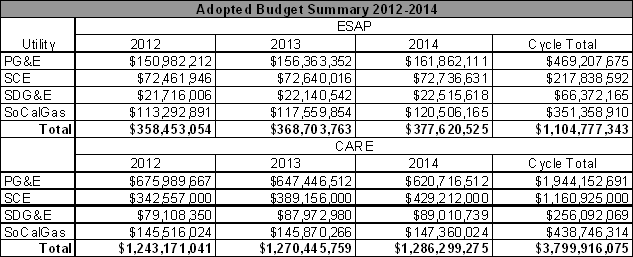
2. Pacific Gas and Electric Company, Southern California Edison Company, San Diego Gas & Electric Company, and Southern California Gas Company shall treat at least 1 million households over the 2012-2014 budget cycle with the Energy Savings Assistance Program Budget approved in this decision.
3. Pacific Gas and Electric Company, Southern California Edison Company, San Diego Gas & Electric Company, and Southern California Gas Company shall continue all their ongoing integration efforts among the Energy Savings Assistance Program, California Alternate Rates for Energy Program, Energy Efficiency programs, Demand Response programs, California Solar Initiative, and any other of the utility demand side programs.
4. Within 60 days after this decision is issued, and consistent with the guidance set forth in this decision, the Energy Division shall form the (a) Energy Savings Assistance Program Cost-effectiveness Working Group, (b) Energy Savings Assistance Program Workforce, Education and Training Working Group, and (c) Mid-Cycle Working Group to review those components of the Commission's Energy Savings Assistance Program and California Alternate Rates for Energy Programs to make recommendations for refinements to improve, wherever possible, the design, administration, delivery and ultimate success of these programs.
5. Effective immediately, the Quarterly Public Meetings held by Pacific Gas and Electric Company, Southern California Edison Company, Southern California Gas Company and San Diego Gas & Electric Company shall be modified as follows:
(a) These Utilities shall be relieved of the Quarterly Public Meetings ordered in Decision 06-12-038.
(b) These Utilities shall convene a minimum of one public meeting per year, within 60 days of their filing of the annual reports, and other public meetings as deemed necessary by either the Utilities, the Energy Division, the ALJ, or the Commission.
(c) In the upcoming 2012-2014 program cycle, these Utilities shall use the meetings as a forum to host the working groups approved, as set forth below:
(1) Unless we have specified otherwise in other parts of this decision, within 60 days of the effective date of this decision, Energy Division is charged with the task of soliciting and putting together the following working groups:
(i) Cost-Effectiveness (CE) Working Group, as outlined and discussed in section 3.5.4 of this decision;
(ii) WE&T Working Group, as outlined and discussed in sections 3.11.5.4 and 3.11.5.5 of this decision; and
(iii) Mid-Cycle Working Group, and other(s) as Energy Division determines necessary and appropriate for this program cycle. (The charge for the Mid-Cycle Working Group will be to review: (a) Weatherization and Installation (WIS) Manual Updates; (b) Statewide Policy and Procedure Manual Updates; (c) Streamlining of the Utilities' Reporting Requirements; (d) The Utilities' Best Practices; (d) General Mid-cycle Program and Process Improvements; and (f) Potential 2015-2017 Application and Cycle Issues, including whether the next cycle applications could benefit from bifurcation of California Alternate Rates for Energy Program issues from Energy Savings Assistance Program issues);
(2) Unless we have specified otherwise in other parts of this decision, the size and makeup of a particular working group will be determined by Energy Division with the direction of the ALJ to yield a fair, informed, balanced and productive review and exploration of the issues that the working group must review;
(3) The Utilities shall host, notice, facilitate and provide public working group meetings, as needed and requested by each of the working groups during
2012-2013 program years;
(4) The Utilities should continue to equitably rotate the responsibility of facilitating these meetings, recording minutes and ensuring recommendations, reports and other progress reports are submitted to the proceeding service list and the Commission for review and consideration for inclusion in the record, subsequent Rulings and/or Decisions;
(5) These newly structured Utilities' public meetings can either be solely dedicated to a particular topic or working group or could accommodate more than one topic or working group, as needed, to address the needs of the working groups authorized in this decision;
(6) Unless we have specified a different schedule and deadlines for the particular working group, in other parts of this decision, each working group must, by no later than February 15, 2013, submit to the ALJ, the working group's progress report of findings and recommendation(s), if any. If no agreed upon recommendation(s) is/are reached, the working group shall submit a progress report nonetheless of its activities since inception and a detailed description of the status of its efforts in each of the subject areas it is charged to review in this decision with justification showing good cause for any additional and estimated time it may require;
(7) Unless we have specified a different schedule and deadlines for the particular working group, in other parts of this decision, each working group must, by no later than July 15, 2013, submit to the ALJ, its final report of findings and recommendation(s), if any. If no agreed upon recommendation(s) is/are reached, the working group shall submit a progress report nonetheless of its activities since inception and detailed description of the status of its efforts in each of the subject areas it is charged to review in this decision; and
(8) The terms of all working groups expire 45 days after its final report and recommendations are submitted to the ALJ.
6. By February 15, 2013, the Energy Savings Assistance Program Mid-Cycle Working Group shall submit to the assigned Administrative Law Judge their Progress Reports of findings and recommendation(s), if any, and if no agreed upon recommendation(s) is/are reached by then, the working group shall submit a progress report nonetheless of its activities since inception and a detailed description of the status of its efforts in each of the subject areas it is charged to review in this decision with justification showing good cause for any additional and estimated time it may require.
7. By July 15, 2013, the Energy Savings Assistance Program Mid-Cycle Working Group shall submit their Final Reports and Recommendations to the assigned Administrative Law Judge.
8. Pacific Gas and Electric Company, Southern California Edison Company, San Diego Gas & Electric Company, and Southern California Gas Company shall immediately begin collecting the following data in these seven Workforce Education and Training areas:
(a) Contractor and subcontractor contract terms (competitive bid, direct award, etc.);
(b) Contractor and subcontractor compensation schemes (hourly, piecemeal, salaried, etc.);
(c) Number of inspection failures and the types of failures (including the number of enrolled customers later deemed ineligible, number of incorrectly assessed households and instances of measure installation inspection failures);
(d) Level and type of Utilities' training (including lead safety training) and screening (including background check) these specific contractors have completed;
(e) Customer feedback for these contractors, positive and negative;
(f) Demographic data of the current Energy Savings Assistance Program workforce, including minority, local, low income, disabled, displaced, and other disadvantaged communities; and
(g) The Utilities' assessment of any other needs of the existing workforce to meet the current and future Energy Savings Assistance Program demands.
9. By February 1, 2013, Pacific Gas and Electric Company, Southern California Edison Company, San Diego Gas & Electric Company, and Southern California Gas Company shall work together to develop a single, uniform reporting template and shall submit a report showing each utility' preliminary findings and summary of Workforce Education and Training data collected in the seven Workforce Education and Training areas for program year 2012 to begin assessing its workforce and the education and training needs, if any, of the existing Energy Savings Assistance Program workforce in yielding effective and quality program outcomes.
10. By April 15, 2013, the Energy Savings Assistance Program Workforce Education and Training Working Group shall evaluate the data gathered and submitted by the Utilities and develop and submit to the assigned Administrative Law Judge their Progress Reports of findings and recommendation(s), if any, and if no agreed upon recommendation(s) is/are reached by then, the working group shall submit a progress report nonetheless of its activities since inception and a detailed description of the status of its efforts in each of the subject areas it is charged to review in this decision with justification showing good cause for any additional and estimated time it may require.
11. By July 15, 2013, the Energy Savings Assistance Program Workforce Education and Training Working Group shall submit their Final Reports and Recommendations to the assigned Administrative Law Judge.
12. By February 15, 2013, the Energy Division shall submit to the assigned Administrative Law Judge a white paper on the subject of the Energy Savings Assistance Program and its cost-effectiveness methodology and framework; and the assigned Administrative Law Judge thereafter shall circulate it for comments to the service list of this proceeding.
13. By March 15, 2013, the Energy Savings Assistance Program
Cost-effectiveness Working Group shall convene a minimum of two public workshops.
14. By July 15, 2013, the Energy Savings Assistance Program
Cost-effectiveness Working Group shall submit to the assigned Administrative Law Judge its Final Proposal and Recommendation; and the assigned Administrative Law Judge thereafter shall circulate it for comments to the service list of this proceeding.
15. Pacific Gas and Electric Company, Southern California Edison Company, San Diego Gas & Electric Company, and Southern California Gas Company shall continue their tracking and report to the Commission on the status of each of their Energy Savings Assistance Program specific integration efforts in their annual report submitted in May of each year, following the guidance set forth in Decision 08-11-031, shall identify and explain if those efforts meet at least two of the four Energy Savings Assistance Programs integrations goals and to devise and refine such efforts, as necessary.
16. The Energy Division shall review the annual reports submitted by Pacific Gas and Electric Company, Southern California Edison Company, San Diego Gas & Electric Company, and Southern California Gas Company and work with them to enhance integration during the 2012-2014 cycle if our metrics are not met and shall update and make recommendations to the Commission on the integration efforts toward meeting the four Energy Savings Assistance Programs integrations goals.
17. Pacific Gas and Electric Company, Southern California Edison Company, San Diego Gas & Electric Company, and Southern California Gas Company shall cooperate with the Energy Division's guidance or recommendations on the integration efforts.
18. Pacific Gas and Electric Company, Southern California Edison Company, San Diego Gas & Electric Company, and Southern California Gas Company shall proactively find and take advantage of all leveraging opportunities for Energy Savings Assistance and California Alternate Rates for Energy Programs with other programs offered in California.
19. Southern California Edison Company's request to discontinue its current efforts to leverage Energy Savings Assistance Program with the California Advanced Homes Program is approved.
20. Pacific Gas and Electric Company, Southern California Edison Company, San Diego Gas & Electric Company, and Southern California Gas Company shall continue their current leveraging efforts, except with the California Advanced Homes Program.
21. The leveraging efforts proposed by Pacific Gas and Electric Company, Southern California Edison Company, San Diego Gas & Electric Company, and Southern California Gas Company are approved.
22. Pacific Gas and Electric Company, Southern California Edison Company, San Diego Gas & Electric Company, and Southern California Gas Company shall:
· Share successful leveraging models and duplicate the successes of other Utilities' leveraging efforts; and
· Actively explore new opportunities and coordinate actual program delivery to promote long term enduring energy savings and cost efficiency.
23. Pacific Gas and Electric Company, Southern California Edison Company, San Diego Gas & Electric Company, and Southern California Gas Company shall continue to measure each of the existing and proposed leveraging efforts listed in their 2012-2014 Application for Energy Savings Assistance and California Alternate Rates for Energy Programs using the metrics in
Decision 08-11-031.
24. Energy Division shall recommend to the Commission if the leveraging efforts of Pacific Gas and Electric Company, Southern California Edison Company, San Diego Gas & Electric Company, and Southern California Gas Company fail to meet the objectives of the Decision 08-11-031 leveraging efforts metrics.
25. Pacific Gas and Electric Company, Southern California Edison Company, San Diego Gas & Electric Company, and Southern California Gas Company shall continue their current efforts of utilizing dual providers (California Department of Community Services and Development and Energy Savings Assistance Program) in program delivery; and if any utility does not utilize dual provider currently, such utility shall actively explore ways to incorporate dual service providers whenever practicable during this program cycle.
26. Pacific Gas and Electric Company, Southern California Edison Company, San Diego Gas & Electric Company, and Southern California Gas Company shall focus their leveraging effort with California Department of Community Services and Development in refining the data sharing activities with CSD's Low Income Home Energy Assistance Program (LIHEAP)/Weatherization Assistance Program (WAP) and to devise an effective leveraging plan, which at a minimum, shall include:
(a) Entering into agreement with CSD to develop a comprehensive statewide database system or bidirectional data sharing exchange that will enable the identification of households served under the LIHEAP/WAP program; and
(b) The design and implementation of a partnership effort that will effectively combine the resources and benefits of the LIHEAP/WAP programs with those of the Energy Savings Assistance Program.
27. Within 45 days after this decision is issued, Pacific Gas and Electric Company, Southern California Edison Company, San Diego Gas & Electric Company, and Southern California Gas Company shall begin coordination and discussions, on an as-needed frequency but no less than every 60 days, with California Department of Community Services and Development to develop and implement an effective leveraging plan between the Energy Savings Assistance Program and California Department of Community Services and Development.
28. Pacific Gas and Electric Company, Southern California Edison Company, San Diego Gas & Electric Company, and Southern California Gas Company shall implement the 2009 Process Evaluation recommendations by updating, simplifying and making uniform the property owner waiver and co-pay forms and making the forms available in languages other than English, if there is sufficient need justifying such expenditure.
29. Within 90 days of full implementation by Southern California Edison Company, Southern California Edison Company shall report to the Energy Division, Pacific Gas and Electric Company, San Diego Gas & Electric Company, and Southern California Gas Company on the effectiveness of its integrated schedule manager and routing tool for possible statewide adoption.
30. Pacific Gas and Electric Company, Southern California Edison Company, San Diego Gas & Electric Company, and Southern California Gas Company shall integrate their Home Energy Efficiency Surveys programs and the California Integrated Customer Energy Audit Tool into the Energy Savings Assistance Program so that Energy Savings Assistance contractors can use this information for easier enrollments and assessments.
31. Within 90 days after this decision is issued, Pacific Gas and Electric Company, Southern California Edison Company, San Diego Gas & Electric Company, and Southern California Gas Company shall review the training curriculum and licensing requirements of the outreach and assessment contractors to evaluate and report to the Energy Division, each utility's projected budget necessary to train and otherwise enable those contractors in their initial visit, to install simple measures such as smart power strips to income qualified customers who have passed the modified 3MM Rule; and the Energy Division shall review and make necessary recommendations.
32. Pacific Gas and Electric Company, Southern California Edison Company, San Diego Gas & Electric Company, and Southern California Gas Company shall continue to conduct their current Marketing, Education and Outreach efforts as directed in this decision.
33. Pacific Gas and Electric Company, Southern California Edison Company, San Diego Gas & Electric Company, and Southern California Gas Company shall anticipate and make plans for potential Marketing, Education and Outreach mid-cycle changes to align with the Commission's statewide Marketing, Education and Outreach activities/directions set forth in Decision 12-05-015, the recently issued Guidance Decision in the general energy efficiency docket, Rulemaking 09-11-014.
34. Pacific Gas and Electric Company, Southern California Edison Company, San Diego Gas & Electric Company, and Southern California Gas Company shall file their statewide Marketing, Education and Outreach applications incorporating low income programs' Marketing, Education and Outreach issues by August 3, 2012 as ordered in Decision 12-05-015 and ensure that such filings meaningfully incorporate low income programs' statewide Marketing, Education and Outreach issues consistent with the directions in this decision and any future directions in this proceeding.
35. In addition to the statewide Marketing, Education and Outreach activities, Pacific Gas and Electric Company, Southern California Edison Company, San Diego Gas & Electric Company, and Southern California Gas Company shall continue to conduct their approved Marketing, Education and Outreach efforts for the Energy Savings Assistance and California Alternate Rates for Energy Program Programs so not to lose any momentum and progress being made in those ongoing efforts.
36. Pacific Gas and Electric Company, Southern California Edison Company, San Diego Gas & Electric Company, and Southern California Gas Company shall continue to provide cost-effective measures within the existing Energy Savings Assistance Program cost-effectiveness framework.
37. Pacific Gas and Electric Company, Southern California Edison Company, San Diego Gas & Electric Company, and Southern California Gas Company shall ensure installation of the measures based on the current cost-effectiveness framework, with continued focus on the measures that meet the 0.25 thresholds, with those exceptions discussed in this decision.
38. The methodology and Cost Effectiveness Test (CE Test) as outlined in Decision 08-11-031 are adopted for the 2012-2014 cycle for evaluating cost-effectiveness of each measure (taking into account the housing type as well as climate zones), including exceptions to such CE Test as follows:
(a) CE Test: Measures that have both a Modified Participant Cost Test (PCm) and a Utility Cost Test (UCT) benefit-cost ratio greater than or equal to 0.25 (taking into consideration the housing type and climate zone for that measure) for that utility, pass the CE Test and shall be included in the Energy Savings Assistance Program. This rule applies for both existing and new measures.
(b) Two exceptions to CE Test are:
(i) Existing measures that have either a PCm or a UCT benefit-cost ratio less than 0.25 (taking into consideration the housing type and climate zone for that measure) is deemed to have passed the CE Test and shall be retained in the Energy Savings Assistance Program; and
(ii) Existing and new measures with both PCm and UCT test results less than 0.25 (taking into consideration the housing type and climate zone for that measure) for that utility may be included in the Energy Savings Assistance Program for health safety and comfort reasons as add back measures, by first securing Commission's approval for such exception; and all approved add back measures are subject to additional reporting requirements.
39. Pacific Gas and Electric Company, Southern California Edison Company, San Diego Gas & Electric Company, and Southern California Gas Company shall follow the two step reporting for all of the add back measures approved in this decision:
(a) Within 30 days after this decision is issued, Pacific Gas and Electric Company, Southern California Edison Company, San Diego Gas & Electric Company, and Southern California Gas Company shall forecast, for 2012-2014 (per year and for the full three year period), for any measure that we include in the program that falls below the 0.25 cost effectiveness threshold test, the following:
(i) The measure type and climate zone;
(ii) How many such measures the utility anticipates installing in 2012-2014 in each add back climate zone;
(iii) The budget impact of the add backs; and
(iv) The energy savings impacts of the add backs, based on the assumption that installation of measures that do not already exist in a home will increase, rather than decrease, energy usage.
(b) Pacific Gas and Electric Company, Southern California Edison Company, San Diego Gas & Electric Company, and Southern California Gas Company shall report in their annual reports, due in May of each year for the prior year, the actual figures in each of the foregoing four categories. If the add backs will compromise these Utilities' ability to meet the 2020 Strategic Plan goal that 100% of eligible and willing customers will have received all cost effective Energy Savings Assistance Program measures, they shall include a narrative in their annual reports on how they propose to address the shortfall in other parts of their Energy Savings Assistance Program.
40. Pacific Gas and Electric Company, Southern California Edison Company, San Diego Gas & Electric Company, and Southern California Gas Company shall add back the attic insulation measure in the housing types and climate zones as approved in the 2009-2011 Energy Savings Assistance Program in the 2012-2014 Energy Savings Assistance Program, with the addition of climate zone 14 for single family homes in Pacific Gas and Electric Company's service area.
41. Pacific Gas and Electric Company, Southern California Edison Company, San Diego Gas & Electric Company, and Southern California Gas Company shall review the issue of whether there is a need or justification for increasing the minimum standards of the installation of attic insulation, as part of their next round of annual updates to the Weatherization Installation Standards Manual.
42. The Air Sealing and Envelope measures, as proposed by Pacific Gas and Electric Company, Southern California Edison Company, and Southern California Gas Company, are approved as added back measures.
43. Pacific Gas and Electric Company's proposed water conservation measures (low-flow showerheads, water heater blankets, water heater pipe insulation, and faucet aerators) are approved as add back measures.
44. The Furnace and Water Heater Repair/Replacement measures, as proposed by Pacific Gas and Electric Company, San Diego Gas & Electric Company, and Southern California Gas Company, are approved as add back measures for eligible owner-occupied homes.
45. The Furnace and Water Heater Repair/Replacement measures for tenant-occupied homes shall not occur without significant review and deliberation of the issue to occur in the second phase of this proceeding.
46. Southern California Edison Company's proposals to add back Central Air Conditioner measure for single family households in climate zones 14 and 15 and for multifamily households in climate zone 14 are approved.
47. Southern California Edison Company's proposal to add back Room Air Conditioner for all housing types in climate zones 10 and 13 is approved.
48. San Diego Gas & Electric Company's proposal to add back Room Air Conditioner for all housing types in climate zone 10 in their territory is approved.
49. Southern California Edison Company's proposal to add back Heat Pumps for single family and multifamily households in climate zone 15 is approved.
50. Pacific Gas and Electric Company's and San Diego Gas & Electric Company's proposed cooling measure retirements in all climate zones for single family and multifamily households is approved, with the exception of Room Air Conditioner in climate zones 10, 13, 14 and 15, and Central Air Conditioners in climate zones 14 and 15.
51. We deny the proposed retirement of the Duct Test and Seal measure by Pacific Gas and Electric Company, San Diego Gas & Electric Company, and Southern California Gas Company, and direct this measure to be added back.
52. Pacific Gas and Electric Company, San Diego Gas & Electric Company, and Southern California Gas Company shall comply with the additional reporting requirements for all add backs as ordered in this Decision, including energy savings values as well as the quantity by housing type and in the climate zones projected for installation for each program year.
53. Southern California Edison Company's proposed retirement of Central Air Conditioner service measure is denied, and therefore this measure shall be added back.
54. Southern California Edison Company's proposed retirement of evaporative cooler maintenance measure is approved.
55. Pacific Gas and Electric Company, Southern California Edison Company, San Diego Gas & Electric Company, and Southern California Gas Company shall immediately begin to work with the Energy Division and consult with their mainstream energy efficiency Heating, Ventilation and Air Conditioning Quality Maintenance (HVAC QM) program staff to investigate approaches to align, coordinate, or integrate these Energy Savings Assistance Program offerings with the mainstream HVAC QM program.
56. Within 120 days after this decision is issued, Pacific Gas and Electric Company, Southern California Edison Company, San Diego Gas & Electric Company, and Southern California Gas Company shall submit a final report to the Energy Savings Assistance Program and general energy efficiency proceeding service lists documenting their findings with regard to the feasibility of aligning these programs and, if feasible and appropriate, how they would propose to modify their Energy Savings Assistance Program offerings to conform to the Commission's Heating, Ventilation and Air Conditioning Quality Maintenance (HVAC QM) program objectives (Final Report). These Utilities shall have first secured public comment on the Final Report, and if appropriate, have also held a workshop to address any outstanding issues.
57. Within 180 days after this decision is issued, Pacific Gas and Electric Company, Southern California Edison Company, San Diego Gas & Electric Company, and Southern California Gas Company shall file, (a) if necessary, a Tier 2 Advice Letter seeking to modify their Central Air Conditioner service offering and budgets or propose new program designs in accordance with the findings of their Final Report and in response to stakeholders' feedback; or (b) a report to the Energy Division Director explaining the rationale for their decision not to file a Tier 2 Advice Letter.
58. San Diego Gas & Electric Company's proposed retirement of evaporative cooler cover measure is approved.
59. Southern California Gas Company's proposed retirement of Tankless Water Heater measure is approved.
60. The below list of newly proposed measures in the housing types and climate zones for program year 2012-2014, as proposed by Pacific Gas and Electric Company, Southern California Edison Company, San Diego Gas & Electric Company, and Southern California Gas Company, are approved:
· Pacific Gas and Electric Company: Thermostatic Shower Valve Measure, Smart AC Fan Delays, and Microwaves
· Southern California Edison Company: Smart Power Strips and Variable-Speed Pool Pumps
· Southern California Gas Company: Thermostatic Shower Valve Measure
· San Diego Gas & Electric Company: Smart Power Strips
61. Within 60 days after this decision is issued, Pacific Gas and Electric Company shall file (a) cost effectiveness values for the smart power strip measure for each of the different housing types and climate zones that they cover, to see if they meet the Cost-effectiveness Test, and (b) an estimate for the costs, energy savings values, as well as the projected quantity (by housing type and climate zone) of this measure to be installed for each program year.
62. Within 60 days after this decision is issued, Pacific Gas and Electric Company, Southern California Edison Company, San Diego Gas & Electric Company, and Southern California Gas Company shall file (a) the cost-effectiveness values for the high efficiency forced air unit measure for each of the different housing types and climate zones that they cover, to see if they pass the Cost-effectiveness Test, and (b) an estimate for the costs, energy savings values, as well as the projected quantity (by housing type and climate zone) of this measure to be installed for each program year.
63. Appendices H-K, which reflect and itemize the approved measures lists for 2012-2014 for Pacific Gas and Electric Company, Southern California Edison Company, San Diego Gas & Electric Company, and Southern California Gas Company are adopted.
64. To the extent Pacific Gas and Electric Company, Southern California Edison Company, San Diego Gas & Electric Company, and Southern California Gas Company have proposed to add back or otherwise add proposed new measures to the Energy Savings Assistance Program for 2012-2014 program cycle in their Applications that fail the Cost-effectiveness Test and/or we did not expressly approve the proposed measures in this decision, such measures are not approved.
65. Pacific Gas and Electric Company, Southern California Edison Company, San Diego Gas & Electric Company, and Southern California Gas Company shall make appropriate revisions to the Statewide Policy and Procedures Manual by incorporating the Appendices H-K of this decision.
66. In planning for the 2015-2017 program cycle and applications, Pacific Gas and Electric Company, Southern California Edison Company, San Diego Gas & Electric Company, and Southern California Gas Company shall apply the same cost-effectiveness methodology used in 2012-2014 cycle to their 2015-2017 Energy Savings Assistance Program, unless the Commission provides a different direction.
67. We retain and make no changes to the Energy Savings Assistance Program's modified Three Measure Minimum Rule, as modified in Decision 08-11-031 and clarified in Decision 09-06-026.
68. Pacific Gas and Electric Company, Southern California Edison Company, and San Diego Gas & Electric Company's proposal to change the Energy Savings Assistance Program refrigerator replacement criteria from pre-1993 units to pre-1999 units is approved.
69. Pacific Gas and Electric Company, Southern California Edison Company, San Diego Gas & Electric Company, and Southern California Gas Company shall follow the directions, guidance or requirements in Decision 12-05-015, concerning Compact Fluorescent Lamps and coordinate their Energy Savings Assistance Program activities in the 2012-2014 cycle, consistent with the directions and approaches we provide therein, where appropriate.
70. Pacific Gas and Electric Company, Southern California Edison Company, San Diego Gas & Electric Company shall continue to install all Compact Fluorescent Lamps they give to Energy Savings Assistance Program customers.
71. Pacific Gas and Electric Company, Southern California Edison Company, San Diego Gas & Electric Company, and Southern California Gas Company shall improve their penetration of the multifamily segment of the low income population, by immediately rolling out the eight immediate Multifamily Segment Strategies, including additional measure offerings approved in this decision, as follows:
Strategy 1 - Whole Neighborhood Approach.
Strategy 2 - Property Owner Waiver Update.
Strategy 3 - Updated Marketing Approach to Multifamily Homes.
Strategy 4 - EUC/MIDI/MFEER Coordination.
Strategy 5 - Single Point of Contact
Strategy 6 - Same Day Enrollment, Assessment, and Installation.
Strategy 7 - Streamline Practice and Service Delivery.
Strategy 8 - Providing Feasible Measures for Multifamily Segment Including Retention of Certain Measures Proposed for Retirement for program cycle 2012-2014.
72. As part of a parallel, two-pronged approach, Pacific Gas and Electric Company, Southern California Edison Company, San Diego Gas & Electric Company, and Southern California Gas Company shall work with the Energy Division to examine the Multifamily Segment issue to devise a full set of comprehensive multifamily segment strategies, as discussed in section 3.10.6.4 of this decision, including developing and advancing more long-term and comprehensive Multifamily segment strategies.
73. Pacific Gas and Electric Company, Southern California Edison Company, San Diego Gas & Electric Company, and Southern California Gas Company are directed to pursue a Multifamily Segment Study ordered in this decision below. The budget for this Multifamily Segment Study is not to exceed $400,000 and shall be funded by the Energy Savings Assistance Program budgets. The Utilities shall pay for the contract with the following split: PG&E: 30%; SCE: 30%; SCG: 25%; and SDG&E: 15%.
74. Within 30 days after this decision is issued, the Energy Division, Pacific Gas and Electric Company, Southern California Edison Company, San Diego Gas & Electric Company, and Southern California Gas Company shall hold a one-day public workshop to garner input from interested stakeholders and parties on the development of the third party consultant request for proposal for a Multifamily Segment Study.
75. Within 60 days after this decision is issued, with the public and stakeholders' input, the Pacific Gas and Electric Company, Southern California Edison Company, San Diego Gas & Electric Company, and Southern California Gas Company and Energy Division shall develop and release the joint statewide request for proposal for a third party Multifamily Segment Study consultant.
76. Pacific Gas and Electric Company, Southern California Edison Company, San Diego Gas & Electric Company, and Southern California Gas Company and the Energy Division shall actively co-manage and oversee the Multifamily Segment Study and its consultant once retained.
77. Within 100 days after this decision is issued, Pacific Gas and Electric Company, Southern California Edison Company, San Diego Gas & Electric Company, and Southern California Gas Company and Energy Division shall take all reasonable actions to ensure award of contract for the Multifamily Segment Study.
78. Pacific Gas and Electric Company, Southern California Edison Company, San Diego Gas & Electric Company, and Southern California Gas Company and Energy Division shall take all reasonable actions to ensure that at a minimum, the Multifamily Segment Study and related consultant's work shall include the following:
(a) Gather data on the state's multifamily housing stock and ownership profiles, including a statewide demographic and programmatic assessment of California's low-income multifamily housing stock (by each utility's territory):
(b) Catalogue multifamily energy efficiency programs, including Commission programs and those administered by other government agencies, Utilities and organizations within the state of California, as well as recent and ongoing multifamily energy efficiency programs administered in other jurisdictions across the country;
(c) Evaluate and further examine comments, objections and proposals from parties to the proceeding in the context of the Energy Savings Assistance Program decisions, the current Commission directions and Strategic Plan;
(d) Review existing Commission's multifamily programs within the overall context of the Energy Savings Assistance Program;
(e) Review other recently completed multifamily projects performed under other state programs;
(f) Conduct field studies, as needed;
(g) Review and investigate the cost and budget implications of a multifamily program implementation;
(h) Review and investigate coordination concerns related to any new delivery methods that streamline the Energy Savings Assistance Program process with external financing and energy efficiency options such as how a single point of contact will be responsible for coordinating utility-administered energy efficiency, renewable, incentive, and financing programs as well as non-utility-administered, external multifamily efficiency, renewable, incentive, and finance programs in California;
(i) Identify available energy efficiency financing options, and develop a funding and implementation schema utilizing the variety of energy efficiency programs available for multifamily housing owner/operators;
(j) Develop overall recommendations for multifamily strategies looking toward the 2020 vision of 100% penetration;
(k) Hold public meetings to obtain, document, review and consider all stakeholders' input;
(l) Deliver a draft report by April 1, 2013, which will be circulated for comments; and
(m) By June 14, 2013, prepare and ultimately propose a feasible long-term multifamily treatment strategy (Final Report) for the Energy Savings Assistance Program to the assigned Administrative Law Judge.
79. By June 14, 2013, Pacific Gas and Electric Company, Southern California Edison Company, San Diego Gas & Electric Company, and Southern California Gas Company and Energy Division shall take all reasonable action to ensure that the Multifamily Segment Study and related Final Report is timely submitted to the assigned Administrative Law Judge and and that it summarizes all of the key findings, address public and stakeholders' comments and input, recommends the proposed multifamily segment strategies and best-practices, taking into account the Utilities' implementation and any interagency constraints and all programmatic, policy, operational and fiscal constraints/concerns, for coordination issues with other agencies and programs and overall program budgets.
80. Pacific Gas and Electric Company, Southern California Edison Company, San Diego Gas & Electric Company, and Southern California Gas Company and Energy Division shall take all reasonable action to ensure that the Multifamily Segment Final Report shall be preceded by ample public review and recurring stakeholder workshops held throughout and leading to its development, and includes recommendations on:
(a) How the Energy Savings Assistance program can be modified to better meet the needs of its low income multifamily residents;
(b) How multifamily segment measure offerings should be modified (including central system needs) and develop possible co-pay framework that comply with the Energy Savings Assistance Program cost-effectiveness approach; and
(c) How to modify the current service delivery approach to address multifamily energy efficiency programming concerns, based on: (i) Past studies and other programs, develop targeted and integrated outreach and marketing to low income multifamily housing owner/operators; and (ii) An understanding of the issues faced by contractors who will participate in the new approach to the low income multifamily housing segment, including training, certifications, service workflow, etc.
81. Pacific Gas and Electric Company, Southern California Edison Company, San Diego Gas & Electric Company, and Southern California Gas Company shall submit their cost estimates and budget categories associated with the integration of Energy Savings Assistance Program into the mainstream Energy Efficiency Workforce Education and Training Sector Strategy efforts and shared funding, where applicable.
82. The proposed 2012-2014 California Alternate Rates for Energy Program budgets of Pacific Gas and Electric Company, Southern California Edison Company, San Diego Gas & Electric Company, and Southern California Gas Company, are adopted with some modifications, as follows:
Adopted Budget Summary 2012-2014 | ||||
|
CARE | |||
2012 |
2013 |
2014 |
Cycle Total | |
PG&E |
$675,989,667 |
$647,446,512 |
$620,716,512 |
$1,944,152,691 |
SCE |
$342,557,000 |
$389,156,000 |
$429,212,000 |
$1,160,925,000 |
SDG&E |
$79,108,350 |
$87,972,980 |
$89,010,739 |
$256,092,069 |
SoCalGas |
$145,516,024 |
$145,870,266 |
$147,360,024 |
$438,746,314 |
Total |
$1,243,171,041 |
$1,270,445,759 |
$1,286,299,275 |
$3,799,916,075 |
83. The California Alternate Rates for Energy Program outreach budgets, as proposed by Pacific Gas and Electric Company, Southern California Edison Company, San Diego Gas & Electric Company, and Southern California Gas Company, are adopted with minor reductions, as reflected in Appendix M of this decision.
84. By December 21st of each year, Pacific Gas and Electric Company, Southern California Edison Company, San Diego Gas & Electric Company, and Southern California Gas Company shall file their reports on cooling center facility activities including, attendance, low income program enrollments, and itemized expenses and describing the energy education and marketing materials provided at each cooling center facility.
85. Within 30 days after this decision is issued, Pacific Gas and Electric Company, Southern California Edison Company, San Diego Gas & Electric Company, and Southern California Gas Company shall post on their websites a list of designated cooling center locations as well as days and hours of operation.
86. The proposals of Pacific Gas and Electric Company and San Diego Gas & Electric Company to continue to fund the cooling centers as part of their California Alternate Rates for Energy Administration budgets and proposal of Southern California Edison Company to utilize a separate memorandum account under Energy Resource Recovery Act for funding are approved.
87. The proposed cooling center budgets of Pacific Gas and Electric Company, Southern California Edison Company, Southern California Gas Company and San Diego Gas & Electric Company are approved with some modifications as follows:
Proposed and Approved Prorated Cooling Center Budgets 2013-2014
Utility |
IOUs' Adopted 2012-2014 Cooling Center Budgets |
IOU Adopted 2013 Budget (Prorated) |
IOU Adopted 2014 Budget (Prorated) |
SCE |
$315,250 |
$105,083 |
$105,083 |
PG&E |
$383,537 |
$127,846 |
$134,846 |
SDG&E |
$102,621 |
$34,329 |
$35,985 |
88. Southern California Edison Company's proposal to spend $30,000 to conduct a subsequent evaluation of its cooling center program is denied.
89. Pacific Gas and Electric Company, Southern California Edison Company, Southern California Gas Company and San Diego Gas & Electric Company shall retain and follow our current Categorical Eligibility and Enrollment Program to continue to allow continued ease of access for enrolling into the California Alternate Rates for Energy Program with the following modifications:
(a) The Utilities shall retain all prior pre-approved categorical enrollment programs, for now;
(b) By January 31st of each year, the Utilities are directed to jointly and annually review and submit, by Tier 2 Advice Letter, an updated list of proposed categorical eligible low income programs for the upcoming year. The list must propose to retain and add categorically eligible programs for enrollment in low income programs, as appropriate, and must include only programs with income thresholds consistent with the California Alternate Rates for Energy and Energy Savings Assistance Program Programs;
(i) These lists, once approved, shall be updated annually and be used to implement the Categorical Eligibility and Enrollment Program for California Alternate Rates for Energy and Energy Savings Assistance Program, for the upcoming fiscal year; and
(ii) Energy Division shall review and issue an annual approval letter (with the approved updated list of programs in the Categorical Enrollment Program) along with the updated annual California Alternate Rates for Energy income guidelines letter on April 1st each year; and
(c) No customers shall be permitted to self-recertify without providing income documentation. As an exception to this rule, in lieu of income documentation, California Alternate Rates for Energy Program customers who have been income verified by a qualifying categorical eligible low income program may recertify by submitting proof of enrollment in an approved categorical eligibility program.
90. Pacific Gas and Electric Company, Southern California Edison Company, Southern California Gas Company and San Diego Gas & Electric Company shall begin an immediate development of an interim targeted Post Enrollment Verification stratified probability model by incorporating following basic factors in their modeling as well as any other territory specific factors, as appropriate:
· High energy use (including customers with usage above 400% baseline in any monthly billing cycle and above)
· Annual bill amounts
· Household size
· PRIZM or ZIP code
· Enrollment method
· Previously indicated customer ineligibility
· Customers previously de-enrolled from the California Alternate Rates for Energy program
91. Within 60 days of this decision, Pacific Gas and Electric Company, Southern California Edison Company, Southern California Gas Company and San Diego Gas & Electric Company shall, based on the Utilities' past post enrollment verification records and experiences, develop and implement an interim Post Enrollment Verification model, at a reasonable rate that each IOU deems reasonably necessary to:
(a) Ensure meaningful size in sampling to yield the necessary results to aid in the development of effective long term probability models for the Utilities;
(b) Ensure the integrity of the California Alternate Rates for Energy Program;
(c) Provide assurance that California Alternate Rates for Energy Program discount rates are received only by those lawfully intended to receive them;
(d) Remove any fraud and abuse; and
(e) Properly factor in the potential program disruptions as well as administrative costs.
92. Pacific Gas and Electric Company, Southern California Edison Company, Southern California Gas Company and San Diego Gas & Electric Company shall, apply their interim post enrollment verification rate to all enrolled California Alternate Rates for Energy Program customers, including self-certified and categorically enrolled California Alternate Rates for Energy Program customers.
93. Pacific Gas and Electric Company, Southern California Edison Company, Southern California Gas Company and San Diego Gas & Electric Company shall not exceed 200% of the Utilities' 2011 post enrollment verification rate in setting an interim probability model and verification rate; and if a utility finds that it requires that its interim verification rate must exceed 200% of the utility's 2011 post enrollment verification rate to meet the criteria set forth in this decision, the utility may submit a Tier 2 Advice Letter seeking approval of such rate and demonstrating its justifications.
94. Beginning immediately, Pacific Gas and Electric Company, Southern California Edison Company, Southern California Gas Company and San Diego Gas & Electric Company shall closely track, monitor and review the data from the implementation of the interim probability model and incorporate lessons learned into the designing the long terms probability models for review by the Energy Division; and in the long term probability model proposals, the Utilities must set forth justifications based on the lessons learned during the interim probability model implementation.
95. Pacific Gas and Electric Company, Southern California Edison Company, Southern California Gas Company and San Diego Gas & Electric Company shall track and report in their annual reports the Post Enrollment Verification data, including:
(a) The number of enrollments verified;
(b) The number of successful verifications and de-enrollments;
(c) The number and reason for each California Alternate Rates for Energy customer de-enrolled during the Post Enrollment Verification process (either through customer non-response or deemed ineligible for the program);
(d) How those successfully verified were initially enrolled in the California Alternate Rates for Energy Program (e.g. capitation agency, self-certification, Categorical Enrollment, etc.);
(e) How those de-enrolled and ineligible customers were initially enrolled in the California Alternate Rates for Energy Program (e.g. capitation agency, self-certification, Categorical Enrollment, etc.); and
(f) Whether probability model is yielding optimal results by de-enrolling ineligible customers from the California Alternate Rates for Energy program and ensuring that California Alternate Rates for Energy Program discounts are not diverted to ineligible population.
96. By September 1, 2013, Pacific Gas and Electric Company, Southern California Edison Company, Southern California Gas Company and San Diego Gas & Electric Company shall design and propose, via a Tier 2 Advice Letter process, a long term probability model framework that incorporates the basic factors required in the interim probability model, including an optimal Post Enrollment Verification rate tailored to each utility, to cost-effectively identify California Alternate Rates for Energy Program enrollees who have the probability of being ineligible in the program, while tailoring the model to the Utilities' specific territory that take into account the basic probability factors, populations and administration costs.
97. Energy Division shall determine whether the Utilities' long term probability model design presents the best modeling and Post Enrollment Verification rate for each of the Utilities to ensure that all California Alternate Rates for Energy Program enrollments is comprised of only eligible households.
98. Southern California Edison Company's request for California Alternate Rates for Energy Program customers who fail to respond to an income verification request be barred from self-certified re-enrollment in the California Alternate Rates for Energy Program for 24 months is approved; however, if at any time during the 24 months a de-enrolled customer verifies eligibility, they shall be placed back on the California Alternate Rates for Energy rate. All of the Utilities shall adopt this new California Alternate Rates for Energy Program rule.
99. We approve Pacific Gas and Electric Company's request to allow California Alternate Rates for Energy capitation contractors to aid in the Post Enrollment Verification process for an "up to $18.00" per capita fee, and direct all other Utilities to institute similar outreach programs.
100. Southern California Edison Company's request for $2.9 million in information technology program upgrades is approved.
101. Southern California Edison Company's request for $2.1 million for increased verification processing is approved.
102. We approve Pacific Gas and Electric Company's high usage customer proposal, with some modifications, and also require its implementation statewide for all electric Utilities. The statewide program changes shall include:
(a) 600% or more above baseline users: California Alternate Rates for Energy electric customers with electric usage above 600% of baseline in any monthly billing cycle shall have 90 days to drop usage below 600% baseline in any monthly billing cycle or be de-enrolled and barred from the program for 24 months. In addition, to continue to stay in the program these customers must undergo Post Enrollment Verification and apply for the Energy Savings Assistance Program within 45 days of notice, and, if not previously enrolled in the program, apply for the Energy Savings Assistance Program within 45 days of notice. To the extent possible, all notifications must be accessible to customers with disabilities and to customers without English language proficiency, and must include information on the Medical Baseline program and the Utilities' appeal process.
(b) De-enrollment Appeal Process: Within 30 days of this decision, the Utilities must develop an expedited appeal process for those customers who may believe that they have been wrongfully de-enrolled to allow them the process to submit an appeal of the de-enrollment documenting their concerns and demonstrating their usage as "necessary, basic and legitimate household energy usage." If the Utilities' appeal process does not effective resolve the customer's appeal, the customer may seek the Commission's Energy Division assistance by contacting the Energy Division's Director and Energy Division Director will make the determination on whether there is reasonable justification demonstrating "necessary, basic and legitimate household energy usage." Once that determination is made, such customer may be re-enrolled upon the customer's agreement to participate in Post Enrollment Verification and energy efficiency/savings efforts by participating in the Energy Savings Assistance Program. An example of justified legitimate "necessary, basic and legitimate household energy usage" may include multiple income qualified households residing in a single residence and customers with documented medical equipment needs which requires and justifies the high usage.
(c) 400% - 600% baseline users: California Alternate Rates for Energy high electric customers with electric usage at 400%-600% of baseline in any monthly billing cycle must undergo Post Enrollment Verification and, if not previously enrolled in the program, must apply for the Energy Savings Assistance Program within 45 days of notice. To the extent possible, all notifications must be accessible to customers with disabilities and to customers without English language proficiency, and must include information on the Medical Baseline program and the Utilities' appeal process. All California Alternate Rates for Energy customers with usage above 400% in any monthly billing cycle who do not complete Post Enrollment Verification requests or have incomes found to be higher than allowed in the program, shall be de-enrolled from the program and barred from re-enrolling in the California Alternate Rates for Energy program for 24 months.
(d) Medical Baseline Program Referral: The Energy Savings Assistance Program contractors who visit these high usage households are to be trained to make referrals to the Medical Baseline program.
(e) Energy Savings Assistance Program Cooperation: If a high California Alternate Rates for Energy electric customer required to participate in the Energy Savings Assistance Program as a condition of their continued enrollment in California Alternate Rates for Energy, fails to keep at least one of the two appointments made with an Energy Savings Assistance Program contractor or fails to provide access to any portion of the metered property in question, or refuses to allow a post-participation quality control inspection, that customer shall be de-enrolled from the California Alternate Rates for Energy program and barred from re-enrolling in the California Alternate Rates for Energy program for 24 months.
(f) Post Enrollment Verification: The electric Utilities shall develop and field a standard income verification document for these instances which may require customers to provide a state or federally verified form of income proof, such as the household's annual tax returns
103. Southern California Edison Company's request to bar California Alternate Rates for Energy customers who fail to respond to an income verification request from self-certified re-enrollment in the California Alternate Rates for Energy Program for 24 months is approved with following additional requirements:
(a) If at any time during the 24 months a de-enrolled customer verifies eligibility, they must be placed back on the California Alternate Rates for Energy rate. After 24 months, those de-enrolled customers may be able to enroll in California Alternate Rates for Energy by again self-certifying their household and income eligibility; and
(b) To ensure consistency statewide, Pacific Gas and Electric Company, Southern California Edison Company, Southern California Gas Company and San Diego Gas & Electric Company shall also implement the California Alternate Rates for Energy program rule change.
104. Southern California Edison Company, Southern California Gas Company and San Diego Gas & Electric Company shall institute similar outreach programs as Pacific Gas and Electric Company by allowing California Alternate Rates for Energy Program capitation contractors to aid in the Post Enrollment Verification process for an up to $18.00 per capita fee is approved.
105. Pacific Gas and Electric Company, Southern California Edison Company, Southern California Gas Company and San Diego Gas & Electric Company shall develop a uniform quality control audit protocol for California Alternate Rates for Energy/Post Enrollment Verification capitation contractors.
106. We adopt an increase in the capitation fee from "up to $15.00" to "up to $20.00" for each new California Alternate Rates for Energy Program enrollment for program year 2012-2014, and similarly adopt that increased capitation fee cap to apply statewide to all of the Utilities.
107. We approve the following budget for pilots, studies and evaluations for the program cycle 2012-2014:
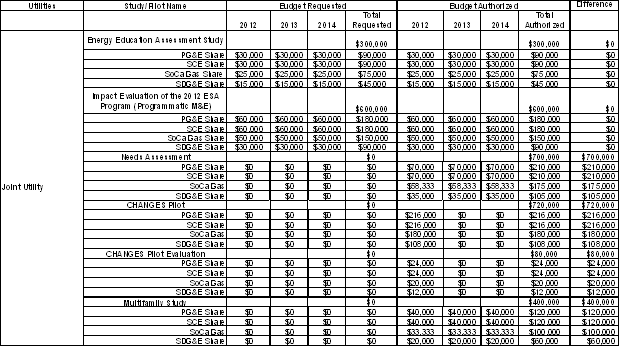
108. The Utilities shall conduct a new and targeted needs assessment during the 2012-2014 cycle, as follows:
(a) The budget for this Needs Assessment is not to exceed $700,000 and shall be funded by the Energy Savings Assistance Program budgets.
(b) The Utilities shall pay for the contract with the following split: PG&E: 30%; SCE: 30%; SCG: 25%; and SDG&E: 15%;
(c) The Utilities shall pay for the contract, but otherwise shall involve the Energy Division at the earliest possible time in the request for proposal and bid evaluation process;
(d) The Utilities, along with the Energy Division staff will evaluate the bids, and the Energy Division shall make the final determination on the contractor selection; and
(e) The process shall also follow the structure outlined in Resolution E-4237. The Utilities and the Energy Division must take all necessary and reasonable actions to ensure that by August 31, 2013, the Final Needs Assessment Report is completed, in order for the results to be incorporated into the California Alternate Rates for Energy and Energy Savings Assistance 2015-2017 program cycle applications process
109. The scope of such the new Needs Assessment study shall include, but is not limited to:
(a) Development of baseline estimates of the potential eligible, willing and remaining population for California Alternate Rates for Energy and Energy Savings Assistance Program, as well as methods for tracking changes over time;
(b) Identification of needs that exist, needs that are being met, and needs that are not met by the existing California Alternate Rates for Energy and Energy Savings Assistance Programs;
(c) Identification of service gaps not being addressed by the existing California Alternate Rates for Energy and Energy Savings Assistance Programs;
(d) Identification of barriers that cause service gaps in California Alternate Rates for Energy and Energy Savings Assistance Programs; and
(e) Recommendations on appropriate and effective methods for meeting energy-related needs in light of these potential barriers in California Alternate Rates for Energy and Energy Savings Assistance Programs.
110. The Final Needs Assessment Report shall address:
(a) How many households are eligible for the California Alternate Rates for Energy and Energy Savings Assistance Programs;
(b) How many households are enrolled in California Alternate Rates for Energy and have recently participated in the Energy Savings Assistance Program;
(c) What is the eligible, willing and remaining population for California Alternate Rates for Energy and Energy Savings Assistance Programs;
(d) Whether the current Energy Savings Assistance and California Alternate Rates for Energy Program's targeting, outreach, enrollment and verification processes are effective, and how can they be improved;
(e) The main reasons why customers choose not to participate in the California Alternate Rates for Energy and Energy Savings Assistance Programs;
(f) The Energy Savings Assistance Program measures that are most needed among eligible households;
(g) The Energy Savings Assistance Program measures that serve the most benefit to eligible households based on the Energy Savings Assistance Program eligible population's energy need, behavior and household characteristics;
(h) The available energy savings potential from the Energy Savings Assistance Programs;
(i) Whether the California Alternate Rates for Energy and Energy Savings Assistance Programs are reaching the appropriate targets, and if there are any significant under- or over-served segments; and
(j) Whether the California Alternate Rates for Energy and Energy Savings Assistance Programs are achieving their maximum potential program benefits, and what strategies should be used toward this end.
111. We approve the request for a $300,000 shared energy education evaluation study proposed by Pacific Gas and Electric Company, Southern California Edison Company, Southern California Gas Company and San Diego Gas & Electric Company; and the Utilities shall pay for the contract from their Energy Savings Assistance Program budgets with the following split: PG&E: 30%; SCE: 30%; SCG: 25%; and SDG&E: 15%.
112. Southern California Gas Company's request for $65,000 for a leave-behind energy education DVDs is approved.
113. Southern California Edison Company's proposed Impact Evaluation is approved with following conditions:
(a) Energy Division's Demand-Side Management Branch should share oversight and review of the evaluation plan and results of the study in collaboration with these Utilities, consistent with the evaluation, measurement and verification processes we set out in Decision 10-04-029. In Decision 10-04-029, the Commission laid out the evaluation, measurement and verification processes for the 2010-2012 mainstream energy efficiency program cycle. Specifically, the Commission directed the Pacific Gas and Electric Company, Southern California Edison Company, Southern California Gas Company and San Diego Gas & Electric Company to submit their evaluation projects for Energy Division approval prior to implementation. We expect these Utilities to adhere to this same process here;
(b) The draft research plan for the approved Impact Evaluation study and all relevant documents, including draft versions of an interim and/or final report, should be posted to Energy Division's document-sharing website (https://energydivision.basecamphq.com/login), and the project would feature its own Project Coordination Group that may facilitate review among these Utilities and Energy Division staff;
(c) The draft research plan and draft interim and/or final report will be shared publicly by also being posted to the Energy Division's Public Download Area website ( http://www.energydataweb.com/). This website will be used to solicit and post public comment on the Utilities' and Energy Division's evaluation plans and reports;
(d) The Utilities' Energy Savings Assistance Programs Impact Evaluation study, as proposed and approved here, should look for opportunities to leverage existing Energy Division or Utilities' studies in their mainstream energy efficiency programs. Collaboration may be possible for evaluation or other research projects currently in the field and future studies such as the Residential Appliance Saturation Survey and the California Lighting and Appliance Saturation Survey, in order to inform the project and produce more robust results. Leveraging existing studies may reduce evaluation costs and open opportunities to understand the whole residential market potential for energy efficiency; and
(e) The Utilities shall take all reasonable actions to ensure that by no later than August 31, 2013, the Final Impact Evaluation Report must be posted on the Energy Division's Public Download Area website ( http://www.energydataweb.com/).
114. Pacific Gas and Electric Company, Southern California Edison Company, San Diego Gas & Electric Company, and Southern California Gas Company shall fund the new Impact Evaluation study from, not to exceed $600,000 in total combined expenditure; and we direct that it be funded by the Energy Savings Assistance Program budgets, with the four Utilities sharing costs with equal split: PG&E: 25%; SCE: 25%; SCG: 25%; and SDG&E: 25%.
115. Pacific Gas and Electric Company, Southern California Edison Company, Southern California Gas Company and San Diego Gas & Electric Company shall track and report customer unwilling/unable percentages of California Alternate Rates for Energy Program customers during the 2012-2014 budget cycle, including the reasons why customers are unwilling and/or unable to participate in the program during the 2012-2014 program cycle.
116. The proposals by Pacific Gas and Electric Company, Southern California Edison Company, Southern California Gas Company and San Diego Gas & Electric Company to increase the California Alternate Rates for Energy Program customers' unwillingness factor are rejected.
117. Pacific Gas and Electric Company, Southern California Edison Company, Southern California Gas Company and San Diego Gas & Electric Company shall continue to use, in their California Alternate Rates for Energy Program, the current 5% unwillingness factor for 2012-2014.
118. We approve the proposed continuation of the 15% disabled household California Alternate Rates for Energy Program penetration enrollment goal.
119. Within 30 days after this decision is issued, the Energy Division is directed to convene and facilitate discussions, on an as-needed frequency but no less than every 60 days, with California Department of Community Services (CSD) and Development and Pacific Gas and Electric Company, Southern California Edison Company, Southern California Gas Company and San Diego Gas & Electric Company to better coordinate with CSD and Low Income Home Energy Assistance Program / Weatherization Assistance Program by developing a referral program for measure replacements not currently offered by the Energy Savings Assistance Program.
120. The proposals of San Diego Gas & Electric Company and Southern California Gas Company to move the Commission's California Alternate Rates for Energy (California Alternate Rates for Energy) annual income letter release date from May 1st to April 1st each year is approved, and we also move up the Family Electric Rate Assistance (FERA) update date so that the California Alternate Rates for Energy and FERA updates are simultaneously released.
121. Pacific Gas and Electric Company, Southern California Edison Company, Southern California Gas Company and San Diego Gas & Electric Company shall actively and cooperatively design, direct and manage all of their contracts in a way to ensure due dates for all of the deliverables, including final reports, at the time of bidding and later while the scope is being developed.
122. The proposal by Pacific Gas and Electric Company, Southern California Edison Company, Southern California Gas Company and San Diego Gas & Electric Company for Tier 2 Advice Letter process for mid-cycle changes, as an alternative to petition to modify process, to California Alternate Rates for Energy and Energy Savings Assistance Programs is denied.
123. Pacific Gas and Electric Company, Southern California Edison Company, Southern California Gas Company and San Diego Gas & Electric Company are directed to assist and use the Mid-cycle Working Group as a way to review the current Utilities' reporting requirements with an eye to streamline and reduce unnecessary and redundant reporting as well as make recommendations to update the application process to make any related process improvements.
124. Southern California Gas Company's request for $2,500,000 and San Diego Gas & Electric Company's request for $2,250,000 to implement a Customer Reward programs are denied.
125. San Diego Gas & Electric Company's request for $130,275 to allow its installation contractors a $15 referral fee is denied.
126. Southern California Gas Company's request for $15,000 to encourage its contractors to wear common uniforms is approved.
127. Southern California Gas Company's request for $10,000 to develop a new Enrollment Kit to assist the Contractor Outreach Specialists is approved.
128. Southern California Gas Company's request for authority to recover $3.1 million in overhead costs associated with proposed Customer Assistance Representative positions to be created using meter readers displaced by the installation of advanced meters is approved.
129. Southern California Gas Company's' request for California Alternate Rates for Energy Program IT costs for the first data sharing effort with a water utility and additional collaboration effort pursuant to Decision 11-05-020 is denied.
130. Once data sharing with water Utilities begin, Pacific Gas and Electric Company, Southern California Edison Company, Southern California Gas Company and San Diego Gas & Electric Company are directed to file a Tier 2 Advice Letter, and these Tier 2 Advice Letters must report on the corresponding costs borne by partnering water Utilities that are filed in accordance with Decision 11-05-020.
131. Pacific Gas and Electric Company, Southern California Edison Company, Southern California Gas Company and San Diego Gas & Electric Company shall file in this proceeding their annual estimates of customers eligible for the California Alternate Rates for Energy Program due by December 31 of each year.
132. Pacific Gas and Electric Company, Southern California Edison Company, Southern California Gas Company and San Diego Gas & Electric Company, consistent with the general Evaluation, Measurement & Verification processes we adopted and set out in Decision 10-04-029, shall:
(a) Submit their evaluation projects for Energy Division approval prior to implementation; and
(b) Adhere to this same process when evaluating pilots and any other activities ordered in this consolidated proceeding. This includes compliance with Commission's direction in Decision 10-04-029, which laid out guidelines for stakeholder input and Energy Division review and approval of utility-led energy efficiency evaluation projects. Specifically, evaluation projects will be posted to the public document website ( www.energydataweb.com) as well as Energy Division's internal file-sharing website (https://energydivision.basecamphq.com/login). In this manner, stakeholders and Energy Division will provide comment on and review of utility's evaluation project research plans, draft reports, and other documents integral to the evaluation project(s).
133. Pacific Gas and Electric Company, Southern California Edison Company, Southern California Gas Company and San Diego Gas & Electric Company shall implement Energy Savings Assistance Program's Evaluation, Measurement & Verification (EM&V) processes and activities to achieve the following core objectives in order to support the Commission's oversight function of ensuring efficient and effective expenditure of ratepayer funds within the energy efficiency portfolios. All activities must be undertaken to meet the overarching goals of clarity, consistency, cost-efficiency, and timeliness. The core objectives we adopt are:
· Savings Measurement and Verification - Measurement and verification of savings resulting from energy efficiency measures, programs, and portfolios serve the fundamental purpose of developing estimates of reliable load impacts delivered through ratepayer-funded efficiency efforts. Measurement and verification work should reflect a reasonable balance of accuracy and precision, cost, and certainty, and be designed for incorporation into in procurement planning activities.
· Program Evaluation - Evaluation of program-specific qualitative and quantitative measures, such as the program performance metrics discussed earlier in this decision and process evaluations, serves a key role in providing feedback for the purposes of improving performance and supporting forward-looking corrections to utility programs and portfolios. In order to maximize return on ratepayer dollars, program evaluations must be completed on a timeline which informs mid-course corrections and/or program planning for the following cycle.
· Market Assessment - In a constantly evolving environment, market assessments are an essential EM&V product needed to set the baseline for strategic design and improvement of programs and portfolios. Saturation studies, surveys of emerging technologies and other such analyses which inform estimates of remaining program potential and forward-looking goal-setting are key aspects of market assessment.
· Policy and planning support - Consistent with prior program cycles, it is essential to reserve funding to support overarching studies and advisory roles which support Commission policy goals. Over the last program cycle this has been inclusive of potential and goals studies, maintenance of the Database for Energy Efficient Resources, developing databases of best practices for program design and delivery, program design mix, and other means which support the Commission's oversight role, but do not fall under the core EM&V categories described above.
· Financial and Management audit - Supporting the Commission's oversight function of ensuring the efficient and effective expenditures of ratepayer funds within the Utilities' energy efficiency portfolios is another objective of EM&V activities. Rigorous financial and management audits overseen by Commission staffs.
134. We reject Southern California Edison's proposal to change the Fund Shifting Rules.
135. Pacific Gas and Electric Company, Southern California Edison Company, Southern California Gas Company and San Diego Gas & Electric Company shall devise and implement more careful management of all funds authorized in the Energy Savings Assistance and California Alternate Rates for Energy Programs, including all pilots and studies, and if a pilot is approved to be administered by a party other than the Utilities, this duty to carefully manage all pilot programs and funds extends to that party and Fund Shifting Rules should be viewed only as an option under extraordinary circumstances.
136. Pacific Gas and Electric Company, Southern California Edison Company, Southern California Gas Company and San Diego Gas & Electric Company shall continue to follow the Fund Shifting Rules in the Energy Savings Assistance and California Alternate Rates for Energy Programs in the 2012-2014 program cycle, as follows:
(a) COMMITMENT OF FUTURE FUNDING FOR LONG-TERM PROJECTS: For those long-term projects that require funding beyond the current budget program cycle and that will not yield savings in the current cycle, if applicable, these Utilities may anticipatorily commit funds for such projects for expenditure during the next program cycle, under strict limitations as follows:
(i) These Utilities shall seek authorization for such long-term projects and current and future cycle funding commitment by itemization of each long-term project in the utility portfolio plan, including an estimate of the total costs broken down by year and an estimate of associated energy savings, if any;
(ii) These Utilities shall seek authorization and commitment of all funding for long-term projects in the current program cycle and actually encumber such funds in the current program cycle;
(iii) All contracts with any and all types of implementing agencies and businesses must explicitly allow completion of long-term project related work beyond the current budget program cycle;
(iv) The amount of next cycle funds encumbered for long-term projects may not exceed 20% of the current program cycle budget;
(v) These Utilities shall separately track and report all long-term projects and obligations, including all information regarding funds encumbered and estimated date of project completion until such project is completed; and
(vi) Energy savings for projects with long lead times shall be calculated by defining the baseline as the codes and standards applicable at the time the building permit for the project is issued.
(b) ENERGY SAVINGS ASSISTANCE PROGRAMS FUND SHIFTING AND LIMITATIONS: Utilities are permitted to shift funds under the following conditions in the Energy Savings Assistance Program. are permitted to shift funds under the following conditions in the Energy Savings Assistance Program.
(i) Within 2012-2014 Budget Cycle: Except for the shifting of funds described in subsection b(3) below, the Utilities are permitted to shift funds from one year to another within the 2012-14 cycle without prior approval.
(ii) Fund Shifting Between 2012-2014 Budget Cycle and Future Budget Cycle:
a. "Carry back" Funding: Except for the shifting of funds described in subsection b(3) below, Utilities are permitted to shift and borrow from the next budget cycle, without prior approval of such fund shifting, if (a) the next cycle budget portfolio has been approved by the Commission; and (b) such fund shifting is necessary to avoid interruptions of those programs continuing into the next cycle and for start-up costs of new programs; and
b. "Carry forward" Funding: Utilities are permitted to carry over all remaining, unspent funds from program year to program year or budget cycle to budget cycle and shall include all anticipated carry over funds in the upcoming budget applications.
(iii) Administrative Law Judge's Prior Approval: For any shifting of funds, within or out of cycle, except for "carry forward" funding considered by the Commission through budget applications, the Administrative Law Judge's prior written approval is required if any of the following applies:
a. Shifting of funds into or out of different program categories including, but not limited to: (a) administrative overhead costs, (b) regulatory compliance costs, (c) measurement and evaluation, and (d) the costs of pilots and studies;
b. Shifting of funds into or out of Education subcategory;
c. Shifting of funds between gas/electric programs; and/or
d. Shifting of funds totaling 15% or more of the total current annual Energy Savings Assistance Program budget.
(iv) These Utilities shall secure prior written approval of the fund shift from the Administrative Law Judge when required by subsection b(3) above, of this ordering paragraph, by filing a motion pursuant to Article 11 of the Commission's Rules of Practice and Procedure. Upon showing of good cause, the Administrative Law Judge may issue a ruling approving the requested fund shift. Utilities, in the motion, must show good cause by setting forth the following:
a. The reason(s) why such fund shifting is necessary;
b. The reason(s) why such motion could not have been brought sooner; and
c. Justification supporting why the proposed shifting of funds would promote efficient, cost effective and effective implementation of the Energy Savings Assistance Programs.
(v) Utilities shall track and maintain a clear and concise record of all fund shifting transactions and submit a well-documented record of such transactions in their monthly and annual reports relevant to the period in which they took place.
(c) CALIFORNIA ALTERNATE RATES FOR ENERGY FUND SHIFTING AND LIMITATIONS: These Utilities are permitted to shift California Alternate Rates for Energy funds in the same manner as they did in the 2006-2008 budget cycle, but shall report all such shifting.
137. Within 60 days from the date of this decision, the Utilities shall submit by filing a petition to modify this decision under the Commission's Rule 16.4, any and all updated budget augmentations, testimonies and attendant updated tables (for measures and NOT already accounted for in this decision's approved budget) for approval by the Commission.
138. SCE requested additional budget for the add back of Central Air Conditioner maintenance measure is reasonable and is approved.
139. SDG&E requested additional budget for HVAC measure is reasonable is reasonable and is approved.
140. SoCalGas requested additional budget for Domestic Hot Water, Enclosure, and HVAC measures as well as a budget increase for Inspections are reasonable and are approved.
141. SCE's request to continue to fund gas service to low income customers on Catalina Island with the Energy Savings Assistance Programs funds is approved.
142. SCE's request to continue to fund gas service to low income customers on Catalina Island with the Energy Savings Assistance Programs funds is approved.
143. We delegate authority to the assigned Commissioner and Administrative Law Judge to make changes to the dates set forth in this decision at their discretion.
144. Within 30 days after this decision is issued, Pacific Gas and Electric Company, Southern California Edison Company, Southern California Gas Company and San Diego Gas & Electric Company shall consult with Energy Division on to the format for all the reports ordered in this decision.
145. Unless expressly approved, all other proposals made in the Applications of Pacific Gas and Electric Company, Southern California Edison Company, Southern California Gas Company and San Diego Gas & Electric Company or by other parties in this proceeding are denied.
146. Unless otherwise provided in this decision, all required Advice Letters shall be Tier 2 Advice Letters pursuant to General Order 96-B.
147. The due date for the Energy Savings Assistance and California Alternate Rates for Energy Programs and Budgets applications for 2015-2017 is July 1, 2014.
148. Application (A.) 11-05-017, A.11-05-018, A.11-05-019, and A.11-05-020 shall remain open, until the completion of the second phase of the consolidated proceeding.
This order is effective today.
Dated , at San Francisco, California.
1 California Public Utilities Code Section 382. All references to Code hereinafter refer to California Public Utilities Code.
2 D.08-11-031 at 2.
3 In this decision the terms household and home (or dwelling unit or unit) may be used interchangeably, as the program enabling terms provide eligibility based on
household-based criteria and the actual measures are delivered to homes, dwelling units or units.
4 See Energy Action Plan II, Implementation Roadmap for Energy Policies II, California Energy Commission and California Public Utilities Commission, September 21, 2005. Available at: http://docs.cpuc.ca.gov/word_pdf/REPORT/51604.pdf.
5 See Strategic Plan ( http://www.cpuc.ca.gov/NR/rdonlyres/D4321448-208C-48F9-9F62-1BBB14A8D717/0/EEStrategicPlan.pdf); see also January 2011 Update to Strategic Plan ( http://www.cpuc.ca.gov/NR/rdonlyres/A54B59C2-D571-440D-9477-3363726F573A/0/CAEnergyEfficiencyStrategicPlan_Jan2011.pdf).
6 Ibid.
7 Ibid.
8 Ibid.
9 Code Section 382 (e) provides, inter alia: The commission shall, by not later than December 31, 2020, ensure that all eligible low-income electricity and gas customers are given the opportunity to participate in low-income energy efficiency programs, including customers occupying apartments or similar multiunit residential structures. The commission and electrical corporations and gas corporations shall make all reasonable efforts to coordinate ratepayer-funded programs with other energy conservation and efficiency programs and to obtain additional federal funding to support actions undertaken pursuant to this subdivision.
10 Id at 1.
11 See supra footnote 3.
12 See KEMA Needs Assessment, at 1-3. This document can be viewed at ( http://docs.cpuc.ca.gov/published/Graphics/73106.PDF).
13 California Public Utilities Code Section 2790. All References to Code, hereafter in this decision, will be to California Public Utilities Code.
14 See www.californiaenergyefficiency.com.
15 Ibid.
16 Id. at 184; see also Strategic Plan which provides "The complementary objectives of the ... [ESA Program] are to provide an energy resource for California and to produce energy savings, while reducing low-income customer bills." Id. at 25.
17 Generally, the energy efficiency measures are provided at no cost to the resident, with the exception of a few measures owned by the landlords. In those instances, the landlord must make a co-pay.
18 Strategic Plan, updated January 2011 at 23.
19 These figures are from the IOUs' annual reports and Applications.
20 Strategic Plan at 25.
21 D.11-11-010, the bridge funding decision, also authorized $6.06 million in additional bridge funding for SoCalGas, for the bridge funding period based upon SoCalGas' projections.
22 On February 13, 2012, SDG&E filed an amended response to its prior response to the December 2011 Ruling.
23 D.12-06-030.
24 See supra footnote 3.
25 2009-2010 energy savings figure is based on the IOUs' annual reports and 2011 energy savings figure is based on the IOUs' December 2011 monthly reports, since 2011 annual reports are not due for filing until May 1, 2012.
26 2009 and 2010 homes treated figures are based on the IOUs' annual reports, and 2011 homes treated figures are based on the IOUs' December 2011 monthly reports, since 2011 annual reports are not due for filing until May 1, 2012.
27 PG&E updated its homes treated projections in its reply testimony. Program cycle total is unchanged but year by year projections were modified.
28 The variance between the IOUs' projections and the Commission's projections reflect the difference between the IOUs' estimates of eligible but unwilling low income homes which are higher than the Commission's estimates for that population. IOUs' estimate for that sector of low income household is 7% and the Commission's estimate is 5%. See section 5.3.1 of this decision generally discussing the Commission's 5% estimate.
29 See Strategic Plan.
30 In this decision, use of the terms and acronyms "integrated demand side management," "IDSM," "DSM," and integrated "Demand Side Resources" refer to all three primary demand side energy resources: energy efficiency (including low income programs), demand response, and distributed generation, and also to energy storage, where appropriate.
31 D.07-12-051 at 11.
32 Id. at 88.
33 D.07-12-052, Conclusion of Law 7.
34 Under the auspice of the energy efficiency budget proceeding, Application (A.) 98-07-021, et al., the Commission authorized the IDSM Taskforce. See D.09-09-047 at 215, Ordering Paragraph (OP) 33.
35 D.08-11-031 at 131-132.
36 See Strategic Plan; see also D.08-11-031.
37 HEES programs are administered by the IOUs and provide customers with information to help them become familiar with ways to control and reduce energy and water usage in their homes by offering customers up to four options (mail-in survey, on-line survey, phone survey, and in-home survey) in multiple languages, including an action plan for implementation. The program also provides survey results to enable participants to understand how their energy use varies throughout the year and how their household compares with similar households. The "official" program implementation plan can be found at the attached link. ( http://www.cpuc.ca.gov/NR/rdonlyres/3A357638-9BF5-4A64-A073- 5462B40AD1AE/0/SCESWResAudit.pdf)
38 SDG&E's IHD Pilot was designed to test technology that could provide real-time energy use and billing information to qualified low income customers. However, recruitment and fielding for the pilot became an issue as ESA outreach specialists did not have the technical expertise to discuss the product with customers due to the complexity and uniqueness of the technology being offered. (https:// www.pge.com/regulation/LowIncomeProgramPY12-14/Other-Docs/SDGE/2012/LowIncomeProgramPY12-14_Other-Doc_SDGE_20120201_228591.pdf.)
39 TURN describes this concept as a program that provides rebates to customers. The rebate amount would equal the electric and natural gas energy bill savings a customer achieves. TURN claims such program would have no minimum energy savings threshold to participate and no cap on the amount of rebate paid.
40 The HEAT System is SoCalGas' ESA Program workflow database used to track program activity and expenditures.
41 Final Report: Low Income Energy Efficiency Process Evaluation, dated June 10, 2011 (2009 Process Evaluation).
42 SCE is in the process of implementing automated routing and scheduling functionality into its central database. This functionality will provide proximity-based scheduling of jobs, mileage and time calculations, and route maps to and in between appointments allowing contractors to utilize the program's database as their single reference tool for scheduling jobs. This will improve customer service by allowing any one person speaking to the customer to respond to appointment inquiries. This technology will also enable ESA Program field crews to receive and close out new work orders through their smart phones. The use of this technology will result in faster response times and potentially reduce phone calls, paperwork and overhead costs. See SCE's Budget Application at 8-9.
43 Code §§ 8281 et seq. which provides: "it is the declared policy of the state to aid the interests of women, minority, and disabled veteran business enterprises in order to preserve reasonable and just prices and a free competitive enterprise, to ensure that a fair proportion of the total purchases and contracts or subcontracts for commodities, supplies, technology, property, and services for regulated public utilities, including, but not limited to, renewable energy, wireless telecommunications, broadband, smart grid, and rail projects, are awarded to women, minority, and disabled veteran business enterprises, and to maintain and strengthen the overall economy of the state."
44 D.11-05-019.
45 D.09-06-026 clarified D.08-11-031.
46 Issued August 9, 2002 in R.01-08-027.
47 Non-energy benefits capture a variety of effects, such as changes in comfort and reduction in hardship, that are not captured by the energy savings estimates derived from load impact billing evaluations, and are ignored in more traditional cost effectiveness approaches like the Total Resource Cost (TRC) Test.
48 D.08-11-031.
49 http://www.liob.org/docs/Non%20Energy%20Benefits%20Study%20-%20SERA%20Inc%20%202010.pdf.
50 Strategic Plan at 24.
51 Currently, the Commission only allows central air conditioning in climate zones 14 and 15, consistent with our prior decisions. Additionally, the Commission does not allow furnace repair and replacement or water heater repair and replacement work, consistent with our conclusions in D.07-12-051 and D.08-11-031, in rented housing as the Commission, time and again, found those should not be the responsibility of ratepayers but in fact should remain the responsibility of the landlord, consistent with landlord's habitability responsibility. See D.08-11-031 at 53; and See Green v. Superior Court (1974) 10 Cal.3d 616 [111 Cal.Rptr. 704], which held that all residential leases and rental agreements contain an implied warranty of habitability. Under the implied warranty, the landlord is legally responsible for repairing conditions that seriously affect the rental unit's habitability. That is, the landlord must repair substantial defects in the rental unit and substantial failures to comply with state and local building and health codes.
52 R-value indicates insulation's resistance to heat flow -- the higher the R-value, the greater the insulating effectiveness.
53 PG&E Testimony at 1-77 - 1-78.
54 EEC Protest at 11-13 and Synergy Protest at 5-6.
55 See also D.11-05-020 which directs the energy utilities in this proceeding to begin data sharing with the water utilities.
56 "Order Approving Pilot Water Conservation Programs Within the Energy Utilities'
Energy Efficiency Programs" in A.07-01-024.
57 See http://www.cpuc.ca.gov/NR/rdonlyres/FB6B2D95-CCC7-4C7B-B22E-00C2624C6E0F/0/EmbeddedEnergyinWaterPilotEMVReport_Final.pdf).
58 Central systems measures CHPC et al. propose include: (1) Whole-building, investment-grade energy audits; (2) HVAC-Heating Systems, repair and replacement: (Boiler/heater repair and replacement, Heating pipe insulation, Boiler plant controls, Boiler blankets, Heat pumps); (3) Thermostats and Thermostatic Radiator Valves; (4) Water Heater, repair and replacement: (Domestic hot water heater repair and replacement, Domestic Hot Water Pipe Insulation, High Efficiency Pump Motors/Heating Loop Pump, Recirculation Controls, Water Heater blankets); (5) Common Area Lighting; and (6) Roof/Attic Insulation.
59 PG&E estimates are based on its Response to ALJ December 2011 Ruling at 24; SDG&E's estimates are based on their 2011 data which shows that contractors repaired and/or replaced 945 space heaters and 152 hot water heaters in owner occupied units. In 2011, SDG&E enrolled approximately 22,751 homes of which 71% were rental units. This estimate assumes a consistent ratio of homes requiring this service, (SDG&E's Response to ALJ December 2011 Ruling at 13); and SoCalGas estimated number of appliance installations was calculated by applying the same rates of furnace and water heater repairs and replacements in owner-occupied units from 2009 through November 2011 to the projected number of rental units to be treated during the 2012-2014 period, (SoCalGas' Response to ALJ December 2011 Ruling Response at 1).
60 These figures are based on a different cost-effectiveness methodology used by CHPC for their projects. The CHPC's methodology is not consistent with the ESA Program's current cost-effectiveness methodology.
61 Measures (based on whole-building investment-grade audits for almost four dozen properties from across the state), Ruling Response at 10.
62 CHPC/NCLC Ruling Response at 10.
63 See D.08-11-031 at 53; and See also Green v. Superior Court (1974) 10 Cal.3d 616 [111 Cal.Rptr. 704].
64 See D.08-11-031 at 53; and See also Green v. Superior Court (1974) 10 Cal.3d 616 [111 Cal.Rptr. 704].
65 NRDC proposes that Duct Test and Seal be considered separately from duct sealing and the WIS manual should be updated to match Title 24 standards. The IOUs' current practice with regards to Duct Test and Seal is consistent with Title 24 standards. If there is a repair and replacement completed in a single family home, Title 24 require Duct Test and Seal, as it is currently in the ESA Program now. Duct Test and Seal performed as a prescriptive measure when Repair and Replacement (R&R) is not performed, actually exceeds Title 24 standards. Therefore, we do not find that WIS manual requires such update.
66 Strategic Plan at 57-65.
67 A climate zone map appears at the following link: http://www.energy.ca.gov/maps/renewable/building_climate_zones.html.
68 Strategic Plan at 25.
69 D.08-11-031 at 95.
70 D.09-06-026 clarified that for the purpose of qualifying a home, the measures used are individual measures, not measures groups, so that the 3MM Rule could be met by meeting the energy savings threshold (measures must achieve energy savings of at least either 125 kWh/annually or 25 therms/annually).
71 SoCalGas requested as an add back measures that do not meet the CE Test that would increase health and comfort, but also make it easier to meet the 3MM Rule, as modified in D.08-11-031, specifically in multifamily dwellings. These include envelope and air sealing measure be offered as an add back measure for all dwelling types and climate zones. (See section 3.6.2 of this decision, this request is approved).
72 Reasons, other than the modified 3MM Rule provided by PG&E include: (1) customer refusal; (2) contractor inability to reach customer to schedule measure installation, (3) contractor inability to get a signed property owner waiver, (4) customer over income limit, and (5) customer with incomplete enrollment paperwork.
73 SDG&E claims that there would be no impact to its overall ESA Program budget since SDG&E, in accordance with Section 4.6 of the California Statewide Low Income Energy Efficiency Policy and Procedures Manual, does not currently place a limit on the number of CFLs installed per home.
74 Smart power strip is approved as a measure that passes the CE Test (See Section 3.6.5.2.1 of this decision).
75 Updated ESA Program Refrigerator Replacement Eligibility Criteria Memo (Refrigerator Degradation Study), dated December 2, 2011.
76 Strategic Plan at 11.
77 D.08-11-031 at 78-79.
78 Id.
79 DRA's Opening Brief at 23. DRA also contends "high-energy use is recommended by both the 2005 and 2009 ESAP Impact Evaluations as criteria to identify households with the highest potential for savings" and suggest that there is high potential for energy savings that could be gained from that segment.
80 NCLC's Opening Brief at 4-5.
81 SCE, in its reply comments, opines that there is no need to emphasize on MF households by ESA Program.
82 NCLC et al. characterize AB 758 (Skinner, 2009) as an effort which created the Comprehensive Energy Efficiency in Existing Buildings Law that requires the energy efficiency retrofit of all buildings by 2020.
83 TELACU et al.'s Opening Testimony, Pilot Proposal at 1-31.
84 U.S. Department of Energy's guidance on accrual of benefits to low-income tenants in multi-family buildings under the Weatherization Assistance Program (April 8, 2010) states: "In instances in which tenants of multi-family buildings pay directly for energy, the accrual of benefits requirement can be assured by demonstrating a reduction in the tenants' energy bills. However, DOE recognizes that there are instances in which a tenant does not pay directly for energy (e.g., energy costs are paid through rent, or under certain housing assistance programs, energy costs are paid for through vouchers). In instances in which a tenant does not pay for energy directly, a combination of several categories of benefits could be used to demonstrate that the benefits of the weatherization accrual primarily to the tenant. Benefits that could be combined, include, but are not limited to:
· Longer term preservation of the property as affordable housing;
· Continuation of protection against rent increases beyond that required under the WAP regulations (10 CFR 440.22(b)(3)(ii));
· Investment of the energy savings in facilities or services that offer measurable direct benefits to tenants;
· Investment of the energy savings from the weatherization work in specific health and safety improvements with measurable benefits to tenants;
· Improvements to heat and hot water distribution, and ventilation, to improve the comfort of residents; and
· Establishment of a shared savings programs.
( http://waptac.org/data/files/website_docs/government/guidance/2010/wpn%2010-15a.pdf)
85 CforAT's Reply Brief at 6.
86 Unless otherwise stated, statutory references are to the California Public Utilities Code.
87 D.07-12-051 at 5.
88 Strategic Plan at 9.
89 PG&E's figures were from its 2000-2006 annual reports. Other IOUs' reports were from their 1997-2006 annual reports.
90 2009 Process Evaluation Report at 43-44 and 60.
91 Id. at 53-54.
92 Id. at 33.
93 D.07-12-051 at 48.
94 Strategic Plan at 80.
95 WE&T Needs Assessment at 293.
96 Process Evaluation at 40-41.
97 PG&E's Testimony at 1-62.
98 PG&E's Reply Testimony at 31-32.
99 SCE's Testimony at 35-36.
100 SCE's Application at 26-27; SCE's Testimony at 52-53.
101 SCE's Application at 15-17; SCE's Testimony at 28.
102 Advice 2588-E-B, approved effective October 29, 2011.
103 WE&T Needs Assessment at 293.
104 Findings from the Process Evaluation noted that during ride-along observations, enrollment and assessment contractors' employment structures influenced the amount of time they spent enrolling homes, impacting the quality of enrollment and assessment contractors' work. The Process Evaluation also refers to interviews and focus group findings suggesting that incentive structures may also impact how installation contractors approach their work. Furthermore, the Process Evaluation also refers to interviews with contractors and stated that piecework incentive structures, coupled with firm directives to focus on profitable measures, may encourage installation contractors to focus their time on installation of measures that the program reimburses at a higher rate. As the report indicates, these findings are not exhaustive as the data is not statistically sufficient; however there may be merit to the concerns raised. (Process Evaluation at 40-41.)
105 Strategic Plan, updated January 2011 at 23.
106 The 2010 Low Income Energy Efficiency Workforce Education & Training (WE&T) Pilot Project aimed to recruit and train residents of disadvantaged, low income communities to install energy efficiency measures in households as part ESA Program Proposal teams were required to include partners from educational institutions, ESA Program implementation contractors, and IOUs. Each team proposed to develop and implement a certificate program (offered through an educational institution) that included both in-class and hands-on training that could be used to train students in the core competencies they would require to find work as Energy and Weatherization Specialists in the IOU ESA Programs. Results can be found at http://liob.org/docs/ACF9D9.pdf.
107 Joint Parties' Response to December 2011 Ruling at 14.
108 SCE should continue its current practice of using its call center operations organization to continue enrolling eligible customers on the CARE rate and charge incremental expenses to the CARE Program budget during the 2012-2014 program cycle.
109 The PPPAM balance is consolidated in SCE's Public Purpose Programs Charge (PPPC) revenue requirement and included in PPPC rate levels in SCE's annual Energy Resource Recovery Act (ERRA) forecast proceeding. The Cool Center program costs may be reviewed by the Commission, along with all entries recorded in the PPPAM, in SCE's April 1 ERRA Review application.
110 SCE's Application at 65-77.
111 SDG&E's Testimony (SW) at 14-15.
112 PG&E's Application at 2-31 - 2-33.
113 SCE E-3885, SDG&E E-3873, PG&E E4040.
114 OP #5 D.06-11-016 Opinion On The Reasonableness And Prudence Of Southern California Edison Company's Energy Resource Recovery Account And Other Regulatory Accounts SCE is authorized to close nine regulatory accounts no longer serving regulatory purposes. Those accounts are the Block Forward Market Memorandum Account, PX Credit Audit Memorandum Account, Songs 2 & 3 Permanent Closure Memorandum Account, Palo Verde Permanent Closure Memorandum Account, Independent Evaluator Costs Memorandum Account, Bill Format Modification Memorandum Account, Voluntary Power Reduction Credit Memorandum Account, Cool Center Program Memorandum Account, and Electric Transaction Administration Costs Memorandum Account. Revisions to its Tariff reflecting the closing of these accounts shall be filed by SCE within 30 days after the date of this order
115 D.05-04-052, OPs 7-8.
116 2011 Annual Reports.
117 Id.
118 SFCP Opening Testimony at 6; and SFCP also argues that the CARE discount rate inadvertently mutes price signals to low income customers that would otherwise prompt conservation or inspire efficiency investments. Ibid.
119 Id. at 10.
120 DRA Reply Testimony at 5; and DRA's reply testimony argues against SFCP's claims that the CARE Program rate encourages energy overconsumption, and instead presents information that in except for the smallest dwellings, low income customers use significantly less electricity than similarly situated higher income customers. Ibid.
121 Code § 739.1 4 provides that tiers 1, 2, and 3 CARE rates shall not exceed 80 percent of the corresponding tiers 1, 2, and 3 rates charged to residential customers not participating in the CARE Program.
122 2009 Process Evaluation at 43.
123 These projections are summarized from the IOUs' responses to the December 2011 Ruling.
124 SDG&E did not provide subsidy savings projections in response to the December 2011 Ruling.
125 No IOUs other than PG&E request increased capitation fee.
126 Joint Parties' Response (dated January 13, 2012) to December 28, 2011 ALJ Ruling Seeking Comments Set #1.
127 Ibid.
128 CforAT's Response (dated January 13, 2012) to December 2011 Ruling, Set #1.
129 SoCalGas` Reply Testimony, SoCalGas' Reply Testimony, SCE Reply Testimony, DRA's Reply Testimony, TURN's Reply Testimony.
130 Opower's Opening Testimony.
131 NRDC's Reply Testimony.
132 TELACU et al.'s Reply Testimony; SoCalGas' Reply Testimony; SDG&E's Reply Testimony; SCE's Reply Testimony; and TURN Reply Testimony.
133 As part of the proposed General Administration cost category of the SoCalGas' Application, SoCalGas has included general program delivery improvements including PCs in the amount of $2,238,000. To the extent, such figures represent funding for any PC tablets, those requested proposal are denied in this decision. SoCalGas' general administration cost category should be augmented to reflect elimination of such funding.
134 2009 Process Evaluation Final Report, Low Income Energy Efficiency Program, dated June 10, 2011 at VII, 46-49, and 2009 Impact Evaluation of the 2009 Low Income Energy Efficiency Program, date June 10, 2011 at ES-15, 97.
135 See Section 3.6.5.1 of this decision.
136 This examination of need should identify what portion of CARE and ESA Program eligible population constitutes cash only workers who are unable to show proof of income documentation, and examine potential methods of enhancing the income verification process for that population.
137 D.08-11-031 at 110.
138 In 2011, the US Census Bureau released a new poverty metric called the Supplemental Poverty Measure that takes into account housing, food subsidies, geographic differences, transportation costs, and medical costs.
139 Joint Parties' Opening Testimony at 12.
140 TURN Reply Testimony at 5.
141 DRA proposes that working groups could take on the following issues: (1) update installation and skill standards, and consider adopting parts or all of the Department of Energy's voluntary skill standards; (2) revise the cost-effectiveness methodology, (3) update and incorporating values and assumptions; (4) consider new program measures, technologies and program delivery approaches; (5) Integrate with other ratepayer-funded Demand Side Management programs; and (6) Draft an ESAP policy manual, as suggested by SCE and consistent with Commission direction. TURN agrees with DRA's suggested functions for such a working group.
142 D.06-12-038, OP 7.
143 SCE, SDG&E and SoCalGas have all sought Commission's authorization in this proceeding to permit them to make "minor changes" to the Statewide ESA Program Policy and Procedures Weatherization Installation Standards Manuals, with appropriate public input, to reflect Commission direction in this proceeding for the 2012-2014 program cycle or similar changes related to updated and/or new code requirements, such as Title 24.
144 SCE requests that a comprehensive ESA Program policy document be developed in this cycle. We do not believe such a document is timely nor necessary at this time, particularly as the ESA Program is going through changes, with multiple critical components being reviewed during this cycle (e.g. cost-effectiveness methodology, etc.). This and other relevant Commission decisions with the backdrop of current Strategic Plan will suffice. SCE's request is denied.
145 R.09-12-017 at 8, and D.11-05-020 at 36.
146 The Utilities have been hampered in ramping up the ESA Program during 2012 due to series of bridge funding, delay in adoption of this decision and all of the related uncertainties. It, therefore, is unlikely that the Utilities could achieve the 2012 homes treated annual benchmark. However, the Utilities should be able to ramp up their activities upon issuance of this decision to begin to reach the overall program cycle goal by end of 2012-2014 program cycle.
147 SCE Application, at 73.
148 See SoCalGas' AL 4067-G, dated March 3, 2010 and SDG&E's AL 2140-E1922-G, dated March 4, 2010.
149 In 2011, the SDG&E ESA Program exceeded its goal for the number of homes treated, as the program served 22,575 customers, which is 111% of the 2011 goal. See 2011 Annual Report, at 3.
150 SoCalGas' ESA Program treated a total of 161,020 homes, which exceeded the 2011 CPUC Treated Goal by more than 10%. See 2011 Annual Report, at 11.
151 D.08-11-031 at 28.
152 Currently, to be categorically eligible for ESA and CARE Programs, customers must prove enrollment in select low income programs. See D.08-11-031 at 29.
