3. 2008 Financial Markets Dislocation
The financial markets in the United States suffered a significant and devastating upheaval beginning in late 2008 in large part due to the home mortgage lending market dislocation and other credit market problems which directly led to the failures or mergers of many long-standing financial institutions. Additionally, there has been the federal government's massive intervention: the "Emergency Economic Stabilization Act of 2008,'' H.R. 1424 (Public Law 110-343), with a stated purpose, amongst others, "to immediately provide authority and facilities that the Secretary of the Treasury can use to restore liquidity and stability to the financial system of the United States."5 This followed closely on the heels of the "Housing and Economic Recovery Act of 2008" HR 3221 (Public Law 110-289).6 The world-wide financial markets have all suffered massive losses and turmoil: it is not simply an American or Californian problem and economic recovery will not be instantaneous. We are seeing further actions now by the new President's administration early in base year 2009, including the "American Recovery and Reinvestment Act of 2009" (Public Law 111-5).7 This act was intended to make "supplemental appropriations for job preservation and creation, infrastructure investment, energy efficiency and science, assistance to the unemployed, and State and local fiscal stabilization, for the fiscal year ending September 30, 2009, and for other purposes."
On December 17, 2008 the assigned Commissioner and Administrative Law Judge (ALJ) issued a ruling inviting the parties to offer testimony on the impacts of the financial market dislocation to the water companies, "to explore whether or not the Commission needs to take any action to enhance or ensure the water utilities' ability to attract and retain debt and equity capital sufficient to ensure safe and reliable utility service in light of activity in the financial market after completion of the Phase 1 hearings." (Ruling at 1.) Additionally, the Division of Water and Audits facilitated the appearance of an independent witness. We will discuss the testimony of the three witnesses below. The ruling included this directive:
Specific Guidance Regarding Testimony on Financial Market Upheaval:
[W]e are primarily concerned with the ability of the utilities to attract and retain debt and equity capital sufficient to ensure safe and reliable utility service. We are also concerned with the question of whether our traditional cost of capital mechanism, including the consideration of various cost of capital models and related analysis are adequate during this period of financial instability, volatility and uncertainty and what, if any, adjustments should be made to cost of capital determinations based on traditional analyses. Finally, we wish to hear what if any specific measures should be considered as a part of our regulatory oversight for 2009 through 2011. (Ruling at 4.)
3.1. Summary of Findings
Based on the testimony and the argument in briefs by the parties we find that the 2009 base year cost of capital, specifically the return on equity component, is adequate without further adjustment (either higher or lower) to provide the applicants the ability to attract and retain debt and equity capital sufficient to ensure safe and reliable utility service in 2009. Elsewhere in Phase 1 we adopted a Temporary Interest Rate Balancing Account for 2009, 2010 and 2011, and in this decision we adopt the settlement agreement for a Water Cost of Capital Mechanism that provides a mechanism for an adjustment to the return on equity in 2010 and 2011 under specific circumstances. We find that there is nothing more we should do to address the financial market dislocation at this time.
3.2. Testimony
Three witnesses appeared as a panel on February 13, 2009. They were cross-examined by all active parties and also examined by the assigned Commissioner and assigned ALJ. Following the hearing parties filed comments and replies. The Commission's Division of Water and Audits arranged for the appearance of Debra G. Coy, Senior Analyst, Water Sector, with Janney Montgomery Scott LLC; the applicants jointly sponsored8 Susan D. Abbott, an independent consultant formerly with Moody's Investors' Service as Managing Director of the Power and Project Finance Group; and DRA sponsored J. Randall Woolridge, Professor of Finance and the Goldman, Sachs & Co. and Frank P. Smeal Endowed University Fellow in Business Administration at the University Park Campus of the Pennsylvania State University. Coy's business expertise is primarily as an equity (stock) analyst; Abbott's expertise is primarily as a bond (debt) analyst; and Woolridge's expertise includes utility cost of capital. Woolridge testified on behalf of DRA in Phase 1 addressing the base year 2009 cost of capital. Coy and Abbott did not appear in Phase 1.
Coy made this point in testimony regarding the water utilities generally compared to other companies in 2008:
The water utility stocks held up better than the overall markets in 2008 - down about 15% as a group, compared to a nearly 40% decline for the S&P 500. However, this decline has come during largely stable earnings, as water utilities are not as vulnerable to economic downturn as many other sectors of the economy. New customer growth has been curtailed, however, due to housing market declines, and there has been some decline in industrial water use. Generally speaking, the core residential revenue base has remained stable.
And further:
Given their defensive profile, water utility stocks should be attractive investments during a period of market turmoil. (Ex. SP-2 at 1.)
Additionally, Coy testified that water utilities, like everyone else, would find it a hard market to entice reluctant investors to convert their cash to investments in equity. Coy argues generically that water companies face large capital financing requirements (the utility plant growth on average exceeds the cash flow from depreciation and amortization) (Ex. SP-2 at 4), and therefore, companies are dependent on earning a reliable return on equity to attract capital. She concludes that regulators should recognize that the percentage of stock held by long-term investors who "buy and hold" has declined for water companies from around 70% - 80% to 55% - 60% and that utility regulators need to provide "additional incentives" to attract investors. (Ex. SP-2 at 7.)
Abbott's testimony focused on the immediate market problems with raising debt capital and the very tight market conditions for commercial paper (the archetypal short-term borrowing instruments for utilities financing balancing account under-collections and bridging financing between long-term debt and equity issuances). Although sponsored by all three applicants, Abbott did not cite to any specific instance where California Water, California American, or Golden State was specifically unable to borrow. Abbott's primary conclusion is:
[the financial market's dislocation led to] dramatic increase in the cost of debt capital for all utilities, and especially for the smaller water utilities; the inability to issue equity in the face of a market that changes dramatically every day and therefore requires unacceptable discounts in new share prices to compensate for the uncertainty; and a commercial paper market that is too frequently closed to many issuers. Most importantly, the increased cost and decreased availability of debt leads to an increase in the cost of equity. (Ex. SP-1 at 2.)
Abbott therefore argues the return on equity needs to continue to be significantly above the cost of debt.
Woolridge addressed the reactions of the federal government to the financial market dislocation and analyzed the impact on the stock prices of the proxy group of 10 water companies9 used in the Phase 1 cost of capital analysis
compared to the Standard & Poor's (S&P) 500.10 Woolridge made several specific findings, the most relevant of which were:
[T]he parent companies of the three large California water companies - California American Water Company (CAWC), California Water Service Company (CWSC), and Golden State Water Company (GSWC), have raised capital and seen their stocks, like the stocks of all water companies, perform significantly better than the overall stock market. (Ex. SP-2 at 1-2.)
Additionally:
[Woolridge] compared the average stock price performance of [the water proxy] group relative to the price performance of the S&P 500 from July 1, 2008 until January 1, 2009. The results are provided in Exhibit JRW-5 [attachment to Ex. SP-2] ... Over the last six months of 2008, the S&P 500 declined 30.89% while the water utility stocks have increased 7.82% since July 1, 2008. In addition, during the months of September and October when the S&P 500 decreased 24.7%, the water stocks decreased only 8.3%. Moreover, over the past year, the S&P 500 was over three times as risky as the water utility stocks as measured by the coefficient of variation. As such, this evidence suggests that water utility stocks have been much less risky and have held up extremely well in the current conditions compared to the overall market. (Ex. SP-2 at 8.)
Woolridge was the only witness with specific numerical, analytical support for his conclusions. In addition to the water proxy group to S&P 500 comparison, Woolridge analyzed the relative volatility of the equity and debt markets (Ex. SP-2 at 6 - 7) and concluded that stock volatility had declined compared to bonds, indicating the markets had "settled somewhat compared the third quarter of 2008."
The applicants have used the financial market dislocation as a justification to argue for a higher regulated return on equity:
In order for the Applicants to continue to attract the debt and equity capital necessary to fund their capital-intensive businesses, water utilities need to be able to offer investors higher returns on equity (ROE) to compensate investors for the increased risk they face during these turbulent times. (Golden State Opening Comments11 at 2.)
Golden State alleges the applicants could not access the commercial paper market which was "closed" for a brief period.12 However, Abbott testified that she was uncertain whether the applicants were specifically denied access or whether there was a general market dislocation:
Q. To your knowledge, have any of the three Applicants actually been denied the ability to issue commercial paper in the last 12 months?
A. I believe that I have been told that they have had difficulty accessing the commercial paper markets, yes.
Q. Well, my question was denied the ability. Have they actually been unable to place commercial paper, to your knowledge?
A. ... I have been told that they have been unable to access the commercial paper [market].
Further:
Q. What conversation are you basing that on?
A. Conversations I've had with the companies.
Q. And they specifically indicated they were denied the ability to issue commercial paper?
A. Yes.
Q. Did they indicate to you whether that was directly attributable to the market generally or to them as an individual company?
A. ... No, that was not indicated in the discussion about whether or not it was because the commercial paper market was closed13 or because they were denied and somebody else was not. (TR at 442-443.)
We review this discussion on access to commercial paper for two reasons: first to consider any linkage between commercial paper access and the authorized return on equity and, second, to consider whether there is any action that the Commission could take which would facilitate current access to commercial paper.
The comments filed by Golden State are stated in the third-person that "utilities" were unable to access commercial paper and that "the world as water utilities knew it changed." (Golden State Opening Comments at 1.) We have no evidence that any one of the three companies was turned away at the teller's window and told "no money for you." A higher return on equity would not directly open that teller's window for commercial paper because the market itself was not functioning at that one point in time and not because of a question of the creditworthiness of the applicants.
California Water, California American, and Golden State recover the cost of commercial paper in the interest allowance for balancing accounts and do not depend on the cost of capital - which is applied to rate base - to fund the ratemaking recovery of commercial paper costs. The recovery of interest expense for balancing accounts provides a sound regulatory mechanism to assure lenders the company can repay commercial paper.14
We have no other testimony in the record to suggest that commercial paper supplants long term debt or equity. Further if it does, its market rate tends to be substantially below the long term debt costs and authorized return on equity. Again, we have no evidence that this traditional relationship does not still apply. We therefore find there are no necessary actions for the Commission to assist the utilities with access to commercial paper.
3.3. Discussion
The issue before us is whether we need to take any specific action now for California Water, California American, and Golden State. None of the applicants proposed any specific action by the Commission in this phase of the proceeding (apart from the Water Cost of Capital Mechanism settlement) although they argue in their briefs that the adopted Phase 1 return on equity is too low. DRA argued more directly that the water utilities were weathering the financial market dislocation better than the stock market as a whole, and therefore we should take no other actions now. Some time has now passed since the February 13, 2009 hearing and, even though the markets have begun to stabilize, the S&P 500 index has continued to rise and fall.
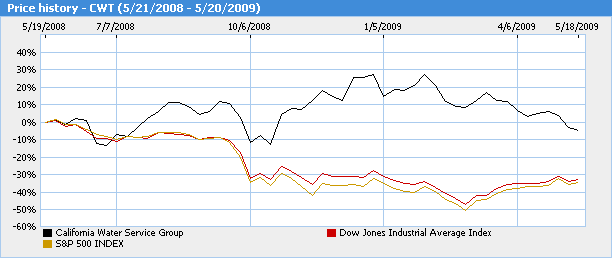
California Water's parent is publicly traded as California Water Service Group (Ticker ID CWT). The following publicly available chart shows CWT's recent trend compared to the Dow Jones Industrial Average15 (Ticker ID DJI) and the Standard and Poor's 50016 (S&P 500) Ticker ID GSPC). The chart shows that over a recent 12-month period, the market price for California Water Service Group suffered a significantly smaller loss in value. For example, by May of 2009 the chart shows that California Water Service Group had lost value only for short periods of time, whereas both the Dow Jones Industrial Average and the Standard and Poor's 500 had lost up to 50% of their value and by May 2009.has still lost over 30% in value.17
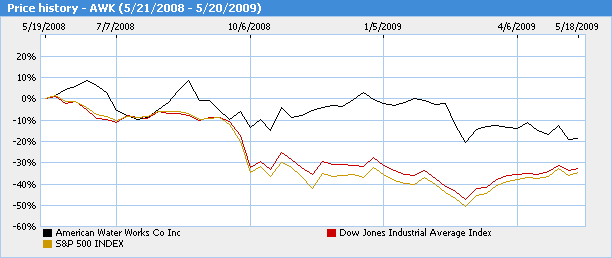
American Water Works Inc. (Ticker ID AWK) is the parent of California American and is publicly traded. The following chart shows AWK's recent trend compared to the Dow Jones Industrial Average and the Standard and Poor's 500. The chart shows that over approximately the past 12 months the market price for American Water Works Inc. suffered a significantly smaller loss in value. For example, in March of 2009 the chart shows that American Water Works Inc. had lost 20% in value whereas both the Dow Jones Industrial Average and the Standard and Poor's 500 lost approximately 50% in value. By May, American Water Works Inc, had still lost 20% while the two indices had recovered slightly but were still showing a loss of 305 in value.18
American States Water Company (Ticker ID AWR) is the parent of Golden State and is publicly traded. The following chart shows its recent trend compared to the Dow Jones Industrial Average and the Standard and Poor's 500. The chart shows that over approximately the past 12 months the market price for American States Water Company suffered a significantly smaller loss in value. For example, in March of 2009 the chart shows that American States Water Company had lost about 20% in value whereas both the Dow Jones Industrial Average and the Standard and Poor's 500 lost approximately 50% in value. By May, American States Water Company was still down by 10% while the two indices had recovered slightly but were still showing a loss of 305 in value.19
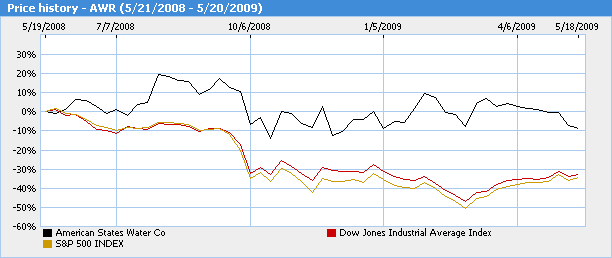
While it is clear that all three parent companies' stocks showed significant trading losses in market value, those losses were nowhere near the magnitude of the percentage losses experienced by the S&P 500 or the Dow Jones Industrial Average.
Based on the absence of any significant trends or other indicators that the currently authorized returns on equity for California Water, California American, and Golden State are causing financial harm, we find no need to modify our Phase 1 decision and no need for any further actions apart from adopting the Water Cost of Capital Mechanism elsewhere in this decision, as well as actions already taken to implement the revised rate case plan and the recent water action plan.
5 http://frwebgate.access.gpo.gov/cgi-bin/getdoc.cgi?dbname=110_cong_bills&docid=f:h1424enr.txt.pdf
See Section 2(1); and also:
SEC. 101. PURCHASES OF TROUBLED ASSETS. (a) Offices; Authority (1) AUTHORITY- The Secretary is authorized to establish the Troubled Asset Relief Program (or `TARP') to purchase, and to make and fund commitments to purchase, troubled assets from any financial institution, on such terms and conditions as are determined by the Secretary, and in accordance with this Act and the policies and procedures developed and published by the Secretary.
6 http://frwebgate.access.gpo.gov/cgi-bin/getdoc.cgi?dbname=110_cong_public_laws&docid=f:publ289.110.pdf
7 http://frwebgate.access.gpo.gov/cgi-bin/getdoc.cgi?dbname=111_cong_bills&docid=f:h1enr.txt.pdf
8 The applicants sponsored a single witness at the request of the assigned Commissioner and ALJ in the December 17, 2008 ruling.
9 American States Water Company (parent of Golden State), Acqua America Water Company, Connecticut Water Service, Middlesex Water, San Jose Water Corp., California Water Service group, Southwest Water Company, York Water Company, Artesian Water Company, and Pennichuck Corp.
10 The S&P 500 is a value weighted index of the prices of 500 large capitalization common stocks actively traded in the United States. The stocks included in the S&P 500 are large publicly held companies that trade on either of the two largest American stock markets, the New York Stock Exchange and NASDAQ (National Association of Securities Dealers Automated Quotations).
11 All citations to Opening or Reply Comments refer to comments filed in response to the February 13, 2009 hearings on the financial markets dislocation issues. They are equivalent to briefs as filed in Phase 1. There are no other briefs in Phase 2 because the remaining issue was the subject of an all-party settlement.
12 Commercial paper is a short-term negotiable instrument, usually an unsecured promissory note that calls for the payment of money at a specified date. Because it is not backed by collateral, commercial paper is usually issued by firms whose credit rating is so good that their notes are immediately accepted for trading. The notes are sold at a discount and mature in from three to six months. Commercial paper is an important source of cash for the issuing firm; it supplements bank loans and is usually payable at a lower rate of interest than the prime discount rate. The current commercial paper rate is the default interest rate used for all Commission authorized balancing and memorandum accounts.
13 Note that earlier Abbott testified: "... the debt markets were frozen in September for eleven days ..." (TR at 434.)
14 Utilities also have a separate allowance for working cash in rate base. Therefore, to the extent the applicants may use commercial paper to finance daily operations any related interest cost is recovered through the working cash allowance.
15 The DJI is one of several stock market indices, created by nineteenth-century Wall Street Journal editor and Dow Jones & Company co-founder Charles Dow. It is an index that shows how certain stocks have traded. Dow compiled the index to gauge the performance of the industrial sector of the American stock market. The average is computed from the stock prices of 30 of the largest and most widely held public companies in the United States. The "industrial" portion of the name is largely historical-many of the 30 modern components have little to do with traditional heavy industry. The average is price-weighted.
16 The S&P 500 is a value weighted index published since 1957 of the prices of 500 large-capitalization common stocks actively traded in the United States. The stocks included in the S&P 500 are those of large publicly held companies that trade on either of the two largest American stock markets, the New York Stock Exchange and NASDAQ. Almost all of the stocks included in the index are among the 500 American stocks with the largest market capitalizations.
17 http://moneycentral.msn.com/investor/charts/chartdl.aspx?D5=0&D4=1&ViewType=0&CE=0&ShowChtBt=Refresh+Chart&D3=0&Symbol=CWT&DateRangeForm=1&C9=0&DisplayForm=1&ComparisonsForm=1&CP=0&PT=7
18 http://moneycentral.msn.com/investor/charts/chartdl.aspx?D5=0&D4=1&ViewType=0&CE=0&ShowChtBt=Refresh+Chart&D3=0&Symbol=AWK&DateRangeForm=1&C9=0&DisplayForm=1&ComparisonsForm=1&CP=0&PT=7
19 http://moneycentral.msn.com/investor/charts/chartdl.aspx?D5=0&D4=1&ViewType=0&CE=0&ShowChtBt=Refresh+Chart&D3=0&Symbol=AWR&DateRangeForm=1&C9=0&DisplayForm=1&ComparisonsForm=1&CP=0&PT=7


