APPENDIX B
2.9 Electric and Magnetic Fields Summary
APPENDIX B
2.9 Electric and Magnetic Fields Summary
2.9.1 Electric and Magnetic Fields
This EIR does not consider electric and magnetic fields (EMF) in the context of the CEQA analysis of potential environmental impacts because [1] there is no agreement among scientists that EMF creates a potential health risk, and [2] there are no defined or adopted CEQA standards for defining health risk from EMF. However, recognizing that there is a great deal of public interest and concern regarding potential health effects from human exposure to EMF from transmission lines, this document does provide information regarding EMF associated with electric utility facilities and human health and safety. Thus, the EMF information in this EIR is presented for the benefit of the public and decision makers.
Potential health effects from exposure to electric fields from transmission lines (i.e., the effect produced by the existence of an electric charge, such as an electron, ion, or proton, in the volume of space or medium that surrounds it) typically do not present a human health risk since electric fields are effectively shielded by materials such as trees, walls, etc. Therefore, the majority of the following information related to EMF focuses primarily on exposure to magnetic fields (i.e., the invisible fields created by moving charges) from transmission lines. Additional information on electric and magnetic fields generated by transmission lines is presented in Appendix D.
After several decades of study regarding potential public health risks from exposure to power line EMF, research results remains inconclusive. Several national and international panels have conducted reviews of data from multiple studies and state that there is not sufficient evidence to conclude that EMF causes cancer. Most recently the International Agency for Research on Cancer (IARC) and the California Department of Health Services (DHS) both classified EMF as a possible carcinogen.
Presently, there are no applicable federal, State or local regulations related to EMF levels from power lines or related facilities, such as substations. However, the California Public Utilities Commission has implemented a decision (D.06-01-042) requiring utilities to incorporate "low-cost" or "no-cost" measures for managing EMF from power lines up to approximately 4% of total project cost. Using the 4 percent benchmark, PacifiCorp has incorporated low-cost and no-cost measures to reduce magnetic field levels along the transmission corridor.
2.9.2 EMF and the Proposed Project
PacifiCorp has prepared an EMF Plan that provides EMF information regarding the Proposed Project and Weed Segment (see Appendix D). The Plans includes a brief introduction to EMF characteristics, scientific research related to possible health effects, and public policy activities. In addition, the Plans identify PacifiCorp's guidelines and general methods for managing EMF for new electrical facilities.
Consistent with PacifiCorp's Electro Magnetic Fields, California Design Guidelines, modeling has been provided for the Proposed Project and Weed Segment delineating the magnetic field levels for both the existing power lines and the proposed transmission line as well as the Weed Substation. As part of the Proposed Project and Weed Segment, PacifiCorp would incorporate "no cost" and "low cost" magnetic field reduction steps. The specific measures proposed by PacifiCorp to reduce magnetic field exposure are:
· Optimum phasing would be used wherever there is distribution underbuild (this is a total of approximately 40% of the upgraded and new transmission line for the Proposed Project);
· The three poles that do not have distribution underbuild but are in an agricultural land use area would be raised 5 feet (from the base case pole height of 70 feet);
· No mitigation would be applied to poles without distribution underbuild in land use areas that are designated as unpopulated or forested;
· No mitigation would be applied to the Weed Segment since the upgrade from a single-circuit 69 kV transmission line to a double-circuit 115 kV transmission line reduces the EMF by more than 15%.
· No mitigation would be applied to the Weed Substation rebuild since the main source of EMF is from the transmission lines surrounding the substation.
Figure 2-9 shows EMF levels for the Proposed Project overhead transmission line with and without EMF reduction measures.
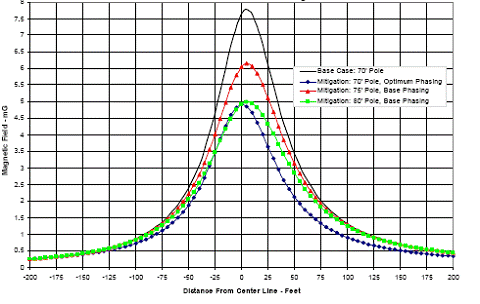
Figure 2-9
Estimated EMF Levels with and without EMF Reduction Measures
(END OF APPENDIX B)

