REPORT TO THE LEGISLATURE
ON
THE CALIFORNIA TELECONNECT FUND
Required by Supplemental Report to the 2003 Budget Act
Item 8660-001-0462
Submitted
January 12, 2004
CALIFORNIA PUBLIC UTILITIES COMMISSION
Table of Contents
C. Services and Discounts Prior to May 8, 2003 44
D. CTF Eligible Services and Discounts As Per SB 1863 (2002) 66
F. Revenues, Expenditures And Surcharges 88
H. CTF And The E-Rate Program 1111
I. Carrier Claims And The Reimbursement Process 1313
CTF APPLICATION INSTRUCTIONS AND FORM 2222
Service Discounts Certification Application Form 2323
A. Executive Summary
In 1997 the California Teleconnect Fund (CTF) was implemented to provide discounts on a wide array of telecommunications services to specific institutions and organizations identified by the legislature as providing beneficial services to Californians. Those institutions and organizations are schools and libraries, municipal, county and hospital district-owned hospitals and health clinics, and Community Based Organizations (CBOs). The covered services range from measured business service (basic telephone service) up to and including OC-3 through OC-192 (high speed transmissions lines) or their functional equivalents.
This report describes how recently, in response to legislation and as a result of its own investigation, the Commission implemented a series of changes to the program. Those changes include increased discounts, additional types and quantities of services available to participants and a simplified application process to decrease the length of time it takes for applications to be reviewed and approved. In the short time these changes have been in effect the program has seen a marked increase in applications to participate, especially on the part of CBOs. Other changes will increase accountability through new auditing processes and improve program-funding estimates via a new carrier forecasting procedure.
The report also includes historical data on program surcharges, revenues and expenditures, program participation and describes the interaction between the CTF program and the federal E-Rate program.
It is also important to mention that the 2003-2004 Budget Act borrowed $150 million from the CTF program for the General Fund. Assembly Bill 1756 (Committee on Budget), Chapter 228, Statutes of 2003, specifies the loan details.
This is important because the current surcharge rate is 0%, and the CTF program funds will be depleted early in the 2004-2005 fiscal year unless the Administration returns an estimated $33 million of the borrowed funds or allows the Commission to raise the surcharge rate (surcharge rate history is discussed on page 6). Either action requires approval by the Department of Finance. The Commission requested either authorization to continue the program.
Due to budget constraints, the Department of Finance has denied the CPUC's request for the General Fund to return some of the borrowed funds to continue the CTF program and has also denied the request to raise the surcharge. The Department has informed the CPUC to align program expenditures with the resources available to the Commission.
B. Background
In D.96-10-066, issued on October 25, 1996 in compliance with Assembly Bill 3643, (Polanco), Chapter 278, Statutes of 1994, the Commission established the California Teleconnect Fund (CTF) to provide discounts on selected telecommunications services to qualified entities. An All End User Surcharge applied to customers' intrastate-billed services funds the program. The surcharge appears on customers' monthly telephone bills as a percentage applied to the intrastate-billed services. The surcharge is updated as needed in order to ensure there is adequate funding for the discounts received by the participants. D.96-10-066 identified the entities qualified to participate in the program as:- · All public schools grades K-12
· Private schools grades K-12 that do not have endowments over $50 million
· Libraries eligible for participation in state-based plans for fund under Title II of the Library Services and Construction Act
· Municipal, county or hospital district owned and operated hospitals and health clinics
· Non-profit Community Based Organizations (CBOs) providing health care, job placement, job training or educational instruction.
C. Services and Discounts Prior to May 8, 2003
|
Qualifying Entity |
Eligible Services |
CTF Discount |
School and/or Library |
All Measured Business Service lines, Switched 56 lines, ISDN, T-1, DS-3 and up to and including OC-1921 services or their functional equivalents |
50% |
Municipal or County Government Owned and Operated Hospital and Health Clinic |
Switched 56 lines, ISDN, T-1, and DS-3 or their functional equivalents |
20% |
Community Based Organization |
Two switched 56 lines, or two ISDN lines, or one switched 56 line and one ISDN line, or one T1 line, or their functional equivalents |
25% |
Senate Bill 1863, (Bowen), Chapter 308, Statutes of 2002, added Section 884 to the Public Utilities code. Section 884(a) states
"...that any program administered by the Commission addressing the inequality of access to advanced telecommunications services by providing those services to schools and libraries at a discounted price should also provide comparable discounts to a nonprofit community technology program."
Section 884(b), was also added to the code and defines community technology program as:
"...a community-based nonprofit organization that is exempt from taxation under Section 501 (c)(3) of the Internal Revenue Code and engages in diffusing technology into local communities and training local communities that have no access to or have limited access to the Internet and other technologies."
Decision (D.) 02-10-060, in Commission Rulemaking 01-05-046 investigating the feasibility of redefining universal telephone service to include high-speed Internet access provided some insight regarding program participation. Comments from the public and certain parties suggested that low participation by hospitals, health clinics and CBOs may be due, in part, to the low discounts and limited types and quantities of service available under the program. Some parties and members of the public also commented that the application process was unduly burdensome, discouraging organizations from applying for participation in the program. The decision directed the Telecommunications Division to prepare a resolution implementing changes to the CTF program responding to the comments of the parties.
On May 8, 2003, to implement the relevant portions of SB 1863 (2002) and pursuant to D.02-01-060, Resolution T-16742 was issued. The resolution expanded the list of services available to hospitals, health clinics and CBOs to match that available to schools and libraries. The resolution also added hospital district owned hospitals and health clinics to the list of eligible entities and added community technology centers to the list of qualifying activities for CBOs. The table below illustrates the types and quantities of services and the discount available to all eligible entities as a result of SB 1863 (2002) and Resolution T-16742:
D. CTF Eligible Services and Discounts As Per SB 1863 (2002)
Qualifying Entity |
Eligible Services |
CTF Discount |
School and/or Library, Municipal, County Government or Hospital District Owned and Operated Hospital and Health Clinic, Community Based Organization |
All Measured Business Service lines, Switched 56 lines, ISDN, DSL, T-1, DS-3 and up to and including OC-192 services or their functional equivalents |
50% |
Finally, the resolution streamlined the application process. Although these changes have been in effect for less than a year, they appear to have had the desired effect. The majority of new applications filed with the Commission are from CBOs and the number of CBOs approved for participation in the program since the changes took effect is almost double the number approved in the first six years of the program.
E. Participation
Since the CTF program's inception, schools and libraries have been the predominant recipients of program benefits with over 6000 current participants. This is not surprising since schools and libraries previously enjoyed a higher discount on a greater range and quantity of services than any other category of participant and were also the beneficiaries of efficient marketing of the program by the California Department of Education. Prior to the implementation of Resolution T-16742, only 68 CBOs and 21 hospitals and health clinics were participating in the program. However, comments in Rulemaking 01-05-046, pointed out that the then-current program application process and limited benefits might be the reason for the low participation by hospitals and health clinics and CBOs.
Schools and libraries, through their affiliation with the California Department of Education (CDE), are part of an established network that effectively disseminates information about the program. Additionally, Commission and utility staff works collaboratively with the CDE conducting annual training and outreach for schools and other interested groups. The training and outreach efforts inform interested entities about the requirements and application process of the CTF and E-Rate programs. Commission staff also participates in regular meetings with the CDE to develop ways to enhance the annual training.
The table below illustrates annual participation in the program as a whole and broken down by entity.
Program Years |
CBOS |
Schools & Libraries |
Hospitals |
Cumulative Total |
1997 |
18 |
1345 |
10 |
1373 |
1998 |
23 |
937 |
9 |
2342 |
1999 |
24 |
958 |
2 |
3326 |
2000 |
3 |
1086 |
0 |
4415 |
2001 |
0 |
819 |
0 |
5234 |
2002 |
0 |
595 |
0 |
5829 |
2003 |
60 |
261 |
4 |
6154 |
TOTAL |
128 |
6001 |
25 |
The Commission's primary goal when implementing the program has been to ensure that as many of the intended beneficiaries of the program as possible participate. As the table above demonstrates, the schools and libraries category is well on its way to achieving that goal with over 6000 currently participating in the program and new applications arriving daily. Of the 6000 schools and libraries participating, some applied as school districts not as individual schools. Because of this, the 6000 figure is an underestimate of the total schools and libraries participating since most school districts include multiple schools.
It is estimated that there are 1000 school districts and approximately 8000 schools in the state of California. At this time no exact penetration rate has been calculated for the schools and libraries category, but Commission staff is working with CDE personnel to determine this figure.
The changes brought about by SB 1863 (2002) appear to be creating renewed interest in the program on the part of CBOs. Prior to the implementation of SB 1863 (2002), program participation numbers for CBOs and hospitals had fallen far short of expectations with only 68 CBOs and 21 hospitals participating by the beginning of 2003, the seventh year of the program. Since the changes promulgated by SB 1863 (2002) took effect, the Commission has received hundreds of CBO applications.
This renewed interest is also a direct result of the CTF Administrative Committee's vigorous efforts to increase public awareness of the program. The number of CBOs participating in the CTF program has almost doubled in the seven months since the changes became effective. There are still several hundred applications awaiting staff review and more arriving in each day's mail.
It is difficult to calculate a penetration rate for CBOs since it is necessary to know the exact number of qualified CBOs. That information is not readily available since not all CBOs engage in activities that qualify for participation in the program.
Participation by hospitals is still very low with only 25 participating to date. Only 4 new applications in the hospital and health clinic category have been received since implementation of SB 1863 (2002). Only county or municipal government or hospital district owned and operated hospitals are eligible to participate in the program. This limits the number of hospitals that qualify for participation in the program. Commission staff is working to determine the number of qualified hospitals and health clinics and seeking input from the CTF Administrative Committee on ways to ensure all eligible hospitals and health clinics are informed of the existence of the CTF program.
Given that over 6000 entities currently participate in the CTF program and new applications arrive daily, the Commission is concerned that if the program is further expanded, specifically by AB 855 and SB 720 (discussed on p. 17-18), it will lack the staff resources necessary to properly administer the fund.
The Commission currently has two people assigned to the CTF program. One staffer reviews the myriad number of new customer applications the Commission receives, while the other reviews and pays the claims, prepares the annual budget and acts as the liaison between the Commission and its advisory committee. These staffers struggle to meet the demands of this program. Please be mindful that if the CTF program is expanded, the Commission will not have the staff resources necessary to administer the program.
F. Revenues, Expenditures And Surcharges
The table below illustrates the CTF program budgeted revenues and expenditures, including administrative expenses, for every year of the CTF program including fiscal year 2004/05 already approved by the Commission.
Year |
Revenue |
Carrier Claims with Interest |
Administrative Expense |
19972 |
$46.2 mil |
$ 8.1 mil |
$ 43,000 |
1998 |
$36.2 mil |
$ 18.7 mil |
$ 15,000 |
1999 |
$ 9.0 mil |
$ 23.7 mil |
$106,000 |
2000 |
$12.6 mil |
$ 32.5 mil |
$960,000 |
2001 Jan - June |
$17.5 mil |
$ 16.5 mil |
$475,000 |
FY 2001/023 |
$41.0 mil |
$144.4 mil |
$1.6 mil |
FY 2002/034 |
$38.9 mil |
$ 56.8 mil |
$2.3 mil |
FY 2003/045 |
$ 2.4 mil |
$ 31.9 mil |
$2.9 mil |
FY 2004/056 |
$ 1.4 mil |
$ 35.3 mil |
$3.7 mil |
Starting in 2000, administrative expenses increase significantly due to audit expenses and interagency agreements. Also, Commission fiscal and legal staff costs for the program are included in the administrative costs. No Telecommunications Division staff positions are included in the administrative expenses.
The table below represents the current and historical surcharge rates from the beginning of the program.
The table below lists the surcharge rates since the beginning of the program.
Period |
Surcharges |
1997 |
0.41% |
1998 Jan - Aug-08 |
0.41% |
1998 Aug - Dec |
0.050% |
1999 |
0.050% |
2000 |
0.050% |
2001 Jan - Nov |
0.185% |
2001 Nov - Dec |
0.300% |
2002 |
0.300% |
2003 to Present |
0.0% |
G. The Application Process
Until recently, organizations and institutions filed applications to participate with their telecommunications service providers (carriers). This process could involve applying with multiple carriers if the applicant subscribed to services from multiple providers. The individual carriers worked with the applicant to determine which and how many subscribed services were eligible for the program and what discount level applied to each eligible service. With that information the carrier calculated the total monthly discount for each applicant.
Once the total monthly discount for an application was calculated, the carrier forwarded the application to the Commission. Commission staff then reviewed applicants' qualifications, checked that all required supporting documentation was supplied and ensured that sufficient funds remained in the CTF program to cover the monthly discount calculated by the carrier. When staff review was completed, and the applicant was deemed eligible to receive discounts, both the applicant and the carrier(s) received letters from the Commission informing them of the applicant's status. The approved participant received the discounts on their phone bill by way of a percentage reduction of the monthly fee for eligible services. Carriers filed monthly claims for reimbursement with the Commission for all discounts provided to program participants. This process was repeated for every applicant to the CTF program.
At the time the CTF program was implemented, this application procedure appeared to be the most efficient way of estimating the monthly draw on the program fund. The Commission expected an overwhelming response to the program and was concerned that demand for discounted services could exceed the program cap of $50 million7. This process ensured that no application was approved prior to determining if there were sufficient program funds available to reimburse carriers for discounts given to participants. It also seemed logical at the time to have the carriers be the first level of contact with prospective applicants as carriers were in the best position to calculate the amount of discount each application would receive each month. In retrospect it appears unduly burdensome, but at the time of implementation it was based on reasonable assumptions about how the program would operate going forward.
Low claims in the first few years did not raise immediate concerns. It is not unusual for word of a new program to spread slowly. Although not immediately obvious, in the years following implementation of the program it became apparent that program participation had not resulted in claims on the CTF funds approximating the Commission-set cap. Anxiety about sufficient program funds was unfounded and the two-step application review process was redundant, resulting in long delays between filing and final determination of eligibility.
The application process was recently streamlined allowing applicants to file directly with the Commission for review and approval. Commission staff reviews the applications for qualifications and required supporting documentation and makes a determination. Once approved for participation, the applicant receives a letter from the Commission informing them that they have been approved to participate in the program and a copy of their approved application that has been stamped with an application number. The approval letter also directs the applicant to contact their carrier regarding receiving discounts on all eligible services. The carrier may require the applicant to provide a copy of the approval letter or application, or check for the applicant's name on the newly developed Commission website list of all CTF participants.
The new procedure also streamlines the process for currently participating entities to add discount-eligible services to their monthly telecommunications services. Now, with just a phone call to their carrier, participating organizations may subscribe to and receive the discounts on new eligible services. The former process required the participant to file another complete application with the attendant review process and time lag.
Under the new process, carriers are still required to file monthly claims for reimbursement with the Commission. However they are also required to file a claims' forecast for the upcoming fiscal year based on the preceding year's claims. Although historically carrier claims have never come close to exceeding the fund cap, with the increased participation anticipated due to the recently expanded rules, it is necessary to continue to monitor the estimated annual claims amounts and the fund cap.
H. CTF And The E-Rate Program
The CTF program, administered by the Commission, provides discounts on selected telecommunications services to qualified schools and libraries, municipal, county or hospital district owned and operated hospitals or health clinics, and community based-organizations offering health care, job training, job placement, and/or educational instruction. Schools and libraries are also eligible for services through the FCC-administered E-Rate Program, which provides eligible K-12 schools and libraries 20% to 90% discounts (sliding scale) on approved telecommunications, Internet access, and internal connections costs.
The table below represents current CTF eligible services and discounts, as established in Resolution T-16742:
Qualifying Entity |
Eligible Services |
CTF Discount |
|
School and/or Library, Municipal, County Government or Hospital District Owned and Operated Hospital and Health Clinic, Community Based Organization |
All Measured Business Service lines, Switched 56 lines, ISDN, DSL, T-1, DS-3 and up to and including OC-192 services or their functional equivalents |
50% |
The table below represents E-Rate eligible services:
Telecommunications Services |
These are leased, tariffed, contracted, or month-to-month services that are used to communicate information electronically between sites. The services MUST be provided by an eligible Telecommunications Service provider. Examples of Telecommunications Services include T-1 lines, basic telephone service, and ISDN. Broadcast services (such as over-the-air radio and television) and cable TV are not considered Telecommunications Services. |
Internet Access |
"Basic conduit access" to the Internet, including e-mail, is eligible for discount, and can be provided by an eligible Telecommunications Services provider or any commercial organization. |
Internal Connections |
Internal Connections consist of the wiring and components that expand data access within a school or library, such as to individual classrooms within a school. Internal Connections can be provided by any commercial organization. |
The table below illustrates how the applicable E-Rate discount for each applicant is determined:
INCOME Measured by % of students eligible for the National School Lunch Program |
URBAN LOCATION Discount |
RURAL LOCATION Discount |
If the % of students in your school that qualifies for the National School Lunch Program is... |
...and you are in an URBAN area, your |
...and you are in a RURAL area, your |
Less than 1% |
20% |
25% |
1% to 19% |
40% |
50% |
20% to 34% |
50% |
60% |
35% to 49% |
60% |
70% |
50% to 74% |
80% |
80% |
75% to 100% |
90% |
90% |
Some of the main differences between the programs are:
· The E-rate program only applies to qualifying schools and libraries while the CTF applies to qualifying schools, libraries, hospitals, health clinics and CBOs.
· The E-rate program provides discounts on data lines, Internet service providers, and internal building equipment. The CTF program provides discounts on regular phone lines and high-speed data lines, not Internet Service Providers or equipment.
· The E-rate program provides up to a 90% discount on lines, service and internal equipment. The CTF program only provides up to a 50% discount on services.
· The E-rate program application process is more complicated than the CTF.
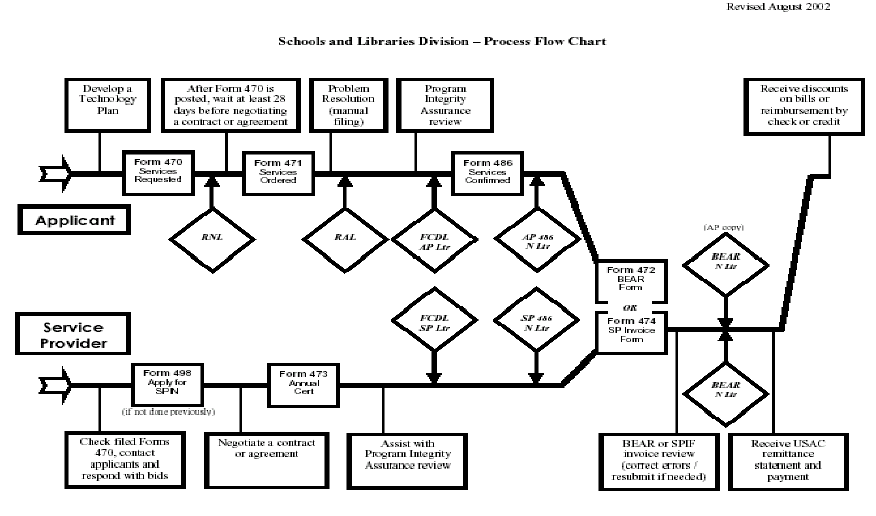
Resolution T-16118 states that eligible schools and libraries can participate in the E-Rate program, the CTF program, or receive cumulative discounts from both programs. There is no Commission requirement that all CTF participants must also participate in the E-Rate program. This is important because many E-Rate eligible California schools and libraries opt not to participate in the E-Rate program to avoid the lengthy and complex E-Rate program application process detailed in Attachment C of this document. This non-participation adversely impacts the CTF program budget. If eligible entities are not applying for participation in the E-Rate program, the federal offsets to the CTF program, dependent on E-Rate program participation, are lost. This means California ratepayers are funding a federal program that is not being fully utilized by eligible California entities. This results in fewer federal program dollars flowing into California to offset the budget requirements of a state program that ratepayers are also funding.
Again, eligible schools and libraries can simultaneously participate in both the E-Rate program and the CTF, but are not required to do so.
The CTF and E-Rate tables discussed above enable qualified telecommunications carriers to calculate and provide the correct subsidy to eligible customers. The carrier first determines the E-Rate subsidy using the pre-discount price and then applies the discount matrix (see table above). The carrier's next step is to apply the CTF discount. The CTF discount is half of either:
1) The monthly rate for the service being claimed for reimbursement, or
2) The monthly rate less the E-Rate discount, whichever is less.
Pursuant to Resolution 16318, carriers are required to apply any E-rate discount the customer is entitled to prior to applying the CTF discount to reach the proper claimed discount amount for claim periods subsequent to July 1999. Customers wishing to participate in both E-rate and CTF discount programs are also required to use the carrier invoicing method of reimbursement for E-rate funding. This has been always been the process, but Resolution T-16763, scheduled to be heard at the Commission meeting early in 2004, seeks to formalize it.
Eligible CTF customers are listed on the CPUC's website.
I. Carrier Claims And The Reimbursement Process
Resolution T-16381 requires carriers seeking reimbursement from the CTF to use a specific form, included with this document as Attachment B. The claim form is filed with the Public Programs Branch of the Telecommunications Division on a monthly basis only and must also provide supporting work papers. The supporting work papers must be filed using a Commission specified format of Excel spreadsheet. The spreadsheet must contain detailed information including the name of the qualified entity, the number and types of service with billing codes and the price for each service. Each file must contain the total amount claimed for each qualified entity as well as a grand total. Each spreadsheet can be no more than 25,000 rows of records and for the largest carriers, each month's filing may contain multiple spreadsheet records. Claiming carriers are required to provide documentation supporting any E-Rate discounts included in the work papers once each funding year along with tariff sheets supporting the pricing for the claimed services.
Commission staff within the Public Programs Branch reviews the carriers' CTF claim forms. The review involves ensuring the claim is for services provided to qualified entities, that services being discounted are those covered by the program, that rates being charged for the services are the appropriate tariffed rates and that all taxes or credits have been applied. Finally, the math is checked for accuracy.
Once the claim has been reviewed, payment letters are drafted informing the Commission's Fiscal Office of the amount that should be paid to each carrier. If a portion of the filing has been disallowed, the payment letter will only include payment for the approved portion of the filing. Carriers are informed in writing of the portions of the filing that have been disallowed accompanied by specific information about the defective records and reasons for rejection. Carriers may correct the defective records by filing revised claims for the disallowed portion of the claim.
Once the Fiscal Office receives the payment letters from the Telecommunications Division, it prepares and forwards the necessary forms and documents to the Controller's Office informing it of the payment amount each carrier should receive from the CTF account. The Controller's Office prepares and mails the checks to the carriers to reimburse them for the approved discounts provided to entities participating in the CTF program.
The graph below illustrates the timing and amounts of claims filed with the Commission and the timing and amount of payments made to carriers.
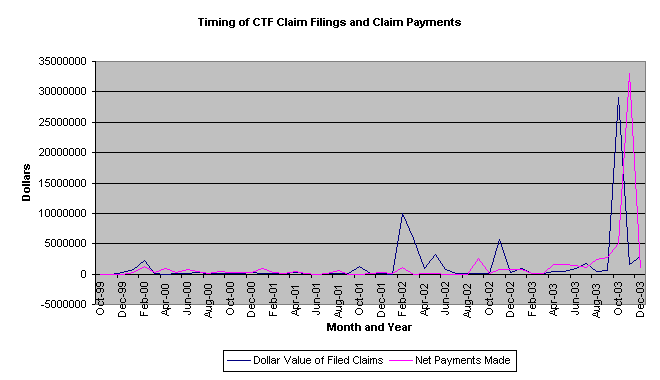
The first carrier claims were received in late 1999, over two years after program implementation. Discrepancies between filed claim amounts and claim payments can be attributed to a number of factors, chief among these is that claim payments are not necessarily made in the exact order that claims are filed. Even after the Commission started receiving claims, the dollar amounts were much lower than anticipated with the first considerable dollar value of claims arriving in early 2002. The Commission is working with the carriers to review and pay all outstanding approved claims as quickly as possible. Results of that effort can be seen in the significant increase in claim and payment amounts in late 2003.
Ongoing efforts are being made to clarify, simplify and streamline claim filing rules and the claim filing process. Here are some examples of steps to streamline the claims process:
· Electronic claims form and process
· Eliminate superfluous data fields
· Provide for multi-month credits and debits, eliminating the need for breaking out lump sum credits month by month
· Provide downloadable CTF program rules in one place on the Commission website
· Shorten claim filing windows in order to keep fund current and improve estimating for budgetary purposes
· Revise guidelines for claiming interest to coincide with Telecommunications Division claim payment cycles
· Revise the provisions for filing amended claims
The Commission is undertaking these efforts in recognition of the difficulties that carriers encounter understanding the process and the resources available to process claim payments in the Telecommunications Division.
J. Fund Balance
There is no single factor responsible for the recent excessive fund balance, but rather a combination of contributing factors. As is often the case with new programs, there were some difficulties in the first few years of the CTF program that were directly related to implementation problems with the E-Rate program.
As explained earlier, the federal E-Rate program discounts are applied to CTF claims first and act as an offset to each carrier's draw from the CTF program. Implementation of the E-Rate program was delayed for over two years. This delay had a two-fold impact on the CTF program. First, the absence of any in E-Rate funding for over two years required the Commission to ensure the CTF program budget was sufficient to cover all costs related to reimbursement of program-eligible telecommunications services. At the time, the Commission's goal was to make certain there was no interruption in service to program participants because of funding shortfalls. The Commission anticipated that at some point the E-Rate discounts would be received and offset future funding requirements. However, with no history on which to base E-Rate contribution estimates, the Commission's only alternative was to fully fund the program.
The second impact of the E-Rate funding delay was to cause carriers to postpone filing CTF claims. Carriers were unsure how much E-Rate funding they would eventually get and how it should be represented on then-current CTF claims. The result was that carriers didn't file their CTF claims at all, hoping the E-Rate program would eventually be launched and they could file accurate claims. This was a major reason why the first significant number of carriers' CTF claims didn't start trickling in to the Commission until late 1999, about the time the E-Rate program was finally underway.
As described in an earlier section, the CTF program application process was designed so that carriers could provide the Commission with estimates of the monthly discount amount for each participant. The Commission used the total of monthly discounts provided by each carrier as the basis for the annual program budget. In the first few years of the program, carriers filed no claims and so the Commission had no historical claim data upon which to base the coming year's claim estimates and adjustment to the resulting budget. The Commission could only rely upon the original claim estimates for program funding requirements and the necessary surcharge.
As the lack of E-Rate program funding presented the Commission with budgeting challenges, so too did the lack of claims from carriers. The Commission was once more faced with the dilemma of fully funding the program to ensure program continuity, yet possibly over-funding the program, or risk a funding shortfall and be unable to reimburse carriers for the discounts given to program participants. The overriding concern was that funding be available to ensure no interruption in discounts on services to program participants. Again, the Commission reasonably assumed that actual claims would at some point approximate the estimated claims and a corresponding drop in the fund balance would occur. And, as the annual claim amounts rose, the assumption that claims would eventually catch-up with funding appeared to be confirmed.
The final factor contributing to the current fund balance was the grossly overestimated budget for fiscal year 2001/2002. Commission staff overestimated program-funding requirements by over $100 million. The $100 million was earmarked to pay claims for earlier years that had not yet been filed, but were expected to come in the following fiscal year. The Commission made several attempts to encourage carriers to start making timely claim filings, going so far as to limit the length of time carriers have to file claims.8
The Commission has taken several steps to ensure the fund balance is reduced and in the future remains more closely related to funding requirements. In Resolution T-16742, the Commission implemented a new carrier claim forecasting procedure that is anticipated to be more accurate in estimating the funding requirements for the coming year. Carriers are required to submit the claims forecast for the next year by February 1st of each year and it is to be based on the preceding year's claims. Also, the program surcharge has been at 0% since January 1, 2003 in an effort to reduce the fund balance.
K. Fiscal Accountability
Public purpose program accountability, including the CTF, has greatly improved with the required transition from cash to accrual accounting (discussed below). Claims are now paid with funds appropriated for the year in which services are provided and not with funds appropriated in the year when claims are paid.
SB 669 (Polanco), Chapter 677, Statutes of 1999, required the commission to create 6 advisory boards to advise the commission regarding the implementation, development, and administration of specified public purpose programs. The California Teleconnect Fund Administrative Committee advises the CTF.
SB 669 also required telephone corporations to submit to the commission approved rate revenues (surcharge) for transfer by the commission to the Controller for deposit in the appropriate public purpose program fund, created by the bill. In effect, this law provided for oversight of these public purpose program funds through the state's budget process.
SB 742 (Escutia), Chapter 118, Statutes of 2001, implemented the provisions of SB 669, requiring that, commencing on October 1, 2001, and continuing thereafter, the commission transfer the moneys received from specified public purpose fund surcharges, and all unexpended revenues collected prior to October 1, 2001, to the Controller for deposit in the various public purpose programs funds.
Prior to SB 742, the commission's telecommunications public purpose programs were administered on a cash accounting basis. Claims were paid from funds accrued in the accounts from surcharge revenues received, with funds being accounted for by reference to the time claims were paid (i.e., cash accounting). The state budget accounts for the payment of funds on an accrual accounting basis, with funds being accounted for by reference to the time when services are provided (not paid) for which payment is made in arrears (i.e., accrual accounting).
The required change in public purpose program accounting methods from cash to accrual accounting, not only placed the oversight of these public purpose program funds through the state's budget process, it also provided both commission staff and other program viewers a more accurate picture of the available program funds.
Audits are another measure to ensure program funds and benefits are administered appropriately. Public Utilities Code section 274 requires carrier remittance and claims audits, a financial audit and compliance audits of the all the public programs, including the CTF program. This year Commission staff conducted remittance and claims audits of 5 small local exchange carriers and has an interagency agreement with the Department of Finance to conduct remittance and claim audits on the large service providers.
The best method to ensure program participants are receiving program benefits is to rely on participants to inform their service provider or the Commission if the discounts for their eligible services do not appear on their monthly bills. The Commission's website contains contact information for questions or comments regarding CTF program participation and benefits.
L. Future Goals
Implementation of SB 1863 (2002) has rekindled interest in the program, particularly from CBOs. Low participation by CBOs was of particular concern especially since many CBOs provide valuable health care and employment services to under served and underrepresented communities. CBOs are also on the forefront of bridging the digital divide by opening community technology centers in these communities. The changes to the program promulgated by SB 1863 were specifically aimed at groups engaging in these activities. The bill found them particularly deserving of the benefits offered by the CTF program. Not enough time has passed since SB 1863's implementation to tell if increased CBO participation will continue, but early indications are positive.
The CTF's Administrative Committee is made up of representatives of various constituencies and telecommunications industry representatives. Input from the Administrative Committee regarding ways to increase participation has been invaluable to the Commission. The Commission hopes the Administrative Committee will continue to inform and advise it. The Commission is especially interested in information regarding barriers to participation affecting certain groups and/or ways to reach underserved and underrepresented groups or areas that may not be part of a network for disseminating information about the program.
Another alternative to increase participation would be to increase program benefits, although higher discounts or expanded eligible services should be weighed against the impact on the fund and the surcharge necessary to support the expanded program.
The Commission has already received feedback about ways to increase hospital participation. In Rulemaking 01-04-056, parties suggested including non-profit hospitals as CTF program-eligible entities. In its decision, the Commission declined to do so since the three largest health care providers in the state are non-profit and clearly not the intended beneficiaries of the program. However, it is clear there are small and/or rural health care providers or telemedicine centers in remote areas of the state that should be included in the program, but do not meet the existing criteria. Some adjustment to the eligibility criteria for hospitals would ensure that health care providers in these areas are not left out.
There has been some concern about the time it takes for applications to be approved. Since the application process was streamlined, the time it takes for applications to be approved has decreased considerably, but several factors still contribute to a longer review time than either the applicants or the Commission desires. The new application includes one page of instructions, one page requiring the applicant to chose one category among those listed that best identifies the organization and a signature page with contact information. Certain entities such as CBOs and private schools and libraries are required to submit supporting documentation with the application. During the first months of the new process, at least half of the CBO applications were submitted without the necessary supporting documentation. Instead of rejecting the applications as incomplete, staff contacts the applicant informing them of the missing information and has developed a tracking process that allows the subsequently filed information to be matched with the original application. With hundreds of applications involved, this extra process greatly increases the overall review time.
Another factor adding to the review time is the sheer volume of applications currently being received. Existing staff resources do not allow for a full time position devoted solely to the CTF application review process. It is impossible to determine if the current volume of applications being received will continue, but ensuring sufficient staff resources to handle the volume will minimizing the necessary delay applicants are experiencing. Currently the review process timeline is 120 days at the very minimum from receipt of application to approval letter.
Public Programs staff is also currently working on implementation of the provisions of Assembly Bill 855 and Senate Bill 720, both enacted this year and associated with the CTF program.
· AB 855 requires the Department of General Services to compile and make available to wireless telecommunications carriers an inventory of state-owned property for the purpose of leasing the sites as locations for wireless telecommunications facilities.
· AB 855 mandates that 15% of the revenues generated from these leases shall be deposited in a newly created Digital Divide Account within the California Teleconnect Fund Administrative Committee Fund, to be administered by the Commission in conjunction with a grant program aimed at narrowing the digital divide.
· AB 855 limits the Commission from using more than 5% of the amounts deposited to implement a "Digital Divide Grant Program" - to develop a program to provide grants on a competitive basis to tax-exempt, nonprofit "community technology programs", subject to criteria to be established by the Commission. These programs would include, but not be limited to, the following types of programs:
o Providing open access to and opportunities for training in technology;
o Developing content relevant to the interests and want of the local community;
o Preparing youth for opportunities in the new economy through multimedia training and skills; and
o Harnessing technology for e-government services.
· AB 855 provides that the grant program would not be implemented unless the Commission projects that $500,000 will be available in the Digital Divide Account during the calendar year following implementation.
· AB 855 also requires recipients of grants to report to the Commission annually on the effectiveness of the grant program, and for the Commission to report to the Legislature and the Governor annually on the effectiveness of the program.
· SB 720 authorizes the Commission to reallocate specified unclaimed California Teleconnect Administrative fund funds to make one-time expenditures of up to $3 million or up to 40% of installation costs for schools, libraries, community-based organizations and Government owned health clinics and hospitals to have access to advanced telecommunications services.
· SB 720 also codifies the Commission's recent action adding DSL service to the California Teleconnect Fund program.
Implementation of these programs involves the same staff currently responsible for reviewing the CTF applications and that has directly affected application review time. Both of the new programs will require an application process again involving the same staff currently reviewing CTF applications. The Commission's goal is to ensure the benefits of these worthwhile programs flow to the participants as quickly as possible. However, adding programs while maintaining current staffing levels will impact that goal.
ATTACHMENT I
CTF APPLICATION INSTRUCTIONS AND FORM
California Teleconnect Fund -
CTF APPLICATION INSTRUCTIONS AND FORM
Service Discounts Certification Application
Applicants shall provide all information required on the application and return the completed application to the Commission for review. If applicants are applying for discounted services under more than one entity type, a separate application form is to be used for each entity type. Service under the discounted rates is not available until the application has been reviewed, in the order received, by the California Public Utilities Commission (CPUC) staff.
The Telecommunications Division will notify eligible entities, in writing, of the status of their application. The specific date of eligibility will be date stamped on your application, which will be returned with the notification letter. Applicants should then contact their service providers to receive service using the notification letter as proof of eligibility. Confirmed eligibility does not automatically establish participation. All participation is subject to the availability of program funds, which are administered on a first come, first served basis. If applicants add to or change subscribed services after they start participating in the program, they must inform the utility customer service representative at the time changes are made, of their participation in the CTF program. This information is necessary to ensure accurate claims information and timely program payments
Applicants are responsible for notifying the CPUC of any change in any statements attested to in the application within 30 days from the date of the change. This notification shall be accomplished by filling out a new certification application, along with any required attachments, and a brief explanation of the change. All applications and any notifications of changes shall be mailed or hand delivered to the CPUC, Telecommunications Division - Attention: California Teleconnect Fund, 505 Van Ness Avenue, Third Floor, San Francisco, CA 94102. Upon receipt of information regarding changes, the staff will evaluate whether the customer still qualifies for the California Teleconnect Fund discounts.
CTF Application No. |
CALIFORNIA TELECONNECT FUND
SERVICE DISCOUNTS CERTIFICATION APPLICATION FORM
Name of Institution or
Organization:__________________________________________________________________
Mailing
Address:______________________________________________________________________
Please check one of the following boxes to identify your entity type (use a separate form for each entity if you are applying for service discounts under more than one type):
DATE STAMP
_______ K-12, Public School / Public School District
Please enter your CDE Code #: ___________________
_______ K-12, Non-Profit Private School
Please enter your CDE Code #: ___________________
(Please attach a copy of tax-exempt statement from
the Internal Revenue Service.)
_______ Library eligible for funds in the state-based plans
under Title III of the Library Services and Construction Act,
now the Library Services and Technology Act.
(Please attach a copy of certification from the California State Library.)
_______
Municipal, county government or hospital district owned and operated hospital or health clinic.
_______ Community based organization, tax exempt under Section 501(c)(3) or 501(d) of the Internal Revenue Code and offering at least one of the following: health care, job training, job placement, educational instruction or a community technology program offering access to and training in the internet and other technologies.
(Please attach a copy of your tax-exempt statement from the IRS and your latest IRS Form 990.)
Please answer yes or no to the following questions as appropriate:
_______ If you are applying as a school, do you have a total endowment that exceeds $50 million?
Applicant is responsible for notifying the California Public Utilities Commission
within 30 days of any change in any of the above statements.
I, (please print name and title) _______________________________________________________, ____________________________ declare under penalty of perjury under the laws of the State of California that I am authorized to act on behalf of the above-named institution, that the above statements are true and accurate to the best of my knowledge and belief, and that the subscribed discounted telecommunications services will not be sold, resold, transferred or shared with any other non-qualifying entity or person.
Signature: ________________________________________ Date: ________________________
Tel: ( )____________ FAX (Required): ( )____________ E-Mail (Required): _________________
For CPUC Use only: Certification Application Complete: Yes ____ No_____ Initials: __________ Date: __________ |
ATTACHMENT II
CALIFORNIA TELECONNECT FUND (CTF) CLAIM FORM
(To be completed by the filing carrier)
(Use one form for each U#)
For the month(s) __________________(Year)
Company Name ___________________________________________CPUC U-____________
The following amounts are submitted for reimbursement. These amounts are supported by an accompanying data file (CD or disk) in the format prescribed by the Telecommunications Division.
A. Schools and Libraries (S&Ls)
1. Total Discounts _____________________________
2. Taxes/User fee _____________________________
3. Claim for S&Ls (Ln 1 + Ln 2) _____________________________
B. Government Owned & Operated Hospitals & Health Clinics (GHCs)
4. Total Discounts _____________________________
5. Taxes/User Fee _____________________________
6. Claim for GHCs (Ln 4 + Ln 5) _____________________________
C. Community-Based Organizations (CBOs)
7. Total Discounts _____________________________
8. Taxes/User Fee _____________________________
9. Claim for CBOs (Ln 7 + Ln 8) _____________________________
D. Total Claims for the Month (Ln 3 + Ln 6 + Ln 9) _____________________________
E. Adjustments (Attach Interest Calculation) _____________________________
F. Net Claim (Ln D + Ln E) _____________________________
Preferred Method of Payment: (Check One Method Only)
Check /___/ Automated Clearing House Transfer (ACH) /___/
For Check: Payee's Name _______________________________________________________
Mailing Address ___________________________________________________________
For ACH Transfer: Account Name________________________________________________
Account No.____________________ Name of Bank _______________________________
Branch Address of Bank_____________________________________ ABA No _________
I hereby certify that this form and the accompanying data file have been examined by me and to the best of my knowledge and belief they are true and complete. Carrier's signatory should be able to answer questions on claim calculations.
Signature_________________________________________ Date________________________
Printed Name_____________________________________ Title_________________________
E-Mail Address____________________________________ Telephone No. (___)____________
Mailing Address________________________________________________________________
For CPUC use only:
Telecom Staff Reviewer__________________________ Committee Approval Date__________
Discount Amount Recommended to Committee _______ Committee Approved Amount_______
See attached /___/ Check Mailing Date_______________
ATTACHMENT III
E-Rate Application Process / Flowchart
E-RATE APPLICATION PROCESS / FLOWCHART
8 Res.T-16381, May 18, 2000
