2007 Resource Adequacy Report
Produced by
The Staff of the
California Public Utilities Commission
April 15, 2008
2007 Resource Adequacy Report
Table of Contents
1. Executive Summary 4
2. Compliance with RAR in 2007 4
3. 2007 Load Forecast and Resource Adequacy Program Requirements 8
3.1. Yearly and Monthly Load Forecast Process 8
3.1.1. Yearly Load Forecast in 2007 9
3.1.2. Monthly Load Migration Adjustments in 2007 10
3.2. 2007 System RA Requirements for CPUC Jurisdictional LSEs 12
3.3. Adoption of Local RAR Program 13
3.4. Local RA Procurement in 2007 13
3.5. Total RA Resources Available to CAISO in 2007 14
4. Counting Resource Adequacy Resources 17
4.1. Introduction to Net Qualifying Capacity 17
4.2. Establishment of CAISO'S NQC Values for 2007 17
4.3. Aggregate NQC Values 2006, 2007, and 2008 18
4.4. NQC for Thermal Generation Units 18
4.5. NQC for Wind Resources without Backup 19
4.6. Import Allocations for 2007 37
5. Use of RA and RMR resources by the CAISO in 2007 37
5.1. Reliability Must Run Designations in 2007 38
5.2. Use of FERCMOO and RAMOO by Unit Location in Summer of 2006 and 2007 39
5.3. Use of MOO by Charge Type (Reason) in Summer 2006 and 2007 40
6. Forced Outage Rates 44
7. Changes to the RA Program for 2008 46
7.1. Path 26 Counting Constraint 46
Index of Tables
Table 1 2007 Aggregated Load Forecast Data (MW) 10
Table 2 Summary of Load Forecast Adjustments in 2007 (in MW) 11
Table 3 2007 RA Filing Summary for CPUC Jurisdictional Entities (MWs) 13
Table 4: Local RA procurement in 2007 14
Table 5 Total CAISO LSE Procurement as Percent of Total CAISO Obligation and Peak Demand 16
Table 6 : NQC values for 2006-2008 18
Table 7. Average and standard deviation of hourly production during HE 13-18 (MW) by month. 21
Table 8. Correlation Coefficients, Wind Production with Price and Load. Summer, 2007. 23
Table 9. HE 13-18 hours where, on average, production was below monthly NQC. 26
Table 10. Count of SO1 Peak Hours during which production was less than 10 percent of NQC. 26
Table 11. Difference in average production during 2007 relative to NQC for all windunits. 27
Table 12. Difference between average hourly production during SO1 Peak hours and all HE 13-18. 28
Table 13. Morning and Evening Wind and Load Ramp Rates 29
Table 14. Survey of wind capacity counting conventions 30
Table 15 Comparison of Calculation Methodologies (2007 Data). 36
Table 16 Import Allocations vs. Used in 2007 (MW) 37
Table 17 RMR Procurement for 2007 and 2008 39
Table 18 - Frequency of MOO by Unit Location, summer of 2006 and 2007 40
Table 19 MOO costs and PMIN by type in 2006 and 2007 41
Table 20 MOO Unit Hours by Location and Charge Code 41
Table 21 MOO Unit Hours by Charge Code and Month 42
Table 22. Forced Outage Rate (percent) 45
Index of Figures
Figure 1 2007 Aggregate Load Forecast Adjustments Reported by LSEs, by Month Showing Load Gained or Lost 12
Figure 2 Total CAISO Summer 2007 Forward Procurement Obligation and Forward Procurement vs. CEC Demand Forecast and Actual Monthly Peak Demand (MW) 15
Figure 3 2007 CAISO-wide wind production during HE 13-18, summed over all included wind generating units, both QF and non-QF. 20
Figure 4 Average production during 2007 SO1 Peak hours 22
Figure 5. 2007 NQC as a percent of nameplate capacity 22
Figure 6. Average hourly wind production during August 2007, by windzone. 23
Figure 7. Hourly Production during August, 2007, grouped by Hourly Load Percentile. 24
Figure 8. Hourly system wind production during the top 20 hours of load in 2007. 25
Figure 9. Time and Wind Production of top 50 load hours in 2007. 25
Figure 10. Different measures of central tendency 31
Figure 11. Different measures of central tendency 31
Figure 12. Normalized Hourly production (all hours) versus measures of central tendency (all measured at SO1 peak). 32
Figure 13. Normalized Hourly production (all hours) versus measures of central tendency (all measured at SO1 peak). 32
Figure 14. Comparison of Calculation Methodologies 34
Figure 15. Hourly Production Compared to Several Calculation Methodologies with August, 2007 Data. 35
Figure 16 FERC MOO and RA MOO in the summer of 2006 43
Figure 17 FERC MOO and RA MOO in the Summer of 2007 44
Figure 18 Forced Outages, 2003-2007. 45
Figure 19: Net Flows across Path 26 in Summer of 2006 and 2007 47
1. Executive Summary
This Report provides an annual review of the California Public Utilities Commission's (CPUC's) Resource Adequacy (RA) program and summarizes the program's experience in 2007. While the report does not make explicit policy recommendations, it is expected to provide factual input into the policy refinement discussions under consideration both in the CPUC's ongoing RA rulemaking, R.05-12-013 and the 2009 RA Implementation Order Instituting Rulemaking R.08-01-025
The intent of the RA program is to ensure adequate capacity is under contract to meet the needs CPUC jurisdictional load serving entities (LSEs). In 2007 the RA program was expanded from one centered on California Independent System Operator (CAISO) system-wide needs to one that also considers transmission constrained local areas. The program has operated as designed, LSEs have generally complied with program rules, and sufficient capacity was procured to meet the identified needs both local and system. There have been numerous minor program violations that staff has addressed through outreach, education and a limited number of enforcement actions. In 2008 the program will be further expanded to address the path 26 transmission constraint that limits the movement of power between Pacific Gas and Electric's and Southern California Edison's service territories.
A key measure in evaluating the effectiveness of the RA program is the ability to meet operational needs through the RA resources rather than relying on backstop procurement such as reliability must-run (RMR) and the FERC authorized must-offer obligation (FERC MOO). In 2007 the there has been a significant reduction in the number and capacity of RMR contracts. In addition, use of FERC MOO has also been reduced.
Net Qualifying Capacity (NQC) is a key component of the RA Program, measuring how much capacity can be counted for RA. The intermittent, non-dispatchable nature of wind resources complicates the calculation of NQC values for these generators. Current NQC rules often significantly overestimate wind production at hours of peak demand; wind production in California and load on the CAISO system are negatively correlated. This report explores alternative counting methodologies, but no single methodology emerges as a clearly preferred alternative
2. Compliance with RAR in 2007
Implementation of the RA program continued for 2007 and built on the experiences of 2006. In D.06-06-064, the Commission added the Local RA obligation to the RA program, and Energy Division staff developed reporting and compliance procedures accordingly. For the 2007 compliance year, LSEs were required to demonstrate compliance with both the System RA requirements, as described in the Final 2006 RA Report1, but also with the Local RA obligations that are discussed in this report. The LSEs submit compliance filings; Energy Division staff reviews the filings, locates compliance issues, and pursues enforcement of RA obligations. CPUC Staff has implemented Commission Decisions, and overall compliance has been acceptable, although minor filing errors continue to consume staff time. In general the 2007 RA process is the same as the description of the 2006 process found in the 2006 RA report, with the exception of a new Local RA program. Description follows of the new Local RA program.
2.1. Overview of the RA Filing Process
The 2007 System and Local RA filing templates and guides built on the 2006 templates and guides, adding a new template on which LSEs demonstrate procurement with the Local RA obligations as detailed in D.06-06-064. Final versions of these were issued to the LSEs on August 10, 2006. LSEs were responsible for submitting two year-ahead filings for 2007, which are described below. As with 2006 implementation, all filings continued to be submitted simultaneously to the CAISO, CPUC, and California Energy Commission (CEC).
o Preliminary Local RA Filing: Due September 22, 2006: this filing was to demonstrate which of the Local RA and RMR resources each LSE had under contract for 2007, so as to offset possible CAISO RMR procurement.
o Final 2007 System and Local RA Filing: Due November 2nd, 2006: this filing is to demonstrate that the LSEs have procured sufficiently to meet their Year-Ahead System RA obligation of 90 percent procurement for the months of May through September 2007, and to demonstrate that they have met their Local RA obligations in the 4 Local Areas (LA Basin, San Diego, Greater Bay Area, and Other PG&E Local Areas). Templates and guides for compliance filing were sent to the LSEs on August 10th, 2006.
o The System and Local templates for the 2008 compliance year were issued in August 2007.2
2.2. Compliance Review Process
The CPUC checked the filings for compliance by verifying that each LSE's submittal was accurate, timely, and satisfied all requirements. The CAISO reviewed the filings to check whether the RA filings submitted by LSEs were consistent with the supply plans submitted by generators and used the submittals to let the operations staff know which units were under contract and available. The CEC reviewed the filings and the historical load information provided by the LSEs for the appropriate time period to determine the accuracy of those filings matching load forecasts.
In 2007, CPUC Staff continued to work closely with LSEs to resolve any questions regarding the RA filing process and templates. CPUC Staff has been able to develop answers to numerous questions raised by LSEs that have special or unique circumstances. Working closely with LSEs has contributed significantly to reducing errors or omissions in the filings. Examples of questions brought to CPUC Staff include: treatment of Net Qualifying Capacity (NQC) for new resources, treatment of NQC for resources when initial NQC list was inaccurate, and discrepancies between the CEC's and LSE's load forecast. It is the hope of CPUC Staff that this process of working with the LSEs to reconcile differences and make revisions will lead to fewer questions in the future and make the RA filing process smoother. CPUC Staff, in a coordinated effort with the CEC and CAISO, has reviewed all compliance filings received to date according to a comprehensive procedure that includes verifying timely arrival of the filings, matching resources listed against those of the NQC list, and requesting corrections. The CAISO collects and organizes supply plans submitted by generators, and helps Energy Division compare the supply plans to the LSE filings. Once compliance is verified, Energy Division approves filings and returns materials to the LSEs.
2.3. Compliance Issues
The essence of the RAR program is mandatory LSE acquisition of capacity to meet load and capacity reserves. The short timeframes necessary to verify adequate capacity has been procured and complete backstop procurement if procured capacity is not adequate, creates a need for filings to occur on time and correct. Errors in filings result in delays in verification of resources that can result in unnecessary backstop procurement. Non-compliance occurs if either an LSE files with a procurement deficiency, meaning they have not met their RA obligations, or does not file at all, files late, or not in the manner required. These two types of non-compliance generally lead to enforcement actions or citations respectively. In the case of enforcement cases, the CPUC has encountered a situation where an LSE has not procured sufficiently to meet their RA obligations, and the CAISO may need to procure resources via backstop mechanisms. In the case of citations, in general, the LSE has not caused deficiencies such that the CAISO must procure backstop. Additionally, errors and deficiencies require staff to spend time investigating and determining the cause of the situation, and then working with the LSE to remedy problems. Due to the administrative obligations of the RA Program, Energy Division Staff must create incentives for LSEs to file correctly and in a timely manner.
Overall compliance in 2007 has been similar to the successful pattern seen in 2006, and continued through the 2007 implementation of the Local RA Program. Through February 2008, the Commission has pursued one enforcement case which resulted in a settlement for $107,500 as well as eight citations issued for a total of $19,0003 in penalties; this totals $126,500. Three citations have been appealed, with two resulting in payment in full and the other still pending.
Enforcement action was taken against an LSE for a procurement deficiency related to their Local RA obligation, and for listing an incomplete and unexecuted contact in their filing as a valid RA resource. This represented the first enforcement action taken under the RA Program, and the Commission reached a settlement with the LSE for $107,500.
Commission Decision 05-10-042 established a baseline penalty of 150 percent of the monthly cost of new capacity for 2006 and a baseline penalty of 300 percent of the monthly cost of new capacity for compliance year 2007 system filings. D.06-06-064 established a penalty structure for the Local RA Program. The factors leading to enforcement for RA non-compliance as indicated in D.05-10-042 include:
· Severity of the offense
· Entity's conduct
· Financial resources of the entity
· Role of precedent
· Totality of circumstances in furtherance of the public interest
CPUC Staff is responsible for enforcing the obligations of the RA program for any LSE's failure to comply. If necessary, CPUC Staff will draft an Order Instituting Investigation or other appropriate proceeding to enforce the Commission rules. Although 2007 saw a large improvement in the quality of the RA filings, recurrent minor errors still consume staff time and delay the processing of filings. For this reason, CPUC Staff is very interested in minimizing the occurrence of errors. These errors include: filing late, listing units that are within 60 days of commercial operation date, filing information for the incorrect month, filing units that were affected by the outage counting protocol, inaccurate reporting of demand response, RMR, or import allocations, incorrect CAISO resource IDs, and a number of other small errors. There is also the continued need to monitor administrative issues such as filing dates and filing procedures.
The Energy Division receives 210 Advice Letters each year, including 12 monthly filings as well as the Preliminary and Final System and Local RA Filings for each of 15 LSEs. In addition the CAISO and CEC perform monthly review in support of the program such as load forecasting duties and validation of generator supply plans. As knowledge in the market has increased, time and work requirements have decreased. However with the possible reopening of the DA market as well as the inclusion of the small and multi-jurisdictional LSEs in the RA program, there is the possibility of a growth in that burden as the Energy Division would need to educate new LSEs upon entrance into the program.
After the compliance year, the CEC has also reviewed load forecasts for 2006 against the actual historical loads for each LSE submitted in 2007. The CEC has located several instances of significant difference between LSE historical loads for a period and the prior load forecasts submitted by LSEs for that period. The CEC has noted that this is a possible compliance violation, and has pursued resolution with a number of LSEs to ensure that their load forecasts are as correct and accurate as possible. These differences have been resolved to the satisfaction of the CPUC, CEC, and LSEs so as to make future forecasts more accurate, but this review will continue; the CEC will receive and review 2007 historical information and compare it to 2007 load forecasts done in 2006 to verify accuracy within a tolerable margin. This is in addition to the review the CEC performs for plausibility adjustments and demand response impacts. In the future LSEs may be subject to penalties if a pattern emerges of continued significant differences between actual historical information and load forecasts.
3. 2007 Load Forecast and Resource Adequacy Program Requirements
Implementation of the RA program continued for 2007 and built on the experiences of 20064. This section describes the new Local RA program instituted for 2007 compliance year and provides updates on the 2007 Yearly and Monthly load forecast processes for CPUC jurisdictional LSEs and the subsequent use of the load forecasts to establish Resource Adequacy Requirements (RARs) for each LSE in 2007. The section also describes the total RA resources procured to meet aggregate System and Local RAR in 2007 for CPUC jurisdictional LSEs. From analysis of the RA program throughout the summer of 2007, CPUC Staff found that CPUC jurisdictional LSEs have developed an understanding of the 2007 Local RA program and complied with the Local RA obligation instituted in D.06-06-064, and in aggregate demonstrated compliance in all Local Areas. LSEs continued that pattern in 2008.
CEC load forecasts and forecast adjustments in 2007 created a system RAR peaking at 49,491 MW for August. LSEs adjusted their forecast loads significantly between the Year-Ahead forecasts and the RA filing month, but the adjustments were largely concentrated in six Electric Service Providers (ESPs) that saw increases of nearly 800 MW in the summer of 2007. This pattern was similar to 2006. CPUC-jurisdictional LSEs procured resources to meet load in all summer months, with total RA procurement ranging from 102 percent of RAR to 141 percent of RAR. As a body, LSEs within CAISO (both CPUC- jurisdictional and non-CPUC jurisdictional) collectively procured resources sufficient to meet the actual peak loads plus reserves in all months of 2007. CPUC jurisdictional LSEs procured Local RA Resources sufficient to meet Local RA in all Local Areas as defined in the CAISO LCR study in 2007.
3.1. Yearly and Monthly Load Forecast Process
The RA program relies on load forecasts supplied and checked by the CEC as the foundation for each LSE's RAR. The load forecast used in the RA program is the most recent CEC "1 in 2" load forecast that is available as of the time the RAR is established for the year.
In order to establish the System RAR, CEC reviewed load forecasts submitted by each LSE, reconciled those load forecasts against its own forecast (from May 2006) for the entire Investor Owned Utility (IOU) service territories, and generated an individual load forecast for each LSE for each month of 2007. For the 2007 Year-Ahead System RA filings due in October of 2006, the CEC mailed an individual load forecast to each LSE by certified mail in June of 2006. This is summarized in Table 1 below.
According to the RA program rules, LSEs can submit monthly load forecasts to the CEC to show any changes in load expected due to load migration. The CEC then checks the revised load forecasts to make sure they remain plausible and are within a tolerance level to the statewide forecast, then supplies each LSE with its adjusted monthly load forecast. The monthly load forecast adjustments are summarized in Table 2.
3.1.1. Yearly Load Forecast in 2007
The CPUC RA obligation is based on two levels of load forecasting done by the LSEs and the CEC. D.05-10-042 requires LSEs to submit historical sales figures and a projected forecast for the following year, based on a reasonable assumption of load growth and customer retention. These forecasts are submitted to the CEC and CPUC for evaluation. The CEC worked to clean the data, adjust for transmission losses, and adjust the IOU load for customers returning from direct access. The CEC developed a trigger for a plausibility adjustment when the aggregate of LSE load forecasts in an IOU service area failed to match the CEC's own load forecast for that IOU service area. As specified by D.05-10-042, adjustments were made to account for the impact of energy efficiency (EE) and distributed generation (DG) and coincidence of peak. Table 1 shows the aggregate LSE submissions for 2007 and any adjustments that were made across all three IOU service areas.
Because the historic and forecast data submitted by participating LSEs contain market sensitive information, results are discussed and presented in aggregate. A more complete description of the methodology, along with more supporting data specific to each LSE, was made available to the LSEs in June of 2006.
Table 1 2007 Aggregated Load Forecast Data (MW)
Line |
Element |
Jan |
Feb |
Mar |
Apr |
May |
Jun |
Jul |
Aug |
Sep |
Oct |
Nov |
Dec |
1 |
Submitted LSE Forecasts |
30,076 |
29,134 |
28,026 |
29,188 |
34,732 |
37,826 |
40,712 |
43,832 |
39,296 |
34,443 |
29,277 |
30,672 |
2 |
Adjustment for Residential Load (IOUs only) |
179 |
179 |
179 |
179 |
179 |
179 |
179 |
179 |
179 |
179 |
179 |
179 |
3 |
CEC Adjustment for Plausibility |
357 |
354 |
383 |
438 |
502 |
496 |
523 |
529 |
521 |
537 |
500 |
452 |
4 |
Net EE/DG Adjustment |
-21 |
-23 |
-25 |
-26 |
-22 |
-22 |
-22 |
-21 |
-22 |
-22 |
-23 |
-20 |
5 |
Pro rata adjustment to Match Energy Commission forecast within 1% | ||||||||||||
5a |
Sum of CEC Service Area Forecasts (Noncoincident) |
31,018 |
30,041 |
28,870 |
30,154 |
35,967 |
39,334 |
42,351 |
45,593 |
40,891 |
35,760 |
30,386 |
31,809 |
5b |
Net Adjustment |
117 |
129 |
91 |
164 |
207 |
456 |
516 |
600 |
490 |
251 |
177 |
252 |
6 |
Coincidence Adjustment |
-442 |
-474 |
-1,064 |
-449 |
-287 |
-2,124 |
-893 |
-519 |
-1,253 |
-969 |
-530 |
-575 |
7 |
Final Adjusted Forecasts to be Used for Compliance |
30,265 |
29,290 |
27,588 |
29,500 |
35,323 |
36,816 |
41,034 |
44,618 |
39,229 |
34,433 |
29,577 |
30,949 |
Source: CEC staff Load Forecast Methodology Letter mailed to LSEs in June, 2006.
3.1.2. Monthly Load Migration Adjustments in 2007
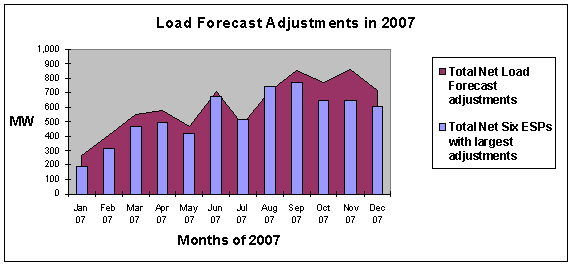
D.05-10-042 outlined a process to adjust an LSE's load forecast on a monthly basis. The CEC and CPUC administered the program through 2007. The LSEs were directed to submit revised forecasts two months prior to the filing month, which is one month prior to the RA Monthly filing due date. These load forecast adjustments were to be solely for the purposes of accounting for load migration. Table 2 shows that the adjusted forecasts each month consistently represent a one to three percent increase over the year-ahead forecasts, or between 270 to 859 MW each month. Energy Division Staff also observed that the adjustments tended to grow as the year progressed, illustrating the increased uncertainty as lead time got longer.
Table 2 Summary of Load Forecast Adjustments in 2007 (in MW)
Line |
Description |
Jan |
Feb |
Mar |
Apr |
May |
Jun |
Jul |
Aug |
Sep |
Oct |
Nov |
Dec |
1 |
Total Forecasts mailed out in Jun. 2006 |
30,265 |
29,290 |
27,588 |
29,500 |
35,323 |
36,817 |
41,034 |
44,618 |
39,229 |
34,433 |
29,578 |
30,949 |
2 |
Monthly Load Forecast adjustments through 2007 |
270 |
407 |
550 |
578 |
470 |
711 |
480 |
705 |
853 |
774 |
859 |
717 |
3 |
Total forecasts used in monthly RA filings in 2007 |
30,535 |
29,696 |
28,138 |
30,078 |
35,792 |
37,527 |
41,514 |
45,323 |
40,083 |
35,207 |
30,437 |
31,665 |
4 |
Line 3 as percent of Line 1 |
101% |
101% |
102% |
102% |
101% |
102% |
101% |
102% |
102% |
102% |
103% |
102% |
Source - Aggregated Load Forecast Adjustments submitted to the CEC and CPUC through 2007
As with many other aspects of RA implementation in 2007, there has been a learning curve on which both the LSEs and CPUC Staff have developed and refined the RA program. In general LSEs sometimes struggled with maintaining current information in their filings regarding outages on units with which they contract to provide RA capacity, and Energy Division staff spent considerable time in the off peak months informing the LSEs of outages. Advances were made in communication and coordination within each LSE, and in general there has been significant improvement in the ability of LSEs to report filings that do not need as much correction.
Further, there has been a growth in the number of third party transactions for RA contracts made with generators that are subsequently resold to LSEs. In some cases, LSEs resell excess capacity, and in other cases a third party non-LSE purchases capacity for the purpose of resale. Some ESPs are beginning to use these third party marketers, particularly in procurement of Local RA capacity. Finally there are still large positive adjustments made to load forecasts in the month-ahead filings that indicate some load that was probably unaccounted for in the year-ahead forecasts.
Figure 1 below depicts the magnitude and diversity of monthly load forecast adjustments as reported by the ESPs and IOUs. Much like 2006, four ESPs reported minimal adjustments of around two percent or less each month, while six of the twelve ESPs reported adjustments in excess of ten percent of their load each month. The IOUs also adjusted their load to account for load migration, and the size of those adjustments did not exceed two percent of their load. However, that is not a good comparison due to the large size of IOUs relative to the pool of direct access customers that migrate. IOU load forecast adjustments are included in the total in Figure 1 however. Load forecast increases were not balanced by decreases, indicating that the yearly load forecasts underestimated ESP load while in general correctly estimating IOU load.
Figure 1 2007 Aggregate Load Forecast Adjustments Reported by LSEs, by Month Showing Load Gained or Lost
 Source: Monthly load forecast adjustment filings submitted by LSEs to CEC
3.2. 2007 System RA Requirements for CPUC Jurisdictional LSEs
For every month of 2007, CPUC-jurisdictional LSEs have satisfied their individual and collective system RAR. The total MWs of RA resources5 procured exceeded the total System RAR by between 2 percent and 41 percent, depending on the month. Please note that the Total CEC Load Forecast is the same forecast as applicable to the Monthly Filings, from Line 4 in Table 2.
During the forecasted and actual peak month of August 2007, the CPUC's jurisdictional LSEs were collectively required to procure 49,491 MW of resources. Collectively, the LSEs procured 102 percent of the total System RAR, or 50,319 MW, which represents 828 MW in reserves beyond that required by the RA program.
Table 3 2007 RA Filing Summary for CPUC Jurisdictional Entities (MWs)
A |
B |
C |
D |
E |
F |
G |
H |
2007 |
Demand Forecast1 |
Demand Response2 |
Net Demand |
RAR3 |
Total Resources Reported4 |
Resources Reported as % of RAR |
Resources Reported as % of Net Demand |
|
|
|
D=B-C |
E=D*115% |
|
G=F/E |
H=F/D |
Jan |
30536 |
1361 |
29175 |
33551 |
44124 |
132% |
151% |
Feb |
29696 |
1361 |
28335 |
32585 |
42339 |
130% |
149% |
Mar |
28138 |
1361 |
26777 |
30794 |
43295 |
141% |
162% |
Apr |
30078 |
1361 |
28717 |
33025 |
42413 |
128% |
148% |
May |
35792 |
1724 |
34068 |
39178 |
44482 |
114% |
131% |
Jun |
37527 |
2201 |
35326 |
40625 |
49061 |
121% |
139% |
Jul |
41514 |
2286 |
39228 |
45112 |
48821 |
108% |
124% |
Aug |
45323 |
2287 |
43036 |
49491 |
50319 |
102% |
117% |
Sep |
40083 |
2288 |
37795 |
43464 |
49151 |
113% |
130% |
Oct |
35207 |
1738 |
33469 |
38489 |
43102 |
112% |
129% |
Nov |
30437 |
1419 |
29018 |
33371 |
41514 |
124% |
143% |
Dec |
31665 |
1420 |
30245 |
34782 |
40199 |
116% |
133% |
Source: Aggregated LSE Monthly RA Filings
3.3. Adoption of Local RAR Program
Beginning in 2007, LSEs demonstrate annually that they have acquired adequate generation capacity within defined, transmission-constrained areas. A new local procurement obligation was established and required for Commission jurisdictional LSEs in D.06-06-064 applicable for compliance year 2007 that included the following requirements:
· LSEs shall demonstrate they have acquired one hundred percent of their Commission determined year-ahead local procurement obligation for the calendar year of 2007.
· A waiver of penalties provision that relies in part on a threshold price of $40 per kilowatt-year. If an LSE demonstrates that a waiver is justified, it will pay for backstop procurement but will not be penalized.
· In the event that an LSE does not meet its local procurement obligation and the LSE has not been granted a waiver, it will be subject to a penalty of $40 per kW-year on the amount of its deficiency, in addition to backstop procurement costs.
3.4. Local RA Procurement in 2007
The CPUC instituted a new Local RA obligation as part of the evolving Local RA Program for 2007 compliance year in D.06-06-064. The first Local RA filings were due November 2nd, 2006. Pursuant to the CAISO 2007 Local Capacity Technical Analysis6, LSEs were ordered to procure Local RA capacity in each of four Local Areas defined by the CPUC in fulfillment of their Local RA obligations within those four Local Areas. CPUC jurisdictional LSEs procured Local RA Resources sufficient to meet Local RA in all Local Areas of California in 2007, with procurement exceeding Local RA by two to nine percent across Local Areas. A new Local Area in Big Creek/Ventura was added for 2008 compliance year.
Table 4: Local RA procurement in 2007
Local Areas in 2007 |
Total LCR |
CPUC jurisdictional Local RAR |
Total Minimum Physical Resources Reported by month |
Local RMR/DR Allocation |
Minimum monthly procurement as percent of Local RAR |
LA Basin |
8843 |
7963 |
8132 |
0 |
102% |
San Diego |
2781 |
2781 |
915 |
2129 |
109% |
Greater Bay Area |
4771 |
4325 |
3797 |
618 |
102% |
Other PG&E Local Areas |
6073 |
5897 |
5979 |
121 |
103% |
Totals |
22468 |
20966 |
18824 |
2868 |
103% |
Source: Aggregated 2007 LSE RA filings
3.5. Total RA Resources Available to CAISO in 2007
The CAISO administered their Interim Reliability Requirements Program Tariff in coordination with the CPUC's RA Program beginning in 2006 and continuing into 2007; in addition to CPUC jurisdictional LSEs, the CAISO also received RA filings from non-jurisdictional LSEs that added to the capacity available to the CAISO to provide reliable service.
Figure 2 compares the total CEC forecast (1 in 2) for the CAISO, the CAISO actual peak load, and the total CAISO Summer Forward Commitment Obligation (including the obligation upon the CPUC jurisdictional entities) for the summer months of May through September, 2007. In all months, the procurement demonstrated through the CAISO's Forward Commitment Obligation exceeded the load forecast and the actual load. Total procurement across the CAISO was well above the procurement obligation and actual peak load was comparable to the CEC 1 in 2 load forecast in all summer months of 2007. In the peak month of August 2007, capacity resources procured by all LSEs (CPUC jurisdictional and non-CPUC jurisdictional) totaled 54,584 MW of resources to meet 48,490 MW of actual CAISO peak load. System RA procurement across the CAISO ranged between 48,449 MW (May) and 54,584 MW (August), or between 117 percent and 138 percent of CEC 1 in 2 demand forecast minus Demand Response.
Figure 2 Total CAISO Summer 2007 Forward Procurement Obligation and Forward Procurement vs. CEC Demand Forecast and Actual Monthly Peak Demand (MW)

Source: Aggregated data compiled from CAISO RCST Analysis
Table 5 shows total procurement for all LSEs within CAISO as a percent of both the total procurement obligation across the CAISO and the actual peak load across the CAISO during the summer of 2007. The data represented in Figure 2 is the same data as is represented in Table 5. Significantly, 61 percent to 64 percent of all resources demonstrated in 2007 were unit specific non-DWR physical resources within the CAISO and only 7 percent to 9 percent were imports and 7 percent to 8 percent were non-DWR (Department of Water Resources) Liquidated Damages contracts. The remaining 20 to 23 percent is comprised of DWR and other resources.
Table 5 Total CAISO LSE Procurement as Percent of Total CAISO Obligation and Peak Demand
Month |
Peak Load (MW): |
Demand Response [@ 115%] (MW): |
Demand forecast - DR (Net Demand) |
Forward Commitment Obligation Minus Demand Response (MW): |
I. Physical Resources in ISO Control Area |
II. Unit Contingent Resources from Outside the ISO Control Area |
III. Non-Unit Contingent Resources from Outside the ISO Control Area |
IV. LD |
V. DWR |
Other or non-specified |
Total RA Capacity |
RA Capacity Relative to Commitment Obligation (100% is Compliant) |
RA Capacity Relative to Net Demand (115% is compliant) |
May-07 - PUC |
35,792 |
1,724 |
34,068 |
39,178 |
30,570 |
2,152 |
140 |
3,800 |
6,946 |
875 |
44,482 |
114% |
131% |
Non-PUC |
3,086 |
132 |
2,954 |
3,397 |
424 |
855 |
407 |
204 |
|
2,077 |
3,967 |
117% |
134% |
Total |
38,878 |
1,856 |
37,022 |
42,575 |
30,994 |
3,007 |
547 |
4,003 |
6,946 |
2,952 |
48,449 |
114% |
131% |
Percent of Total |
|
|
|
|
64% |
6% |
1% |
8% |
14% |
6% |
100% |
|
|
June-07 PUC |
37,527 |
2,202 |
35,325 |
40,624 |
31,955 |
2,201 |
430 |
3,808 |
9,794 |
875 |
49,063 |
121% |
139% |
Non-PUC. |
3,315 |
186 |
3,129 |
3,599 |
448 |
857 |
495 |
272 |
|
1,810 |
3,882 |
108% |
124% |
Total |
40,842 |
2,388 |
38,455 |
44,223 |
32,403 |
3,057 |
925 |
4,080 |
9,794 |
2,685 |
52,944 |
120% |
138% |
Percent of Total |
|
|
|
|
61% |
6% |
2% |
8% |
18% |
5% |
100% |
|
|
July-07 PUC |
41,514 |
2,286 |
39,228 |
45,112 |
31,830 |
2,408 |
430 |
3,496 |
9,783 |
873 |
48,821 |
108% |
124% |
Non-PUC |
3,681 |
185 |
3,497 |
4,021 |
521 |
875 |
441 |
467 |
|
1,969 |
4,274 |
106% |
122% |
Total |
45,195 |
2,471 |
42,725 |
49,133 |
32,351 |
3,283 |
871 |
3,964 |
9,783 |
2,842 |
53,094 |
108% |
124% |
Percent of Total |
|
|
|
|
61% |
6% |
2% |
7% |
18% |
5% |
100% |
|
|
Aug-07 PUC |
45,323 |
2,287 |
43,036 |
49,492 |
33,191 |
2,408 |
1,280 |
3,492 |
9,776 |
173 |
50,319 |
102% |
117% |
Non-PUC |
3,674 |
182 |
3,491 |
4,015 |
478 |
904 |
429 |
513 |
|
1,941 |
4,265 |
106% |
122% |
Total |
48,997 |
2,469 |
46,527 |
53,506 |
33,669 |
3,312 |
1,709 |
4,005 |
9,776 |
2,114 |
54,584 |
102% |
117% |
Percent of Total |
|
|
|
|
62% |
6% |
3% |
7% |
18% |
4% |
100% |
|
|
Sept-07 PUC |
40,083 |
2,289 |
37,794 |
43,453 |
32,029 |
2,408 |
1,280 |
3,486 |
9,776 |
173 |
49,151 |
113% |
130% |
Non-PUC |
3,388 |
182 |
3,206 |
3,686 |
517 |
908 |
346 |
468 |
|
1,771 |
4,010 |
109% |
125% |
Total |
43,471 |
2,471 |
40,999 |
47,139 |
32,546 |
3,316 |
1,626 |
3,954 |
9,776 |
1,944 |
53,162 |
113% |
130% |
Percent of Total |
|
|
|
|
61% |
6% |
3% |
7% |
18% |
4% |
100% |
|
|
Source: Aggregated RA data collected by CPUC along with RCST data from CAISO for the summer of 2007.
4. Counting Resource Adequacy Resources
During the development of the RA program, the Commission established counting conventions for the different resource types which are summarized in previous Commission decisions. The NQC for each resource is computed based on the counting conventions for the applicable resource type. Once each year, the CAISO posts on their website the NQC for each resource that is eligible to sell NQC to CPUC jurisdictional LSEs. This has been done for 2006, 2007, and now for 2008 compliance years7. Significant new resources were added to the NQC list this year, highlighted by the addition of the Long Beach generating units, as well as the peakers built by SCE. In total, over 1,500 MW of NQC was added to the NQC list for 2008, including both new resources and incremental additions to existing resources.
4.1. Introduction to Net Qualifying Capacity
NQC is the amount of a resource's capacity that can be counted for resource adequacy compliance filings. NQC counting conventions vary by resource type, as described throughout this section, but it is intended to reflect the expected capacity value that will be available to the CAISO during periods of system peak demand. An overview of Net Qualifying Capacity can be found in the 2006 RA report. NQC counting conventions and the Planning Reserve Margin are closely related concepts. For example, one could interpret the PRM to include an adjustment for any deviations of actual production from NQC values.
4.2. Establishment of CAISO'S NQC Values for 2007
Significant changes have occurred to the NQC list since posting the list began for the 2006 compliance year. Several new resources have been added, the format of the list has changed, and now there is more information posted on the list such as Zonal and Local Area designation. On July 14, 2006, the CAISO updated the NQC list to be used for the compliance year 2007. The update of the NQC list was completed for the following adjustments:
· Updated values for resources whose counting conventions include historical data (e.g. wind and solar without backup resources).
· Updated values for resources with erroneous or missing NQC that may have been listed in error in the previous 2006 NQC posting. This update included modifications to the NQC by the CAISO pursuant to its testing and verification authority under section 40.5.2 of its Tariff.
· Added Zonal and Local Area designations, to support the implementation in the 2007 compliance year of the Local RA Program and implementation for the 2008 compliance year of the Zonal RA Program.
The CAISO has stated that it will continue to publish an annual NQC list on or about July 1st of each year for the following RA compliance year. The CAISO has not yet developed procedures or metrics for evaluating a unit's actual performance, and the CAISO is committed to doing so within one year of the introduction of MRTU. 2007 NQC values were not adjusted for performance such as excessive outages.
4.3. Aggregate NQC Values 2006, 2007, and 2008
Table 6 shows aggregate NQC values from the CAISO NQC list for 2006-2008. In compiling the totals, most facilities were given a single, year-round NQC value. Some facilities such as wind and solar units without backup were given twelve monthly NQC values due to performance variations between months. For those facilities that were given monthly NQC values, this table uses August NQC values for the annual total.
Table 6 : NQC values for 2006-2008
Year |
Total NQC |
Total Number of Scheduling Resource IDs |
NQC change |
Scheduling Resource ID additions |
2006 |
46687 |
563 |
|
|
2007 |
46504 |
572 |
-183 |
9 |
2008 |
48056 |
600 |
1552 |
30 |
Source: CAISO NQC lists, 2006-2008
While the total NQC available for purchase decreased between 2006 and 2007 due to the re-calculation of wind and solar resources and other NQC adjustments made by the CAISO, the NQC for 2008 increased by approximately 1552 MW due primarily to over 1000 MW of new resources from approximately 30 new generating units that were added to the NQC list for 2008, as well as an incremental 400 MW of added NQC from existing resources.
The NQC list as of August 9, 2006 was applicable for compliance year 2007. The NQC list published on July 6, 2007 is applicable for 2008.
4.4. NQC for Thermal Generation Units
The counting conventions for thermal generation units are perhaps the most straightforward application of NQC. The NQC is defined as the maximum dependable capacity available from the unit. The NQC identified for most thermal units on the NQC list is simply the PMax, or the amount of MWs available when the unit is at its "maximum performance". Although the capacity of thermal units is in part dependent on the ambient temperature at the generator site when the unit is in operation, there is no current NQC derating methodology to adjust for ambient temperatures throughout the course of the year. Generation owners are expected by the CAISO to report ambient temperature induced reduction in generation capability via the CAISO's reporting mechanisms as they occur. Some generator owners have voluntarily provided NQC values that are adjusted to account for ambient variations, but there is no systematic approach or rule to adjust NQC based on ambient conditions yet. Ambient conditions tend to lower a generator's actual output during the summer months.
4.5. NQC for Wind Resources without Backup
The intermittent nature of a wind power plant, without integrated storage or other backup generation, presents a complex challenge to represent by a single annual NQC value, or even twelve monthly NQC values. On the other hand, a daily or hourly NQC would be difficult or impossible to calculate in advance and would be inconsistent with the current RA paradigm. Thus, monthly or annual NQC values must be calculated for wind and solar resources in order for their capacity to be properly valued by the RA program, even though such values will not represent actual production at many specific times.
A wind generator's typical or average production is a function of at least two factors: location and wind turbine technology, while it's time-specific production is only a function of technology and current wind velocity. There is no clear industry consensus on a methodology to predict a generator's hourly production based on location and technology alone. In order to best represent the hourly variability of wind production, the Commission has chosen to base the NQC counting rules for wind on historical production8. Staff believes that continuing to use historical production as the basis for calculating NQC is appropriate, but investigates the implications of the current methodology in the analysis below. This analysis compares the current counting rules to many other methodologies, but no single methodology emerges as a clearly preferred alternative. Instead, the different methodologies merely emphasize different components of the historical data.
Data used in this analysis generally reflects hourly purchase data reported by the three IOUs for all wind units (QF and non-QF) during the first nine months of 2007 and some data from earlier years is also used. Purchase data for the remainder of 2007 was not available to Staff in time for inclusion in this report. Hourly load and price data were obtained from the CAISO's OASIS database. The CEC and the CAISO both group wind resources into "windzones" for analysis. This grouping is intended to help clarify the differences between wind production patterns in different regions of California. Some of the windzones (e.g. San Gorgonio, Tehachapi) have substantially larger installed wind capacities than others (e.g. Pacheco, Solano).
Survey of the Data & Assessment of Current NQC Counting Conventions
Current CPUC rules dictate that monthly NQC is calculated based on a three year average of hourly production during SO1 peak hours. Figure 3, below, depicts the daily production during hours ending (HE) 13-18 for each day in the first nine months of 2007 and the 2007 monthly NQC values, which are based on historical production during 2003-2005. Based on the graph, it is evident that daily production deviates broadly, in both directions, from the established NQC.
Figure 3 2007 CAISO-wide wind production during HE 13-18, summed over all included wind generating units, both QF and non-QF.

Wind production is extremely variable. As shown in Table 7 below, the standard deviation of production during peak often exceeds the average production, indicating that there is a large spread in the data and the possibility of a bi-modal distribution. The minimum hourly production for a windzone-month combination occurred during HE 13-18 17 times out of 45 combinations (Pacheco was not considered in the minimum production analysis because for all months the minimum production rounded to zero); the maximum production occurred during HE 13-18 eleven times of 54 combinations.
Table 7. Average and standard deviation of hourly production during HE 13-18 (MW) by month.
Month |
Altamont |
Pacheco |
San Diego |
San Gorgonio |
Solano |
Tehachapi |
1 |
16.4 (35.7) |
0.9 (2.3) |
69.2 (69.9) |
109.1 (118.3) |
15.8 (22.2) |
57.4 (71.3) |
2 |
19.8 (29.4) |
2 (2.9) |
114.5 (105.8) |
166.5 (142.3) |
20.6 (23) |
87.8 (79) |
3 |
68.2 (89.2) |
2.2 (3.4) |
90.1 (82.6) |
178.9 (141.7) |
23.2 (26.5) |
111.6 (100) |
4 |
96.6 (105.3) |
3.5 (4.1) |
135.4 (106.7) |
236.5 (138.4) |
40.2 (33.4) |
153.8 (105) |
5 |
175.7 (123.9) |
6.1 (4.1) |
116.2 (93.5) |
198.9 (134.8) |
66.7 (34.1) |
107.8 (96.6) |
6 |
155.4 (119.1) |
5.4 (3.9) |
139 (87.5) |
252 (129.1) |
54.5 (31) |
130.7 (90.1) |
7 |
150.1 (105.2) |
5.1 (3.6) |
80.5 (84.1) |
153.2 (107.1) |
60.7 (29.9) |
85.5 (74) |
8 |
114.4 (107.8) |
3.5 (3.5) |
77.3 (75.3) |
150.5 (117.3) |
52.5 (33.8) |
72.7 (67.7) |
9 |
92.7 (109.1) |
3.4 (3.9) |
115.9 (97.9) |
151 (112.2) |
37.8 (35.9) |
69.3 (75.1) |
Wind production varies in a number of ways over the course of the year. In general, average production during peak hours is highest during the spring and lowest during late fall and early winter. The 2007 NQC values reflect this pattern, as shown in Figure 5 below. For instance, NQC values during the peak summer months (7-8) is between 15-30 percent of nameplate capacities, down from 20-60 percent in June (month 6). The additional two years of data reflected in Figure 5 serve to "smooth" the curves relative to Figure 4.
Figure 4 Average production during 2007 SO1 Peak hours

Figure 5. 2007 NQC as a percent of nameplate capacity

Further, there is notable variation between windzones. For instance, wind NQC in relation to nameplate capacity varies significantly. Tehachapi generally has the highest ratio of NQC to nameplate and Solano the lowest. On the other hand, Figure 6 shows that during August, 2007 Solano - on average - produced the highest fraction of its NQC during peak hours. In HE 3, Solano produced about 275 percent of its NQC and about 140 percent in HE 12. Tehachapi, by contrast, produced the least power, as a fraction of its NQC for all of the peak hours (HE 13-18), with a low of about 40 percent of NQC in HE 13. The results of the other summer 2007 months are similar to those presented for August.
Figure 6. Average hourly wind production during August 2007, by windzone.

Note: Fraction of NQC, on the vertical axis, indicates the ratio of average hourly production to the NQC of the resources in the windzone (the vertical axis could be read as a percentage of NQC by multiplying by 100).
Some parties have expressed concern that current NQC counting rules overstate the availability of wind generation. As Figure 6 demonstrates, this was true for several windzones, on average, during August, between approximately HE 7 and HE 15 (indicated on the graph by values below 1, while values above 1 indicate average production above NQC). The latest of these hours of average low production fall in the early afternoon, close to the traditional peak times of electricity demand in the summer.
Table 8. Correlation Coefficients, Wind Production with Price and Load. Summer, 2007.
All Hours, May-September |
HE 13-18, May-September | |
Correlation with Load |
-0.32 |
-0.30 |
Correlation with Price, NP15 |
-0.11 |
-0.15 |
Correlation with Price, SP 15 |
-0.10 |
-0.13 |
Correlation with Price, Average |
-0.11 |
-0.15 |
Wind production does not conveniently match the variation of load and electricity prices. Table 8 shows that wind production is negatively correlated with CAISO system load and prices in both zones (North of Path 15 {NP15} and South of Path 15 {SP15}) during the summer months, indicating that wind production is generally lower during the periods of high prices and high demand. Figure 7 demonstrates this correlation graphically by grouping hours by load and showing the hourly production for each hour in August, 2007. Most of the highest load hours fall in the lower right hand corner of the graph, during several high load days late in the month when wind production was low. Figure 7, shows that during August, 2007, the highest five percent of load hours almost all had production levels below 600 MW and most of these 38 hours were even below 200 MW.
Figure 7. Hourly Production during August, 2007, grouped by Hourly Load Percentile.

Note: The horizontal axis in this chart is time, i.e. on the left hand side of the figure are hours from the early part of the month while the end of the month is on the right.
Wind production at super-peak hours very often falls below NQC. Figure 8 shows that in only one of the twenty hours of highest load during the summer of 2007 did the actual hourly wind production exceeded NQC. Figure 9 shows that production exceeded NQC eleven of fifty highest load hours. Of these fifty hours, production exceeded fifty percent of NQC in 23 hours. Although the effect is small, note that the hours later in the afternoon tend to have a higher production level than the early hours. This is consistent with the upward slope of the curves depicted in Figure 6 from approximately HE 13 to HE 19. Figure 8 and Figure 9 also reconfirm that the highest load hours of the summer tend to occur during HE 13 to HE 18, (84 percent of the fifty hours in Figure 9 fall within that range) suggesting that this timeframe is an appropriate period of data to use for NQC calculations for summer months.
Figure 8. Hourly system wind production during the top 20 hours of load in 2007.

Note: All 20 top hours occurred during August and the NQC shown is for that month.
Figure 9. Time and Wind Production of top 50 load hours in 2007.

Table 9 summarizes the summer hours during HE 13-18 where, on average production was below NQC. In corroboration of Figure 6, this table clearly demonstrates that under-production, relative to NQC, was most common in the early afternoon. Under-production was most prevalent during HE 13 and 14. Table 10 shows that over the nine months of data, all windzones produced less than 10 percent of monthly NQC for at least 10 percent of SO1 peak hours. San Gorgonio performs the best by this metric (11 percent of hours under 10 percent of NQC) and Pacheco performs worst (42 percent of hours under 10 percent of NQC). Table 10 summarizes the frequency of severe under-production, hours where generation was less than 10 percent of NQC.
Table 9. HE 13-18 hours where, on average, production was below monthly NQC.
|
May |
June |
July |
August |
September |
Altamont |
|
13 - 16 |
14 |
13 - 14 |
13 - 15 |
Pacheco |
|
13 - 18 |
13 - 15 |
13 - 16 |
13 - 15 |
San Diego |
13 - 18 |
13 - 17 |
13 - 17 |
13 - 15 |
|
San Gorgonio |
13 - 17 |
13 - 15 |
13 - 15 |
13 - 14 |
13 - 14 |
Solano |
|
|
|
|
|
Tehachapi |
13 - 18 |
13 - 18 |
13 - 17 |
13 - 17 |
13 - 18 |
Total |
13 - 17 |
13 - 16 |
13 - 15 |
13 - 15 |
13 - 15 |
Note: For example, an entry "13 - 15" indicates that for the given windzone-month combination, average hourly production for hours-ending 13, 14, and 15 is below the NQC.
Table 10. Count of SO1 Peak Hours during which production was less than 10 percent of NQC.
Month |
Altamont |
Pacheco |
San Diego |
San Gorgonio |
Solano |
Tehachapi |
Total SO1 Peak Hours |
1 |
81 |
93 |
3 |
12 |
61 |
42 |
132 |
2 |
58 |
54 |
11 |
14 |
27 |
27 |
120 |
3 |
62 |
77 |
22 |
21 |
41 |
33 |
132 |
4 |
37 |
73 |
26 |
12 |
10 |
36 |
126 |
5 |
18 |
19 |
34 |
18 |
1 |
38 |
132 |
6 |
32 |
39 |
20 |
14 |
0 |
28 |
126 |
7 |
14 |
21 |
42 |
8 |
2 |
15 |
126 |
8 |
25 |
58 |
26 |
12 |
8 |
35 |
138 |
9 |
31 |
45 |
17 |
11 |
29 |
35 |
114 |
Total % |
31.2% |
41.8% |
17.5% |
10.6% |
15.6% |
25.2% |
100.0% |
The above data shows significant deviations from NQC production during 2007, but this does not mean 2007 was not a normal year for wind production. Despite significant month-to-month variation, overall 2007 wind production during SO1 Peak is comparable to NQC values. The winter of 2007 was windier and the spring and early summer were less windy than recent years.
Table 11 below shows that, although some individual units deviated significantly from their NQC values, system-wide wind generators performed within roughly 35 percent of NQC. 2007 data will have an effect on 2009 NQC, but not a disproportionate effect, given the three years of data that is used to determine NQC.
Table 11. Difference in average production during 2007 relative to NQC for all windunits.
January |
February |
March |
April |
May |
June |
July |
August |
Sept | |
Large |
1690% |
810% |
200% |
220% |
189% |
33% |
66% |
62% |
75% |
Small |
679% |
306% |
129% |
86% |
112% |
30% |
87% |
82% |
88% |
Large |
90% |
75% |
4% |
5% |
13% |
-11% |
2% |
23% |
46% |
Small |
162% |
197% |
30% |
207% |
-16% |
2% |
-17% |
42% |
48% |
Small |
330% |
163% |
21% |
14% |
-23% |
-7% |
-34% |
15% |
64% |
Small |
540% |
596% |
314% |
258% |
99% |
176% |
153% |
220% |
128% |
Small |
65% |
105% |
21% |
-5% |
-31% |
2% |
-23% |
-9% |
27% |
Large |
76% |
39% |
-3% |
1% |
-8% |
-13% |
-15% |
14% |
41% |
Small |
107% |
-37% |
9% |
-18% |
-25% |
-41% |
-12% |
-47% |
-19% |
Small |
439% |
94% |
8% |
2% |
23% |
-53% |
-15% |
-15% |
-2% |
Small |
-95% |
-94% |
-94% |
-94% |
-92% |
-92% |
-91% |
-92% |
-94% |
Small |
-5% |
-30% |
-3% |
4% |
23% |
-33% |
17% |
-18% |
6% |
Small |
-42% |
-71% |
88% |
56% |
99% |
16% |
68% |
52% |
72% |
Small |
667% |
24% |
-8% |
4% |
24% |
-24% |
4% |
-3% |
21% |
Small |
143% |
102% |
14% |
-24% |
31% |
-32% |
5% |
-26% |
12% |
Large |
298% |
31% |
4% |
-8% |
19% |
-31% |
-3% |
-29% |
-32% |
Small |
44% |
-42% |
8% |
3% |
25% |
-25% |
10% |
2% |
70% |
Large |
3% |
-55% |
0% |
5% |
13% |
-34% |
0% |
7% |
122% |
Large |
1270% |
277% |
-26% |
48% |
85% |
13% |
21% |
17% |
43% |
Large |
-66% |
-76% |
-29% |
-31% |
-3% |
-40% |
-15% |
-39% |
-37% |
Small |
126% |
-19% |
7% |
-5% |
23% |
-28% |
5% |
-13% |
16% |
Large |
106% |
106% |
11% |
-27% |
-28% |
8% |
-72% |
6% |
-44% |
Small |
94% |
99% |
25% |
-16% |
-22% |
6% |
-19% |
16% |
29% |
Large |
25% |
50% |
6% |
-6% |
-28% |
-1% |
15% |
17% |
3% |
Large |
-47% |
-36% |
-45% |
-47% |
-64% |
-57% |
-46% |
-42% |
-52% |
Large |
71% |
85% |
-17% |
-35% |
-28% |
-15% |
-18% |
-4% |
33% |
Average |
30.6% |
35.8% |
-8.6% |
-17.9% |
-20.7% |
-20.8% |
-9.6% |
-3.9% |
3.3% |
Note: calculated as (production - NQC)/NQC. Units labeled as "large" have an August, 2007 NQC greater than 10 MW; all other units are labeled as "small". Each row is an individual wind unit
The current NQC counting rules use only SO1 peak hours, effectively ignoring the performance of wind resources on weekends and NERC holidays. Staff believes there is no reason to expect different behavior of the wind itself on different days. However, there is some chance that there could be a systematic difference between holidays and weekends compared to weekdays due to different economic incentives of generator owners. This effect is expected to be small, if it exists at all. Table 12 shows no systematic difference in the averages of production during SO1 peak hours and all HE 13-18. Instead, the table appears to show that certain months (4, 6) were less windy on weekdays than on weekends and holidays while the opposite was true for other months (2, 9).
Table 12. Difference between average hourly production during SO1 Peak hours and all HE 13-18.
Month |
Altamont |
Pacheco |
San Diego |
San Gorgonio |
Solano |
Tehachapi |
1 |
22.1% |
24.8% |
9.0% |
4.3% |
-4.7% |
3.9% |
2 |
0.2% |
7.2% |
4.2% |
8.7% |
-1.1% |
11.9% |
3 |
-15.8% |
-1.9% |
4.6% |
4.4% |
-6.5% |
2.3% |
4 |
-25.3% |
-46.5% |
-15.0% |
-11.4% |
-16.9% |
-8.5% |
5 |
-3.4% |
-4.2% |
2.4% |
-8.6% |
-3.7% |
-13.8% |
6 |
-15.1% |
-12.9% |
-0.3% |
-7.8% |
-10.3% |
-14.9% |
7 |
-8.0% |
2.0% |
3.4% |
-2.0% |
-5.3% |
-5.6% |
8 |
-27.0% |
-17.3% |
-8.8% |
-4.6% |
-28.0% |
-0.1% |
9 |
10.8% |
11.4% |
5.1% |
0.3% |
6.1% |
1.9% |
Parties have described anecdotal evidence that changing wind conditions effectively amplify morning and evening load ramps (increase or decrease in load requiring a corresponding change in generation), therefore compounding the difficulty of maintaining reliability during the ramp periods. Table 13 confirms that wind conditions generally change in the opposite direction of load. Hours selected to represent the ramp periods in Table 13 reflect the most rapid changes in average wind generation. For the hours selected, the evening wind ramp rate is approximately one third of the magnitude of the load ramp. In the morning, the wind ramp is approximately one thirtieth of the load ramp.
Table 13. Morning and Evening Wind and Load Ramp Rates
|
Month |
Wind Ramp (MW/hour) |
Load Ramp (MW/hour) |
CAISO Load (MW) |
Morning (HE 7-10) | ||||
|
May |
-50 |
1,432 |
27,011 |
|
June |
-75 |
1,668 |
27,536 |
|
July |
-77 |
1,885 |
29,566 |
|
Aug |
-73 |
1,865 |
30,409 |
|
Sep |
-33 |
1,541 |
28,128 |
Evening (HE 16-19) | ||||
|
May |
73 |
-245 |
30,356 |
|
June |
82 |
-174 |
33,500 |
|
July |
108 |
-249 |
38,267 |
|
Aug |
87 |
-325 |
39,702 |
|
Sep |
42 |
-249 |
33,561 |
Note: Load is averaged over the same hours as the ramp rates of the resources (e.g. HE 7-10 for all days in month).
Wind production varies in complicated ways - there are many intriguing patterns that are relevant to electricity policy discussions. One of the key lessons from this analysis is that generally in California summers wind production and electricity demand frequently do not align. However, in average terms, wind production is lowest around noon and tends to be higher later in the afternoon. Even among high demand days, wind generation sometimes "catches up" with NQC values by late afternoon; conversely, during high demand hours close to noon, wind generation is often significantly below its current NQC.
Although the windzones in California have some different characteristics and patterns, these differences are not easily described. There are likely some benefits to considering the prospects of a new wind generator within the context of the historical performance of its windzone, but this analysis does not justify differentiating policies across windzones.
Discussion of Methodologies
Any attempt to represent stochastic data (e.g. the patterns of wind production) with a deterministic calculation will yield imperfect results. Any conceivable counting convention for as available resources may significantly misrepresent the actual amount of capacity available at any given time due to variability in conditions. All reasonable methodologies have advantages and disadvantages, and in order for a clear alternative to emerge there must be a clear prioritization of policy goals. All common approaches to represent as available resources fit within one of three broad categories:
· Expected value: Calculate an expected amount of production for a specific time period based on a combination of assumptions and historical data. The three-year rolling average approach applied to wind by D.04-10-035 is a mechanism for calculating an expected value.
· Minimum probable: In order to ensure that capacity is not overestimated, and therefore that reliability is not compromised, an estimate of the minimum probable production could be used. For example, this could be based on historical data by taking the lowest value from the last several years for a comparable hour (e.g. for August the lowest average production during SO1 hours recorded on any single August day in last 3 years).
· Maximum probable: Calculate a historical maximum production to be used for capacity credit.
Table 14. Survey of wind capacity counting conventions
Jurisdiction |
Methodology |
Category |
PJM |
Rolling 3 year average of capacity factor; 3pm-7pm; June 1 - August 31 |
Expected |
NYISO |
Initially, use 4-hr sustained max; modify based on actual generation/outage |
Maximum probable |
ISO-NE |
Nameplate times one minus Forced Outage Rate (FOR) |
Expected |
SPP |
15th percentile of top 10 percent of load hours |
Minimum probable |
RMATS |
20 percent of nameplate |
Expected |
MAPP |
Median of a daily 4-hr period containing monthly max |
Expected |
Many studies |
Effective Load Carrying Capability (ELCC) |
Expected |
Source: M. Milligan & K. Porter. May, 2005. Determining the Capacity Value of Wind: A Survey of Methods and Implementation. NREL/CP-500-38062
Table 14, adapted from a paper published by the National Renewable Energy Laboratory, summarizes the approaches used by several jurisdictions to calculate the capacity credit of wind resources. The authors of the study, Milligan and Porter, favor an Effective Load Carrying Capability (ELCC) approach that uses a Loss of Load Probability (LOLP) model to calculate values. This approach has the advantage of integrating historical load and production data in a manner that directly calculates a wind resource's contribution to improving LOLP. ELCC effectively weights hours based on the risk of an outage, while simpler approaches either weight hours based on load, or simply eliminate hours that are considered non-peak from the calculation. However, the significant data and computational requirements of an ELCC approach are a deterrent. Simplifications of this approach have been tried, but have not been successful in systems with significant hydro penetration.
The previous section demonstrates that during 2007, current NQC rules - based on an historical running average of production at peak times - overestimate wind production at specific times, sometimes severely. The converse is also true; the average approach also underestimates production at many times. These observations imply a question: is there a better measurement of central tendency or "expected" production?
Beginning the exploration of alternative measures of central tendency, Figure 10 and Figure 11 compare mean, median, mode, and 25th and 75th percentiles for single windzones during HE 13-18 over nine months. The selected windzones represent the larger capacity (San Gorgonio) windzones and smaller capacity windzones (Altamont).
Figure 10. Different measures of central tendency
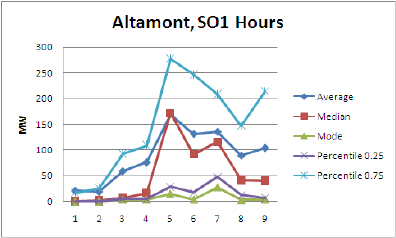
Figure 11. Different measures of central tendency
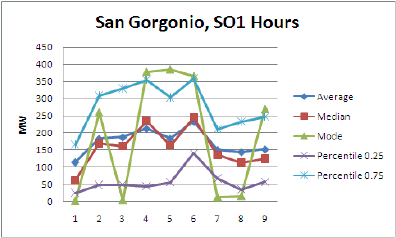
Comparing these different measures of central tendency shows that the 25th and 75th percentile measurements approximate the same shape as the median (i.e. the 50th percentile). For the windzones with more installed capacity, the median and the average track each other well, as shown in Figure 10. As calculated, the mode is clearly too volatile to be a useful measure of central tendency (here values are simply rounded to the 1 MW level). A higher level of aggregation of the data would make the mode more stable, but would lower its resolution.
One complication in choosing a measure of central tendency is the possibility of a bimodal distribution of the production data. Figure 12 below shows that the hourly data for most units (this unit is representative) does have a bimodal nature; in general the measures of central tendency fall between the primary groups of data, but both the 25th and 75th percentile curves appear to approximate the large groups of hourly production. The unit shown in Figure 13, by contrast, has a very regular distribution of hourly production.
Figure 12. Normalized Hourly production (all hours) versus measures of central tendency (all measured at SO1 peak).
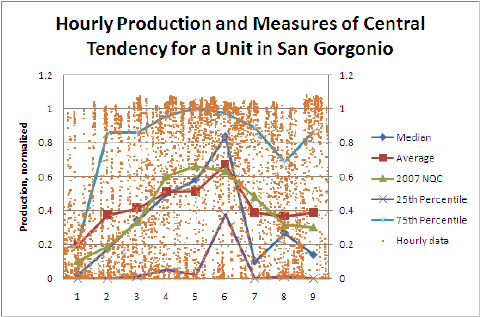
Figure 13. Normalized Hourly production (all hours) versus measures of central tendency (all measured at SO1 peak).
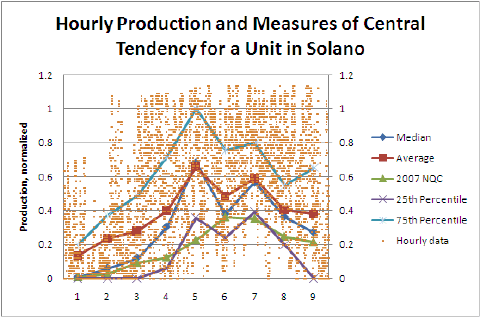
The bimodal distribution shown in Figure 12, which is typical of most wind units in California, clearly complicates the selection of a measure of central tendency. One simple, intuitive change to the current NQC rules for wind is to use the weighted average of the hours to be considered, instead of a straight (unweighted) average. This type of approach partially addresses the bimodality of the data by selecting certain data points to be weighted more heavily in the calculation than others. One implicit goal of the RA program is to reduce the risk of an outage, so the ideal weight for data is an outage risk metric such as LOLP. In the absence of a readily available risk metric, a proxy for risk is hourly load. Figure 14 shows the NQC that would be calculated, based solely on 2007 data, using weighted and unweighted approaches in addition to several other methodologies described below. The difference between weighted and simple averages is small compared to interannual variability; however, it is significant when viewed over the CAISO as a whole. Comparing the weighted and unweighted averages of HE 13-18, the difference ranges from 2 percent (June) to 8 percent (May). The basic formula for the weights shown here is:

In order to increase the impact of the weighting, the weights can be squared, cubed, or raised to a higher exponent. Since the weights all fall within the range of zero to one, this has the effect of moving most of the weights significantly toward zero, with the exception of the hourly weights that are close to one. Effectively, this means that hours with load very close to the maximum load (weight near one) become very important to the weighted average while all other hours become unimportant. Figure 14 and Figure 15 show the results of this type of calculation using a variety of exponents.
Other methodologies are shown in the following series of tables and figures. There are 25th and 15th percentiles of production data across all hours in the month, as discussed above. Another approach is to discard all hours that did not fall within the top ten percent of load; after discarding the low load hours, production data can either be simply averaged or a certain percentile of the remaining data can be taken (for example, the SPP approach described above in Table 14 is shown here). Figure 14 shows the results of all of these calculations for the summer of 2007 and Figure 15 compares the August, 2007 results to hourly production data.
Figure 14. Comparison of Calculation Methodologies
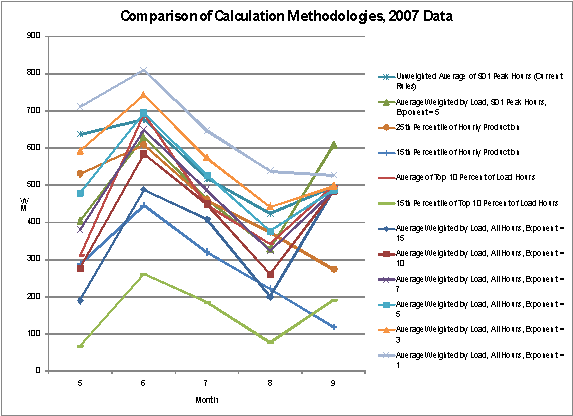
Figure 14 demonstrates a wide range of calculated values for each month. A policy maker who is primarily concerned with selecting a NQC methodology that will provide a NQC value that is nearly always exceeded by actual production may select a methodology that discards low load hours and then takes a low percentile of hourly production (i.e. the lowest, light green line in Figure 14). On the other hand, Figure 15 would lead a policy maker who is concerned with accurately representing "typical" wind conditions for the month of August to select a different methodology with a higher value, closer to more of the hourly production data points.
Figure 15. Hourly Production Compared to Several Calculation Methodologies with August, 2007 Data.
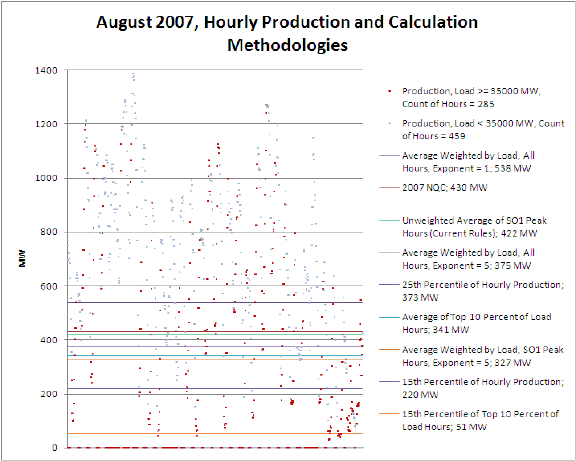
Note: Hourly production is displayed in two separate series, differentiated by hourly load on the CAISO system during that hour. The horizontal axis in this chart is time, i.e. on the left hand side of the figure are hours from the early part of the month while the end of the month is on the right.
Figure 15 shows that all of the methodologies overestimate actual production for at least some hours during August and that some of these are high load hours. Another take-away from this figure is the distribution of the high-load hours - although a significant number of the lowest production hours are high load hours, not all of the high load hours are low production hours. This trend is anticipated by Figure 7, which shows that during August, 2007, the highest five percent of load hours all had production levels below 600 MW, most of these 38 hours were even below 200 MW. Thus, an extreme enough system of weighting hours based on load would dramatically decrease the calculated NQC. Table 15 demonstrates that a weighting scheme with an exponent of 15 accomplishes this feat and calculates substantially lower NQC values than the current rules. The percent difference is from current rules (middle row, Positive Numbers Indicate Value is Greater than Current Rules), and Number of Top 50 Load hours in Month (bottom row, hours with production exceeding value/total hours).
Table 15 Comparison of Calculation Methodologies (2007 Data).
Month |
5 |
6 |
7 |
8 |
9 |
Average Weighted by Load, All Hours, Exponent = 15 |
189 (-70%) (0/0) |
487 (-28%) (0/0) |
407 (-21%) (0/3) |
198 (-53%) (13/36) |
487 (-1%) (4/11) |
Average Weighted by Load, All Hours, Exponent = 10 |
275 (-57%) (0/0) |
583 (-14%) (0/0) |
448 (-13%) (0/3) |
260 (-38%) (11/36) |
483 (-2%) (4/11) |
Average Weighted by Load, All Hours, Exponent = 7 |
379 (-41%) (0/0) |
648 (-4%) (0/0) |
488 (-6%) (0/3) |
321 (-24%) (9/36) |
483 (-2%) (4/11) |
Average Weighted by Load, All Hours, Exponent = 5 |
477 (-25%) (0/0) |
693 (3%) (0/0) |
525 (2%) (0/3) |
375 (-11%) (9/36) |
486 (-1%) (4/11) |
Average Weighted by Load, All Hours, Exponent = 3 |
590 (-7%) (0/0) |
742 (10%) (0/0) |
573 (11%) (0/3) |
441 (5%) (7/36) |
496 (1%) (4/11) |
Average Weighted by Load, All Hours, Exponent = 1 |
710 (11%) (0/0) |
809 (20%) (0/0) |
646 (25%) (0/3) |
538 (28%) (5/36) |
526 (7%) (4/11) |
Average Weighted by Load, HE 13-18, Exponent = 5 |
407 (-36%) (0/0) |
651 (-4%) (0/0) |
472 (-9%) (0/3) |
340 (-19%) (9/36) |
455 (-8%) (4/11) |
Average Weighted by Load, SO1 Peak Hours, Exponent = 5 |
402 (-37%) (0/0) |
629 (-7%) (0/0) |
462 (-11%) (0/3) |
327 (-22%) (9/36) |
607 (23%) (3/11) |
Unweighted Average of HE 13-18 |
672 (5%) (0/0) |
737 (9%) (0/0) |
535 (4%) (0/3) |
471 (12%) (6/36) |
470 (-5%) (4/11) |
Unweighted Average of SO1 Peak Hours (Current Rules) |
637 (0%) (0/0) |
676 (0%) (0/0) |
516 (0%) (0/3) |
422 (0%) (7/36) |
493 (0%) (4/11) |
25th Percentile of Hourly Production |
529 (-17%) (0/0) |
607 (-10%) (0/0) |
460 (-11%) (0/3) |
373 (-12%) (9/36) |
272 (-45%) (8/11) |
15th Percentile of Hourly Production |
286 (-55%) (0/0) |
444 (-34%) (0/0) |
319 (-38%) (1/3) |
220 (-48%) (12/36) |
117 (-76%) (11/11) |
Average of Top 10 Percent of Load Hours |
310 (-51%) (0/0) |
691 (2%) (0/0) |
447 (-13%) (0/3) |
341 (-19%) (9/36) |
496 (1%) (4/11) |
15th Percentile of Top 10 Percent of Load Hours |
66 (-90%) (0/0) |
259 (-62%) (0/0) |
184 (-64%) (3/3) |
75 (-82%) (27/36) |
188 (-62%) (10/11) |
Note: Top value is the MW value of the calculation, middle value is the percentage different relative to the current rules calculation, bottom value is the number of the 50 peak hours shown in Figure 9 that exceed this value and the number of the 50 peak hours in the month. Table 15 only includes year 2007 data.
The data in Table 15 demonstrate the wide range of calculation options that could possibly be used to calculate NQC. A strong exponential weighting approach does significantly decrease NQC during the hot and peaky load month of August, but this approach has almost no effect on September. This is explained by a number of high-load (i.e. high-weight), high-production hours during the first several days of September, 2007. However, even substantial reductions in the August NQC does not greatly change the number of peak hours during which the calculated NQC exceeds the hourly production. On the other hand, a simpler approach produces much more uniform changes. For instance the 15th percentile of top ten percent of load hours approach shows decreases between 85-95 percent of calculated NQC relative to the current rules. These dramatic decreases are sufficient that during 45 of the 50 highest load hours, production is below calculated NQC.
4.6. Import Allocations for 2007
The CAISO allocated available import capacity to CPUC jurisdictional and non-CPUC jurisdictional LSEs to ensure the State was not relying on more imports than could be accommodated by the current transmission system. Throughout the summer of 2007, the CAISO allocated 9,618 MW out of 14,918 MW of import capacity to LSEs, while 5,300 MW was allocated to existing transmission contracts (ETCs). In their monthly RA filings, all LSEs in CAISO reported between 4,314 and 6,224 MW of import capacity. Table 16 shows the aggregated amount of import allocation provided to LSEs. It also shows the amount of import allocations used and the difference between the allocations and the amount used. LSE's showed a preference for instate generation, only using between 45 and 65 percent of their total import allocations during the summer of 2007. Imports represented seven and nine percent of all RA capacity.
Table 16 Import Allocations vs. Used in 2007 (MW)
|
May |
June |
July |
August |
Sept. |
Import Allocations provided to LSEs for use in RA filings |
9618 |
9618 |
9618 |
9618 |
9618 |
Import Allocations provided for ETCs |
5300 |
5300 |
5300 |
5300 |
5300 |
Total Import Capability |
14918 |
14918 |
14918 |
14918 |
14918 |
Imports shown by CPUC jurisdictional LSEs |
-- |
-- |
-- |
-- |
-- |
Unit-Specific |
2152 |
2201 |
2408 |
2408 |
2408 |
Non-Unit Specific |
140 |
430 |
430 |
1280 |
1280 |
DWR contracts |
760 |
760 |
760 |
1203 |
1203 |
Imports shown by non-CPUC jurisdictional LSEs |
|
-- |
-- |
-- |
-- |
Unit-Specific |
855 |
857 |
875 |
904 |
908 |
Non-Unit Specific |
407 |
495 |
441 |
429 |
346 |
Total Imports shown |
4314 |
4743 |
4914 |
6224 |
6145 |
CPUC-Jurisdictional Allocations not used in RA Filings: |
5304 |
4875 |
4704 |
3394 |
3473 |
Source: Import Allocation information posted on the CAISO website as well as aggregate RA filing information
5. Use of RA and RMR resources by the CAISO in 2007
The RA program seeks to provide the CAISO with capacity needed to reliably maintain grid operations; these resources are then dispatched or put into service to meet real time grid conditions. The CAISO uses RMR and the Must Offer Obligation (MOO; either under RA program rules or Federal Energy Regulatory Commission (FERC) rules{RA MOO or FERC MOO, respectively}) to provide flexibility within the RA Program and occasionally with added resources outside the RA Program. The CAISO procures units under RMR contracts that are needed for specialized reliability concerns such as local generation adequacy, Dual Fuel or Blackstart. The CAISO may need to call upon resources because there is a local reliability need, there is a large difference between the forecasted load and the actual load, or other grid reliability needs. This chapter details the decrease in RMR designations for 2008, the recent trends in forced outage rates across the CAISO, and a comparison of the use of FERCMOO and RAMOO from 2006 to 2007.
5.1. Reliability Must Run Designations in 2007
RMR resources are generation resources that the CAISO needs to ensure local reliability. These contracts are either terminated or renewed by the CAISO each year in October. There are two types of RMR Contracts: Condition 1 and Condition 2. Capacity procured via RMR Condition 1 contracts is allowed to operate in the market even if not dispatched by the CAISO for reliability purposes, and Condition 2 units are generally not allowed to operate in the market but are under the full dispatch of the CAISO for reliability purposes. Both types of RMR contracts are paid for by all customers in the transmission area, but Condition 1 units are able to competitively earn revenue in the market in addition to the capacity payments made under the RMR Agreement.
Under the CPUC's RA program, Decision 06-06-064 allowed Condition 2 RMR units to count for Local as well as System RAR for 2007. The decision also allowed Condition 1 RMR units to count for Local but not System RAR for 2007. Condition 1 units are allowed to sell their System RA credit to a third party, typically through a "wrap around" contract. Condition 2 units are not allowed to sell their System RA credit; instead the total amount of Condition 2 MWs is allocated to all LSEs that pay for a portion of those costs within a service territory. RMR units with RA contracts that set the fixed cost recovery via the RMR contract to zero are not allocated and are able to count towards the RAR of the LSE that has entered into RA contracts with them. CPUC Staff has notified each LSE of the amount of RMR capacity that can be allocated to it as "RMR credit" in order to offset Local RAR for 2008.
In 2006, there was no Local RAR, and the CAISO designated 10,776 MW of generation under annually renewable, one year RMR contracts. Pursuant to the stated policy preference of the Commission, Local RA began to supplant RMR contracting in 2006 in order to provide CAISO with sufficient resources to maintain system reliability, and the trend continued in 2007 for 2008. Table 17 provides a summary of the CAISO's 2006, 2007, and 2008 RMR designations. In 2006, the CAISO completed its assessment of RA capacity procured by LSEs in 2007 Local RA Filings and adjusted their RMR designations accordingly. CAISO management renewed the annual RMR contracts for 3,995 MW of RMR capacity for 2007, representing a 6,781 MW reduction from 2006. In 2008, the CAISO reduced their RMR designations even further; 731 MW of RMR capacity was released due to Local RA contracts that provided local reliability services which replaced reliability services previously provided for through RMR Contracts. In addition there are RMR units that now also have RA contracts and are able to lower their RMR fixed cost recovery to zero with all fixed costs being paid through RA Contracts.
The CPUC has stated a policy preference to minimize the use of RMR contracts and a policy preference towards reliance on LSE-based procurement fostered through Local RAR, rather than the RMR process.9 The Commission has also recognized that the shift from predominant reliance on RMR to predominant reliance on LSE procurement will require a transition period; therefore RMR will remain a factor going forward.
Table 17 RMR Procurement for 2007 and 2008
PG&E |
SCE |
SDG&E |
Total | |
MW / Units |
MW / Units |
MW / Units |
MW / Units | |
CAISO Board of Governors 2006 RMR Contracts |
7,053/95 |
1,389/5 |
2,334/29 |
10,776/129 |
CAISO Board of Governors 2007 RMR Contracts |
2,034 / 39 |
-- / -- |
1,961 / 26 |
3,995 / 65 |
CAISO Board of governors 2008 RMR Designations |
1303 / 13 |
--/-- |
1,961 / 26 |
3,264/39 |
Source: CAISO Board of Governors Presentations, 9/8/05, 10/18/06, and 10/17/2007, * - includes Contra Costa 4 and 5 for 0 capacity and other RMR units that have fixed costs set to zero.
5.2. Use of FERCMOO and RAMOO by Unit Location in Summer of 2006 and 2007
Until the implementation of the RA program, the CAISO relied on FERC MOO in order to ensure that sufficient capacity was available to meet load during the course of the day. With the advent of the RA Program, the CAISO is able to commit units contractually via the RA MOO, allowing the CAISO to rely less on the FERC MOO. Now that the RA Program is implemented on a system level and on a Local RA level for 2007, the frequency of FERC MOO calls decreased while RA MOO now fills a larger part of the CAISO needs. Generating units from across the CAISO provide capacity to meet a variety of CAISO system needs. Table 18 illustrates the locational breakdown of MOO calls, by FERC MOO and RA MOO and shows the trend in frequency from 2006 to 2007. Note that this table does not include RMR dispatch, as that is handled separately. In addition, the table only illustrates the location of the generating units, and is not meant to imply the specific reliability need these units filled. Although these units are located predominantly in Local Areas, the CAISO has committed them for Local, Zonal, or System reliability needs. For that reason, Local Areas with high numbers of RMR units like San Diego may seem underrepresented. The leading areas in terms of frequency of calls are the LA Basin, San Diego, and Fresno. Kern becomes a significant area in 2007, and units in areas such as Humboldt and North Coast/North Bay are rarely forced into service. In general there has been a 13 percent increase in the frequency of MOO being exercised, although the frequency of FERC MOO calls has dropped by 56 percent. Five units received approximately 30 percent of all MOO calls in 2006 and 2007.
Table 18 - Frequency of MOO by Unit Location, summer of 2006 and 2007
Frequency of calls by Local Area |
2006 MOO |
2007 MOO |
Percent Difference | ||||||
Local/Zonal Area |
RA |
FERC |
Total |
RA |
FERC |
Total |
RA |
FERC |
Total |
NP26NonLocal |
6 |
36 |
42 |
51 |
7 |
58 |
750% |
-81% |
38% |
SP26NonLocal |
12 |
10 |
22 |
10 |
10 |
20 |
-17% |
0% |
-9% |
LA Basin |
759 |
286 |
1045 |
715 |
54 |
769 |
-6% |
-81% |
-26% |
Fresno |
273 |
95 |
368 |
490 |
64 |
554 |
79% |
-33% |
51% |
San Diego |
266 |
127 |
393 |
461 |
61 |
522 |
73% |
-52% |
33% |
Greater Bay Area |
14 |
125 |
139 |
144 |
38 |
182 |
929% |
-70% |
31% |
Big Creek Ventura |
39 |
49 |
88 |
19 |
73 |
92 |
-51% |
49% |
5% |
Kern |
0 |
0 |
0 |
107 |
10 |
117 |
NA |
NA |
0% |
Sierra |
2 |
40 |
42 |
56 |
5 |
61 |
NA |
-88% |
45% |
Humboldt |
2 |
1 |
3 |
14 |
21 |
35 |
600% |
2000% |
1067% |
Stockton |
0 |
2 |
2 |
6 |
0 |
6 |
NA |
NA |
200% |
NCNB |
0 |
0 |
0 |
0 |
0 |
0 |
NA |
NA |
0% |
Total |
1373 |
771 |
2144 |
2073 |
343 |
2416 |
51% |
-56% |
13% |
Source: Aggregated Confidential CAISO Commitment Data
5.3. Use of MOO by Charge Type (Reason) in Summer 2006 and 2007
Table 19 illustrates the breakdown of MOO costs and PMin (the minimum feasible generation level of a unit) commitments by type from 2006 to 2007. Table 20 and Table 21 illustrate the number of hours per unit that units were committed for various charge codes (Local, Zonal, System) in 2006 and 2007, both by location and by month. Although use of MOO rose 20 percent in 2007 by total unit hours committed, total PMin capacity committed via MOO dropped 29 percent and total cost dropped 42 percent from 2006 to 2007. This result, in combination with the previous table, implies that the CAISO is committing smaller units more often for lower cost. There was also a redistribution of total hours by charge code, with a 57 percent drop in Zonal contingencies and a 59 percent rise in the commitment of units via MOO for Local contingencies. Overall, the use of FERCMOO dropped 74 percent by PMin capacity and 60 percent by cost between 2006 and 2007.
Table 19 MOO costs and Pmin by type in 2006 and 2007
2006 |
Pmin Capacity Committed (MW) |
Percent of total |
Total cost |
Percent of Total |
RA Moo |
41,559 |
62% |
$26,389,192 |
45% |
FERC MOO |
25,230 |
38% |
$32,733,693 |
55% |
Total |
66,789 |
100% |
$59,122,885 |
100% |
2007 |
Pmin Capacity Committed (MW) |
Percent of total |
Total cost |
Percent of Total |
RA MOO |
38,913 |
86% |
$21,288,926 |
62% |
FERC MOO |
6,660 |
14% |
$13,051,303 |
38% |
Total |
45,572 |
100% |
$34,340,228 |
100% |
Percent change between 2006 and 2007 |
Change in Pmin Capacity Committed 2006-2007 |
Change in Total Cost 2006-2007 | ||
RA MOO |
-2% |
-19% | ||
FERC MOO |
-74% |
-60% | ||
Total |
-29% |
-42% | ||
Source: CAISO confidential commitment data
Table 20 MOO Unit Hours by Location and Charge Code
Unit Hours by Location and Charge Code |
2006 MOO (Hours) |
2007 MOO (Hours) |
Percent Difference (%) | |||||||||
Local/Zonal Area |
Local |
Zonal |
System |
Total |
Local |
Zonal |
System |
Total |
Local |
Zonal |
System |
Total |
North |
0 |
0 |
64 |
64 |
0 |
0 |
67 |
67 |
0 |
0 |
5 |
5 |
South |
0 |
66 |
112 |
178 |
16 |
48 |
45 |
109 |
0 |
-27 |
-60 |
-39 |
LA Basin |
3484 |
7290 |
1670 |
12444 |
4948 |
2799 |
1307 |
9054 |
42 |
-62 |
-22 |
-27 |
Fresno |
0 |
11 |
4412 |
4423 |
0 |
0 |
9484 |
9484 |
0 |
-100 |
115 |
114 |
San Diego |
0 |
443 |
6107 |
6550 |
224 |
321 |
7731 |
8276 |
0 |
-28 |
27 |
26 |
Bay Area |
144 |
0 |
848 |
992 |
204 |
0 |
554 |
758 |
42 |
0 |
-35 |
-24 |
Big Creek/Ventura |
26 |
1147 |
145 |
1318 |
428 |
715 |
338 |
1481 |
1546 |
-38 |
133 |
12 |
Kern |
0 |
0 |
0 |
0 |
0 |
0 |
1739 |
1739 |
0 |
0 |
0 |
0 |
Sierra |
0 |
0 |
44 |
44 |
0 |
0 |
64 |
64 |
0 |
0 |
45 |
45 |
Humboldt |
0 |
0 |
3 |
3 |
0 |
0 |
196 |
196 |
0 |
0 |
6433 |
6433 |
Stockton |
0 |
0 |
4 |
4 |
0 |
0 |
14 |
14 |
0 |
0 |
250 |
250 |
NCNB |
0 |
0 |
0 |
0 |
0 |
0 |
0 |
0 |
0 |
0 |
0 |
0 |
Total |
3654 |
8957 |
13409 |
26020 |
5820 |
3883 |
21539 |
31242 |
59 |
-57 |
61 |
20 |
Source: Aggregated from Confidential CAISO data
Table 21 MOO Unit Hours by Charge Code and Month
2006 MOO (Hours) |
2007 MOO (Hours) |
Percentage Difference (%) | ||||||||||
Local |
Zonal |
System |
Total |
Local |
Zonal |
System |
Total |
Local |
Zonal |
System |
Total | |
May |
327 |
1965 |
1648 |
3940 |
560 |
158 |
2795 |
3513 |
71 |
-92 |
70 |
-11% |
June |
1201 |
2660 |
2909 |
6770 |
1205 |
164 |
3952 |
5321 |
0 |
-94 |
36 |
-21% |
July |
812 |
2531 |
3064 |
6407 |
665 |
1414 |
4006 |
6085 |
-18 |
-44 |
31 |
-5% |
August |
829 |
506 |
2519 |
3854 |
805 |
435 |
4238 |
5478 |
-3 |
-14 |
68 |
42% |
September |
416 |
957 |
1997 |
3370 |
882 |
366 |
3847 |
5095 |
112 |
-62 |
93 |
51% |
October |
69 |
338 |
1272 |
1679 |
1703 |
1346 |
2701 |
5750 |
2368 |
298 |
112 |
242% |
Total |
3654 |
8957 |
13409 |
26020 |
5820 |
3883 |
21539 |
31242 |
59 |
-57 |
61 |
20% |
Source: Aggregated from Confidential CAISO data
The CAISO discusses their use of the FERC and RA Must Offer Obligations and costs incurred by these mechanisms in monthly Market Performance Reports that are posted online.10 These reports describe the reasons for which the CAISO engages in forcing units into service. Figure 16 and Figure 17 below illustrate the large proportion of MOO that was RA MOO, and the overall similar pattern of MOO use from the summer of 2006 and 2007.
Figure 16 FERC MOO and RA MOO in the summer of 2006
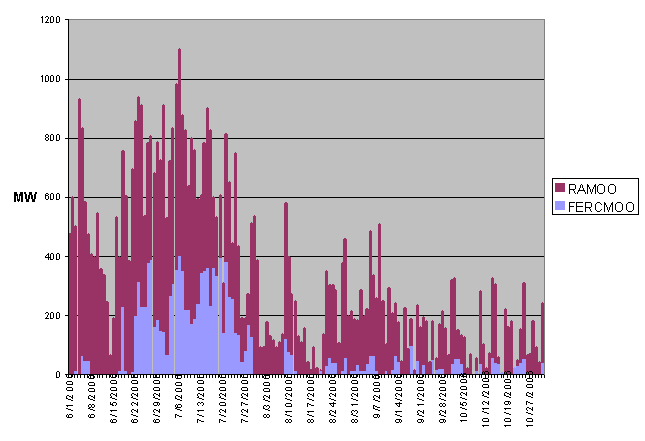 Source: Aggregated CAISO data
Figure 17 FERC MOO and RA MOO in the Summer of 2007

Source: Aggregated CAISO data
6. Forced Outage Rates
Forced outages are unplanned curtailment of generating units, as opposed to scheduled or planned outages that are usually used for upkeep or maintenance. Forced outages have been decreasing consistently since the end of the energy crisis. The CAISO calculates an average forced outage rate of 2.3 percent for 2007, and 3.12 percent over the last five years (2003-2007), illustrated in Figure 18 below.11 The CAISO attributes this downward trend to two actions: installing new generation since 200012, and increasing the energy bid cap to $400/MWh in 200613.
Figure 18 Forced Outages, 2003-2007.
|
Table 22. Forced Outage Rate (percent) Percent Forced Outages 2001 9.0% 2002 5.6% 2003 3.8% 2004 3.4% 2005 2.9% 2006 3.2% 2007 2.3% |
|||

The CAISO uses a simple methodology to present average hourly curtailed MWs as a percent of CAISO System Total Installed Capacity for each year. The Commission has encouraged the development of more complex resource performance and availability measures to better evaluate system reliability and reserve requirements.
A number of U.S. entities responsible for regional resource planning, such as Independent System Operators and utilities, utilize reliability and availability indices developed initially by the Institute of Electrical and Electronics Engineers, and later modified by the North American Electric Reliability Council (NERC).
NERC utilizes several indices to measure power plant reliability. The two most commonly-used indices measure forced outage rates. The Equivalent Forced Outage Rate (EFOR) measures a plant's partial outages, while the Equivalent Forced Outage Rate of demand (EFORd) calculates the percentage of time that a unit is out of service when there is demand for it to produce power. Planners also use EFORd to compare units with different operating patterns, such as that of cycling/ peaking units to that of base-loaded generators.
The Equivalent Availability Factor indicates the percentage of time that a unit is capable of providing generation. The Net Capacity Factor measures the actual energy generated by a unit, relative to the amount of power the unit can produce at maximum operating capacity. Other relevant indices calculate Outage Factors, Outage Rates, and Outage Hours.
To ensure meaningful calculations, NERC collects and stores availability and outage data from generators around the country into a national Generating Asset Database System (GADS). According to NERC, approximately 74.3 percent of generators in North America report data to GADS. NERC also developed proprietary software to calculate performance indices based on the generators' data.
The New England Power Pool and the PJM Interconnection have developed probabilistic resource planning models, which use NERC reliability indices as inputs. Private corporations, such as American Electric Power Service Corporation and Houston Lighting and Power, among others, utilize GADS performance indices to track outages and to target location-specific improvement programs. We anticipate the CPUC will consider similar analytical approaches and performance measures in the Planning Reserve Margin and other Procurement proceedings.
7. Changes to the RA Program for 2008
The Commission further refined the RA program in 2008 compliance year in D.07-06-029. This decision adopted a counting constraint on resources across Path 26 and added a new Local Area in Big Creek/Ventura. Implementation of these changes will be explored in a possible 2008 RA report issued after the 2008 compliance year, while a short description of their specifics is given below.
7.1. Path 26 Counting Constraint
The CAISO demonstrated that a potential overload on Path 26 can occur due to an RA capacity distribution problem; without addressing the problem, the possibility existed that an over abundance of RA capacity could be contracted for north of Path 26 that is ultimately needed to serve load south of Path 26 (and vice versa) in an amount that endangers reliability across Path 26. While the path rating is 4,000 MW, the CAISO engages in operational solutions and re-dispatch whenever loading on Path 26 exceeds 3000 MW and begins to approach 4,000 MW. If flows ever were to exceed 4,000 MW, the CAISO would have violated WECC criteria and would need to reduce flows within 20 minutes.
Figure 19 represents net flows across Path 26 in the summers of 2006 and 2007, with negative numbers representing net flows North to South and positive numbers representing net flows from South to North. The flows are illustrated as a snapshot of daily flows taken at the general peak hour of the day, HE 16. The figure illustrates that flows exceeded 3,000 MW net North to South 28 times during the daily peak hour during summer of 2006, with 18 of those days being between June 1 and July 15. After July 15, high load conditions in both North of Path 26 and South of Path 26 limited exports from both areas, reversing the trend and nearly equalizing flows on the peak day of July 24, and even becoming a net flow from south to north on September 12. Flows across Path 26 also exceeded 3,000 MW North to South seven times in 2007, but more often than that the flow was of a lower magnitude. There was never an instance where net flows exceeded 3,000 MW South to North.
Figure 19: Net Flows across Path 26 in Summer of 2006 and 2007

Source: CAISO OASIS date for 2006 and 2007
The CAISO and parties developed a proposal to address this reliability concern, and via workshop discussion yielded a joint proposal which included an implementation process and schedule. This was adopted in D.07-06-029. LSEs are required to apply for and receive allocations of Path 26 counting capacity either north to south or south to north, similar to the CAISO's import allocation process for resources moving into the CAISO. This is to ensure that the CAISO has sufficient resources both North of Path 26 and South of Path 26 to meet load in the case of extreme conditions. The process is summarized as follows.
Step 1. The CAISO will determine the amount of Path 26 transfer capacity available for RA counting purposes after accounting for Existing Transmission Contracts (ETCs) and loop flow.14 The CAISO will notify the LSEs via their Scheduling Coordinators.
Step 2. The CAISO will allocate a baseline "Path 26 transfer capability" to each LSE, and notify them via their Scheduling Coordinator. The baseline allocation is the higher of (1) their Load Share Ratio of load in the zone into which capacity is being transferred, or (2) the sum of the LSE's existing commitments including ETCs, TORs, and RA Commitments executed prior to March 22nd, 2007. Any LSE with a baseline allocation in excess of Load Ratio Share due to existing commitments will receive Path 26 transfer capability to cover those commitments, which will be taken out of other LSE's baseline allocations.
Step 3. Once the baseline quantities are determined, LSEs will have an opportunity, but not an obligation, to submit RA resource contract commitments (Preliminary Path 26 Submittals) that exist as of July 31st, 2007, including Grandfathered RA Commitments, that need to use Path 26 to deliver to the LSE's loads (Existing RA Commitments). The CAISO will use these Preliminary Path 26 Submittals to "net" the north-to-south and south-to-north Path 26 RA counting impacts associated with the Existing RA Commitments. An LSE's Preliminary Path 26 Submittal cannot exceed its baseline Path 26 RA counting capacity. Once submitted, the Preliminary Path 26 Submittals will create a binding obligation on the LSE to include the Existing RA Commitments in its Year-Ahead and month-ahead RA compliance filings, and make them subject to the CAISO Tariff regarding RA Resources.
Step 4. The CAISO will allocate the additional Path 26 RA counting capacity that was made available due to netting of existing commitments. This additional counting capacity will be allocated to LSEs based on load-ratio shares, and will be additive to the LSEs' baseline allocations. However, LSEs whose baseline Path 26 RA counting capacity exceeds their load-ratio shares because of Grandfathered RA commitments in Step 2 will only receive additional Path 26 RA counting capacity after all other LSEs have been allocated additional Path 26 RA counting capacity in an amount that causes them to exceed their respective load-ratio share by the same percentage that the initial LSE received because its baseline allocation exceeded its load-ratio share.
Step 5. The CAISO will notify LSEs of the final results of the Path 26 RA counting capacity process. This final notification can add to the baseline allocation in Step 2 but cannot decrease it.
Pursuant to workshops wherein stakeholders discussed the optimal means of addressing this transfer constraint, D.07-06-029 adopted a counting constraint on Path 26 that is similar to an import allocation. The procedure is laid out in the 2008 RA Guide and it is implemented via the 2008 RA Templates. The Path 26 counting constraint was implemented first for the 2008 compliance year. Thus the figure above shows conditions prior to implementing the Path 26 Counting Constraint.
1 Previous implementation is documented in the Final 2006 RA report in section 3. A link is available here: http://docs.cpuc.ca.gov/Published/REPORT/65960.htm
2 The 2008 Year-Ahead System and Local RA Filing Guide and Templates are available here: http://www.cpuc.ca.gov/PUC/hottopics/1Energy/resourceadquacy/resadeq_2008guides.htm
3 Citation and settlement amounts come from internal Energy Division staff records
4 Previous implementation is documented in the Final 2006 RA report in section 3.1. A link is available here: http://docs.cpuc.ca.gov/Published/REPORT/65960.htm
5 RA Resources include unit specific in-state physical generation, imports, LD contracts, Demand Response programs, and DWR contracts.
6 Posted online via the following link: http://www.caiso.com/1838/1838aecf4aae0.pdf
7 The NQC list for 2007 is posted here: http://www.caiso.com/1c80/1c80b28a38130.xls
8 D.05-10-042, Section 7.7, and D.07-06-029, Section 9.2
9 California Public Utilities Commission D.06-06-064, Section 3.3.7.1.
10 http://www.caiso.com/17ed/17ed90c231ac0.html
11 California ISO Department of Market Monitoring (2006). 2006 Annual Report, Market Issues and Performance. 14-15.
12 Ibid. 14.
13 California ISO Department of Market Monitoring (2006). Department of Market Monitoring Report: Memorandum to the ISO Board of Governors, dated August 31, 2006.
14 The transfer capacity on Path 26 must be de-rated to accommodate ETCs that are used to serve load outside the CAISO control area. "Loop flow" is common to large electric power systems and must be accommodated to prevent overloading of lines.
